The Youth’s Instructor, Vol. XLIX, No. 43

HEALING THE IMPOTENT MAN AT BETHESDA

The Youth’s Instructor

October 31, 1901

Review and Herald Publishing Company · Battle Creek, Mich. · October 31, 1901

HEALING THE IMPOTENT MAN AT BETHESDA

INTRODUCTORY

Preceding Events.— Important events in the Saviour’s life since the healing of the paralytic:—
  1. The call of Matthew. Mark 2: 13–17.
  2. Question about fasting. Luke 5: 33–39.
Main Reference.— John 5: 1–17.
Other References.— None.
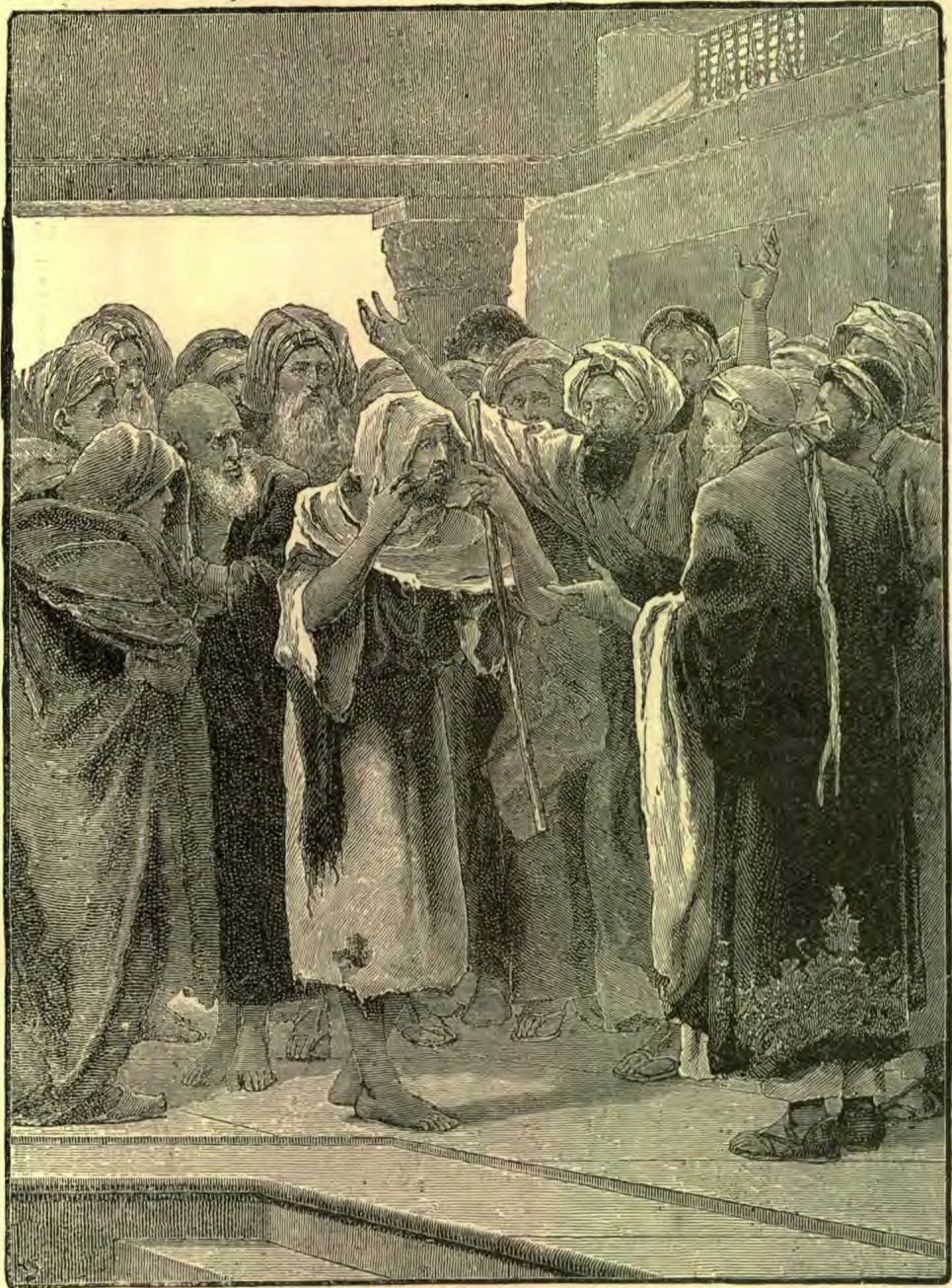
ONE THING I KNOW—THAT I AM HE THAT ONCE WAS BLIND, BUT NOW I SEE
Bible Story of the Miracle.— “After this there was a feast of the Jews; and Jesus went up to Jerusalem. Now there is at Jerusalem by the sheep market a pool, which is called in the Hebrew tongue Bethesda, having five porches. In these lay a great multitude of impotent folk, of blind, halt, withered, waiting for the moving of the water. For an angel went down at a certain season into the pool, and troubled the water: whosoever then first after the troubling of the water stepped in was made whole of whatsoever disease he had. And a certain man was there, which had an infirmity thirty and eight years. When Jesus saw him lie, and knew that he had been now a long time in that case, he saith unto him, Wilt thou be made whole? The impotent man answered him, Sir, I have no man, when the water is troubled, to put me into the pool; but while I am coming, another steppeth down before me. Jesus saith unto him, Rise, take up thy bed, and walk. And immediately the man was made whole, and took up his bed, and walked: and on the same day was the Sabbath. The Jews therefore said unto him that was cured, It is the Sabbath day: it is not lawful for thee to carry thy bed. He answered them, He that made me whole, the same said unto me, Take up thy bed, and walk. Then asked they him, What man is that which said unto thee, Take up thy bed, and walk? And he that was healed wist not who it was: for Jesus had conveyed himself away, a multitude being in that place. Afterward Jesus findeth him in the temple, and said unto him, Behold, thou art made whole: sin no more, lest a worse thing come unto thee. The man departed, and told the Jews that it was Jesus, which had made him whole. And therefore did the Jews persecute Jesus, and sought to slay him, because he had done these things on the Sabbath day.” John 5: 1–17.
Circumstances.— Christ was attending the feast, probably the Passover. No doubt many worshipers were passing in and out of the temple. Evidence of a growing prejudice against Christ had begun to appear. It was the Sabbath day. The miracle was performed without request, Christ himself asking the impotent man if he would be made whole. No such statement as, “Thy sins are forgiven thee,” or “Go in peace,” was made. The miracle stands alone in this respect.
Great Lesson.— “Sin no more, lest a worse thing come unto thee.” The great lesson of this miracle is contained in the foregoing admonition. This man’s condition was probably due to his own sin, and the Saviour warned him not to continue in transgression, lest a worse affliction overtake him. The Master warned this man to sow no more for suffering and disease, lest a still more disastrous harvest of affliction overtake him. Transgression always precedes its penalty.

STUDY OF THE MIRACLE

Having Five Porches.— On this Sabbath day the Great Physician was found at the place where he was most needed; for the five porches around the sheep market at the Pool of Bethesda were in reality five wards of a hospital filled to overflowing with sick folk. There were five different porches full of people. In almost any religious gathering to-day there may be found five porches of waiting ones,—five classes of careless, indifferent, or lukewarm souls. Some one has given the following classes: (1) those who are waiting for a more convenient season,—always reckoning on a fair “to-morrow,” though to-morrow is found only in the fool’s calendar; (2) those who are waiting for things startling or wonderful; (3) those who are waiting for the spirit to move them,—some sort of sheer compulsion; (4) those who are waiting for revival; and (5) those who are waiting for an impression. For all five classes the prescription is, Cease waiting, and come; look no longer at the pool, but look unto Jesus. “The word is nigh thee, even in thy mouth, and in thy heart.”
Waiting for the Moving of the Water.— While this pool is perhaps a type of the healing and saving grace of Christ, there is this one great distinction: its virtues were intermittent, while the stream that flows from the riven side of Christ is continual. At any time, without the waiting of a moment, the sinner, the afflicted soul, may find relief in the stream that flows from Calvary. Heaven’s stream is continuous; salvation’s waters are always troubled.
While the impotent man waited for the mysterious occasion that was supposed to impart healing power to the waters of the pool, the Divine Healer himself walked unnoticed and unrecognized among the sick ones. And to-day many Christians seek for blessings which hang over their heads, vainly striving for victories, which, did they only believe, are already won,—waiting in darkness and despair for forgiveness and peace which are already theirs. Jesus says, “Peace I leave with you, my peace I give unto you.” The devil’s delusion of waiting is one which he uses most frequently, and which meets with the greatest success. When Satan is unable longer to deceive or delude an erring soul, when a sinner is about to turn to God, then it is that the delusion of delusions—procrastination—is brought to bear upon the mind. “Wait until to-morrow; not to-day; some other day.” Any time will please the deceiver better than now; for “now,” the Lord has said, “is the accepted time.”
The Christian should wait, however long the time may be, until the Lord has spoken; but when the divine word has gone forth, we should no longer tarry. In the matter of forgiveness of sin, and the salvation of the soul, there is no need of waiting at any time; for Jesus said, “It is finished,” while on the cross. The sinful soul needs only to have a willing mind, and that, the Lord has said, is acceptable. 2 Cor. 8:12. The garment of the righteousness of Christ has been woven in the loom of heaven for every soul. Not one garment for all, but a perfect raiment for each one.
This poor sufferer was waiting for an angel when the Lord Jesus himself, the Commander of the angels, was by his side. How often, in our vain endeavor to secure some supposed blessing, we pass by, unrecognized, a greater blessing that the Lord had purposed to give us.
W. S. SADLER.

The Man Born Blind

He stood before the Sanhedrim, The scowling rabbis gazed at him: He recked not of their praise or blame: There was no fear, there was no shame, For one upon whose dazzled eyes The whole world poured its vast surprise; The open heaven was far too near, His first day’s light too sweet and clear, To let him waste his new-gained ken On the hate-clouded face of men.
But still they questioned: “Who art thou? What hast thou been? What art thou now? Thou art not he who yesterday Sat here and begged beside the way; For he was blind.” “And I am he; For I was blind, but now I see.”
He told the story o’er and o’er, It was his full heart’s only lore: A Prophet on the Sabbath day Had touched his sightless eyes with clay, And made him see, who had been blind. Their words passed by him like the wind Which raves and howls, but can not shock The hundred-fathom-rooted rock. Their threats and fury all went wide; They could not touch his Hebrew pride; Their sneers at Jesus and his band, Nameless and homeless in the land, Their boasts of Moses and his Lord,— All could not change him by one word.
“I know not what this man may be, Sinner or saint; but as for me, One thing I know, that I am he That once was blind, but now I see.”
They were all doctors of renown, The great men of a famous town, With deep brows, wrinkled, broad, and wise, Beneath their long phylacteries; The wisdom of the East was theirs, And honor crowned their silver hairs. The man they jeered and laughed to scorn Was unlearned, poor, and humbly born; But he knew better far than they What came to him that Sabbath day; And what the Christ had done for him He knew, and not the Sanhedrim.
—Hon. John Hay.

LESSONS FROM THE LIFE OF JOSEPH

III

THE sending of Joseph into prison was apparently the worst thing that could happen. What possible good could come from such a misfortune? There are two unseen and overruling forces at work on our experiences and destinies. Satan, the adversary, works for our ruin through agents and circumstances. God, our Father, works even through Satan’s work for our present and eternal good. This is so well established that the apostle says: “We know that all things work together for good to them that love God.” Not that everything that happens is good, but the grace of God will bring good out of it if we love and trust him.
Joseph became the light and comfort of the prison because God was with him. It reads strange that “the keeper of the prison committed to Joseph’s hand all the prisoners that were in the prison; and whatsoever they did there, he was the doer of it. The keeper of the prison looked not to anything that was under his hand; because the Lord was with him, and that which he did, the Lord made it to prosper.” But that is the way with Jesus. When we take him into our hearts and lives, he assumes the loving control. He is the Prince of peace. Whatever we do under his control is sure to prosper, because God is with us. Joseph brought the Lord into the prison, and brought his blessing to all the inmates. Jesus also stands at the door of our hearts and knocks, ready to come in and bring the Father’s blessing.
Among the other prisoners were the chief butler and the chief baker of the Pharaoh. They were awaiting their trial on some charge that involved their lives. In fact, it did not require much of a charge to forfeit life in those days. The will of the Pharaoh was supreme. One morning these men looked very sad. The hour was approaching when their fate would be decided. They each had an impressive dream, which they felt sure contained the secret of their condemnation or freedom. They feared it might bode the former.
Joseph came to them, cheerfully inquiring the cause of their sadness. They told him it was because of a dream, and there was no interpreter. Joseph used this opportunity to tell them of God, and of his power and willingness to help those who are in trouble. He offered to speak to them for God. The butler, whose office it had been to provide wine for the king, told his dream. He saw a vine; it had three branches, Buds and blossoms shot forth, grapes appeared, developed, and ripened. Pharaoh’s cup was in his hand, the grapes were pressed into it until it was brimful, and then he faithfully passed it to the hand of his master. Joseph at once saw the happy significance of such a dream. There was fidelity on every feature. Beginning with the bare vine, the butler had faithfully attended to each detail of his work until the wine was in his master’s hand. He had not neglected any opportunity, he had prevented every accident and loss. His work was well and faithfully done. He would be exonerated, and in three days restored to his place.
Good enough, thought the baker. “Now hear my dream,” he eagerly exclaimed. “I had three baskets on my head. They were full of holes, and, except the top one, were empty. In that were placed bake-meats, or delicacies of the baker’s art, for the king.” Evidently he had not baked them. He was a lazy hypocrite; for he pretended to have three baskets of cakes when he had but one. As he sauntered carelessly along, enjoying himself by the way, the birds stole from the basket all that had been committed to his care. A very little attention certainly would have prevented this. When he came to his master, lo, he had nothing but empty baskets!
It was easy to read his doom in such a dream. He had been unfaithful all the way through. He had allowed all his opportunities to pass unimproved, and had nothing to present but a misspent life. He had lived for passing enjoyment, unmindful of the future day of reckoning. In three days Pharaoh hung him to a tree, and the birds picked his bones.
In these dreams we have a startling lesson for all mankind. Every one of us is working out one or the other of these dreams. Let me ask the reader how it is with him. Is the evil one stealing all our talents? Are we too indifferent to drive away the birds of evil thoughts and deeds that flutter around our heads? Shall we not rather imitate the faithful butler, and carefully do our allotted work? G. C. TENNEY.

“ONLY A BOY”

More than half a century ago a faithful Scotch minister coming early to kirk, met one of his deacons, whose face wore a very resolute but distressed expression. “I came early to meet you,” he said. “I have something on my conscience to say to you. Pastor, there must be something radically wrong in your preaching and work; there has been only one person added to the church in a whole year, and he is only a boy.”
The old minister listened. His eyes moistened, and his thin hand trembled on his broad-headed cane. “I feel it all,” he said. “I feel it, but God knows that I have tried to do my duty, and I can trust him for the results.”
“Yes, yes,” said the deacon, “but ‘by their fruits ye shall know them,’ and one new member, and he, too, only a boy, seems to me rather a slight evidence of true faith and zeal. I don’t want to be hard, but I have this matter on my conscience, and I have done but my duty in speaking plainly.”
“True,” said the old man; “but charity suffereth long, and is kind; beareth all things; hopeth all things. I have great hopes of that one boy, Robert. Some seed that we sow bears fruit late, but such is generally the most precious of all.”
The old minister went to the pulpit that day with a grieved and heavy heart. He closed his discourse with dim and tearful eyes. He wished that his work was done forever, and that he was at rest among the graves under the blooming trees in the old kirk-yard. He lingered in the dear old kirk after the rest were gone. He wished to be alone. The place was sacred and inexpressibly dear to him. It had been his spiritual home from his youth. Before this altar he had prayed over the dead forms of a bygone generation, and had welcomed the children of a new generation; and here, yes, here, he had been told at last his work was no longer owned and blessed!
No one remained—no one? “Only a boy.” The boy was Robert Moffat. He watched the trembling old man. His soul was filled with loving sympathy. He went to him, and laid his hand on his black gown.
“Well, Robert,” said the minister.
“Do you think that if I were willing to work hard for an education, I could ever become a preacher?”
“A preacher?”
“Perhaps a missionary.”
There was a long pause. Tears filled the eyes of the old minister. At length he said: “This heals the ache of my heart, Robert. I see the divine hand now. May God bless you, my boy! Yes, I think that you will become a preacher.”
Some years ago there returned to London from Africa an aged missionary. His name was spoken with reverence. When he went into an assembly, the people rose; when he stood in public, there was deep silence. Princes stood uncovered before him; nobles invited him to their homes. He had added a province to the church of Christ on earth; had brought under the gospel influence the most savage of African chiefs; had given the translated Bible to strange tribes; had enriched with valuable knowledge the Royal Geographical Society; and had honored the place of his birth, the Scottish kirk, the United Kingdom, and the universal missionary cause.
It is hard to trust when no evidence of fruit appears. But the harvest of right intentions is sure. The old minister sleeps beneath the trees in the humble place of his labors; but men remember his work because of what he was to that one boy, and what that boy was to the world.
“Only a boy!”
“Do thou thy work; it shall succeed In thine or in another’s day; And if denied the victor’s meed, Thou shalt not miss the toiler’s pay.”
— Youth’s Companion.

HE LEADETH ME

In “pastures green”?—Not always; sometimes he Who knoweth best in kindness leadeth me In weary ways, where heavy shadows be,—
Out of the sunshine, warm and soft and bright, Out of the sunshine into darkest night; I oft would faint with sorrow and affright,
Only for this: I know he holds my hand; So, whether in the green or desert land, I trust, although I may not understand.
And “by still waters”?—No, not always so; Ofttimes the heavy tempests round me blow, And o’er my soul the waves and billows go.
But when the storm beats loudest, and I cry Aloud for help, the Master standeth by, And whispers to my soul, “Lo, it is I.”
Above the tempest wild I heard him say, “Beyond this darkness lies the perfect day, In every path of thine I lead the way.”
So, whether on the hilltops high and fair I dwell, or in the sunless valleys where The shadows lie, what matter? He is there.
And more than this: where’er the pathway lead, He gives to me no helpless, broken reed, But his own hand, sufficient for my need.
So where he leads me, I can safely go; And in the blest hereafter I shall know Why in his wisdom he hath led me so.
—Selected.

DIVISION I—GEOLOGY

Chapter VIII—Mountain Ranges
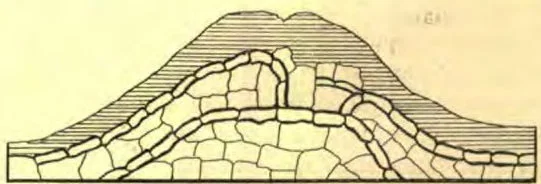
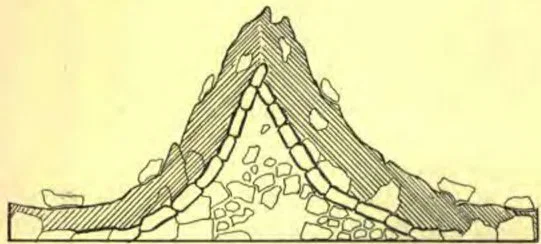
§74. “Most mountain chains,” says Houstain’s Physical Geography, page 40, “seem to have been produced by tremendous lateral pressure in portions of the earth’s crust, causing either long folds or deep fissures with upturned edges rising into high ridges, the broken strata forming into ragged peaks.” Again, on page 26, we read: “There are two distinct types of mountain chains,—mountains by folding, which are generally of moderate elevation; and mountains by fracture, to which belong the highest chains of the globe.” Figure 1 shows a transverse section of a mountain caused by the folding, or crushing together, of the lower strata of the earth’s crust; while figure 2 shows the same view of a mountain caused by complete fracture, and upheaval of the earth’s crust.
No.1 Mountain by Folding
§75. The “tremendous lateral pressure” spoken of in the foregoing quotation, expresses the thought presented in Sections 58, 59; thus, when the beds of our seas sank to their present positions, great ridges of earth, with the underlying strata of rock, were crowded high in the air, forming elevated cracks, or ridges, making mountain chains many miles in length. This gives the reason why mountains, especially the higher ones, are generally found in continuous ranges, with their upturned ledges of rock protruding from their summits. The lower mountains, scattered about singly, also the foothills found in the vicinity of mountain ranges, were undoubtedly formed by the washing of the waters of the flood when the Lord caused that mighty wind to pass over the earth. See Sections 70, 71.
§76. The highest mountains are found in the torrid zone, those of less altitude in the temperate, and the smaller ones in the frigid zones. This is as we would expect; for in the torrid zone a greater amount of the earth’s surface was inundated, and that to a greater average depth, than farther toward the poles. The greatest known depth to which the land then sank is some ninety miles off the island of St. Thomas, W. I., where it amounts to 23,250 feet. It has been claimed that deeper sea soundings have been taken south of Grand Bank, Newfoundland; but later soundings in that locality do not corroborate the claims. The average depth of the oceans for sixty degrees both north and south of the equator is but little short of three miles.
§77. The highest mountains in the world are the Himalayas in Asia, the most elevated point being 29,002 feet above sea-level, where the internal layers of rocks, or foundations of the world, were shoved up fully five and one-half miles in the air. The highest mountain in America is one of the Chilean Andes, which is 22,456 feet above sea-level. Mt. Brown, the highest of the Rockies, is 15,900 feet high, while Mt. Shasta, the pride of California, attains a height of 14,450 feet. The highest point in Europe is Mt. Blanc, one of the Alps, whose summit is 15,781 feet above sea-level. The highest point of human habitation on this globe is in Peru, 16,000 feet above sea-level.
§78. We do not understand that all the phenomena connected with the present conditions of our mountain ranges are traceable to their upheaval at the time of the flood; for there have been many changes made in them this side of that event. Earthquakes and other causes are continually changing their appearance, but evidently the greatest change they have ever experienced since their formation was that which occurred when our Saviour died. When he, by whom all things had been created, “cried again with a loud voice, and yielded up the ghost; . . . the earth did quake, and the rocks rent; and the graves were opened.” The Father never permitted his only begotten Son to come to this rebellious world,—the very seat of Satan’s government,—and die the ignominious death of the cross, without shaking Satan’s usurped dominion from center to circumference, leaving visible marks of his displeasure of sin.
§79. The deep gorges through which many of our mountain streams and rivers flow were undoubtedly laid open at that time. The long, deep cut through which the Kentucky River passes; the narrow confines of Whirlpool Rapids just below Niagara Falls; the yawning chasm along whose sunken bottom the Rio Grande River plunges and foams,—these are a few of the many examples we have witnessed of that kind.
§80. “Jesus had united with the Father in making the world. Amid the agonizing sufferings of the Son of God, blind and deluded men alone remain unfeeling. The chief priests and elders revile God’s dear Son while in his expiring agonies. Yet inanimate nature groans in sympathy with her bleeding, dying Author. The earth trembles. The sun refuses to behold the scene. The heavens gather blackness. . . . Nature sympathizes with the suffering of its Author. The heaving earth, the rent rocks, proclaimed that it was the Son of God who died. There was a mighty earthquake. Terror seized the executioners and spectators, as they beheld the sun veiled in darkness, and felt the earth shake beneath them, and saw and heard the rending of the rocks. . . .”
No.2 Mountain by Upheaval
§81. “Jesus did not yield up his life till he had accomplished the work which he came to do, and exclaimed with his departing breath, ‘It is finished.’ Satan was then defeated. He knew that his kingdom was lost. Angels rejoiced as the words were uttered, ‘It is finished.’ The great plan of redemption, which was dependent on the death of Christ, had been thus far carried out.”—“Testimonies for the Church,” Vol. II, pages 209, 211.
§82. Never do I look upon the rocks laid open, but I call to mind how terribly this earth—Satan’s dominion—was shaken when our Saviour “entered the strong man’s house, and spoiled his goods.” The power that rent those very rocks asunder is the power that is pledged to sustain and redeem every trusting, obedient son of Adam’s fallen race. God has left this token of his mighty power in the riven rocks for our instruction, our courage, our comfort, and our hope.

QUESTIONS

Describe the manner in which mountain chains seem to have been formed. What evidently caused this crowding together of the earth’s crust? How were the isolated mountains and foothills formed? How do the heights of the mountains vary in the different zones? What reason can you give for this? Tell what you can of the corresponding depth of the oceans. Where is the highest point of land in the world? In America? In Europe? What great event besides the flood caused marked changes in our earth’s appearance? How was the sun affected? What happened to the earth? Why should God do this? Give several reasons. Have you ever seen places where the rocks were rent? Where? Name some remarkable instances. Of what do these riven rocks speak to our souls? Do they so speak to your soul? If our Father has such power, need we, his children, fear what man may do unto us? DR. O. C. GODSMARK.

The Golden Organ: A Heart of Joy

As God’s children, we ought to have a joy in heart which nothing can ever quench. There is a beautiful story of a golden organ in a monastery. Once robbers besieged the monastery to rob it of its treasures. The monks carried the golden organ to a river near by, and sunk it in the water to keep it from the robbers’ hands. At certain periods, so the old legend runs, the organ would rise out of the river, and give forth such ravishing music as was never elsewhere heard by mortal ears. Such an instrument is a truly thankful heart, one in which is the joy of the Lord. The floods may go over it, but it ever rises out of them, and sings its sweet songs. Nothing can ever check its praise. It sings in the darkest night, its music rolling out into the gloom to cheer the weary pilgrim.—Selected.

MISSIONARY STUDY

Preparation Needed

(November 3–9)
1. DID God intend that men of all nations should seek him? Acts 17:26, 27; Rom. 10:13; note .
2. Why have these people not called upon the Lord nor believed on his name? Rom. 10:14, 15.
3. Why has the preacher not been sent? See note .
4. Since all will not accept the gospel message (Matt. 13:3–8), why must it be preached to every nation? Acts 15:14.
5. What alone delays the coming of the Lord? Matt. 24:14.
6. How near are we to that event? Matt. 24:14.
7. What instruction did Jesus give his disciples which shows that at his ascension they were not in a condition to work for the heathen round about them? Luke 24:47, 49; Acts 1:4.
8. What preparation were they to receive? Acts 1:8; Joel 2:28, 29.
9. When was this given? Acts 2:1–4. What work did the disciples immediately do? Acts 2:4–11. How many nations were represented?
10. For what people were they working when the following marvelous manifestations of the Spirit occurred? Acts 2:4–12; 8:14–17; 10:44–46.
11. What is the work of the church to-day? Matt. 28:18–20; 24:14.
12. Then what preparation is needed?

Suggestive Program

Opening Exercises. Ten minutes, using missionary hymns.
Bible Study—The Preparation Needed. Twenty minutes.
Field Study. Fifteen minutes.
(a) Africa—The present condition; its bearing on our work; a fulfillment of prophecy; the success attending the work; the lesson for us.
(b) The Orient—The situation; difficulties that must be endured; faithfulness of Sabbath-keepers; needs; progress reported.
(c) Brief Sketch of Life of some Pioneer Missionary.
(d) A Summary of the appeals for help and the encouraging items reported during the month.
The Elijah Message, and our relation as young people to it. Five minutes.
Consecration Service and Closing. Ten minutes.
Note.—The material for the field study will be found in the Missionary Magazine for November. It is based upon the Missionary Reading Circle study for the second week in November. The Elijah Message is also treated in this same number.
For the life sketch we would suggest such names as William Carey, Adoniram Judson, Bishop Patterson, David Livingstone, or any one to whom you have access. If you do not have any book, the Life of Chalmers which appears in this issue could be sketched with profit, even though all have read it.

THE CRY OF THE HOUR

EDUCATION is the crying need of the hour. God has placed upon us the burden of warning a doomed world. There remains only a little time for discharging this mighty duty. “Yet a little while [how little! how little!—Syriac], and he that shall come will come, and will not tarry.” Heb. 10:37. “We are standing upon the threshold of great and solemn events. Prophecies are fulfilling. Strange, eventful history is being recorded in the books of heaven. Everything in our world is in agitation. There are wars, and rumors of wars. The nations are angry, and the time of the dead has come, that they should be judged. Events are changing to bring about the day of God, which hasteth greatly. Only a moment of time, as it were, yet remains.” Every soul who knows this thrilling truth must bear his portion of responsibility. An army of vigorous young men and women is needed for proclaiming this glorious message. Calls are coming for workers in all departments of the cause.
Teachers.—Two or three thousand teachers are needed to supply our churches in this and other countries. There are now about two thousand churches in America and only two hundred church schools. We are to have a school wherever there is a company of believers, and some scattered families need teachers. “The management and instruction of children is the noblest missionary work that any man or woman can undertake.” The speedy education of young men and women for this high calling will put new life into our ranks, such as we have not seen for years.
Ministers and Evangelists are needed as never before. The dearth of these laborers is felt and deplored from land to land.
Missionaries for all lines of work abroad are one of the most deeply felt needs of the cause to-day. The great majority of calls from distant fields must be filled by young men and women.
Educated Farmers are now being called for. Our work requires men who are so proficient that they can teach others. Young men must be taught the nobility of tilling the soil. Our industrial schools are now beginning to place instruction in agriculture on an equality with other studies. This will result in cultivating a love for the farm, and an ability to understand the working of God in nature. “When students employ their time and strength in agricultural work, in heaven it is said of them, ‘Ye are laborers together with God.’”
Trained Workers must be provided for every branch of our message to the world. Let our young people arouse, and devote themselves to the glorious work of God. The preparation needed by the inexperienced is a thorough course for a year or two in one of our industrial academies, such as that at Cedar Lake, Mich., or Bethel, Wis., and a few months in the Missionary College at Berrien Springs.
“Educate, educate, educate,” is the cry to-day from the Spirit of God to every Seventh-day Adventist. “Educate young men to labor, and tarry not.” JOEL C. ROGERS.

Using Your Gifts Faithfully

“USE your gifts faithfully, and they shall be enlarged; practice what you know, and you shall attain to higher knowledge.”

SABBATH, OCTOBER 19

Was a profitable day for all who are interested in Sabbath-school and Young People’s Work in Battle Creek. Beginning with Sabbath evening, the day was given over to an interesting program in which nearly every phase of the importance of the Sabbath-school work was considered; and the attendance at the various services showed that the subject was one in which a large proportion of the members of the church are interested. Reminiscences, papers, and discussions, with model classes and appropriate music, made the time pass so quickly and pleasantly that when the regular hour for the Young People’s meeting came, few availed themselves of the opportunity offered by a brief recess between the two meetings to go home. It is a rule in the Battle Creek Society that the Young People’s meeting shall be held regularly,—and that word is taken to mean just what the dictionary says. It is no more to be postponed, swallowed up, or absorbed than any other service of the day.
Those who stayed were well repaid by the privilege of listening to a talk by Brother E. R. Palmer, on “The Relation of Young People’s Work to Sabbath-school Work.” Taking as a basis the words of John, “I write unto you, young men, because ye are strong,” he spoke forcefully of some of the excuses that are made by young people for their non-attendance at the Sabbath services, of the danger of such a course, of the great work that young people can do for one another, and of their responsibility as those who are so soon to take a prominent place in giving the message for these last days. “The Sabbath-school and the Young People’s Society are to be the recruiting-ground for every department of Christian service,” he said. We hope to be able soon to give in this department portions of this impressive talk.
The hour was concluded with the study for the day, “Who Is My Neighbor?” the time being occupied by Dr. Newton Evans in setting forth some of the practical answers to this question.
Continue reading: NELLIE'S MISSIONARY GAME