The Youth’s Instructor, Vol. 28, No. 1.

FIRST LESSONS IN IDOLATRY

The Youth’s Instructor

Jan 1, 1880

S. D. A. Publishing Association · Battle Creek, Mich. · Jan 1, 1880

FIRST LESSONS IN IDOLATRY.
FAR away across the wide ocean, where the palm-tree lifts its broad leaves to the sun, and where the earth is kissed by the hot breath of the Torrid Zone, there dwells a dark race of people. To them, the sun shining in his majesty, the earth clothed with the beauties of nature, the warbling of birds, and the music of running brooks, do not speak of a Divine Power; for they know not the true God, but are idolaters, bowing down to gods of wood and stone.
Many readers of the INSTRUCTOR will doubtless wonder how people can be so deluded as to worship gods made with their own hands. David explains this when he says that “they that made them are like unto them,” deluded, blinded and ignorant of the truth, so that they imagine there is some real power in these effigies.
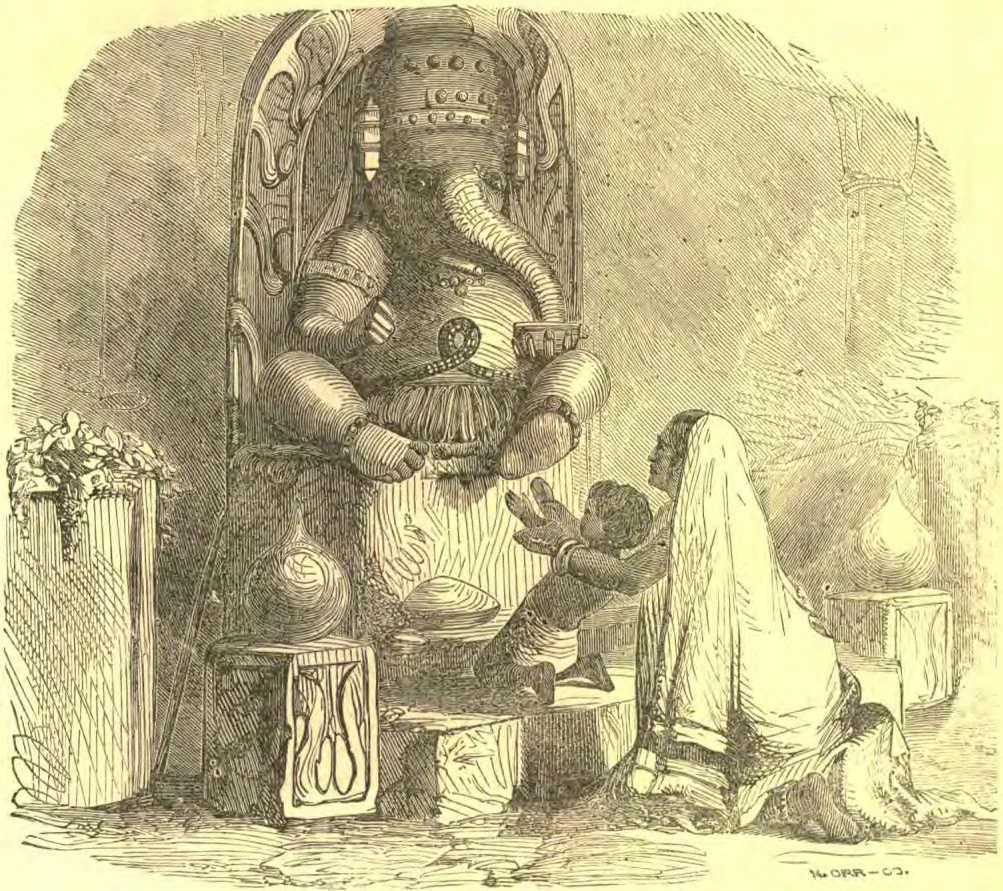
The artist gives us on this page of our little paper, a picture of one of these idols; and what a sad picture it is—a poor Hindoo mother teaching her child to pray, and to pray to such a hideous monster. Do you suppose that she is repeating our beautiful prayer, “Our Father who art in Heaven, hallowed be thy name?” No; oh, no! Poor woman! She has never learned that we have a Father in Heaven to whom we should pray. She has never been told how much he loves us; so much that he gave his own dear Son to die for us. But instead, she has been taught that she must worship this image. No wonder the little child starts back and is afraid. He may well be frightened by such a monster. Could you love such a god as this? You could not imagine that such a being could love you and say, “Suffer little children to come unto me, and forbid them not, for of such is the kingdom of Heaven.”
Dear children, when you kneel to pray to our Father in Heaven, who loves you and will answer your prayers, pray for the poor pagan children, and thank God that
“You were not born as thousands are, Where God was never known, And taught to pray a useless prayer To blocks of wood and stone.”

SCRAPS FROM HISTORY.

THE ESTABLISHMENT OF EARLY KINGDOMS.

THE readers of the INSTRUCTOR who have studied the “Bible Lessons on Prophecy,” are aware of the fact that our world has been ruled in the past by four universal kingdoms,—Babylon, Media and Persia, Grecia, and Rome.
When God created our world, he placed Adam in the garden of Eden. Adam sinned against God, and for this reason was driven from his Eden home; but his children were taught to worship God and to have faith in Jesus as the promised Messiah. Many of them, however, did not retain the knowledge of God nor the plan of salvation in their minds, but gave themselves up to idolatry, or the worship of false gods, and plunged into crime and wickedness of every description, until “every imagination of the thoughts of man's heart was evil continually.” Gen. 6:5. Men at that time lived several hundred years, and had that long-lived race been permitted to exist a few years longer, the name and the knowledge of God would have perished from among men.
In order to preserve a knowledge of his worship, God caused a flood of water to destroy all the people in the world except Noah and his family. They were the only ones who truly worshiped God.
After the flood, which occurred a little more than fifteen hundred years after Adam was placed in Eden, a portion of the decendants of Noah settled in the land of Shinar, or Mesopotamia, which afterward became a part of the Chaldean kingdom. This was overcome by the Assyrian Empire, which, in turn, was ruled over by the universal kingdom of Babylon.
Nimrod, the great-grandson of Noah, founded the Chaldean kingdom. He also built four cities, one of which was the city of Babylon. Gen. 10:10, margin. From the first, the Chaldeans manifested a disposition to build. At one time, they attempted to erect the tower of Babel,—a tower whose top should reach unto heaven. They made some progress in the arts and sciences, had some knowledge of astronomy, engaged in manufacturing goods, and carried on commerce. They did not worship the true God, but were idolaters, and adored the heavenly bodies—the sun, moon, and stars.
In our next article, we will tell you about the introduction of idolatry into our world.
S. H. LANE.

THE HINDOO GIRL'S LAMENT.

I am a little Hindoo girl; Papa thinks nothing of me, For it is only the boys who are Taught and loved; not me,— Poor me!
“Mother was sad when I was born, For hard my lot will be; Wherever I go, wherever I am, There is no good for me,— Poor me!
“But we have heard of the Christian’s God, Who cares for great and small; That in his earth is room enough, With love and care for all. Poor me!
“Can you tell me if this is true? Does he love me as he loves you? You seem so glad in all you do, I wish he would take me in too. Poor me!”
“Oh, yes! our Father in Heaven Is your dear Father, too; And Jesus his Son, our Saviour, Has also come to save you.
“In his love we love each other, But not ourselves alone; We think of the children who bow To gods of wood and stone.
“Come learn the beautiful story Of Jesus and his grace, Whose ways are ways of pleasantness, And all whose paths are peace.

J. N. L

FROM SEA TO SEA.—NO. 20.

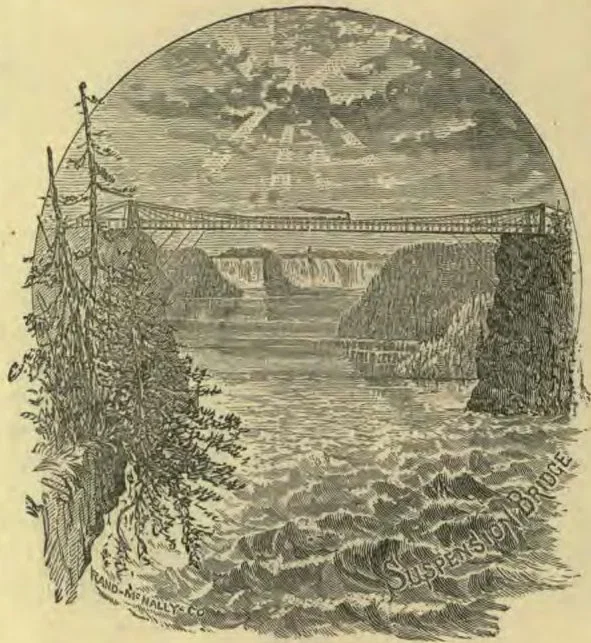
Having again taken the cars, a few minutes’ ride brings us to the great Suspension Bridge. Here we must stop and view this work of art, and also one of the great wonders of nature, the falls, two miles up the river. Even here at the bridge, we hear the loud roar of the falls, as the river pours its vast volume of water over the rocks into the abyss below.
SUSPENSION BRIDGE
SUSPENSION BRIDGE
The chasm over which the Suspension Bridge is constructed, and through which the Niagara River runs, is about eight hundred feet wide. When we think of the chain of great lakes that pour their waters through this narrow channel, we would suppose the water must be very deep. Recent sounding, and actual measurement of its depth, have proved it to be the deepest river in the world. Not far from this bridge, the water is seven hundred feet deep.
The track of the railroad bridge is two hundred and fifty feet above the water, and below this is a bridge for carriages and foot passengers. Thus we see this is really a two-story bridge. Each of these bridges is supported by two cables. Each cable is ten inches in diameter, and is composed of 3,569 No. 9 wires, so bound together as to make an exceedingly tough wire rope.
These great cables are passed over the tops of four towers, two of which are on either side of the river. These towers are constructed of huge stones, and are about eighty feet in height, sixteen feet square at the base, and eight feet square at the top. The weight of the whole structure of the bridge between the towers is about eight hundred tons, and the bridge is supposed to be capable of supporting about five hundred tons beside its own weight.
After passing the ends of these cables over the tops of the towers, they were carried back some sixty feet from the shore, and securely anchored thirty feet below the surface of the earth in stone mason work. These cables being very heavy, could not of course be drawn straight. Although they pass over towers eighty feet high, the middle of the cables sags nearly to the level of the bridge. The cross-pieces supporting the platform of the bridge, are hung to these cables by strong wire ropes, and there are six hundred and twenty-four of these suspenders. On each side of the bridge are twenty-eight strong wire rope stays, passing from near the center of the bridge to the rocks on either side of the river, where they are firmly secured. These stays keep the bridge from swinging side-wise. In making the cables, suspenders, and stays to the bridge, the architect claimed that he used four thousand miles of No. 9 wire.
The first time that I crossed this bridge was over twenty years ago, some two weeks after the lower, or carriage, bridge was completed. Ten of us went over in an omnibus, and more fear was manifested than we now see when a train of cars with three hundred passengers is passing over the upper bridge. It looks strange indeed to stand upon the shore and see a whole train of cars hung up at so giddy a height. Having safely passed over and viewed the bridge, we will look at the falls from the American side before resuming our journey.

J. N. L

A WORD FOR BOYS.

A GENTLEMAN, on returning home from work, thought he would secure some more coal; so stepping into the office near by, he asked if he could be accommodated.
“Well, sir,” was the reply, “I will send it if I can. Our orders are many; enough to keep us until twelve o’clock to-night.”
“But, if you cannot send it, I shall go to another yard.”
“Very well, I will send it.”
“All right.”
He returned home and waited until it grew quite dark. No coal had come. Finally all retired. An hour later a loud knock was heard at the door. Upon opening it, there was the load of coal.
“Ah!” said the man, “I can depend upon that man. I will call there again.”
Now, boys, what do you learn from this simple story? “I’m no coal dealer,” says one.
“Nor I,” says another. Perhaps not, but, if only a school-boy, you may learn to keep your word.—Mrs. E. F. Keiter, in Western Advocate.

The New Year.

“I am coming, I am coming, says the glad New Year; “I'm coming 'mid bright smiles and the sad falling tear.”
JANUARY, 1880! How queer it sounds before we have grown accustomed to it! But so it is, and we stand in the dawn of this another year. And what will this New Year be to us? we question eagerly. What gifts has it for us? What tidings of weal or woe? Curiously, we strive to peer with our human vision down that future which we see as in a glass darkly. In vain we speculate upon it—it is locked up amid the hours to come. But the great lesson for us to learn is that we are all living for the future, and that every day we are making our future.
Dear reader, the good and the evil will come to us, as we walk down the days of this year, like the summer and winter days; and as the rain and the sunshine are both alike necessary for the development of grain, so these will both help toward the ripening of the soul for the harvest of the world.
You and I, reader, who stand in the morning of this first day of the year, can not tell where its death-night will find us; but when or where, let it find us at our posts—working for the Master. And whatever the record of the years that are past, may we, this new day of the year, receive new strength and new desires to live this life aright. May this year be the best planned and the most satisfactory one of any year of our lives, that when this time next year we recall the same event, our hearts may be gratified by feeling that we have improved every moment, and that the record on the books of Heaven is one of which we are not ashamed. V. A. M.

LESSONS FOR CHILDREN.

LESSON LIII.—THE DEDICATION OF THE TEMPLE.

When Solomon had finished the temple, he brought the ark of God into it, and put it in the most holy place. The tabernacle itself, also, and all its holy vessels, were brought in; but they were probably put in the chambers that had been built against the sides of the temple.
Then all the people came together at Jerusalem to dedicate the temple. The singers, arrayed in white linen, and having cymbals, psalteries, and harps, stood at the east end of the altar, and with them a hundred and twenty priests, sounding with trumpets. When they all sung and praised the Lord together, the glory of the Lord so filled the house that the priests could not stand to minister by reason of the cloud.
Then Solomon told all the congregation what the Lord had said to David about the building of the temple; and blessed the Lord because he had fulfilled all his promises to David. And he stood by the altar, and spread forth his hands and prayed; and when he had finished, fire came down from heaven, and consumed the sacrifices. “Then the king and all the people offered sacrifices before the Lord. And king Solomon offered a sacrifice of twenty and two thousand oxen, and a hundred and twenty thousand sheep: so the king and all the people dedicated the house of God.”
After this, “The Lord appeared to Solomon the second time, as he had appeared unto him at Gibeon. And the Lord said unto him, I have heard thy prayer . . . ; I have hallowed this house which thou hast built, to put my name there forever . . . ; and if thou wilt walk before me . . . in integrity of heart and in uprightness, to do according to all that I have commanded thee, and wilt keep my statutes and my judgments, then I will establish the throne of thy kingdom upon Israel forever . . . ; but if ye shall at all turn from following me, ye or your children, and will not keep my commandments . . . ; but go and serve other gods, and worship them; then will I cut off Israel out of the land which I have given them, and this house which I have hallowed for my name will I cast out of my sight; and Israel shall be a proverb and a byword among all people.”
He said also that the people of other nations should be astonished, and should say, “Why hath the Lord done thus unto this land, and to this house?” and they should be answered, “Because they forsook the Lord their God, who brought forth their fathers out of the land of Egypt, and have taken hold upon other gods, and have worshiped them, and served them; therefore hath the Lord brought upon them all this evil.”

QUESTIONS.

  1. What did Solomon do with the ark of God when the temple was finished? 2 Chron. 5:5.
  2. What other holy things were taken into the temple?
  3. Where were they probably put?
  4. For what purpose did all the people come together at Jerusalem when the temple was finished? 2 Chron. 5:1; 7:4, 5.
  5. Describe the singers and their song of praise. Chap. 5:12, 13.
  6. What miracle was performed when the singers and trumpeters had finished their song?
  7. What was next done? Chap. 6.
  8. Where may we find this prayer?
  9. When Solomon had ceased praying, how did the Lord show that he accepted their worship, and the house that had been built for him? 2 Chron. 7:1.
  1. What did the king and all the people then do?
  2. Tell the number and kind of Solomon’s sacrifices.
  3. Where was Solomon when the Lord appeared to him the first time?
  4. What privilege did the Lord give him at that time?
  5. What did Solomon choose?
  6. What did the Lord give him?
  7. Now, when the Lord appeared to him the second time, what did he say about Solomon’s prayer?
  8. What did he say about the temple?
  9. On what conditions did the Lord promise that the people of Israel should always have one of their own nation to rule over them?
  10. What did he say he would do if they should not obey him but should serve other gods?
  11. What did he say should become of the temple?
  12. What would be said by people of other nations?
  13. What answer would be given them?

BIBLE LESSONS FOR YOUTH.

LESSON LXXIX.—THE KINGS OF JUDAH; REHOBOAM AND ABIJAH.

  1. How did Rehoboam prepare for the defence of his kingdom? 2 Chron. 11:5–12.
  2. Why did the priests and Levites leave the kingdom of Israel and come to Jerusalem? Verses 14, 15.
  3. Who followed their example?
  4. How long did they thus continue to strengthen his kingdom?
  5. What course did Rehoboam afterwards take? 2 Chron. 12:1.
  6. What enemy came against him because of this transgression?
  7. Describe his army. Verse 3.
  8. What cities did he first take? Verse 4.
  9. How did he despoil Jerusalem? Verse 9.
  10. Why did the Lord permit all this?
  11. How was Rehoboam and the princes saved from utter destruction?
  12. How much longer was Rehoboam permitted to reign?
  13. What was the entire length of his reign?
  14. Who succeeded him?
  15. With whom did Abijah have war?
  16. How many men were brought to battle on each side? 2 Chron. 13:3.
  17. What did Abijah do when the armies came near each other?
  18. Of what did he accuse Jeroboam?
  19. How can it be shown that Jeroboam did right in taking the kingdom?
  20. Who did Abijah say was with them as their captain? Verse 12.
  21. Who were there to cry alarm against their foes?
  22. What solemn admonition did Abijah give the men of Israel?
  23. How did Jeroboam improve the time while Abijah was making his speech?
  24. What did the men of Judah do when they saw that they were surrounded by their enemies?
  25. What took place when the men of Judah shouted?
  26. How many of the men of Israel were slain?
  27. How long did Abijah reign? 1 King 15:2.
  28. Who reigned in his stead?
  29. In what year of Asa’s reign did Jeroboam die?
  30. By whom was Jeroboam succeeded?
  31. How long did he reign?

SYNOPSIS.

Having traced the history of the kingdom of Israel to its close, we now return to the kings of Judah. Rehoboam built fifteen cities for defence in Judah and Benjamin. In these fortified cities he laid up stores of arms and provisions, and appointed captains; and so he did with all the strongholds which he had fortified.
“And the priests and the Levites that were in all Israel resorted to him out of all their coasts.” This they did because they would not offer sacrifices to the false gods which Jeroboam had set up. “And after them out of all the tribes of Israel, such as set their hearts to seek the Lord God of Israel, came to Jerusalem to sacrifice unto the Lord God of their fathers. So they strengthened the kingdom of Judah, and made Rehoboam the son of Solomon strong, three years; for three years they walked in the way of David and Solomon.”
“And it came to pass when Rehoboam had established the kingdom, and had strengthened himself, he forsook the law of the Lord, and all Israel with him. And it came to pass that in the fifth year of king Rehoboam, Shishak king of Egypt, came up against Jerusalem, because they had transgressed against the Lord, with twelve hundred chariots, and three score thousand horsemen; and the people were without number that came with him out of Egypt. . . . And he took the fenced cities which pertained to Judah, and came to Jerusalem.”
“So Shishak king of Egypt came up against Jerusalem, and took away the treasures of the house of the Lord, and the treasures of the king’s house; he took all. He carried away also the shields of gold which Solomon had made.”
All this the Lord permitted because Rehoboam and the princes of Judah had forsaken him; yet because they humbled themselves, he saved them from utter destruction, and let Rehoboam reign twelve years longer, seventeen years in all.
“And Rehoboam slept with his fathers, and was buried in the city of David; and Abijah his son reigned in his stead.”
Jeroboam king of Israel had now just entered upon the eighteenth year of his reign. In a war between these two kings there was one of the most terrible battles on record. The following is the Scripture account, much abridged:—
“And Abijah set the battle in array with an army of valiant men of war, even four hundred thousand chosen men; Jeroboam also set the battle in array against him with eight hundred thousand chosen men, being mighty men of valor.”
When the armies drew near each other, Abijah stood upon the top of a mountain, and cried out to the men of Israel, accusing Jeroboam of usurping a large part of the kingdom that the Lord had promised to the descendants of David, and of leading the people away from the true God, to the worship of idols. He said, “God himself is with us for our captain, and his priests with sounding trumpets to cry alarm against you. O children of Israel, fight ye not against the Lord God of your fathers; for ye shall not prosper.”
While Abijah was making his speech, Jeroboam sent a part of his army around the mountain so that they came up behind the army of Judah, “And when Judah looked back, behold, the battle was before and behind; and they cried unto the Lord, and the priests sounded with the trumpets. Then the men of Judah gave a shout; and as the men of Judah shouted, it came to pass, that God smote Jeroboam and all Israel before Abijah and Judah. . . . And Abijah and his people slew them with a great slaughter; so there fell down slain of Israel five hundred thousand chosen men.”
After reigning three years, Abijah died, and Asa his son reigned in his stead. In the second year of Asa’s reign, Jeroboam died, having reigned over Israel twenty-two years, and Nadab began his short and wicked reign of something less than two years.

Questions Withheld From Pupils Until Given
No PUPIL should ever know who is likely to receive a question until it has been given.

THE GOOD OLD TIMES.

I'll tell you a story true: 'Twas when the country all was new, And bears, sometimes, came ranging through.
On woods and fields, all brown and grey, Was closing the November day, With cold winds whistling every way.
Just eight years old was little Ned. Along the lonesome path he sped, With pa's old hat down on his head.
Changing, to give each hand its share, A heaped-up pail of pommes de terre, Just dug, all fresh, and white, and fair.
The pail was heavy, and too slow His hurrying footsteps seemed to go, Dark fears and darkness gathering so.
And now looms up, just in his track, A something, strange and awful black. The woods are dark, he can't go back—
And that black something, growling low, Is coming toward him, crawling slow.— Way down the hill the home-lights glow.
“The candle's lit; pancakes for tea,” He said aloud; “and here I be, And there's the cake ma promised me.
“If I could fly, or climb a tree, Or pa would come, or somebody, For that's a bear, I truly see.
“Oh, if I only wasn't Ned, Or this a dream, and I in bed.” Then popped a thought into his head.
*The steady gaze of human eye Will make the wildest creature shy.*
So fixing on the moody bear Both eyes fierce shining with despair, He looked and looked, with all his might, Crept sideways and outflanked him quite. Slowly, full two rods the other side, The magic of his heels he tried. He scarcely minded logs and stumps, Nor heeded many graceless bumps, Still kept his pail, the contents too (To lose them it would never do; Though twenty bears were at his back, Breakfast must not potatoes lack); And reached home safe, poor little boy, Back through the years, I wish him joy.
Close to the door, he thought a minute What he should say, and how begin it. For Ned was famed for seeing bears, And having many causeless scares. So, he said, creeping in quite still, “I saw a black dog on the hill.” “What dog? How big?” the children cry. “Large as our pig, and just as high; He reared on his hind feet, just so, And showed his teeth, and eyes aglow. I called, ‘Good fellow,’ he growled more;” “I don't know what it was I'm sure.” “Seems like a bear,” said Uncle Dick; “I'll go and see; Ned, where's my stick?”
Short time sufficed his search to make, It was a bear, and no mistake; He saw it in the twilight dim; It reared and made great mouths at him. Ma'ma and children, all turned pale. Papa came in and heard the tale. “I'll go to Smith's,” he calmly said; “Hush, children, you have nought to dread; Smith always keeps a loaded gun; You get the pitchforks, Ned, now run.”
Pa, Uncle Dick, Smith and his boys, Were soon en route, with little noise; Their main dependence, Smith's old gun, Of long descent from sire to son. Pitchforks were three, with three keen prongs; Dick held aloft the massive tongs. Darkness had gathered round the hill, As cautiously they marched, and still, Peering far off into the dark, With now and then a whispered “Hark!” Till “Halt,” says Smith, “there sits your bear.” All looked; all saw his eyeballs glare. They halted, held a consultation, Giving to every man his station. Smith made a speech. They all agreed To march right up, with fiercest speed; Not to back out, or shirk, or run, Until the victory was won. Smith was to fire, the rest be ready To meet the bear with weapons steady. Flash in the pan did that old gun; But bravely rushed they, every one, And all at once gave thrust and thump, When, lo, 't was nothing but a stump!

MORAL.

So, children, never let your fear Make mole-hills mountain high appear. And when your duty you've begun, Be sure there's danger ere you run. For Satan, sly and artful foe, Is not well pleased that you should go In paths of right, and hence will try By fears to make you turn and fly. But do not tremble at his scares, They all are stumps, they are not bears.

THE INSTRUCTOR FOR 1880.

It is gratifying to us to find the readers of our little paper steadily increasing, and to know that our friends appreciate the efforts we are making to have the INSTRUCTOR a power on the side of good.
In the character, scope and plan of the INSTRUCTOR, no change will be made; but we shall labor for increased interest, usefulness, and beauty in all its departments.
It will, as heretofore, unfold the true and expose the evil, that the beauty of the one and the deformity of the other may be seen; and we shall aim to have all its pages such that the heart of every reader may respond with pleasure.
Friends, extend to us a helping hand, and co-operate with us, by obtaining subscribers, and by sending matter for the paper, both original and selected. Aid us by your prayers that the Lord will bless this part of the work, and that much good may be done in his name.

THE GULF-STREAM.

There is a river in the ocean. In the severest drouths it never fails, and in the mightiest flood it never overflows. Its banks and the bottom are of cold water, while its current is of warm. The Gulf of Mexico is its fountain, and its mouth is the Arctic seas. It is the Gulf-stream. There is in the world no other so majestic a flow of water. Its current is more swift than the Mississippi or the Amazon, and its volume more than 1000 times greater. Its waters, so far as the Carolina coasts, are of indigo blue. They are so distinctly marked that the common sea-water can be traced with the eye. Often one-half the vessel may be perceived floating in the Gulf-stream water, while the other half is in the common water of the sea, so sharp is the line and the want of affinity between these waters; and such, too, the reluctance, so to speak, on the part of those of the Gulf-stream to mingle with the common waters of the sea. In addition to this, there is another peculiar fact. The fishermen on the coast of Norway are supplied with wood from the tropics by the Gulf-stream. Think of the Arctic fishermen burning upon their hearths the palms of Hayti, the mahogany of Honduras, and the precious woods of the Amazon and the Orinoco.

SABBATH-SCHOOL SECRETARIES.

THE secretary of each of our schools should be prompt to fill out the quarterly report blank, and very careful to direct it to the right place and person. They should all be mailed before Jan. 20.
In some places, ministers have requested the secretaries to send the report to them. We have no objections to your filling out a second report and sending it to any one you please, but do not neglect to send your report regularly to the Secretary of your State S. S. Association, as is required by the Constitution.
W. C. WHITE, Pres. Gen. S. S. Assn.

Suspension Bridge and the Great Western Railway

We are indebted to F. Broughton, Esq., general manager of the Great Western Railway, for the loan of the engraving of Suspension Bridge in this number. This well-known railway crosses the bridge, and is a link in the great highway between the East and the West.

LETTER BUDGET.

DEAR CHILDREN: We again find our “budget” brim full and running over. We know that you all like to read these letters, but we can give you only one this week.
KALAMAZOO, MICH.
I have taken the INSTRUCTOR the past two years, and I like it better than anything else I have to read excepting my Bible. I have had the monthly INSTRUCTOR, but now I would like to take the weekly. I like to read the letters, and I am so glad that so many of the INSTRUCTOR family love Jesus and are trying to work for him. I am trying to overcome sin and do right that I may meet you in Heaven. Please to pray for me. I wish you a happy New Year. ELECTA H. DRAKE.
We wish you and the rest of the INSTRUCTOR family a “Happy New Year.” We are glad to learn that the Bible is to you the best of anything to read.

You have reached the end of this edition.

The Youth’s Instructor · Jan 1, 1880