The Youth’s Instructor, Vol. LIII, No. 15

Korean Sketches

The Youth’s Instructor

April 11, 1905

Review and Herald Publishing Assn. · Washington, D. C. · April 11, 1905

Korean Sketches

Korean Houses
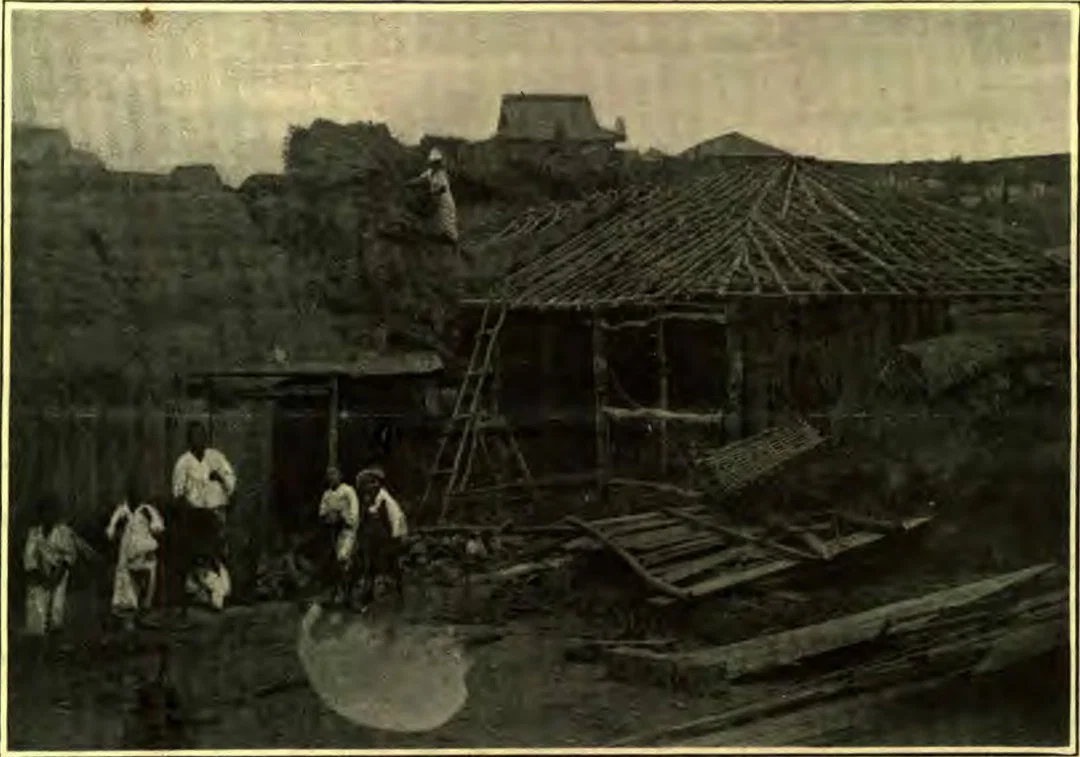
The average Korean dwelling is among the humblest on earth. Only among savage and barbarous peoples are the houses so poor as in this “land of the morning calm.” Let me describe the construction of such a dwelling. A framework of small timbers is first erected, then the walls are completed by filling in between the upright timbers with mud, or with stones laid in mud. These walls are made smooth by being plastered with mud inside and outside. A thatch of millet straw, reeds, or like material completes the roof. Inside, the spaces between the rafters are plastered with mud, and this answers for ceiling. The windows, and sometimes the doors, are of lattice-work, covered with white paper to admit the light, and are usually located in the front of the house only. There is no other provision made for ventilation.
The floors deserve a detailed description, for thereby the heating of the house is understood.
In all the rooms except the kitchen, parallel walls of stones and mud about a foot high, are built upon the ground. The spaces between these walls are then bridged over with flat stones, and the whole leveled up with a layer of mud. Thus these spaces under the floors are like so many flues, and are connected with the earthen stove or fireplace in the kitchen. The hot air and smoke traverse these flues, and finally reach the chimney, which is usually placed near one corner of the house. Often the chimney is only a foot or two high, and the smoke blackens the wall of the house; sometimes it is six or eight feet high, topped out with a roll of cane matting, its mud sides thatched with straw to keep the rain from dissolving them.
This arrangement for heating seems to be quite effective, but is said to be very expensive. The common fuel is the small branches of pine and other trees, dried with the leaves on, and is gathered from the scrubby trees which grow upon the otherwise barren hills and mountains. These pines look as if the people had got the start of them; for they are kept cut back almost to the ground, to furnish fuel.
The cottage in which I am sitting as I write this sketch, is in a little country village in western Korea. It is about fourteen feet wide and thirty feet long. The kitchen is at one end, and occupies about one third of the whole length. The remainder is divided into two equal rooms by only a partial partition. The main timbers of the frame are crooked and unhewn. The rafters are poles about as thick as a man's arm, such as might be picked from an American farmer's wood-pile. The walls are scarcely six feet high next to the eaves, and I can easily reach the ridge-pole with my fingers while standing erect. The earthen floors are covered with cane and reed mats, upon which the inmates sit.
A KOREAN HOUSE — STRIPPED TO SHOW THE FRAME
The newcomer is liable to conclude that the simplicity of Korean houses is due to the poverty of the people; and doubtless there is some truth in this. But those who are well informed affirm that even people of means dare not show their wealth by erecting decent dwellings; for to do so would be to expose themselves to the extortion of dishonest government officials. Government positions are sought for the express purpose of enriching the officials at the expense of the people. It is largely this corrupt condition of the government that makes Korea such an easy prey to her grasping neighbors.
But this very poverty and oppression of the people render many of them all the more ready to receive the good news of salvation, and to prepare for the life to come, where they will exchange their rude dwellings for “a house not made with hands, eternal in the heavens.”
F. W. FIELD.

A True Sabbath Reform

MUCH agitation exists in the world in reference to a reformation concerning the Sabbath. There are powerful organizations, such as the National Reform Association, Lord’s Day Alliance, and others, conducting a strong propaganda to secure civil laws compelling all to cease work on Sunday, and observe the day as the Sabbath. This is a counterfeit reform, one reason being that a person can not be made a Sabbath-keeper by law. The law of God is holy, just, and good; the entire law is spiritual. Rom. 7: 12, 14. Sabbath-keeping is, therefore, a spiritual work, a matter of conscience between the individual and the Lord, and no one who is not spiritual can keep the Sabbath, and any law compelling us to act as if we were Sabbath-keepers when we are not in heart, simply makes hypocrites, and those are not even desirable citizens.
It would be just as proper to enact laws compelling all to partake of the Lord’s supper, or to be baptized, as to keep the Sabbath; for the Bible commands one as well as the other. It would be wicked for believers and unbelievers, Jews and Gentiles, indiscriminately to partake of the sacred emblems of the Lord’s table or receive the holy ordinance of baptism. It is equally wicked to compel all to observe a sabbath.
But the Lord has foretold in his Word a true Sabbath reform in the last days, just before the coming of the Lord, accomplished, not by the power of civil law, but by the power of the gospel, through the Holy Spirit.
It will not be an effort to exalt a pagan festival day, but to restore the true Sabbath of the Lord to man, which for centuries has been buried beneath the superstition and tradition of men.
“And the dragon was wroth with the woman, and went to make war with the remnant of her seed, which keep the commandments of God, and have the testimony of Jesus Christ.” Rev. 12: 17. The dragon is Satan; the woman represents the church; the “remnant” is the last part of the church, or the true people of the Lord who will be living on the earth when Jesus comes. Satan, knowing that he has but a little time longer in which to deceive souls (verse 12), will wage a relentless warfare against this “remnant,” who are distinguished from all others by keeping the “commandments of God.” Most of the professed Protestant churches acknowledge the binding claims of nine of the precepts of the decalogue, but this does not designate them as commandment keepers. But when the fourth commandment is observed with the other nine, or, in other words, when all ten of the commandments are kept, those who observe them are noted as great sticklers for the law, and keepers of the commandments. This indicates clearly a Sabbath reform.
Again, in Rev. 14: 12 we read: “Here is the patience of the saints: here are they that keep the commandments of God, and the faith of Jesus.” Here they are. Where? “And I looked, and behold a white cloud, and upon the cloud one sat like unto the Son of man, having on his head a golden crown, and in his hand a sharp sickle.” Verse 14. Here just before the Saviour comes to reap the ripened harvest of the earth, a people are seen who are distinguished by keeping the “commandments of God.” They are developed under the three messages of verses 6-11, announcing the opening of the heavenly tribunal in the solemn work of the judgment, the fall of spiritual Babylon, and the warning against the worship of the beast and his image and the reception of his mark. The beast and his image appear just before the Lord comes; for both go alive into the lake of fire. Rev. 19: 20. So under the proclamation of these mighty messages, a remnant church is gathered out, which, in the midst of the most rank apostasy, while the searching investigation in the heavenly sanctuary is going forward, and the lives of earth’s teeming millions are being compared with the eternal code in the ark, will uphold the claims of the law. “Jesus then raised the cover of the ark, and lo! the tables of stone, with the ten commandments written upon them. They [the remnant] trace down the lively oracles, but start back with trembling when they see the fourth commandment among the ten holy precepts, with a brighter light shining upon it than upon the other nine, and a halo of glory all around it.”—“Early Writings,” page 188.
That the Sabbath is to be restored to man, stripped of all its papal garb and the superstition heaped upon it during the world’s midnight, is clearly set forth. To have a part in this heaven-born work is the most precious privilege given to mortals.
Once more we read: “Thus saith the Lord, Keep ye judgment, and do justice; for my salvation is near to come, and my righteousness to be revealed. Blessed is the man that doeth this [keeps judgment and does justice], and the son of man that layeth hold on it; that keepeth the Sabbath from polluting it, and keepeth his hand from doing any evil.” Isa. 56: 1, 2. This scripture applies when the Lord’s “salvation is near to come.” This is at his second appearing, for we read, “Unto them that look for him shall he appear the second time without sin unto salvation.” Heb. 9: 28. Then, at this time, when the coming of the Lord is near at hand, a blessing is pronounced by the Lord upon all who “lay hold” of the Sabbath. This indicates clearly that people have lost their hold upon the Lord’s rest day, for they would not be admonished to “lay hold” upon it if they had hold. And the blessing being pronounced upon those who heed this admonition, shows unmistakably that there will be a work of Sabbath reform just prior to the Saviour’s return to the earth, and the Edenic Sabbath, so long hidden beneath the rubbish of error, is to be exalted before all the world. The work of bringing the true Sabbath of Jehovah to the attention of the world now progressing in all parts of the earth is a marked fulfilment of this scripture.
Again we read: “And they that shall be of thee shall build the old waste places: thou shalt raise up the foundations of many generations; and thou shalt be called, The repairer of the breach, the restorer of paths to dwell in. If thou turn away thy foot from the Sabbath, from doing thy pleasure on my holy day; and call the Sabbath a delight, the holy of the Lord, honorable; and shalt honor him, not doing thine own ways, nor finding thine own pleasure, nor speaking thine own words: then shalt thou delight thyself in the Lord; and I will cause thee to ride upon the high places of the earth, and feed thee with the heritage of Jacob thy father: for the mouth of the Lord hath spoken it.” Isa. 58: 12-14.
A “breach” has been made in the law. The true Sabbath has been torn from its bosom, and one of pagan origin substituted in its place. It is underfoot, and the Lord asks us to “turn away” our feet from his “holy” and “honorable” day, and “delight” ourselves in the blessing of the true Sabbath. The reward promised is a home in the new earth (verse 14), for this is what was promised to Jacob. Gen. 28: 12-14. And in the new earth the Sabbath will be observed by “all flesh” through the unending ages of eternity. Isa. 66: 22, 23.
G. B. THOMPSON.

Lost in the Woods

“MOTHER, dear, it is getting late, and I must go; for I have never been down to the camp, and the road is new to me.”
“Wait,” said a friend, “I am going soon, and I know the way. Wait, I will go with you.”
“Thank you, but I am sure I shall easily find it with the directions that have been given me, and I am sure to meet some one who can tell me, if there is any doubt as to which way to go.”
It was one of those long June days, with lingering twilights. The path lay up through the canyon. It was a steep climb, but the breeze was fragrant and cool, and in the tops of the oak and madrone trees, which made a heavy shade all the way, the birds chirped and sang merrily as if to keep me company.
At last the road was reached; but before this, I had pulled out of my book a scrap of poetry, and was absorbed in committing its lines, only glancing up occasionally as a flock of quails from the bushes suddenly took to the wing, or as the lizards rustled the ferns by the roadside.
The way was longer than I had expected. Here were the forks in the road. I did not remember having been told of them. Which way of the three should I take? The main road turned abruptly to the right, while leading straight ahead was a narrow cart road, and at the left a well-beaten pathway.
I decided to go straight ahead. It was growing dusk, and I hurried on and on, but it seemed the road would never come to an end.
At last I saw a little cottage on the hillside, and a gateway leading to it. “Why not inquire the way to the camp?” I thought. There was no answer to the rap on the door, and my “coow-e-e” was only responded to by a calf out in the barnyard.
I sought the forks in the road. This time I would try the road that turned to the right. It led up a steep ascent, past a wood-cutter’s deserted cabin—almost to the top of the mountain from which I had just descended. I thought I heard the roaring of the canyon stream, and would soon find my way home, even if I could not reach the camp. No, it was only the moaning of the wind among the pines.
Again I sought the forks in the road. There seemed to be but one other chance of my reaching the camp that night; I would try the foot-path. It was growing dark, unusually dark; for the sky was cloudy. The path could scarcely be seen. A shower was coming on; soon the drops began to fall. The path became more and more indistinct, and at last ended in a brush heap, and I lost it altogether.
Now I wished that I had waited for my friend; she knew the road. How foolish I was to go on so carelessly. It does not give one a pleasant sensation to be lost in the woods on a dark, rainy night. Yet I can not say that I was afraid. I knelt down among the wet bushes, and asked God to care for me and show me the path, that I might reach home in safety.
And then it didn’t seem lonely any more, and I forgot all about being lost in the woods. “O Father,” I said, “life’s path is dreary without thee. I have tried to go on alone and find my own way. Heedlessly I have hastened on when I might have had thy guidance and companionship all the way. O that I had waited for thee to lead, that I had not tried to choose my own path! But now I am lost, lost and alone; I have passed the forks in the road, and have lost my path. I know not how to retrace my steps, nor could I go any farther if I would. O, I am so weary, so weary! find me, and set my feet in the right path, and walk thou by my side.”
“Just trust me, my child,” the answer came. “Wait for me, and the pathway will not be hard to find; for I know every step of the way. Let me go with you, then it will not be a dreary walk.”
That hour in the woods—I love to think of it. It seems the sweetest and best of all my life; ’twas when he said, “Wait, my child,” and I answered, “Yes, my Lord, I will ever gladly wait for thee.”
Soon I found the path, and when I reached the forks in the road, my friend was waiting there. She had reached the camp some time before, and fearing that I might have turned the wrong way after leaving the canyon path, had followed the main road in the direction I had taken, and now stood at the forks, wondering which way I had gone.
“I was just going to return for some searchers when I saw you,” she said. We walked on in silence; for my heart was too full to speak. I was thinking of the long, lonely pathway of life, of the many forks in its road, and of being lost in the darkness. Now the road would no longer be dreary; for I was not going on alone.
“Listen! they are singing! It is the hour of evening worship.” Then I felt like singing, too, for a strange, wonderful joy filled my soul.
E. M. WHITE.

Germs as Friends and Enemies

What Prevents Our Growth—Antiseptics

THERE are some kinds of organic matter which will not spoil or decay, because the germs can not live on it. Soap, for instance, will keep indefinitely, though the soap grease might spoil under favorable circumstances.
The germs can not grow in the presence of soap because of the large quantity of alkali (usually soda) which the soap contains. Substances which hinder the growth of germs are called antiseptics. They may not destroy the germs, but simply retard the growth for the time being. Substances which destroy the life of germs are called germicides. Substances which in strong solution act as germicides will usually act as antiseptics in weak solutions.
Thus corrosive sublimate, or mercury bichlorid—one part to one thousand parts of water—is a strong germicide. One part to one hundred thousand parts of water acts as an antiseptic. Many of the oils, such as oil of peppermint, oil of wintergreen, oil of cinnamon, oil of cloves, are decidedly germicidal, and hence are never subject to decay. Cinnamon water, made by dissolving a few drops of oil of cinnamon (or oil of cassia) in water, makes a very pleasant and efficient mouth wash on account of its germicidal action.
White sugar, when dissolved in a large amount of water, is an excellent food for germs. In strong solution it has the property of preventing germ action. Canned fruit is more apt to keep if it is put up with a large proportion of sugar. Jellies and rich sirups do not have to be canned, because the sugar retards the action of germs. Berries are sometimes preserved raw by mixing a large quantity of sugar with them. The germs are not killed, as no heat is used, but they are unable to grow in the presence of so much sugar. If now some water be added to this fruit, so as to dilute the sugar, there will be fermentation in a short time.
You may have seen meat preserved by putting it into brine. You have probably wondered why the brine preserved the meat. It is because the salt acts as an antiseptic, keeping the germs from growing. The salt, however, does not kill the germs. The meat will not spoil so long as the germs can not grow. You have already learned that it is the growing of germs that causes decay, and that causes food and other things to spoil. There are germs in abundance, ready to grow at the expense of the meat, but the salt keeps them quiet. Butter is salted to make it keep longer.
Do we salt our potatoes and other food just before we eat it, in order to keep the germs from working on it in our stomachs? Or do we salt the food because we like it better that way?
As a rule, anything added to food to keep the germs from acting on it is liable to make the food harder to digest. Salt meats and dried meats are harder to digest than fresh meats. None of them is a very good food, by the way, for those who want to be pure in mind and body. Meat is not an ideal food. There are other foods which are much better.
Another method of preserving meat is to hang it up in a “smoke-house,” and keep a wood fire burning in the house until the meat is well smoked. The smoke contains creosote, a substance which acts very strongly as an antiseptic. This penetrates the meat, and “preserves” it by keeping the germs from acting on it.
MIKE ROSE.
(To be concluded.)

Can You Do Something?

No genuine Christian can remain indifferent to the evils that are destroying his fellow men. In our day the demon of strong drink has well-nigh the entire nation in its grasp. It was so in the time of Noah, but he was not content to be merely a passive Christian. He was not only just and perfect in his generation, but he was also “a preacher of righteousness,” and in the face of a most disheartening outlook he lifted up the standard as enthusiastically the day before he entered the ark as he did the day that he began his work. We may do the same to-day.
The people of this nation last year contributed for the stimulant evil a sum equivalent to $18.15 for each man, woman, and child in the land. They spent more money for tobacco than they did for food. It is also estimated that a million of our inhabitants are slaves to morphin and cocaine.
Shall we, because of this absolutely disheartening outlook, fold our hands in passive indifference? Instead, let us remember that “as thy days, so shall thy strength be,” and recognize in the present situation a clear message from Providence that we are “come to the kingdom for such a time as this,” and why should not each one say from the bottom of his heart, “How can I endure to see the evil that shall come unto my people? or how can I endure to see the destruction of my kindred?” Esther 8:6.
Christ came to send fire on the earth, and if he is in us, he will do the same through us. We are not simply to be good, but to do good. He expects us to be “the salt of the earth,” and if we are not, we shall “be cast out, and . . . trodden under foot of men,” no matter how painful the process may be to us.
Daniel was a mere youth like ourselves, but what he determined in his heart God brought out in his life, and a whole nation was made better by his beneficent influence. John the Baptist bore a fearless testimony in reference to temperance and other truths for that time, and the influence of his life is still felt in the earth.
Do you say, “I am so young, and have no influence in the world”? Some one else said that, and the Lord replied, “Say not, I am a child.” Can it not be true even in this world that “a little child shall lead them”? As for influence, the Lord can take a worm and thrash a mountain.
Many a victim of the drink habit is groaning under the curse, but knows no way of deliverance. If you have already experienced in your life the power of the gospel, you may be the instrument that God will use to point some poor drunkard to the true source of deliverance.
Highly spiced food, fiery condiments, and other unnatural and unwholesome foods are creating a thirst in thousands that water will not quench, but which can be satisfied temporarily by liquor.
Are you preparing yourself to instruct the rising generation how to eat “for strength, and not for drunkenness,” and to see the practical application of the words, “The curse causeless shall not come”?
“SAVE THE CHILDREN AND YOU SAVE THE MEN AND WOMEN”
In many instances a group can do more effective work than single individuals. Years ago we were told, “Temperance societies and clubs have been formed among those who make no profession of the truth, while our people, although far ahead of any other denomination in the land in principle and practical temperance, have been slow to organize into temperance societies, and thus have failed to exert the influence they otherwise might have done.”
But that is not all; God calls upon us to do aggressive work. Just recently we have been told: “A decided warning is to be borne against intemperance. Many of the terrible crimes that are becoming so common in our world, many of the murders, robberies, and railroad accidents, which are so rapidly increasing, may be traced to the use of intoxicants. Many of the men and women who fill our insane asylums and prisons are there because of the influence of alcohol. And yet this cruel traffic, the fearful results of which may be seen on every hand, is legalized by the laws of the land. And Satan stands by exulting.” Note particularly the following words: “God calls for an army to be formed against the sale of the drugged liquor that is making men mad. As yet the contest has scarcely begun. Who will put forth a determined effort against this terrible evil? Soon we shall see its fearful results as we do not see them now.”
Rather than be content to do nothing to stay this terrible rising tide, for the liquor traffic in this country has doubled since 1880, should we not ask the Lord to touch our lips with a live coal so that we shall be led to say in reference to the temperance cause as well as to every other truth that God wants proclaimed in this generation, “Here am I; send me”?
DAVID PAULSON, M. D.

A Single Soul

“RUTH, I have tickets for the concert of the Bell-Ringers on Wednesday night. Can you go?” Alice said to a friend at her gate.
“It is prayer-meeting night.”
“I know; but they sail for Europe Friday night, and this is their last concert.”
“But I never stay away from prayer-meeting for anything.”
“But this is a sacred concert — and only once. We can worship just as well there.”
So, reluctantly, and against her convictions, Ruth consented.
That night the girl dreamed that an angel in shining raiment stood before her, and asked, gently, “Where are you going to-morrow night?”
And she answered, “I thought I would go to the concert.”
Then the angel said, sadly, “Have you so little appreciation of the value of a single soul?”
She decided she must take back her promise to attend the concert, and go to the prayer-meeting.
Ruth sat in the house of prayer with a strange joy in her soul, singing:—
“Plenteous grace with Thee is found, Grace to cover all my sin; Let the healing stream abound, Make and keep me pure within. Thou of life the fountain art, Freely let me take of thee; Spring thou up within my heart, Rise to all eternity.”
As the music ceased, the young girl sprang impulsively to her feet.
“I meant to hear the Bell-Ringers to-night,” she said, “but I decided I would rather come to prayer-meeting; and I am happier here than I should have been at the concert; and I am sure no music could be sweeter to to me than the hymn we have just sung.”
As the hour for closing drew near, the pastor arose and invited any who would give themselves to Christ to come forward.
As he waited in silence, a lady in mourning walked slowly up the aisle, and kneeling, was shown the way of salvation.
When the service was ended, a friend came to Ruth and said: “The lady who went forward wishes to be introduced to you.”
Much astonished, the girl went to receive an introduction to Mrs. Walters.
“I wanted to tell you,” the lady said, “that I owe the fact of my being a Christian to-night to your testimony. I have not been inside a church for ten years. I came here to please a friend, and when you said you would give up a concert for a prayer-meeting, and no music could be sweeter to you than the hymn, ‘Jesus, Lover of my soul,’ I thought to myself, ‘There must be something in religion, and I am going to have it.’ So, I wish to thank you that it is because of your testimony that I shall go home to-night a servant of the Lord Jesus Christ.”
Ruth held out her hand, and pressed gratefully that of her new friend.
She knew now the meaning of the angel’s message.
“I thank you for telling me this,” she answered; “I shall never forget it.”
Yet she little guessed what cause she would have to always remember it.
Ruth’s home was close beside the railroad track. About midnight she was awakened by a horrible crashing sound. Looking from the window, she could see where the midnight express and the 11:30 freight had collided.
The cries of the frightened and the piercing shrieks of the wounded made her shudder. But she bravely put away all thought of self, and, calling her father, was soon ready to go with him to the rescue.
And the first face that looked into hers as she stood beside the burning train was that of Mrs. Walters. Pale and peaceful it was, though showing how intensely she suffered. She was extracted and borne to Ruth’s home. The power of speech was almost gone. She rallied a little as they laid her on Ruth’s couch.
Taking her hand and pressing it to her lips, she whispered feebly: “Child, I am going — it was my last chance — what if you had not spoken — what if I had not taken it?”
And kneeling there beside the dead, the tears raining down her face, Ruth promised her Father to always do her duty; always to give her testimony; always to appreciate the value of a single soul.— Christian and Missionary Alliance.

THE WEEKLY STUDY

Paul's Farewell Visit with the Elders of the Church at Ephesus

OPENING EXERCISES.
SCRIPTURE FOR STUDY: Acts 20:17-36.
REFERENCE STUDY: “Sketches from the Life of Paul,” pages 198-202.
TOPICS FOR STUDY:—
Calls for the Ephesian elders.
Reminds them of past labors.
Declared the whole counsel of God.
Taught publicly.
Taught from house to house.
Taught repentance and faith.
Going bound in spirit unto Jerusalem.
Bonds awaiting him everywhere.
Farewell visit.
Bids them watch.
Warning.
Commends them to the Word.
Parting prayer.

Notes

Study prayerfully this meeting with the Ephesian elders, and the parting instruction which reveals the tenderness and affection of the great apostle and his fatherly care for the churches. Picture in your mind their joy on hearing that he who had taught in the school of Tyrannus, and been so long in their midst, was in the harbor at Miletus, about thirty miles distant. They held their meeting perhaps in some solitary, secluded spot on the shore of the sea.
“Kept back nothing.” Though exposed to dangers, because commissioned to preach unpopular truths, at all hazards he declared “all the counsel of God.”
Note the integrity and determination of this great gospel warrior. Though confronted with “bonds and affliction,” he triumphantly exclaims, “None of these things move me.” He counted himself as belonging to the Lord, ready to live or die as he might decide. He was anxious only that he might finish his course with joy. Read 2 Tim. 4:6-8.
Note in verse 28 the instruction to “feed” the church. John 6:63; Job 23:10-12. Also the tremendous price paid to “purchase” the church.
“Grievous wolves shall enter in.” This danger was not from without, but from within the church. Of their “own selves” some were to arise speaking perverse things. Apostasy was to be revealed within the church. These wolves were to be robed in “sheep’s clothing,” thus increasing the danger. These teachers were to draw away disciples after themselves.
As the only safeguard against “perverse” teachers, and heresy in all its deceitful forms, the apostle commends them “to God, and to the word of his grace, which is able to build you up, and to give you an inheritance among all them which are sanctified.”
“Could ministers of the gospel constantly bear in mind that they are dealing with the purchase of the blood of Christ, they would have a deeper sense of the solemn importance of their work. They are to take heed unto themselves and to the flock. Their own example must illustrate and enforce their instructions.”
“By his fidelity to the truth, Paul inspired intense hatred; but he also inspired the deepest and warmest affection. Sadly the disciples followed him to the ship, their hearts filled with anxiety, both for his future and for their own. The apostle’s tears flowed freely as he parted from these brethren, and after he had embarked, there came to him from the shore the sound of weeping.” G. B. T.

Young People's Convention

On Sabbath, March 4, the Young People's Society of Keene, Texas, held a convention. There was a session in the forenoon, also one in the afternoon. As it was a beautiful Sabbath, there was a large attendance at both sessions. The decided success was an encouragement to all present.
Some of the topics presented and discussed were as follows: Personal Efforts, the Most Effectual Method of Saving Souls; The Importance of Systematic Thought and Work; Responsibility of the Young People's Society; Power of Influence; The Call for Service; The Young People's Society and the Closing Work. Vocal solos, duets, and quartets were interspersed, adding greatly to the interest of the convention.
Our membership at present is sixty, and all realize that the message must go to all the world in this generation.
God is wonderfully blessing the efforts of the young people. Over one thousand copies of the special numbers of the Signs and Watchman were sold in one of our neighboring towns, which proved a great blessing to all.
The prayer of the Keene Young People's Society is that heaven's blessing may rest upon all the different young people's organizations.
B. M. HEALD, President.

Character Is Higher Than Intellect

CHARACTER is higher than intellect.—Emerson.

Inquisitiveness and Natural Intelligence

“INQUISITIVENESS is as natural to intelligence as hunger is to the stomach.”

Every Man Is My Master in Something

EVERY man I meet is my master in some point, and can instruct me therein.—Emerson.

Giving Without Hesitation, Losing Without Regret

“Know how to give without hesitation, how to lose without regret, how to acquire without meanness.”

Walking Steadily Toward a Great Purpose

WALK perseveringly in the light of a great purpose, and difficulties will disappear, even as the horizon recedes before the advancing step.—Spalding.

The Report

IN this issue of the YOUTH'S INSTRUCTOR, we take pleasure in publishing the report of the Young People's Societies for the year ending December 31. Perhaps a few words of explanation would be appropriate; for the report is very incomplete, and does not begin to state accurately the amount of work that has been done, or even the number of Societies that are organized and in a prospering condition.
Our young people are good workers, but they are very loath to tell about it. The opinion seems to prevail in many places that if we keep a record of the missionary work the Lord enables us to do, it fosters our pride, and that it will appear to others that we do it to receive praise, and not because we love to do it. If that were to be the result, we had much better never mention it again. But, on the contrary, if we allow others to know what we have done, that they, by seeing our good works, may be led to glorify our Father who is in heaven, and be persuaded to go and do likewise, have we not accomplished good, and only good?
The Societies have not only worked well, but they have studied well. They have taken, for the basis of their study, the lessons given in the YOUTH'S INSTRUCTOR, supplementing these with lessons from the different books of prophecy, the missionary fields, biographies of missionaries, “Great Controversy,” and other general subjects of practical value.
We feel that the young people's meetings have been a source of strength to the youth, and have resulted in much good to others. We hope that another year will witness an increase in the number of Societies, a deep spiritual growth among the members, and a work accomplished that will hasten the soon coming of our Lord, even in this generation. MRS. FLORA L. BLAND.

Summary of the Young People's Reports for Quarter Ending Dec. 31, 1904

At. U. Conf. Can. U. Conf. Lake U. Conf. Cent. U. Conf. N. U. Conf. S. W. U. Conf. Pac. U. Conf. Total
Number of societies 10 2 20 55 3 16 24 130
Present membership 132 49 319 817 88 315 462 2182
Members in State H. D. 30 8 38 2 20 98
Missionary letters written 58 92 83 6 76 175 490
Missionary letters received 16 31 28 3 16 31 125
Missionary visits 52 5 598 381 23 546 2110 3715
Bible readings or cottage meetings 17 6 112 76 7 28 243 489
Subscriptions taken for periodicals 10 7 65 55 18 22 177
Papers sold 1662 1608 1653 2540 60 2670 2888 13081
Papers mailed or given away 401 1269 3309 6505 949 865 17047 30343
Books sold 41 110 27 441 10 4 49 682
Books loaned 5 5 45 53 2 19 47 176
Pages of tracts sold 7193 1500 7070 850 80 450 17143
Pages of tracts given away 109136 5031 17658 1611 470 7693 141599
Hours of Christian Help work 321 435 36 108 29 929
Persons supplied with food 6 9 2 16 106 139
Articles of clothing given away 39 80 6 24 321 470
Total contributions during quarter $12.21 $17.35 $66.68 $102.43 $6.67 $45.00 $81.99 $332.33
Paid for supplies 3.05 12.99 6.67 3.00 25.71
Offerings for home mission work 5.46 4.80 51.94 38.24 10.00 40.65 151.09
Offerings for foreign mission work 6.75 2.50 14.74 51.20 32.00 41.34 148.53
Washington fund 7.00 7.00
Mrs. Flora L. Bland.

Pretty Pansies All Aquiver

Shy little pansies Tucked away to sleep, Wrapped in brown blankets Piled snug and deep, Heard in a day-dream A bird singing clear: “Wake, little sweethearts, The spring-time is here.”
Glad little pansies, Stirring from their sleep, Shook their brown blankets Off for a peep, Put on their velvet hoods, Purple and gold, And stood all a-tremble Abroad in the cold.
Snowflakes were flying, Skies were grim and gray, Bluebird and robin Had scurried away; Only the cruel wind Laughed as it said, “Poor little April fools, Hurry back to bed.”
Soft chins a-quiver, Dark eyes full of tears, Brave little pansies, Spite of their fears, Said, “Let us wait for The sunshiny weather; Take hold of hands, dears, And cuddle up together.” — Emily H. Miller.
Continue reading: Questions About Nature for City Children