Our Lord, in his Sermon on the Mount, which may be read in the fifth, sixth and seventh chapters of Matthew, says: “Think not that I am come to destroy the law or the prophets; I am not come to destroy, but to fulfill. For verily I say unto you, till heaven and earth pass, one jot or one tittle shall in no wise pass from the law till all be fulfilled.”
The words of Jesus, “think not that I am come to destroy the law,” show that some would even think that Jesus destroyed his Father’s law, when he came to this world and died on the cross. But he here warns us against thinking so. He says he came to fulfill it. The word fulfill, here means, to obey. Jesus obeyed his Father’s law, for he says in John xv, 10, “I have kept my Father’s commandments.” We will see what the Apostle teaches that it is to fulfill this law. He says: “If ye fulfill the royal law according to the scripture, thou shalt love thy neighbor as thyself.” James ii, 8. He teaches that to fulfill the law of God, is to keep it, instead of destroying it.
The apostle James also teaches that it should be kept according to the scripture. The word scripture here refers to the ten commandments recorded in the twentieth chapter of Exodus. Jesus also declares that, “till heaven and earth pass, one jot or one tittle shall in no wise pass from the law.” As long as the world stands, there cannot be the least alteration in the law of God. Every one of the ten commandments will remain the same as God wrote them on the tables of stone.
Contrary to the teachings of Christ, the Roman Catholic Church has altered some of the commandments in the law of God, as may be seen in their “General Catechism, by Dr. James Butler.”—Here are the commandments as printed in the Catechism, page 20.
“1. I am the Lord thy God, thou shalt not have strange gods before me, &c.
Thou shalt not take the name of the Lord thy God in vain.
Remember that thou keep holy the Sabbath day.
Honor thy father and thy mother.
Thou shalt not kill.
Thou shalt not commit adultery.
Thou shalt not steal.
Thou shalt not bear false witness against thy neighbor.
Thou shalt not covet thy neighbor’s wife.
Thou shalt not covet thy neighbor’s goods.—Exodus xx.”
You will see that they have left out the second commandment and called the third the second, the fourth the third, the fifth the fourth, the sixth the fifth, the seventh the sixth, the eighth the seventh, the ninth the eighth, and have divided the tenth, and made two of it to make out the ten.
God spake the commandments, and says [Ps. lxxxix, 34] that he will not alter the thing that is gone out of his lips. Yet the Catholic Church has taken the liberty to leave out the second commandment and divided the tenth.
On page 26 of this Catechism, is the following questions and answers:
“Q. Say the third commandment?
A. Remember that thou keep holy the Sabbath day.
Q. What is commanded by the third commandment?
A. To spend the Sunday in prayer, and other religious duties.”
In the first place, they here call the fourth commandment the third, and then say that to keep Sunday, or the first day of the week, is what is required by it. But the fourth commandment requires the seventh day to be kept holy. Young friends, believe God, and keep his holy law.
NUMBER VI.
“Then one of them which was a lawyer, asked him a question, tempting him, and saying, Master, which is the great commandment in the law?—Jesus said unto him, thou shalt love the Lord thy God with all thy heart, and with all thy soul, and with all thy mind. This is the first and great commandment. And the second is like unto it: thou shalt love thy neighbor as thyself. On these two commandments hang all the law and the prophets.” Matt. xxii, 35—40.
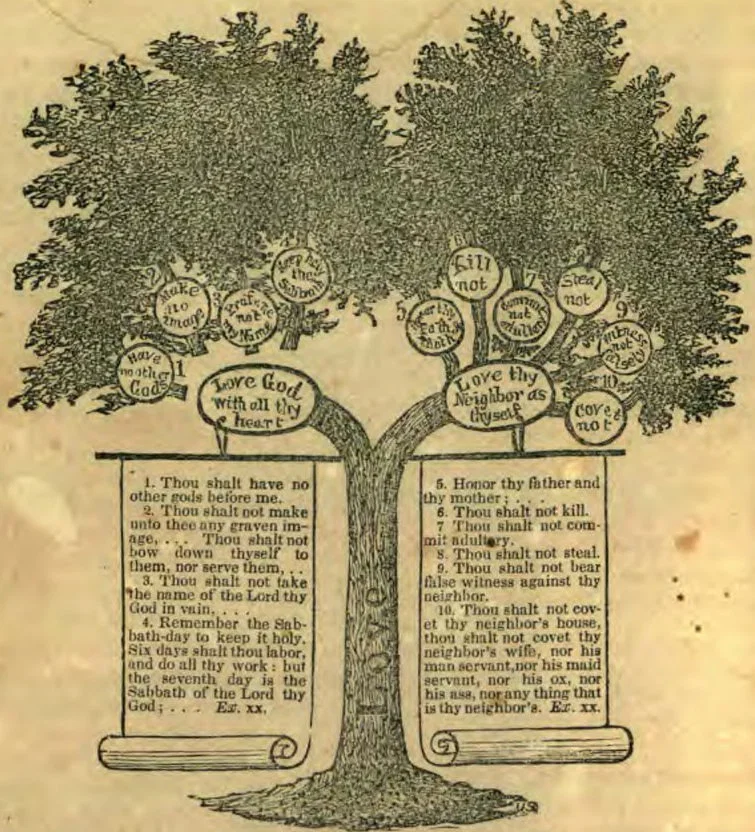
Now look at the picture of the tree with two large branches, and ten smaller ones, and the two10scrolls hanging to the two large branches, containing the ten commandments. This picture illustrates the above words of our Lord. The two large branches of the tree represent the two great commandments mentioned by our Lord. The large branch, marked, “Love God with all thy heart,” represents the first great commandment. On this branch are four smaller ones. [These should be joined.] They represent the first four of the ten commandments, which were written on the first table of stone. These all show our duty to God, how we may love him supremely. The first great commandment, then, embraces the first four of the ten commandments.
The other large branch, marked, “Love thy neighbor as thyself,” represents the second great commandment mentioned by our Lord. On this branch are six smaller branches. These represent the last six commandments which were written on the second table of stone. These all show our duty to our neighbor, how we may love others as ourselves. The second great commandment, then, embraces the last six of the ten commandments.—Then we are plainly taught by our Lord that the great object of the ten commandments is, to teach us, first, supreme love to God, and, second, the same love to others that we have for ourselves.—
Our Lord says that on these two commandments hang all the law, and the prophets also. You see the ten commandments written upon the two scrolls in the picture. These two scrolls, which hang upon the two large branches, represent all the law hanging upon the two great commandments, mentioned by Jesus.
Then let it be remembered that all ten of the commandments of God now hang upon the two great commandments. Not one has fallen off.—The Sabbath commandment still hangs there with the rest.
NUMBER VII.
THE FIFTH COMMANDMENT.
“Honor thy father and thy mother, that thy days may be long upon the land which the Lord thy God giveth thee.” Ex. xx, 12.
The ten commandments were of such importance that God came down upon Mount Sinai, and spake them to the people with his own voice, and then wrote them on two tables of stone with his finger. The fifth commandment, then, which requires children to honor their parents, is as holy as the other nine, and must be strictly obeyed. God cannot love those who break this commandment. His frown is upon them for disobeying and slighting the words of his mouth.11
The fifth commandment is expressly addressed to children. But very few of the youth seem to realize this, and feel the importance of honoring their parents. In fact, it has become so common for children to disobey and dishonor their father and mother, that St. Paul mentions their disobedience as a sign of the last days. In naming other sins in Tim. iii, 1—5, which are signs of the last days, he mentions “disobedience to parents.”—This is a very great sin which must be repented of, and forsaken, before those who break the fifth commandment can have the favor of God.
But there is a glorious promise to children, connected with this commandment. “Children,” says the apostle Paul, “obey your parents in the Lord, for this is right. Honor thy father and mother, (which is the first commandment with promise,) that it may be well with thee, and thou mayest live long on the earth.” Eph. vi, 1—3. The Apostle does not mean that this is the first commandment of the ten, but the first one of the number that has a promise connected with it. In fact, it is the only one of the ten that has a promise connected with it.
God knows our natures, and, in giving his righteous law, has come down to our capacity. In giving the fifth commandment to children, he has added a precious promise to encourage their young hearts to strictly obey, and thus honor their parents. But in giving the other nine commandments to those old enough to fully understand them, who do not so much need a promise to encourage them to obey, he has added no promise. This should lead children to love their kind Father in heaven, who has held out to them such an encouraging promise for those who obey.
But what is this precious promise? Answer:—“That thy days may be long upon the land which the Lord thy God giveth thee.” Or as the Apostle says: “That it may be well with thee, and thou mayest live long on the earth.”
The “land,” or “earth,” mentioned in this promise does not mean only this earth in its present state, as some suppose. For many good and obedient children live here but a short time. So you see the promise to them is to be fulfilled after the resurrection of the righteous, in the New Earth. O, what a precious promise to those who obey their parents! To live for ever in the beautiful New Earth!
Our Saviour says: “Blessed are the meek; for they shall inherit the earth.” Matt. v, 5. This is the same New Earth. “But the meek shall inherit the earth, and shall delight themselves in the abundance of peace.” Ps. xxxvii, 11. This also refers to the same New Earth. “For behold I create new heavens and a new earth.” Isa. lxvi, 17; 2 Pet. iii, 12, 13.
NUMBER VIII.
THE LIFE OF CHRIST.
We now design giving several lessons on the life of our Lord Jesus Christ. We shall not stop to explain everything relative to his life named in the New Testament; but shall mention only those things of most importance. Read the second chapter of Matthew and the second chapter of Luke. Do not neglect to do this while studying this lesson.
Jesus was born in Bethlehem of Judea, in the days of king Herod. His parents at this time had come up from Galilee, out of the city of Nazareth, to be taxed. The young child, Jesus, was laid in a manger, there being so many people assembled in Bethlehem, there was no room for him in the inn.
In the same country there were shepherds abiding in the fields, keeping watch over their flock by night. The angel of the Lord came down, and the glory of the Lord shone round about them, and they were sore afraid. And the angel said unto them, Fear not, for behold, I bring you good tidings of great joy, which shall be to all people.—For unto you is born, this day, in the city of David, a Saviour, which is Christ the Lord.
And this shall be a sign unto you; ye shall find the babe wrapped in swaddling-clothes, lying in a manger. And suddenly there was with the angel a multitude of the heavenly host praising God, and saying, Glory to God in the highest, and on earth peace, good will toward men.
When the angel had gone away into heaven, the shepherds went with haste to Bethlehem, and there they found the babe lying in the manger, as the angel told them, also his parents, Joseph and Mary. The shepherds returned glorifying and praising God for what they had heard and seen.
And when eight days were accomplished for the circumcision of the child, his name was called JESUS. There was in Jerusalem, a just and devout man, whose name was Simeon, who was waiting for the consolation of Israel. It was revealed to him by the Holy Ghost, that he should not see death, before he had seen the Lord’s Christ.—The Holy Ghost led this good man into the temple, and when the parents brought in the child, Jesus, to do for him after the custom of the law, Simeon took him in his arms, and blessed God and said: Lord now lettest thou thy servant depart in peace, according to thy word; for mine eyes have seen thy salvation, which thou hast prepared before the face of all people.
King Herod sought for the young child, Jesus, to destroy him. But the angel of the Lord appeared to Joseph in a dream, saying, Arise, and take the young child and his mother, and flee into12Egypt, and be thou there till I bring thee word; for Herod will seek the young child to destroy him. Joseph obeyed the angel, and took the young child and his mother by night, and departed into Egypt.
Herod, who was mocked of the wise men, was exceeding wroth, and sent forth and slew all the children that were in Bethlehem, and in all the coasts thereof, from two years old and under.—The wicked king did this, thinking that Jesus would certainly be slain with the rest of the children. But God had sent his angel before hand to tell Joseph to flee into Egypt. There Jesus was safe with his parents, at the time Herod slew so many children.
But when Herod was dead, the angel of the Lord appeared to Joseph again in a dream while in Egypt, and said to him, Arise, and take the young child and his mother, and go into the land of Israel.
TO BE CONTINUED.
COMMUNICATIONS
Beauties of the New Earth.
DEAR YOUNG FRIENDS:—At the close of my communication in the first number of the Instructor, I stated that I would tell you something of the beauties of the New Earth, in the next paper, and now I will fulfill my promise.
The glorious City of God has twelve gates, set with pearls most glorious. It also has twelve foundations of various colors. The streets of the City are of pure gold. In this City is the throne of God, and a pure, beautiful river proceeding out of it, as clear as crystal. Its sparkling purity and beauty makes glad the City of God. The saints will drink freely of the healing waters of the river of life.
On either side of this beautiful river is the tree of life. And the redeemed saints, who have loved God and kept his commandments here, will enter in through the gates of the City, and have right to the tree of life. They will eat freely of it, as our first parents did before their fall. The leaves of that immortal wide-spread tree will be for the healing of the nations. All their woes will then be gone. Sickness, sorrow and death they will never again feel, for the leaves of the tree of life have healed them. Jesus will then see of the travail of his soul [Isa. liii, 11] and be satisfied, when the redeemed, who have been subject to sorrow, toil and afflictions, who have groaned beneath the curse, are gathered up around that tree of life to13eat of its immortal fruit, that our first parents forfeited all right to, by breaking God's commands. There will be no danger of their ever losing right to the tree of life again, for he that tempted our first parents to sin, will be destroyed by the second death.
All faces will reflect the image of their Redeemer. There will then be no anxious, troubled countenances, but all will be bright, and smiling in spotless purity. The angels will be there, also the resurrected saints with the martyrs, and the best of all, and what will cause us the most joy, our lovely Saviour who suffered and died that we might enjoy that happiness and freedom, will be there.—His glorious face will shine brighter than the sun, and light up the beautiful City, and reflect glory all around.
Children will be there. They will never be engaged in strife or discord. Their love will be fervent and holy. They will also have a crown of gold upon their heads, and a harp in their hands. And their little countenances, that we here see so often troubled and perplexed, will beam with holy joy, expressive of their perfect freedom and happiness. They will express in child-like purity their wonder and delight, as they behold every thing around them so new and lovely. They will look to the blessed Saviour who has given himself for them, and, with admiration and love for him who is smiling upon them, raise their voices and sing to his praise and glory, while they feel and realize the matchless depths of a Saviour's love.
This earth, dear children, is to be purified with fire; then it will be much more beautiful. The grass will be living green, and will never wither. There will be roses and lilies, and all kinds of flowers there. They will never blight or fade, or lose their beauty and fragrance.
The lion, we should much dread and fear here, will then lie down with the lamb, and everything in the New Earth will be peace and harmony.—The trees of the New Earth will be straight and lofty, without deformity.
The saints will have crowns of glory upon their heads, and harps of gold in their hands. They will play upon the golden harp, and sing redeeming love, and make melody unto God. Their former trials and suffering in this world will be forgotten and lost amid the glories of the New Earth. And they will ever have the approving smiles of Jesus upon them, and their happiness will be complete. There will be glory, glory all around.
Dear children, the future abode of the saints will be all over glorious, and will you strive to be there? Let your minds dwell upon the glories of heaven, for this you may do with safety, and this will bring substantial joys, and will make you heavenly minded. If you have trials here, and feel lonesome, look away from this dark world to the bright glories of heaven. Set your affections upon heavenly joys, and then you will not feel so deeply the trials and disappointments of this life, for you will feel that you have a home in glory, a crown, a harp, and a lovely Saviour there. Strive for that blest inheritance which God has promised to those that love him, and keep his commandments.
E. G. WHITE. Rochester, October, 1852.
DEAR YOUNG FRIENDS:—As one who loves you, and feels, I trust, towards you a little of the Spirit of Him, who took little children in his arms and blessed them, and said, “Suffer little children to come unto me,” I would say a few words to you trusting that they will assist you to love, and give your hearts to him. You may often think that those older than yourself, who feel interested for your salvation, cannot, from the fact of their being older, truly sympathize with you, or realize what your feelings, temptations and trials are. But you must remember that we have all been young; have felt, acted, and been tempted like yourselves. We know how we felt then; and are, by experience, better prepared to instruct you, to warn you of the dangers we have escaped, to comfort you in trials, and to help you to overcome the temptations to which you are exposed.
I have been young, and have had kind friends, brothers and sisters; but how little did I realize, when in the enjoyment of all these blessings, the goodness of God in giving them; and how little did I prize them until I saw one after another separated from me. How often have I wept alone that I had ever given way to an unkind feeling, or grieved and wounded those for whom I would have given worlds (were they mine to give) could I but have them with me once more, that I might prove how much I loved them. But some I never shall see here again, for they sleep in the cold, dark grave. O, how often I have wished I had never done wrong!
Most of you, no doubt, have kind friends. O, love them! Be kind to them. Are you sometimes tempted to give way to wrong feelings towards them, and speak unkind words? Pause—utter them not; but think how you should feel if one of those dear friends should be taken from you. They could no longer unite with you in your pleasures, or sympathize in your sorrows. Think how you would miss their tender love, and grieve them not. Well do I remember how I felt when a dear, little sister was taken from our circle. My brothers and sisters, with myself, were called up in the night, to see her before she died. I saw her struggle in death's last agonies. Early in the morning I hurried down stairs, hoping to see my14dear sister once more before she died. But I could never see her again, could never hear her speak, or laugh, or play again; for she was cold and still in death. How suddenly was she, who but one day before was so actively engaged with us in sports and plays, called to leave them. Her little limbs apparently so full of health and vigor, how soon were they palsied by death. There lay her playthings just where she left them; but oh, how lonely I felt, when I thought she could never come back to play with me again. Then I would think of all I had ever said to her that was unkind. I was older than she, and was sometimes impatient when we played. I longed to have her here again, that I might love her better, and always make her happy. As I have grown older, I have had friend after friend taken from me; and now, how gladly would I recall every wrong word I ever uttered to them, and every unkind feeling.
You who are in possession of kind parents, brothers and sisters, so love and obey your parents, and be so good and gentle to your dear brothers and sisters, as you would wish you had, if they should be taken from you by death; or when Jesus comes to take all who are like him to himself. When you are enjoying yourselves in the society of your young friends, then try to practice lessons of patience and forbearance. If they encroach upon your rights, and disregard your feelings, do not feel angry; but remember, that Jesus has taught that when you are reviled you should not revile again. Do not say unkind words to make them feel angry; for in so doing, you not only do wrong yourself, but are the cause of another's sin. Now, instead of thinking how unkindly others may have treated you, commence and see how kind and useful you can be to them. Think not because you are so young, that you are incapable of doing good; or, that in order to love God, and become like Jesus, you must do some great thing, you know not what. That, God does not require. He made you, caused your heart to beat, by his care you breath. He has watched over your infant years, and has always known what that tender age required; and his blessings have been adapted to all your wants. As you advance, step by step in life, you still receive his watchful, and all-sustaining care.
Stop now, and listen to the regular beating of your heart. Should its motion cease, should the warm blood which now fills every vein, imparting life, health and vigor to your limbs, cease to circulate, your heart would then grow cold, and you would be a corpse. Suppose the air which (at every breath you draw) fills and expands your lungs, should be withdrawn, death would be the consequence. God could withhold the rain, sun, and gentle dews which now warm, refresh and fertilize the earth. Think then in what depths of misery you would at once be plunged. How soon you, with every living creature on the earth, would die. Think of having the bright sun cease to impart its light and heat, how soon would your bodies tremble in the cold, damp air, the moon and brilliant stars would cease to shine, and a cold, misty, death-like pall would cover all the (now) beautiful face of nature.
Now look about you, and see if you can begin to count the blessings you may have been thoughtlessly receiving from your kind Creator. God made you to be happy, made you to love him, and rejoice in all his works. Who made all the beautiful flowers which in summer adorn the earth?—Did you ever hear of any one in all the world that could really make a simple flower? Listen to the music of the birds. Who made them, and gave them such sweet voices, and taught them how to sing? Watch them, and see how kind they are, and how happy, and learn from them a lesson of unity and love, and be kind to each other. Why did God make all the beautiful flowers, fruits and birds, and all other things which we behold in nature? Simply, because he loved his creatures, and delighted in their happiness. This is why he has done so much to make them happy. Then can you, young friends, for a moment, doubt his love, and kind regard for you? Do you doubt that he desires your happiness, when you are constantly a witness of all he is doing to promote it. And that too, while you are receiving, and enjoying these comforts, unmindful of him who is the Great Source from whence they flow? Can you now resist these emotions which must spontaneously arise within your breasts. How good God is. I must, I do, I will love God. Resist them not; but go kneel down before him, and pour forth in prayer your heart's best affections, your most humble and grateful adorations. Thank him for all his love to you, and ask him to help you to realize it more, and fill your young hearts with real gratitude.
Dear children, I have mentioned but a very little of all that the Lord has done for your temporal comfort, for your bodily health and enjoyment. In the next paper, I may tell you something of the far greater manifestation of God's love to you, in what he has done for your spiritual good, and for your eternal salvation. ELMIRA O. DAVIS.
Fairhaven, Mass.
OUR Saviour says, “Suffer little children, and forbid them not to come unto me; for of such is the kingdom of heaven.” Matt. xix, 14.
Jesus here shows that those children who come to him, and believe on him, and walk in his commandments are subjects of the kingdom of heaven. Those children who do thus, are the lawful15subjects, or heirs of that kingdom that God has promised to them that love him.
I will here point out some of the duties of those children who thus come to Christ. The first duty that is expressly enjoined upon children is found in the fifth commandment, [Ex. xx, 12,] and reads as follows: “Honor thy father and thy mother; that thy days may be long upon the land which the Lord thy God giveth thee.” This commandment is also quoted by St. Paul in the New Testament. Eph. vi, 1—3. It reads thus: “Children obey your parents in the Lord, for this is right.—Honor thy father and mother, (which is the first commandment with promise,) that it may be well with thee, and that thou mayest live long upon the earth.”
The earth here spoken of cannot mean this present earth which is under the curse, because many good children who obey their parents, and honor their father and mother do not live but a little while. It must be the New Earth which the Lord has promised to make for the abode of his people, and all good children, that they may dwell therein for ever, and delight themselves in the abundance of peace. Isa. lxv, 17; 2 Pet. iii, 13; Ps. xxxvii, 11, You will please find these passages of Scripture, and read them, and try to get an understanding of what God has promised to the children, and to all that obey him and keep his commandments.
This command is again spoken of in Col. iii, 20. “Children obey your parents in all things, for this is well pleasing unto the Lord.” You see by this that if you obey your parents you will not only please them, but you will please the Lord also. Then on the other hand if you do not obey your parents, you will displease the Lord, and have no promise of being saved in his kingdom unless you repent, and yield perfect obedience to your parents. You must not think that you can serve God, and do those things that are pleasing in his sight, unless you obey your parents, and honor your father and mother. To honor them is not merely to obey them when compelled so to do by fear of the rod, or something else, but it is to show the utmost respect to all their words and advice.
You must also give up your will and judgment to that of your parents, and believe that they know better than you do what is for your good. You must not only obey them while in their sight, but when out of their sight or hearing. If you do not God certainly knows it, and will be displeased with you until you repent and confess your disobedience. How pleasing it is to God, and all good men to see children obey their parents, Yes, children, you not only please your parents, and God, by obeying them, but you, also, please, and gain the love and good will of all the good and pious that know you. It is no small thing to meet with the approbation of Christians, and have their prayers in your behalf. All Christians will feel an interest in your salvation, and will offer up prayers to God for you, if they see that you are trying to be good and obedient to your parents, or those that have the charge of you.
Some children use deception, that is, they will appear to be good when with their parents, or others, but when out of their sight will disobey their commands, thinking that they will not be found out. This is very wicked in the sight of God.—You must remember that God always sees you, and knows all that you do or say, whether in secret or openly. And if you seek to hide your faults from your parents or friends you will not prosper. God's frown will be upon you. But if you confess your faults and forsake them, then you will find mercy, and God will love you, and save you at his coming. You have only a short time to get ready to meet the Lord. He is coming to save all the good, both parents and children. But he will destroy all those who know not God, and that obey not the gospel. O, do you not want to be saved with your parents, and live with them for ever on the beautiful New Earth? I know you do. Well, the only way that you can be saved is to be obedient to your parents, and serve God with all your heart.
Dear children, I want to meet you in the kingdom; and I hope and pray that you who are not serving the Lord, will begin immediately to get ready for his coming. You must be willing to give up all the vanities of this world, and, also, the company of wicked children, and come out from among them, and be separate, and the Lord will receive you and save you. ELIAS GOODWIN.
Oswego, N. Y., October, 1852.
DEAR CHILDREN:—I wish to ask you a few simple questions. And, first, Why is it that God's dear children at Rochester take such an interest in your welfare? In this important time, when they have such a multiplicity of cares, so many calls for their time and labor. Why is it that they should be willing to devote a portion of that time to you? Is it not because they feel a degree of that love which our blessed Saviour felt, when he said, “Suffer little children to come unto me, and forbid them not; for of such is the kingdom of heaven?”
Then, dear children, how important that you prize your paper, that you study each lesson with care, treasure up the instruction, and live under the influence of it, day by day. O, let it not prove a savor of death unto death, but rather of life, for remember that you are living in a solemn moment of time, and very soon you will have to give an account for all your misimproved privileges. Even this little paper will witness against you, unless you rightly improve it.16
Then, my dear children, be careful, and when you take your paper to get your lesson, kneel down and ask for the Holy Spirit to assist you, and be assured that you will not ask in vain. No, no, Jesus will behold you, and if you truly, and sincerely, desire help, you will surely obtain it.
Portland, Me., October, 1852. P. R. C.
DEAR BRO. WHITE:—I am a son of J. B. Sweet. He is trying to keep the commandments of God.—I feel interested in them also, and, am trying to keep them, that I may enter the Holy City with my parents. I feel very much interested in the Youth's Instructor, and wish to contribute a mite for the benefit of that paper. I do not know of any other children in the place that want the paper, but my brother, and sister, and myself, I now send you enclosed, $1. Please send three copies of each number of the paper, and direct to me.
Milan, O., Aug. 11th, 1852. F. O. SWEET.
To our Young Patrons.
By Editor
THIS number of the INSTRUCTOR has been delayed one month, in consequence of our being absent from home. For the future, we intend to publish it regularly each month, and hope to be able to give our young readers a still greater variety of instructive and interesting matter.
Our young friends are invited to write for the INSTRUCTOR. Communications from them, relative to their experiences, hopes, joys, and determinations to serve the Lord; also, good advice and exhortations to their young friends, will be acceptable. We hope to receive many such communications before No. 3 shall be published.
At present, our list of names for the INSTRUCTOR is too small. Let all who receive this paper try to obtain one or more subscribers. If you know of poor children who really wish to read the INSTRUCTOR, and have no money to pay for it, tell them that they can have it, and if you cannot pay for it for them, we will send it to them free. It is necessary that all who take the paper, should commence immediately, so as to learn the lessons as they are published. We have more than 500 copies of No. 1 on hand.
The interest already manifested in this little sheet is very encouraging, and we expect that it will increase. Let the youth feel that this is their paper, that it is their duty to try to obtain subscribers, and that it is their privilege to write for its columns. Do not try to imitate others, but write in simple style your views and feelings much as you would talk them. Then read what you have written, and carefully copy it on another sheet, improving it what you can, leaving out useless words.
Come! The Saviour’s call obey,
To him humbly kneel and pray;
Though he reigns above the sky,
Yet he looks with pitying eye,
Hears thy simple, fervent prayer,
Watches o’er thee every where.
Come, and learn his teachings mild,
Jesus loves a little child.
Come! His blessing to receive,
Paths of sin and folly leave;
He will grace and strength impart
To thy young and tender heart,
Guide thy feet in wisdom’s ways,
Fill thee with thy Maker’s praise.
Come, and learn his teachings mild,
Jesus loves a little child.
Come! No longer doubt or fear,
Strive to love and serve him here.
O, be gentle, kind and true,
Meekly in his steps pursue.
Such his glory soon will share
In his kingdom, gathered there.
Come, and learn his teachings mild,
Jesus loves a little child. A. R. S.
Rochester, October, 1852.
QUESTIONS FOR SABBATH SCHOOL LESSONS.
LESSON V.
WHERE is our Lord's Sermon on the Mount recorded?—What did he not come to do? What did he come to do? What do the words of Jesus [Matt. v, 17] teach? What does the word fulfill here mean? Whose commandments did Jesus keep? What does the apostle James teach that it is to fulfill the law of God? How does he teach that we should keep it? What does the word scripture, used by him, refer to? What does Jesus, also, declare? How long, then, will all ten of the commandments remain the same as when God wrote them on tables of stone? Who has altered the commandments? Which one have they left out? Which one have they divided? What day does the Catholic Church require to be kept? What day does God require?
LESSON VI.
WHO came to Jesus, tempting him? What did he say to Jesus? What did Jesus say to him? What do the two large branches of the tree represent? What does the branch marked, “Love God with all thy heart” represent? What do the four smaller branches represent? What do these show? What does the first great commandment embrace?
What does the other large branch represent? What do the six smaller branches represent? What do they show? What does the second great commandment embrace?—What are we here plainly taught by our Lord? Where does all the law and the prophets hang? What do the two scrolls represent?
LESSON VII.
REPEAT the fifth commandment. How did God give the ten commandments? Where did God write his law? What of the fifth commandment? To whom is it addressed? What does St. Paul mention as a sign of the last days? Where does he mention disobedience to parents? Which of the commandments has a promise connected with it?—Why has God added a promise to the commandment addressed to children? What should this lead children to do? What is this precious promise to children? What does the “land” or earth here mean? Where must this promise be fulfilled to good children who die young? What does our Saviour say? In what will the meek delight themselves in the beautiful New Earth?
LESSON VIII.
WHERE was Jesus born? In the days of what king?—Where was the young child laid? What was there in the same country? What appeared to them? What shone around them? What did the angel say to them? What sign did the angel give them? What was suddenly with the angel? What did the heavenly host do? What did they say? Where did the shepherds go in haste? Who did they find? What did the shepherds then do? What name was given to the young child at his circumcision? What just and devout man was at Jerusalem? What was he waiting for? What was revealed to him? Where did the Holy Ghost lead him? What did Simeon do to the child Jesus? What did he say? What did Herod do? What appeared to Joseph? What did Joseph then do? What did Herod then do? What was his object? Where was Jesus at this time? What appeared to Joseph after the death of Herod? What did the angel say to him?