The Youth’s Instructor, Vol. LI, No. 51

Worldly Wisdom Put to Test

The Youth’s Instructor

December 22, 1903

Review and Herald Publishing Assn. · Washington, D. C. · December 22, 1903

Worldly Wisdom Put to Test

THE court of Babylon represented the accumulated wisdom of the world in the time of Daniel. He and his fellows were sent to that court as humble captives to be the means in God's hands of exposing the folly of that wisdom, and to exalt God, the only source of real wisdom.
There were three distinct tests provided by providence for the pretended wise men. The first was that recorded in Daniel 2, when the king had a dream which deeply impressed his mind, but which he could not recall. The wise men were called upon to reproduce the dream, and give the interpretation. This they were entirely unable to do, and protested against such a demand. They told the king to relate to them the dream, and then they would interpret it. With the penalty of death and destruction hanging over them, they could not even undertake to do what was required of them. And yet it was nothing unreasonable, if we consider the pretenses they made to supernatural knowledge.
But Daniel came to the rescue, related the dream, and saved the lives of all those professed wise men. He gave all the glory to God, and confessed that it was through no wisdom of his own that he was able to tell the dream or give its interpretation.
The second test is recorded in Daniel 4. Here Nebuchadnezzar has a dream which he can remember. He calls upon his counselors, relates to them the dream, and again they are silent. They do not even attempt what they have declared themselves prepared to do. Their wisdom fails them again. Once more Daniel comes in, and by the aid of the Spirit of God the dream of the tree is faithfully explained. Again, in chapter six, before the dissolute and sacrilegious Belshazzar, the so-called wise men are hastily called in, and there, blazoned upon the wall in flaming letters, are written words of serious import. We are left to conclude that they were words of the current Chaldee language. A great reward was offered for reading them, and giving their meaning. We are told that the wise men “could not read the writing.” Neither the agony of their king nor his rewards could move them. Again Daniel was called upon, and once more the wisdom of God shone forth.
First, by a test that was really severe the pretenses of the so-called wise men were laid bare. Next, in a test of their own proposing, they utterly failed. Third, in the simple reading of an inscription they fully proved their complete failure as the exponents of anything that could be called wisdom. They really knew nothing.
Daniel’s proficiency was at the beginning ten times better than theirs, and it is evident theirs had not improved. They were schooled in luxury, and no doubt were versed in vice and sin; but for any real, practical use their education was worthless.
Human science and skill and worldly wisdom have no value in solving divine mysteries. To such philosophers the ways and words of God are entirely incomprehensible. Daniel was ever ready to exhibit the truth of God, because he was taught in God’s school, lived in constant communion with him, and had no confidence in the flesh.
G. C. TENNEY.

A Purpose in Life

“LET thine eyes look right on, and let thine eyelids look straight before thee. . . . Turn not to the right hand nor to the left.” Prov. 4:25, 27.
The first thing to do when launched on the sea of life is to get one’s bearings. To every one who reaches the years of maturity, the questions are presented, What is the purpose of my existence? and how can I best carry out that purpose? These are important questions in an important period of life; for the whole future of the young man or young woman depends on their answer. The “critical period of American history” was the period when we were launched as a separate and independent nation. The critical period in our lives is the period of youth, when great decisions are being made, and the plans and purposes of life are being formed.
The first requisite of success is an absorbing purpose, and the quality of the success depends upon the quality of the purpose. The recognition of the seriousness of life and its responsibilities might be termed the transition to manhood or womanhood. Elizabeth Stuart Phelps says: “What an immense power over life is the power of possessing distinct aims! The voice, the dress, the look, the very motions of a person, define and alter when he or she begins to live for a reason.”
The demands of life are not many purposes indifferently, but one purpose supremely. So many young persons are aimlessly drifting, with no settled convictions of a mission to fulfil. Paul had a great purpose that guided his life. “This one thing I do,” he said; and that absorbing purpose won for him a grand success in the gospel work, and a crown of immortal glory.
The character of the aspiration determines the value of the success. “One’s resolution is one’s prophecy.” Not occasional resolutions in moments of ecstasy, but one’s habitual and constant resolution. We never actually rise higher than the plane of our habitual thought.
What is the high purpose we shall adopt? I do not mean what career we shall choose. “Character is greater than career,” that which will guide it. The great aim of some is power; with others it is wealth, pleasure, or social position; dress is the absorbing purpose of others. All such are devoted to themselves; but Christians have a higher aim, even the purpose of Him who from his earliest years was possessed of one purpose, who lived “to bless others.” There is one factor which may enter into every profession, business, or avocation,—service for humanity.
Joseph and Daniel, though exiles in heathen lands, held before their minds constantly this one aim, and God used them mightily. Moses closed his eyes to the glories of Egypt, and chose to carry out God’s purpose for him, though it meant affliction.
We are living in an age of busy activities, when young men and young women are doing their share of the world’s work. In the realm of science, literature, and commerce, young men are in the lead, many of them men of ordinary means, but of extraordinary application. Their lives have a lesson for us. As Christian young people we need to arouse ourselves and work in earnest, and for definite results.
There is the grandest work presented for young Seventh-day Adventists to do that has even been committed to man, even the work of giving the Advent message to the world in this generation. This purpose is the noblest that can appeal to any human being. Inspired with this purpose, we ought to become the strongest and noblest young people in the world. “Only let the truth for this time be cordially received, and become the basis of character, and it will produce steadfastness of purpose which the allurements of pleasure, the fickleness of custom, the contempt of the world-loving, and the heart’s own clamors for self-indulgence, are powerless to influence.” What wonderful results of cordially receiving the truth! But it means sacrifice. The lower must always be sacrificed for the higher. “Unless we accept into our lives the principle of self-sacrificing love, which is the principle of his character, we can not know God.”
When the temperance crusade began in Ohio in 1874, Francis Willard’s soul was deeply stirred; she resigned a good position, and plunged into the noble cause. She and her mother came to the verge of want, but she labored on. One day she received an offer of a position as president of the normal institute of New York, at twenty-five hundred dollars a year, and another offer of the presidency of the Chicago W. C. T. U., a position of hardship and poverty. But something more than money led her to choose the latter; and few women of our time have done so much to uplift their fellow men. She is the woman who said, “No success in life is anything but an absolute failure unless its purpose is to increase the sum of human good and happiness.”
Let it be our grand aim and purpose now and all the time to be soul-winners. Whether we are in preparation for the Lord’s work, or waiting to gain the preparation, we must be about our Father’s business. William Carey was once asked about his business. He said, “My business is to save souls. I cobble shoes to pay expenses.” If we consider the saving of souls our business, it will shape the whole course of our lives.
What shall be our reward for leaving the vain allurements of the world and working for God? — The privilege of more and greater service is the great reward. The true happiness which comes from noble service is another. The privilege of the one hundred and forty-four thousand will also be ours. “These are they which follow the Lamb whithersoever he goeth.” “There the grandest enterprises may be carried forward, the loftiest aspirations reached, the highest ambitions realized.”
God has a plan for each of us. Let us unite with him in carrying out that plan.
M. E. KERN.
College View, Nebraska.

Two Voices

ONE saith: “November days are drear; For withered leaves all brown and sere Bestrew the ground; and far and near Death reigneth everywhere. Bare, leafless branches tower on high, Outlined against a wintry sky, And wild geese shrill their piercing cry Down through the chilling air.
Another saith: “Be still, sad one; Nature but rests from labor done, And with the warm, returning sun Her work begins again. Within the brown earth, safe and deep, Ten thousand thousand seedlings sleep, And winter winds their safe watch keep Above their lowly beds.
Upon the naked boughs so bold, Securely sheltered from the cold, Next summer’s leaves are safely rolled In blankets soft and warm. Prophetic eyes can catch the sheen Of branches robed in living green, Of dreamy splendors which, unseen, The future holds in store.
Be still, sad heart! Beyond the skies Which darkly lower, the sunlight lies; And still beyond, the great All-wise, Thy Father, reigns above.
VIOLA E. SMITH.

One Day’s Record

It seemed as if there had never been so many dishes to wash, and the stuffy little kitchen was warm and close. Marian Wilcox stood by the heavily loaded table, and sighed dismally at the task before her.
“Might’s well begin; the pile will not grow smaller by looking at it,” and Marian resolutely sorted out the glasses, and put them in a pan by themselves.
She turned to the window, and tried to push it up a trifle farther, to see if a breeze could not be enticed into the warm room; but it stuck, and no amount of effort on Marian’s part could move it.
“Wish I had the strength of a Hercules—but if I had, I wouldn’t be here! How glorious ’twould be,” this aloud, “to be able to do things like other folks—to accomplish something!”
Marian rested her hand on the window sill, and looked out over the meadow to the hills beyond, nestling softly against the sky. Just over those hills—somewhere, it seemed to her, lay Opportunity, a world far remote from the humdrum daily existence she was forced by circumstances to endure.
“Here I have no chance, no opportunity for doing anything noble, or even ordinary. Who ever heard of a heroine with her hands in the dishwater, or hanging out clothes, or holding a broom! And I’d like to do so much—to be counted ‘worthy,’ as Mr. Harris said, in his sermon, when I was visiting at Aunt Mary’s. I shall never forget the inspiration of that talk, but what can I be, here?”
Marian stepped to the stove for a kettle of boiling water.
“If only I had a chance to do something, I’d be careful not to let it slip by unimproved. But then, To Be and To Do never call at a place like this,” and her eyes, after a sweep round the low-posted, narrow kitchen, rested for a moment on the fields without, before she finished her work.
“How wrongly she interprets the being and the doing,” thought Mrs. Wilcox, anxiously, from the next room, where she stood starching some clothes for the forenoon’s ironing. “She fails so woefully to see that the opportunities she longs for are all about her; that the one who does the homely family duties cheerfully, uncomplainingly, is truly a doer of great things, with a life enriched thereby.”
She smoothed out on the table, with her reddened hands, a baby garment, and stepped to the kitchen for an iron.
“Marian doesn’t realize what she might be to us all, if she would,” resumed Mrs. Wilcox, softly closing the door; “how her world of opportunity is right at home! It’s a lesson hard to master; I’m about discouraged over Marian’s ever learning it.”
Only the rubbing of the iron broke the silence. At length, Mrs. Wilcox’s face appeared less troubled.
“It may do some good—to see in black and white the little chances for helpfulness neglected,” and Mrs. Wilcox folded up her ironing sheet, and laid it away in the closet.
Whether there were more demands made of Marian that day, or not, one had no means of knowing, but it seemed to her mother that Marian had since morning more opportunities “to do and be” than she had ever noticed before. Perhaps it was from the fact of her keeping record.
“I’ve been thinking all day, mother,” ’twas after the supper dishes had been put away, and Mrs. Wilcox and her daughter were on the little vine-covered veranda, enjoying the cool of the evening, “how some folks are completely cut off from a single chance of doing anything—anything helpful or influential, I mean. I didn’t realize it before I went away—that some girls have such splendid opportunities for doing things.
“I was introduced to Belle Norris while at Aunt Mary’s, and I learned so much about her life—her mission class, and hospital work, and so many lovely things she was doing; and other girls, too. I’ve been comparing my life with theirs, and my opportunities, and there isn’t a thing that I can do here, so far from everybody—not one!”
An expression of doubt overspread Mrs. Wilcox’s face.
“Wait a minute, dear—I’ll be back in just a minute,” and her mother went into the warm little sitting-room.
“I’d be so happy,” continued Marian, on her mother’s return, “could I do something—no matter how trifling—for some one. But I can’t make opportunities!”
“Do you have to, dear? Is there any need—when you lose so many?”
“Lose them! Why, I never have them; that’s where the trouble lies.”
Mrs. Wilcox unfolded a bit of paper she held in her hand.
“Would you like, dear, to hear a record—a record of one day only?” and her eyes, filled with the mother love, met those of her daughter.
“I—I don’t quite understand.”
“But you will, dear,” and Mrs. Wilcox slowly read the one day’s record. “Neglected to begin the day with a cheerful, thankful spirit—a duty to herself. Neglected to write out a recipe for Mrs. Hollis, when she had trudged all the way over here in the heat.”
“But I said I would, later—before she needs to use it.”
“Neglected to arrange grandmother’s hair,” not heeding the interruption. “Neglected to write the letter for father, about the new horse-rake. Refused, because ’twas so hot, to carry the papers down to old Mrs. Newcomb—and she depends on them so much for company. Neglected to help Ralph with his algebra, when she knew she could so easily give him the desired aid. Neglected to do an errand for Aunt Louise. Refused—”
“To recognize her opportunities, at the same time making herself miserable because she didn’t have any,” hastily interrupted Marian. “And all of them—opportunities of but a single day!” She turned pleadingly to her mother.
“Have—have I missed as many—right along? Why didn’t you tell me!”
“I have, dear; but it’s only now that you’ve realized it—the opportunities of doing and being—at home!”—Well Spring.

Judge Gently

“I SHALL never speak to Alice Eaton again,” said Ethel Reid, as she rushed into the sitting-room after school, where Grandmother Grey sat.
“Why, Ethel, what is the matter? I thought you and Alice were very fond of each other,” said grandma.
“I thought so, too, but I never want anything more to do with the proud thing. She was on the street with that rich Brown girl, and never seemed to know I was there—she might have nodded at least, but she evidently didn’t care to recognize me, and she needn’t. I can get along without her,” said Ethel, in her impetuous, emphatic way.
“Get your chores done, and come to see me a little while this evening,” said grandma, quietly.
Ethel liked nothing better than grandma’s stories. They had given her many a brighter, braver view of life, but she noticed to-night that a look of pain swept over her grandmother’s face. What can it mean? thought Ethel. She had been wont to think of her grandmother as not only the dearest but the happiest old lady she knew. Ethel was a bright, winsome girl, impulsive to a fault, but truly devoted to her friends.
When the “chores” were done, and the evening lamps lighted, she sought grandma in her own quiet room, and took her favorite seat, a comfortable foot-rest. Many a time had she sat there, and laughed over grandma’s quaint stories of the “long ago,” but somehow she felt that she wasn’t going to laugh to-night. When she was seated, grandmother said, “Are you sure Alice Eaton’s eyes are as good as yours, Ethel?”
What can grandma mean, thought Ethel, but she replied, “I think her eyes are good enough—I never heard her complain of them.”
“Well,” said grandma, “many years ago, when spectacles were not in such general use as now, and very little was said about eyes, there was a girl in our neighborhood who was near-sighted, although it was a long time before many people found it out; indeed, many never knew it. She was not as near-sighted as some, yet enough so to cause her great regret and inconvenience. She was a sensitive girl, and never alluded to the defect. In school she lost much of the written work on the blackboard, although she trained her ears to catch minutest details, which relieved the unfortunate situation somewhat.
“When meeting people on the street, she could not recognize them at a distance, and was so shy that she felt it would be rude to look them in the face when they were near, so she acquired the habit of not trying to recognize people, as she felt that she could not do so at the usual and proper distance. No one but herself knew the regret and mortification this defect cost her. Years after the habit was established, a dear friend said to her, ‘I met you on the street yesterday, but you must have been very much absorbed, for you did not notice me.’ Then she explained the habit she had formed, and the occasion of it. Sometimes she was stung with keenest suffering because she was considered proud, for no other reason than because she failed to recognize her friends on the street. ‘True as steel’ to friendship, and highly prized when known and understood, the painful fact came to her slowly, in the after-years, that many of what might have been valued acquaintances and cherished friendships had been missed through this sad deficiency, combined with the habit so early formed. Then, when walking with relatives or intimate friends, she used to ask them to speak to her if about to meet some one whom she should recognize. Alas! the force of habit! Ethel, let me beg of you to watch yourself, and allow no habit to settle upon you that will cause you a lifetime of regret. Always place the most favorable construction upon the actions of your friends and others.”
“Thank you, grandma, dear,” said Ethel, kissing her good-night. “I needed this lesson. I understand it, and will profit by it.” And she did.
MARY MARTIN MORSE.

Christmas Poem

Four thousand years for His coming The priest and the prophet sighed, They turned their eyes to the future, And prayed and hoped till they died. The smoke from altars ascended, While censers by priests were swung, And e’er to the hope of “Shiloh” The hearts of a nation clung.
Four thousand years, in heaven, Was the gift of the Son delayed, But prophetic gleams were given, And the faithful watched and prayed; And the angels up in heaven, Yea, all of the shining host, Worshiped the One that was given “To seek and to save the lost.”
At last in the roll of the ages A Son to the earth was given, And Bethlehem was grander That night than the heights of heaven. Earth’s highest hope was granted That night in Bethlehem As unnumbered angels chanted, “Peace” and “good-will to men.”
No blast of the brazen trumpet, No name on the scroll of fame; ’Neath the solemn stars of midnight, The Lord of glory came. But earth thrilled with rejoicing, In the gray of that Christmas morn, And shepherds afar had seen his star, And the “Prince of Peace” was born.
He came to uplift the fallen, To break the oppressor’s rod, And the Scriptures that spake of his coming Had called him, “The Mighty God;” The deaf heard the voice of the Master, And the darkened eyes did see; But Bethlehem was the prelude To the cross upon Calvary.
O “Captain of our salvation!” Heaven’s choicest diadem, Ye came unto our lower sphere, A Babe in Bethlehem. While the glad news of salvation To a waiting world is given, We keep our Christmas time on earth; Christ keeps it up in heaven.
L. D. Santee.

Making a Bichromate Tumbler Battery for Running Small Electric Machinery

A good battery for running experimental electric machinery is the Bichromate Tumbler. It furnishes a powerful current for half an hour or so at a time, and is very easily renewed when worn out. It will not, as a rule, be found to work well on long runs, say for four or five hours. The reason for this you will learn later. Its simplicity recommends it to all students and experimenters.
The cells, or containers, are either large-size jelly tumblers or beer bottles cut off to the right height. This may be done by wrapping a string that has been dipped in kerosene around the bottle at the desired height, burning it, and dipping the hot bottle quickly in cold water. It will crack right where the string was wrapped.
Solution for running the battery: 1 pound bichromate potash (should cost twenty cents), dissolved in 3 pints cold water. To this solution add 1 pint commercial sulphuric acid (should cost ten to fifteen cents), pouring it in very slowly. If poured too quickly, it may cause the liquid to boil, and fly up in your face.

Making the Cell

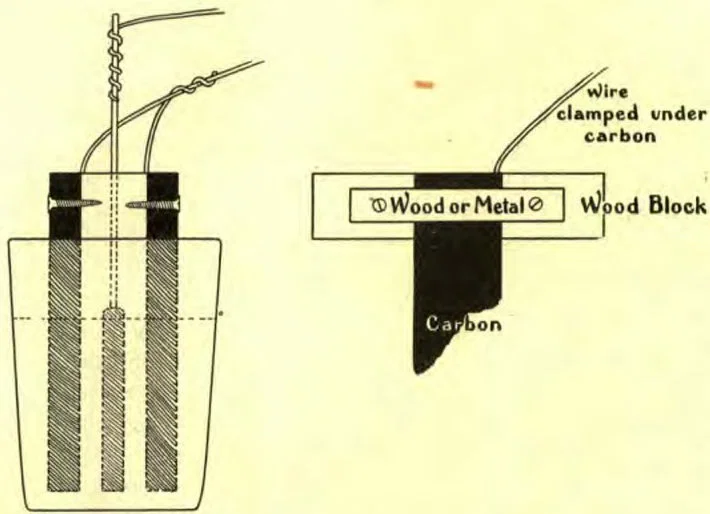
At any telephone station, or almost any junk dealer’s, old, worn-out dry batteries may be purchased for about two and one-half cents each. These you need for the carbons and zinc they contain. Each dry cell has one carbon, and for a bichromate cell you need two. Carefully dig out the carbons from two dry batteries, saw them off the right length with an old, fine-toothed wood-saw, bore holes through the ends with an old drill, and screw to each side of a block of wood 4 × ¾ × ¾ inches. There are, of course, other ways of fastening these on the wood without boring the holes, as you can see by the diagram.
Melt up the zinc cases of the old batteries in the fire shovel, held in a hot fire. Straighten and clean several pieces of brass, copper, or iron wire, six or eight inches long. With a little square block of wood make a depression, or mold, a quarter of an inch deep in a box of moist sand or earth. Lay one of the wires you have straightened so that an inch of it will penetrate one end of the mold. Pour in the melted zinc, and let it harden. If you have zinc enough, make several of these for future use.
Dip the zinc in the acid battery solution, and rub a drop of mercury over it till every part of the surface is silvery white. This protects the zinc from speedy destruction in the acid. Now make a hole through the block that holds the carbons just large enough to fit the zinc’s wire tightly, push the wire through, clamp some wires under the carbons, wrap one around the wire of the zinc, and the cell is complete. By raising or lowering the zinc in the acid, the strength of the current may be varied; and when not in use, it should be kept entirely out of the jar. Keep it bright with mercury.

A Strong Battery

By combining several cells, a strong battery may be made, capable of running a larger motor, or of lighting a small electric lamp. When using two or more cells, be sure to connect them properly; that is, connect the carbons of one cell to the zinc of the next, and the zinc of that one to the carbons of the next, and so on, running the two remaining free wires away to your machinery. EDISON DRIVER.

The Port of Bottles

It is a common thing for officers or sailors on sea-going vessels, and especially for passengers, whose time often hangs heavily on their hands, to write some message on a paper, inclose it in a bottle, cork it tight, and throw it overboard. Usually the paper contains a mere memorandum of the name of the ship, its latitude and longitude at the time, the date, the name of the captain and of the writer, with perhaps a humorous message to the finder—the whim of an idle hour. But possibly the writing may convey a more serious message, stating that the ship has sprung a leak, and is about to founder, compelling its passengers and crew to take to the small boats. Very rarely has such a bottle been picked up by a passing vessel in time to rescue the survivors.
If the bottle has been securely corked, it may float a long time on quiet seas, and may be carried many hundreds of miles on an ocean current. Such a waif dropped into the Gulf Stream off the coast of the United States, has been picked up, many months afterward, on the shore of Ireland, Scotland, or Norway. When ocean storms come, the angry waves dash the frail bottles on floating spars or projecting rocks, and the greater number are doubtless broken in this way. There are a few “dead spots” in the ocean, however, to which these tiny glass vessels may be carried, and where they may float in security for an indefinite time.
An officer on a Brazilian ship describes such a spot in the Caribbean Sea, which he says ought to be called the Port of Bottles. It lies nearly midway between the cities of Cartagena, Colombia, and Kingston, Jamaica, and about due east of Cape Gracias a Dios.
“It is out of the steamer tracks,” he says, “and the action of the great currents going one way and another has left a space of stagnant water without any real movement at all. Anything that gets into the dead spot is apt to stay there, unless driven out by some big storm, and will simply drift round and round, gathering sea-grass and barnacles.” He picked up there three bottles floating together amid the drift, one empty, the others with papers inside. One of these had been dropped in the sea three years before from a yacht in the Grand Cayman. He adds:—
“I noticed a lot of other driftwood in the same spot, and I am confident that no end of bottles could be culled from the place. Hundreds are dropped overboard every year, but very few escape being knocked to pieces unless they happen to find their way to some such still place as I have described.”
There are a few other similar dead spots in the ocean, and it is possible that bottles might be picked up in them which had been floating securely for many long years.
What messages of merriment, what tales of distress and doom, these frail glass voyagers might contain, who may guess?—Selected.

What Is the Secret of Success?

“WHAT is the secret of success?” asked the Sphinx.
“Push,” said the Button.
“Take pains,” said the Window.
“Never be led,” said the Pencil.
“Be up to date,” said the Calendar.
“Always be cool,” said the Ice.
“Do business on tick,” said the Clock.
“Never lose your head,” said the Barrel.
“Do a driving business,” said the Hammer.
“Aspire to greater things,” said the Nutmeg.
“Make light of everything,” said the Fire.
“Make much of small things,” said the Microscope.
“Never do anything offhand,” said the Glove.
“Spend much time in reflection,” said the Mirror.
“Do the work you are suited for,” said the Flue.
“Get a good pull with the ring,” said the Doorbell.
“Be sharp in your dealings,” said the Knife.
“Find a good thing and stick to it,” said the Glue.
“Strive to make a good impression,” said the Seal.— Junior Christian Endeavor World.

The Reformation in the Netherlands and Scandinavia

Scripture Study:—
Historical Reading:—
“Great Controversy,” Chapter XIII.
1. How did the Reformation in the Netherlands begin? Read the protest of the “two bishops.” How long was this before the days of Luther?
2. To what other noble missionaries were these Reformers of the Netherlands similar? How did they translate the Waldensian Bible? and in what words did they tell their appreciation of the Sacred Word?
3. Give a sketch of the experiences and work of Menno Simons.
4. Describe the persecution in the Netherlands, and the heroic spirit in which it was met and endured.
5. How did the Reformation prosper in Denmark? Tell briefly of the work of Tausen, “the reformer of Denmark.”
6. The reformation in Sweden. How were the teachings of Luther and Melanchthon carried to Sweden? Describe the work of Olaf and Laurentius Petri. Germany carried the reformation to Scandinavia; how did Scandinavia in later years render a great service to Germany?

To the Leader

Select a suitable person to conduct a Bible study, for fifteen minutes, on the subject of the beast as a persecuting power; and let this be followed by the historical exercise, conducted by six persons. This exercise may well continue for twenty-five or thirty minutes.
It may be well for the leader to point out the interesting fact that the Reformation was carried to the Netherlands and Scandinavia by young men who had studied in Wittenberg under Luther and Melanchthon. What a power our young men should become!
Secure a good map, if possible, and point out the countries of the Netherlands and Scandinavia.
E. R. P.

Letter to Instructor Readers

“REMEMBER now thy Creator in the days of thy youth, while the evil days come not, nor the years draw nigh when thou shalt say, I have no pleasure in them.”
There have been no greater men or women in the service of God than those who have enlisted while young. The leading Bible characters are those who have been filled with the Spirit from their youth up; such as, Abraham, the father of the faithful; Joseph, the prime minister of Egypt; Moses, the great Hebrew leader; and Samuel, who served in the temple from his earliest years. Many other instances might be given.
But persons who wait till they grow older to enlist in the service of God, find that their habits are fixed. When a dwelling-house is turned into a school building or a sanitarium, it must be overhauled, thus causing much expense; so those who have lived an aimless life until their habits are set, find that they have many ways that can not be used in God’s service; and before they can do efficient work for him, they need to undergo a thorough change. Experience teaches that this takes much longer than to change a building. Such persons are often heard saying, “O that I had given my heart to God when I was young!”
To enlist in the service of God shows true conversion. Great opportunities are afforded to the converted by the Young People’s Societies. If they are not organized in all churches where there are young people, they should be.
There are many encouraging reports from the different Societies. At the recent camp-meeting, held in Los Angeles, the Young People’s Societies of Southern California had an interesting joint meeting. Each Society had a good report of work done. The one with which the writer is connected has undertaken to raise one hundred and fifty dollars to pay the tuition of a Fijian at the Avondale School, hoping in this way soon to have a representative in Fiji working for the Lord.
We are raising the money by the sale of our papers. Last June was our first month at work, and at the close of September our fund was about sixty dollars. During this time we have been in correspondence with Elder Gates, who was here last spring and suggested the plan. The letters received have been a great stimulus to all of us. We received a letter from one of the students at Avondale, who told us a great deal about Isoa (or Esau), the Fijian native; also one from Isoa in his own hand-script and in the Fijian language. The following is a translation of what he said:—

A Little Story—Fiji

“To My Brethren:—
“Fiji. This was a very dark land in former times. In those times my forefathers ate as real food the bodies of men. Yes, every day the oven was kept going in which men were cooked. And also when a chief died, other men were compelled to die with him as a kind of respect shown to the chief. Sometimes they were buried alive with the dead chief. It was a terrible time.
“Let me tell of the death of the white missionary, Mr. Baker. He lived in the cannibal days. Those Fijians who lived near the water first took to the lotu (Christianity), but those in the interior of the island were warlike, and hated it. Mr. Baker went to them with some natives who had lotued. They wanted to preach, but the people were angry. The people surrounded them, and they were killed; only one escaped to tell Mrs. Baker that her husband was killed. She said nothing, but took to crying.
“They took the body of Mr. Baker and cut it up. Then they cooked it. They had never seen boots before, and supposed Mr. Baker’s boots were a part of the white man’s body, so they cooked all together, and tried to eat boots and all. This was a time of horror, but now there is enlightenment, yet they are not fully enlightened, for they do not follow the truth for this time, and do not know God’s holy Sabbath. It is now four years since the first preaching was done on the true Sabbath. Now the truth of God is springing up.
“There are two of us now attending the school at Avondale. We are here that we may prepare ourselves to enter the work of the Lord. I was born in the year 1884, June 3. My name is—
“ISOA NAVOSAMAIWAI.
“P. S.—Fiji is a very productive country. Our food is plentiful, and some of it grows wild in the woods. The woods are filled with vines, from which we make ropes with which we tie anything we have to tie.”
There is another feature of this work that is very interesting, the interest shown by those not of our faith. We who are selling the papers have been given donations by these people, who say that they wish to help along in the good work. When we take hold of the work in earnest, the Lord will stir up hearts to help financially.
O, that we all might realize and improve the great opportunities that we have! A recent message to God’s people clearly states that “the last messages of warning are going to God’s people,” and if we do not deliver them to others, he will raise up those who will. Dear young people, let us arouse and work while we have opportunity, lest He shall say, “Sleep on now, and take your rest; behold the hour is at hand.”
ELBRIDGE ADAMS.
[Accompanying this general letter to the INSTRUCTOR readers, was a personal letter speaking further of the work being carried on in Los Angeles by the young people. The secretary of the Society writes: “We are very much encouraged. The people to whom we sell papers have also taken much interest in the undertaking. Our enrolment is only twenty-eight, but most of them are real active workers. Often we hear of twenty-five or thirty papers sold in one day by some of the younger members.”]
Continue reading: The Children's Work in Pittsburg