The topic of all-absorbing interest for some time past has been that of war with Spain. There are a great many people in this country who think we ought to have war with Spain over the blowing up of the “Maine;” this is evident from all reports that come to us, making the most liberal allowance for journalistic “inaccuracies.” And not a few of these belligerently-minded people occupy the position of ministers of the gospel of Christ.
Of course, if “this is a Christian nation,” there will be no war; for even should it be proved that an act of treachery caused the disaster to the “Maine,” the nation would forgive the offense, which would probably be all that Spain would require. It cannot be denied that Christianity requires the forgiving of offenses, however wanton and injurious these may be, and forbids taking revenge upon an adversary. “Dearly beloved,” it says, “avenge not yourselves, but rather give place unto wrath; for it is written, Vengeance is mine; I will repay, saith the Lord.”
But it is needless to say that no such considerations will govern in the case; for this is not a Christian nation, and depends not upon God to fight its battles, but upon its army and navy. No Christian nation ever found it necessary to maintain an army and navy. No Christian ever found it necessary to preserve his standing and maintain his interests among his neighbors by carrying about with him a loaded revolver.
We have heard of “Christians” who were willing to prove their Christianity by fighting any person who might call it in question. This may be rather an extreme case; still it is quite in accord with the dictates of the natural heart, and quite as convincing an argument as would be furnished by carrying out the warlike suggestions of some of the preachers. The tendency of the times is toward making a person’s willingness to fight a test of his Christianity. If he does not believe in fighting he is set down as not patriotic; and the worst denunciations he will receive will come from the pulpit and the religious press.
“Well, then, should not an individual do any fighting in this world at all?” This is a natural question, and can be very easily answered. The purpose of God in the gospel does not contemplate that we shall do no fighting in this world; on the contrary it provides that every person who will conform his life to it shall have all the fighting he can possibly want. It simply substitutes another object of attack for that which the individual, left to himself, would naturally choose. In place of “the other fellow,” it points him to self as his worst enemy, and directs him to exert all his energies to conquer that. It declares—and very truthfully—that “greater is he that ruleth his own spirit, than he that taketh a city.”
There is nothing figurative about this; it is intensely real. The only person who could doubt its reality would be he who never tried to live the Christian life. The fight with self is a battle royal. The gospel provides a harder battle for the believer than any that he would ever engage in without it; but at the same time it gives him a perfect assurance of victory. So the individual who likes to be belligerent need not pass the gospel by for fear that he will not have ample scope under it for the exercise of his combativeness. He need not fear that it will make of him a weak, supine creature because it requires meekness and forbearance toward all men. On the contrary it will develop in him the strongest possible character. Moses was reputed as being the meekest man on the face of the earth; but he was at the same time the strongest and most fearless character of his time. The man who is master of self has attained to the pinnacle of human greatness, whether he be recognized as great by the world or not.
God is not fighting men; on the contrary he is working to save them, without distinction of class or nation. Must it be thought strange, then, that he does not want men to be fighting and killing each other? God is fighting the evil that has established itself in the human heart; he is fighting the selfishness which is man’s mortal enemy. And if men had the will and the courage to coöperate with God in fighting self in themselves, there would be no occasion for all the fighting that they are so ready to do with one another.
Self is always ready to fight—some one else. There are individuals who go about the country making a business of fighting. Was ever one of them known to be willing to fight self? They glory in the thought of being able to master other people; but not one of them is master of himself. They are conspicuously subject to their own passions. They are slaves to their worst enemy. No other possible foe can bring upon them so much evil; no other can bring them to such a fearful destiny. It is the settled purpose of self to plunge the soul into ruin for all eternity; for this it is working every hour and every moment. Why then cannot men see that their first business137as fighters is to fight self; that they are to be masters of themselves first of all? He who is not master of himself is not fit to be master of anything else; and as long as men are not masters of themselves there will be no end to their efforts to be masters of each other.
However, we believe it safe to say that there will be no war with Spain over the loss of the “Maine.” The issues which determine peace or war in these days are different from those which settled the question centuries ago. This is the age of commercialism. Commercial interests dictate the policy of nations. The “great powers” will unhesitatingly make war upon any weak tribe which refuses their trade. England forced the opium trade upon China; and only recently China was forced to accept a loan which she did not want from England and Germany. When there are weighty financial reasons for war, war is very apt to follow; but war in this day, when it costs thousands of dollars to fire a big gun even once, and when millions of dollars are put into a single warship which may be sent to the bottom of the sea by a single blow, is a very costly undertaking; so that usually financial considerations weigh heavily in the opposite direction. Spain is reported to be bankrupt; and however well a nation may be supplied with patriotism, it cannot go to war if it is not supplied with gold.
By the way, can any one tell why it is that government officials are so chary about giving any news relating to important matters out to the public? These officials are always pledged to the strictest secrecy regarding all information in possession of the Government of such a nature as would naturally exert a powerful influence upon national action, as for example the discoveries relating to the disaster to the “Maine.” Why are the people left for days and perhaps weeks to feed upon newspaper lies? We had always thought that in this country the people themselves were the real government, and that those in office, from the President down, were the servants of the people; and we never knew it was the proper business of a servant to conceal from his master important information concerning the latter’s business. Where do these officials get their authority for such a course? Not from the people, certainly. Do they really consider themselves the servants of the people? or do they regard themselves as their rulers? Cannot the American people be trusted? If they cannot, then the sooner the pretense of self government is abandoned, the better. But we believe in a government by and for the people.
It seems that a movement is on foot which has in view the appointment of the pope to arbitrate the difficulty between the United States and Spain. The pope, it is said, is the only arbitrator Spain would accept, and doubtless Leo himself would not decline an invitation to act in that capacity.
Church and State in Brazil.
By W. H. Thurston
THE constitution of Brazil guarantees perfect liberty to all religious denominations, and declares, “A free church and a free state, without which there could be no self government.”
This is all that any one could ask, providing it meant what it says; but when we come to the practical workings of religious liberty we find liberty to be somewhat wanting. As long as not much is said against the established religion and customs of the country all goes very well, but when the Word of truth is proclaimed, setting forth the gospel as the power of God unto salvation and that the church is subject to Christ, and that he is the head of the church, we are sometimes called in question.
The following facts will serve to show some of the religious freedom enjoyed by Protestants in Brazil.
Not long ago a Protestant colporter was selling Bibles and religious books in the State of Espirito Santo and one evening he was seized, dragged into a store, and there tantalized until midnight by an impudent crowd of men, and all of his books and Bibles were taken from him and burned in the street.
In the State of Rio de Janeiro, a Protestant minister was holding meetings in a village, about twenty five miles from the city of Rio de Janeiro, and one evening during service the building in which the meetings were being held was surrounded by a furious mob of Roman Catholics and the windows were broken in, the minister thrashed, others beaten with sticks, some cut with knives and as soon as possible they fled to the woods for their lives.
The minister appealed to the proper authorities for redress, but he could not get a hearing. The authorities told him that he had better not go there any more and then there would be no more trouble.
A month or so later I visited the same village and while there I had an interview with a prominent Roman Catholic of the place relative to the recent trouble, and he said he did not approve of mob violence, and then he went on to explain that the mob was composed of the lower class of Catholics. I asked him why he did not protest if he did not approve of the disturbance. “Well,” said he, “I haven’t anything against Protestants enjoying their own religion, but I don’t think they should be teaching it in Catholic communities.”
I then told him that, according to his idea, the commission, “Go ye into all the world and preach the gospel,” should read, “Go ye into all the world, except where there are Catholics, and preach the gospel.” He smiled, and after a short conversation on the topics of the day, I thanked him for the privilege of so pleasant an interview and departed.
About six months ago, in the State of Santa Catharina, a Protestant minister, accompanied by two colporters, held a series of meetings and as a result about forty Germans embraced the new faith and many of them were baptized and a Protestant church was organized.138
Many in the place who rejected the influence of the gospel and its power to save, became displeased with the new doctrine (the gospel pure and simple), and one man had his two daughters, young ladies, arrested and put in jail for being baptized and keeping the Sabbath (seventh day) as it was contrary to the religion and the customs of the country, and against his personal wishes. Several others were put in jail for the same offense(?) and they were held there a week, but their testimony was the same when they were released as when they went in, “We cannot help but believe the things which we have seen and heard.” When the minister and the colporters were leaving the place, they were overtaken by a furious mob, armed with guns and clubs, and after a few minutes’ babel, a man struck one of the colporters on the head with a club and then the mob dispersed.
The colporter was carried away for dead, but he finally rallied and it was three days before he regained consciousness. Before he was able to walk the officers of the place came and demanded his presence at the court. He told them that he was too ill to go, and they dragged him out of bed, but on finding that he could not walk they left him with orders to appear as soon as able. A few weeks later he appeared before the court to answer for, he did not know what. He had done nothing but what he had a perfect right to do. He was called in question for filling the place with his doctrine. He was not the minister, he was only assisting in the meetings and had been nearly killed for it, but that was no matter; he was one of the company; so with Bible in hand he answered the questions and was finally released with the charge not to speak at all nor teach any more in that place.
The question may arise as to what was done with the man who gave, what he hoped would be, the fatal blow. Nothing at all was done with him. The colporter went on his way rejoicing that he had been counted worthy to suffer for the name of Christ, and praying for his persecutors that they might learn better and do better.
These are some of the practical workings of religious liberty(?) in Brazil, but if the people knew better no doubt they would do better.
Before closing I wish to say that the foregoing has not been written with any feelings against Brazil and her people, but simply to set forth the facts as they exist. There are many good people in Brazil and all they lack is the great principles of truth which are able to perfect them in righteousness. The gospel is spreading over the land and some are yielding to its saving power.
The motto on the Brazilian flag is, “Ordem e Progresso” (Order and Progress), but it is a progress in evil without much order. Just to the extent that the people receive the gospel, just to that extent is the reformation taking place and no further.
With sword and bayonet the government has been trying for years to make the people better, and every charge makes them worse, but where the gospel is received into the hearts of the people there they have no use for the sword. How different the effects of compulsion and persuasion! One is a savour of death unto death, and the other a savour of life unto life. W. H. THURSTON.
Rio de Janeiro, Jan. 24, 1898.
Catholic Doctrine Relating to Public Schools.
In a recent Encyclical to the bishops of Manitoba, the head of the Roman Catholic Church speaks as follows on the subject of the “rights” of pupils in the public schools:—
“The matter is indeed one of very great and very weighty moment. We wish to bring to mind what seven years ago the legislators of the province of Manitoba decreed in session; who indeed took away a right which the laws of the Canadian Confederacy had established, namely, that Catholic children had a right to be taught and educated in the public schools in accordance with their conscientious beliefs.”
Catholic children have a “right” to be taught the papal religion at public expense, and no other religious belief has any right to be taught at all. The Encyclical says on this point:—
“Wherefore it is as foolish to wish to imbue minds with right moral principles while they are allowed to be deprived of religion as to call them to recognize virtue when the fountain of virtue has been removed. Now, to a Catholic the Catholic religion is one and the only one; wherefore he can neither accept nor recognize any moral or religious teaching unless it is sought for and derived from intrinsic Catholic sources. Therefore justice and reason demand that the school supplies to every scholar not only a knowledge of literary character, but also, as we have said, that knowledge of morality joined with precepts taken from our religion without which assuredly all education will be not only unfruitful but injurious. From which these consequences naturally follow; the teachers must be Catholics, and the books from which the scholars are taught must be such as the bishops approve. There must be unfettered power of arranging and ruling the discipline, so that the whole system of teaching and of learning shall exactly agree and coincide with the belief of the Catholic faith and the duties which thence arise.”
Catholic children have a “right” to be educated in Catholic doctrine at public expense.
All education which does not embody a “knowledge of morality joined with precepts taken from our [the Catholic] religion” is “not only unfruitful but injurious.”
The state evidently has no right to give anyone an “unfruitful and injurious” education.
Hence the state ought to teach every pupil in the public schools, Protestant and Catholic, the Roman Catholic religion, and has no right to teach them anything less or contrary to it.
This is Roman Catholic doctrine on the subject of the duty of the state in relation to the public schools, as enunciated by the highest Catholic authority, and published in the Catholic Mirror.
Please bear it in mind.
Studies in French History.—XI.
By Mrs. L. D. Avery-Stuttle
“Of whom were we speaking at the close of our last study,” began Professor Carman.
“Philip the Second,” answered a chorus of voices.
“When did he live—in what century?”
“In the last part of the twelfth and the first of the thirteenth,” answered Joe Palmeter.
“Right; Philip was a very ambitious man, and was anxious to raise his country to as great a degree of prosperity and splendor as it attained under the great Charlemagne. This it was quite impossible to do. But he did succeed in cementing his kingdom so firmly together that it did not fall in pieces when he died.
“When he had been king seven years, all Europe was again agitated by a proposition to start out upon another crusade—the third. Of course, Philip’s ambition led him to become the first in the movement; so as he just then happened to be friendly with the king of England, they started out for Palestine together. But after they had been there a while, they became disgusted with one another, though they did not exactly put their feelings into words. So Philip left Richard to fight it out alone, while he returned home.”
“I wonder that Richard was not afraid of treachery,” said Will Barnaby, who was getting to be wonderfully interested.
“He trusted in the oath which Philip took, to do him no harm while he was gone. But Philip went directly to the pope, and asked to be released, or absolved, from his solemn vow.”
“I think this was about the same as granting Philip an indulgence,” said Will Barnaby.
“I should say so!” indignantly exclaimed Joe Palmeter. “The idea of any one setting himself up so much higher than the Almighty, as to pretend to forgive sins before they are committed!”
“It is dreadful, indeed,” assented the professor. “Then Philip began courting the close friendship of Prince John, Richard’s brother, and John and Philip began to plot against Richard, and they succeeded in making him very much trouble. Finally Richard died, and the fickle Philip deserted John, who was then king of England, and the remainder of John’s reign was a miserable struggle with the powerful king of France.”
“Which king was victor at last?” asked Charlie White.
“Philip was victorious at the battle of Bouvines,—he won a complete victory,—after which he did no more fighting.”
“I wonder if he did anything to better the condition of his country,” said Joe Palmeter.
“O yes, he did very much; he enlarged and beautified the city of Paris. The streets were narrow and filthy, and he changed all this.”
“Well, I don’t care what good he did, he was a mean fellow,—a false friend, and a deceitful man,”—said Julia March, indignantly.
“You judge him by the way in which he treated those whom he pretended to regard as friends, I presume,” answered Professor Carman, “but we must not overlook the good he did.”
“Nor the times in which he lived,” chimed in tender-hearted Milly Brown.
“We were talking about Philip II. this morning at the breakfast table,” said Harry Ray, “and grandma said that she once read that the uncle of Philip was killed by a fall from his horse, caused by his stumbling over a pig which was roaming, with others of its kind, over the streets of Paris. She said this was the reason why he determined to put things in better order.”
“Well done, Harry. I see you are making our studies in history a part of your conversation, and that is right.”
“Mother asks me to repeat all I have learned as soon as I get home every Wednesday afternoon,” said Edna Phillips, “and I find it a great help to my memory.”
“So it will be. Well, during the reign of Philip, the poor Jews were again the victims of another cruel persecution in the name of religion; but not alone were they the victims of intolerance and hatred from the church; the kindly and simple-hearted Albigenses, from the south of France, endured a fearful persecution. They reproved the monks for their evil lives, and of course this could not be tolerated; so they were treated like the infidels and persecuted to the death.”
“Why, I wonder if infidels have not as good a right to expect fair treatment from their neighbors as any other class of people,” exclaimed Joe Palmeter, indignantly.
“Certainly, Joseph, and it is the duty of Christians to treat them as kindly as they would those who believe as they do. But a cruel man, named Simon de Montfort, was just the kind of man to carry out the wishes of Pope Innocent III., who believed that a heretic had no earthly right to live. De Montfort, backed by papal authority, raised a large body of troops, and rushed among the poor Albigenses, with the same dreadful zeal with which, once before, he had marched against the Turks. Once they destroyed a town in which it was hard to discriminate between the Catholics and the heretics. So one of the priests, a companion of De Montfort, was asked how they were to manage the difficulty. Just imagine, if you can, the unreasoning, blind cruelty and bigotry which could prompt the reply given: ‘Kill them all; the Lord will know his own!’”140
“O professor! did they do it?” asked Milly Brown, with a little tremor in her voice.
“Yes, Milly; they left not a soul alive, and afterwards set fire to the town. One writer who lived in this dreadful time said that they once gathered a great many heretics together into a large castle and burned them alive with extreme joy.”
“Is it possible that this was all done in the name of the religion of the gentle Nazarene?” asked Julia March.
“Yes, though Philip did not really approve of it; but he was too busy in other matters to trouble much about the sufferings of a few miserable wretches. So the beautiful homes of the Albigenses, where nature had lavished her bounties with such a liberal hand, were made desolate and silent. So, as the historian says, ‘Simon de Montfort made a solitude, and called it peace.’”
MRS. L. D. AVERY-STUTTLE.
“He Shall Think to Change Times.”
By F. B.
“Mama,” said Charlie, “you have never explained about ‘the times.’ The text we were talking about says, you know, ‘He shall think to change times and laws.’”
“What are God’s times?”
“Why, mama, what a queer question? All time is God’s.”
“Has he reserved no time as his especially?”
“Yes; the Sabbath.”
“Suppose you turn to Ex. 20:8, 9, 10, and read the 4th commandment.”
“‘Remember the Sabbath day, to keep it holy. Six days shalt thou labor, and do all thy work; but the seventh day is the Sabbath of the Lord thy God.’”
“This day then belongs to God. Why did he choose the seventh day as his? Please read on.”
“‘For in six days the Lord made heaven and earth, the sea, and all that in them is, and rested the seventh day: wherefore the Lord blessed the Sabbath day, and hallowed it.’”
“Do you remember what Jesus said about the law?”
“Yes; that not a jot or tittle of it should pass away till heaven and earth passed.”
“Then could any part of this commandment be changed?”
“Of course not. Mama, who ever thought it could?”
“The prophet has told us that the papacy would think not only to change God’s law, but his times. You may read some statements from the Catholic Catechism, and from some of the leaders in the church. I suppose, Charlie, you’ll be as surprised as I was to find out these things; for I never gave the matter any thought until quite recently. But if God said the papacy would think to change his times, then we should rejoice to find that he foresaw and foretold the events of ages. Now you may read in the ‘Doctrinal Catechism,’ p. 174.”
With wide-open eyes Charlie read—
Question.—“Have you any other way of proving that the church has power to institute festivals of precept?”
Answer.—“‘Had she not such power . . . she could not have substituted the observance of Sunday, the first day of the week, for Saturday, the seventh day, a change for which there is no Scriptural authority.’”
“O, mama, Isn’t Sunday, Sunday?”
Mrs. Ross laughed. “Yes, dear. Sunday is Sunday; but Sunday is not the Sabbath. We have been keeping the wrong day, dear; but it has been because we were ignorant, and the sin of ignorance is atoned for. Here is another statement I would like you to read, from the ‘Catholic Christian Instructed,’ p. 252”:—
Charlie read: “‘Q. What warrant have you for keeping the Sunday, preferable to the ancient Sabbath, which was Saturday?’
“‘A. We have for it the authority of the Catholic Church and apostolical tradition.’”
“Cardinal Gibbons says, ‘Sunday, as a day set apart for the obligatory worship of Almighty God, . . . is purely a creation of the Catholic Church.’ Father Enright offered $1,000 to any one who would prove from the Bible alone that Sunday was the Sabbath.”
“And so, Saturday is Sunday. Why, how queer that seems!”
“No; Saturday, the seventh day, is the Sabbath of the Lord thy God.”
“Why, mama, that’s the Jews’ Sabbath.”
“Is that what the commandment says?”
“‘The seventh day is the Sabbath of the Lord thy God,’” repeated Charlie.
Charlie leaned his head on his hand for some moments. Mrs. Ross looked at him anxiously, for she knew that he was going through a struggle both intellectual and spiritual. When he looked up his face was pale.
“Mama, did Jesus keep the seventh day?”
“Yes, dear. Luke says, ‘He went into the synagogue on the Sabbath day as was his custom.’ When he told the disciples of the destruction of Jerusalem which took place forty years after his death, he said, ‘pray ye that your flight be not in the winter, neither on the Sabbath day.’ The women who came to embalm his body on the first day of the week had ‘rested according to the commandment.’”
“And didn’t the disciples change the day to celebrate his resurrection?”
“No; baptism is a memorial of his resurrection. The day was changed just as the prophet said it would be by the papacy. The first Sunday law on record is the one commanded by Constantine in 321 A. D., and that was a very lax one, that the church afterward made more stringent. Church and state have always been united through Sunday laws. From Constantine’s time the state wielded the sword at the request of the church. The Sunday law seems to be the wedding ring of church and state. It was through this unholy alliance that the Dark Ages blighted over 1200 years.”141
“Mama, why does the church want power from the state?”
“Because she feels her weakness without it. But no church ever appeals to the state for power, which realizes that Christ is her champion; for he has all power in heaven and in earth.”
“Well, then, the church must begin to feel her weakness, mama; for it was only last Sunday that our minister told the people to vote as the church wanted them to. He said the churches could control the ballot if they would, and that unless we had a strict Sunday law, the Sabbath would be lost to our country. But as Saturday is the Sabbath, the Sunday law wouldn’t do much good.”
“Well, Charlie, whose day is the Sabbath?”
“God’s,” said Charlie, reverently.
“To whom then shall we render it?”
“To God.”
“Yes. Jesus said, ‘Render therefore to Cæsar (or the state) the things that are Cæsar’s, and unto God the things that are God’s.’”
“Shall we do it, my boy?”
“Yes, mama. The pope in me and the pope out of me say, ‘No;’ but I must answer as Peter did in our lesson a few weeks ago, ‘We ought to obey God rather than men.’” F. B.
TO OUR PATRONS:
By Editor
Write names plainly.
Remit by P. O. Money Order, or Express Order, or by Bank Draft on New York. Personal checks are not desired.
Make all Orders and Drafts payable to Pacific Press Publishing Co., not to the editor or any other individual.
We will receive Postage Stamps in small quantities and any kind of good money. Defaced coins will not be taken. If paper money or coin is sent, register the letter.
SEND FOR LIST OF EXCELLENT BOOKS
slightly damaged, offered at half price.
Address, PACIFIC PRESS PUBLISHING CO., 39 Bond St., New York.
Every-Day Dishes.
A book containing 184 pages of practical information concerning the healthful preparation of numerous dishes of all edible grains, fruits, and vegetables. A chapter is devoted to Suggestions for Canning Fruit, which alone is worth the price of the book. There is also a Daily Morning Program of Kitchen Work, including hints on Economizing Money, Material, and Time; General Suggestions for Economical Housework; Every-day Bills of Fare, and a copious index of the entire work.
Bound in board sides and cloth back.
PRICE, postpaid, . . . 85 CENTS.
PACIFIC PRESS PUBLISHING CO.,
39 Bond St., New York City.
LADIES’ GUIDE IN HEALTH AND DISEASE.
By John Harvey Kellogg
By J. H. KELLOGG, M. D.
Girlhood, Maidenhood, Wifehood, Motherhood.
CONTAINS CHAPTERS ON THE
Anatomy and Physiology of Reproduction, The Little Girl, The Young Lady, The Wife, The Mother, Diseases of Women, with an Appendix of Prescriptions and Dietetic Recipes.
672 octavo pages, with 123 illustrations, 26 of which are lithographic plates. It is printed on fine paper, and it is beautifully and substantially bound.
PRICES:
Cloth, embossed in jet and gold — $3.00
Half buffing, marbled edges — 3.50
Full leather, library style, marbled edges — 3.75
Half morocco, gilt edges — 4.25
Full morocco, gilt edges — 5.50
Sent, postpaid, on receipt of price.
Address,
PACIFIC PRESS PUBLISHING COMPANY,
39 Bond Street, New York City.
Oakland, Cal. Kansas City, Mo.
MAP Illustrating the Travels of Paul.
Very useful for Sabbath Schools
Especially when studying the Book of Acts.
Clear and plain. Size 52x71 inches. Printed on cloth. Regular price, $5. We will send it to any address Postpaid for $4.
Order now and get the benefit of a splendid help in the Sabbath School or family.
Address, PACIFIC PRESS PUB. CO., 39 Bond St., New York.
Oakland, Cal. Kansas City, Mo.
TRADE MARK REGISTERED
1895. Prevents and relieves Constipation and Liver troubles. An appetizing, nutritious Family Food, for Bread, Gems, Griddle Cakes, etc. Unrivalled by America or Europe. Pamphlet and Sample Free. All dealers or write to Farwell & Rhines, Watertown, N.Y.
SOMETHING NEW, NEAT, NICE,
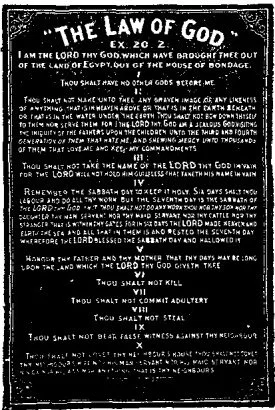
And necessary, if you would know, and have others know the COMPLETE DECALOGUE as God spake it from Sinai’s flaming summit.
A CHART 12x18 INCHES.
On thick paper, mounted at top and bottom with metal and ready to hang on the wall.
Postpaid, 25 Cents.
Postage stamps acceptable.
PACIFIC PRESS PUBLISHING CO., 39 Bond Street, New York.
NUT BUTTER MILLS.
By Joseph Lambert
Something new. Designed especially for converting nuts into butter for table and culinary purposes. Valuable recipes for the use of nuts. Shelled and unshelled nuts of all kinds at reasonable prices. Send for descriptive circular and price list.