Your ShelfYour Projects

Review and Herald, Vol. 90, No. 30.

It Must Be Settled Right

Review and Herald

Jul 24, 1913

Review and Herald Publishing Association · Takoma Park, Washington, D. C. · Jul 24, 1913

It Must Be Settled Right

However the battle is ended, Though proudly the victor comes, With fluttering flags and prancing nags And echoing roll of drums, Still truth proclaims this motto, In letters of living light: No question is ever settled Until it is settled right.
Though the heel of the strongest oppressor May grind the weak in the dust, And the voice of fame with loud acclaim May call him great and just, Let those who applaud take warning, And keep this motto in sight: No question is ever settled Until it is settled right.
Let those who have failed take courage, Though the enemy seems to have won. Though his ranks are strong, if he be in the wrong The battle is not yet done; For sure as the morning follows The darkest hour of night, No question is ever settled Until it is settled right.
— Selected.

"What to Do First," and "Digestive Disorders" Number

The Magazine That Tells You How to PREVENT as Well as CURE Disease
June Edition Sold by May 28—Second Large Edition of July Number (10,000) Fast Disappearing!

SOME AUGUST FEATURES

Beautiful Cover Design (3 Colors) What to Do First for Burns, Drowning, etc. Digestive Disorders—How to Remedy Them Sunlight and the Body What Is the "Staff of Life"? Is Alcohol Never a Food? What to Do for Hay Fever Friedmann Tuberculosis Treatment How to Make Wholesome Breads How to Loosen a Cough "U. S. Inspected and Passed" Questions and Answers, etc. Human Carriers of Disease
EARN A SCHOLARSHIP: Sell anywhere from 1,700 to 3,000 copies to earn a year's scholarship in the Academy or College you have picked out. Sell half the number for a half year's scholarship. Three to eight weeks of vigorous effort will suffice! All aboard!
Make All Arrangements for Territory and Supplies With Our Agency Nearest You. See List in Magazine
10 cents in stamps will bring you a sample copy
Send $1.00 for 20 copies; $2.00 for 50; $4.00 for 100; $8.00 for 200. Fifty or more, 4 cents each, post-paid.

ORDER THROUGH OUR NEAREST AGENCY

(If you do not know the address of our Agency, ask "Life and Health," Washington, D. C.)
Don't Forget to Take Subscriptions! PRICES, POST-PAID

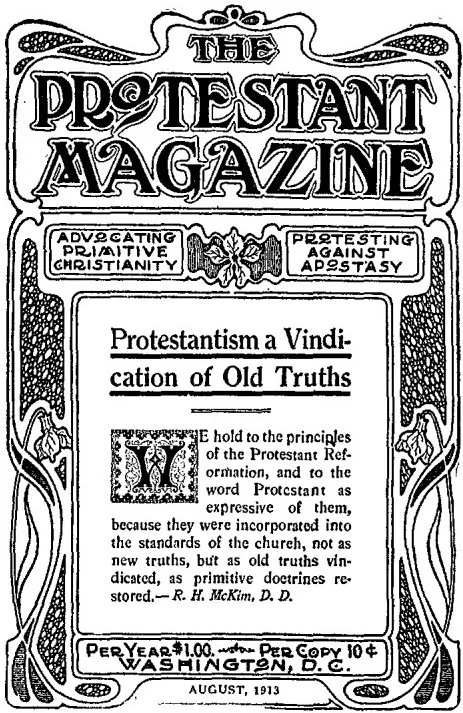
SHALL ROME THROTTLE FREE SPEECH IN AMERICA?

Do You Know That Within the Past Few Weeks Two Protestant Speakers Have Been Attacked by Roman Catholic Mobs, One in Oelwein, Iowa (June 12), and the Other in Pittsburgh, Pa. (June 17), for Daring to Lecture Upon "Rome's Attitude Toward the Public Schools," "Savonarola Sacrificed to Popish Greed and Lust," and "Martin Luther and the Reformation"?
Rome is again trying to carry out her old program, so well expressed in these three words penned in Rome by Prof. W. S. Tyler of Amherst, Mass., in 1870: "REPRESSION," "SUPPRESSION," "OPPRESSION."

PARTIAL AUGUST CONTENTS

Double Frontispiece: First Public Appearance of the Pope After His Recent Illness—Photograph of That Remarkable Bonzano Letter.
  • Rome Proposes to Have Protestant Periodicals Excluded From the Mails
  • Proposed Change in Name of "Protestant" Episcopal Church
  • Primacy of the Roman Pontiff
  • The Famous Bonzano Letter
  • The Word of God
  • Catholics and Religious Liberty
  • "The Double Doctrine of the Church of Rome"
  • Great Papal Persecutions
  • Paganism and Popery
  • A Murderous Attack Upon Jeremiah J. Crowley
  • Church and State in Spain
  • The Church in Politics
Ever since 1910 the American Federation of Catholic Societies has been doing all in its power to have the Postmaster-General of the United States exclude Protestant periodicals from the mails.

DO YOU WISH TO KNOW WHY ROME ALWAYS ATTEMPTS TO SUPPRESS PROTESTANT ARGUMENTS, ORAL OR WRITTEN, WHICH SHE CANNOT ANSWER?

Read and circulate this "Free Speech," "Bonzano Letter," and "Papal Persecutions" number.
TO TEN FRIENDS: You can send $3.00 for 10 six months' (or 5 yearly) subscriptions, in behalf of friends. These will be sent to different addresses.
Send ten cents for sample copy. Liberal terms to agents.

ORDER THROUGH OUR NEAREST AGENCY

(If you do not know the address of our Agency, ask "Protestant Magazine," Washington, D. C.)
PRICES, POST-PAID Yearly subscription - - - - $1.00 Six months - - - - .50 (Subscriptions for less than six months not accepted) Three years (or 3 subs. 1 year) - - - 2.00 Five years (or 5 subs. 1 year) - - - 3.00 20 copies ordered at one time - - - 1.00 50 copies ordered at one time - - - 2.00 100 copies ordered at one time - - - 4.00 NO EXTRA CHARGE ON FOREIGN SUBSCRIPTIONS

Faith and Humility

MRS. MARY H. WILLIAMS
HUMILITY sat the wayside by With meekly folded hands, and said, I never can climb the mountain high; I faint so oft I fear to try With others stronger and swifter than I." Then Faith came up with a buoyant tread, But his eyes were fixed on the light afar That gleamed from the golden gates ajar; And he saw not the weary, drooping head Till he heard Humility's cry.
Then he stooped and looked in her tear- stained face: Come, lean on me. I will quicken your pace; I need moreover your childlike grace To keep from presumptuous pride." She looked at his shining armor bright, In his starry eyes with visions light, Then trustingly walked by his side.
And thus they travel the King's highway, Hand in hand till close of day. In whatever ills betide, Humility finds in Faith her stay; Faith's eager course brooks no delay: So Faith and Humility thus abide.
Charles City, Iowa.

Defying God

(Concluded)

MRS. E. G. WHITE
WELL would it have been for the prophet had he adhered to his purpose to return to Judah without delay. While traveling homeward by another route, he was overtaken by an aged man who claimed to be a prophet, and who made false representations to the man of God, declaring, "I am a prophet also as thou art; and an angel spake unto me by the word of the Lord, saying, Bring him back with thee into thine house, that he may eat bread and drink water." Again and again the lie was repeated, and the invitation urged, until the man of God allowed himself to be persuaded to return.
Because the prophet allowed himself to take a course contrary to the path of duty, God permitted him to be destroyed. While he and the one who had invited him to return to Bethel were sitting together at the table, the inspiration of the Almighty came upon the false prophet, "and he cried unto the man of God that came from Judah, saying, Thus saith the Lord, Forasmuch as thou hast disobeyed the mouth of the Lord, and hast not kept the commandment which the Lord thy God commanded thee, . . . thy carcass shall not come unto the sepulcher of thy fathers."
This terrible sentence was swiftly followed by its execution. "It came to pass, after he had eaten bread, and after he had drunk, that he saddled for him the ass. . . . And when he was gone, a lion met him by the way, and slew him: and his carcass was cast in the way, and the ass stood by it, the lion also stood by the carcass. And, behold, men passed by, and saw the carcass cast in the way, . . . and they came and told it in the city where the old prophet dwelt. And . . . he said, It is the man of God, who was disobedient unto the word of the Lord."
The penalty that overtook the messenger of God was a still further evidence of the truth of the prophecy uttered over the altar. If, after disobeying the word of the Lord, the prophet had gone on in safety, the king would have used this fact to vindicate his own disobedience. In the rent altar, in his palsied arm, and in the terrible fate of the prophet, Jeroboam should have discerned the swift displeasure of an offended God, and should have taken warning not to persist in wrong-doing.
But none of these judgments brought him to repentance. "Jeroboam returned not from his evil way, but made again of the lowest of the people priests of the high places: whosoever would, he consecrated him, and he became one of the priests of the high places." Thus he not only sinned greatly himself, but he "made Israel to sin." "This thing became sin unto the house of Jeroboam, even to cut it off, and to destroy it from off the face of the earth."
Toward the close of a troubled reign of twenty-two years, Jeroboam met with a disastrous defeat in a war with Abijah, the successor of Rehoboam. "Neither did Jeroboam recover strength again in the days of Abijah: and the Lord struck him, and he died."
The apostasy that became so prevalent in Israel during Jeroboam's reign, resulted finally in the utter ruin of the kingdom. Before the death of Jeroboam, the result of this apostasy was foretold by Abijah, the aged prophet at Shiloh, who many years before had predicted the elevation of Jeroboam to the throne. The prophet now declared: "The Lord shall smite Israel, as a reed is shaken in the water, and he shall root up Israel out of this good land, which he gave to their fathers, and shall scatter them beyond the river, because they have made their groves, provoking the Lord to anger. And he shall give Israel up because of the sins of Jeroboam, who did sin, and who made Israel to sin."
Yet the Lord did not give Israel up without first doing everything that could possibly be done to lead them back to their allegiance to him. Lovingly, patiently, through long, dark years when ruler after ruler stood up in bold defiance of Heaven and led Israel deeper and still deeper into idolatry, God sent message after message to his backslidden people. Through his prophets he gave them every opportunity to stay the tide of apostasy, and to return to him. It was during these years that Elijah and Elisha lived and labored, and that the tender appeals of Hosea and Amos and Obadiah were made. Even in the darkest hours, there were some who remained true to the God of heaven, and in the midst of idolatry lived blameless lives.
Thus it has been in every age and in every land. The world has never been left without witnesses to the mighty power of God to save from sin. And in the closing scenes of this earth's history, when iniquity will have reached a height never before attained, it will still be possible to say of the remnant people who have remained true to God, "Here are they that keep the commandments of God, and the faith of Jesus."

Avoiding Debt

T. E. BOWEN
(Continued)
LAST week the article closed with two quotations from the Testimonies regarding the need that private families so manage their affairs, through industry and economy, as to live within their income, pay their honest dues, and thus save the cause of God from reproach. Let us study further quotations to see if these same principles apply in the erection of church buildings and institutions.

Debts Upon Church Buildings Displeasing to God

"It is displeasing to God for our churches to be burdened with debt." "When you place the Lord first, and determine that his house shall no longer be dishonored by debt, God will bless you." "The lax way which some churches have of incurring debts and keeping in debt, was presented before me. In some cases a continual debt is upon the house of God. There is—

Continual Interest to Be Paid

These things should not and need not be. If there is that wisdom and tact and zeal manifested for the Master which God requires, there will be a change in these things. The debts will be lifted."—"Testimonies for the Church," Vol. VI, pages 102, 103.

Sanitarium and School Debts

Much is said regarding the conduct of schools and sanitariums in later volumes of the Testimonies. Just a few pointed quotations can be given.

The Value of Land Connected With Our Large Schools

"To expend money in additional buildings when a school is already deeply in debt, is not in accordance with God's plan. Had the money which our larger schools have used in expensive buildings been invested in procuring land where students could receive a proper education, so large a number of students would not now be struggling under the weight of increasing debt, and the work of these institutions would be in a more prosperous condition. Had this course been followed, there would have been some grumbling from students, and many objections would have been raised by parents; but the students would have received an all-round education, which would have prepared them not only for practical work in various trades, but for a place on the Lord's farm in the earth made new.
"Had all our schools encouraged work in agricultural lines, they would now have an altogether different showing. There would not be so great discouragements. Opposing influences would have been overcome; financial conditions would have changed. With the students, labor would have been equalized; and as all the human machinery was proportionately taxed, greater physical and mental strength would have been developed. But the instruction which the Lord has been pleased to give has been taken hold of so feebly that obstacles have not been overcome."—Id., pages 177, 178.

The Accumulation of Debt Upon Institutions

"Methods must be devised to prevent the accumulation of debt upon our institutions. The whole cause must not be made to suffer because of debt which will never be lifted unless there is an entire change, and the work is carried forward on some different basis. Let all who have acted a part in allowing this cloud of debt to cover them now feel it their duty to do what they can to remove it."—Id., page 213.

Giving Character to the Work

"God designs that we shall learn lessons from the failures of the past. It is not pleasing to him to have debts rest upon his institutions. We have reached the time when we must give character to the work by refusing to erect large and costly buildings. We are not to copy the mistakes of the past, and become more and more involved in debt."—Id., Vol. IX, page 71.

Studying Christ's Example

"Those who lead out in the establishment of medical institutions must setright example. Even if the money is in sight, they should not use more than is absolutely needed." "We must also remember that our work is to correspond with our faith. We believe that the Lord is soon to come, and should not our faith be represented in the buildings we erect? Shall we put a large outlay of money into a building that will soon be consumed in the great conflagration?" God desires that the humble, meek, and lowly spirit of the Master, who is the Majesty of heaven, the King of glory, shall ever be revealed in our institutions. Christ's first advent is not studied as it should be. He came to be our example in all things. His life was one of strict self-denial. If we follow his example, we shall never expend means unnecessarily.—Id., Vol. VII, pages 91, 92.
Webster's New International Dictionary defines debt as follows: "That which is due from one person to another, whether money, goods, or services; that which one person is bound to pay to another, or to perform for his benefit; thing owed; obligation; liability."
When it comes to our churches, sanitariums, schools, and publishing houses, these properties are not realizable in the same sense that private homes are, in that they are not usually of such a nature as to be sold to advantage, as though adapted to our work. Consequently all the more important is it that these be established and kept free from debt.

Gospel Finance—No. 1

The Only Source of Revenue

THE fall of man made the establishment of a kingdom of grace necessary, in order that the great gospel plan for man's salvation may be carried out. For nearly six thousand years this work has been in progress, and while having to do with men, nations, and conditions perverted and distorted and diametrically opposed to Heaven's ways, every plan and provision for the gospel work is based upon right principles. This is true as well of the financial phase of the gospel work. Whatever arrangements are made and whatever burdens are imposed for financing the gospel must be recognized as the best and most effective, for God's wisdom and perfect knowledge of our needs as well as his regard for our welfare would permit nothing but a perfect plan.
The gospel first calls a man from the world, from bondage, as, in the type Israel was called from Egypt, in these loving words, "Come unto me, all ye that labor and are heavy-laden, and I will give you rest;" and then the commission, "Go ye therefore, and teach all nations." This commission imposes a tremendous responsibility when we consider the field, "all nations," and all that is involved in heeding the command, "Let him that heareth say come." Every one who truly hears and heeds the call senses his responsibility regarding the teaching of all nations. This general responsibility of the individual is impressed more strongly by the Saviour's parting words to his disciples at the time of his ascension: "Ye shall be witnesses unto me both in Jerusalem, and in all Judea, and in Samaria, and unto the uttermost part of the earth." This assignment can leave no question in our minds as to our relation to the home and near-home fields as well as to the "uttermost part of the earth." We note the promises that provide for power, "Ye shall receive power;" "All power is given unto me in heaven and in earth. . . . And, lo, I am with you alway, even unto the end of the world." He also provides power to acquire wealth so that ample provision is made for the part we have to perform in carrying out the commission.
In view of this great responsibility thus placed upon believers, let us consider briefly the source from which the necessary funds for financing the gospel work are to come. This we should know definitely. There are those who seem to feel that it is a matter of slight importance to provide funds for the work, and many, I believe, are not aware that the responsibility is placed so fully upon humanity. An inspired statement on this point is fitting: "Voluntary offerings and the tithe constitute the revenue of the gospel. . . . The only means which God has ordained to advance his cause is to bless men with property. He gives them the sunshine and the rain; he causes vegetation to flourish; he gives health and ability to acquire means. All our blessings come from his bountiful hand. In turn he would have men and women show their gratitude by returning him a portion in tithes and offerings." For a few thousand believers to furnish the funds necessary to carry this message of the coming kingdom to all the world, calls for sacrifices and a sense of responsibility that many have not yet experienced. Nevertheless, the only provision known or provided for financing this great work is the revenue of tithes and offerings from men and women. This plan has been and will be carried out. At the risk of retarding his work, the Lord has fixed this financial arrangement, which makes such gifts and offerings the only source of revenue for the gospel.
The silver and gold, the beasts of the forests and the cattle on a thousand hills, belong to the Lord. He could place in the hands of our conference and mission treasurers a sufficient amount of gold to meet every requirement out in the great needy fields and the needs in our home conferences and institutions. And what a relief it would be! What a burden would be lifted from our shoulders if all these perplexing financial problems could be thus suddenly solved! As a people we possess but little wealth. Through our connection with this cause we take on the great responsibility, and God holds strictly to the plan of having his work wholly financed by our tithes and offerings. Why should this be required? Why is such a heavy burden imposed? In our next article we shall consider the answers to these questions.
Mount Vernon, Ohio.

The Wide-Spread Occurrence of the Signs in the Heavens

THE question is sometimes raised, Why were the signs in the sun, moon, and stars, as foretold by our Saviour, seen only by the dwellers in the United States?
It is worthy of note that at the proper time to fulfil the specifications of prophecy these signs were seen in various parts of the world.
Our readers are familiar with the fact that on May 19, 1780, there occurred in the eastern portion of North America a darkness "so intense that many who were but a little way from home, on well-known roads, could not without difficulty retrace the way to their own dwellings."—John W. Whiton, in "Sketches of the History of New Hampshire," page 144.

Darkness in Europe

In 1783 a mysterious darkness rested over all Europe, extending far into Asia on the west, and into the northern regions of Africa on the south.
The darkness was first experienced at Copenhagen on the twenty-fourth of May, and spread southward and westward, until by the end of June it had spread over all Norway, France, Italy, Austria, Sweden, Russia, and other European countries, and by the middle of July it had penetrated into Asia as far as the Altai Mts. Leaves fell from the trees in June, as they usually fall in the autumn.
"The obscurity prevailed a greater portion of the summer, imparting to the sun an unnatural color of a dull, rusty red, and causing both the days and the nights to wear a weird and gloomy aspect. The atmosphere was highly electric, and nature was greatly convulsed."—D. T. Taylor, in "Great Consummation."
The Hamburger Neue Zeitung of July 18, 1783, speaks of the appearance of the sun, and says that it was gradually dimmed, till it appeared as if its rays had passed through thick smoke or dark glass.

Dark Days in Canada

"On the ninth of October (1785) there was an uncommon darkness in Canada, while the atmosphere was of a very luminous appearance. This was followed by squalls of wind and rain, with severe thunder. On the fifteenth occurred a still greater obscurity, succeeded also by lightning, thunder, and rain.
"On the sixteenth, the morning was calm and foggy. At ten o'clock arose a wind from the east, which partly expelled the fog; and soon after commenced the darkness of midnight. The people dined by candlelight."—Dr. Noah Webster, in "History of Epidemics and Pestilential Diseases," Vol. I, page 280.

A Dark Day in France

In the REVIEW AND HERALD of Oct. 29, 1867, a lengthy article is quoted from the Advent Herald, entitled "A Dark Day in France." The writer of this article quotes the following from the "Encyclopedia, First American Edition, Philadelphia, 1798," found in the article on the "French Revolution":—
"We cannot here avoid mentioning a physical event which assisted not a little in producing many of the convulsions attending the revolution, a general scarcity of grain, which occurred about that time. On Sunday, the thirteenth of July, 1788, about nine in the morning, without any eclipse, a dreadful darkness suddenly overspread several parts of France. It was the prelude of such a tempest as is unexampled in the temperate climates of Europe. Wind, rain, hail, and thunder seemed to contend in impetuosity; but the hail was the great instrument of ruin. . . . The country people, beaten down in the fields on their way to church, amidst this concussion of the elements, concluded that the last day had arrived; and scarcely attempting to extricate themselves, lay despairing and half suffocated amidst the water and the mud, expecting the immediate dissolution of all things."

A Solemn Impression

On these dark days the predictions of Scripture regarding the darkening of the sun came to the minds of many. Men and women who were usually irreverent, prayed for mercy. In the churches many of the preachers read to their congregations those portions of Scripture that foretell the coming of the day of judgment.
One writer declares that on May 19, 1780, "hosts of people believed that the end of the world had begun to come; men dropped to their knees to pray in the field; many ran to their neighbors to confess wrongs and ask for forgiveness; multitudes rushed into the meeting-houses in towns where they had such, where pious and aged ministers, pleading repentance, interceded with God in their behalf; and everywhere throughout this day of wonder and alarm, the once careless thought of their sins and their Maker."—"History of the Town of Antrim, New Hampshire," by W. R. Cochrane.
Dr. Noah Webster also speaks of the "haziness in the atmosphere," which spread over "all parts of Europe, Great Britain, Italy, Sicily, France, and even the Alps," and says:—
"This caused universal consternation, as a similar appearance had preceded the earthquake in Sicily on the fifth of February. The churches were crowded with suppliants. The French astronomer Lalande attempted to quiet the popular fears by ascribing the phenomena to a superabundance of watery particles in the earth, from the moisture of the preceding year, which were then exhaled by the summer heats."—"History of Epidemics," Vol. I, page 267.

Causes of These Dark Days

So long as these dark days occurred at the time specified by the prophecy, need we contend that they were supernatural? However, the differences of opinion among scientists is at least significant. Dr. Noah Webster does not regard the explanation offered by Lalande as satisfactory, and he attributes the darkness in Europe of 1783 to volcanic dust from Mt. Hecla.
The famous German meteorologist, Alexander Von Humboldt, in turn, doubts the plausibility of Webster's explanation. He says: "On account of the magnitude of the phenomena, I have always regarded as exceedingly improbable the opinion which is even still sometimes expressed, attributing the remarkable darkness which . . . overspread a considerable portion of Europe and Asia as well as of the north of Africa . . . to great volcanic action in Iceland and to the earthquakes in Calabria."—"Kosmos," Vol. III, page 414 (German edition).
Some thought that this darkness was the result of the earth's having entered the tail of a comet. Others regarded these dark days as having been caused by an eclipse, while others have suggested that the darkness may have been caused by smoke from forest fires. Thus we see that there is no agreement among scientific writers as to the real cause, and Humboldt admits that "for such phenomena no general satisfactory explanation has been assigned."—Ib.
We can only conclude that be the cause what it may, supernatural or natural, these dark days were, like the great darkness which enshrouded Egypt, amanifestation divinely foreseen and divinely foretold.
Thus it will be seen that there seems to have been a period of a few years, beginning with the darkness of May 19, 1780, in which the inhabitants at least of the Christian portion of the globe witnessed the sign in the heaven that reminded them of the words of Christ.

The Falling of the Stars

The same conclusion may be reached regarding the falling of the stars, which was the next sign foretold by Christ after the darkening of the sun and moon. The first star shower of the magnitude that has been witnessed within these last days was on the night of Nov. 12, 1799. It was described by Alexander von Humboldt, who with Aime Bonpland, a French scientist, was then traveling in Venezuela. Their statement, as recorded by Amedee Guillemin, is as follows:—
"Between the hours of two and five in the morning, the sky was covered with innumerable luminous trains, which incessantly traversed the celestial vault from north to south, presenting the appearance of fireworks let off at an enormous height; large meteors having sometimes an apparent diameter of one and a half times that of the moon, blending their trains with the long, luminous, and phosphorescent paths of the shooting stars."—"The Heavens," translated into English by Norman Lockyer, page 166.
In his "Kosmos" (Vol. I, page 115), Humboldt says that by the observations he had brought together, this fall of meteors was shown "to have extended simultaneously over the new continent, from the equator to New Herrnhut, in Greenland, . . . and from 46° to 82° of west longitude from Paris."
For further statements regarding the splendor and extent of this celestial exhibition, see Humboldt’s "Relation Historique," Vol. I, pages 519-527; also Andrew Ellicott’s "Transactions of the American Society," 1804, Vol. VI, page 29.

Star Shower in Europe

A splendid meteoric shower was witnessed in Europe on Nov. 12, 1832.
"This phenomena was seen in England, France, Switzerland, southern Germany, Belgium, on the Rhine, in Berlin, Warsaw, Riga, St. Petersburg, and at Odessa. At Suczowina, in the Bukowina, according to Dr. Rohrer’s observations, the stars were so many and fell so thickly that they resembled a heavy rain of fire."—"Poggendorff’s Annalen der Physik und Chemie," Vol. XXIX, page 447.

In the United States and Canada

"But the most sublime phenomenon of shooting stars of which the world has furnished any record, was witnessed throughout the United States on the morning of Nov. 13, 1833. The entire extent of this astonishing exhibition has not been precisely ascertained; but it covered no inconsiderable portion of the earth’s surface."—"Burritt’s Geography of the Heavens," page 163, edition 1854.

A Sign of the End

As was the case during the dark days, many who witnessed these brilliant spectacles thought of the words of the Scripture referring to the event, and were filled with fear and apprehension. The following statement, which appeared in the Old Countryman, New York (quoted in the Portland Evening Advertiser, Nov. 26, 1833), no doubt expresses the conviction of others besides the writer:—
"Many things now occurring upon the earth tend to convince us that we are in the latter days. This exhibition we deem to be a type of an awful day fast hurrying upon us."
Sanitarium, Cal.

The World’s Armageddon Battle in Prophecy

WHEN Turkey is finally driven from Europe, he will plant his temporary capital in Jerusalem. He will there come to his end, with none to help him. Dan. 11:45. The overthrow of the Ottoman dominion in Asia is the sign that the Armageddon battle is about to break upon the world.

The River Euphrates Dried Up

In the book of Revelation the scene of this great conflict is thus described: “And the sixth angel poured out his vial upon the great river Euphrates; and the water thereof was dried up, that the way of the kings of the East might be prepared. And I saw three unclean spirits like frogs come out of the mouth of the dragon, and out of the mouth of the beast, and out of the mouth of the false prophet. For they are the spirits of devils, working miracles, which go forth unto the kings of the earth and of the whole world, to gather them to the battle of that great day of God Almighty. Behold, I come as a thief. Blessed is he that watcheth, and keepeth his garments, lest he walk naked, and they see his shame. And he gathered them together into a place called in the Hebrew tongue Armageddon. And the seventh angel poured out his vial into the air; and there came a great voice out of the temple of heaven, from the throne, saying, It is done. And there were voices, and thunders, and lightnings; and there was a great earthquake, such as was not since men were upon the earth, so mighty an earthquake, and so great. And the great city was divided into three parts, and the cities of the nations fell: and great Babylon came in remembrance before God, to give unto her the cup of the wine of the fierceness of his wrath. And every island fled away, and the mountains were not found. And there fell upon men a great hail out of heaven, every stone about the weight of a talent: and men blasphemed God because of the plague of the hail; for the plague thereof was exceeding great.” Rev. 16:12-21. When probation for sinners closes, Christ ceases to minister in the heavenlytemple, and the seven last plagues are poured out upon the earth. Rev. 15:8. The restraining Spirit of God ceases to hold in check the war spirit among the nations. Rev. 7:1-4. The spirits of devils then take complete control of the nations of earth and lead the whole world into the Armageddon battle, with which the history of the world closes. Christ comes as a thief upon the nations thus engaged in war and strife. From the throne he announces the close of earth’s history. His voice scarcely ceases to reverberate through the earth when other voices and thunders and lightnings, followed by the most terrific earthquake of which the human mind can conceive, occur. Then comes the final hail-storm that shall sweep away every refuge of lies. Eze. 13:10-16. Every stone weighs about fifty-seven pounds. Rev. 16:21.
The overthrow of the Ottoman Empire in Asia does not mark the beginning of the Armageddon battle. It marks the beginning of a time of trouble for the nations, which, under the sixth plague, ends in the Armageddon battle. The Turkish dominion in Asia is overthrown before the first plague falls. Dan. 11:45; 12:1; 7:9-14. It is not until the sixth plague that the Armageddon battle is fought. Rev. 16:12-14. The river Euphrates is first dried up as a special judgment under the sixth plague. It is not a long process, it is the work of the sixth plague. This does not mean that the literal water shall be dried up, but that the power occupying the territory of the Euphrates shall be scourged and ravaged under the sixth plague until it shall no longer be an obstruction to the kings of the East when they shall gather in the Holy Land for the Armageddon battle. Rev. 16:12; 17:15. The Armageddon battle cannot take place until the power controlling the territory along the Euphrates is dried away like the drying up of a river, under the sixth plague. The Ottoman Empire has controlled the territory of the Euphrates for centuries. For the last seventy years the Ottoman Empire in Europe has been wasting away. In every war this power has lost a strip of its great possessions in Europe until it now stands in the ridiculous position of having a capital with practically no territory in Europe. This is not the drying up of the river Euphrates under the sixth plague, but a prelude to it. That drying up is the result of the sixth plague, and cannot take place until the time of the sixth plague; the same as the fifth plague falls upon the seat of the Papacy. Rev. 16:10-12.
Under the heading “Death Knell of Turkey,” the London News of the World, Nov. 10, 1912, said:—
“With swift and overwhelming tragedy the Turkish Empire in Europe has been laid in ruins. The defeat of the Ottoman army at Lule Burgas, and the subsequent action, in which the Turkish rear-guard were cut up, forms one of the classic downfalls of history.”
In the same issue, under the heading “Downfall of Turkey and the Sequel,” it says:—
“There is no longer a Turkish Empire in Europe. A strip of country around Constantinople is still held by the sultan's troops; but all the other provinces of the Turkish Empire are in the hands of the Balkan confederation. Bulgaria is mistress of Thrace, Servia of Macedonia, Greece of Epirus, while on the west coast a combined force of Montenegrins and Servians dominate the situation. This being the position, it is out of the question that the Turk can hope to retrieve his losses. By the sword his rule was forced upon southeastern Europe; and by the sword the old-time vassals of the Ottoman have destroyed the edifice raised upon their slavery.”
The London Daily Telegraph says:—
“Over the whole of the Balkan imbroglio are written in letters of fire, ‘Too late!’”
The London Star says:—
“The concert is cemented by selfish fear rather than by any lofty purpose. The powers are holding one another's hands lest they should tear one another to pieces. They dread a greater tragedy than a Balkan war. They dread Armageddon.”
These utterances are the counterpart of the prophetic predictions of the prophets of old regarding present-day war prospects. When the downfall of the Turkish Empire in Asia takes place, the prophetic declaration is that then the real trouble among the nations begins. They will then be unable longer to hold one another's hands tightly enough to prevent the much-dreaded conflict which ends in Armageddon.
Shanghai, China.
(To be continued)
Continue reading: A Short Sermon