ELDER E. G. OLSEN reports the baptism of two persons at Massena, Iowa, and the addition of three members to the church at Eureka.
ELDER J. W. RAYMOND reports the addition of five members to the church at Olean, N. Y., and four additions to the Wellsville church.
A CHURCH of thirteen members was recently organized at Millville, N. J., by Elder S. B. Horton, assisted by Brother John F. Jones.
THE Scandinavian tent work, in charge of Elder S. F. Svenson, in Brooklyn, N. Y., was closed October 18, with a record of fifteen conversions.
IN the last locality in which tent labor was performed in Baltimore, by Elders R. D. Hottel and S. B. Horton, sixteen persons embraced the faith, and a number of others are deeply interested. Those who have taken hold have taken the preliminary steps toward the purchase of a house of worship.
THE world is busy circulating its vari-colored, vari-principled literature, all of which springs from motives of worldly selfishness, and the objects of which are merely temporal. Should not those who have a literature laden with eternal truth, bearing a Gospel of eternal salvation, be equally zealous? In the world, when times are hard and the outlook discouraging, men work all the harder and vary their efforts to accomplish their purposes. Shall the “children of light” be less energetic and less fruitful in ways and means for doing the business intrusted to them by their Master? “In the world ye shall have tribulation; but be of good cheer; I have overcome the world.” John 16:33.
Educational.— We have received the announcement for the third term of the Walla Walla College School of Correspondence. The gist of the announcement is summed up in these statements:—
“We believe that the interest shown by our people in the Correspondence School thus far shows that there is a real demand for just such a system of study. A more carefully arranged course has accordingly been prepared, embracing the subjects of Bible, history, English language, science, arithmetic, Latin, and Greek. The student is brought in direct contact with his teacher once each week, and is thus enabled to keep in close touch with the work done in the college.”
“Lessons are sent out to students every week. These lessons contain directions for study, and a list of questions to be answered by the student. The answers should be written out with pen and ink, and sent in one week from the time the lessons are received. Twelve lessons constitute one term's work, and four terms constitute a year. A card of standing will be sent to each student at the end of every term's work.”
“One dollar per month is charged for two studies. This covers the expense of printing, mailing, postage one way, and such other expenses as are incurred in the work. Two lines of study are all that any average person under ordinary circumstances should undertake.”
“Special arrangements will be made for those who desire to take Greek. It is not known at present just what the tuition will be for this line. Those who contemplate taking up this study should send in their names at once, and more definite information will be given.”
“The fourth term will begin Dec. 1, 1896. Those who desire to take up the work should present their names before that time, so as to be able to begin their study at the commencement of the term. Students can not be taken in at all times, as it would bring confusion into the work, and make it much harder for the instructors. Those who send in their names will receive definite instruction as to the manner of carrying on their work. The winter months afford the best season for study, and it is hoped that a large class will be formed at the beginning of the term. All correspondence and money orders should be sent to Walla Walla College School of Correspondence, College Place, Washington.”
Rags Wanted.— The Industrial Department of the Working Men's Home in Chicago is now in full operation. Several looms have been started, and the workmen have become expert enough to turn out a good many yards of matting, carpeting, and other fabrics daily. We now want material. An almost unlimited amount of carpet-rags can be used, and a liberal supply is needed right away. Just now there is great need of such material as worn-out, soft, woolen goods, worn calico dresses, worn sheets, and worn-out, woolen blankets,—anything made of soft wool or cotton. If you have not time to prepare the material, send it right along as it is, without any preparation whatever; we have a work-room for poor women, and can prepare the material ourselves. Be careful to put at least one hundred pounds in a package, or if it is more than one hundred pounds, avoid small fractions of one hundred pounds, as any excess will be charged for at the rate of one hundred pounds. It will cost just as much to send ten pounds as one hundred pounds. If you have not enough for so large a package, get your neighbors to contribute. Those who wish to organize sewing circles to prepare carpet-rags for the mission should send for directions. The family has now increased to nearly two hundred, and as the cold weather comes on, we find our supply of bedding getting short. One cold night last week there were many bitter complaints of insufficient covering. If there are any who read this who have extra woolen blankets, be they ever so much worn, or ever so poor a quality, but thick and warm, which they can spare, there is no place in the world where they can do more good just now than at the Working Men's Home, 42 Custom House Place, Chicago, Ill. We can manage to keep comfortable for a week or two longer by means of extra fires, but when severe cold weather sets in, a considerable amount of extra bedding will be required, and the funds of the mission are too low to make it consistent for us to purchase blankets. Any help our friends may send will be greatly appreciated. Blankets might be sent along with carpet rags, or worn garments of any description. Freight and communications should be addressed to The Working Men's Home, Industrial Department, 42 Custom House Place, Chicago, Ill. To all who are interested we should be glad to send a little leaflet giving a full description of the mission.
19 “They said therefore unto him, Where is thy Father? Jesus answered, Ye know neither me, nor my Father; if ye 20 knew me, ye would know my Father also. These words spake he in the treasury, as he taught in the temple; and no man took him; because his hour was not yet come. 21 “He said therefore again unto them, I go away, and ye shall seek me, and shall die in your sin; whither I go, ye can not come. 22 The Jews therefore said, Will he kill himself, that he saith, Whither I go, ye can not come? And he said unto them, Ye are from beneath; I am from above; ye are of this world; I am not of this world. 24 I said therefore unto you, that ye shall die in your sins; for except ye believe that I am he, ye shall die in your sins. 25 They said therefore unto him, Who art thou? Jesus said unto them, Even that which I have also spoken unto you from the beginning. 26 I have many things to speak and to judge concerning you; howbeit he that sent me is true; and the things which I heard from him, these speak I unto the world. 27 They perceived not that he spake to them of the Father. 28 Jesus therefore said, When ye have lifted up the Son of man, then shall ye know that I am he, and that I do nothing of myself, but as the Father taught me, I speak these things. 29 And he that sent me is with me; he hath not left me alone; for I do always the things that are pleasing to him. 30 As he spake these things, many believed on him.”
QUESTIONS.
1. What query did Jesus’ last statement raise in the minds of the Pharisees?
2. How did Jesus expose their ignorance of God’s character?
3. Where was Jesus speaking? Why was he not arrested?
4. What further instruction did he then give them?
5. How did they interpret his teaching?
6. What contrast did Jesus then draw between the character of the Pharisees and his own character?
7. Of what statement did he declare this to be the reason?
8. How did he further explain the reason for that same statement?
9. What inquiry did this lead the Pharisees to make?
10. Where did he tell them to look for an answer?
11. What did he say of his future work among them?
12. To whom did he refer as the source of all his instruction?
13. Did the Pharisees perceive the meaning of this statement?
14. What event did Jesus declare would make it clear to them? In what more specific way did he refer to the source of his teaching?
15. Whose presence did he say that he had?
16. What made this experience possible to him?
17. What result followed from his teaching at this time?
NOTES.
1. THE fact that the Jews did not recognize the character of God in Christ (2 Cor. 5:19) showed that they did not know God. Christ was the “outshining” of God’s glory (Heb. 1:3), the arm reaching down from heaven (Isa. 53:1), the means devised in infinite wisdom and condescension to reveal God to men (Matt. 12:27), and yet the very people to whom had been intrusted the oracles of God (Rom. 3:2), foretelling all these things, rejected him (John 1:11).
2. THE rejection of Christ by us here involves his rejection of us in the heavenly courts (Luke 9:26), whither he went. Refusing to follow him here (Matt. 16:24), we can not follow him there (Rev. 14:4). It is important to notice that Christ says “can not” rather than “will not.” So he said to Nicodemus “can not see” and “can not enter.” There is only one way (John 14:6; Heb. 10:19, 20), and one name (Acts 4:12); and when these are refused,13God “can not,” in harmony with his divine plan, and in view of man’s freedom of choice, bring man into his presence. “The goodness of God leadeth to repentance.” But it is equally true that by the mystery that attaches to our creation, man has it in his power to frustrate this intention of God. The Holy Spirit pleads with him, but he resists. He can resist. Were it not so, he would be a mere machine. “Hearts can not be compelled; they can only be drawn. Christ knocks at the door; but we can, if we choose, keep it bolted on the inside, and Christ will not break the door down and force the way in.” The choice which we are making daily is fixing our choice for eternity. What choice are we making? The personality of Christ is inseparable from his teaching. He was what he taught. He not only spoke the truth, but he was the truth; he not only revealed the way, but was himself the way. He not only instructed them about eternal life, but he was “that eternal life.” The Word was made flesh.
3. HOW CONSTANTLY Christ presents the Father to the people, and himself as merely the mouthpiece and representative of the Father. “The only witness he cared for was that which the Father bore to him. Chapters 5:32; 8:18. The name in which he came was the Father’s. Chapter 5:43. He professed that all the attraction wrought by him upon men was due to his Father’s agency. Chapter 6:44. He was sent by the Father; he lived by the Father; he could do nothing of himself; the life he had was given, so also was the authority with which he executed judgment. Chapters 5:26, 27; 6:57. He spoke only as the Father taught him. Chapter 8:28. He could dispense with all human help, because the Father never left him alone. Chapter 8:16, 29. To honor him, to please him, to work his works, to live in his love, to perform his commandments, to show good works from him, to glorify his name, to divert the attention of men to him—such was the passion of his life.” We are to follow his example (Matt. 16:24; 1 Peter 2:21), but “service like this is a fruit which can only be plucked from trees which have been planted and are tended by the Spirit of God.”
4. THREE times in this Gospel Christ speaks of himself as one to “be lifted up.” The first was in his private talk with Nicodemus. This is the second time he has spoken of it, but the first public mention.
Suggestions for Further Study.
1. With “his hour” of verse 20 compare “your hour” of Luke 22:53.
2. The people who thought that possibly he might kill himself, probably little thought that they would kill him. Acts 3:15. What wrought this change in their attitude toward him?
3. What is the difference between being “in the world” and being “of the world”? Note carefully Christ’s statements, I am “from above,” I am “not of this world.”
4. Christ says, “I judge no man” (verse 15), and, “I have many things to . . . judge concerning you” (verse 26, R. V.). Make the difference between these statements clear.
5. The word rendered “lifted up,” in chapters 3:14; 8:28, and 12:32, is rendered “exalted” in every other place in the New Testament, with one exception only. What part did the crucifixion have in the exaltation of Christ? Compare Phil. 2:8, 9; James 4:10, etc. The cross was the ladder to the throne.
6. In what way is life only in Christ taught in this lesson?
7. Christ was what he taught, and this gave power to his teaching. What a lesson for all who would be teachers of the word!
PERIODICALS WANTED.
MRS. NELLIE LONG, 207 East Third Street, Fort Worth, Texas, desires back numbers of the SIGNS or Review for missionary work. Please prepay postage, and if the amount on any one package is over ten cents, the excess will be refunded.
CLEAN copies of any Seventh-day Adventist publications will be used in ship missionary work if sent to C. T. Wood, 623 N. Payson Street, Baltimore, Md.
SURE WORD OF PROPHECY.
A study of the book of Daniel.
A concise study of this important prophetic portion of the Bible. Fully illustrated. Paper covers. 96 pages. Bible Students’ Library No. 131. Price, 10 cents.
Address,
PACIFIC PRESS PUBLISHING CO.
OAKLAND, CALIFORNIA
Kansas City, Mo. New York City, N. Y.
Arabia's Interior Invites Missionary Work
THE interior of Arabia, says a writer in the Missionary Journal, as the interior of Africa, invites the missionary who has come in contact with coast natives. They are a pastoral people, of large hospitality, live in the plateau of the Nejed, speaking purer Arabic, and living a more quiet and tolerant life.
ADEN HARBOR.
THE magnificent harbor, to which Aden, Arabia, owes all its ancient splendor and present importance as a military position and center of trade, is eight miles long from east to west, and four broad from north to south. It consists of two positions—an outer and an inner harbor. The former is all that large expanse of water between Little Aden and the western extremity of Aden proper. The inner bay, which is almost landlocked, extends in an easterly direction for about five miles between the coast of Arabia and the northern shore of the peninsula until it reaches the isthmus, which forms its eastern boundary.—Foreign Missionary Journal.
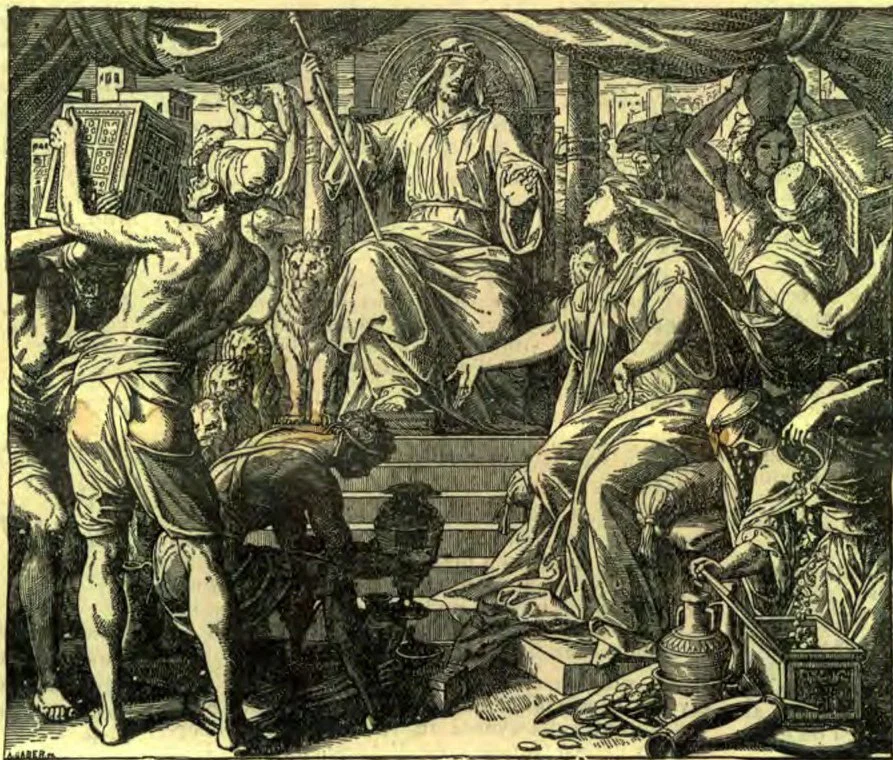
1. AND when the queen of Sheba heard of the fame of Solomon concerning the name of the Lord, she came to prove him with hard questions.
2. And she came to Jerusalem with a very great train, with camels that bare spices, and very much gold, and precious stones; and when she was come to Solomon, she communed with him of all that was in her heart.
3. And Solomon told her all her questions; there was not anything hid from the king, which he told her not.
4. And when the queen of Sheba had seen all Solomon’s wisdom, and the house that he had built,
5. And the meat of his table, and the sitting of his servants, and the attendance of his ministers, and their apparel, and his cupbearers, and his ascent by which he went up unto the house of the Lord, there was no more spirit in her.
6. And she said to the king, It was a true report that I heard in mine own land of thy acts and of thy wisdom.
7. Howbeit I believed not the words, until I came, and mine eyes had seen it; and, behold, the half was not told me: thy wisdom and prosperity exceedeth the fame which I heard.
8. Happy are thy men, happy are these thy servants, which stand continually before thee, and that hear thy wisdom.
9. Blessed be the Lord thy God, which delighted in thee, to set thee on the throne of Israel; because the Lord loved Israel forever, therefore made he thee king, to do judgment and justice.
10. And she gave the king an hundred and twenty talents of gold, and of spices very great store, and precious stones; there came no more such abundance of spices as these which the queen of Sheba gave to king Solomon.
13. And king Solomon gave unto the queen of Sheba all her desire, whatsoever she asked, besides that which Solomon gave her of his royal bounty. So she turned and went to her own country, she and her servants.
Golden Text: “Behold a greater than Solomon is here.” Matt. 12:42.
NOTE.—The parallel account is 2 Chron. 9:1-12. The title of this lesson requires for its full answer a review of Solomon’s career up to the time of the present lesson, and the further recital of his acts in the chapters above named. Read the entire chapters.
SUGGESTIVE QUESTIONS.
(1) Who came to visit Solomon, and for what purpose? Verse 1. Note 1. (2) In what manner did the queen of Sheba come to Jerusalem? What is said of her conversation with Solomon? Verse 2. (3) How complete were his replies? Verse 3. (4) What were some of the principal things of interest shown the queen? Verse 4, 5. What effect did this have upon her? Note 2. (5) What did she say concerning the report of his greatness? Verse 6. (6) Yet how had she regarded the report before she came? Verse 7, first part. (7) What did she now acknowledge? Verse 7, last part. (8) How did the queen regard the condition of Solomon’s servants and of the nation at large? Verse 8. (9) After all, to whom did she attribute praise? Verse 9. Note 3. (10) What present did she make the king? Verse 10. Note 4. (11) What did Solomon give to her? Verse 13. Note 5.
NOTES.
1. Sheba.—Sheba was a country in Arabia Felix, now called Yemen, on the east of the Red Sea. It was famous for its traffic in gold, frankincense, and precious stones. This journey was no light undertaking. The distance was about fifteen hundred miles, and the route lay through the great desert or wilderness, a place infested by robbers. At an ordinary caravan rate, something like seventy-five days would be necessary to complete the journey one way. This was undertaken because of Solomon’s fame. This was not alone his personal greatness, but was concerning the name of the Lord; in fact, this feature seems to have been the first to connect itself with his fame. This was right; for he could have had none of his remarkable wisdom without it had been given him of the Lord. But popularity is dangerous; for it is a principle always true on this sin-cursed earth that the world loves with a constant love only its own. Sooner or later, there will come a change; either on the part of the world, or on the part of the one who is at present popular. The hard questions might include the riddles and puzzles of the east, or intricate or deep questions upon any topic. That they were upon various subjects is very evident from verse 3.
2. Had seen all Solomon’s wisdom.—That is, when she had seen all that he had wrought by his wisdom, and had heard his words. On the ascent see 2 Chron. 9:11. This stairway must have been magnificent to warrant the words in the text referred to, and to awaken the wonder of the queen. In addition were his commerce, public works, aqueducts and pools, his gardens, singers, and army. No more spirit, or breath, remained in her. Her amazement was so great that, as we would say, it took away her breath; she was lost in admiration.
3. Blessed be the Lord.—This acknowledgment was the best of all. So long as Solomon’s greatness and wisdom led those who knew Him not to the knowledge of God, he was accomplishing God’s purpose in placing him in such an exalted position. Yet such a position as Solomon occupied is not necessary to the spreading of God’s truth. Jesus Christ, in whom are hid all the treasures of wisdom and knowledge, came as a humble man, with none of the world’s riches or greatness. He himself said, “Behold, a greater than Solomon is here,” teaching this principle by contrast. Pomp, display, and riches, which are so frequently seen nowadays, are not necessary. On the contrary, such are dangerous possessions to the majority. Let no one despair because he is poor in this world’s goods. The reward of doing is in the motive, and the Lord has for you all you can possibly do. Be faithful to him, and let your glory be his glory.
4. Gold.—An 120 talents, at $26,280 a talent, is over $3,000,000. Josephus states that among the spices was some of the Arabian balsam, and that in consequence of her visit, this plant was naturalized in the famous gardens of Jericho.
5. Her desire.—The “royal bounty” of Solomon covers the present, whatever it may have been, that he gave to the queen. Besides this, there were other gifts, according to oriental custom between equals. Here the queen is told to ask what she will, and for her to have hesitated to ask would have been, according to the ideas of the east, to admit an inferiority of position. We may learn, too, a lesson from this. The greatest gift we can make to God is ourselves, consecrated to his service; but he has already made the inestimable gift of his Son to be life for you and me, and for the whole world. And with him he freely gives us all things, whatsoever we may ask, and infinitely more besides. Rom. 8:32; John 14:13. We are called joint-heirs with Christ, who calls us brethren. Shall we learn to ask?
Your Life Work
Is it of Men or of God? A new tract in the Apples of Gold Library. Order A. G. L. No. 20. Price, 50 cents per 100 or one cent each in small quantities. Address, PACIFIC PRESS PUBLISHING CO., Oakland, Cal.; Kansas City, Mo.; or New York City, N. Y.
FOREIGN
—A despatch from China states that the government of that country has just signed contracts ordering two new cruisers and four torpedo-boats.
—A complete pardon has been issued by President Dole, his Cabinet, and the Council of State, to ex-Queen Liliuokalani. She is now as free to come and go as others.
—Edward John Poynter, R. A., has just been elected president of the Royal Academy of Art, London, as successor to Sir John Millais, who died in August last.
—The French scientist Moissan has discovered that minute diamonds exist in very hard steel, formed in the process of hardening, so says the Scientific American.
—A despatch from Rome concerning Cardinal Satolli’s report to the pope of affairs in the United States places the political situation as a special feature of the report.
—The secretary of the British Colonial Office has announced that before Parliament assembles again, the Venezuelan boundary dispute will have been satisfactorily settled.
—Advices from India state that about sixty-seven thousand men are engaged in relief work in the famine-stricken districts. No rain has yet fallen, and prices are slowly rising.
—On November 4 the Archduchess Maria Dorothea, of Austria, renounced all her rights of succession to the throne, prior to her marriage to the Duke of Orleans, the pretender to the throne of France.
—Advices from Spain state that General Polavieja, known as “The Butcher” from his past records in Cuba, has been ordered to the Philippine Islands to replace General Blanco as Captain-General of those colonies.
—At a recent meeting in London of the directors and shareholders of the British South African Company, the capital stock was increased $5,000,000. This action is due to the favorable outlook at present in South Africa.
—The Japanese Government has awarded contracts for two cruisers to be built in the United States, one by the Union Iron Works, San Francisco, the other by the Cramp Ship and Engine Company of Philadelphia.
—A recent despatch from Peking says that an imperial edict has commanded the punishment of Li Hung Chang for entering the precincts of the ruined summer palace while on a visit near the spot! The punishment is the loss of a year’s salary!
—The French Minister of Agriculture has recently issued an order permitting shipment of American cattle to Basle, Switzerland, via Boulogne, France, on condition that they be sanitarily inspected at receiving port, and also before being loaded on cars, which must be stalled.
—An old Roman “tub”-well has been discovered in ancient ruins at Silchester, England. The excavators have succeeded in raising the tub, the wood of which is well preserved, tho at least 1,600 years old, without damaging it, and it will be exhibited at the Reading Museum.
—A Marseilles, France, despatch, under date of November 6, says the government officials have refused to accept foreign copper coin. As a result, tradesmen are very much excited, 3,000 of them petitioning the government to grant delay. An immense crowd paraded the streets, and threatened the banks and newspapers advocating the refusal.
—The Pall Mall Gazette, of London, recently despatched a correspondent to Paris from New York, the trip to be made by land. The route necessarily was via Alaska and Siberia, but Mr. Dewindt, the gentleman who undertook the mission, has just returned, having got no further than the coast of northeastern Siberia. The journey from there could only be made by dog trains, and in the month of April.
—The street-cars of Toronto rest on Sunday, but as some agitation has been made over the matter, the city council recently ordered a ballot taken among the employees of the street railway company to ascertain their sentiment in regard to the matter. Out of 250 voting, 220 declared against Sunday work, and, as it is said public sentiment is like-minded, the cars will probably continue resting on that day.
—An arrangement is now being proposed in Manitoba, that the public school system be maintained undenominational, but that after school hours any denomination, Catholic or Protestant, will be at liberty to give such instruction to its children as it may choose, we suppose in the school buildings. The Catholics appear determined to gain some concession if possible, but thus far every effort has failed.
—It is announced from Stockholm, Sweden, that M. Andree will make another attempt to reach the north pole next summer in his balloon. It will be remembered that he failed to make the trip as proposed during the summer just past.
—A despatch from St. John’s, N. F., states that the schooner Maggie was run down by an outward bound steamer on the night of the 6th inst., and thirteen persons drowned. There were twenty-eight on board, but the survivors were picked up by the steamer’s boat.
—The trial of the Castles, the wealthy Americans arrested in London for shoplifting, has ended, resulting in acquittal for Mr. Castle, and sentence of three months without hard work for his wife. The verdict holds her irresponsible, and it is thought she will be released soon.
—A London despatch dated November 5 states that severe earthquakes have occurred again in Iceland. On October 4, 150 farms were ruined, a large number of cattle killed, and large quantities of stored food destroyed. The people are camping in improvised shelters. No loss of human life is reported.
—A news item states that the people of Scotland are much aroused over Sunday golf games. The usual cry is raised that the act is sacrilegious, and in addition degrades the game. When it was learned by the people of Leith that the Member of Parliament from their burgh occasionally played a Sunday game when from under their eyes, he was severely handled, word-wise. He attempted to justify his course, and it is announced that he will probably lose his seat at the next election. By this it appears that political methods for making men religious are about the same everywhere.
DOMESTIC.
—The cost of maintaining the United States Navy for last year, exclusive of increase and improvements at yards and docks, was $15,494,862.
—By the explosion of a locomotive boiler in the yards of the Southern Railway, at Atlanta, Ga., November 5, two men were killed and one seriously wounded.
—During the week just passed the first severe storm of the winter season struck the Great Lakes region, causing considerable damage in various places. Heavy storms are also reported on the coasts of Spain, and Western Russia.
—Peter Fisher, a mine owner of Butte County, Cal., was found dead about a hundred yards from his mountain cabin on November 5. Three days before he had started for home after dark, and it is believed he became lost and died from exposure.
—A second receivership has been appointed for the Santa Fé Railroad in Kansas. The action is believed to have been brought about by those who opposed the recent reorganization plan of the Santa Fé, and is permitted under a state law against acquisition of property beyond a certain limit by an alien corporation.
—A complete counterfeiting outfit, together with several thousand dollars in counterfeit gold coin, was recently discovered in the cabin of a sheep-shearer named Garner, near Bakersfield, Cal. Garner has been considered a quiet, inoffensive man, but appearances are often misleading. A friend induced him to give himself up to the officers.
—A serious set-to occurred between the police and a crowd of negroes, in Winchester, Ky., on the 4th inst. The trouble originated by a negro boy snatching papers from a newsboy. The attempted arrest of the offender met with resistance, and shots were freely exchanged. Ten men were wounded, and it is reported that three of the negroes will die from wounds received.
—A shooting affray occurred at Matewan, W. Va., on election day, between Captain Hatfield, a noted desperate character, and John Rutherford and others. Rutherford, his brother-in-law and nephew were killed, and a sheriff’s posse immediately set out in pursuit of the murderer. He was captured on the night of the fifth. It is stated that seventeen murders constitute Hatfield’s life record.
—Experiments with an electric motor are being pushed on the elevated roads of New York. The power is received from two sources,—storage cells on the motor, and from the power station by means of a third rail placed just outside one of the track rails. Either supply can be used, separately and together, and it is claimed the arrangement gives a constant current to the motor, a variation of the trolley-rail current being automatically compensated for from the supply in the cells.
—On November 5 the new canal permitting vessels to pass over the upper cascades of the Columbia River, sixty miles from Portland, Or., was formally opened. The canal contains three locks, and the upper gates are claimed by engineers to be the largest lock gates in the world. The cost to the government has been over two and a half million dollars. Work was first begun on the canal eighteen years ago. This opens navigation to the Dalles, and it is proposed to overcome the obstruction at the latter place by means of a ship railroad.
—Russell Sage, the millionaire, has brought suit against the Erie Railroad Company for $100, because employees of the company shot one of his horses that had fallen through a trestle on the road and broken its legs. The horse was killed to put it out of its misery, but Mr. Sage had the body exhumed and examined by a veterinary surgeon, who believed the horse’s life might have been saved by placing its legs in splints for some time.
—The excitement of election week is abating, and the supposed strain under which the country has been laboring for months ought now to be relieved. The full count has not been announced as we go to press, but latest news gives Mr. McKinley, the Republican candidate for President, over 260 electoral votes. As 224 votes only are necessary for safety, the result is decisive. In many respects, owing to the questions involved, and the standing of the candidates, the campaign just closed has been one of the most remarkable and interesting in the history of American politics. We do not predict peace to follow, nor prosperous times of any length, not because of party lines, for these have a minor significance, but because God’s word tells us that social conditions will wax worse and worse to the end. The trust of the Christian and his hope should be based on the power of God as the only sure foundation.
—Another prophetess, this time in our own city, is exhorting her hearers and followers to flee to the hills to avoid the great war that is inevitably at hand. This is the last battle, the Armageddon. After four years they can return to the cities, as the Lord will then take possession. This is another of the Lo! heres, and Lo! theres, that speak not according to the word of God. That word tells us that the day and hour of his coming is not revealed, altho we may know when it is near; and that when he comes, the earth will be desolated, the wicked living destroyed, and the righteous living taken to heaven, together with the resurrected righteous dead. The Lord nowhere brings to view a second probation, where his personal presence will convert the world. Faith in the efficacy of the sacrifice of Jesus Christ, and the evidences already given, is the only thing that can avail to cause repentance. What is seen is not faith.