The Youth’s Instructor, Vol. 30, No. 12.

JAFFA

The Youth’s Instructor

Mar 22, 1882

S. D. A. Publishing Association · Battle Creek, Mich. · Mar 22, 1882

JAFFA
Joppa, or Jaffa, as it is now called, is situated on the coast of the Mediterranean Sea, about thirty miles west and a little north of Jerusalem. It is one of the oldest cities in the world, and its harbor, though unprotected, is the best in Palestine. Jaffa was the seaport of Jerusalem when that city became the metropolis of the kingdom of the house of David. Herod the Great, in his march to Jerusalem, took possession of Jaffa, as it was at that time a strongly fortified city.
During the Maccabean wars, described in the Apocrypha, a large proportion of the population were foreigners, the native Jews numbering only a few hundred. These foreigners at one time enticed about two hundred of the Jews aboard their ships, and then threw them into the sea. For this, Judas Maccabeus attacked the city by night, and burnt the shipping and all on board.
There is probably no city in the world that has been overthrown, sacked, pillaged, plundered, burned, and rebuilt, more times than Jaffa. History records the fact that at one time there was but one house left standing in the town, and that, a “guard-house;” and whenever a foreign vessel landed, the watchman notified the merchants of Ramlah, a town a few miles inland. Forty years ago, the population numbered about six thousand, but at the present time it is estimated at twice that number.
JAFFA AS IT NOW IS.
JAFFA AS IT NOW IS.
This city is first mentioned in the Bible in the book of Joshua, in the nineteenth chapter, where Joshua, in dividing the land, mentions “Japho” as one of the boundary points of Dan. We hear no more of it until the time of Solomon. When he purposed to build the temple at Jerusalem, he sent to Hiram, King of Tyre, to furnish him with pine and cedar for the building. Hiram sent back a favorable answer, and said he would convey the timber from Mt. Lebanon to the sea, and down the sea to any place Solomon might name. He chose Jaffa; accordingly the timber was delivered there, and thence carried across the country to Jerusalem. When Zerubbabel rebuilt the temple, over five hundred years afterward, the wood was procured from the same place, and transported in the same manner. See Ezra 3.
It was from Joppa that Jonah sailed when fleeing from the presence of the Lord. We read in the third verse of the first chapter of Jonah, that he “went down to Joppa, and he found a ship going to Tarshish, so he paid the fare thereof, and went down into it.”
It was at this place, also, that Tabitha, or Dorcas, was raised to life by Peter, an account of which is given in Acts 9:36–43. While at Joppa, Peter stopped at the house of one Simon a tanner, who dwelt by the sea-side, and it was from this house-top that he saw the wonderful vision recorded in the tenth chapter.
The groves about Jaffa are very fine, and the gardens very productive. The place is noted for its fine fruits, such as oranges, lemons, citrons, watermelons, apricots, etc. The lemon and orange orchards are very beautiful, and extend far out into the country. When King Hiram sent Solomon the timber for the temple, Solomon sent back to him great quantities of grain and fruits, which might well have been obtained from the fertile fields and gardens about Joppa.
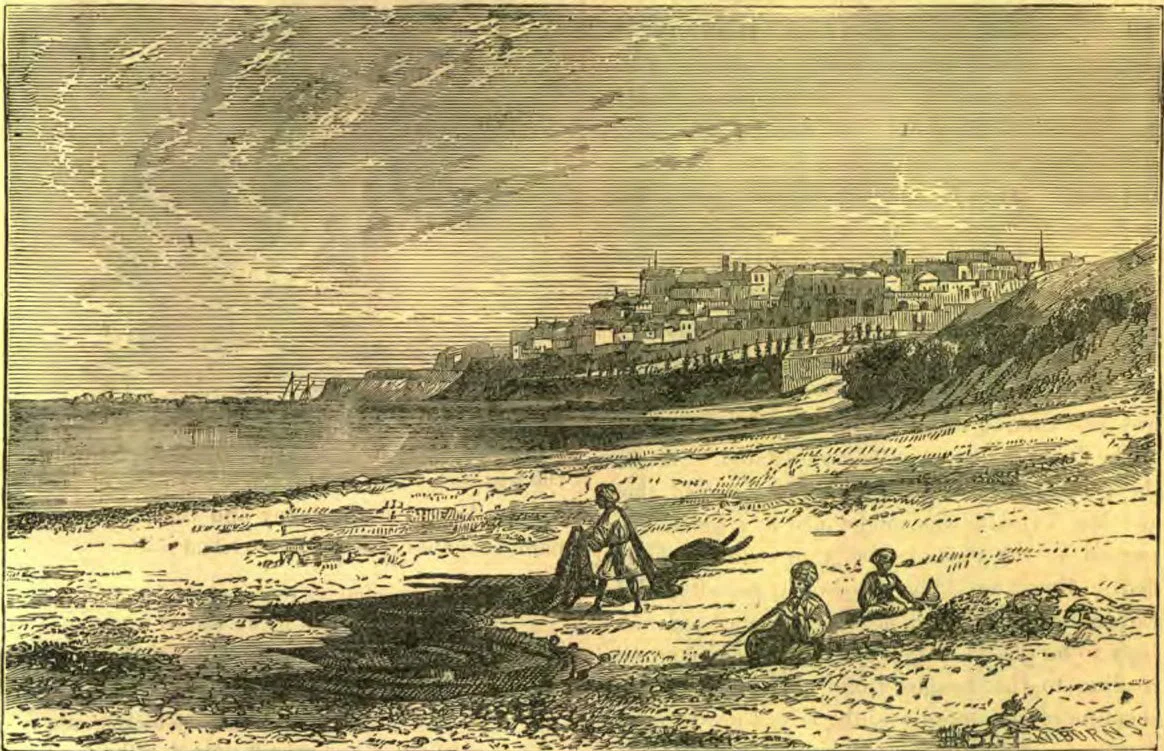
The accompanying picture presents a view from the south-west. The town is built upon a steep hill, and on approaching it from the sea, the square-topped houses give it the appearance of being terraced. Many of these houses are very ancient. Jaffa is the gathering-place of many vagabonds and fugitives, and this so imperils the safety of the better class of people, that few Europeans settle there. The mission schools, which have of late been established in the suburbs by some benevolent persons, are an interesting feature of the place, and are said to be already doing something toward improving the morals and state of civilization in the town.
R. H. COGGESHALL.

HOW ENGLAND WAS REFORMED.

A FEW weeks ago it was shown how the people of England were for many hundred years unable to obtain the Bible to read themselves, and so depended on their priests and bishops for religious instruction; and how they were taught by these men to believe and do many things that were forbidden in God's word. But the good Father will not suffer his children always to remain ignorant of his will; and in the year 1324, in Yorkshire, was born a man, named John Wycliffe (also spelled Wickliffe), who was destined to act an important part in undeceiving the people. This man won great distinction on account of his superior ability and learning, and held high offices in the church. But he feared God more than man, and was not afraid to preach against the wrong practices of the church, and to denounce the doctrines which he thought were false. While this made him many friends among the common people, his brother bishops and priests were exceedingly bitter toward him. He was pronounced a heretic by the pope, and deprived of some of his offices; and many were the plots laid to shed his blood. But partly by the aid of certain influential men in the kingdom, and partly because the minds of his enemies were diverted by divisions in the church, he was permitted to meet a peaceful death. Over forty years afterward, however, his bones were hunted out, burned, and their ashes thrown into a brook.
But the greatest good which this man did to his countrymen, is yet to be mentioned. With the aid of his pupils and friends, he translated the entire Bible into the English tongue, and had copies of the translation made with pen and ink. From these, certain poor priests, who had received his instruction and had great respect for his learning and piety, read to the people when they taught them. These priests also distributed to the people copies of tracts written by Wycliffe, in which he exposed many of the errors of the church. Though at the time his bones were given to the flames, an effort was made to collect and burn his writings, and about two hundred of his works so perished, yet the seed sown by his efforts could not be destroyed, but ripened into fruit which afterward did much toward the overthrow of the Romish power. His followers, whom the people called “Lollards,” were after his death persecuted very cruelly, and many of them left England.
Two hundred years afterward, Henry VIII., king of England, renounced the authority of the pope, and assumed the title of “supreme head of the Church of England,” all because the “holy father” had refused to grant a certain request he had made. Thus he virtually became pope of England, while he and his subjects still remained Catholics. Yet his defiance of the pope set the people to thinking, and revived many of the teachings of Wycliffe and the Lollards. About this time, two men, William Tyndale and Miles Coverdale, availed themselves of the printing art, which was just coming into use, and printed some copies of the Bible, which they had translated. At first the people were forbidden to buy or read them, and Mr. Tyndale was condemned as a heretic, and burned at the stake in Belgium, whither he had fled. But the king afterward permitted Mr. Coverdale to print them openly, and ordered a copy to be placed in every church. The continual reading to the people from the Bible, showed them more and more plainly how they had been deceived; and although the king and many of his officers were wicked men, and those who did not believe and obey what was taught by this new church, were persecuted just as cruelly as before, still the Reformation in England was begun. The power of the pope over the minds of the people was broken, they were given the word of God for their own study, and a flame was kindled in their breasts, which was not to be quenched until liberty of conscience should be granted to every son of British soil.
During the reign of Henry's successor, Edward VI., the Reformation made some further progress under the labors of three noted men, named Cranmer, Ridley, and Latimer. But upon the death of Edward, a bitter Roman Catholic, named Mary, became queen of England; and then began that period known as the “Bloody Reign of Queen Mary.” Although she promised, upon coming to the throne, to carry on the reform begun by her predecessors, yet when she became fully established, she took every measure in her power to restore the authority of the pope. Hundreds were made to feel her vengeance for having taught contrary to the church of Rome, and the history of the Marian martyrs is a dark stain on the page of history. At another time you will be told more of this cruel woman whose life was a curse, and whose death was a blessing to all mankind.
C. H. G.

SPRING

GENTLE Spring, in sunshine clad, Well dost thou thy power display! For Winter maketh the light heart sad, And thou, thou makest the sad heart gay. He sees thee, and calls to his gloomy train,— The sleet, and the snow, and the wind, and the rain,— And they shrink away, and they flee in fear, When thy merry step draws near.
Winter giveth the fields and the trees, so old, Their beards of icicles and snow; And the rain, it raineth so fast and cold, We must cower over the embers low; And snugly housed from the wind and weather, Mope like birds that are changing feather. But the storm retires, and the sky grows clear, When thy merry step draws near.
Winter maketh the sun in the gloomy sky Wrap him round with a mantle of cloud; But Heaven be praised, thy step is nigh; Thou tearest away the mournful shroud, And the earth looks bright, and the Winter surly, Who hath toiled for naught both late and early, Is banished afar by the new-born year, When thy merry step draws near.
—From the French, by Longfellow.

THE PALM-TREE.

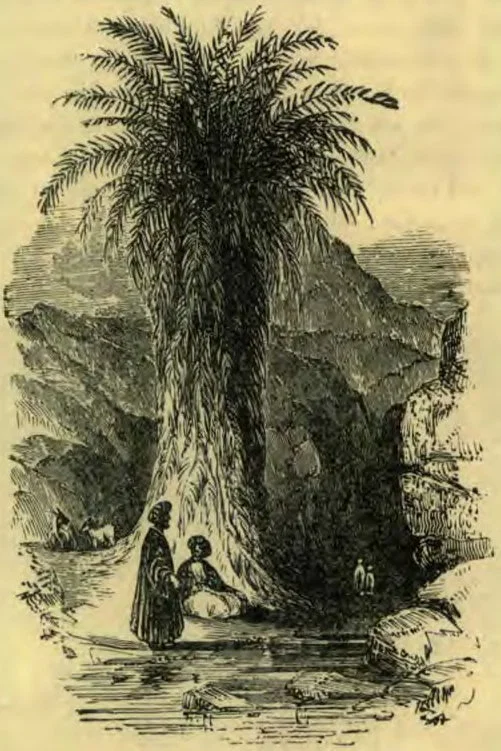
The palm-tree grows mostly in the tropical regions. There are many different varieties; indeed, botanists say that there are more than one thousand distinct species of the palm. Some are only small plants, while others rise into slender and graceful columns a hundred feet or more in height. The many different kinds of this tree, with their fruit, bark, and leaves, give food, shelter, clothing, and almost every other necessary of life, to the people who live where they grow. There is one variety known as the cabbage-palm, because of its large, tender buds, which are called “cabbages,” and considered a great delicacy either raw or boiled. The one represented in the picture below is known as the feather-palm. In the following piece of poetry, by Mr. Whittier, the many and varied uses of the palm-tree are beautifully described:—
Is it the palm, the cocoa-palm, On the Indian Sea, by the isles of balm? Or is it a ship in the breezeless calm?
A ship whose keel is of palm beneath, Whose ribs of palm have a palm-bark sheath, And a rudder of palm it steereth with.
Branches of palm are its spars and rails, Fibers of palm are its woven sails, And the rope is of palm that idly trails!
What does the good ship bear so well? The cocoa-nut with its stony shell, And the milky sap of its inner cell.
What are its jars, so smooth and fine, But hollowed nuts, filled with oil and wine, And the cabbage that ripens under the Line?
Who smokes his nargileh, cool and calm? The master, whose cunning and skill could charm Cargo and ship from the bounteous palm.
In the cabin he sits on the palm-mat soft, From the beaker of palm his drink is quaffed, And a palm-thatch shields from the sun aloft!
His dress is woven of palmy strands, And he holds a palm-leaf scroll in his hands, Traced with the Prophet’s wise commands!
The turban folded about his head Was daintily wrought of a palm-leaf braid, And the fan that cools him of palm was made.
Of threads of palm was the carpet spun Whereon he kneels when the day is done, And the foreheads of Islam are bowed as one!
To him the palm is a gift divine, Wherein all uses of man combine,— House, and raiment, and food, and wine!
And in the hour of his great release, His need of the palm shall only cease With the shroud wherein he lieth at peace.
“Allah il Allah!” he sings his psalm, On the Indian Sea, by the isles of balm; “Thanks to Allah who gives the palm!”

MR. WHITTIER'S CHILDHOOD.

Few American poets have been as widely known by the children, and as much beloved by those of all ages, as John G. Whittier. A little girl in Oxford, Penn., wanted to know what the good Quaker poet thought about and did when he was a little boy (he is now over seventy years of age); so she asked him in a letter, and received this reply:—
“My dear young friend: I think, at the age of which thy note inquires, I found about equal satisfaction in our old rural home with the shifting panorama of the seasons, in reading the few books within my reach, and dreaming of something wonderful and grand somewhere in the future. Neither change nor loss had then made me realize the uncertainty of all earthly things. I felt secure in my mother's love, and dreamed of losing nothing, and gaining much. Looking back now, my chief satisfaction is that I loved and obeyed my parents, and tried to make them happy by seeking to be good. That I did not succeed in all respects, that I fell very far short of my good intentions, was a frequent cause of sorrow. I had at that time a very great thirst for knowledge, and little means to gratify it. The beauty of outward nature early impressed me; and the moral and spiritual beauty of the holy lives I read in the Bible and other good books also affected me with a sense of my falling short, and longing for a better state.
“With every good wish for thee, I am thy sincere friend,
JOHN G. WHITTIER.”

WHAT GOD WANTS OF US.

ONE day a good Christian man was driving a nail in his study to hang something on. When he had done pounding it in, he said to himself, “I want to make use of that nail, and the only way in which it can make itself useful is by just staying still where I have fixed it, and holding on to what I put on it. If that nail could think and speak, and should say to itself, ‘I don’t like to be staying here all the time. I think I could be more useful in some other place’—than where I have driven it in—and should go flying off all over the house, making a busybody of itself, where it was not wanted, and doing what it was not asked to do, I should be very much put out with that nail.” And then the good man went on to say to himself, “Well, are not men and women, and boys and girls like living nails? Does not the Bible speak of Jesus as ‘a nail fastened in a sure place’? And are we not all like nails that God has fastened just where he wants us to be? And is there any better way for us to make ourselves useful than just to stay quietly where God puts us, and try to hold whatever he hangs upon us?”—Christian Weekly.

The Origin and Course of a Good Name

As a rill from a fountain increases as it flows, rises into a stream, swells into a river, so, figuratively speaking, are the origin and course of a good name. At first its beginning is small; it takes its rise from home, its natural source, extends to the neighborhood, stretches through the community, and finally takes a range proportioned to the qualities by which it is supported,—its talents, virtue, and usefulness.

SCENES IN THE LIFE OF CHRIST.

LESSON 61.—THE FEAST OF TABERNACLES.

The Feast of Tabernacles, which Jesus was now going to attend, was one of the three great feasts of the year. At each of these feasts a great multitude assembled at Jerusalem; for the law required every man in the nation to attend them, and thousands of women and children went with their fathers, husbands, and brothers to these great festal gatherings. The Feast of Tabernacles was a feast of rejoicing. It was held just after the gathering in of the harvest. The whole nation came together to spend a week in praising God for the bounties of the year. God gave his promise that while the whole land was thus left almost deserted, no enemy should invade it. This feast was called the Feast of Tabernacles, because while holding it, the people dwelt in booths. These leafy tabernacles were made of bushes, and the branches of green trees. They were meant to remind the people of the wanderings of their forefathers in the wilderness, where for forty years they had to encamp in the open air, with no shelter but booths, or tents of some kind; for they were continually moving from place to place, and could not build permanent houses. During this feast there was also a ceremony which was meant to remind the people of God's goodness in bringing water from the rock in the wilderness.
All through this feast Jerusalem presented a beautiful sight. In the daytime nothing was to be seen but a forest of green booths, adorning the flat house-tops, covering the sloping hillsides, and scattered along the winding valleys. At night, the whole city was lit up by the light from the temple and its courts. At break of day the priests blew their silver trumpets; and when the people heard the sound echoing among the hills, and through the valleys, they all joined in a glad shout of praise. Many animals were sacrificed; and all through the week ceremonies were performed to impress upon the people a sense of the majesty and goodness of God, and of his care over them as a people. Suitable passages of Scripture were read and repeated, and frequently the air was made to ring with the music of voices and instruments, sounding forth the praises of the God of heaven.
It was such a feast as this, that our Lord was going to attend. We have already seen that he did not go up at the beginning of the feast; but after the great crowd of people had gone up, he followed on quietly with his disciples, teaching them many useful lessons by the way, and sending out seventy of their number to prepare the people for his preaching. It seems that the people at the feast were expecting to see him there, and wondered why he did not come. There was much talk about him, some saying that he was a good man, and others claiming that he deceived the people.
About the middle of the feast, Jesus went up into the temple, and began to teach with such effect that even his enemies wondered at the power and wisdom of his words. He told the people plainly that he was sent from heaven; that his doctrine was from above; that he was the Son of God; and that he spoke just what his Father had given him to speak. He said, “I am the light of the world. He that followeth me shall not walk in darkness, but shall have the light of life.” Thousands of honest people were delighted with his words of instruction and comfort. To them that believed on him, he said, “If ye continue in my word, then are ye my disciples indeed; and ye shall know the truth, and the truth shall make you free.” But many of the Jews, especially the chief priests, and the doctors of the law, were jealous because Jesus had so much influence with the people. They were also angry because he exposed their wickedness. They wanted to kill him, and sent officers to take him; but when the officers came into his presence, they were powerless, and returned, saying, “Never man spake like this man.”
To these wicked leaders of the people, Jesus said, “Ye are of your father, the devil, and the lusts of your father ye will do; he was a murderer from the beginning, and abode not in the truth, because there is no truth in him. When he speaketh a lie, he speaketh of his own; for he is a liar, and the father of it. . . . He that is of God heareth God's words; ye therefore hear them not, because ye are not of God.”

QUESTIONS.

  1. What feast was Jesus now going to attend?
  2. How did this feast rank among other feasts?
  3. How fully were these great festal gatherings attended?
  4. What brought so many people together on these occasions?
  5. What was the nature of the Feast of Tabernacles?
  6. At what time of the year was it held?
  7. For what purpose did the whole nation come together at this feast?
  8. What protection did God promise to give them at such times?
  9. From what circumstance did this feast derive its name?
  10. Describe these booths.
  11. Of what were they meant to remind the people?
  12. Why did not the Israelites build houses during their forty years' wandering in the wilderness?
  13. Of what astonishing miracle were the people reminded by one of the ceremonies at this feast?
  14. How did Jerusalem appear during this feast?
  15. What scene was presented in the daytime?
  16. What at night?
  17. What happened at daybreak?
  18. What work was carried on during the week?
  19. For what purpose were these ceremonies performed?
  20. In what other ways did the people honor God, and show their gratitude for his mercies?
  21. What have we already learned about our Lord's attendance on this feast?
  22. Were the people expecting him there?
  23. How did they regard his absence during the first part of the feast?
  24. What different opinions were held concerning him?
  25. What did he do, about the middle of the feast?
  26. What was the nature of his teaching?
  27. What did he plainly tell the people?
  28. What did he say about being the light of the world?
  29. How was his teaching received by the people?
  30. What did he say to them that believed on him?
  31. Who rejected the teachings of Jesus?
  32. Why were these men jealous?
  33. Why were they angry?
  34. What did they want to do?
  35. How did they try to get Jesus into their power?
  36. How did these officers succeed?
  37. What did they say when they returned to the men who sent them?
  38. What did Jesus say to these wicked leaders of the people?

NEW-TESTAMENT HISTORY.

LESSON 74.—REVIEW.

1. What remark was made by one who was sitting at meat with Jesus? Luke 14:15.
2. Give the prophetic parable which our Lord then related.
3. To what period of the world’s history does this parable apply?
4. What supper is here referred to? Luke 12:36, 37.
5. When is this supper to be given?
6. In the parable, how many calls are made to this supper?
7. What prophecy concerning these parables is found in Rev. 14:6-14.
8. Of what did the first of these calls, or warnings, consist?
9. What did the second present?
10. What is presented in the third call, or message?
11. What does it set before us?
12. As presented in the parable, how was the first call received?
13. How does this correspond with the way in which the first message was treated?
14. To whom, according to the parable, was the second call made?
15. What were the peculiarities of the third call?
16. How do the statements made in reference to these two calls correspond with the circumstances connected with the giving of the last two messages?
17. After relating the parable, what remarks did Jesus make to show that God demands our supreme love, and an entire consecration to his service?
18. By what important questions did Jesus show the necessity of counting the cost, and making a complete surrender when entering the service of God?
19. What important lesson did Jesus teach under the figure of salt?
20. For what did the scribes and Pharisees complain of him?
21. Relate the parable by which Jesus illustrated the joy that is felt in heaven over one repentant sinner.
22. Taking up the parable of the prodigal son, relate that part which pertains to his departure, his riotous course, and his repentance.
23. Relate that part pertaining to his return.
24. Relate that part pertaining to the elder brother’s course, and his father’s conversation with him.
25. Give some of the important suggestions which this parable contains.
26. Relate the parable of the unjust steward.
27. Relate the parable of the rich man and Lazarus.
28. What is the general scope and purpose of these two parables?
29. What is especially brought out by the first?
30. What by the second?
31. To what conclusion must this lead us?
32. Was the course of the steward right in itself?
33. How could his master admire it?
34. Does our Lord mean to commend such a course?
35. In what sense is it worthy of imitation?
36. How is our use of worldly means made a test of loyalty?
37. How does it affect our prospects of a life to come?
38. What is meant by the “mammon of unrighteousness”?
39. What seems to be the meaning of the clause, “when ye fail”?
40. Explain the clause, “that they may receive you into everlasting habitations.”
41. What gross error did the Jews at this time appear to hold with respect to God’s estimate of the rich and poor of this world?
42. How was this parable eminently adapted to the correction of this error?
43. For whom does it contain comfort and encouragement?
44. For whom does it contain a warning?
45. How may it be shown that this parable cannot prove the conscious state of the dead?

“HE KNOWETH HIS SHEEP BY NAME.”

“We had been encamped in a beautiful situation near Mount Ararat. The tent was pitched on the banks of a rocky ravine, through which flowed a bright stream, while near at hand was a little village and the picturesque ruins of an Armenian Convent. We were wandering about, awaiting the loading of the packs, and the other morning preparations for continuing the journey, when we saw a boy come out of the village, followed by a large flock of sheep and goats, more than a hundred in number. The young shepherd led them to a short distance, and then, sitting down on a rock, he produced his knitting from the horse-hair bag which held his provisions for the day, while the flock fed quietly around him. We went up to him, and found him very ready to enter into conversation. He assured us that he knew all the members of his flock by name, and that they also knew their names, and would answer to them. Pointing out a pretty young kid on the edge of the flock, we requested him to call it. At the first call the little creature lifted its head, with a quick, intelligent look. At the second, it came trotting up to the shepherd, and received his caresses with every appearance of delight. He repeated the experiment many times, and the animal called never failed to respond to the shepherd’s voice. We then tried to call them in the same way, but imitate the shepherd’s voice as closely as we would, neither sheep nor goats would pay the least attention to us. ‘For a stranger will they not follow, but will flee from him; for they know not the voice of strangers.’”

ONLY A FLOWER.

“Love your enemies; do good to them that hate you.”
This was Bennie’s verse for the day; over and over he read it, then he closed the little red Bible papa had given him, and an odd smile lit up his face.
“That’s the hardest one I’ve had yet,” he said. “I haven’t got but one enemy, but I’m quite sure I couldn’t love him. And as to doing good to him—well, I ought to, of course—”
So thought Bennie, as he trudged along; but a sharp whistle ahead suddenly drove verse and all from his mind.
“It’s Tom,” he cried joyfully. “I wonder what he’s got to tell me now. About that new game, I hope. Was there ever, ever such a boy as Tom?”
“I want to tell you,” he began, as soon as Bennie came in sight, but Bennie interrupted him. Somehow the contrast of Tom’s friendly face and the thought of how he loved him suddenly brought the verse to mind; he regarded his hero with a disappointed air.
Tom was not at all the kind of boy Bennie wanted to see that moment.
“I wish you were my enemy, Tom Hart,” he said soberly. “I would give anything if you were Bob Tyler now. I want to try something, something the Bible says about—”
“About enemies?” broke in Tom. “That’s funny enough, Bennie Lee. If you want to try to love your enemy, you’ve got the best chance in the world just now. Listen, Ben. Who do you think has just gone into your school? Why, Bob Tyler, old straw hat, patches, and all. I was going to tell you, because I know what a time he’ll have with some of those mean boys, and I feel awfully sorry for Bob. I know he was mean to you; but if you want to try to love your enemy, now’s your time; you can do something in your sweet little way—”
But again the bell rang; the last time, now, and Bennie, without time to answer, hurried on to school. Sure enough, there sat Bob Tyler, with his eyes cast down and a very unhappy look on his face; sure enough, there were the mean boys nudging each other and staring at him with mocking smiles.
Despite his broken boat and the stolen walnuts, Bennie’s heart began to ache for him. What a hard time he would have, what a dreary time, he thought.
“Do good to them that hate you.”
Oh, he wanted to, now, he so wanted to, now; but what could he do—one little boy among so many—to make it pleasanter for him? Just now he wanted to do something. If he could only think—
A joyful little cry burst from Bennie’s lips; his hand was quickly raised for permission, and then away he trudged down the long room to the new boy’s desk. He could speak no word; his heart was too full for that; he only laid in the little, rough hand the pretty rose mamma had buttoned in his coat that morning, and silently turned away, but not before he saw the surprised look and heard the words,—
“You’re the last boy I thought would ever like me, Bennie Lee; but you wont be sorry for it, see if you are.”
What a happy boy was Bennie as he went back to his desk!
“Love your enemies; do good to them that hate you.”
He had tried it; he had done the one little kindness that moment in his power. And he found the joy that all find who obey the words of the Holy Book.
Only a flower; but the gift gained him a friend he came to love almost as much as Tom,—a friend he kept all through life.—Rosa Graham.

THE WASP.

I dare say you think that the wasp is an ugly, bad-tempered insect, who does nothing in the world but sting little children. She is apt to do this when she is meddled with. Of all things, she dislikes a meddler. Yet, when she seems to be buzzing about, seeking whom she may sting, she is really busy making a home for her young.
I watched her at work the other day. She had chosen the ceiling of my room, where the open window allowed her to pass in and out. She had already made a little clay hut with an opening at one end. In order to set her mind at rest, I let her finish her cradle and nursery. Daily it grew bigger, till it was perhaps as large as a large plum. Then one day she closed and locked the door, so to speak, and flew away.
When her back was turned, I broke into her mud cabin like a burglar. I found there two tiny rolls of something that looked like cotton-wool. Each was wrapped in a brown, gauzy blanket, and they were, in reality, the wasp’s babies,—their larvae. The wasp is a worm before she gets her wings and sting. All around were lying the bodies of dead flies and spiders, which the wise mother-wasp had stung with her sting, and sealed up with her babies in their snug quarters. When they woke up hungry, they would find plenty of food in the cupboard.
This little worker was one of the wasps that live alone; but there are others who live together in little tenement houses of their own. They not only build their houses themselves, but they make the paste-board for the walls and chambers from shreds of wood, as we make rags into paper.—Our Little Ones.

LETTER BUDGET.

ALMA R. CRENSHAW, who wrote to us a few weeks ago, from Peoria, Texas, signing only her initials, now sends us another letter. She writes: “Mamma says I may write to you again, and tell you my name is Alma. I have one sister; her name is Ida. We do not go to school; but mamma teaches us at home. We expect to have a good school here after awhile. They have commenced building a new brick church. Sister and I are trying to read the Bible through this year. We have read as far as Num. 35. Our good Sabbath-school has seventy-four scholars. Sr. Kilgore is our teacher, and we love her so much. It has been very warm here this winter; we have had no snow.”
CHARLIE P. FLATT writes from Spirit Lake, Iowa. He says: “I have just begun to keep the Sabbath. I will be twelve years old next April. I like the INSTRUCTOR well. I go to school in the winter, and herd cattle in the summer. I have four brothers. One is a baby four months old.”
Continue reading: THE GUINEA-PIG