The Youth’s Instructor, Vol. 36, No. 39.

THE REFUGE

The Youth’s Instructor

Sep 26, 1888

S. D. A. Publishing Association · Battle Creek, Mich. · Sep 26, 1888

THE REFUGE.

WITHIN the car a little girl With hair of gold, and tress and curl Like living sunshine—all alive, Kept flitting up and down the aisle; Now here, now there, from seat to seat Danced merrily the little feet; The sunny face now pressed the pane, Now called the sunshine back again.
All loved her, as from place to place She fluttered with a bird-like grace; And now with this one, now with that, Stopped to exchange a smile or chat. So the long journey we beguiled; Her blue eyes could so friendly be, Nobody knew whose treasure she.
But suddenly from sunlit plain Into a tunnel rushed the train. Ah! then we knew whose arms should hold The little one with locks of gold. “Papa! papa!” she trembling cried, And, groping, sought her father’s side; As out into the day we dashed Her head lay on her father’s breast!
’Tis so with us: when life is fair We, too, forget our Father’s care, And wander wheresoe’er we will; But, oh, he’s watching, watching still; And when the shadows round us fall, He hears and heeds his children’s call. We run to him with fear oppressed— He folds us to his gracious breast. —The Congregationalist.

NEW ZEALAND SCENERY.

There is no country in the world with more varied and beautiful scenery than New Zealand. Its mountains are not so high as some of the lofty peaks of the Alps, or the rugged summits of the Sierras forming the western slope of America. Its rivers are not so long as some in other parts of the world; neither do they bear on their bosom the commerce of the world, as do the Mersey of England, or the Mississippi of our own country. But there is something peculiarly grand about New Zealand scenery, that is not noticeable in other countries.
Just what makes this difference it is hard to tell; but when one comes in sight of this island country, he feels impressed with the sublimity of the scenery before him. And this feeling only increases as one visits the various points of interest. On nearing the western coast, Mount Egmont appears like a huge citadel, which has sprung from the encircling plain, its snow-clad summit overlooking the surroundings from an elevation of 3,000 feet. As the immense mass stands out against the clear sky, it is a magnificent sight.
Other parts of the North Island present fine mountain scenery, but probably the finest river views are found in what is known as the South, or Middle Island. Through the plains in which stands the city of Christchurch, on the eastern side of the South Island, flows the river Avon, probably so named from the river flowing by the birthplace of Shakespeare. Its winding course lies through a level country of great beauty and fertility. In places on its banks grow willows, the branches of which meet overhead, and form a natural archway over the smooth and quiet stream. In the heart of the city the banks bordering the river have been tastefully decorated with flower gardens, green lawns, grottoes, and shrubbery, making a boat ride through it seem almost like a trip through fairy land.
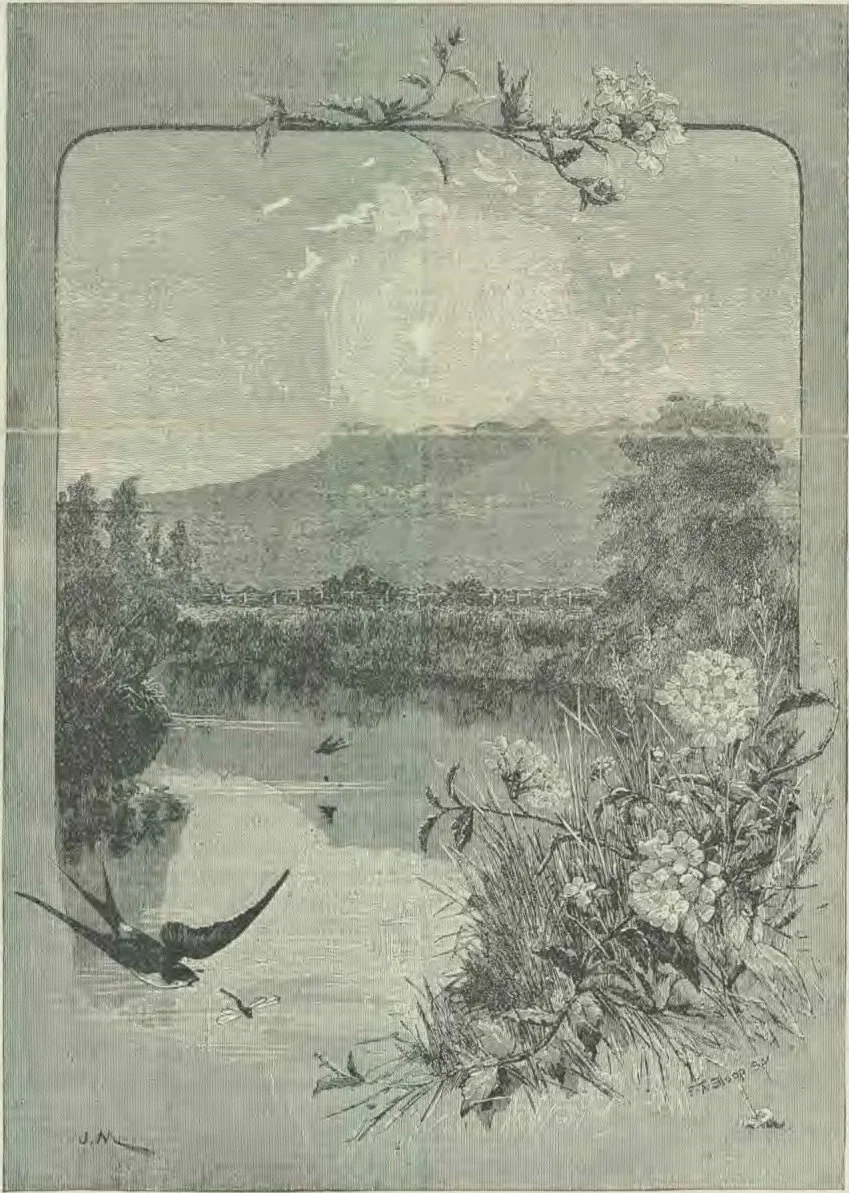
We present on this page a picture of another little stream near Christchurch, known as the Heathcote. The word “cote” has one meaning which is, “to go side by side with;” hence “to pass by.” Along the river are found quantities of an evergreen plant which bears the pretty little “heath flower;” and because the river runs by the side of, or passes by, so much heath, it has been named Heathcote. At the point from which our sketch was made, from near what is called the Ferry Road, the stream is very quiet; but as the course of the river is followed up between the high hills seen in the distance, it is more disturbed and rapid in its race toward the Avon, into which it discharges its water near the mouth of that stream.
There are some very beautiful places in this world; but none that are absolutely perfect, because sin is found in them. No earthly scenery can satisfy the one great desire of humanity—a place where sickness and sorrow will never come. Such a place has never been known here since man lost Eden. But we can believe that those who are fortunate enough to be permitted to dwell in the final home of the blest will behold scenes that for beauty and loveliness far surpass anything this world affords. We have read of the river of life over there, with the tree of life growing on either side of it. We have also heard of the inhabitants of that country—Abraham, Isaac, and Jacob, and all the prophets—and some of us have started on the journey to that place to meet them. How many will succeed in reaching it? This is a question that every one must answer for himself. Each one must, with the help of Christ, work out the problem of his own salvation. It will be far pleasanter to meet there, and behold the earth robed in Eden beauty, than to see the best sights it contains in its present condition. Let all strive to be found there. J. O. C.

OUR LITTLE GRIEFS.

The train stopped suddenly between two stations. Several of the passengers rushed out of the car excitedly, and came back with the tidings that there was an obstruction on the track which would cause the delay of an hour.
The countenances of most of the passengers instantly fell into depths of gloom and despair.
“This is simply intolerable!” muttered one middle-aged man to his companion. “I shall not reach the city before the market closes. It will cost me two or three thousand dollars.”
A physician dropped his newspaper, and paced impatiently up and down the car. “An hour late with all my patients!” he exclaimed.
“Are any of them in immediate danger?” asked a by-stander.
“No. But an hour late! It is unbearable!”
A young girl looked at her companions with tears in her eyes. “I am going into town for the trimming for my dress. Now it will not be done in time. I shall have to wear my old blue to the party.”
A short, pompous old man talked loudly and incessantly, scolding conductors and brakemen, as if they were personally responsible for the delay.
“I am to lecture this afternoon before the Lyceum,” he explained, in hot indignation. “The audience will have to wait twenty minutes!”
A young man sat immovable, his head bent upon his breast, his face set and hard. “My little boy is dying,” he said to some one who questioned him. “I was telegraphed for. I shall not see him alive.”
But while, with most of the passengers, there was a secret conviction that the wheels of the universe had stopped because they were delayed in their pursuits or work, one woman sat silent and tranquil.
She was near the end of a long life of pain and hardship and wide experience. She had come, too, near enough to the God who rules over all lives to understand how every event and accident, great or little, has its place and purpose in the eternal order, as have motes floating in the sunshine. She was close enough to the great change where life is swallowed up in death, to see how little was the old ball-dress, or the fall of stocks, or even the loss of an hour with the dying child.
“One of the most singular studies in life,” says Bouchet, “is to note how different men, each with his own scales, weigh the same objects, and attach to them different values.”
The lost bit of finery which brought tears to the eyes of the school-girl was lighter than a feather in the eyes of the stock-broker; and his loss of thousands was contemptible to the man whose child was going from him into the grave without a word; and doubtless even his pain seemed momentary and trivial in the vision of angels, to whom a thousand years are as a day.
How, then, are we to find the true weight and value of things in the world?
In the United States Mint, when they built a machine for weighing coin with absolute accuracy, they sank a shaft deep into the earth and through upper formations, which are shaken by passing jars, and rested the foundation upon the immovable granite beneath.
The man who digs in this way to find a foundation for his life, through the flowers and surface growths, which shake with every storm, to the everlasting Rock below, only can weigh the events and belongings of the world at their real value.—Selected.

WHILE WE HAVE TIME.

“We ought to stop in and see Helen Marsh,” said Mary Lee to her school-mate, as they walked home at noon.
“Dear, I cannot bear to see any one who is in such distress,” said Janet Harrow.
“I know it is hard,” said Mary, “and I never know what to say.”
“We have so little time just now.”
“Yes, but this day after her mother’s funeral must be such a trying one to her, and we can show that we are thinking of her in her trouble, and that will be something.”
The door was opened to them by a sad-faced girl, who looked to her young friends as though years might have gone over her head since they had last seen her as one of the merriest among them.
“Perhaps you are busy,” said Mary, as she led them in. “It is not exactly the time of day for a visit, but we wanted to let you know that we did not forget you.”
“Yes, I am busy, but not too busy to be glad to see you.”
“When are you coming back to school, dear?” asked Janet.
“I don’t know,” said Helen, with a sorrowful shake of her head. “I find more to do here at home than I ever dreamed of before. And I used to let mother do it all,” she said, bursting into sobs which shook her whole frame.
“Why, Helen,” said Mary, anxious to say something comforting, “you were in school—you had so much studying to do. You had no time for helping.”
“So I used to think, but I can see it differently now. And it seems to me that I would gladly give half of my life if I only had the chance of helping her. And I never, never can—and sometimes I think that perhaps if I had, she might be here now.”
“Dear Helen,” said Mary, greatly moved by her friend’s distress, “you must not think so. God knew when to take your dear mother.”
“Yes,” said Helen, “and all my thinking what I might have done is of no use now.”
“O girls,” she said, as they bade her good-by, “do be thankful that it is not too late for you to help your mothers. If I only could see my mother smile, and hear her loving words, it seems as though I would never think anything hard again.”
Little was said by Helen’s friends as they walked toward their homes. Janet’s heart was full, and she felt as though she could not wait for an opportunity to throw herself into her mother’s arms and speak to her of what she felt.
But as she drew near the gate, she saw her mother stepping into a buggy which stood there.
“It is an inconvenient time for me to be going away,” she said to Janet, looking into her face as if in fear of some petulant objection, “but little Dolly has been taken sick, and your Aunt Eleanor wants me to see her. I will come back as soon as I can. The dinner is all ready for you and father and Will to sit down; and, Janet, my dear, be sure and keep those crab-apples warm on the back of the stove. I was just ready to make the jelly. Good-by, my daughter.”
Janet had been marking the lines of care in the dear, patient face as she talked, and as the buggy drove away, she turned into the house with a feeling of discontent.
She had wanted to begin at once to show how she intended to help her, and now she was gone, and things looked cheerless and comfortless without her. Father evidently thought so; for he hurried away as soon as dinner was over.
“It seems lonely,” said Will. “I wonder what we’d do if mother was away every day.”
Janet was looking at the dishes on the table, thinking how she hated to wash dishes. But Will’s words recalled something Helen had said.
“I’ll have everything done by the time mother comes back,” she said. “I’ll run and take off my school dress. I can always work better when I go at it thoroughly.”
“O Will, won’t you see if the fire is all right to keep the crab-apples hot till mother comes?”
Returning to the kitchen, she found Will looking at a row of glass jars.
“It’s a pity mother couldn’t have finished her jelly before she had to go,” remarked Janet. “She will be so tired when she comes back.”
“Why don’t you make the jelly?” asked Will.
“I? Why, I never made jelly in my life.”
“It’s time you did, then, isn’t it?” said Will, bluntly, but not unkindly. “Doesn’t the cook-book tell all about it?”
“Sure enough,” said Janet, running to look at it. “Yes, here it is—as much sugar to so much juice. Why, Will, wouldn’t it be delightful to have it done when mother comes?”
“Delightful to her, I guess,” said Will. “I’ll help.”
His stout hands gave valuable help in the squeezing. Janet let the other work wait until the jelly was made, and then she declared she was so taken up looking at the glasses of bright-colored jelly that she could scarcely wash the dishes. Will brought a towel to wipe them as she washed, and both made such good use of their time that the kitchen was in perfect order, and Janet had changed her dress again, and was busy over her geometry when mother drove up to the door.
“How is little Dolly, mother?”
“Doing well now, but Eleanor was too frightened about her to let me come away before.”
“Don’t put on your kitchen dress again, mother,” said Janet. “You must not do any more work to-day.”
“Yes, I must, dear; there is that jelly. Oh, did you keep the crab-apples hot, as I told you, Janet?”
“No, mother, I didn’t.”
“Dear me! Will, do bring some light wood. Perhaps they will do warmed up again.”
But she stopped at sight of the clean kitchen and the jelly glasses, with a smile on her face which it did Janet good to see.
“Everything done!”
“Now, come and rest, mother,” said Janet, taking her arm.
“My dear daughter, what a comfort and blessing you are to me!”
The words were very sweet to Janet.
“And I’m going to deserve just such words and many more such, if God will only let me keep my mother,” was her inward resolution.—Sydney Dayre.

RAILROAD MAIL SERVICE.

If the Instructor boys and girls could see the mass of letters and papers that are sent from the different towns every day, they would wonder where it was all going to. And then, no doubt, they would try to imagine how very, very busy it must keep the men who handle the tons of mail that go over the road every day. There are very many busy and hard-working men in the world; but I suppose that the railroad postal clerk, while he works, is as busy and works as hard, as the most diligent man among them. Indeed, the work is so hard that a clerk can work only two days at a time; then he is obliged to rest two days.
One of these postal clerks, in writing in the United States Mail, says: “The truth of the matter is, that when the boys are at work, they labor so hard and during so many hours that when laying-off time comes, they are completely used up.”
The writer then gives a very interesting account of the mailing-clerk’s work:—
“When a man is on duty, he has to work between seventeen and twenty-two hours out of the twenty-four. The longest run is between Chicago and Minneapolis, which is twenty-two hours; and during that time there is no rest for anybody, unless the crew is an exceptionally smart one and the mail light. In that case the men can get a couple of hours’ sleep.
“This postal work is of the hardest kind; for it requires both mental and physical exertion. A man must be able to tell in what county every post-office in three, four, or five different States is located, and know what railroad junctions and connections are to be made, in order to get a letter to its destination in the shortest time. He must be able to stand up before a case of, say, seventy-five boxes, while the train is in motion, and distribute the letters at the rate of from ten to twenty a minute, and keep it up for hours. He must also have the strength to handle two or three tons of pouches and sacks, which weigh, when full, from seventy-five to one hundred pounds apiece. On the average run, there is about nine tons of mail matter, although we carry as much as fifteen tons on heavy runs.
“Every mistake a man makes in the distribution of letters and papers or in the dispatching of pouches is recorded on a slip of paper, and sent to headquarters, where the error is charged up against him. It is an excellent plan; for the slip is then given to the clerk, and he learns just how he made the error, and usually the same mistake is not repeated. Some of the old clerks only make ten or fifteen errors a month, while new ones will run up to one hundred or one hundred and fifty. Why, we are obliged to work so hard to keep up with the changes of post-offices and connections which are made every week that we don’t have time to think of anything else. I even have to keep my wife busy when I am home examining me on these points.
“How do I tell at night when we are nearing a station where we don’t stop, and where mail is to be caught? Oh, I have been on my run so long that I can tell by the curves of the road and the motion of the train just about where we are.”
Not so very many years ago; one person afoot or on horseback could carry all the mail from one town in his hat or coat-pocket. Certainly we should appreciate the increased facilities we have of communicating with each other. And, too, how thankful we should be that God has in this way better enabled us to spread the light of the gospel and his coming kingdom to those who are ignorant of it!
E. W. WEBSTER.

THOUGHTS FOR SEPTEMBER.

A MONTH of golden fruit and ripened grain, Of skies and peaks that melt in mists together, And streams that sing in murmurs soft and low, A tender requiem for the summer weather. —Mrs. Jordan.
A pleasant look has she, Such as the children love to see upon Their mother's face when they her smiles have won. Let others choose their love—September pleases me. —Thomas MacKellas.
O sweet September! Thy first breezes bring The dry leaves rustle and the squirrel's laughter, The cool, fresh air, whence health and vigor spring, And promise of exceeding joy hereafter. —George Arnold.
The song birds leave us at the summer's close; Only the empty nests are left behind, And pipings of the quail among the sheaves. —Longfellow.
O your asters, purple and gold, I read their mystical meaning well; They symbol the world with their purple and gold, The gay, gay world with its glittering spell. —Norah Perry.
The lands are lit With all the autumn blaze of golden-rod, And everywhere the purple asters nod And bend and wave and flit. —Helen Hunt.

NOT SO FAST.

“O MAMMA!” cried Blanche, “I heard such a tale about Edith. I did not think she could be so very naughty. One—”
“My dear,” said her mother, “before you tell it, we will see if your story will pass three sieves.”
“What does that mean, mamma?”
“I will explain it. In the first place, let me ask about your story, Is it true?”
“I suppose so. I got it from Miss White, and she is a great friend of Edith’s.”
“And does she show her friendship by telling tales of her? In the next place, though you can prove it to be true, Is it kind?”
“I did not mean to be unkind, but I am afraid it was. I would not like Edith to speak of me as I have of her.”
“And, Is it necessary?”
“No, of course, mamma; there was no need for me to mention it at all.”
As we put flour through sieves to get the good apart from the bad, so let us ask, when we are going to say something about others, these questions: “Is it true?” “Is it kind?” “Is it necessary?”—Selected.

THE THIRD ANGEL'S MESSAGE.

LESSON 15,—THE WORKING OF SATAN.

1. What will be said to the people just before the Lord comes? Isa. 8:19, with verse 17.
2. What is the object of their seeking unto them that have familiar spirits? Ans.—To obtain communication with the dead. Verse 19, last part.
3. What is that doctrine called? Ans.—Spiritualism.
4. Do the dead know anything? Eccl. 9:5, 6.
5. What are the familiar spirits which these persons have, and with which men are invited to communicate? Rev. 16:14.
6. What have we found to be one great object of these miracles and lying wonders? Rev. 13:14.
7. What does this prove? Ans.—That Spiritualism will act a most important part in making the image to the beast, and enforcing the worship of the beast and his image.
8. When the National Reformers secure their National Constitutional acknowledgment, what do they expect? Ans.—“Let us acknowledge God as our father and sovereign, and source of all good, and his blessing will be upon us. Crime and corruption will come to an end, and the benign reign of Jesus, our rightful Lord, will be established.” “Either like them [the Jews] we will reject him and perish, or, becoming a kingdom of our Lord and his Christ, we shall fill the earth and endure forever.” “And when we reach the summit, . . . the train will move out into the mild yet glorious light of millennial days, and the cry will be raised, ‘The kingdoms of this world have become the kingdoms of our Lord and his Christ.’”—New York National Reform Convention, 1873, pp. 42, 75, 47.
9. When they shall have set up what they call his kingdom, what then do they expect? Ans.—“When we finish our testimony, then Christ will come and finish his work.”—Secretary J. M. Foster, in Reformed Presbyterian and Covenanter, December, 1887, p. 403.
10. By whom will there be great signs and wonders wrought to deceive? Matt. 24:24.
11. Who will finally manifest, and work with, all power? 2 Thess. 2:8.
12. As these great wonders are to be wrought by false Christs, and as Satan is to work the greatest of them, then in what form will Satan present himself in this? Ans.—In the form of a false Christ.
13. When the National Reform kingdom shall have been formed, and Satan, by this great wonder-working power, shall be transformed into an angel of light, and thus shall come personating Christ, then what will be the universal shout? Ans.—“Christ has come!” “The kingdoms of this world have become the kingdoms of our Lord and of his Christ.”
14. Then who will be the king of the National Reform Government?
15. Is Spiritualism expecting such a new messiah? Ans.—Spiritualism promises a new messiah, and announces his coming “to this very generation.” The World's Advance Thought is the avant-courier of the new spiritual dispensation, and in its issue of April 5, 1886, says:—“Another son of righteousness is called for on earth, and the messenger cannot be far off whose life mission it shall be to practically illustrate the new truths that will be vouchsafed. He will not be a mere radical messiah, nor a half-world messiah, as was the great Nazarene; but steam locomotion and lightning communication, and the harmonizing influences of commercial intercourse, have made a whole-world messiah possible, and such the next one shall be. Though themselves ignorant of the fact, as a body, the great and multiplying army of mediums are his avant-couriers.” “The unanimity of the immortals’ answers may thrill the world with the promise of a new messiah.”
16. What says infidelity? Ans.—“Now I think I can safely say that if the National Reform movement succeeds, and God will sign and seal his edicts, so that there can be no doubts about their authority, the disbelievers will cheerfully obey them; and if Jesus will come and sit visibly on the throne, where we can see and talk to him, there will be no unbelievers, and all will obey.”—P. F. Shoemaker, Flat Creek, La., in a letter to the editor of the American Sentinel, Sept. 17, 1887.
17. What says the National W. C. T. U.? Ans.—“The Woman's Christian Temperance Union, local, State, national, and world-wide, has one vital, organic thought, one all-absorbing purpose, one undying enthusiasm, and it is that Christ shall be this world's king. Yes, verily, this world's king in its realm of cause and effect; king of its courts, its camps, its commerce; king of its colleges and cloisters; king of its customs and its constitutions.”—Union Signal, December 1, 1887, p. 2.
18. Taking all these with the other different bodies that now favor the National Reform movement, and how general will be the acceptance of the king of the National Reform government?
19. What have we found is given to save men from this terrible deception?
20. Then who alone will refuse to acknowledge the National Reform king? Ans.—Those who receive the love of the truth of the third angel's message.

MARS

It is generally held by the best observers that the surface of Mars consists of land and water; that the poles are surrounded by snow-caps, melting in summer, and growing larger in winter; that fogs often conceal the plains from view; that clouds are carried hither and thither by the wind; that storms rage, and fierce winds blow, and that rosy dawns, sunny noons, and gorgeous twilights diversify the Martian landscape.
Every continent, island, and sea has been named, and Martian maps and globes are as familiar to astronomers as are terrestrial maps and globes.
A discovery of exceeding interest was made in 1879 by M. Schiaparelli, an Italian astronomer. He perceived what, for want of a better term, he called canals, running like a network over the Martian surface, connecting sea with sea, different portions of the same sea, or uniting with other canals. Observations made in succeeding years showed that some of the canals were traversed by parallel lines; the canals were double! Other astronomers confirmed this discovery.
At the latest opposition of Mars, on April 11th, when the planet was nearest to us, and seen to the best advantage, M. Perrotin, Director of the Observatory of Nice, renewed his observations in the same field with wonderful results. He found that while many of the canals seen in 1888 resembled in general features those of 1886, some were fainter, and some had disappeared.
M. Perrotin's observations upon the surface of Mars were more wonderful than those upon the canals. He found the continent Lybia entirely submerged. Plainly visible two years ago, it has been engulfed in the surrounding sea. Lake Moeris, in its vicinity, has vanished from sight.
The extent of the region whose aspect has thus changed is a little greater than the surface of France. A new canal has appeared twenty-five degrees north of the submerged continent, and another canal on the white spot that marks the north pole.
M. Perrotin is a worker who inspires confidence. His reports are faithful transcripts of what is revealed to his practiced eye with the aid of a telescope of fine definition, in the exceptionally clear atmosphere of Nice.
The meaning of these changes is a problem yet to be solved. The submerging of the land may be due to inundations, but how can the duplication of the canals be accounted for?
The next opposition of Mars occurs in 1890, and it will be safe to say that no pains will be spared to gain further tidings of our ruddy neighbor.—Companion.

WASHINGTON MONUMENT.

The site of the Washington Monument was selected by Washington himself; not, however, to commemorate his own fame, but as a memorial of the great struggle by which our country's independence was secured.
Washington died December 14, 1799, and ten days later Congress resolved to erect a monument to commemorate the events of his military and political life. The poverty of the country prevented the immediate execution of the project, and in a little while men's thoughts were engaged by more pressing matters. In 1833 it was thought a public disgrace that nothing had been done to carry out the early resolution to recognize by a monument the great debt of the country to Washington, and the National Washington Monument Society was formed to raise money for the purpose by popular subscriptions. Fifteen years passed before enough money had been collected to begin with, and then—July 4, 1848—the corner-stone was laid. During the next eight years a foundation 80 feet square and 23 feet deep was laid, and a shaft 55 feet square was raised to the hight of 156 feet; this at a cost of $266,000. Then the project came to a practical standstill for twenty years.
In the summer of 1876—the Centennial year—a joint commission was created to supervise the completion of the monument, and $200,000 were appropriated to carry on the work. Work was not resumed until October, 1878. It had now been decided to raise the monument to five hundred feet or more, making it necessary to enlarge and strengthen the foundation. A large part of the old foundation was removed, section by section, and replaced by stronger masonry. Then a great trench or cellar was dug under the foundation and filled in with concrete, adding greatly to the depth of the foundation; and the foundation was further extended outward on the four sides, making it 126 feet square. This work of rebuilding and enlarging the foundation of a structure 156 feet high, and weighing over seventy million pounds, was a bold and admirably executed piece of engineering.
The monument was completed December 6, 1884. It is built of Maryland marble with a backing of granite, mostly from Maine. Above 450 feet the shaft is entirely of marble. The monument overtops the highest Egyptian pyramid by eighty feet. Its nearest rival in height, though not in magnitude, is the tower of the Public Buildings in Philadelphia. The next is the tower of the Cathedral of Cologne, 511 feet. Strasburg Cathedral spire is 468 feet high; St. Peter's, at Rome, is 448 feet; the Milan Cathedral, 355 feet.—Golden Days.

HARVESTING ANTS.

THE harvesting ants belong almost exclusively to a single genus, which, however, comprises a number of species distributed in localized areas over all the four quarters of the globe. Their distinctive habits consist in gathering nutritious seeds of grasses during summer, and storing them in granaries for winter consumption.
Moggridge, one of the most careful students of the ways of the ant, found that from the nest in various directions there proceed outgoing trains, which may be thirty or more yards in length, and each consisting of a double row of ants moving in opposite directions. Those composing the outgoing train are empty-handed, while those composing the incoming train are laden. At their terminations in the foraging ground, or ant-fields, the insects composing these columns disperse by hundreds among the seed-yielding grasses. They then ascend the stems of the grasses, and, seizing the seed or capsule in their jaws, fix their hind legs firmly as a pivot, round which they turn and turn till the stalk is twisted off. The ant then descends the stem, patiently backing and turning upward again as often as the clumsy and disproportionate burden becomes wedged between the thickly-set stalks, and joins the line of its companions to the nest. I have occasionally seen ants, engaged in cutting the capsules of certain plants, drop them, and allow their companions below to carry them away.
As further evidence that these insects well understand the advantages arising from the division of labor, I once saw a dead grasshopper carried into the nest of harvesting ants by the following means: It was too large to pass through the door, so they tried to dismember it. Failing in this, several ants drew the wings and legs as far back as possible, while others gnawed through the muscles where the strain was greatest. They succeeded at last in pulling it in. These ants will also, on a long road to the nest, establish a series of depots, the stores being transferred from one depot to another by regular bands of workmen.—Exchange.

AN ANCIENT STONE.

In the National Museum of the city of Mexico, there is a large round stone carved with many strange figures. This is the temalacatl, or sacrificial stone of the ancient Aztecs. It is about eight and one-half feet in diameter, twenty-seven and one-half feet in circumference, and nearly three feet high. It was made by order of Tizoc, king of the Aztecs, somewhere between the years 1481 and 1486. It was placed in the center of the court in front of the temple of Huitzilpochtli, “god of the sun,” “god of the air,” or “preserver of mankind,” as he is variously called. Around the outside of the stone are fifteen groups of two persons each in relief. They were originally painted in yellow, red, green, carmine, and black, and commemorated King Tizoc’s victories. The face of the stone is a hieroglyphic representation of the sun. In the center is a round bowl from which a channel runs to the edge of the stone. In the ancient rites, which were those of human sacrifice, three priests stood over this stone, one clothed in a tiger’s skin, one in a lion’s, and the third in that of an eagle. The chief of these tore out the heart of the victim, and then burned it in the holy fire, which was never suffered to go out. Tizoc is said to have killed on this stone one hundred victims with his own hand. The Aztecs were more anxious in war to make prisoners than to kill. These prisoners of war were used as sacrifices to the gods. Ten thousand of them were said to have been slain on the day of the inauguration of Huitzilpochtli’s temple.—Well-Spring.

HOW LEAVES CHANGE THEIR COLOR IN AUTUMN.

A BOTANIST thus describes how the leaves change their color in autumn. He ridicules the belief that frost has anything to do with it: “The green matter in the tissue of a leaf is composed of two colors—red and blue. When the sap ceases to flow in the autumn, and the natural growth of the tree ceases, oxidation of the tissue takes place. Under certain conditions the green of the leaf changes to red; under different conditions it takes on a yellow or brown tint. This difference in color is due to the difference in combination of the original constituents of the green tissue and to the varying conditions of climate, exposure, and soil. A dry, cold climate produces more brilliant foliage than one that is damp and warm. This is the reason that our North American autumns are so much more gorgeous than those of England.”—Sel.

THE NAUGHTY FAIRIES.

There are two or three naughty fairies Who lurk in our pretty house, They are sly as the wily foxes, And one is as still as a mouse, And one can growl and mutter, And one has a chain on her feet, These naughty and mischievous fairies, Whom you may have happened to meet.
The still-as-a-mouse one whispers When a bit of work must be done, “Oh! just let it go till to-morrow, And take to-day for fun!” And the mutter-and-growl one pricks you Till you pucker your face in a scowl, Or whimper and fret in a corner, Or stand on the floor and howl.
But the worst of the three bad fairies Is the one with the chain on her feet, And the strangest thing is her fancy For a child who is gay and sweet. She makes her forget an errand, And loiter when she should haste, And many a precious hour She causes the child to waste.
Should you happen to see these fairies, Please pass them proudly by With lips set close and firmly, And a flash in your steadfast eye; For three very naughty people These little fairies be, Who mean, wherever they're hiding, No good to you and me.
—Harper's Young People.
Continue reading: A WONDER-WALK