Pacific Press Publishing Company · New York · Feb 6, 1896
STATE GUARDIANSHIP OF MORALITY.
The State, in whatever its agency appears, stands for force—compulsion. The State exists not to give advice, not to persuade, but to define and enforce. Within the sphere of its action, individual option is done away.
It is quite generally assumed that one proper function of the State is to be the public guardian of morality. But in this assumption lies the possibility of untold evil.
What is “morality”? What authoritative standard have we, outside of the word of Omniscience, by which to determine it? There are various standards among men, but these differ one from another. What is considered moral in one country is regarded as immoral in another. Not even in the same community do we find one standard adhered to by all individuals.
There are, it is true, many acts, the immorality of which would nowhere, in civilized lands at least, be called in question. And the terms “moral” and “immoral” have come to be commonly used with reference to such acts, indicating a vicious nature rather than one that is simply irreligious. But no certain boundary line is known, in the public mind at least, separating between what is vicious and what is “irreligious.” And when human legislation sets out to deal with acts upon moral grounds, it can find no logical stopping place short of religious despotism.
State guardianship of morality means enforced morality,—morality as defined by the State and accepted as such by the majority of the people. And what will be viewed as moral or immoral will depend very largely, if not wholly, upon the form of the prevailing religion. The State will naturally turn to the Church for enlightenment upon questionable or controverted points.
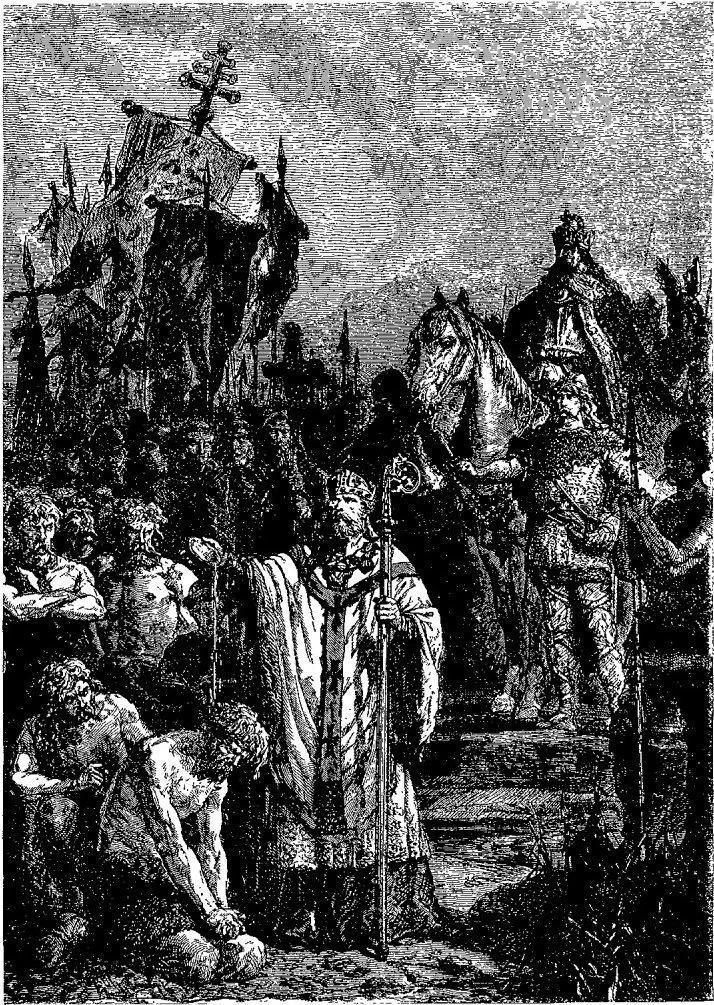
From the assumption that the State is the properly-constituted guardian of morality, it is but a short step to the position that the State should also “protect” religion,—that religion, of course, which is the prevailing one. Religion and morality are found to be too closely connected to admit of dealing with the interests of one separately. When the State “protects” religion, it does so, of course, with a view to the highest welfare of its citizens. In that view force comes to be considered of value as a means of serving the interests of the soul. This was the view commonly entertained not many centuries in the past. Our illustration, “Charlemagne Inflicting Baptism upon the Saxons,” whom he had conquered in battle, is thoroughly characteristic of the times in which this theory prevailed. The unfortunate Saxons did not comprehend the doctrine of baptism, nor, as their looks show, were they at all anxious to be baptized; but the conqueror inflicted the rite upon them, doubtless having in view the glory of God and the salvation of their souls. As the historian relates, also, he did this with especial reference to the preservation of the peace and prosperity of the State.
Among the acts which are counted immoral by many to-day, is the violation of the “Christian sabbath;” in other words, the act of performing ordinary labor upon the first day of the week. The doctrine of State guardianship of public morality is held to include the enforcement of the observance of this institution by compulsory rest upon that day. There is a growing demand for more and stricter legislation to this end. But the Sunday sabbath, when enforced as now demanded, will be as great and as useless an infliction upon the people as was Charlemagne’s “baptism” upon his Saxon prisoners.
As we have before observed, there is no rest in compulsory idleness. Voluntary idleness is bad enough, but compulsory idleness is ten times worse. The promoters of compulsory Sunday observance will not be satisfied with a law which enjoins merely cessation from work and amusement, for they do not aim at the result which would follow from this alone. The evil of enforced idleness must finally result in a demand that the people be brought into the churches, where they may receive the benefit of religious services. It will be found that to enforce idleness is not to guard morality, but to promote immorality; and a religious observance of the Sunday will be viewed as a logical necessity of the situation.
Charlemagne Inflicting “Baptism” upon the Saxons.
But with what grace will the individual who wishes to be free to go about his work or engage in some amusement, proceed with an enforced religious observance of the “sabbath” day? The same, evidently, as that with which Charlemagne’s Saxons submitted to the rite of “baptism;” and the effect will be of the same nature and value in the one case as in the other.42
The truth is, that the State has no concern with morality, as such. The true American doctrine of the proper office of the State is set forth in the Declaration of Independence, where it is held as a self-evident truth that men “are endowed by their Creator with certain unalienable rights; that among these are life, liberty, and the pursuit of happiness;” that governments are instituted among men to preserve these rights. The State, therefore, by this doctrine, considers an act not with reference to its morality or immorality, but as being either subversive or not subversive of human rights. And when it cuts loose from this doctrine, and proceeds to deal with questions of morality, religious legislation soon follows, and despotism is the inevitable outcome.
Let the State keep upon the safe ground marked out in the Declaration of Independence, concerning itself only with that which relates to the preservation of the rights of its citizens, and leaving religion wholly free to do its work of uplifting and regenerating mankind.
A DEMORALIZING SYSTEM.
By Editor
THE AMERICAN SENTINEL does not hold that it is the duty of government to teach morals in the proper acceptation of that term. But while this is true it is certainly the duty of government not to foster immorality by putting a premium upon those things which are demoralizing.
We are living in an era of “reform” when the “better classes” are demanding “decent municipal government.”
New York City has been living under a “reform” régime for something over a year, and much good has certainly been accomplished; and for this all good citizens ought to be thankful. But while some good has been done not a little evil has likewise resulted.
The zeal of the police authorities to execute the excise and Sunday statutes has led them to acts that are more demoralizing than the things they have sought to suppress.
A few facts will illustrate this matter. As recorded in these columns a few weeks ago, a policeman, zealous for “reform,” and incidentally for promotion, went into a tobacconist’s where cigars were sold from one counter and stationery from the other. The “law” permits the sale of manufactured tobacco on Sunday, but does not permit the sale of paper or other stationery. This officer professed to be very anxious to write a letter, and induced the clerk to sell him a sheet of paper and an envelope for three cents, and then arrested the young man and dragged him off to the police station for violating the Sunday law!
Another police spy secured admittance to a small store on Sunday, and by representing to the proprietor that his wife was without a pair of stockings to go to meeting, as she happened to have none clean, induced the tradesman to sell him a pair of hose. Of course the accommodating merchant was arrested.
These particular arrests were made some time ago, but they are only samples of cases that are occurring all the time. No longer ago than the small hours of the morning of the 26th ult., a policeman, disguised as a sewer workman, with rubber hip boots, an old sou’wester, and a dirty rubber coat, induced a watchman to let him have a drink of whiskey from his private flask, and finally to sell it to him, on the ground that he was sick and suffering from a chill and stood very much in need of the stimulant. No sooner was the transaction finished than the watchman was arrested on the double charge of giving away liquor and of selling it contrary to law.
The AMERICAN SENTINEL has no sympathy whatever with the liquor traffic nor with the use of intoxicating liquors as a beverage. Nor have we any sympathy with the idea that a man needs whiskey because he chances to feel a little cold. Nine times out of ten a cup of hot water or a little lively exercise would do much more good. But the question of the man’s real need does not enter into this case. Whiskey is supposed by many to be a panacea for nearly all the small ills and discomforts incident to humanity; and it is certain that this sale of liquor was made by this watchman not with any intent to violate any law, but only at the earnest solicitation of a “man” who represented himself as being in a suffering condition.
The watchman was held for trial for violation of the law? The disguised policeman ought to be discharged in disgrace from the force. The man who induces another to commit crime is himself a criminal; if not always in the eyes of the law, he certainly is in fact and in justice; and a guardian of the peace who will stoop to such means to “detect” crime in order that he may arrest the “criminal” is certainly not a man to be trusted to guard the lives and property of the people. Such work is more demoralizing than would be the real crime which the law is designed to prevent.
One of the worst features about this latter case, is that the officer is said to be quite “pious.” And as this procurer of “crime” professes faith in the Bible, we earnestly commend to his attention the text which says, “All liars shall have their part in the lake which burneth with fire and brimstone: which is the second death.” And also that other text, which, describing the New Jerusalem, the city of the redeemed, says: “There shall in no wise enter into it anything that defileth, neither whatsoever worketh abomination, or maketh a lie.”
The New York police force cannot be purged of such creatures too soon, nor will the civil atmosphere be fit for honest men to breathe until the system which puts a premium upon such “detective” work has given place to one which will tend to preserve the self-respect and manhood of the guardians of the peace.
PLAUSIBLE AND DANGEROUS TEACHING.
By Editor
It may seem to some readers of the SENTINEL that its efforts are largely expended in fighting a dragon of straw,—in pointing out and opposing sentiments and purposes which are not seriously entertained by men of prominence and influence among the people. It is this ignorance on the part of so many that constitutes one of the gravest features of the situation. While the custodians of liberty sleep in the fancied security of their treasure, insidious foes are rapidly doing their work of invasion and spoliation. Counterfeit principles are being everywhere put in circulation, which are accepted by the people as the true principles of liberty and justice. Already the logic of propositions, “laws,” and judicial decisions in which the people seemingly acquiesce, demand the surrender of the birthright liberties of American citizens.
Some propositions which show what is being widely taught and accepted as sound doctrine concerning things which have to do with the liberties of the people, occur in an article by Rev. Christopher G. Hazard, in the Evangelist (New York) of January 23, entitled, “Why Does Society Enforce the Sabbath?” We present them for the reader’s consideration.
“It is the State,” says Mr. Hazard, “that has made sabbath law, and it is the State that is enforcing it. The State has deliberately adopted a large part of the Decalogue, and the fourth commandment has been included in that part adopted. To this extent society has set up the Hebrew State, and is resolved to maintain it.” If this be true, it is time that the people should fully understand the fact, and its significance.
Can the State rightfully adopt and undertake to enforce a part of the Decalogue? Can the civil power properly undertake to enforce a spiritual law? “We know,” writes Paul, “that the law is spiritual.” Rom. 7:14. The Saviour in his sermon on the mount showed in commenting upon the commandments forbidding killing and adultery, that they reach even to the thoughts of the heart. Hence if the State is to enforce this portion of the Decalogue, it must have some means of getting at the thoughts of a person’s heart. And this the civil authorities tried to do back in the Dark Ages by means of the rack, thumbscrew, and similar instruments of the “holy Inquisition.” Are we ready to grant that the State is authorized to pursue a similar course to-day?
But it may be answered, no one claims that the State laws against murder and adultery are violated by mere thoughts in such directions, but only by overt acts. Very well, then, such State laws are not a portion of the Decalogue. In other words, they are not laws against sin, but against crime. They forbid the overt act, as a violation of human rights; while the laws of the Decalogue forbid both the act and the thought that is back of it, as a sin against the Creator.
As concerns the fourth commandment, that precept of the Decalogue is certainly no less spiritual than are the sixth and the seventh. Like them, it cannot be kept by mere outward conformity to its requirements. And so far from having power or authority to enforce this part of the Decalogue, the State has no authority even to enact a law of its own against Sabbath breaking. It has no authority even to define what the Sabbath is. If it has such authority, then it can also define what constitutes baptism, or the celebration of the Lord’s supper.
But we are told further by the above-named writer, that “as moral law, the Sabbath has civil value. It has been well said, that where parents are dishonored, society cannot continue, and that therefore no man’s days can be long in the land; and to this may be added that where the Sabbath is dishonored, morality cannot continue, and the prosperity of the State cannot follow.” This sounds plausible, certainly; but there is nothing in it beyond the sound. It amounts simply to this: Morality as a feature of individual character has a civil value. Certainly it has; but does it follow from this that the State should undertake to enforce morality? Conversion—making a bad man good—has a very high civil value. Converted, the thief ceases to steal, the violent man to assault and murder, the forger and counterfeiter to cause financial loss and disorder; in short, if all the bad men were only converted, and would remain so, we would not need a police force, society would be safe, and incalculable trouble and loss would be avoided. But does it follow that the State can properly undertake the work of changing men’s hearts? The psalmist said, after he had grievously sinned, “Create in me a clean heart, O God.” Ps. 51:10. That is what conversion is, and only He who has creative power can do it.
The State cannot compel children to honor their parents, save in appearance, and that43only to some extent. As well might it undertake to compel one person to love another person. No more can it enable or compel a person to keep the Sabbath. It can compel him to stop working; but as Mr. Hazard himself says, “The Lord emphasized the truth that the Sabbath is not the day of the do-nothing. It is not consecrated to idleness.” Idleness under the pretense of Sabbath keeping is mocking God; for God made the Sabbath “a delight” (Isa. 58: 13, 14.), a day of activity in worship and communion with him. What the State wants, on any and every day, is not more idle men, but more good men.
Nor is it true that “where the Sabbath is dishonored . . ., the prosperity of the State cannot follow.” For some men honor the seventh day, while others honor the first, and communities which do the former are certainly as orderly and prosperous as those which do the latter; yet one of these days cannot be the Sabbath. Nor does history give any warrant for believing that national prosperity is necessarily dependent upon the observance of any day of the seven.
We grant that the Sabbath institution is a human necessity; we believe it as strongly as any one can. And Mr. Hazard truthfully observes, “As well think to change God’s ordinance of night as God’s ordinance of the Sabbath.” But this is just what men have thought to do; for while God’s ordinance is, “The seventh day is the Sabbath of the Lord thy God; in it thou shalt not do any work,” men have changed it so that the world are now taught that the first day is the Sabbath; and Mr. Hazard and others would have this change sanctioned and enforced upon all persons by law. Of course, the Creator has not sanctioned and does not recognize any such change; for he was wise enough to make the Sabbath just as he wanted it and just as it would best serve the needs of mankind, in the beginning; and this all men will find out at the final day of reckoning. The Sabbath is a human necessity, as a spiritual institution. The physical-necessity argument is considered separately elsewhere in this paper.
Speaking of the law against Sabbath breaking in the time of the ancient Israelite theocracy, Mr. Hazard says: “There was no tyranny over conscience in the case, and there is none. In things moral and social the State has right over the conscience of the minority in it, to compel it.” Has the State such right? Are the American people ready to accept such doctrine? If they are, then the scenes of the Dark Ages are ready to be repeated in this land; for no worse principle was ever cited in justification of any act of oppression or prosecution.
Think of it: “In things moral, . . . the State has right over the conscience of the minority in it, to compel it”! Is this the doctrine that is to be gathered from the pages of history or of revelation, or deduced from reason, in the light of the nineteenth century? Is it a true saying, after all, that “might makes right”? Is the State to define morality? and not only that, but to compel the conscience of individuals in moral things, who happen to be in the minority? God himself does not undertake to compel the conscience.
The author of this proposition cites as an example under it the case of a man who has “a conscience distorted to fit stealing,” or “another” who “may fail to see the use and value of the Sabbath,” in which case, he says, the State will see it for him. But if a man should plead conscience for stealing, the State would disregard his plea not on the ground that his conscience was bad or that he was in the minority, but simply on the ground that he had violated human rights, which it is the purpose of the government to protect. The State would not make itself lord of his conscience; it would not concern itself with his conscience at all. It would simply take cognizance of the fact that the rights of some of its citizens had been violated, and as the appointed protector of those rights, its proper action in the matter would be clear, without any reference to the criminal’s plea of conscience.
It may be that the Rev. Mr. Hazard does not see that this doctrine of the right of the State to coerce the conscience of the minority, would hold as well in heathen lands as in our own, and hence would justify all the idolatry and wicked practices which are esteemed necessary and right by the majority in such countries; it may be that he does not see that it would justify all the persecutions carried on in Catholic countries, or any that the majority in this country might see fit to inaugurate; but it is none the less harmful for that.
We are told further that because the Sabbath appears to be “against men before it is seen to be for them,” “the State, like a wise father, enforces it first that it may be appreciated afterwards.” We do not acknowledge any such “father.” Our paternal needs are fully provided for by the “fathers of our flesh,” and our all-wise, all-powerful Father in heaven, who created them and us. We want no “father” created by a popular vote. We want no religion defined and approved by the civil power; we want no conscience instructed by it. We want no Sabbath keeping or appreciation of religious privileges by State direction.
Our conscience is our own,—the gift of God. His word—not the vote of the majority—is its guide. And as that word never directs any one to violate human rights, but enjoins love on the part of each toward his fellowmen, its guidance will be no menace to the peace and prosperity of the State. Majorities in this world have always been wrong in religious belief and practice; and we will “not follow a multitude to do evil.” We will take our religion from the Bible, and will obey also the laws of the civil power, save only when they are in plain conflict with the law of God.
WHAT IS FAITH IN JESUS CHRIST?
By Chas. F. Wilcox
BY CHAS. F. WILCOX.
The professed Christian world seem to be making one general move toward honoring Christ. Each denomination is vying with all others to do him the most honor. Some choose one way, and some another. But under whatever name, all claim to have one object, and that is that Christ shall be exalted. In view of this, is it not appropriate that we seek the reason for this, and ask in what manner it can be properly done?
Faith is the foundation of all action. Man’s effort is put forth for that in which he has confidence, based upon evidence. Christ has represented himself to the world as the only hope for mankind. Those who accept him act in harmony with his instructions, and thus he controls their lives to a greater or less extent.
Through confidence in the life and experience of Christ, through a study of the lessons he has left on record, man becomes educated in reference to his claims. If he has confidence or faith in these claims of Christ, he is guided by the principles and teachings of Christ, and his life will testify to the world that he is a disciple of Christ.
Now the question, Is the move to exalt Christ through an expression on the part of nations, as such, in harmony with his teaching? Unless it is, can it be said to be actuated by faith? and if it is not of faith, what is it? “Whatsoever is not of faith is sin.” Then any move to exalt Christ, that is not based on a “thus saith the Lord,” can be nothing but sin, for where there is no word of Christ, there can be no faith in his word.
Christ has said positively that his kingdom is not of this world. John 18: 36. This positive statement should forever silence him who would do honor to Christ by giving him an earthly throne. To believe Christ’s word is to have faith in him. And faith in this word will lead to obedience, and obedience will never cause one to seek to do that which Christ has said should never be done.
Faith in Christ will lead to a humble opinion of our own knowledge as compared with that of Christ. Whatever he says will be agreed to, whether understood or not. His word giveth light and when gladly received, it illumines the mind, and ere one is aware, he understands facts and truths that were obscure.
To-day the world is filled with popular denominations, popular churches, and popular preachers. Has faith in Jesus Christ built all these up to their present position? Is the good will of the world toward them an evidence that they have “the faith once delivered unto the saints”? The word of Christ to his followers is, “Ye shall be hated of all men for my name’s sake.” Again he says, “Woe unto you, when all men shall speak well of you.” From these words it is evident that the true followers of Christ will not be considered the friends of the world. Like their Master, they will rebuke sin by holy lives, and this testimony against iniquity evil men will seek to silence.
Faith in Christ asks, Is this the way of the Lord? and then humbly walks in it. The popular cry is, The great majority think so, and I will go that way too. Faith in Christ may bring sorrow and trial now, but by and by it will give joy. The majority may laugh now at the simplicity of the true Christian, but their laughter will soon give place to bitter lamentation.
Faith in Christ does not lead any church to do contrary to the express word of Him who came to speak the words of life. So he who is connected with any body that is doing anything for which they have not the plain instruction of Christ, may be sure that in that thing they are not acting through faith in him. Many true and sound principles may be cherished and obeyed, but in the single particular wherein there is a deviation from right and truth, lies a grave danger. The only way to escape is to cast aside the false principle, accept the truth, and thus walk in the light as God is in the light.
In the strife for the highest place, for the largest honors, for the greatest power, true faith takes no part. Simple faith in Christ works by love, and this love is toward the Father and the Son, and seeks to uplift every soul for whom Christ died. It moves to obedience, for working by love it must express itself by the works of love, and this is to keep the commandments of God. John says: “This is the love of God, that we keep his commandments; and his commandments are not grievous.” We may therefore know that the voice, be it from preacher, or church, or denomination, that says, the law of God is changed or done away, does not love God, hence44shows no faith in Christ, and should not be followed.
He who would exercise faith in Christ must stand against the world and overcome it. Its applause is not sought after. Like the Master, the man of faith can wait for the glory that is to be revealed by and by. Join not the majority, but follow Christ and have faith in his word, which is faith in him.
Battle Creek, Mich.
CHRIST'S SUMMARY OF THE LAW.
By A. H. Lewis
Christ’s summary of the ten commandments does not indicate his indifference to the Sabbath. In that summary he brings out the highest reason why men should keep these commandments. Whoso loves God with all his heart will keep all the first table of the Decalogue, including the fourth; whoso loves his neighbor as himself, will keep all those commandments which regulate the relations between men. Laws are intensified rather than abrogated by being thus summarized, and lifted from the low ground of slavish obedience to the high lands of delightful service through love.
In this connection we must note a position which has been assumed by some. It is this: “God blesses his people in their worship on Sunday, and blesses the preaching of his Word on that day, therefore Sunday keeping is right.” This claim is both weak and deceptive. God does not rebuke error nor punish disobedience petulantly, nor by immediate judgments. He sendeth rain and sunshine on the evil and the good, the just and the unjust, alike. The Word goes on its mission with the power of truth, whenever or however proclaimed. Those who preach the word faithfully on Wednesday find it blessed as much as on Sunday. Neither does God refuse to bless devout worship even though it be mingled with much of error. A sordid ritualistic view of the Sabbath, or Sunday, or any other day, is on a level with the Jewish formalism which Christ condemned. Mormonism and Communism both shout their theories to crowds on Sunday, and their theories are received, and they increase, to the shame and peril of the land. Is it therefore right for them to thus observe Sunday? Sunday as a day of leisure is the harvest day of the rumseller. Is it, therefore, right for him to thus devote Sunday? Financially, he is greatly blessed on every Sunday; so are Sunday newspapers and Sunday trains. Men could not resort to such pleas in support of Sunday if they were not conscious that the claims of the Sabbath cannot be fairly answered. These good brethren dodge the issue because they cannot meet it.—A. H. Lewis, D. D.
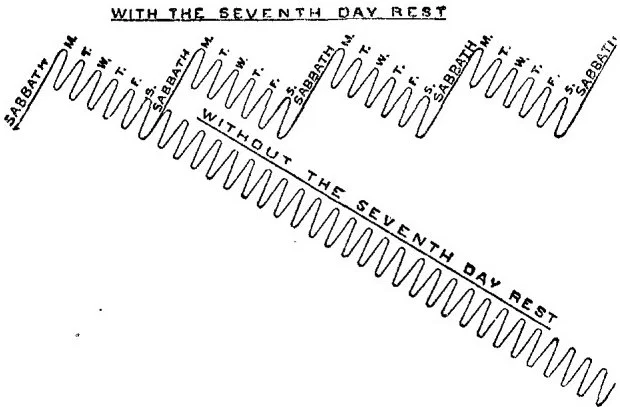
DR. HAEGLER’S CHART.
In our issue of last week brief allusion was made to the singular fact(?), overlooked by the physicians and scientists, but discovered by the clergymen, that Sunday rest is absolutely essential to mankind for the preservation of physical health.
There is, however, one exception to the rule, which should be noted. One physician, Dr. A. Haegler, stands abreast of the clergy in knowledge of the facts of physical science, and has prepared a “chart,” showing the result to an individual of the omission of Sunday rest, as compared with the result when Sunday is regularly observed. We present herewith this remarkable production. It will be observed that the person who disregards Sunday rest goes steadily down hill, physically, until, as may be supposed, he sinks, a complete bodily wreck, into the gulf of physical perdition; while the one who has regularly abstained from work on Sunday naturally and easily maintains the level of his physical health.
As an illustration of an idea, this chart serves its purpose well. The only trouble is, it must stand without any support in truth. The “facts” of the illustration do not exist.
An illustration is not an argument. The one conveys an idea, the other demonstrates its truth or falsity. The demonstration of the truth of what this chart represents is yet to be had.
An appeal to the facts of history or of present human existence is sufficient to show the utter fallacy of this illustration. The number of people in this world who have regularly observed Sunday as a day of rest, or who so observe it to-day, is comparatively small. The weekly rest-day is found only in those lands where the people profess Christianity. In what are known as “heathen” lands, it is not observed. Nor has it ever been known as a practice among the heathen nations of past times. Yet, in point of physical perfection, the heathen compare favorably with the people of so-called Christian nations. The physical giants of ancient times were not among the Sabbath-keeping Israelites, but among the heathen nations whom God dispossessed of the land which he would give to his people. There were men such as Goliath of Gath, Og, king of Bashan, and the Anakim, of whom the ten spies said in their report, “We were in their sight as grasshoppers.” Coming to the testimony of later times, we find that the ancient Greeks were the most noted men of their age in point of physical perfection and prowess; yet they had no weekly day of rest. Nor did the conquering Romans know such an institution. And for our own times we have such testimony as the following from Bishop Andrews, of the Methodist Church, on his return from China:—
In China they have no septennial division of time, no weekly rest-day, merely annual festivals. They work right along all the time with no day of rest as such; yet they live to a very advanced age. This fact has led one of the most careful thinkers who has ever been sent as a missionary to China, to raise a serious question whether the great purpose of the Sabbath is not for worship and communion with the other world.
But it is not necessary that we go to pagan lands for these comparisons. Multitudes of people in our own country either spend Sunday in work or in some other manner requiring as much physical exertion as their ordinary labor. But it is safe to assert that Dr. Haegler himself could not distinguish between these men and others who regularly rest and go to church on Sunday, by any evidence to be gathered from a physical examination.
The truth is, that it is not mere rest—idleness—that man’s physical system demands, but change—recreation. We except, of course, the daily demand for that nearly complete cessation of physical activity which is obtained in sleep. No one, however, advocates spending the Sunday in sleep. It is assumed that men are to be on that day in the full possession of their physical and mental activities; otherwise what would become of the church services? But when these faculties are fully awake they want exercise. This is a law of man’s being. An all-wise Creator has wisely made activity the normal condition of the human system. Mere idleness without sleep is more exhaustive of nerve force and vitality, than is exercise. In these statements we are only telling what is well known to intelligent people.
It is not work that wears, but worry; not exercise that breaks down the system, but excess; not discipline that destroys its faculties, but dissipation. A thousand and one causes operate in determining the individual’s physical status. Intemperance, inherited defects, uncontrolled passion, the cares and worries of life, too prolonged or violent exertion, weakness and excess of every kind and degree, affect our physical well-being. Yet Dr. Haegler in his chart presumes to differentiate between all these causes, not in one case merely but for all individuals, and distinguish the physical effect due to the observance or non-observance of a weekly rest day!
We might refer to the Sabbath institution as set forth in God’s holy Word, and show that it is designed by the Creator not as a day of idleness, but of activity in spiritual exercises; but the purposes of this article do not require it. It is sufficient to say, in conclusion, that the clergymen who are calling for “laws” to compel people to “rest” on Sunday, both ignore Dr. Haegler’s chart in their own practice—Sunday being pre-eminently their “busy day”—and also in their hopes and45desires respecting others. They are perfectly willing that men should be as active as they please on Sunday, provided that activity is directed in religious channels, and for purposes they may specify as proper.
A chart which would portray the disastrous effects upon individuals and upon society of enforced Sunday idleness, would be a much more useful one, and would have a foundation in reality.
NATIONAL REFORM INCONSISTENCY.
By Editor
THE Christian Statesman, which is a most persistent champion of legislation for the enforcement of Sunday observance, is out in its issue of January 11, with severe strictures on Romanism. It quotes from other sources, and charges that “Pope Leo is at one time saying ‘white,’ and at another ‘black.’ It is the same Jesuitical policy in Europe as in America,” etc. Now our chief objection to this language on the part of the Statesman is its inconsistency. One cardinal principle of the Roman Catholic church is the union of Church and State. Our ever watchful contemporary, the Statesman, adopts the Catholic’s Sunday as the sabbath, rejects the only Sabbath of divine appointment, and then unites with the Roman Catholics in an attempt to enforce its observance through religious legislation which commits the government to this Catholic measure. This appears to us like decidedly crafty scheming in a line that is well pleasing to the very body against which the Statesman professes so much hostility. Pilot and Herod were once made friends for a very unworthy purpose. Can the Statesman see any parallel in that, and its own coalition with the “Jesuitical policy” of those whom it one day courts and the next day curses?—Sabbath Recorder.