The Youth’s Instructor, Vol. 37, No. 34.

THE LARK

The Youth’s Instructor

Aug 21, 1889

S. D. A. Publishing Association · Battle Creek, Mich. · Aug 21, 1889

THE LARK.

THOU sweet songster of the summer sky, How joyous is the song, that from on high Thou pourest down to glad the listening wold, O lark, sweet songster of the summer sky!
Straight as an arrow speeding to its mark, Up to the noonday sun thou soar'st, sweet lark, Leaving the mists below thee, gray and cold, Thou, the sweet songster of the summer sky!
High in the blue, still as a floating cloud, Hovering o'er earth's wide pastures, sweet and long Thou singest; and all the azure heaven is loud With the resounding music of thy song, O lark, sweet songster of the summer sky!
—Song Birds and Seasons.

THE SKY-LARK.

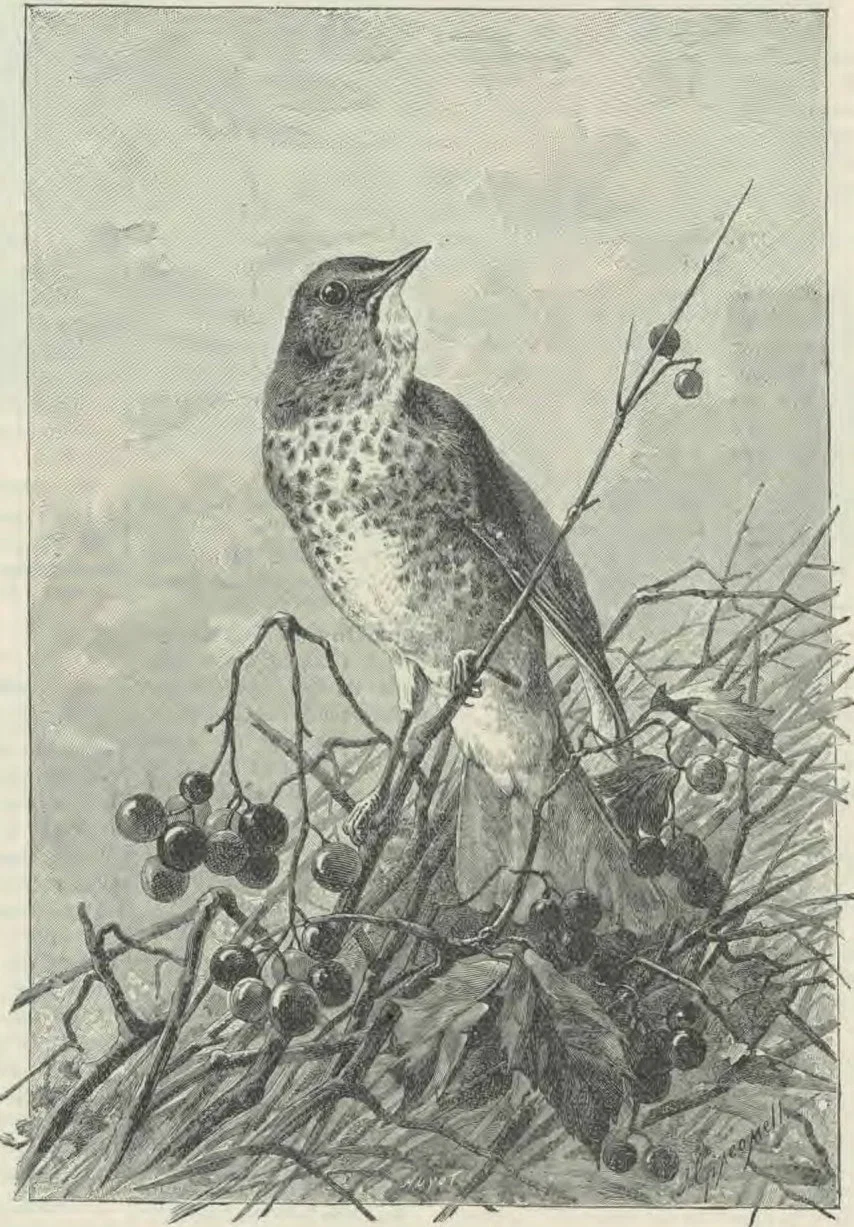
THE sky-lark, as shown in the accompanying picture, is a bird of European origin, never appearing on American soil. Its early arrival in spring and its marvelous song have made it a favorite with all. Says one naturalist: “The bird rises on quivering wing, almost perpendicularly, singing as he flies, and even after gaining an extraordinary elevation, so powerful is his voice that his wild, joyous notes may be heard distinctly when the pained eyes can trace his course no longer; but an ear well tuned to his song can yet determine by the notes whether he is still ascending, stationary, or on the descent; for the strain is continued on his downward course till he approaches the ground, when it stops abruptly, and with a headlong dart the bird alights.”
In regard to its domestic life, another observer says: “The mother-bird builds her nest between two clods of soil, and lines it inside with dry grasses. She lays four or five spotted eggs, brown or gray, which she hatches hastily. As soon as the young ones are feathered, they leave their nest, and roam about the fields under the lead of the mother, and their promptness often misleads those who are hunting for bird’s nests.”
“Whilst these are tripping over the stubble fields, the mother keeps flying about them with constant care and solicitude. She feeds them with worms, caterpillars, ants’ eggs, and grasshoppers. This, however, is only the food of their infancy; for as soon as they are grown, they live upon vegetable food. In summer, the season of song and bold soaring upwards, larks are very lean; but they make up for lost time towards autumn, when they live more on the ground; eating at all hours, they then grow plump and fat.”
But prosperity brings with it dangers to sky-larks as well as to human kind. The corpulent little body tempts the hunter with the promise of a dainty dish, and larks are accordingly hunted down with net and mirrors, and every known device. Competent authorities state that during the last century over five million larks were received in Leipzig annually, and “in 1854 there were brought to the London markets about four hundred thousand, and the official returns state that in 1867–68 more than a million and a quarter were taken into the town of Dieppe, France.” It seems a pity that such sweet songsters should meet so ignominious a doom as to satiate the appetite of the epicure. W. E. L.

"IN THE BATTLE."

“I’ve finished Kings, mother. Of course I’ll have to skip Chronicles!”
Elsie Raymond sat by the open window, Bible in hand, ready for her Sabbath afternoon reading, and thus appealed to her mother, who passed through the room as the young girl found her place.
“Why do you say ‘of course,’ my dear? The Chronicles were written to be read,” and the mother paused a moment at her daughter’s side.
“Look at those names! Just all names!” exclaimed Elsie, with a sort of explosion. “What’s the use?” And the little puckers in her forehead were astonishing to see. They asked a dozen questions at once.
“Well,” said Mrs. Raymond, indulgently, “I will not make you begin with ‘Adam, Seth, Enosh,’ but you may take the fourth and fifth chapters to-day. There are things in them that will help you, if you will use them. You may not understand, my child,” the mother went on, “why I insist upon your reading the Bible through in course, but I know it is a good plan. I finished it, for the first time, long before I was your age, and so did your father. I cannot talk to you more now, for I must go to the little ones. You may see what you can find in your chapters,” and the mother left the room.
“It’s all because I’m a minister’s daughter and granddaughter, back to Methuselah,” said Elsie to herself. “I don’t believe the other girls read the Chronicles!”
But this had nothing to do with the case, and the brown head soon bent over the page. It was not such a great hardship, after all. The soft June air brought a faint scent of roses through the window. A bird sang in a tree near by. It was all so sweet and quiet everywhere that Elsie felt she ought to be gentle and lovely herself. She read her chapters through, though she thought it a mistake about there being anything in them, and then she had a little thinking time.
“If that Madge Hartley makes me angry to-morrow, it will be just horrid. Why can’t she let me alone, I wonder? The tease! I wish everything could be as still and pleasant on Monday as it is on Sabbath. So ran her reflections, ending with the resolution to ‘try to keep her temper all the week, in spite of everything.’” Then little Floy came in, and the quiet time was over.
“Am I a soldier of the cross?” rang out the young voices in the parsonage next day, at morning prayers. “Sure I must fight if I would reign,” sang Elsie, with great vigor, and feeling quite like a soldier as she thought of her enemy, hasty temper, and determined that it should not get the better of her. Afterward, she said “Amen” very sincerely to her father’s prayer that “the Great Captain would give them the victory over sin that very day.”
Madge Hartley overtook her a few steps from the school-house, and Elsie chatted with her in a friendly way, as they passed in together. The girls were fairly good friends, but Madge was such a mischief that she bubbled over in teasing ways. She loved to see Elsie’s dark eyes flash, and her funny little curls bob about in a breezy fashion they had when she was vexed. Then she was so easily teased, and stormed at such a rate, that it was “great fun,” Madge said, “just to stir her up about nothing.”
Matters went very well with Elsie this Monday, until after school; for she had nothing to try her. But on the way home several of the girls stopped to rest in Hattie Sheldon’s yard; and, in the midst of a lively talk, Madge turned suddenly, and said to her touchy schoolmate, “Why didn’t you report to-night, miss? I saw you whisper.”
“I had permission, you mean thing! You heard me ask,” retorted Elsie, roused in an instant.
“I didn’t, either,” said Madge, “and I guess you took the answers into the arithmetic class, too.”
“I never did, never!” exclaimed Elsie, hotly. “You know better.”
“Oh, indeed! Not in your head? Well, you ought to have done it then,” laughed Madge, teasingly, “but I’m sure I saw you look into your book.”
This touched Elsie in a tender point; for she was an honorable girl. Her eyes fairly blazed.
“You horrid thing,” she said, with rising temper. “Before the class, of course,” said Madge, mockingly, “not in recitation. I never said so.”
It was such a little beginning for a quarrel; but it was easy to make Elsie furious, and the other girls took sides, till there was a disgraceful war of words, though none knew just what the accusations had been. Finally, Elsie broke away and rushed home. Her mother saw her flushed face as she came in, and drew from her by gentle questionings the whole day’s history, its resolute beginning and its humiliating close.
“Dear child,” she said, smoothing the rumpled curls, “if you had read your Chronicles carefully yesterday, you would have known how to win victory to-day.”
Elsie looked up with surprise and doubt in her face. “I never saw any such thing,” she said.
“That does not prove that it is not there,” returned the mother, smiling. “Bring your Bible, and open to 1 Chronicles 5:20.” Elsie obeyed. “Now see,” said Mrs. Raymond, “how the Israelites defeated the Hagarites in time of war.”
The young girl read, in thoughtful tone: “And they were helped against them, and the Hagarites were delivered into their hand, and all that were with them; for they cried to God in the battle, and he was entreated of them, because they put their trust in him.”
“You see, daughter, that they cried for help in the very time of need.”
“It was a queer place for a prayer-meeting, in the midst of a battle,” said Elsie, slowly. “I wonder that they thought of it then.”
“That is the very thing,” said her mother. “They did think of it, they did it, and were helped. It is well to be on guard, but the very minute that we need help is a good time to ask and receive it. One little upward thought, one cry to God, in the midst of the battle to-day, would have quieted your rising temper, I think, if you had tried it.”
“I did not think,” said Elsie, and hid her face, while the gentle voice went on:—
“All Scripture is profitable, dear. Remember the battle with the Hagarites told in Chronicles. And let me give you a bit of advice which I like, from a quaint old writer: ‘Do not forget the short dagger of ejaculatory prayer, when there is no time to draw out the long sword of a formal prayer.’” Then feeling that she had said enough, mother left Elsie to think it over.—The Interior.

Good Manners: Respect Due to Old People

GOOD MANNERS.—NO. 3.

In our last, we told you how bad boys—boys who would have their own way, and do as they pleased in spite of all father and mother could say, fared among the Jews; how they were taken before the judges of the land, and complaint made against them by their parents; and how the law took its course against them—how they were stoned to death; and how wicked young persons who called Elisha “bald head,” and told him to “go up,” were punished.
In this number I want to say something about respect due from young people to old people. In this age of the world, the want of respect shown to old people by children is great, and a faithful account is being made before the Lord, and will have to be met in the judgment because of it. If the children would only stop to think, they would see how very bad such conduct is.
There are several reasons why old age should be respected; but first turn and read Lev. 19:32. These are the words: “Thou shalt rise up before the hoary head, and honor the face of the old man, and fear thy God: I am the Lord your God.” This was what the Lord commanded—to honor old people. Notice, it is placed along side of the fear of God. Then it is just as right that the old and gray-headed should be respected as that you should fear God; every bit as binding on you, don’t you see? Don’t forget it.
If God commanded us to give such respect, there must be some good reason for it, because he never commands anything without reasons, although we may not at all times be able to see them. But in this case, I think we can see why he did so. 1. Old persons have had more experience than you, having lived longer in the world. They are thus able and are willing to give young people much valuable advice. The experience may have cost them much,—may have cost them dearly,—but they are willing to give you for nothing what cost them so dear.
2. Old people generally love young people, and are willing to do for them anything they can. Just notice what an interest grandpa and grandma have in you. What will not these dear old souls do for you? You should, to say the least, show common gratitude. You should give love and respect in return.
3. Old persons are often sensitive, and feel keenly any lack of respect. Any slighting remark, especially from young people, makes them feel bad. Never try to mimic their way of speaking or acting. Never correct nor contradict them. These are some of the reasons why young persons should be polite and obliging to old age. N. J. BOWERS.

A SHREWD STRATAGEM.

It is claimed by some that animals other than man are not capable of reasoning, and that they know how to care for themselves only by a natural impulse called instinct. They are supposed to possess this faculty to a much greater degree than do people; though you may think of some things which human beings know from earliest intelligence, without ever having been taught them.
But however powerful an instinct animals may have, that could not account for their wise doings sometimes observed. You have doubtless heard many incidents relative to the sagacity of pets; but we add another, which it would seem could be explained only by crediting the subject with ability to reason:—
Starting one day to feed the chickens, one of the hens nearest, noticing me before I reached them, immediately turned and ran in the opposite direction, and when in the midst of the others, began to cackle vigorously, flapping her wings, and appearing to make great haste to reach the farther end of the yard. The entire flock, startled, and confidently supposing some danger in the rear or prize in advance, hastened in the same direction, when the crafty leader began to lessen her speed, though still maintaining a semblance of haste. When all had passed her, she complacently turned and hurried back to the feed, of which she had devoured a greedy share before the others, missing their leader and failing to discover the cause of flight, returned to comprehend the trick that had been practiced at their expense. MRS. ADA D. WELLMAN.

GIVE LOVE.

FLOWERS there are that pine in darkness, Which the light would cause to live; Hearts there are that long in secret For the love that we might give.
Touched by warm, bright rays of sunlight, Drooping flowers expand and grow; And sad souls look up and brighten Underneath love’s steady glow.
We shall never know how many, Walking near us day by day, Long for sympathy and kindness— For a word that you might say.
Think not then, O brother, sister, There is naught you can bestow, Long as there are those who’re yearning For the love a child might show.
Seek the souls that dwell in darkness, Lonely, sad, and tempest-riven: It may be that you may cheer them,— You may point the way to heaven.
Then give love, and flowers shall blossom, Where before none ever grew; Give, and thine own soul shall brighten With a radiance ever new.
VIOLA E. SMITH

A LITTLE THING.

A TWELVE-YEAR-OLD boy was writing a letter. It was an important letter. He meant to write it very carefully. He hoped that it would secure him a place in a great business house, and he believed that a start in such a house would lead to success in business.
Perhaps you wonder that a twelve-year-old boy should be planning for himself in this way. His father had died a few weeks before. A mother and two young sisters were left. A little home and a small amount of money in the bank were all that they had to depend upon.
Howard said, “I must leave school, and begin to work my way into some business. In two or three years I can surely support you.” Mrs. Day smiled sadly, but she was pleased to have her boy so brave and hopeful.
When the letter was finished, Howard read it over. He saw no mistake in it. It was a boyish letter, asking for work. He carried it to his mother. She pointed out a misspelled word, and a misplaced comma. Howard carefully erased the extra letter from the word, and corrected his punctuation also. “But it shows, after all,” he said. However, he sent the letter.
The next day the old merchant sent for him.
“Did you write this letter?” said he.
“I did,” answered Howard.
“Without help?”
“Yes, sir.” After a moment’s pause the boy added, “Perhaps you saw that I had scratched out a letter, and changed a comma. Mother told me of those mistakes.”
“I will see you to-morrow,” said the merchant.
Three things this employer always required in engaging a new hand,—carefulness, strict truthfulness, and promptness.
“The boy is probably prompt,” said he to himself, considering the case; “for he came at the very time I appointed. His letter is carefully written, though he did make two mistakes. And the fact that he told me that his mother pointed out the mistakes shows strict truthfulness. That decides the matter. I will take him.”
The next day Howard was engaged, and twenty years later was made a partner in the great business house.
It was a little thing to tell the exact truth in this matter; but it opened a door to Howard which meant comfort for his mother and sisters, and assured business success for himself.—S. S. Advocate.

THAT CUP OF WATER.

Years ago, when I was a small child attending a country school, it so happened that the teacher overheard a little boy speaking some bad words. As the boy came into the school-room, the teacher talked with him, told him how sorry she felt that he had used such language, and then sent him to the water-pail, telling him to take a cup of water and to wash out his mouth. When this had been done once, she had him repeat it over and over again.
Well, I cannot tell what the effect was upon that little boy; whether he learned any useful lesson from it or not. This much I do know: that the circumstance referred to made a lasting impression upon my own mind.
It was brought again to my recollection this morning as I was grieving over some words that I had spoken and would fain recall. I remembered the little boy with the cup of water, and thought, oh, how gladly would I resort to the same measure, if I could only wash out those words, spoken so “unadvisedly” with my lips.
But words once spoken are gone; they are ours no longer; we may grieve over them, may repent and ask for pardon, and it be granted us. No water is sufficient to remove their defects. Only the precious blood of Jesus can finally wash away each stain.
MRS. F. H. SMILEY.

GREAT MEN AND GOOD MANNERS.

The Chief-Justice of the United States lives on a beautiful knoll in the suburbs of Washington. His elegant home, called Belmont, with turrets and spires, built of rough, light-colored stone, is only a few rods from the Fourteenth Street car-line that leads to the White House and the Capitol. As I was hurriedly passing his home yesterday, in the pouring rain, I saw three little girls all in a flutter of haste and excitement—wrapped in garments, with school-bags tucked away out of the wet—running to catch the car. Just behind them walked a scholarly-looking, gray-haired gentleman, with a most kindly, sunny face shining out from under the umbrella.
“O papa! papa! do hurry; you’re getting so wet,” I heard said; and the three little maids stopped and turned back to hold and pull and tug away at the quiet gentleman, hurrying him to take his place in the crowded car packed with a rainy-morning crowd.
“Papa” took hold of the strap, and the rosy little daughters kept fast hold of him to steady themselves in the swaying throng. The dripping umbrella leaned against the door, and the gentleman chatted pleasantly with the conductor, helped an old colored woman with a huge basket of clothes to a place behind him; and when the “transfers” were given for Pennsylvania Avenue, and the little family “changed cars,” a murmur of inquiry and pleasure swept over the faces of those left. “Who was that gentleman? Do you know him?”
The conductor walked through, very straight, and looked very proud, as he said: “That man was Chief-Justice Fuller, and he rides on my car every day. We like him. We like him and all his family. They ain’t a bit proud nor stuck up, and they know good manners from shoddy ones every time. Mr. Chief-Justice talks to us conductors just as kind and good as he does to the President. We hope he will stay on our line forever!”—Wide Awake for July.

VISITS TO THE INDIANS.

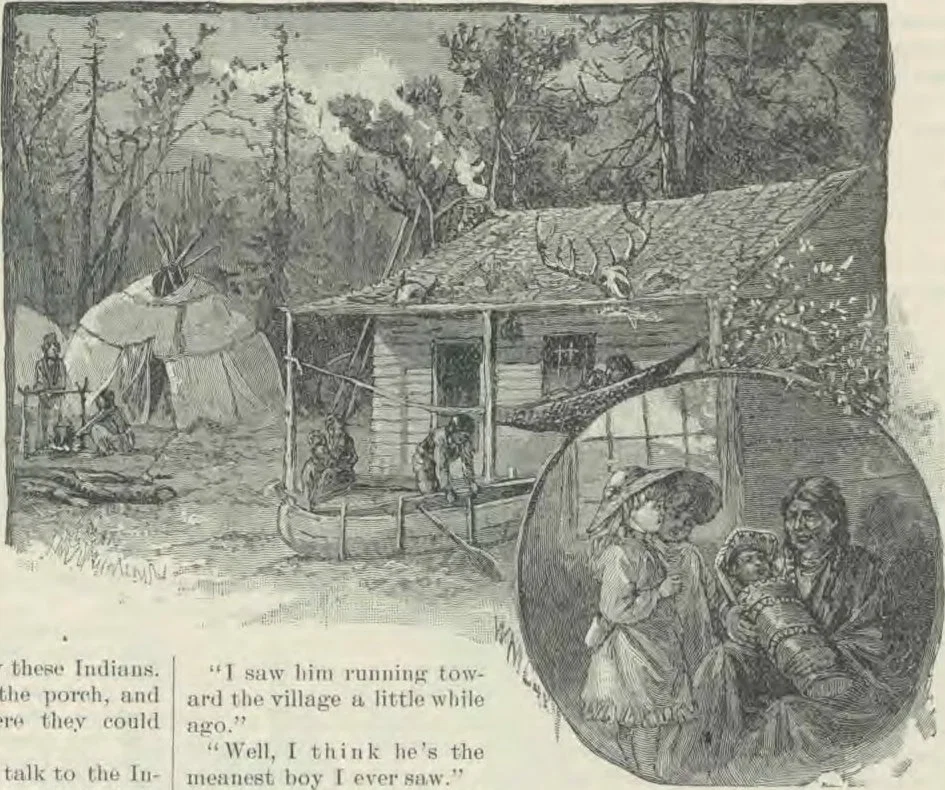
Two little girls, Allie and Nettie, went once to see some Indian houses. Their uncle took them, and they had to drive a long, long way over the prairie. The Indians were not wild like those who live in the far West. They lived on a Reservation, and had frame houses.
In each house was only one room, and in front a large porch, almost as large as the house. But there was no floor in the porch except the ground. Near each house was also a wigwam, made of bark, and the Indians liked better to stay in the wigwam or the porch than in the house. On this page is a true picture of the houses built by these Indians. They had hammocks hung up in the porch, and wide platforms along the sides, where they could sleep.
The little girls were almost afraid to talk to the Indians at first, but they soon found courage to look into the houses and wigwams.
At the second house they visited, they found a little pappoose. That is the Indian name for baby. It was asleep in a hammock on the porch. It was about two years old, and as brown as a berry.
Then the squaw took them into the room, and showed them another baby. It was a little bit of a thing, and was strapped on to a board. There was a piece of hoop that came in front of its head. The hoop had tiny bells hung on it, and when the pappoose was moved, the bells would jingle.
The little girls wanted to take the baby home with them, but the squaw thought too much of her baby to let it go. She laughed when they asked for it.
A squaw mamma once did let her baby go. She saw some beautiful earrings in a lady's ears that she thought she would rather have than her own pappoose, so the owner of the earrings traded with her. It was not long, however, before the squaw went in great haste to the woman, threw down the ornaments, snatched the pappoose, and ran home with it. She loved her baby best of all.
Nettie and Allie each bought a bead necklace to remember their visit to the Indians.
A little boy, named Hal, once went with his papa and some soldiers to visit an Indian encampment. Here the houses were all wigwams, set up near the edge of a grove on the river-bank. There were four close together, under a large cotton-wood tree. And what do you think Hal saw there?
On one of the branches hung three Indian babies! The babies' mammas had hung them there out of the way. They were not hung up by their necks though. Each baby was strapped on to a flat board, which was hung to a limb by a piece of leather.
Hal had never seen a pappoose before, and he took great pleasure in looking at them. The squaws were much pleased to see him so interested in their babies, so one squaw came and took down her pappoose, so that he could see it better. She let him hold it in his arms too. It must have seemed odd to hold such a stiff baby, as the board would not bend a bit. He did not care to hold it long. Although it was a pretty baby, he thought it was almost too brown.
This pappoose had on a red blanket under the bandages which bound it to the board. Hal said it looked like a great red bird hanging there. The other babies were asleep, and had brown blankets around them.
As they rode home, Hal asked one of the officers, who knew a great deal about Indians, if the babies liked to be tied to a board that way. He said they seemed to, and would cry if left off from the board. Then if they were put back again, they would be quiet.
—Adapted.

JAMIE, THE GENTLEMAN.

There's a dear little ten-year-old down the street, With eyes so merry, and smile so sweet, I love to see him whenever we meet, And I call him Jamie, the gentleman.
His home is of poverty, gloomy and bare, His mother is old with want and care. There's little to eat and little to wear In the home of Jamie, the gentleman.
He never complains, though his clothes be old. No dismal whinings at hunger or cold; For a cheerful heart that is better than gold Has brave little Jamie, the gentleman.
His standing at school is always ten; "For diligent boys make wise, great men, And I'm bound to be famous some day, and then,"— Proudly says Jamie, the gentleman,—
"My mother shall rest her on cushions of down, The finest lady in all the town, And wear a velvet and satin gown," Thus dreams Jamie, the gentleman.
"Trust ever in God," and "Be brave and true"— Jamie has chosen these precepts two; Glorious mottoes for me and for you; May God bless Jamie, the gentleman. —Wide Awake.

Susie's Lesson.

“I wonder where Harry is. Har-ry!”
No answer came, and Susie went about the house, calling for her brother in a tone which was not at all pleasant.
“What do you want, Susie?” asked her mother, opening the door of her room.
“I want Harry, mamma. Do you know where he is?”
“I saw him running toward the village a little while ago.”
“Well, I think he's the meanest boy I ever saw.”
“What has he done that is so mean?” asked her mother in much surprise.
“Why, he knows I want to go early to the lawn party, and now he's gone off, and nobody knows when he'll come back.”
“I dare say he'll come by the time you are ready.”
“Oh, but I wanted him to pick me some flowers for a bouquet; and I wanted him to black my shoes.”
“Patience, my little daughter. Jane will black your shoes, and you can get the flowers yourself.”
“Harry always does it better than Jane,” grumbled Susie.
“Then if Harry is usually so good to you, I don't think you ought to complain of him.”
“But he had no business to go off, just when he knew I wanted to go early. Are you coming to help me with my hair, mamma?”
“Yes, as soon as you get your shoes blacked.”
Susie went down to Jane, spending all the time used in blacking her shoes in making complaints against Harry.
“I hate to wear these old hair ribbons,” said Susie, as her mother brushed and braided her hair.
“They are faded, but they do not look bad.”
“I think they do. I ought to have some new ones.”
“If I could get them for you, you should have them, Susie.”
“It's hateful not to be able to have things. Emma Morse has new ribbons whenever she wants them, and I don't have anything.”
If you could have looked at Susie's face just then, you would have wondered to see how many pretty things were sadly spoiled by ugly temper. Her smooth forehead was tied up into a knot, while the blue eyes under it had lost all the sweetness which should belong with bright eyes. And the red lips were twisted into an ugly scowl. How could they help it when such cross, crabbed words were coming through them?
“Go and look in the glass, little one,” said mamma. “Do you know who made those pretty features for you? Don't you think the dear Lord meant them for smiles and pleasant words, instead of snarls and frowns?”
If Susie ever thought so, she surely did not think so to-day; for she kept on fretting and complaining about Harry, until poor mamma was glad enough to be done braiding the glossy hair. But the complaints lasted until the white dress was buttoned, and shoes were put on.
“Now I am going to get my flowers, and if I get my clean dress dirty, it will be all Harry's fault.”
Ah, Susie! How can you keep on a scowl when the sun smiles down on you, and the flowers smile up at you? How can you grumble when every bird is singing its song of gladness and thanksgiving for all the beautiful things in which you have a share?
“I don't see Harry coming yet,” said Susie as she went back to the house. “I believe I'll go without him.”
“I don't think I'd do that,” said mamma. “You know Harry is a little bashful, and perhaps he would not go at all if he had to go alone. He would be disappointed, I know.”
“I don't care if he is. He has no business to keep me waiting. You can tell him to come on after me. It's all nonsense, his being bashful about it.”
Susie put on her hat, and walked down the road, often turning back to see if Harry was coming. As she reached the turn in the road, she gave one more look, and said, “No, he isn't coming. He's the most provoking boy that ever lived. I shall keep right on, and not walk slowly for him any longer.”
“Susie! Susie!”
Before she had taken many steps beyond the turn, she heard Harry's voice.
“Susie! Oh, I'm so tired.” Harry came up to her all out of breath.
“Why did you go away and stay so long?” asked Susie. “You knew it would be time to go.”
“Wait till I can talk,” panted Harry. “Why, see—is this what you wanted?”
“Oh, how beautiful!” exclaimed Susie. “Where did you get it, Harry?” She looked with delight at the pretty ribbon which Harry took out of a piece of paper.
“Over at the village, of course. I meant to go earlier, but papa wanted me to rake up the leaves. And I meant to get back quicker, but I had to go to so many places before I could find the ribbon. I heard you say you wanted blue ones, and they had pink ones most everywhere. I ran most all the way. Now let me tie them on for you. I can do it pretty nearly as well as mamma.”
“Harry,” said Susie. “Where did you get the money for them?”
“Oh, a fairy gave it to me.”
“Grandma, I guess,” said Susie.
“Now come on, quick,” said Harry, “and we'll be there in plenty of time.”
“I'm sorry I felt so cross at Harry,” said Susie, when she was talking to mamma afterward. “He went all the way to the village for new hair ribbons for me. I was so sorry I didn't enjoy the lawn party half so much.”
“I'm glad you were sorry,” said mamma. “Your brother was very kind to take such a long walk and spend all his money for you—”
“O mamma, did he do that?” asked Susie, with tears in her eyes.
“Yes, dear, he did. All the while you were saying such unkind things about him, he was doing his very best to get something to please you.”
“I'm glad he didn't know what I said. Mamma, it isn't any harm when he didn't know, is it? It wouldn't hurt him any.”
“No, dear, it couldn't hurt your brother; but have you thought of how much it hurts yourself?”
“How can it hurt me?”
“Don't you know that every unkind thought is a blot on your heart—your heart which the Lord made pure and clean, and commanded you to keep with all diligence, that the stain of sin might be kept from it? Have you forgotten that ugly thoughts write themselves upon your face? and that ugly words once spoken can never be called back? Ask the dear Saviour, my little one, to help you to shut out evil thoughts, and to keep back evil words.”
I hope Susie will not forget her lesson, and that every little girl or boy who may chance to read this may try the only way of trampling down evil in the heart.—Sydney Dayre.
Continue reading: THE STORY OF A RED HOOD