The Youth’s Instructor, Vol. 28, No. 37.

FOR THINE IS THE POWER

The Youth’s Instructor

Sep 8, 1880

S. D. A. Publishing Association · Battle Creek, Mich. · Sep 8, 1880

“FOR THINE IS THE POWER.”

“I CAN'T do it,—it's quite impossible. I've tried five times, and I can't get it right,”—and Ben pushed his book and slate away in despair.
Mrs. Hartley gave a little sigh at her boy's perplexity, but only said quietly, “Then you don't believe in the Lord's prayer?”
“The Lord's prayer, mother! Why, there's nothing there to help me with this example.”
“Oh, yes; there is help for every trouble in life in the Lord's prayer, if we only know how to get at it. I am afraid you don't yet know that prayer.”
Ben flushed. If it had been anybody else that had said that, he would have been really vexed, but mother was different. Ben always tried to be sure he quite understood her, for he never for one instant forgot why her hands were never idle.
“Now, mother, you don't mean that. I've said that prayer ever since I was a baby! I couldn't go to bed or leave my room in the morning without saying, but you know, mother, I do try to mean it—I—I—” But Ben stopped, his voice half choked.
The mother saw that her boy had misunderstood her, and answered quickly, “I never doubt, Ben, boy, that you are trying and praying; but I was trying a long time before I knew what the last part of the Lord's prayer really meant. I'm no minister or scholar, but I'll try and tell it to you. You know we ask God for bread, to be kept from evil, and to be forgiven, and then we say, For thine is the kingdom, the power, and the glory. It's God's power we rely on,—not our own; and it often helps me, Ben, when I have a difficult new pattern to fit. I say, ‘For thine is the power,—this is my duty, heavenly Father, give me thy power,’ and he does, Ben, he does.”
Ben sat silent. It seemed almost too familiar a prayer. And yet, that time when he had to stay from school because he had no clothes, he had asked God; and the minister's wife had brought him a suit the very next day. “But a boy's sums, mother!” he said.
“I think that the sum is just as much to you as many a grander sounding thing to some one else. You say if only you get that right, you will be perfect for the month. Now, I care a great deal about that, but I'm sure your heavenly Father loves you more than I do. I would help you so gladly, Ben, if I could, but he can help you; his is the power; ask him.”
There was another silence, and then Mrs. Hartley said, “Now, Ben, I want you to run to the store for some sewing-silk for me; the air will do you good. I believe, my son, that, if you ask, you can do that sum when you come home.”
Ben started at once; his mother's slightest wish was law to him. He ran along, enjoying the rest from study and the cool, fresh air. The sewing-silk was bought, and Ben started home, when he caught sight of Phil Earlie across the street. Ben gave the whistle that boys so delight in, and Phil looked back, and joined him.
“Done your lessons?”
“All but my sums.”
“Did you try the fifteenth example?”
“Yes.”
“Get it right?”
“No, not yet; but I will.”
Phil gave a provoking little laugh.
“You will? I guess not; I've done it, but I never could have found it out alone, I had help.”
Ben's heart fairly ached with envy for a moment. It was always so; Phil had his Uncle George, and other boys had big brothers or fathers to help them; only he was left quite alone. But just then he remembered his mother's words, “It's God's power we rely on,—not our own.” “I'll get help, too,” he said to himself. The boys chatted on, played leap-frog, and raced each other; but even as he raced and romped, Ben felt changed. He had begun to believe in his heavenly Father as never before, and was wonderfully happy.
After giving the silk to his mother, he picked up his slate and book, and went up to his own little room. Kneeling by the bed, he repeated the Lord's prayer, stopping at “Thine is the kingdom,” and saying with all his heart, “And thine is the power, heavenly Father. I want power to understand this. There's no one to help me; please give me power.”
Ben waited a moment, and then he took his slate and tried again. Do you ask me, “Did he succeed?” “If any of you lack wisdom, let him ask of God, that giveth to all men liberally, and upbraideth not; and it shall be given him.” Ben had asked, and God had answered. After a little earnest thought, he saw what rule he had neglected, and worked the example correctly. The next day he was “head,” for he was the only boy who had “done his sums without being helped.”
“Yet I was helped, mother,” he said; “and I shall never forget the last part of the Lord's prayer after this.”—HOPE LEDYARD, in S. S. Times.

SOWING AND REAPING.

EVERY one is sowing, both by word and deed; All mankind are growing, either wheat or weed; Thoughtless ones are throwing any sort of seed.
Serious ones are seeking seed already sown Many eyes are weeping, now the crop is grown; Think upon the reaping,—each one reaps his own.
Surely as the sowing shall the harvest be,— See what you are throwing over hill or lea, Words and deeds are growing for eternity.
There is One all-knowing, looking on alway, Fruit to him is flowing, feeling for the day— Will your heart be glowing, in the grand array?
Ye that would be bringing sheaves of golden grain, Mind what you are flinging, both from hand and brain, Then ’mid glad songs singing, you shall glean great gain. —The Advance.

The Wonder and Power of Music

THERE is something very wonderful in music. Words are wonderful enough, but music is even more wonderful. It speaks not to our thoughts, as words do, it speaks straight to our hearts and spirits, to the very core and roots of our souls. Music soothes us, stirs us up, it puts noble feelings into us; it melts us to tears, we know not how; it is a language by itself, just as perfect in its way as speech, as words, just as divine, just as blessed.

OBSERVATIONS AT SEA.

While waiting on deck for the noon “observation,” we entered into conversation with a gentleman from Miraflores, Mexico. Seeing the spray breaking from the tops of the waves, he called out to us, “See the flying-fish!” But he mistakes; flying-fish are not found in December in waters so far north. We will excuse him, however, in his mistake, as he has just made the trip from Mexico to New York, and in passing out of the Gulf of Mexico, saw many flying-fish.
When I sailed to California, in 1868, from the Bahama Islands through the West Indies to Central America, and then again on the Pacific Ocean from Panama to the Gulf of California, we saw a great many flying-fish. These curious creatures are from six to ten inches in length, and as white as silver. From the side fin, just back of the gill, there is a thin flap of skin extending nearly to the tail of the fish. As they move this fin out at right angles with their body, it spreads this flap into a wing. While the sea is rough, these shining beauties will leap out of the top of a wave, spread this flap, and then go soaring along over the water from ten to twenty rods, dropping again into the deep. They do not seem to have power to rise higher than the point from which they leave the wave. It is an interesting pastime for passengers to watch the movements of these fish. Our only regret now is that Mr. Ward has made a mistake, and we have only the spray of the white caps before us to watch instead of the flying-fish.
But here come the captain and mate with their instruments for taking observations. We will watch their movements, for this is something of deep interest to us. It always seemed to me that it required considerable skill to keep track of the movements of a ship, and so guide it across a trackless ocean as to come out at just the right point instead of on some unknown rock. We now learn that in order to do this it is necessary to know, each day, the latitude and longitude of the ship.
The observations are made every day at noon, provided it is clear enough to see the position of the sun. As the sun is shining now, they proceed at once to make their observations. I hope that we may have an opportunity on this voyage to see how they find their way when they can not see the sun.
The instrument that the captain holds in his hands is called a sextant. With this he measures the exact distance of the sun from the southern horizon,—this is called “making the observation.” When this is done, he goes to his room, and, by the aid of tables of figures contained in books which he keeps for the purpose, finds out the exact latitude of the ship. By another calculation, he tells just what her longitude is, or where she is east or west. Comparing this with where she was the day before at noon, he can tell just how far the ship has sailed in the last twenty-four hours.
It will take the captain about one hour to complete all his calculations. While he is doing this we will go to our lunch. Meanwhile there is much conjecture among the passengers as to how far the ship has sailed. Sometimes the excitement runs high, and the passengers get to betting. I am glad that none of our passengers have any disposition to engage in such a useless practice.
Having finished our lunch, we are soon up in the upper saloon to see the map. The captain has completed his work, and again placed the map upon the wall. He has drawn a line from New York, extending in a north of east course, to the point where we now are. He has placed on this line the figures “268,” meaning that we have sailed two hundred and sixty-eight miles since leaving our pier in New York City. By looking at the map, and comparing our position with points on land, we see that we are about fifty miles south-east of Nantucket.
As night comes on, the sea becomes so rough that we are obliged to seek our state-rooms. The ship rolls at such a furious rate that we cannot walk, and even sitting we become dizzy. Although we have resolved to keep from sea-sickness, these resolutions are fast being broken, and we seek a reclining posture in our berths to await fairer weather and a smoother sea.
J. N. L.

NEVER AGAIN.

Listen to the water-mill, all the livelong day,— How the creaking of the wheels wears the hours away! Languidly the water glides, useless on, and still, Never coming back again to the water-mill; And a proverb haunts my mind,—like a spell is cast: The mill will never grind again with the water that has passed.
Take the lesson to yourself, loving heart and true; Golden years are passing by, youth is passing, too; Try to make the best of life, lose no honest way; All that you can call your own lies in this to-day. Power, intellect, and strength may not, cannot last: The mill will never grind again with the water that has passed.

“HOLD UP THE BERRIES.”

THAT was good philosophy, as well as true self-denial, which a missionary of the American Sunday-school Union in North Carolina learned from a little boy. One day he met a little fellow on the road carrying a basket of blackberries, and said,
“Sammy, where did you get such nice berries?”
“Over there, sir, in the briers.”
“Won’t your mother be glad to see you come home with a basket full of such nice, ripe fruit?”
Just then Sammy stooped down to pull thorns out of his bare feet; and then, looking up into the missionary’s face, said,
“Yes, sir, she always seems glad when I hold up the berries, and I don’t tell her nothin’ ’bout the briers in my feet.”
The missionary put a small Testament in Sammy’s hand and rode on, resolved henceforth to hold up the berries only, and say—nothing about the briars. It is hard to pick berries without being pricked by the briars; and how few have the good sense to enjoy, and to bestow, the fruits of the picking without thinking or telling of the pricking.—Sel.

Books and Friends: Few, Well Chosen, Worth Preserving

A CERTAIN writer says, “Books, like friends, should be few and well chosen.” We further add, good friends, like good books, are worth preserving.

HURRY! HURRY!

This warm summer weather is hardly the best time, perhaps, to choose for talking about hurrying, for if ever the spirit of languor comes over one, it is now. The sun baptizes the earth with floods of light and heat, with hardly a cloud to form a protecting veil between us and him; but even taking all this into account, still temperament will manifest itself. A listless person will be languid and inert, whether the crisp, fresh winds of November blow, or the soft, warm breezes of summer fold their soft pinions, scarcely stirring a leaf; while a person of a quick, animated turn will find opportunity for enthusiasm and activity, no matter what degree is registered by the thermometer.
Activity and energy are to be admired wherever seen; but when carried so far as to partake of the spirit of “hurry,” they are to be condemned, whether in old or young. Hurrying is a characteristic of the American people. We have become intoxicated, almost mad, in our attempts to outrun and outdo everybody. A person in a chronic state of hurry—and such we have occasionally seen—carries this unfortunate habit in his face,—premature wrinkles.
We are always pained to hear a child told to “hurry!” Yet we do hear it, hear it often. “Hurry, Maud! Hurry, Willie! It is almost school-time and you will be late!” But school-time comes at the same hour every day, and a child who is trained to prompt and punctual habits will not need to hurry on one day more than on another. To commence in time, and by steady application avoid hurrying, is as much a necessity for ease and comfort in a ten-year-old as in a person of forty.
The habitual presence of hurry in one’s mind produces confusion; then, too, hurry is never elegant. But to go to the opposite extreme, and, in an effort not to be flurried and in too much haste, be always behind time, is equally to be avoided. Choose a happy medium. Be active, energetic, and thorough, but stop short of hurrying.
Hurry is no friend to a growth in spiritual things; for we must enter into the closet and shut the door if we would enjoy free intercourse with Heaven. To possess and enjoy genuine religion, we must take time for quiet meditation. Hurry is irreverent,—in the house of God, in private prayer, and whenever in the presence of God. Let us abolish hurry, for
“Not by hurry, not by worry, Is life’s duty done. Application, concentration, On will swiftly run.”
V. A. M.

LESSONS FOR CHILDREN.

LESSON LXXXIX.—NEBUCHADNEZZAR’S HUMILIATION.

In the fourth chapter of Daniel, verses 1–28, Nebuchadnezzar tells a dream which he had had, and the interpretation given him by the prophet. He addresses himself to “all people, nations, and languages, that dwell in all the earth;” and says he thinks it good to show the signs and wonders that the high God hath wrought toward him. He then begins his narrative as follows:—
“I Nebuchadnezzar was at rest in mine house, and flourishing in my palace. I saw a dream which made me afraid, and the thoughts upon my bed and the visions of my head troubled me. Therefore made I a decree to bring in all the wise men of Babylon before me, that they might make known unto me the interpretation of the dream. Then came in the magicians, the astrologers, the Chaldeans, and the soothsayers; and I told the dream before them, but they did not make known unto me the interpretation thereof. But at the last Daniel came in before me, . . . and before him I told the dream, saying, . . . Thus were the visions of mine head in my bed: I saw, and behold a tree in the midst of the earth, and the height thereof was great. The tree grew, and was strong, and the height thereof reached unto heaven, and the sight thereof to the end of all the earth. The leaves thereof were fair, and the fruit thereof much, and in it was meat for all. The beasts of the field had shadow under it, and the fowls of the heaven dwelt in the boughs thereof, and all flesh was fed of it. I saw in the visions of my head upon my bed, and, behold, a watcher and a holy one came down from Heaven; he cried aloud, and said thus, Hew down the tree, and cut off his branches, shake off his leaves, and scatter his fruit; let the beasts get away from under it, and the fowls from his branches. Nevertheless, leave the stump of his roots in the earth, even with a band of iron and brass, in the tender grass of the field; and let it be wet with the dew of heaven, and let his portion be with the beasts in the grass of the earth. Let his heart be changed from man’s, and let a beast’s heart be given unto him; and let seven times pass over him. This matter is by the decree of the watchers, and the demand by the word of the holy ones; to the intent that the living may know that the Most High ruleth in the kingdom of men, and giveth it to whomsoever he will.”
When Daniel heard the dream, he was sad, and disliked very much to tell the king what it meant. But Nebuchadnezzar told him not to be troubled; and so, after wishing that the interpretation might be fulfilled upon the king’s enemies, he went on to tell its meaning. He said that the great tree represented Nebuchadnezzar; for his greatness had reached unto heaven, and his dominion to the ends of the earth. Of the cutting down of the tree he said, “This is the interpretation, O king, and this is the decree of the Most High. . . .,—that they shall drive thee from men, and thy dwelling shall be with the beasts of the field, and they shall make thee to eat grass as oxen, and they shall wet thee with the dew of heaven, and seven times shall pass over thee, till thou know that the Most High ruleth in the kingdom of men, and giveth it to whomsoever he will. And whereas they commanded to leave the stump of the tree roots, thy kingdom shall be sure unto thee, after that thou shalt have known that the Heavens do rule.”

QUESTIONS.

  1. Who told the dream found in the fourth chapter of the book of Daniel?
  2. Who was Nebuchadnezzar?
  3. What did he do in the third year of the reign of Jehoiakim?
  4. What dream had Nebuchadnezzar had, not many years after Daniel was taken captive?
  5. What difficulty did he have in getting the dream interpreted?
  6. To whom does he address himself in telling this dream of the fourth chapter? Dan. 4:1.
  7. Why does he tell the dream?
  8. How does he begin his story? Verse 4.
  9. How did the dream make him feel?
  10. How did he try to find out the meaning of the dream? Verse 6.
  11. Who came in answer to this call?
  12. How did they succeed in giving an interpretation of the dream?
  13. Who finally interpreted it?
  14. What did Nebuchadnezzar see in his dream?
  15. Describe the size of the tree.
  16. Describe its leaves and fruit.
  17. How was it useful?
  18. Whom did he see come down from Heaven?
  19. What did the holy one say must be done to the tree?
  20. What part was to be left?
  21. Where was the tree, or the person represented by it, to have his portion?
  22. How was his heart to be changed?
  23. How long was he to continue in this condition?
  24. Why was all this to be done? Verse 17.
  25. How did Daniel feel when he had heard the dream?
  26. Why did he feel so?
  27. How was he encouraged to tell the meaning of the dream?
  28. What did he say the tree represented?
  29. How did he interpret what the holy one said about hewing down the tree, stripping off its leaves, and scattering its fruit? Verses 24, 25.
  30. What about leaving the stump? Verse 26.

BIBLE LESSONS FOR YOUTH.

LESSON CXV.—THE FLIGHT INTO EGYPT.

It must have been after the presentation of Jesus at the temple that the magi came from the East to inquire for him who was born king of the Jews; for had they bestowed their rich presents before that time, Joseph and Mary would not have been too poor to offer a lamb. These men must have come from Chaldea, or Persia, or some of the other countries where the Jews had settled at the time of the captivity; and it seems altogether probable that they had been led to expect the birth of the king of the Jews by studying the Hebrew prophecies. A description of their visit is found in the second chapter of Matthew:—
“Now when Jesus was born in Bethlehem of Judea in the days of Herod the king, behold, there came wise men from the East to Jerusalem, saying, Where is he that is born king of the Jews? for we have seen his star in the east, and are come to worship him. When Herod the king had heard these things, he was troubled and all Jerusalem with him. And when he had gathered all the chief priests and scribes of the people together, he demanded of them where Christ should be born. And they said unto him, In Bethlehem of Judea; for thus it is written by the prophet, And thou, Bethlehem, in the land of Juda, art not the least among the princes of Juda; for out of thee shall come a Governor that shall rule my people Israel.
“Then Herod, when he had privily called the wise men, inquired of them diligently what time the star appeared. And he sent them to Bethlehem, and said, Go and search diligently for the young child, and when ye have found him, bring me word again, that I may come and worship him also. When they had heard the king, they departed, and, lo, the star which they saw in the east went before them, till it came and stood over where the young child was. When they saw the star, they rejoiced with exceeding great joy.”
Thus the wise men, guided by Heaven, went on to Bethlehem, where they worshiped the infant Saviour, and presented him rich gifts of gold and other very valuable commodities. The Lord, not wishing these good men to return to the wicked Herod, warned them in a dream, and they returned to their own country by another route. When Herod knew this, he was so enraged that he slew all the children in Bethlehem and in all the country near it, not sparing any that were under two years of age. But he did not succeed in destroying his supposed rival; for the Lord had foreseen what Herod would do, and warned Joseph to flee to Egypt.
“Herod did not long survive the massacre of Bethlehem. A few months after, he died of a disease which is described as a very horrible complication. It consisted of a slow fever, with ulceration of the bowels, and other ulcerations that bred worms,—swollen feet, want of breath, and convulsion fits. Knowing how the Jews hated him, he fell upon a novel plan of securing (as he thought) a general lamentation at his death. He summoned all the principal men of the kingdom to appear at Jericho, where he lay; shut them up in the circus, and commanded his sister, Salome, who had instigated him to many of his murders, and her husband, to put them to death as soon as he should be dead. But the savage order was not obeyed. Herod died in his seventieth year, after having reigned thirty-seven years as king of the Jews.”
On his death his dominions were divided among three of his sons,—Archelaus, Philip, and Herod Antipas.
“But when Herod was dead, behold, an angel of the Lord appeareth in a dream to Joseph in Egypt, saying, Arise, and take the young child and his mother, and go into the land of Israel; for they are dead which sought the young child’s life.” Joseph immediately obeyed, but when he heard that Archelaus reigned in Judea, he feared that the cruel and jealous disposition of that unprincipled ruler might lead him to attempt to carry out the purposes of his father; and for this reason he avoided Judea, and took up his abode in Nazareth of Galilee, which was under Herod Antipas.”

QUESTIONS.

  1. Which must have occurred first, the visit of the wise men from the East, or the presentation of Jesus at the temple?
  2. Why do you think so?
  3. From what country must these men have come?
  4. How had they probably been led to expect that one would be born about this time that should be king of the Jews?
  5. Where may we find a description of their visit to the infant Saviour?
  6. Repeat the first verse of the chapter.
  7. What question did they ask?
  8. On what errand did they say they had come?
  9. What effect did the words of these wise men have upon Herod and others in Jerusalem?
  10. What measure did Herod take to secure an answer to their question?
  11. To what did all the priests and scribes agree in regard to the birthplace of the Messiah?
  12. What prophecy did they quote?
  13. Where is this prophecy found? Micah 5:2.
  14. Describe Herod’s private interview with the wise men.
  15. What did he enjoin upon them?
  16. How were they guided to the place where Jesus then was?
  17. How did they honor him?
  18. How were the wise men prevented from returning to Herod?
  19. How did Herod feel when he found that the wise men had shown contempt for his command?
  20. How did Herod try to destroy Jesus?
  21. How was he thwarted in his purpose?
  22. How long did Herod live after committing this enormous crime?
  23. Of what disease did he die?
  24. How did he try to secure a general lamentation at his death?
  25. How did his plan succeed?
  26. How old was Herod at his death?
  27. How long had he reigned as king of the Jews?
  28. How were his dominions divided after his death?
  29. How long did the Lord tell Joseph to remain in Egypt? Matt. 2:13.
  30. What message did he send him after the death of Herod?
  31. What did Joseph fear in regard to Archelaus?
  32. How did he try to avoid him?

LETTER BUDGET

Willie Burleson writes that he has not yet signed the teetotal pledge, but does not chew tobacco, nor drink tea or coffee. He has neither brother nor sister. He had two sisters, but they are both dead.
T. F. L. Waite writes from Snowilpa, Alabama, that he keeps the Sabbath with his parents, and attends Sabbath-school every week. His answer to the question in the article, “A Visit to the Capital,” is correct.
Lizzie E. Haven, of Proctorville, Vermont, writes: “I am a little girl seven years old. My aunt sends the INSTRUCTOR to me. I like to read it very much. I have one sister and two brothers. They are not old enough to read any yet.”
Polly Mullen, an orphan girl, writes us from Van Wert, Ohio: “I go to Sabbath-school every Sabbath, where I get the INSTRUCTOR. I hope soon to become a good Christian. Please pray for me.” Do not put it off too long, Polly, but commence now to be a Christian.
Mary E. Hobbs writes from Kingsville, Missouri, that she likes the INSTRUCTOR the best of any paper that she ever read. She attends Sabbath-school, is in the “youth’s” class, and likes to learn the lessons. She is trying to do right, but finds it hard work. Keep trying, Mary, and ask Jesus to help you.
Nora E. Dixon says that she loves to read our little paper very much. She has written for the “Budget” once before, but did not see her letter in the paper. We are glad that you did not get discouraged, Nora, but wrote again.

THE COUSINS.

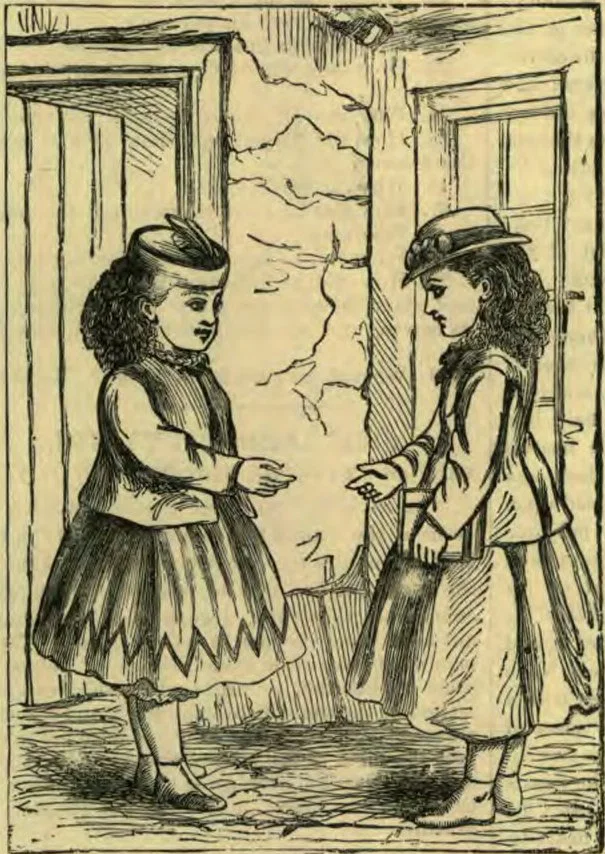
MINNIE BROWN went to visit her cousin Laura, who lived in Massachusetts. She was going to stay “a whole week,” so she told papa and mamma; but papa and mamma thought that she would be homesick in less than a week, for she was only a little seven-year-old girl, and had never been separated from mamma one night.
Now, can some of our little Yankee readers guess how Minnie made the journey of thirty miles that stretched between the city where she lived and Laura’s country home?
You guess that her father, or big brother Hal, or one of the servants of the household went with her.
But you haven’t guessed right. Not one person that she had ever before seen was on the train that carried her to the country.
Do you think that her parents were willing to run the risk of sending a little girl like Minnie all alone on a journey?
They did send her alone, however, but it was not quite in the ordinary way.
About her neck they put a little ticket, on which it said,
BY EXPRESS, CARE JONAS POND, MINTON, MASS. C. O. D.
These last mysterious letters meant, “Collect on delivery.” Or, in other words, that her Uncle Jonas was requested to pay the expressman when this curious little package was brought to his door.
This, Uncle Jonas did very gladly, and two happier children were nowhere to be found in country or city, than these two little girls, Minnie and Laura. They played in the fields and woods, gathering wild-flowers, and coming home tired and hungry. They hunted for hens’ nests, played “house-keeping” in the wide, roomy barn, and were, in a word, two very merry little girls. On the Sabbath they took their Bibles and went to Sabbath-school.
Minnie staid “a whole week,” not being homesick once; but oh, how glad she was to be at home again, and see papa, mamma, and brother Hal!—Sel.

NAZARETH

LYING in a secluded vale among the mountains which skirt the plain of Esdraelon on the north, is the little town of Nazareth, where the Saviour passed the days of his childhood and youth. It is about seventy miles north of Jerusalem, and is said to be one of the most beautiful villages in all Syria. A girdle of fifteen rounded hills encircles it, shutting out all view of the world beyond, and giving that air of quiet, peaceful seclusion which constitutes its chief charm. These hills rise around it like the edge of a shell, and seem as if formed to guard it from intrusion. The hill on the north-west of the vale overtops all the others, rising to a height of some four hundred feet above the village. Its side is steep, furrowed by ravines, and broken by ledges of bare rock. On its lower declivities, partly in ravines, partly on the shelving base, and partly on the sides and tops of the rugged ledges, stand the houses of Nazareth,—plain, neat, substantial white stone buildings with flat roofs. This is the hill on which the evangelist tells us “their city was built” (Luke 4:29); and there is more than one cliff along its side that might have served the purpose of the infuriated people, when they led Jesus to the brow of a hill “that they might cast him down headlong.”
Nazareth is now a secluded village of some three or four thousand inhabitants; and in the words of a traveler, “There is nothing at all to keep the place alive, except that all men know that Jesus had here his home.” Says another, “Nothing can be plainer than those houses, with the doves sunning themselves on the white roofs, and the vines wreathing about them. There is about the whole place an indescribable air of quiet and repose; and the narrow, rugged glens that branch off in all directions among the hills, seem as if made for meditation.”
Quite a number of traditional “holy places” are shown in and around Nazareth, but they have no historic basis. There is, however, a fountain which travelers visit with interest. It has from time immemorable supplied the town with water, and was without doubt daily visited by the youthful Jesus. “But,” says a traveler, “the charm of the spot is rudely broken by the scene that usually attracts the notice of visitors,—the quarrels of the girls who come for water, contending who shall have the earliest supply.” The town contains a mosque, a large Latin convent, and two or three chapels.
From the summit of the hill on the eastern slope of which Nazareth lies, is obtained one of the finest prospects in all Palestine. Toward the north the eye glances over the countless hills of Galilee, and rests on the majestic and snow-covered Hermon. On the east the Jordan valley may be traced, and beyond it the dim heights of ancient Bashan. Toward the south spreads the broad and beautiful plain of Esdraelon, with Mt. Tabor and portions of Little Hermon and Gilboa visible on its eastern border, and the hills of Samaria on the south. Then comes the long line of Carmel itself, with the Convent of Elias on its northern end, and Haifa nestling on the shore at its foot. In the west gleams the Mediterranean, and Mt. Carmel, extending far out into the sea, dips his feet in its blue waters. Says Dr. Robinson in his “Biblical Researches in Palestine:”—
“I remained for some hours upon this spot, lost in the contemplation of the wide prospect and the events connected with the scenes around. In the village below, the Saviour of the world had passed his childhood; and though we have few particulars of his life during those early years, yet there are certain features of nature which meet our eyes now, just as they once met his. He must often have visited the fountain near which we had pitched our tents; his feet must frequently have wandered over the adjacent hills, and his eyes have doubtless gazed upon the splendid prospect from this very spot.”
Ah Nazareth! though of such ill-repute among thy sister cities in the days gone by, yet now with reverent eyes shall all men gaze upon thee evermore, because that in thy streets and over thy hills lived and wandered the divine Son of God, in those days when he was made flesh and dwelt among men. EVA BELL.

You have reached the end of this edition.

The Youth’s Instructor · Sep 8, 1880