The Youth’s Instructor, Vol. 28, No. 2.

PEARLS

The Youth’s Instructor

Jan 7, 1880

S. D. A. Publishing Association · Battle Creek, Mich. · Jan 7, 1880

PEARLS

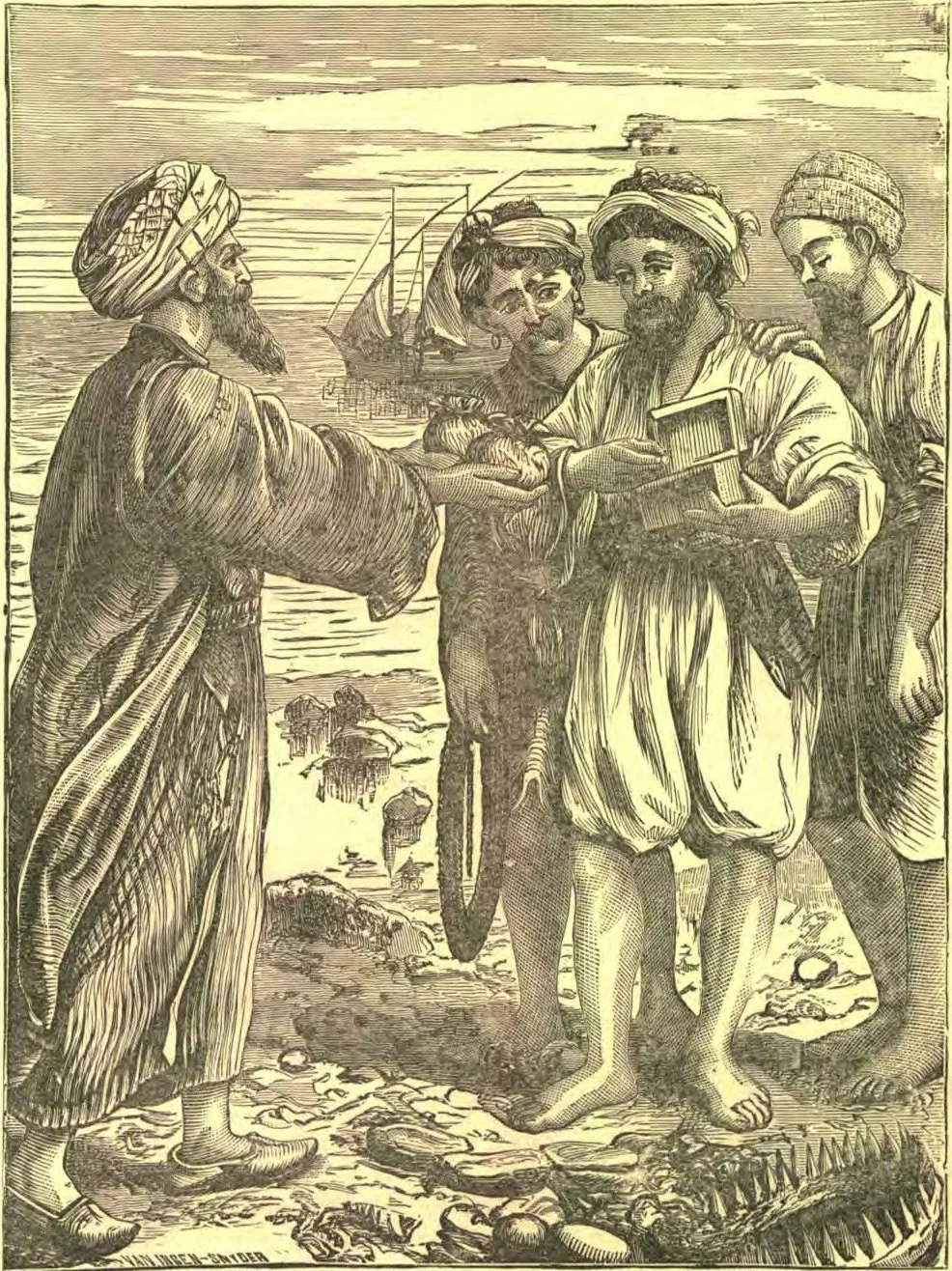
In the picture on this page, we see a merchantman and three sailors. What is the sailor taking from his box? See, it is a pearl. How eager the merchant seems to be to obtain it. See him holding out with both hands two bags of gold in exchange for it. Two bags of gold for one pearl? Yes; for pearls are very costly.
Perhaps the question arises, Where does the pearl come from? Down, down, beneath the waters. It is born in the bosom of an oyster; a dark and obscure home; but worth often has such homes; and worth, like pearls, is sought for, and comes to light, and finds its proper value by and by.
The island of Ceylon is famous for its pearl fisheries. Let us visit one. There we find boats of from ten to fifteen tons burden, rigged with only one mast and sail, and with a crew of thirteen men and ten divers. Each boat has five diving stones, weighing from fifteen to twenty-five pounds. A kind of scaffolding is formed of oars and other pieces of wood, on each side of the boat, from which the diving tackle is hung; three stones on one side and two on the other. The diver strips off his clothes, jumps into the water, takes hold of the rope which supports a stone, and puts one foot into a loop or stirrup on the top of the stone. After getting his balance, a basket hanging from a rope, is thrown to him, and in this he puts his other foot. Feeling himself ready, he grasps the rope in one hand and his nose with the other, to prevent the water from rushing in, and the ropes are let off. Down, down he sinks to the dark oyster bed below. On touching the bottom, he takes his foot from the stone, which is drawn up for the next diver. Then throwing himself as much as possible on his face, he scrambles up the oysters; and if it is a rich bed, and he is expert, he can gather a hundred and fifty in about a minute and a half, which is as long as he can stay under water. He jerks the rope, and he and his basket are hauled up. There are two divers to each stone, and they go down one after the other, one resting while the other is plunging; and so they work on for six hours together.
On the return of the boats to the shore at night, the oysters are thrown into paved pens, where they stay ten days to dry and rot. The shells are then broken, and those which have pearls cleaving to them are handed to the clippers, who wrench the pearls off with pincers.
Pearls have always been favorite ornaments; and some have been of enormous value. We read that Queen Cleopatra had pearl ear-rings worth more than eight hundred thousand dollars.
Such facts throw light on the words of our Lord: “The kingdom of Heaven is like unto a merchantman seeking goodly pearls, who, when he had found one pearl of great price, went and sold all he had and bought it;” showing that the salvation of the soul, which is found in the gospel of Christ, and which may well be called the “pearl of great price,” is of more value than every thing else, and worth the cost of all we have in order to get possession of it.

“HOW READEST THOU?”

'Tis one thing now to read the Bible through, Another thing to read to learn to do. 'T is one thing to read it with delight, And quite another thing to read it right. Some read it with design to learn to read, But to the subject pay but little heed. Some read it as a duty once a week, But no instruction from the Bible seek; Whilst others read it with but little care, With no regard to how they read, nor where. Some read it as a history to know How people lived three thousand years ago. Some read to bring themselves into repute, By showing others how they can dispute; Whilst others read because their neighbors do, To see how long ’t will take to read it through. Some read it for the wonders that are there, How David killed a lion and a bear; Whilst others read, or rather in it look, Because, perhaps, they have no other book. Some read the blessed book they don’t know why; It sometimes happens in the way to lie; Whilst others read it with uncommon care; But all to find some contradictions there. Some read as though it did not speak to them; But to the people at Jerusalem. Some people read, as I have often thought, To teach the book, instead of being taught. So many people in these latter days Have read the Bible in so many ways, That few can tell which system is the best, For every party contradicts the rest. If wisdom true from it you would derive. Read Proverbs two and verses one to five.

SCRAPS FROM HISTORY.

THE INTRODUCTION OF IDOLATRY.

WHEN the four great kingdoms of Babylon, Media and Persia, Grecia, and Rome, were established, the prevailing religion of each was that of paganism or idolatry; that is, the people worshiped false gods which were made of wood, stone, iron, brass, silver, and gold. Some of these idols were in shape like men, elephants, horses, dogs, cats, rats, and mice. There were some who worshiped the heavenly bodies.
In olden times these gods were placed in beautiful groves, in which the people built altars and dedicated them to the service of these false gods. At a later period, they erected large and expensive temples which they adorned with a great amount of silver and gold, and regarded them sacred to these idols.
Although the descendants of Adam were acquainted with the true worship of God, yet as soon as they fully departed from him they ran into idolatry, and as the apostle Paul says of them in the first chapter of Romans, they “changed the truth of God into a lie, and worshiped and served the creature more than the Creator,” “changed the glory of the uncorruptible God into an image made like to corruptible man, and to birds, and fourfooted beasts, and creeping things.”
From the creation of Adam in the garden of Eden until Abraham’s time, there were some in every generation who faithfully worshiped God, and had faith in Jesus, and manifested their faith by offering the sacrificial offerings; that is, they erected altars, and selected an offering and sacrificed it to the Lord. Sometimes the offering consisted of a turtle dove, a lamb, or a bullock. They slew these animals and offered them as a sacrifice to God upon their altars, thus showing their faith in Christ, by which they taught their children from generation to generation that at last Jesus would die upon the cross and shed his blood for us, and thus become a sin-offering for us.
Soon after the flood men again ran into idolatry, and in order that his worship might be preserved, God called Abraham, and his posterity maintained the service of God for hundreds of years. In the next paper we will tell you about the call of Abraham. S. H. LANE.

DEATH OF LITTLE CARRIE.

Last night, where I was holding meetings in Bellville, Ohio, a dear little member of the INSTRUCTOR family died very suddenly. Last Sabbath she was in her usual place in the Sabbath-school, and took a deep interest in the lesson. She became very tired, but would not leave until she received her INSTRUCTOR. How little did she or any of her friends then think that this would be the last paper she would receive, and the last school she would attend. May not some of us be cut down just as suddenly? Carrie was only seven years old, and though her parents did not keep the Sabbath, yet she loved the Sabbath-school and the weekly INSTRUCTOR so well that it was a delight for her to attend, and her parents kindly aided her to do so. Often she was the first one at school, so anxious was she to be on time and get all the benefit of the school.
Dear readers of the INSTRUCTOR, if you should die as suddenly, are you ready to meet the Lord? Some of you are older than Carrie and more would be required of you. Could it be said that you loved the Sabbath-school? and that you loved to learn about what God has taught us in his Holy Bible? How sad it would have been if little Carrie on the last Sabbath she lived, had been naughty, had neglected or refused to get her Sabbath-school lesson, had preferred to go and play with bad children, or had been rude in the school!
So we should always remember, when we are tempted to do wrong, that this may be the last day of our lives. We should never allow ourselves to be cross, naughty, or in any way bad now, calculating that by and by, when we are older, we will change our ways and become good. Now may be all the time we will ever have.
The Lord says, “Behold, now is the accepted time, behold, now is the day of salvation.” D. M. CANRIGHT.

YOUR EVENINGS.

BETWEEN now and the first of May there are more than one hundred evenings to be disposed of in some way. What are you going to do with them, young friends? Will you allow them to slip by, one by one, and when they are past, find that you are no better or wiser for having had them?
At this season of the year, when all kinds of pleasure parties are being held, young people who have become entangled in the meshes of fashionable society, spend a large share of their evenings in attending such gatherings. Having once become fascinated with the charm of young society, they do not scruple to go even to the dance hall to obtain it. Thus they are led on, step by step, and what the end will be, who can tell?
We hope that none of the INSTRUCTOR family will begin in this downward road; and the safest way to shun it is to have the mind so occupied with interesting and profitable things at home that you will have no particular desire to attend such places. “Of all the amusements which can possibly be imagined,” said Sir John Hershel, “there is nothing like reading an entertaining book.” What a source of domestic enjoyment is thus laid open! The father may read aloud while the rest work, or the eldest son or daughter may read, or the book may be passed around from hand to hand. All have the benefit of it, each contributes to the gratification of the others, and a feeling of common interest and pleasure is excited.
Most could easily get two hour each evening in which to read or study; and we recommend that the first hour be spent in reading from The Great Controversy, as suggested in the Review for Jan. 1, and that the last hour be occupied in reading good histories and biographies, such as the Life of Luther, the lives of foreign missionaries, History of the Reformation, etc. If you have never read history much, do not commence with such extensive works as Rollin or Gibbon, but first take some interesting school history, giving either the history of the United States, or an outline of the world's history. By faithfully pursuing this course during the winter, you will be surprised to see how much you can learn.
If any who read this are in the habit of attending popular places of amusement, where all is frivolity and mirth, or of spending their evenings in idleness at home, we hope you will give up the practice. Devote your evenings to mental and spiritual improvement, and see, when the spring flowers bloom, if you have not developed more of those traits of character which you and all others most admire.
M. K. W.

Lessons for Children.

Lesson LIV.—Solomon's Greatness.

The fame of Solomon spread to all the nations round about; and when the queen of Sheba heard of his wisdom, she came to prove him with hard questions. “And she came to Jerusalem with a very great train, with camels that bare spices, and very much gold, and precious stones; and when she was come to Solomon, she communed with him of all that was in her heart. And Solomon told her all her questions; there was not anything hid from the king, which he told her not. And when the queen of Sheba had seen all Solomon's wisdom, and the house that he had built, and the meat of his table, and the sitting of his servants, and the attendance of his ministers, and their apparel, and his cup-bearers, and his ascent by which he went up unto the house of the Lord; there was no more spirit in her. And she said to the king, It was a true report that I heard in mine own land of thy acts and of thy wisdom. Howbeit I believed not the words, until I came, and mine eyes had seen it; and, behold, the half was not told me; thy wisdom and prosperity exceedeth the fame which I heard. Happy are thy men, happy are these thy servants, which stand continually before thee, and that hear thy wisdom. Blessed be the Lord thy God, which delighted in thee, to set thee on the throne of Israel; because the Lord loved Israel forever, therefore made he thee king, to do judgment and justice.”
“And she gave the king a hundred and twenty talents of gold, and of spices very great store, and precious stones; there came no more such abundance of spices as these which the queen of Sheba gave to king Solomon. . . .
And king Solomon gave unto the queen of Sheba all her desire, whatsoever she asked, besides that which Solomon gave her of his royal bounty. So she turned and went to her own country, she and her servants.”
And king Solomon made two hundred targets of gold, each target weighing six pounds, and three hundred shields of gold, each weighing three pounds. He also made a great throne of ivory, and overlaid it with pure gold: leading up to the throne were six steps, and beside the steps were twelve lions, six on the right hand, and six on the left. All of Solomon's drinking vessels, and all the vessels of the house of the forest of Lebanon were of pure gold, nothing was made of silver, for gold was so plenty that silver was counted of little value.
“And king Solomon passed all the kings of the earth in riches and wisdom.”

Questions.

  1. What is said of the fame of Solomon? 1 Kings 4:31.
  2. Who came to Jerusalem to see king Solomon? Chap. 10:1.
  3. On what errand did she come?
  4. What did she bring with her?
  5. How did Solomon succeed in answering her questions?
  6. How was she affected by what she saw and heard?
  7. What did she say to the king?
  8. How had she changed her mind since leaving her own country?
  9. Why did she think Solomon's servants were especially favored?
  10. For what did she bless the Lord?
  11. What presents did she make Solomon?
  12. What did Solomon give her in return?
  13. What did the queen and her servants then do?
  14. What did king Solomon make?
  15. How many pounds did each target weigh?
  16. What was the weight of each shield?
  1. Describe the throne which Solomon made.
  2. Describe Solomon's drinking vessels, and the vessels of the house of the forest of Lebanon.
  3. Why were none of them made of silver?
  4. What is said of Solomon's wealth and wisdom? 2 Chron. 9:22.

BIBLE LESSONS FOR YOUTH.

LESSON LXXX.—KING, ASA.

  1. Who first reigned over Judah after the kingdom was divided?
  2. How long did he reign?
  3. Who was the next king of Judah?
  4. How long did he reign?
  5. By whom was he succeeded?
  6. What course did Asa pursue? 2 Chron. 14:2.
  7. Describe his attempts to put down idolatry.
  8. How did he attempt to strengthen his kingdom against invaders?
  9. How great was his army?
  10. How long did he have peace with the countries about him?
  11. Who finally came up against him?
  12. Describe the Ethiopian army.
  13. In whom did Asa trust for deliverance?
  14. Repeat his prayer. Verse 11.
  15. What was the result of the battle?
  16. What spoil was taken?
  17. How did Asa and the men of Judah show their gratitude? Chap. 15:11, 12.
  18. What covenant did they make?
  19. How was Asa annoyed by Baasha? Ch. 16.
  20. Of whom did he seek help?
  21. How did he obtain it?
  22. Where was Ramah situated?
  23. What did he do when the Lord reproved him for such a course?
  24. Describe the changes of government that took place in the kingdom of Israel during the latter part of Asa’s reign.
  25. How long did Asa reign in Judah?
  26. Who then reigned in his stead? Chap. 17:1.
  27. How long did Jehoshaphat’s good reign continue? 1 Kings 22:42.
  28. How did he instruct the people in the way of the Lord? 2 Chron. 17:7–9.
  29. How was he treated by surrounding nations?
  30. How many men of war were numbered in his kingdom?

SYNOPSIS.

“And Asa did that which was good and right in the eyes of the Lord his God; for he took away the altars of the strange gods, and the high places, and brake down the images, and cut down the groves; and commanded Judah to seek the Lord God of their fathers, and to do the law and the commandment.”
Because Asa acted so wisely, the Lord gave him peace for ten years. This time he improved in building fortified cities, and strengthening those already built. Finally there came out against him Zerah the Ethiopian, with a million of men and three hundred chariots. Although Asa had an army of nearly six hundred thousand men of valor, he felt that his only hope was in the Lord his God. “And Asa cried unto the Lord his God, and said, Lord it is nothing with thee to help, whether with many, or with them that have no power: help us, O Lord our God; for we rest on thee, and in thy name we go against this multitude. O Lord, thou art our God; let not man prevail against thee.”
So the Lord smote the Ethiopians before Asa and before Judah, and the Ethiopians fled. The flight of this vast army was so precipitate that their tents and their cattle, very many in number, were left a spoil to the men of Judah.
Asa and his men returned to Jerusalem, rejoicing and praising God. They offered to the Lord seven hundred oxen and seven thousand sheep; and entered into a covenant to seek the Lord God of their fathers with all their heart and with all their soul. “And there was no more war unto the five and thirtieth year of the reign of Asa.”
Then Baasha, king of Israel, came, and began to build a fortified city at Ramah, which was only six or seven miles north of Jerusalem. Instead of seeking counsel of the Lord, Asa took the silver and gold which he and his father had dedicated and placed in the house of the Lord, and sent it to Benhadad, king of Syria, to induce him to break the league with Baasha, and make war against the kingdom of Israel. Benhadad accepted the rich present, and did as Asa requested. Baasha was then obliged to leave off building Ramah, and go against the enemies that had invaded his kingdom on the north.
The Lord was greatly displeased with this act on the part of Asa, and sent a prophet to reprove the king. Instead of receiving the reproof meekly, Asa was angry, and put the prophet in prison. It seems sad to see this great and good man turning away from the Lord after a long life of good deeds.
During the latter part of Asa’s reign, there was great confusion in the kingdom of Israel. Baasha died in the twenty-sixth year of Asa’s reign, and was succeeded by his son Elah, who, after two years, was slain by Zimri. Zimri reigned only seven days, when he was overcome by Omri, who reigned nearly twelve years, sharing the rule for the first five years with Tibui, and succeeded by the wicked Ahab.
Asa died in the forty-first year of his reign, and was succeeded by Jehoshaphat, his son. Jehoshaphat was a good man, and reigned twenty-five years. He sent priests and Levites to all the cities of Judah, to teach the people the law of the Lord; and the fear of the Lord fell upon all the surrounding nations, so that they made no war against Jehoshaphat, but brought him presents, and tried in every way to secure his friendship.
Judah was very populous at this time; for, according to the numbering, there were eleven hundred and sixty thousand men of war.

“PULL TOGETHER.”

SAILORS know that it takes not only a “long pull,” and a “strong pull,” but a “pull all together,” to move the heavy burden.
You all remember the lesson taught by the bundle of sticks; but it will bear repeating. An old man, when dying, called his children about him, and after sending one of them out for a bundle of sticks, requested his son to break the bundle across his knee. He tried and failed. “Try them separately,” said the father. He did so, and they snapped like pipe-stems. Thus the father taught his children that united they might stand, but divided they would easily fall.
When every man, woman, and child pulls every pound he is able; when all pull together, in the same direction, something will be accomplished.
To apply this to the Sabbath-school work,—pull together; be united. Do not oppose every plan that is suggested, nor think that you are in duty bound to discourage every effort toward improvement. Stay up the hands of your officers, help and cheer them by doing all you can to second their efforts. You have elected them, not to criticise, or find fault with them; but that they may lead out, and make the exercises interesting.
No wonder if at your elections you find it difficult to get any one to accept an office; for I greatly fear that when your officers with trembling hands and quaking heart step forward to “put their shoulder to the wheel,” many of you jump on the car, or pull back, some shouting, “Hold on there! You didn’t take hold of the matter just right; you are putting on too much style!” while others whisper, “Did you ever see anything half so awkward?”
Brethren, you may smile, but these things are acted over and over again.
Is it not of more consequence that we “put our shoulder to the wheel” than it is to be constantly criticising, and finding fault with the manner of performing the work?
CHAS. C. LEWIS.

SAMSON

SUPPOSE the children have all heard of Samson. He lived more than three thousand years ago, in the country of Palestine, the same country where our Saviour afterwards dwelt. His father's name was Manoah, and their home was in a village called Zorah. Perhaps you can find it on a map of that country.
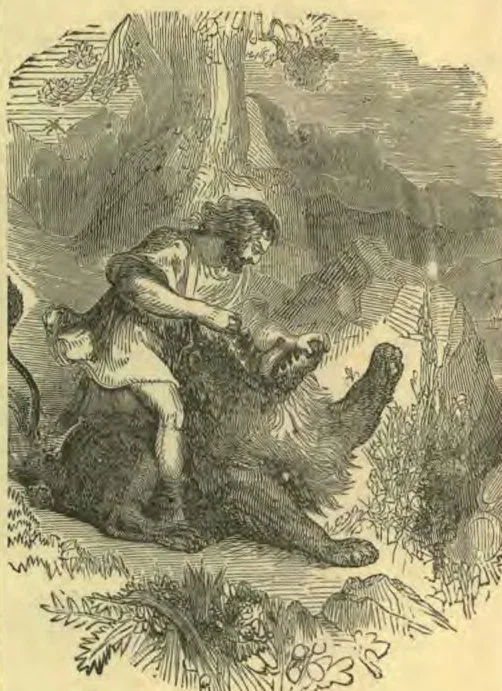
The Bible tells us nothing of the childhood of Samson, but very likely he loved to run and play as well as children now-a-days. His hair was never cut, so that when he was grown, it must have been very long. One day when he had come to be a young man, Samson, with his father and mother, went down to Timnath, a town a few miles from where they lived. On the way, Samson turned aside into a wood, and a young lion came out and roared against him. He had nothing to kill the lion with, so he slew him with his hands alone. In the picture you see him breaking the jaws of the lion. He must have had great strength to do this. But what seems strangest of all, was that he did not tell his father and mother what he had done, but went on as if nothing had happened. After a time they were going that way again, and Samson turned aside to see what had become of the lion, and found that a swarm of bees had gone in and made honey there. He ate of the honey, and gave some to his father and mother, but did not tell them where he had found it.
At another time, he slew a thousand men of the Philistines with the jaw bone of an ass. Again, he took up and carried away the gates of the city of Gaza, where the Philistines had shut him up. At one time when the Philistines had wronged him, he caught three hundred foxes, and tied them together two by two. He then set their bushy tails on fire, and sent them into the standing corn of the Philistines, and it was all destroyed.
Now the Philistines were very anxious to know what made Samson so strong, so they told his wife, who was a Philistine woman, that they would give her eleven hundred pieces of silver if she would find out the secret of Samson's strength. So she persuaded him, and he told her that if his hair was cut off, he would be no stronger than other men. Then she had one of the Philistines come and shave off his hair, while he slept. When he awoke his strength was gone; and the Philistines took him, bored out his eyes, and made him grind in their prison-house.
Finally, the lords of the Philistines made a great feast to their god, and brought out Samson to make sport for them. But his hair had begun to grow again, and praying to God to give him strength, he took hold of the two main pillars of the house and pulled them down, killing himself, the lords of the Philistines, and more people than he had killed in all his life, for there were three thousand on the roof.
Samson was a strong man, and in many respects a wise man. He judged some of the tribes of Israel twenty years. The Lord raised him up to deliver his people, but Samson was so willful that God could not work with him. It may be, too, that he trusted too much in his own strength, instead of looking to God for help. We must be careful not to make the same mistake in trying to serve the Lord. E. B.

HOW RUBBER SHOES ARE MADE.

Gum elastic is one of the principal exports of the city of Para, Brazil, and one of its most valuable commodities. It is there called borracha. The use of this gum was learned from the Omagus, a tribe of Brazilian Indians. The savages used it in the form of bottles, and it was their custom to present one of these bottles to every guest at the opening of one of their feasts.
The Portuguese settlers in Para were the first who profited by putting it to use in the making of boots and other garments. It was specially useful for such a rainy country. But lately the gum has been improved by manufacturers, and put to a greater variety of uses, so that it is now an advantage not only to Brazil but to the whole world. It is the production of a tree called siphoni elastica, which grows to the height of eighty and often to one hundred feet. The lower part of the trunk is usually without any branches, the top is spreading, with its beautiful glossy foliage toward the sun.
On the slightest incision, the gum exudes, resembling a rich cream. The trees are mostly tapped in the morning, and about a cup of the liquid is procured from one opening in a day. It is first caught in small vessels made out of clay, moulded for the purpose by the hand, and then poured into large jars. It is ready for use as soon as it comes from the tree, and is made into different forms after models formed of clay. When people make shoes or boots they find it cheaper to have lasts of wood, which are covered with clay, so that the article may be easily withdrawn. These lasts have handles that the work may be done more neatly and with greater speed. The liquid is poured over the mold and a thin coating sticks to it. The gum is then dried, darkened, and hardened by being exposed to a smoke made by burning the fruit of the wassou-palm. When one covering becomes hard, another is put on and smoked, and then another, until they get as many thicknesses as they want. Then the articles are exposed to the sun’s rays, after which they are ornamented to suit the tastes of the workmen. When ready for exportation, they are stuffed with leaves or dried grass to keep them in shape.
Such goods are extensively manufactured in the vicinity of Para, where are whole plantations of these trees. The gum can be gathered through the whole year; but May, June, July, and August are the best months for getting it. It is one of the best exports of the country, and grows in inexhaustible quantities. The tree is beautiful, and is one of the greatest ornaments of the Amazonian forests, yet withal it is profitable and useful to the entire world.
When you wear your comfortable “gum shoes” next time, think of what I have told you about the gum elastic procured in the forests of the Amazon. Because of the good providence of the great Creator in making this provision, you are protected from an exposure which might bring to you serious discomfort and danger.—Child’s World.

LETTER BUDGET.

New London, Wis.
Dear Editors: Inclosed you will find 75 cents for which I wish you to send the weekly INSTRUCTOR with the book of “Poems” to my little cousin for a Christmas present. My little brother and I saved this money to do good with. He is five years old and I am seven. Mamma told us that it would be doing good to use it this way. Our teacher told us last Sabbath that God gave us a Saviour for a Christmas present, and so I give this present in his name, hoping that he will bless my little cousin, and that she too may become a member of the “INSTRUCTOR family” and be saved in the kingdom.
Yours in love, Nellie Walker.
P. S. Mamma wrote my letter, but I helped her think what to write. N. W.
This letter has the right ring to it. The INSTRUCTOR is just the thing for a Christmas or New Year’s present. Something that will remind one of the giver every week during the year. It is not yet too late to make New Year’s presents. Send in the names.

You have reached the end of this edition.

The Youth’s Instructor · Jan 7, 1880