The Youth’s Instructor, Vol. 35, No. 15.

WELLINGTON

The Youth’s Instructor

Apr 13, 1887

S. D. A. Publishing Association · Battle Creek, Mich. · Apr 13, 1887

WELLINGTON
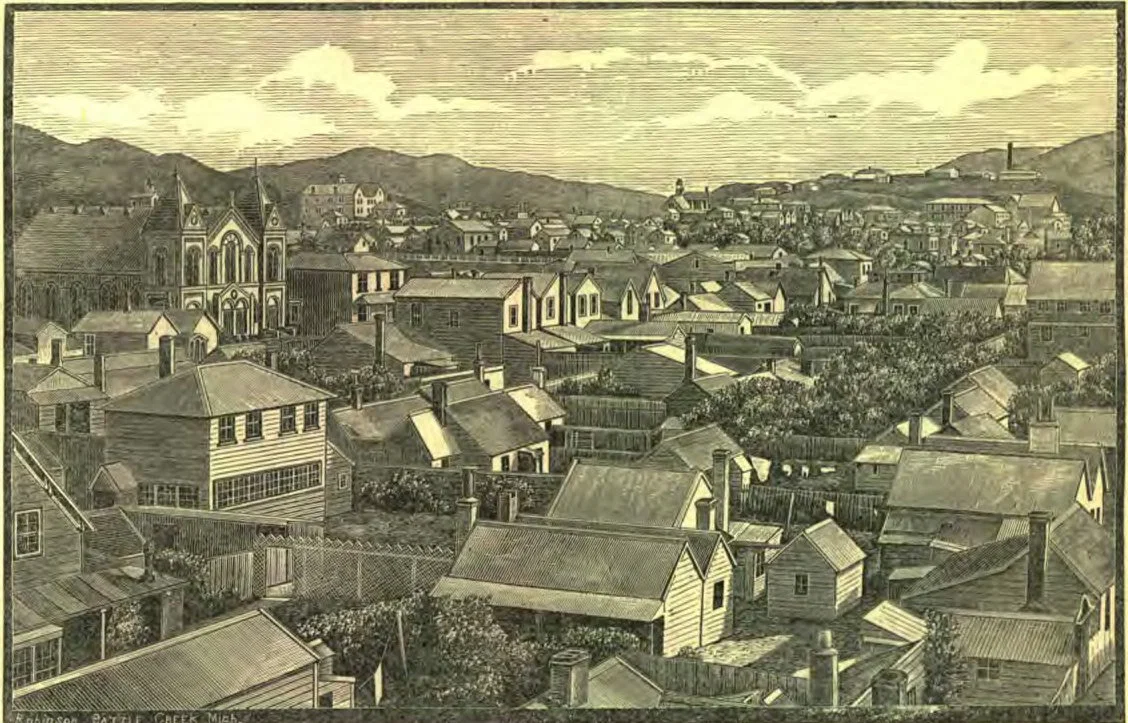
By looking at the map of New Zealand, it will be seen that Wellington, the capital city, is situated on the southern coast of the North Island. This city is second in size in the country, and contains about forty-five thousand inhabitants. It was in 1839, before New Zealand had become an independent colony, that the site for this city was selected, and in the following year a company of settlers arrived.
The citizens of Wellington are proud of their harbor, and perhaps justly, as it is a most magnificent one. Entered by a narrow but deep channel, it spreads out into a spacious sheet of water, where the largest ships can ride safely, and may advance to load or unload to the very streets of the town. The city is built along a strip of land lying on the bay, which has principally been reclaimed from the sea by the efforts of the citizens, thus gaining a level tract of ground upon which the business part of the city is located.
To get a good idea of the city, one should ascend the hills back of it, where a most excellent view of the city and the surrounding country may be obtained. In Wellington and its suburbs are many fine wooden buildings, as also at the present time many brick and stone structures, though the latter have been erected within a few years. The liability to earthquakes formerly deterred the people from making use of brick and stone; but as there have been no shocks for many years, an ordinance has been passed forbidding the erection of wooden houses within prescribed limits. The Government Offices comprise what is said to be the largest wooden building in the world. The Parliament Buildings are immense structures also. The large Museum will interest the lover of the curious. In this is a very large Maori house, built by a tribe renowned for their skill in carving, being a perfect specimen of the Maori art. The Botanical Gardens cover about a hundred acres back of the city, and are well stocked with the flora of New Zealand. In a little suburb called the Hutt, is another garden, which illustrates the facility with which plants from every latitude and longitude accommodate themselves to the genial New Zealand climate.
WELLINGTON, NEW ZEALAND.
About sixty miles northwest of Wellington is Masterton, connected with the capital by a railroad which winds over mountains and through tunnels, the highest elevation being 2389 feet above the sea. Between two of these tunnels, is a space called “Siberia,” because of the severe gales which sweep through it. Sometimes the wind has thrown the cars from the track, but precautions have since been taken to render the road perfectly safe, although when riding, you are reminded of the place by the rattling of sand and pebbles, as they are driven by the wind against the windows. This railroad exhibits great engineering skill in its construction, and well pays the visitor for the time spent in making the trip.
Many spacious churches rear their heads above the town, the Catholic Cathedral being the largest. Extensive shipping trade is carried on, and the wharfs present a scene of activity, very commendatory to New Zealand enterprise.
To the student of New Zealand history, this locality has many interesting features, as the scene of numerous conflicts between the various tribes, and also between the natives and the early settlers. The entire province of Wellington covers an area of about seven and a quarter million acres, and abounds in rich pastures and valuable forests. S. N. HASKELL.

NEVER-DYING WORDS.

The natural-science class was up for recitation at Pictou Academy, and the teacher was brightly explaining the theory of sound to a dozen deeply interested boys.
“Do you know,” he continued, after telling them how every sound made tiny waves in the air, just as a stone does when thrown into still water, “that some wise men are of the opinion that those waves, or pulsations, never altogether cease after they have once been started? Nobody, of course, has delicate enough hearing to catch their meaning; but there they are all the same, just as when they first made an impression upon the ear for which they were intended, and they will continue to pulsate until the end of the world.”
So you see, boys, if that be true, no utterance that goes from our lips into the air can ever be lost, but must live on long after our voices are forever silent. All the words that have been spoken since Adam first opened his mouth are preserved in the air; and if our sense of hearing were only sharp enough, we might hear Noah giving directions at the building of the ark, David singing before Saul, Christ preaching the Sermon on the Mount, Shakespeare reading “Hamlet” to his admiring friends, Washington giving commands to his army at Yorktown, and so on down through the centuries to what was said by ourselves the day before yesterday.”
Seeing how eagerly the boys were listening, Mr. Maynard thought it a good chance to teach them something more than science, so he continued in a somewhat graver tone:—
“If, then, all the words that you and I have spoken, all the speeches we have made, kind or unkind, respectful or impertinent, true or false, cross or good-natured, are still in the air above us, even though we cannot hear them, how would we like it if they all could be heard? Wouldn’t some of us be made to feel a good deal ashamed? What do you think? You often sing, ‘Kind words never die;’ but suppose unkind words never die either?”
Nobody in the class was brave enough to answer, so Mr. Maynard wisely dismissed it, and, soon after, school broke up for the day.
Fred Newton and Will Munroe walked home together, as they almost always did, being great friends; and they had both been unusually quiet for a time, when Fred suddenly exclaimed:—
“Say, Will, that was a queer thing Mr. Maynard told us this afternoon about never-dying words. I don’t half believe it myself.”
“It does seem a funny idea, Fred, and I don’t quite like it, either,” replied Will. “A fellow is always saying things he oughtn’t to, and it isn’t pleasant to think of them as being up there in the air still, even if people can’t hear them.”
“Why, of course,” rejoined Fred, who, as all his friends knew, and some of them at the expense of their feelings, had a very ready tongue, and a sharp one at that. “You can’t always stop to think just what you’re going to say, especially when you’re mad about something.”
“That’s so,” concurred Will promptly. “When I get mad, I just say the first thing that comes handy; and it isn’t always what I’d like Mr. Maynard to hear, I tell you. I’m just glad he can’t make out what is up there in the air.”
“Well, it’s no use crying over spilt milk, any way,” returned Fred, who seemed anxious to drop the subject. “Let’s hurry up and pitch into the foot-ball.”
And the two boys made haste to the ball-field, where they played vigorously until dark.
When Fred Newton went home that evening, he found the parlor empty, and a fine big fire blazing cheerily in the grate, before which he stretched himself at full length upon the soft rug. He had not been there very long before such a babel of voices filled the room that at first he was fairly bewildered; but after a little it seemed to him he could distinguish what some of the voices were saying, and not only that, but they all sounded strangely like his own. So he raised his head, and listened eagerly to see if he could find out what it all meant. Presently he heard what he felt perfectly sure was his own voice, answering somebody in the most disagreeable of tones, thus: “No, I won’t do anything of the kind! Who was your servant last year, miss?” And it gave him a very uncomfortable twinge of conscience to remember that he had said those very words to his sweet little sister Edie only last week, when she asked him to carry a small parcel to one of her friends. Of course, to do so would have taken him a good deal out of his way just then, but he need not have given her such a cross answer, at all events.
Next, he heard the words of a slang verse, which brought up in his mind the poor, harmless, crippled, old colored man, who sometimes came begging to his father’s door, and whose life the boys made miserable by their cruel teasing. Somehow or other the words did not seem quite so funny as Fred heard them now; and if his cheeks did not redden a bit, it was only because they were already glowing with the heat of the fire.
Then this sentence, muttered in a very sulky, willful tone, fell on his ear: “Mean old thing! Won’t let a fellow have any fun;” and it recalled to him what he had said under his breath when his father had firmly forbidden him to be out at night with Frank Rudolph, Ned Jones, and the other boys whose fathers were not so particular. Fred couldn’t help a little start for fear his father might possibly be in the room now, and overhear his son’s undutiful speech after all.
“Who wants to go to Sunday-school? I’ve had enough of Sunday-school,” said the familiar voice again; and this time it brought up the picture of his mother’s sad, shocked face when he had blurted those very words out last Sunday almost before he knew it.
And so it went on until it seemed as if every hard, naughty, unkind word that Fred Newton had ever said was pulsating through the air of that parlor,—white lies and black lies, cutting things said before people’s faces, and cruel things said behind their backs, and every one of them seemed to have a sting in it, just as if they were a swarm of hornets, so that poor Fred was fairly writhing in mental agony, when suddenly another voice, this time not his own, but his beloved mother’s, overpowered all the others, as it called out merrily:—
“Why, Fred, what’s the matter with you? You’re squirming about on the rug like an eel in hot water. You shouldn’t go to sleep so near the fire.”
And Fred, springing to his feet with a cry of relief, threw his arms round his mother’s neck, and giving her a hug, while the tears brimmed in his eyes, exclaimed with a vehemence that quite astonished her:—
“Mother, darling, I’ll never say an unkind word again!”
It would, of course, be too much to expect that Fred kept his promise to the very letter; but this may be said, at all events, that both his temper and his tongue were under better control ever after.—J. Macdonald Oxley, in S. S. Times.

AN APRIL MORNING.

THIS morning when I woke, I heard The low, sweet chatter of a bird Beside my window, where so long I've missed the music of the song That filled last summer with delight, And saw a sudden arrowy flight, A flash of blue that soars and sings, A bit of heaven itself on wings.
“The bluebird has come back,” I cried, And flung the window open wide; I leaned across the mossy sill, And heard the laughing little rill, That comes but once a year, and stays Through the brief round of April days; Then, when its banks with bloom are bright, It seems to vanish in a night.
The old spring gladness filled the air, I saw it, felt it, everywhere; The sky was bluer, and a tint Of color, that was but a hint Of “green things growing,” greeted me Along the willows by the lea, And I could almost feel and hear The quickened pulses of the year.
A warm south wind that seemed a draught Of wine, the sweetest ever quaffed, Blew round me, bringing balmy smells That made me dream of Pimpernels And pink Arbutus by the brook, And I was happy as the bird Whose heart with spring's swift joy was stirred.
—Selected.

TWO MONTHS.

“I was once,” said a judge, “in the waiting-room of a great physician, with other patients, waiting my turn. One of them, a stout, genial, middle-aged man, began to talk to me. ‘It is ridiculous my coming here,’ he said. ‘A mere trifle, which will wear off of itself. But my wife would have me come—you know how women are. It is nothing but a peculiar feeling at the tip of my tongue—a kind of numbness.’”
“At that moment he was summoned to the physician’s office. The conference was a long one. At last the door opened. The man came out. He was pale. His large face was covered with drops of sweat, as if he had received a mortal blow. He stopped and turned to the physician, saying hoarsely,—
“‘Doctor, you’re sure? There is nothing to be done—no operation—no?”—
“‘I know of nothing,’ said the physician, gently. ‘No cure has as yet been discovered for your disease.’”
“‘And—how long?’”
“There was a moment’s silence.
“‘Not more than two months. Sit down. Let me bring you some water.’”
“‘No, no.’ He hurried, staggering to the door, muttering, ‘I have not time. I have so much to do. Only two months!’”
“I heard afterwards that he died within the appointed time. But I have often thought of the mad haste with which he would work in those two months, to finish all that he had to do in the world, to show his friends the best side of his nature, to speak kind words, to help all that needed help, to prove to wife and children how he loved them, and to come nearer to his God. Sixty short days! How fast they would go! How he must have counted the hours—the minutes!”
And yet—is it different with us? The time left to us may not be two months—or two days. And what are we doing in them?—Youth’s Companion.

"WHAT SHALL I DO TO BE SAVED?"

I SUPPOSE you have thought of this question many times, and really it is one of the most important ones that you could ask,—far more important than how to get rich, how to be honored in this world, or what you shall eat or drink or wear. For if we could obtain all these things, they would last us only a little while; we could not carry any of them beyond this life.
But if we are saved, we shall have riches and honor; we shall eat of the tree of life that grows in the kingdom of God, and we shall live forever. Just think of it! After you have lived as long as the oldest man that ever lived on this earth, you will only have begun to live, and you will be growing happier every day, for there will be no sickness, no sorrow, and no pain in the paradise of God.
Would it not be pleasant to see Adam and Abel, Enoch and Elijah, Abraham, Isaac, and Jacob, and all the righteous that have ever lived? And would you not like to see the angels, and best of all, our blessed Saviour? But just a desire to see them will not be enough; there are some things that we must do if we want to be saved.
You have all done things that you ought not to do. Perhaps you have broken the fifth commandment by dishonoring your parents. That is a terrible sin, which will shut you out of heaven. Perhaps you have told lies, and so broken the ninth commandment. May be you have had hatred in your heart; and the Bible says that “he that hateth his brother is a murderer.” Have you broken the Sabbath? Have you been cross and selfish, and so shown that you love yourself more than you do others? Then how can you be saved?
You say that you will stop breaking the commandments, and go to keeping them; you will obey your parents, always speak the truth, and put hatred out of your heart. This is right as far as it goes; for Jesus says, “If thou wilt enter into life, keep the commandments.” And the Lord will help you to do this if you earnestly ask him.
But there is something more to be done. All your past sins stand against you in the books of heaven, and your being good will not blot them out, any more than simply being good would mend a mirror after you had broken it. What can you do, do you ask? First you must repent of all your sins; that is, you must feel so sorry about them that you will stop sinning. Acts 3:19. Did you ever feel so bad because you had sinned against God that you have wept over your sins, and really resolved that you would live better? That is repentance.
Then you must confess your sins. 1 John 1:9. Tell the Lord how wicked you have been, and ask him to forgive you. Jesus died that your sins might be washed away in his precious blood. Don’t you think that he wants you to be saved?
Then you must believe (Acts 16:31) that God will truly forgive you, because he has promised to do it. You need not doubt. Dear young friends, will you do it? The Lord wants you to be his children. In Acts 2:38 we read of another step that is to be taken in order to become one of God's children. Repent of your sins, confess them to God, ask his forgiveness, and then keep his commandments. “Blessed are they that keep his commandments, that they may have a right to the tree of life, and may enter in through the gates into the city.” May many of the INSTRUCTOR family find a home in the city of God!
H. W. PIERCE.

RESOLUTION

WHY wait for New Year's to come—and disappear? Whene'er the spirit moves to nobler creeds, When conscience disapproves, or duty pleads, Then make resolves, and of resolves make deeds, And make each day begin a New and Happy year. —Selected.

DON'T BE TOO POSITIVE.

Mr. WASHINGTON GLADDEN, in an article recently written, reminds boys of fifteen that they are not likely to know as much as men of fifty. He adds that boys of the age aforementioned think they know “what is what.” Of course Mr. Gladden is right in the main. But this much may be said in favor of the lads: Their impressions are fresher and stronger than those of a man of fifty. Fire is hotter to them; ice is colder. All things have a freshness and zest to a wide-awake boy, and too often the perceptive powers of men become dulled. The anecdote related by Mr. Gladden is too good to be lost. This is what he says:—
“When I was eight years old, I traveled from Central Massachusetts to Western New York, crossing the river at Albany, and going by canal from Schenectady to Syracuse. On the canal-boat a kindly gentleman was talking to me one day, and I mentioned the fact that I had crossed the Connecticut River at Albany. How I got it in my head that it was the Connecticut River, I do not know, for I knew my geography very well then; but in some unaccountable way I had it fixed in my mind that the river at Albany was the Connecticut, and I called it so. ‘Why,’ said the gentleman, ‘that is the Hudson River.’ ‘Oh, no, sir!’ I replied politely but firmly. ‘You’re mistaken. That is the Connecticut River.’ The gentleman smiled and said no more. I was not much in the habit, I think, of contradicting my elders; but in this matter I was perfectly sure that I was right, and so I thought it my duty to correct the gentleman’s geography. I felt sorry for him that he should be so ignorant.
One day, after I reached home, I was looking over my route on the map, and lo! there was Albany, standing on the Hudson River, a hundred miles from the Connecticut. Then I did not feel half so sorry for the gentleman’s ignorance as I did for my own. I never told anybody that story until I wrote it down on these pages the other day; but I have thought of it a thousand times, and always with a blush for my boldness. Nor was it the only time that I was perfectly sure of things that really were not so. It is hard for a boy to learn that he may be mistaken; but unless he is a fool, he learns it after awhile. The sooner he finds it out, the better for him.”—Golden Days.

MENTAL LOAFING.

It is considered a disgrace to be lazy. He who is too indolent to work for his own living becomes a by-word and a reproach. But there is a very common form of laziness which is not always noticed: it is that of the mind. We first become conscious of it in our young days when we “don’t feel like study.” We dawdle over our book with our thoughts half asleep, and as a result give a fine exhibition of stupidity in the recitation-room. It is true that disinclination to study sometimes grows out of fatigue and illness; but in the majority of cases it is pure laziness, as young people will discover if they will shake themselves up and go resolutely to work. This sort of indolence in youth is very dangerous; for it becomes a habit, and the mind grows rusty and dull in the very prime of life, when it should be at its best.
On the heels of this form of laziness comes another bad habit—that of intellectual loafing. What loafing is in the common sense we all know: it is hanging about with no definite aim or purpose, idling away the time without method and without profit. Well, there is mental loafing as well, and it is known in the dictionary as “reverie.” It is a dreamy state of the mind, when the thoughts go wool-gathering. The fancy sails away into fantastic seas, and revels in unreal things till the wits are fairly benumbed and unfitted for sober work. This habit, so common to young people, is fatal to mental growth; many a promising youth is ruined by over-indulgence in it. It wastes time and enfeebles the mental powers. It is really a form of laziness, and it should be sternly corrected at the very outset. The action of the mind should be kept under control. When the thoughts begin to wander, it is time to whip them into order. A resolute will will do it.—Selected.

AN ICE-PRESERVED RHINOCEROS.

THE rhinoceros is a native of tropical climates, but the remains of some extinct species have been discovered nearly as far north as the arctic circle. How the ancestors of these tropical animals have become imbedded in the ice so far from home is accounted for by the naturalist, Charles F. Holder, in this way. Writing upon the subject, in the St. Nicholas, he says:—
“Perhaps their living and dying so far north is owing to the fact that nowhere else upon earth are there found such extremes of temperature. In the winter it is so cold that the trees explode with a loud noise, and yawning chasms are formed in the earth’s crust by the frost and ice. But the summer, though short, is so extremely warm that the various animals range as far as the polar sea, where the cold is even less severe than in the interior,—sheltered by the luxuriant forest growth that extends nearly to its northernmost shores. It was the abundance of food that probably brought these animals to that arctic coast; and that they herded there in vast numbers is evident from the quantities of tusks found yearly in that region.”
We clip from the same article his description of one discovery in that northern clime. It reads as follows:—
“The River Viloui, in 64° north latitude, is frozen a greater part of the year. In the cold season the natives follow its course to the south; and as spring comes on, and the snow and ice melt, they return to take advantage of the fish and other game to be found on the coast. It was during one of these migrations that an entire rhinoceros was discovered. The river, swollen by the melting snow and ice far to the south, had overflowed its banks and eaten into and undermined the frozen ground, until finally, with a crash, a huge mass of mingled earth and ice broke away and came thundering down, the ominous sound being heard far and near. A short time later, some of the more daring natives ventured near and were rewarded by a sight wonderful in the extreme. A broad section of icy earth had been exposed, and hanging from a layer of ice and gravel was a creature so weird that at first they would not approach it. It hung partly free, and had evidently been uncovered by the landslide. From the head extended a long horn, as tall as some of the children, while behind it was another, smaller one. But the strangest feature of this curious monster was that it was covered with hair.”
“At first, the astonished discoverers thought the creature was alive, and that it had pushed aside the earth, and was coming out. But the great rhinoceros was dead, and had probably been entombed thousands of years. The body was frozen as hard as stone, and the hair-covered hide seemed like frozen leather, and did not hang in folds as does the skin of living species. Several months passed before the animal was entirely uncovered, and so perfectly had nature preserved it, that it was then cut up and the flesh given to the dogs.”
“The news of this discovery passed from native to native, and from town to town, until it reached the ears of a government officer. He at once sent orders for the preservation of the carcass, but the flesh had already been destroyed; and now only its head and feet are preserved in one of the great museums of Russia. There is sufficient evidence, however, to show that the creature was hairy, and that its head was of great size and bore two long horns. The total length of the large horn was nearly four feet.”

FAITH

Lesson 2.—Basis of Faith.

1. What are Paul’s words about the impossibility of pleasing God without faith? Heb. 11:6, first clause.
2. What are the first two essential features of faith? Heb. 11:6, last clause.
3. What does the apostle say that faith is? Heb. 11:1, margin.
4. Is faith exercised before the blessing is received, or after? Mark 11:24.
5. How were the heavens and the earth made? Ps. 33:6-9.
6. How do we know that this is so?—Because God’s word says it is so. Heb. 11:3, first clause.
7. By what language does the apostle show that faith is not based on what appears? Heb. 11:3, last clause.
8. What kind of reasonings does faith discard? 2 Cor. 10:5, margin.
9. What made Abel’s offering more acceptable than Cain’s?—Abel’s offering showed faith in the blood of Christ, to be shed according to God’s promise. Heb. 11:4.
10. What was the difference in the two offerings? Gen. 4:3, 4.
11. What was the basis of Noah’s faith in the coming flood?—Faith in God’s word. Gen. 6:13, 14.
12. How did Noah show that he believed what God had said? Heb. 11:7.
13. For how long a time was Noah required to exercise this faith? Gen. 6:3.
14. To what are the days of Noah likened? Matt. 24:37-39.
15. Were any saved in the ark except those who believed that a flood was coming?
16. What shall we then conclude respecting those who will be saved when Christ comes? Heb. 9:28.

NOTE.

To believe the promises of God with all the heart makes them real. This is illustrated by the forming of the worlds by the word of God. We know that they were thus formed because God says so, and the knowledge comes to us through God’s word. We credit the testimony, and it becomes to us a reality. It is the same with things not seen, in proportion as we really believe the testimony of God. Happy is the man who can apply to himself the promises without questioning or doubt, because God says so.

TRUE TEACHING.

Be assured that the real benefactor must work with his own brain and with his own hands. He must give a part of himself. Our Saviour did not pay some one for suffering on the cross; he came to earth himself, led a humble life, suffered hardships and privations in his own person, and with his own hands anointed the eyes of the blind. His own lips spoke words of comfort and instruction, his own eyes shed the tear of sympathy, his own flesh was torn by the cruel nails, and from his own veins flowed the crimson tide that burst from the inhuman spear-thrust in his side.
We must impart the best we have,—knowledge, wisdom, sympathy, faith, and love. This is the work of a real teacher. This is propagating in others the highest type of our own life. But this kind of propagation is in one respect very different from that which pertains to physical reproduction; for while the latter exhausts the life of the giver, the former quickens every noble faculty, giving it new vigor, and making it bloom in perpetual youth. It has been said that no one can fully know or understand a thing until he has taught it to another. Be that as it may, it is well known that no one can earnestly and lovingly teach a thing without receiving new light and broader views concerning it, as well as a higher appreciation of the subject taught. Thus, “There is that giveth, and yet increaseth.” Especially is this true when we teach things that will not pass away with this life, but will continue throughout the limitless cycles of eternity. God be praised for having given the susceptibility of culture, and the power to aid others in so grand a work.—The Fireside Teacher.

Worry, Not Work, Wears Men Down

It is not work that kills men, it is worry. Work is healthy; you can hardly put more upon a man than he can bear. Worry is rust upon the blade. It is not the revolution that destroys the machinery, but the friction.—Henry Ward Beecher.

“SAVE THE PIECES!”

We once knew a lady who, if she heard anything break, would immediately cry out, “Save the pieces!” although oftentimes they were so small as to be of no earthly use. But recently, while reading how possible it is to save a dismembered finger or toe, we thought, in case of accident to these members, the lady’s advice to “save the pieces” could not be overestimated, especially by any in the habit of using edged-tools. Even should one not always succeed so well in his attempt as did the surgeons named, there is always a satisfaction in trying to sustain a loss to feel that we did all in our power to prevent it. The following, from so reliable a paper as the Youth’s Companion, is worthy of the attention of the readers of the INSTRUCTOR:—
“We have spoken of skin-grafting,—the process by which bits of skin from healthy parts of the body, or from the body of some self-sacrificing friend, are transferred to an ugly ulcer, or an extensive and deep burn, and which, becoming centers of healthy growth, promote the healing, otherwise doubtful. We have also spoken of sponge-grafting, in which pieces of sponge are introduced into gaping wounds, and with the blood-clot that fills the interstices, are rapidly organized into flesh with all its proper nerves and vessels.
“More lately it has been found that bone-grafting is a possibility for the healing and restoration of destroyed bone, bits being used somewhat as bits of skin are used in skin-grafting. In the first instance, the physician was able to employ bone from the severed leg of a child; subsequently he used with equal success bits from a kid killed for the purpose.
“This method will need further testing. But it has long been known that where a portion of a bone—it may be a large portion—has been lost, the intermediate space will fill up with new bone, and fully reunite the several parts, provided the limb is kept fully extended. For this, however, it is necessary that the thin membrane which covers the bone, (periosteum) should have remained sound.
“In the Boston Medical and Surgical Journal, a few months ago, Dr. Souther, of Worcester, told of a young man who brought to him a severed part of his little finger, wrapped up in his handkerchief. The doctor adjusted the piece,—it was three-quarters of an inch in length,—and, much to his surprise, the parts grew together, and the circulation was renewed.
“More recently a surgeon of Burdett, New York, has given a still more signal case. He was called to a boy, three of whose fingers had been cut off by an axe. It was three or four hours before he reached the boy. The fingers were cut clean off from the middle joint of the first finger to the root of the nail of the third. While dressing them, the grandmother brought in the fingers, which she had just found in the snow.
“Against his own convictions, he consented to try to save them. He succeeded, and saved all except about one half the joint of the first finger, in which the blood failed to circulate. The boy regained the free use of the severed fingers.”

INVENTIONS COPIED FROM NATURE.

Most of the skillful devices invented by men for doing fine work rapidly can be traced to nature, where, for countless centuries, they have been operating. The discoverer of each new appliance or mechanism might be shown that his idea was as old as the hills. It is claimed that the inventors of the future will be those who carefully study the natural world.
The buhr-stones of mills are another style of the molar teeth which grind all the grist that feeds men and beasts. The hoofs of horses are made of parallel plates like carriage springs. The finest file of human manufacture is a rough affair compared with the Dutch rush used by cabinet-makers. The jaws of the turtle and tortoise are natural scissors. The squirrel carries chisels in his mouth, and the hippopotamus is provided with adzes, which are constantly sharpened as they are worn. The carpenter’s plane is found in the jaws of a bee. The woodpecker has a powerful little trip-hammer.
The diving-bell imitates the work of the water-spider, which constructs a small cell under the water, clasps a bubble of air between its hind-legs, and dives down to its submarine chamber with the bubble, displacing the water gradually until its abode with the fishes contains a large airy room surrounded by water.
In laying its eggs on the water, the gnat fastens them into the shape of a life-boat, which it is impossible to sink without tearing to pieces. The iron mast of a modern ship is strengthened by deep ribs running along its interior. A porcupine quill is strengthened by similar ribs. When engineers found that hollow beams were stronger than solid ones, they only discovered a principle that is very commonly seen in nature. A wheat straw, if solid, could not support its head of grain. The bones of the higher animals are porous and those of birds, where lightness and strength are most beautifully combined, are hollow. The framework of a ship resembles the skeleton of a herring. Aeronauts try to copy the structure and movements of birds.
Palissy, the French potter, studied sea-side shells to learn the best method of fortifying a town. The ship-worm is an admirable tunneler, boring his way through any submerged timber, and lining the rough passage with a hard casing. The engineer Brunel took a hint from this animal, and was the first to succeed in tunneling under water. The Eddystone light-house is built on the plan of a tree trunk, and is fastened to the rock in a manner similar to the way a tree clings to the soil. It is supposed that the first idea of a suspension-bridge was suggested by the creepers of a tropical forest.
When plans were wanted for the London Crystal Palace, Joseph Paxton, gardener to the Duke of Devonshire, having noticed the structure of the gigantic leaves of the enormous water lily Victoria Regia, a plant which had been introduced into England a few years before, adopted the idea of copying in iron the ribs of the leaf, and filling the remaining space with glass. So by patterning after nature, the obscure florist became Sir Joseph Paxton, the great architect.—Harper’s Young People.

ALCOHOL

WE put a drop of alcohol into a man's eye. It poisons it. We try it upon the lining of a living stomach. Again it poisons it. We study, after death, the stomachs of drinking men, and find alcohol produces in regular stages redness, intense congestion, morbid secretions, deeper hurt, destruction of parts, utter ruin. We study its influence upon the health and strength of sailors and soldiers, and find it helps to freeze them in the arctic regions, and exhaust them in the tropics. We watch two regiments on a long march in India, one with and the other without grog, and are driven to the conclusion that even moderate quantities of alcohol weaken the muscles and break the endurance. We visit the training grounds of oarsmen, pedestrians, and prize-fighters, and learn everywhere the same lesson, alcohol is poison to muscle and brain.
Continue reading: A WORD TO THE CHILDREN