The Influence of Puritan Religious Legislation Upon Subsequent Christianity.
By T. J. Van Horn
[Continuation of a thesis by T. J. Van Horn of the University of Chicago.]
As we study the legislation of the Puritans, we may better understand it and them, by keeping two or three things in mind.
1st. The age in which Puritanism was born was an age of religious emancipation and of intellectual awakening. The soul was getting free from the tyranny of popes and prelates who had so long kept it bound in the shackles of superstition and error. The mind was just awakening from its long stupor to a consciousness of its own power. “Beware,” said Emerson, “when the gods let loose a thinker upon the world.” He had reference, no doubt, to strongholds of error being in danger; but the alarm may well be sounded to the defenders of truth also. Beware! men awakening from their slumbers start forth with the strength of giants, but with the indiscretion of children, wielding the weapons of truth, and strike about them in the dazzling light. Tolerance was something unknown to them in their thralldom, and consequently, in their freedom, they knew not how to use it. One is not altogether unprepared, therefore, for what he sees in their religious legislation.
2nd. The Bible was to them a new revelation. They received it from Genesis to Revelation without modification or comment as the very word of God to them. They did not conceive that any part of it was designed for a special people, in a special time, in a certain stage of development. The law for the witch and the Sabbath-breaker in Moses’ time was the law for that same class of sinners in their time. The popish church was the antichrist. The defeat of the Spanish armada was to them very much as the tumbling of the walls of Jericho. It was a vindication to them of the righteousness of their cause, and their work henceforth was to rid the world of Romanism and its associated evils, as much as it was Joshua’s work to rid the Promised Land of the Canaanites, and the sword was just as legitimate an instrument for that work.
3rd. As to religious intolerance in their colonial history, it should be remembered that they came to America to secure freedom in worship for themselves, according to their standard of right, which privilege had been denied them in their mother land. “We separate not from the Church of England but from its corruption. We came away from the common prayer and ceremonies in our native land where we suffered much for non-conformity, in this place of liberty we cannot, we will not, use them. Their imposition would be a sinful violation of the worship of God.” This remark, made when the Brownes, prelatical sympathizers, were sent back to England for refusing to abandon the353prayer-book, reveals their real purpose and attitude.
While these considerations do not excuse the errors which mar the Puritan chapter of history, yet it will enable us to be more charitable as we enter upon a brief examination of some of their religious enactments. This done, the question of their influence will have been, at least, partially answered.
For maintaining their ideal theocratic state in its purity, various measures were from time to time adopted. These were intended to secure, first, purity of faith among themselves; and secondly, to prevent the formation of sects and churches which might endanger the unity of the government. 1st—Let us consider some of those enactments having in view the first-named purpose.
In Chapter 51, sec. 1, of the Charters and Laws of Massachusetts Bay Colony, I find the following, enacted in 1646, which I quote in full:—
Although no human power be Lord over the faith and consciences of men, yet because such as bring in damnable heresies, tending to the subversion of the Christian faith and destruction of the souls of men, ought duly to be restrained from such notorious impieties, it is, therefore, ordered and declared by the court, that if any Christian within this jurisdiction shall go about to subvert and destroy the Christian faith and religion, by broaching and maintaining any damnable heresies; as denying the immortality of the soul, or resurrection of the body, or any sin to be repented of in the regenerate, or any evil done by the outward man to be accounted sin, or denying that Christ gave himself a ransom for our sins, or shall affirm that we are not justified by his death and righteousness, but by the perfections of our own works; or shall deny the morality of the fourth commandment, or shall openly condemn or oppose the baptising of infants, or shall purposely depart the congregation at the administration of that ordinance, or shall deny the ordinance of the magistracy, or their lawful authority, to make war, or to punish the outward breaches of the first table, or shall endeavor to induce others to any of the heresies above mentioned: Every such person continuing obstinate therein, after due means of conviction, shall be sentenced to banishment.
In the following section of the same chapter, the maximum limit of the penalty for denying “either by word or by writing” any of the books of the received canon “to be the written and infallible word of God” on the part of any person, above sixteen years, professing the Christian religion, and “belonging to this jurisdiction,” was fined at fifty pounds or “forty strokes.” It was further enacted that “if the said offender after his recantation, sentence or execution shall the second time publish, and obstinately and pertinaciously maintain the same wicked opinion, he shall be banished or put to death as the court shall judge.”
Section 13 of this chapter decreed that—
If any Christian within this jurisdiction shall go about to subvert and destroy the Christian faith and religion, by broaching and maintaining any damnable heresy, he shall pay twenty shillings a month for the first six months and forty shillings a month for the next six months, and so continue through his obstinacy.
For trying to seduce any other person to the like heresy he was fined five pounds.
2nd. Let us next consider some of those laws enacted to prevent the growth of what were regarded as dangerous sects. These were especially severe against Quakers. Anabaptists were punished under the general laws against heresy.
The opening clause of Section 4, chapter 51, I quote as best explaining the temper of these laws:—
WHEREAS there is a cursed sect of heretics lately risen up in this world, which are commonly called Quakers, who take upon them to be immediately sent of God, and infallibly assisted by the Spirit, to speak and write blasphemous opinions, despising government, and the order of God in church and commonwealth, speaking evil of dignities, reproaching and reviling magistrates and ministers, seeking to turn the people from the faith, and gain proselytes to their pernicious ways. The court considering the premises, and to prevent the like mischief, as by their means is wrought in our native land. . . .
The enactments under this clause prohibited the importation of Quakers or “any other blasphemous hereticks” under penalty of one hundred pounds; the entertainment of Quakers under penalty of “forty shillings for every hour’s entertainment or concealment.” It cost any person ten shillings to defend or encourage, by speaking or writing, “their pernicious ways,” and every one speaking in a Quaker meeting was fined five pounds. Penalties and restrictions were increased until they were banished under pain of death. Under this law four persons who persistently returned contrary to orders were executed. Vagabond Quakers were tied to a cart’s tail, the upper half of the body laid bare, and whipped through the streets of different towns.
The authorities, after the execution of the four persons above referred to, seeing the utter futility of trying to keep them out of the colony by such harsh measures, repealed corporal punishment and the death penalty against them; but soon re-enacted the law against vagabond Quakers.
Most jealously every encroachment upon the unity of faith and practice of the churches was guarded.
Statutes providing for an able ministry: for their support by taxation of all, whether church members or not: for the regular attendance upon the administration of the Word: for the deposition of unworthy ministers, were enacted: one imposing a fine of forty shillings a month “as long as he shall continue in his obstinacy,” upon every Christian who should go about openly renouncing his church membership or the ministry or other ordinances upon any “groundless conceit” as enacted in 1646. As late as 1679 they thought it necessary to prohibit by statute the building without permission of the free men of the town, of new meeting-houses which might perpetuate divisions and weaken “such places where they dwell, in the comfortable support of the ministry orderly settled amongst them.”
3rd. The relation of Church to State was a peculiar one. The two following sections may illustrate this relation:—
It is further ordered, that no person being a member of any church which shall be gathered without the approbation of the magistrates and the said churches, shall be admitted to the freedom of the commonwealth. The civil authority here established hath power and liberty to see the peace, ordinances and rules of Christ be observed in every church according to his word: as to deal with any church member in a way of civil justice, notwithstanding any church relation, office or interest.
It thus appears to have been a State within a Church rather than a union of State and Church. The State, although within, threw its protecting arms over the Church. With the limitation of franchise to church members, the supremacy of the State could be acknowledged with no danger from without to the Church.
This subordination of the Church to the State was an important principle with the Puritans, and was nominally secured by the final clause of Section 10, “But no church censure shall degrade or depose any man from any civil dignity, office or authority he shall have in the commonwealth.” Yet their intention was, as will be seen by these enactments, to keep the State, in a very important sense, subordinate to the Church. This policy involved endless complications and inconsistencies which, from its very nature, could not be avoided.
4th. By far, most of the legislation on religious subjects related to the proper observance of the Lord’s day. The copy of “Laws” above referred to, summarily disposes of the subject by the statement that “many acts were passed and revised for the due observation of the Lord’s day, too long to be printed at large in this limited edition of the Colony and Province Laws.”
Many acts were passed by Plymouth Colony relating to the same matter. One of these prohibited sleeping in church or remaining out doors to play, or jest, on pain of being set in the stocks. Another imposed a fine of ten shillings or a whipping in default of payment, for doing any servile work on the Lord’s day, another a fine of ten shillings “for assembling themselves upon any pretense whatsoever contrary to God and the allowance of the government, tending to the subversion of religion and churches.” Still another requires the payment of twenty shillings or sitting in the stocks four hours, for travelling or bearing burdens upon the Lord’s day, to prohibit the sale or giving away of intoxicating liquors on the Lord’s day except for medicinal purposes. One, on penalty of payment of twelve pence forbids smoking tobacco on the Lord’s day, “going to or coming from the meetings” within two miles of the meeting house.
In this cursory review of the laws enacted by our Puritan forefathers, it has not been the intention to refer only to the most fantastic or unjust, but to such as are truly representative of this kind of legislation. What shall be our judgment upon it?
International Congress on Sunday Rest.
The Evangel and Sabbath Outlook, in its report of the International Sunday Rest Congress at Chicago, September 28–30, says:—
Its printed programme announced over thirty addresses and papers. “A partial list of the Advisory Council” of this congress gives about eighty names from Great Britain, four from Belgium, two from Holland, four from Italy, three from Hungary, eighteen from France, nineteen from Switzerland, twelve from Germany, eight from Canada, two from Denmark, two from Norway, and about eighty from the United States. On paper it was “international;” in fact, it was not. There were several papers from abroad, which were read by the officers of the congress.
The attendance was surprisingly and phenomenally small, even when allowance is made for the “reaction” following the “Main Parliament,” which closed on the 27th, and the storm which prevailed on the 30th. The largest attendance was on the evening of the 30th, when Archbishop Ireland was the chief speaker. About three hundred were present, the majority of whom were evidently co-religionists with the archbishop and especial sympathizers with the questions touching the “working classes.” The morning session on the 30th, at which the archbishop presided, began with fifteen persons and did not reach fifty at any time; actual count at several other sessions showed less than one hundred present. Leading representatives of religious thought were conspicuous334by their absence. Roman Catholics made a strong showing in the congress. A paper on the “Place of Sunday observance in Christianity,” by “His Eminence Cardinal Gibbons, Baltimore,” was read by a Catholic priest of Chicago on the evening of the 28th. It was highly commended by Dr. Atterbury (Presbyterian), chairman of the committee of arrangements, who declared that the cardinal had stated the question as essentially held by evangelical Protestants. This was a surprising avowal of the fact that in spite of the temporary “Puritan Sabbath” episode in modern history, Protestants have never left the fundamental positions held by Roman Catholics on the Sunday question. This congress, developed and carried forward under the management of Presbyterian Protestantism, has had for its key-note what puritanism has hitherto called the “low-ground Roman Catholic idea,” and nothing has occurred in modern “Sunday movements” which so clearly demonstrates the inevitable return of Protestants to the Catholic platform, as the general drift of this congress. We have often shown that this return must come unless Protestants give up their false claims concerning Sunday and accept the Sabbath. “His Eminence” the cardinal, and the “eloquent archbishop,” whose speech formed the main feature of the last session and whose prayer closed the programme, have reason to be abundantly satisfied with the tendencies and the results of the congress.
Some speakers, like Dr. Henson and Joseph Cook, disclaimed vigorously against the indifference and the inconsistencies of Christians, and called loudly for more courage and conscience along the line of religious thought and action. The “increasing evils of Sunday desecration” were vividly portrayed, and the downfall of Christianity and of the Republic were repeatedly predicted “if the disregard for Sunday continues;” but no scriptural basis for Sunday was offered and no ground for conscience was set forth. Denunciatory eloquence concerning things that are, creates more “applause” than real good when it fails to give an adequate and biblical basis for remedy. It is far easier to complain than to cure, and the absence of efforts by “eminent speakers” to give any biblical ground for “Sunday rest” revealed the necessity which drove the congress to lower ground.
Although it is true that the Roman Catholic element took, if anything, the superior place in this congress, still the denomination made the least effort there, and rather, in fact, treated the movement somewhat cavalierly. It was really rather painful to see how the quite small consideration of the Roman Catholics was magnified and made much of by the Protestant promoters of the congress. But the ancient hierarchy had no need to step down from its dignity to propitiate these its minions, for this entire Sunday movement is in reality, though ignorantly, an organized Roman Catholic propaganda. Those who doubt or deny this should read the articles from the Catholic Mirror lately published in this paper.
Exhibition of American Christianity.
By W. M. Herd
An idea which obtained considerable currency the past year among a certain class of religionists, was to the effect that the Sunday-closing of the World's Fair, by the authority of the national Government of the United States, would be the most striking exhibition to foreign nations of “American Christianity”; and that this action would convince the most sceptical, or at least ought to do so, that “this is a Christian Nation.”
Most of the readers of the SENTINEL, however, heartily disagree with any such notion; and it would be a good thing for the Nation, if every intelligent individual in it, understood the true bearings of this question. I am glad to know, that, by the Lord's blessing, the SENTINEL has opened the eyes of thousands upon thousands to see the light of truth in this matter.
It would seem that, if it were possible for National Reformers to open their eyes to see clearly, such paragraphs as the following, from the secular press, would convince them of the erroneous nature of the ideas for which they so earnestly contend. Under the title of “Foreign Reverence,” a World's Fair correspondent to the daily press says:—
There is here a chapel which ranks high among the wonders of the Fair and of the world.
In this chapel I observe a little difference between our folks and foreigners, which is, at least, worth noting, be the moral what it may.
Every Italian, Frenchman, or Spanish American, and almost every European of more northern nations, reverently removes his hat and maintains a profound silence; while Americans tramp through and chatter, without a sign that the place is any more to them than Machinery Hall.
It is the same in other places where religion is illustrated.
It would be interesting to know what these foreigners think of us.
Indeed, it would be interesting. If this sufficiently indicates “foreign reverence,” it no less clearly shows that American irreverence is a national characteristic. Just as straws indicate the direction from which the wind is blowing, so such records as these show that National Reformers are cultivating a spurious Christianity, which falls short of gaining even the observance of the formalities which they seek.
W. M. HERD.
Decadence of Sunday in Massachusetts.
NOTHING could better show how the former regard for Sunday has departed, than the following extract from correspondence of Dr. A. P. Foster, in the Advance for March 30, 1893:—
He declared that Massachusetts, once first in morals, is now the last in New England in respect to Sabbath law and Sabbath practice. The license laws of the State, he affirmed, permit the licensing of Sabbath-breaking. It seems that according to law in Massachusetts, steam, gas and electricity may be manufactured on the Sabbath for light, heat and power; the telegraph and telephone may be used; horses, yachts and boats may be let; newspapers may be manufactured, transported and sold; butter and cheese may be made; public bath-houses may be kept open; food in bakeries may be made and sold before 10 A. M., and between 4 and 6 30 P. M.; steamboats and railroad trains may be run “as the public necessity and convenience may require, having regard to the due observance of the day.” This list is exceedingly suggestive as to the modern ideas in regard to what work is necessary on the Sabbath day. Undoubtedly the same things are done in other States, but it would seem without permission of law.
The deep significance of the general statement concerning Sunday lawlessness in Massachusetts, cannot be overestimated. Massachusetts, originally, had the most rigid civil laws concerning Sunday. The earlier laws and practices covered the time from “Sunset on Saturday to sunset on Sunday.” During this time all business and recreation were forbidden, with a strictness more than “Mosaic.” If Sunday laws are of supreme value in preventing disregard for the day, how has it come to pass that this legislation which was once supported by such public conscience as insured its enforcement, has not only fallen into disuse, but has been actually repealed? Do men expect to begin with this ruin and accomplish reformation through a system of laws which have not only failed to check the downward drift, but have been actually swept away? Can the fragments of the overthrown system be drawn from their place in the mud of the overflowing deluge, and made into barriers which will turn back the tide, and restore the drowned conscience of the State? No one can expect such a result. The evil lies far deeper than decaying civil law. The Puritan Sunday was built upon a compromise with God’s law and the Bible. It assumed a falsehood, namely, that the Sabbath could be ignored and disregarded in the name of Christianity, could be stigmatized as “Jewish” and “obsolete,” and that the Sunday, by the fiction of transferred law, could be built on that compromise. The inherent weakness of that error insured present results. When God and his law were eliminated from the question there was no ground left for religious conscience. The “Civil Sabbath” took the place of the divine. It was “New England’s day,” against “God’s day.” The only result that could come has come. Massachusetts is practically Sabbathless. Her mistaken Christian citizens sowed to the wind, and have reaped the whirlwind. They took the sword of “Civil Sabbathism” and now lie slain with that sword thrust through the heart of the dead Sunday.
Come back to God; there is no help in Egypt.—The Evangel and Sabbath Outlook.
Missionary Law in the Pacific Islands.
THE Signs of the Times, Oakland, Cal., reprints an article written from Niue, or Savage Island, Pacific Ocean, to the Fiji Times, by Dr. M. G. Kellogg, medical missionary accompanying the missionary brigantine Pitcairn, in the course of which he presents this very suggestive and instructive information:—
The island has no well-established government. It is independent, no foreign power having considered it worth looking after. The missionaries have been industrious in their efforts to civilize and Christianize the people, and on the adoption of Christianity by them the missionaries have endeavored to have what they consider Christian laws and customs adopted. As a consequence, none but church members are allowed to hold office, and sin is punished instead of crime.
The same mistake has been made in all the islands that I have visited where the London Missionary Society has been at work. Strict laws are enacted against what the good missionary considers great sins, such as working on Sunday, for instance. Heavy fines are imposed, and zealous church members are set to spy out the transgressor. The judges, or fakafali, as they call them, are also church members, and they impose certain fines. The fine when collected is divided between the judges, the spies (police they call them on some isles), and the native teachers. On Maugia I was informed by a white resident that the white missionary received a portion of the fine, claiming that he was entitled to it for services as general counselor. The system of laws concocted by the missionaries, and the manner of executing them, have not resulted in arousing the individual conscience to a sense of what is right and to the importance of doing right for the sake of the right. Instead of this the natives who are disposed to do wrong have learned to practice deceit to avoid detection, but, if detected, they, by paying the fine, condone the offense and are again in good social standing, with no real reformation of character. On some of the islands the missionaries have not only been “regal” in authority, but, to use the language of an English resident on one of the islands, their reign has been as autocratic as that of the Czar of Russia.
Here is the paradise of the National Reform Association and the American Sabbath Union. Where is that hot-headed and cold-hearted advocate of their principles, who has been so often quoted as desiring to exile all who disagreed with him and his confreres to some desert island, etc.? Let his attention be called to this far away rest for his own soul.
Led by the Spirit, Not Dragged
To be “led by the Spirit” is not to be dragged by it. The soul that has to be dragged is not born of the Spirit. Forced obedience is not the sign of Sonship.—The Christian Index.
THE MEDICAL MISSIONARY.
J. H. KELLOGG, M. D., Editor.
A twenty-four page monthly journal, devoted to the various phases of medical missionary and benevolent work. It contains each month also articles of general interest on mission fields, and items of missionary intelligence. Each number is illustrated.
Published by the S. D. A. Medical Missionary and Benevolent Association.
Price 25 cents per year.
Address Medical Missionary,
Battle Creek, Mich.
The Grand Trunk Railway OF CANADA AND THE Chicago & Grand Trunk Railway
Form the GREAT THROUGH LINE to all Points in the West, AND OFFER TO THE TRAVELING PUBLIC THE ADVANTAGE OF THROUGH TRAINS WITHOUT TRANSFER, AND A VIEW OF
THE ST. CLAIR TUNNEL,
“THE LINK THAT BINDS TWO GREAT NATIONS.”
It is the greatest submarine tunnel in the world, extending from Port Huron, Mich., under the St. Clair River to Sarnia, Ontario, and connecting the Grand Trunk Railway System of Canada with the Chicago & Grand Trunk Railway. It has just been completed at a cost of $2,700,000.
The tunnel proper is a continuous iron tube, nineteen feet and ten inches in diameter, and 6025 feet, or more than a mile, long. The length of the approaches, in addition to the tunnel proper, is 5603 feet, making all told a little over two miles.
Trains of the Grand Trunk and Chicago & Grand Trunk Railways are hauled through this tunnel by engines specially constructed for the purpose. They are said to be the largest engines in the world. The entire weight of the engine and tender rests upon ten drive-wheels. The weight of one of these monster engines in actual service is found to be approximately one hundred tons.
N. J. POWER, W. E. DAVIS,
G. P. A. Grand Trunk Ry.,G. P. & T. A. C. & G. T. Ry.,
MONTREAL, CANADA. CHICAGO, ILL.
FRANK P. DWYER,
Eastern Passenger Agent, G. T. Ry.,
271 BROADWAY, NEW YORK CITY.
New Historical Atlas and General History
NEW HISTORICAL ATLAS AND GENERAL HISTORY—By Robert H. Labberton. This is the only atlas that has a map for every period. A map for any particular date can instantly be found by any one. It contains, now made for the first time, maps of the Chaldean, Elamitic, Egyptian, Kossean, Armenian, Hittite, and Assyrian Empires. It contains 198 maps, printed in colors, 30 genealogical charts, and is complete in one volume. 4to, 312 pages. Sent by mail or express, post-paid. Half law sheep, $2.75; half morocco, $3.00.
SIBERIA AND THE NIHILISTS.—Why Kennan went to Siberia. By William Jackson Armstrong. This is one of the most intensely interesting and thoroughly reliable contributions to literature on Russia and the Nihilists ever published. Everybody should read this book, because no one can be intelligent upon the subject of which it treats without familiarity with its contents. 160 pages, paper covers, 25 cents.
THE NEW BIBLE ATLAS AND GAZETTEER, with 16 colored maps by W. and A. Keith Johnson, and a very elaborate gazetteer, giving information about nearly every place which is marked upon the maps, with scripture references. 4to, cloth, $1.50.
THE POCKET ATLAS OF THE WORLD—A comprehensive and popular series of maps, illustrating physical and political geography, with geographical statistical notes, 54 double maps, cloth, $1.00.
GINN'S CLASSICAL ATLAS—4to, cloth, $2.50. This work contains 23 colored maps, which were projected and executed by the late A. Keith Johnson, with a complete index.
MEMOIRS OF EDWIN BAINBRIDGE.—The subject of this memoir is the young English tourist who met his death at the dreadful volcanic eruption of Tarawera, New Zealand, on the 10th of June, 1886. 12mo, 160 pages, fully illustrated, cloth extra, 75c.
THOMAS J. COMBER, Missionary Pioneer to the Congo—By Rev. J. B. Myers, Association Secretary Baptist Missionary Society. 12mo, 160 pages, fully illustrated, cloth extra, price, 75 cents.
JAMES CHALMERS, Missionary and Explorer of Raratonga and New Guinea—By Wm. Robson, of the London Missionary Society. 12mo, 160 pages, fully illustrated, cloth extra, 75 cents.
ROBERT MORRISON, the Pioneer of Chinese Missions—By Wm. J. Townsend, Sec. Methodist New Connexion Missionary Society. 12mo, 160 pages, fully illustrated, cloth extra, 75 cents.
WILLIAM CAREY, the Shoemaker who became a Missionary—By Rev. J. B. Myers, Association Secretary Baptist Missionary Society. 12mo, 160 pages, fully illustrated, cloth extra, 75 cents.
MISSIONARY LADIES IN FOREIGN LANDS—By Mrs. E. R. Pilman, author of “Heroines of the Mission fields,” etc. 12mo, 160 pages, fully illustrated, cloth extra, 75c.
HENRY M. STANLEY, the African Explorer—By Arthur Montefiore, F. R. G. S. Brought down to 1889. 12mo, 160 pages, fully illustrated, cloth extra, 75 cents.
FAVORITE BIBLE STORIES FOR THE YOUNG—With numerous illustrations. 16mo, handsomely illuminated board covers, 50 cents.; cloth extra, 75 cents.
Address all Orders to
PACIFIC PRESS PUBLISHING COMPANY, 19TH & CASTRO STS., OAKLAND, CAL. 43 BOND ST., NEW YORK.
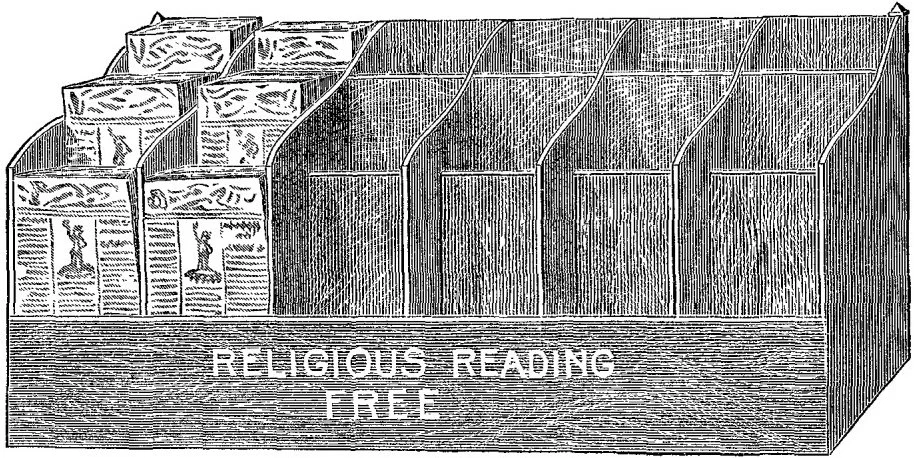
Literature Receptacle at Columbus Union Passenger Station
By C. L. Shelton
The above cut represents a receptacle for S. D. A. literature, now being used by the T. & M. Society in the Union Passenger Station, Columbus, Ohio. Societies or individuals desiring to get important matter before the public who would choose this method and style of box are informed that I am prepared to furnish the boxes and any information concerning same on application.
Address,
C. L. SHELTON,
Columbus, Ohio.
AGENTS MAKE 100 PER CENT. PROFIT
and more. Get samples free. Best known goods in all America. Corsets, Belts, Brushes, Safety Razors, Curlers, Insoles, Plasters, and all our other popular goods. (Either sex.) Address, DR. GEO. A. SCOTT, 842 Broadway, N. Y. City.
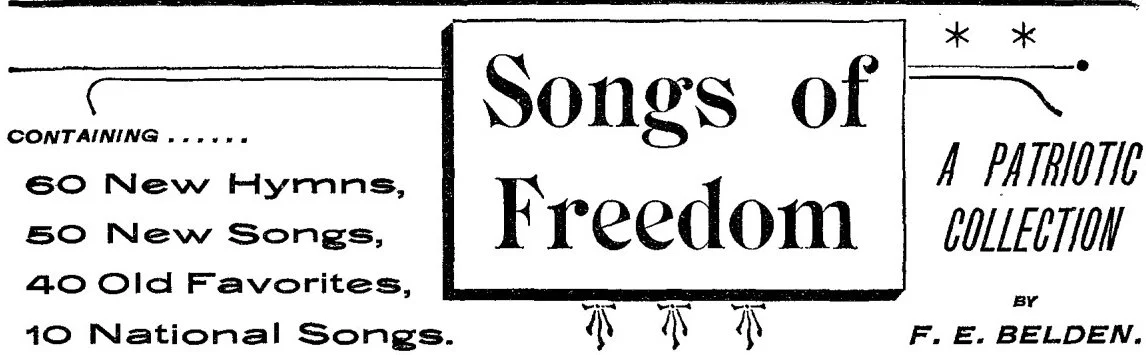
Songs of Freedom
A Patriotic Collection by F. E. Belden.
Containing . . . . . . 60 New Hymns, 50 New Songs, 40 Old Favorites, 10 National Songs.
The original songs were written by Danks, Butterfield, Barnes, Emerson, Herbert, Hakes, Towne, Russell, Ogden, Tenney, Davis, Sweney, Belden, and others.
Selected Musical Compositions by Haydn, Mendelssohn, Verdi, Sullivan, Groos, Wilhelm, Mason, Claribel, etc.
The original hymns were written by D. W. McCourt, Rev. Dwight Williams, Mrs. L. B. Price, M. B. Duffie, T. R. Williamson, Mrs. L. D. A. Stuttle, John Talman, Fannie Bolton, Emma L. Pardon, Albion F. Ballenger, Mary L. LaForge, Elizabeth Rosser, J. J. Ellyson, Victoria A. Buck, R. F. Cottrell, Wm. Brickley, S. B. Whitney, F. E. Belden, etc.
Selected Patriotic Hymns by Bryant, Whittier, Dwight, Drake, Joaquin Miller, Felicia Hemans, Theodore Tilton, Rev. Henry Alford, Rev. Leonard Bacon, etc.
120 pages, embracing a large number of songs in the interests of Religious Liberty, Soldier’s Reunions, Independence Day, Memorial Day, Washington’s Birthday, Etc.,
Arranged as Songs, Duets, Trios, Quartets for both Male and Female Voices, Choruses for both Male and Mixed Voices, Patriotic Songs for Children, etc.
The principal object of the book is to oppose efforts tending toward a union of Church and State.
PRICES, Postpaid:
Heavy Manila Covers, cloth joints, 35 Cents.
Strong, Flexible Cloth, cloth joints, 50 Cents.
Address, PACIFIC PRESS PUB. CO., 43 Bond St., New York City.