The Youth’s Instructor, Vol. 30, No. 27.

GATHER UP THE FRAGMENTS

The Youth’s Instructor

Jul 5, 1882

S. D. A. Publishing Association · Battle Creek, Mich. · Jul 5, 1882

GATHER UP THE FRAGMENTS.

It was Kathie’s birthday; and she stood in her own little chamber, with her arms full of treasures. “So many new things, it will be quite like a new room!” she exclaimed gleefully, pulling off the slightly faded bureau cover and tossing it scornfully on the floor. The new one, of linen momie-cloth, bordered with Kate Greenaway figures, was Cousin Nellie’s gift; and Aunt Nell had added a jewel case covered with violets, so natural you could almost smell their fragrance. This took the place of a small Japanese box, and the pile on the floor grew rapidly. The letter-case of silver cardboard with blue trimmings, which Kathie had heretofore thought so beautiful, yielded its place to one of carved holly-wood. Two pretty chromos, papa’s gift, were hung in the room of some plainer prints. The shell mamma’s fairy fingers had painted, crowded a little glass vase from its bracket; and mamma’s own dear face, framed in crimson velvet, occupied the little round stand instead of the small ebony easel, which, however, was transferred to the mantel instead of the floor. “It crowds some; but I want it to hold this beautiful birthday card,” said Kathie, as mamma came in, bringing the little Wakefield rocker which had come all the way from Uncle Daniel’s store, in Boston. “See how nicely everything fits in, mamma; and my cane rocker can go up garret with these other old duds.”
“You certainly have no further need of them,” said mamma, smiling. “But remember to ‘gather up the fragments that nothing be lost,’” she added, before closing the door.
“What can she mean?” thought Kathie, looking rather dubiously at the pile on the floor. “They might as well be lost as tucked away up garret; but I don’t need them, mamma said so herself; the mantel is all filled up, now.”
“Kathie!” called mamma. “Suppose you carry this basket of fruit and jelly to Mrs. Wilbur. Clara will enjoy seeing some of her young friends, now her mother is better.”
Mrs. Wilbur was a widow lady who did fine sewing, and her daughter Clara was Kathie’s schoolmate; but Kathie herself had never been inside the small cottage where they lived. She liked Clara: all the girls did; but, somehow, they seldom thought of her out of school. Perhaps her plain dresses and shy manners were to blame.
Kathie went rather reluctantly; but, when she saw how pale and thin the sweet face had grown beside the mother’s sick-bed, her heart went out to the young girl who welcomed her so warmly, and she willingly accepted her invitation to enter the sick-room. How bare and forlorn the little room looked, in contrast with the one she had just left! Plain white window curtains, a plain muslin cover on the old-fashioned dressing table, and two hanging shelves holding a few books, were all the attempt at ornament. The pine stand by the bedside had no cloth; the four bare walls showed all the ugliness of the wall-paper; there was not even one little rocker.
“Oh, dear, how could I ever sleep in such an ugly little room?” thought Kathie; and then, suddenly a bright light flashed into her eyes, and, hardly waiting to inquire after the invalid’s welfare, she rushed away home.
“Mother! mother! would they like—did you mean—could we fix up that old bedroom?” she exclaimed eagerly. “There’s the pictures, and lots of cards, and the bureau cover for the little stand, and the Japanese box, and that vase, and the letter-case, and—yes, she shall have the easel to put on the mantel: it crowds mine, and—I do suppose there are more books than I really need.”
The pile of “old duds,” suddenly grown precious again, was soon ready for removal; and the next day the hired man, taking them on his wheel-barrow, rocker and all, followed Kathie and her mother to Mrs. Wilbur’s, giving them time, first, to send Clara out for a walk. What a different room they soon made of it! the invalid looking on, through a mist of glad, thankful tears. And the pleased surprise on Clara’s face when she came back, amply repaid the little self-denial which had covered the bare shelves with interesting books.
“How did you make it look so nice and cheerful?” she exclaimed. “The very things I wanted, too: pictures, and a vase, and a table cover,—oh, and books, and that dear little rocker for mother to sew in. Oh, you can never, never know how happy you have made us!” she added, hiding her own tear-wet face on the invalid’s shoulder.
“And it would all have been lost up in our attic but for you, mamma dear,” said Kathie, as they walked home. “How much more happiness there might be in the world, if everybody remembered to ‘gather up the fragments!’”—Well-Spring.

THE TAPIOCA PLANT.

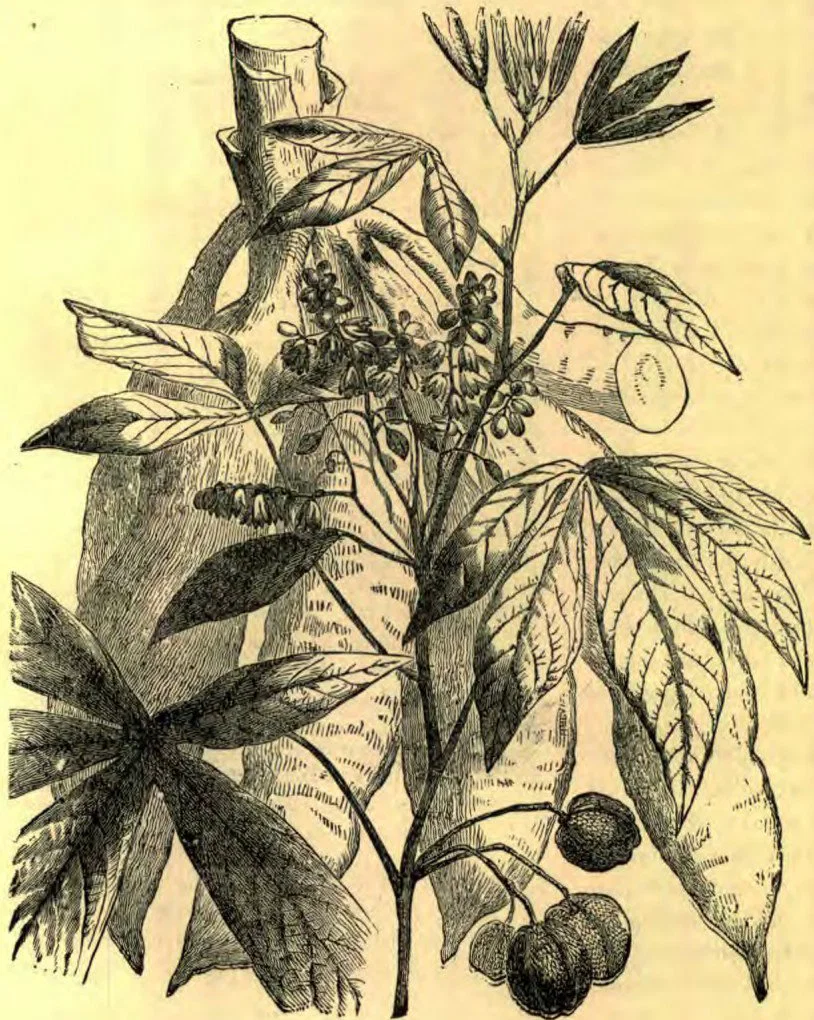
In the warmest parts of the earth, and mostly in Brazil, grows the plant from which tapioca is obtained. Its most common name is the Manioc Plant, though it bears several other names much resembling this. You will all, perhaps, be surprised when you learn that the juice of the plant is deadly poison to both man and beast, and you may wonder how we are able to eat it without injury. It is indeed wonderful that man should be able to convert a poisonous plant into an article of food, which is used all over the world.
But let us first notice the plant itself. It is a shrub, with very crooked branches, and grows to the height of six or eight feet. The accompanying picture shows a small branch bearing leaves, flowers, and fruit. The flowers are of different colors, and the fruit is composed of three cells, each containing a shining seed. Behind the branch shown in the picture, may be seen a cluster of roots. These are the only parts of the plant which furnish food. They always grow in clusters, and are from one to two feet long, often reaching the size of a man's thigh, and sometimes weighing thirty pounds.
These roots are stripped of their rinds, and ground into a pulp, or paste. This is put into sacks and submitted to a heavy pressure, for the purpose of removing the poisonous juice. The cakes of flour that remain are baked or dried on hot iron plates. This process causes whatever juice remains to evaporate. The natives call this flour cassava, and the poorer classes make cassava bread their chief food. The flour can be kept for a number of years, if preserved from moisture, and is very nutritious, half a pound a day being enough for one person.
But the tapioca which we eat, is taken from the juice itself! After it is pressed out of the flour, it is left to stand for a long time, during which a starchy substance settles at the bottom. The poisonous fluid being turned off, the substance that remains is thoroughly dried, and shipped to all parts of Europe and America, where it is called tapioca, or Brazilian arrow-root. So much of this is now used that the plant has been transported to other parts of the world, and is made an important article of commerce. It is less affected by the climate, soil, and ravaging animals than most other crops, and an acre of it is said to furnish support to as many persons as will six acres of wheat.
Some kinds of Manioc are not poisonous. The roots of these varieties are sweet to the taste, and are roasted in hot ashes and eaten with butter.

WHAT THE BURDOCK WAS GOOD FOR.

“Good for nothing,” the farmer said, As he made a sweep at the burdock’s head; But then, he thought it was best, no doubt, To come some day and root it out. So he lowered his scythe, and went his way, To see his corn, to gather his hay; And the weed grew safe and strong and tall, Close by the side of the garden wall.
“Good for a home,” cried the little toad, As he hopped up out of the dusty road. He had just been having a dreadful fright, The boy who gave it was yet in sight. Here it was cool and dark and green, The safest kind of a leafy screen. The toad was happy; “For,” said he, “The burdock was plainly meant for me.”
“Good for a prop,” the spider thought, And to and fro with care he wrought, Till he fastened it well to an evergreen, And spun his cables fine between. ’T was a beautiful bridge,—a triumph of skill; The flies came ’round, as idlers will; The spider lurked in his corner dim, The more that came, the better for him.
“Good for play,” said a child, perplexed To know what frolic was coming next. So she gathered the burs that all despised, And her city playmate was quite surprised To see what a beautiful basket or chair Could be made, with a little time and care. They ranged their treasures about with pride, And played all day by the burdock’s side.
Nothing is lost in this world of ours; Honey comes from the idle flowers; The weed which we pass in utter scorn, May save a life by another morn. Wonders await us at every turn. We must be silent, and gladly learn. No room for recklessness or abuse, Since even a burdock has its use.
—St. Nicholas.

WATCHING ONE'S SELF.

“When I was a boy,” said an old man, “we had a schoolmaster who had an odd way of catching idle boys. One day he called out to us, ‘Boys, I must have closer attention to your books. The first one of you that sees another boy idle, I want you to inform me, and I will attend to the case.’”
“Ah,” thought I to myself, ‘there is Joe Simmons, whom I don’t like; I’ll watch him, and if I see him look off his book, I’ll tell.’ It was not long before I saw Joe look off his book, and I immediately informed the master.
“Indeed?” said he. ‘How did you know he was idle?’
“I saw him,” said I.
“You did? And were your eyes on your book when you saw him?”
“I was caught, and never watched for idle boys again.”
If we are sufficiently watchful over our own conduct, we shall have no time to find fault with the conduct of others.

WHICH WAS THE GENTLEMAN?

ONE day, as a group of merry school-children were enjoying themselves very much, sliding down hill, an old man came along, walking very feebly, and supporting himself by the aid of a cane. As he came near the children, he paused, and stood there leaning upon his staff, while in one hand he held a heavy satchel, the weight of which seemed almost more than he could bear.
Soon he spoke to a boy near him, whose shiny broadcloth coat and gay scarf and gold watch-chain contrasted strangely with the old man's threadbare garments.
“Young gentleman will you tell me if I am on the direct road to B——?”
“No,” curtly replied the boy, giving a disdainful look at his questioner. “No, you are not.”
“Then will you please be kind enough to direct me rightly?” said the old man, timidly.
“Oh, I can't bother! Get out of the path, won't you? I can't spend my time on old ragamuffins.”
And then the rude boy, thinking he had said something very witty, laughed at his own folly, and turned to ascend the hill.
The old man hesitated a moment, as if to say something more, but, lacking courage, he sadly turned away.
“Can I do anything for you, sir?” said another boy, who had witnessed the scene from a little distance, and now hurried to the old man's side. “If I can, I shall be very glad to.”
“Thank you, sir,” said the old man, in broken accents. “If you will please tell me how to get on the direct road to B——, I shall be very thankful.”
“I am sorry,” said the boy, “but you have missed your way. You should have turned at the corner, back here by the mill,—nearly a mile away.”
“So far as that!” said the old man, sadly. “Well, well, there is nothing to be done but to plod my way back again.”
The boy looked at the merry group of school-fellows, a little bit away, hesitated a moment, and then said to the old man: “If you please, sir, I will go with you. I shall have time to go there and back before school begins. Just put your satchel on my sled, and I can draw it easily; and, if you will lean upon my arm, perhaps you can walk without getting so tired.”
“Thank you, kindly, lad; but I dislike to take you from your sport. I was once a boy like you, myself,—many years ago, though.”
“Oh, that's nothing, sir! I can slide down hill to-morrow. Come, let me take your satchel.” And, after carefully fixing it upon the sled, the lad offered his arm to the old man, and started off, regardless of the jeers of his schoolmates, who were watching the strange proceeding.
Clayton Howard, the boy who had spoken so rudely to the old man, thought himself a gentleman, because he dressed nicely, could make a graceful bow, and was very polite to guests, especially ladies, in his mother's parlor.
Philip Gleason, the boy who so kindly accompanied the old man on his journey, was looked down upon by Clayton, because his parents were poor, and he dressed plainly, and was not as well versed in the manners of polite society.
But, after all, which was the real gentleman?
—Dellie May.

LITTLE FEET.

Two little feet, so small that both may nestle In one caressing hand,— Two tender feet upon the untried border Of life's mysterious land.
Dimpled, and soft, and pink as peach-tree blossoms, In April's fragrant days, How can they walk among the briery tangles, Edging the world's rough ways?
These rose-white feet, along the doubtful future, Must bear a woman's load; Alas! since woman has the heaviest burden, And walks the harder road.
Love, for a while, will smooth the path before them All dainty, smooth, and fair,— Will cull away the brambles, letting only The roses blossom there.
But when the mother's watchful eyes are shrouded Away from sight of men, And these dear feet are left without her guiding, Who shall direct them then?
How will they be allured, betrayed, deluded, Poor little untaught feet! Into what dreary mazes will they wander, What dangers will they meet?
Will they go stumbling blindly in the darkness Of sorrow's tearful shades? Or find the upland slopes of peace and beauty Whose sunlight never fades?
Will they go toiling up ambition's summit, The common world above? Or in some nameless vale, securely sheltered, Walk side by side with Love?
Some feet there be which walk life's track unwounded, Which find but pleasant ways: Some hearts there be to which this life is only A round of happy days.
But these are few. Far more there are who wander Without a hope or friend,— Who find their journey full of pains and losses, And long to reach the end.
How shall it be with her, the tender baby, Fair-faced and gentle-eyed, Before whose unstained feet the world's rude highway Stretches so far and wide.
Ah! who may read the future? For our darling We crave all blessings sweet, And pray that He who feeds the crying ravens Will guide the baby's feet.

Softened by Prayer.

Little Annie, before going to bed, lifted up her heart in prayer to Jesus, and gave herself into his keeping, while Nettie, her sister, was thoughtlessly undressing herself and jumping into bed without prayer. Annie at once fell asleep, and was resting peacefully in the arms of Him to whom she committed herself, while Nettie was restlessly turning over. At length she awoke Annie, complaining that her pillow was hard and so flat that she could not sleep upon it. “I know what is the matter with your pillow,” said Annie; “there is no prayer in it.” Little Nettie thought a moment, then crept quietly out of bed, prayed, lay down again and found her pillow softer. She then said to herself, “That is what my pillow wanted; it is soft now;” and she soon, too, was sweetly sleeping.—S. S. Visitor.

THE SEED-TIME OF YOUTH.

In youth, you must lay in a stock of knowledge which may carry you through life, whatever your after-pursuits may be, with usefulness and honor. But recollect this is not to be done without exertion, without the frequent sacrifice of momentary pleasure and gratification. Self-denial is a virtue of the highest quality; and he who has it not, and does not strive to acquire it, will never excel in anything.

SCENES IN THE LIFE OF CHRIST.

LESSON 76.—THE SICKNESS AND DEATH OF LAZARUS.

On the east side of Jerusalem is a narrow valley. Through this valley, from north to south, runs a brook called the Kidron. Beyond the valley, toward the Jordan and the Dead Sea, is a large rounded hill, or low mountain called Olivet, or the Mt. of Olives. On the eastern slope of Olivet, and about two miles from Jerusalem, was the quiet little town of Bethany. This was the home of Martha and Mary and their brother Lazarus, who were especially dear to our Lord; and here he often stopped to rest, after some of his long and toilsome journeys.
Now while Jesus was away on the east side of the Jordan, preaching and working miracles, Lazarus was taken sick. Mary and Martha wanted Jesus to come and heal their brother, so they sent word to him, saying, “Lord, behold he whom thou lovest is sick.” When Jesus received this word he said, “This sickness is not unto death, but for the glory of God, that the Son of God might be glorified thereby.” Instead of going at once to see Lazarus, he remained two days longer where he was. Then he said to his disciples, “Let us go into Judea again.” But the disciples were afraid to have him go there, and said unto him, “Master, the Jews of late sought to stone thee; and goest thou thither again?” Jesus intimated that he had light from heaven to show him what to do, and that if he followed it, he would not make any mistakes. Then he said, “Our friend Lazarus sleepeth, but I go that I may awake him out of sleep.” But the disciples said, “Lord, if he sleep, he shall do well.” The disciples did not understand what Jesus meant by saying that Lazarus was asleep; so he told them plainly, saying, “Lazarus is dead.” He also told them that he was glad for not being there before Lazarus died; for now they would have a chance to see a more wonderful miracle than the healing of a sick man, and thus their faith would be made stronger.
When the disciples found that Jesus was determined to go to Bethany, Thomas said to the others, “Let us also go that we may die with him.” Thomas thought that the Jews would take the life of his Master, but he was willing to go and suffer with him.
When they came to Bethany, they found that Lazarus had already been in the grave four days. Martha and Mary had much company, for many of the Jews had come over from Jerusalem to comfort them concerning their brother. But when Martha heard that Jesus was coming, she left all and went out to meet him. As soon as she came to him, she said, “Lord, if thou hadst been here, my brother had not died. But I know, that even now, whatsoever thou wilt ask of God, God will give it thee.” Jesus wishing to remind her that her brother was not lost forever, said, “Thy brother shall rise again.” Martha said, “I know that he shall rise again in the resurrection at the last day.” Jesus then said, “I am the resurrection and the life; he that believeth in me, though he were dead yet shall he live.” He also reminded her that those who were brought to life at the resurrection, would never die again, and then asked her if she believed what he had said. Martha did not seem to understand all his words, but said, “I believe that thou art the Christ, the Son of God, who should come into the world.” Then she went back to the house, and secretly called Mary, saying, “The Master is come, and calleth for thee.”

QUESTIONS.

  1. What brook runs from north to south, through a narrow valley on the east side of Jerusalem?
  2. What rises beyond this valley toward the Jordan and the Dead Sea?
  3. What little town is situated on the eastern slope of this hill?
  4. How far is it from Jerusalem?
  5. What family had a home here?
  6. How did Jesus regard them? John 11:5.
  7. What had made Jesus especially familiar with their home?
  8. What affliction came upon them while Jesus was away preaching and working miracles?
  1. In what part of the country was Jesus at this time?
  2. What did Mary and Martha desire?
  3. What did they do?
  4. When Jesus received this word, what did he say? John 11:4.
  5. Did he go immediately to see Lazarus?
  6. How long did he remain where he was?
  7. What did he then say to his disciples?
  8. Why were the disciples afraid to have him go into Judea?
  9. What did they say to him?
  10. Was there any danger that Jesus would make a mistake?
  11. Why not?
  12. What did Jesus then say about Lazarus?
  13. Did the disciples understand what he meant?
  14. What did they say?
  15. Why was he glad for not being in Bethany before Lazarus died? Verse 15.
  16. What did Thomas say to the other disciples when he found that Jesus was determined to go to Bethany?
  17. How long had Lazarus been dead when Jesus came to the place?
  18. What company had Martha and Mary?
  19. What did Martha do as soon as she heard that Jesus was coming?
  20. What did she say to him when she met him?
  21. How did Jesus try to comfort her?
  22. What did Martha say about her brother’s rising again?
  23. What did Jesus then say about himself?
  24. Of what did he also remind Martha?
  25. What question did he finally ask her?
  26. How did she reply?
  27. What did she then do?

NEW-TESTAMENT HISTORY.

LESSON 29.—REVIEW.

1. To what is the kingdom of heaven compared in the parable recorded in Matt. 22:1-14?
2. How many calls is the king represented as making?
3. Describe the first call and its results.
4. Describe the second call, and tell how it was received?
5. To what people are these two calls supposed to have reference?
6. What punishment did the king inflict on those who slew his servants?
7. To what is this supposed to refer?
8. Describe the third call, and give its results.
9. What does this call represent?
10. Describe the case of the guest who was found without a wedding garment on.
11. What does this illustrate?
12. Describe the attempt made by the Pharisees to entangle Jesus in his talk.
13. Tell how Jesus confounded them.
14. What similar attempt was made by the Sadducees?
15. How did Jesus answer their question?
16. What lesson did he then give them concerning the resurrection of the dead?
17. What question was asked by one of the Pharisees who was a lawyer? Matt. 22:34-36.
18. Repeat our Lord's answer.
19. What admission did this answer call forth from the lawyer?
20. What did Jesus then say to him?
21. What question did Jesus then ask the Pharisees?
22. What effect was produced by this question?
23. How did Jesus warn the people against the scribes and Pharisees? Matt. 23:1-3; Mark 12:38-40; Luke 20:45-47.
24. What lesson did Jesus give as he watched the people casting their gifts into the treasury? Mark 12:41-44; Luke 21:1-4.
25. What request was presented to Jesus in behalf of some Greeks who had come up to Jerusalem to attend the Passover?
26. What did Jesus say when this request was presented to him?
27. What remark did he make that would encourage his disciples to risk even life for the sake of Christ and the truths he taught?
28. What soliloquy did he utter with reference to the suffering that he was about to pass through?
29. What remarkable evidence left all without excuse for not believing in Jesus?
30. What did the people say about this voice?
31. What did Jesus say about it?
32. How did Jesus refer to the victory that was to be gained over Satan through the death that he himself was about to suffer on the cross?
33. How did he allude to the manner of his death?
34. How did some of the Jews then try to show that Jesus could not be the Christ?
35. What remark did our Lord make with reference to walking in the light?
36. What prophecies were fulfilled at this time?
37. How were many kept from confessing Christ?
38. How did Jesus show that in rejecting him they rejected God?
39. How will those be judged who reject Christ?
40. In what sense is it true that the commandments of God are life everlasting?
41. Enumerate in their order the journeyings and principal events in our Lord's life during the six months just preceding this last Passover.

The Wedding Garment.

Among the orientals, long white robes were worn at public festivals; and those who appeared on such occasions with any other garments were esteemed, not only highly culpable, but worthy of punishment. Our Lord seems here to allude to Zeph. 1:7, 8: “The Lord hath prepared a sacrifice, he hath bidden his guests. And it shall come to pass, in the day of the Lord’s sacrifice, that I will punish the princes, and the king’s children, and all such as are clothed with strange apparel.” The person who invited the guests prepared such a garment for each, for the time being; and with which he was furnished on his application to the ruler of the feast. It was this which made the conduct of the person mentioned in the text inexcusable; he might have had a proper marriage garment, if he had applied for it.
Among the Asiatics, garments called caftans, great numbers of which each nobleman has ordinarily ready in his wardrobe, are given to persons whom he wishes to honor; to refuse to accept or wear such a dress would be deemed the highest insult.
This marriage feast or dinner (the communication of the graces of the gospel in this life) prepares for the marriage supper of the Lamb, Rev. 19:7, 8, 9, the enjoyment of eternal blessedness in the kingdom of glory. Now, as without holiness no man can see the Lord, we may at once perceive what our Lord means by the marriage garment—it is holiness of heart and life: the text last quoted asserts that the fine, white, and clean linen (alluding to the marriage garment above mentioned) was an emblem of the righteousness of the saints. Mark this expression: the righteousness, the whole external conduct, regulated according to the will and word of God.
He saith unto him, Friend.—Rather, companion. As this man represents the state of a person in the visible church, who neglects to come unto the master of the feast for a marriage garment, for the salvation which Christ has procured, he cannot be with any propriety called a friend, but may well be termed a companion.
How camest thou in hither—Why profess to be called by my name while living without a preparation for my kingdom?
He was speechless.—He had nothing to say in vindication of his neglect. There was a garment provided, but he neither put it on or applied for it. His conduct, therefore, was in the highest degree insulting and indecorous.—Clarke.
Those, and only those who put on the Lord Jesus, that have a Christian temper of mind, and are adorned with Christian graces, who live by faith in Christ, and to whom he is all in all, have the wedding garment. —Comprehensive Commentary.

What Scholars Owe Their Sabbath School Teachers
Scholars do not always think how much they owe to their teachers. Perhaps they have become very tired with their work on week-days, and would like to rest on the Sabbath; but they willingly teach you, because they love the Saviour, and wish you to love him, too. Ought you not to love them? Ought you not to make their work as easy, instead of as difficult as you can?

THE WASHINGTON ELM.

HOW we all look forward every year to the Fourth of July! At last the morning comes, and we are awakened at daylight by the booming of cannon, and spring from our beds to commence the “celebration.” And for weeks after it has passed, we talk in the daytime and dream through the night of the music, the processions, the speeches, and the fireworks. Perhaps, too, some of us carry the marks of the day on our faces or hands, by reason of being too careless with the powder. But for all that, we each vote the day a jolly one, and wish it came oftener than once a year.
But how many of us think, as we light our fire-crackers and sling our torpedoes, of the reason of all this noise and jubilee? Do we stop to think of our great grandfathers risking their lives, their families, and their happy homes that they might make us, their great grand-children, a free nation? And do we realize that the “celebration” is to make us remember how much we owe to their bravery? If so, perhaps some of us would spend more of the day in reading of their noble deeds, and would resolve that we, too, would try to be as noble hearted and brave as they. What! children be noble and brave! do you ask? Certainly! When you stand up for that poor boy with ragged clothes, whom the others are laughing at and pelting with sticks and stones; when you do every thing you can to help and amuse your sister, instead of plagueing her until she crys and calls you a “horrid boy”; when you both let a little of your play wait until you have helped papa or mamma; when you do these and a score of other little things, you are being as noble hearted as any soldier who ever faced the cannon’s mouth.
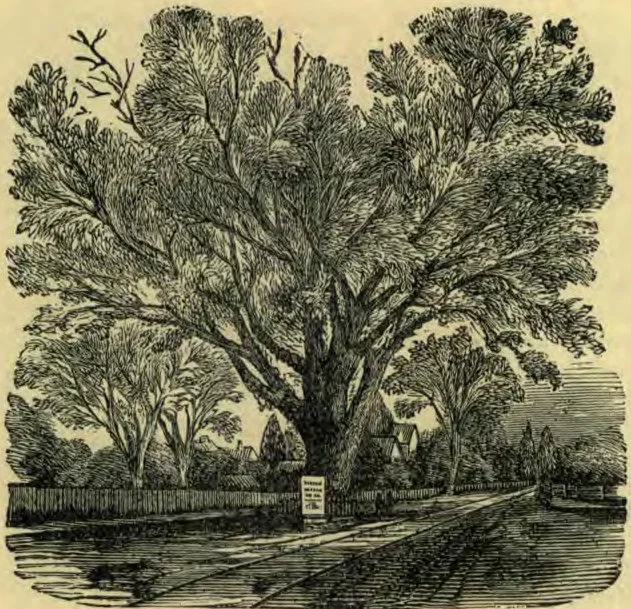
But you will wonder what all this has to do with “Washington’s Elm.” Well, you know that George Washington was the General, commanding all the American forces during the war of the Revolution. The place where he first took command of the army was in Cambridge, Mass., under the very old elm seen in the picture. On the granite slab under the tree are these words:—
Under this Tree, WASHINGTON First took command of the AMERICAN ARMY. July 3, 1775.

Bunker hill monument, and the old battle grounds at Lexington and Concord are familiar to every school boy, but Washington’s Elm is not so well known. How many of the INSTRUCTOR children will read about it in the history, and resolve to be noble and brave in your youth, that you may the same when you get to be men and women. “As the twig is bent so the tree inclines.”

Letter Budget.

Here are some words of cheer from one of our older friends, Mrs. M. E. McKee. She says: “Though I am not one of the little ones, I would like to send a word of greeting and appreciation of the little paper. It comes to us as a friendly visitor. We have saved the INSTRUCTOR numbers for many years, and have four or five books with stiff paper covers, which we stitched ourselves, and keep to lend. I think it better than giving away single papers. I have given away one book, and am going to send another to some children in Nebraska who I think will be glad of them. The paper grows in interest; some of the stories are very touching, and bring tears to my eyes.”
Minnie D. Holiday writes from St. Charles, Mich. She says: “I am eleven years old, and keep the Sabbath with my mother and one sister. I have two own sisters, and eight half brothers, and six half sisters. My sister and I were baptized by Eld. Burrill. We get the lessons in Bible Lessons, No. 2.”
We have a letter from both Willie and Nellie Bain, but they do not tell in what State they live. Willie is nine years old, and Nellie is eight. They keep the Sabbath with their mother, and are both trying to be good children. Willie says he is never going to drink any strong drink.
Maggie Thomson writes from Denver, Colorado. She says: “I will be twelve years old next September. Ma and I have kept the Sabbath for about one year. We have a nice little Sabbath-school here, and I go to it. We like to read the INSTRUCTOR very much.”

A COSSACK HORSE.

Not long ago, in front of one of the theatres of St. Petersburg, two ladies, having hired a sledge, got in, and told the coachman where to drive.
The throng of carriages and people was very great there, and the noise was considerable, and the isvoshtchik's horse, which was apparently rather an excitable animal, reared and backed and jumped about, but would not start. One of the policemen standing near, exasperated at last by the obstinacy of a creature which was keeping other vehicles from driving up, struck the horse on the side with the flat of his sword to make it move on.
But judge of his surprise when the animal only responded by falling down on the snow, and lying there apparently dead! Some of the bystanders came forward, and with the driver attempted to get the horse on its legs again, but it was of no avail; and the ladies were just about to leave the sledge and take another, when they noticed two Cossack officers standing near and laughing immoderately. At that moment one of them, nudging his companion with his elbow, put his fingers to his lips and gave a low, peculiar whistle. The effect was magical. The horse started to its feet, its head up, its ears forward, its whole attitude one of diligent attention.
Then the officers came forward, apologized for their seeming rudeness, accompanied the sledge a few paces out of the crowd, and explained the mystery.
The horse was a Cossack, and probably had served in the late war. Now, Cossack horses are trained by their masters to obey certain signals. For instance, a stroke of the flat of the sword is the sign that they are to lie down that the enemy may fire over their heads. The peculiar whistle is again the order to rise.
The officers had seen in what school the animal had been taught, and, being initiated, gave the signal, which caused the intelligent creature to rise of its own accord. Another peculiar sound started the horse in a rapid trot, which dragged the light sledge swiftly over the snow, while the officers remained behind, doubtless not a little entertained with the comical adventure.—S. S. Visitor.

TEETOTAL

The word teetotal is a common provincial phrase used in Lancashire, England; and it is generally applied to workmen being dismissed from their employ, and is intended to signify an entire discharge, a complete dismissal.
A good man, named Richard Turner, speaking at a meeting in Lancashire on the subject of abstinence from strong drink, said he gave it up teetotally, which meant that he gave strong drink “an entire discharge.” The term was very forcible and well applied. The people at once understood its complete meaning, and it seemed to them so fully to express their feelings about strong drink that it passed into common use, and spread from Lancashire all over England, and since then into all those countries where true temperance has been taught.

A GOOD WAY.

Two little girls, Lily and Violet, were playing in a yard where they had hung up some twine for a clothes-line, and were washing their dolls' garments in a diminutive tub, and hanging them out to dry. Along came Lily's brother, Master Jack, the juvenile tease, and with one sweep of his hand jerked the whole day's washing from the line and scattered it on the grass. Lily burst into tears at once. Violet was saddened, too, but the necessity of playing peace-maker in the impending family quarrel was the first thought in mind; so she said soothingly, “Never mind, Lily, let's play Jack was a high wind.”—Syracuse Herald.
Continue reading: THE BIRD'S NEST