The Youth’s Instructor, Vol. 66, No. 3.

Miscellaneous News Notes from Wartime America

The Youth’s Instructor

Jan 15, 1918

Review and Herald Publishing Assn. · Takoma Park Station, Washington, D. C. · Jan 15, 1918

Miscellaneous News Notes from Wartime America

There are 350,000 Sunday schools scattered all over the world, and 3,500,000 instructors.
Every inch added to the length of the skirt means $10,000,000 saved in the shoe bill for America.
Thursday, January 24, 1918, has been set apart as a day of prayer throughout the country for national prohibition of the liquor traffic.
The man who had $1,000 saved in 1896, may be surprised to learn that his thousand dollars, measured in purchasing power, has now shrunk to about $300.
Members of Congress will urge that the government make land allotments to our soldiers after the war, thus helping them to get a ready start in life after their return from Europe.
The Institute of France recently awarded a prize of $2,000 to each of two Frenchmen having unusually large families. One has fifteen children, the oldest of whom is under eighteen, and the other has sixteen ranging in age from thirty-four to eight.
The fact that friends and relatives of soldiers cease to write is given by one soldier as the reason why so many of the men go wrong. Let us not forget our boys in the camps, but write the inspirational, interesting, newsy letter at least once a week.
In each of the thirty or more air raids made by Austria on Venice, that city has been prepared. The electrical microphones at the Venice observation station are said to have been able to detect the sound made by the planes as they left Triest, sixty miles away.
On December 6, the “Mont Blanc,” a vessel loaded with 3,000 tons of munitions for France, because of a confusion of signals in the Halifax, Nova Scotia, harbor, collided with another vessel, and the resulting explosion killed and injured several thousand persons, and destroyed millions of dollars’ worth of property.
The National Reform Association has issued a call to the Christians of the world to meet in conference at Pittsburgh, Pennsylvania, July 2-9, 1918, to discuss the question of a lasting peace and to aid in the reconstruction of the world at the close of the war, in accordance with Christian principles. The address of the association is 209 Ninth Street, Pittsburgh.
Introduction of “meatless Tuesdays” in hotels and restaurants has resulted in the saving by one great chain of restaurants of seven tons of meat weekly, according to a report to the Food Administration. This includes about 3,500 pounds of pork and 8,300 pounds of beef. One New York hotel reports that during October it curtailed its consumption of flour by fourteen barrels as the result of “wheatless Wednesdays.”
The largest flour mill in Minneapolis means the largest mill in the world, and belongs to a company which grinds out over 35,000 barrels of flour every twenty-four hours. It takes about half a pound of flour to make a loaf of bread, so that the output of this company alone would give a loaf a day to 14,000,000 people, or to more than the inhabitants of New York, Chicago, Philadelphia, Boston, Cleveland, and Detroit combined. It handles every day in the neighborhood of 175,000 bushels of wheat.
Uncle Sam is now carrying out the greatest building undertaking ever accomplished by a nation in so short a time, namely, the building of his “war cities,” as the various cantonments are called. There are to be sixteen major camps and a number of smaller ones. Each major camp requires 1,500 or more buildings for the accommodation of the 50,000 men it is to care for. Twenty buildings a day, on an average, it is said, are being completed at each cantonment (can’tonment). At both Camp Travis, Texas, and Camp Taylor, Kentucky, a big barracks two-story structure rose from the ground in one and one-half hours. The contractors are paid at the rate of cost plus seven per cent.
One of our ministers sought an audience with a high war official in an attempt to secure exemption from Sabbath labor for our boys. The official was very busy, but our minister said he wanted only two minutes of his time. The interview was granted. The minister merely said: “Our boys do not drink, use tobacco, play cards, or gamble. They will work hard for you; but we ask for them exemption from Sabbath labor.” The official said, “All right; they shall have it;” and the interview was closed. School readers counsel: “Talk to the point and stop when you reach it.” In this instance at least, the carrying out of this advice brought good returns.
Siberia is one of the fairest lands upon the earth, rolling hills and endless plains, forest-clad slopes and great fields of grain ready to harvest; lovely rivers winding away to the forest—fire-tints of the lingering sun, which in Siberia and Russia is very much of a night owl in summer. Siberia seems to have everything lovely and worth while, except people. Every one seems to be at the station, but behind that, humanity seems to become invisible. After the Chengtu plain, Siberia seems as uninhabited as a haunted house.
The government of Holland recently paid the immense sum of $200,000 for a painting by the Dutch seventeenth-century master, Vermeer. As the picture measures only eighteen by fifteen inches, this means that the pecuniary value is $775 per square inch. The subject of this costly work is the very homely one of the “Cook” or “Milk-woman.”
John R. Mott, America’s great Y. M. C. A. leader, is a strong believer in the prevailing power of prayer. He says: “Those who spend enough time in actual communion with God to become really conscious of their absolute dependence on him, shall change the mere energy of the flesh for the power of God.”
Prof. E. G. Martin, of Leland Stanford University, has been experimenting to see whether resting one day in the week increases one’s efficiency. He found that students were much more sensitive to electricity immediately after a day of rest. Each day after Monday he found the sensitiveness grew less.

MRS. M. A. LOPER

Recreation

MRS. M. A. LOPER

It fell to my lot recently, with several other ladies, to stand in front of a moving picture theater, to secure signers to the Government food pledge. It was the usual motley throng that entered—rich and poor, some so poor in appearance that it seemed they could not much more than eke out an existence; and yet parents with their children took enough of their scanty earnings (with the additional war tax) to attend the moving picture show! It is surely a sign of the fast approaching end of all things to see how many people are “lovers of pleasures more than lovers of God.”
Moving picture shows are so universally detrimental to one’s moral and spiritual welfare that people do well who avoid these popular places of amusement. The pure film that is beneficial along educational lines is so unpopular that it is rarely seen in the ordinary show place.
This is a pleasure-loving age, when the mental appetite of the general public demands many things that are not conducive to the uplifting of humanity or to the welfare of the world in general.
There is a divine principle underlying all the activities of life, which we would do well to recognize. It is a law of reciprocity, if we may call it so, which has to do with the balanced upkeep of the mental and physical powers, and is also closely connected with spiritual welfare.
Work is of divine appointment, and so is recreation; it has its own legitimate place in the life of every individual. The physical strength should not be built up without regard to the mental, nor should mental culture be sought at the expense of physical welfare. Both should be secured, and to both should be added the spiritual attainments it is one’s privilege to enjoy.
Many good things in life may become harmful when carried beyond their legitimate limit. We must eat in order to live, but the common practice of overeating is a great physical menace. Gardening—outdoor exercise—is conducive to health; and yet the frail person may overdo along this line until the physical exercise becomes to him a means of shortening life. Missionary work is essential to one’s spiritual welfare; but it is very easy for one whose life is devoted to gospel work, to so neglect his own physical needs as to impair permanently his health.
On one occasion, Jesus said to his weary disciples, “Come ye yourselves apart . . . and rest awhile.” Their labors had been so arduous and so long continued that they were in need of a change that would afford them time to look after their physical welfare.
It is possible to follow the very best of occupations until a change is demanded in order to balance up the energies of mind and body.
Young people, as well as those of older years, need periods of recreation. But as already intimated, we live in a time when recreation and amusement are entirely overdone, and the world is suffering a moral and spiritual downfall as the result. But even this does not change the divine order of things, in which recreation of the right kind has its appointed place.
It is not the part of wisdom to engage in matched games which may result in fractured skulls, broken limbs, or instant death. Such games are not played for the sake of recreation, but for the winning of personal glory; and students who spend their time in this manner, do so at the expense of school duties and obligations. The feverish excitement which such games engender, strengthens the spirit of rivalry, and ill feelings are likely to result.
Gambling cards are to be shunned as moral and spiritual poison. A fascination has been woven about card playing that almost envelops even the so-called Christian world. Even though it might be possible to play an innocent game with such cards, it would seem much like entering a saloon to secure a drink of lemonade. The associations are evil and the influence is decidedly in favor of following the trail of the serpent.
Many games which in themselves are harmless may become harmful if the players permit themselves to become so infatuated with them as to waste precious time which ought to be used for a better purpose. When one goes beyond the legitimate limit of recreation, the mind becomes so absorbed in the pastime that life’s duties are likely to be neglected and become irksome. It is possible to become so trained that the inclinations of the heart will go out constantly toward amusements and frivolous pleasures.
To every individual is given a definite work, just as definite as is his mansion in the eternal city. That work requires the very best efforts of which he is capable ; it requires the consistent use of time and energy. The accomplishing of this task is his business in life. Recreation must be subservient to the best interests of the life work, if one would reach the highest success.
A means of recreation which one person may find very beneficial may prove of no value to another. Persons who are mentally weary should not seek recreation in that which calls for fine discriminations of thought, nor should those who are physically weary expect to recuperate wasted energies by indulging in pastimes which include strenuous physical exercise. That which may be a wrong use of time for one person may be the very thing which will prove helpful to another.
So if you believe a certain form of recreation to be right for you, do not take that as proof that it is best for every one else to engage in the same thing.
If you believe a certain recreation to be wrong, do not indulge in it, even though you may see others do so.
If you are undecided as to whether or not a thing is wrong, do not engage in it.
The individual who seeks to honor God in recreation as well as in work, who asks for divine guidance in all the details of life’s activities, need not be led astray in the matter of recreation.

To Thine Own Self Be True

By thine own soul's law learn to live, And if men thwart thee, take no heed, And if men hate thee, have no care; Sing thou thy song and do thy deed; Hope thou thy hope and pray thy prayer, And claim no crown they will not give, Nor bays they grudge thee for thy hair.
Keep thou thy soul-worn steadfast oath, And to thy heart be true thy heart; What thy soul teaches learn to know, And play out thine appointed part, And thou shalt reap as thou shalt sow, Nor helped nor hindered in thy growth, To thy full stature thou shalt grow.
Fix on the future's goal thy face, And let thy feet be lured to stray Nowhither, but be swift to run, And nowhere tarry by the way, Until at last the end is won And thou mayst look back from thy place And see thy long day's journey done. —Pakenham Beatty.

H. A. MILLER

Eutychus

THE story of Eutychus as given in Acts 20, is an old one to most of us. We read that previous to Paul's departure for Assas there was a meeting held in a third-story room of some building in Troas. Night settled upon the city while these earnest believers were gathered to listen to the apostle's instruction. Doubtless Eutychus selected his seat in the window because he thought it would be pleasanter than any other, and because from it he could look down upon the street and see what was going on, while he could also listen to Paul. The evening breezes delighted him, for they brought a taste of the outside world. But the meeting being of unusual length, as Paul talked long, Eutychus was “borne down with sleep,” and suddenly and unexpectedly fell from his lofty pew, being taken up dead by those in the room who hurried below to care for him.
The night of sin in its terrible blackness has settled upon the world, and the Lord has led us to the third story—above the world of sin, in our hopes and ideals. We have been in this truth a long time listening to the message. Has it become just a little stale to us, and have we taken our seat in the window where we can listen to the preaching of the truth, and also see and hear the alluring attractions of the world? Have worldly breezes been playing about our heads? They surely will if we continue there! This condition brings sleep, and with slumber comes the fall. Fall where?—Out of the truth and back into the world, to be dead in sin. We are admonished, “Awake, awake, put on thy strength;” “Arise, shine;” “Cry aloud.”
This sleepy condition is pictured in Revelation 3: 14-18. It is the “neither cold nor hot,” the halfway mark, that the Lord dislikes. If we have been sitting in the windows, let us resolve to get down from our dangerous position and take our place squarely inside, where our footing may be firm and sure.
Perhaps you have experienced the fall of Eutychus. If so, when the love of God embraces you, endeavoring to renew life within you, do not spurn and reject it, but gladly yield and accept the new life; for your eternal welfare is at stake. You can't afford to lose.

H. A. MILLER

Crucifying Self

(Gal. 5:24) To Christ
THEE have I crucified without a thought, Yes, crucified thee, when I knew it not. Down mine own way, with light and tripping feet, Have passed, pursuing joys that seemed so sweet I could forget the thorns upon thy brow; But can I do what thou demandest now? On that same cross can I my dearest stretch,— Drive those sharp nails, and with mine own hand fetch The mallet that will make the lifeblood flow? Yet I will try—I give one little blow. Ah! how it hurts myself to crucify! It would be easier at once to die. O self! dear self! what have I done to thee? I weep beside thee till I cannot see; But I must haste, self or my soul to lose. Strengthen mine hand, dear God, and help me choose The long, hard path of duty, and the nails That pain until my very spirit fails. And if at night a little life remain, Help me to strike those cruel nails again. Thou, a meek victim of another's hate, Didst die but once. Mine is a harder fate. Each day a struggling self to fasten down, One that I love, and would so gladly crown With joyous life, with wealth, and painless ease Were this life all, and I myself could please. Give larger vision to my tearful eyes, Unfold before me the eternal prize. Give me the standpoint of thy Father's throne, Help me to make that point of view mine own. There still is time, if I myself will yield, To be a worker in thy harvest field. I marvel that thou shouldst have died for me When all my selfishness is seen by thee. My heart responds to such a love as thine, My will surrenders to thy will divine.
MRS. J. W. PURVIS

A Cripple Newsboy

A MINISTER stopped at the corner of Broadway and Thirty-fourth Street, New York, and asked a newsman for an evening Journal. The newsman said, “All out of Journals. I have the Sun, World, Mail, Globe, Telegram, and the rest.” The minister said he wanted to see an editorial in the Journal against whisky. The newsman, who is a cripple, said, “Stay here a minute and I will get you a copy.” He hobbled across that terribly crowded thoroughfare, and had to go the rounds before he could find one, the minister meanwhile selling papers for him.
The customer said, “You are the most obliging newsboy I ever saw,” and gave him a quarter and would not take back the change. Then he asked, “How long have you been in this business?” “Twenty-five years on this corner.” “You have no stand; only this little bench against the pavement and up against the building?” The newsy replied, “My father was one of the prominent contractors of this city. He speculated and lost his money and died, and I, the only child, was driven out on the street to sell papers to support my widowed mother. About this time I received a stroke of paralysis, and stood on this corner a cripple, nine years of age, with papers in my arms. The owner of this building saw me, and told me to get a little box six inches wide and three feet long and put it close up against the wall and that would be my news stand, and I have sold papers here ever since. I have supported a wife and children, have a son fifteen years of age in college, and take care of my dear old mother, who is eighty-five years old.” In answer to the minister’s question as to whether he was a Christian, he said: “Oh, yes, I am; I attend church services, try to live an honest and unselfish life, and have determined that while I look after my customers and my family, I will not neglect my own soul’s salvation.”—Christian Herald.

A Royal Family’s Tragedy Revealed

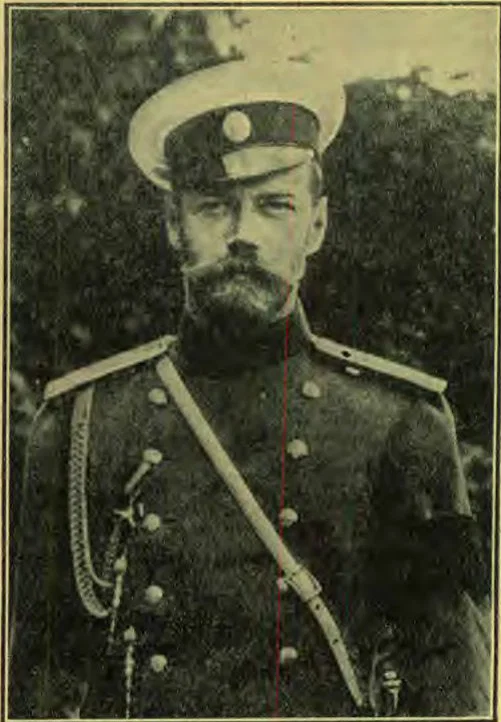
EVERY revolution has its victims. Standing out prominently among those of the recent one in Russia are four girls, whose names have barely been mentioned in the great cataclysm that has swept away their father’s throne, and whose fate is about as tragic as that of any of the heroines of old Greek drama.
I am thinking of the daughters of the man who, a few months ago, was the mighty czar of all the Russias, and who is now nothing but a prisoner in Siberia. No one has had a word of pity for these girls, who, born amidst all the pomp of the most luxurious imperial house in Europe, find themselves today outcasts among their own people; who have lost their position, their rank, their fortune, everything they ever possessed, and who stand, helpless and unknowing, in the presence of a future as uncertain as it is threatening.
NICHOLAS ROMANOFF, THE DEPOSED CZAR OF RUSSIA
There are people who seem to have been born to misfortune, and the daughters of Nicholas II undeniably belong to the number. First of all, their births were nothing but a series of disappointments for their parents as well as for the Russian nation, who had, each time, hoped for an heir. When Olga, the eldest one, made her appearance, people grumbled, but thought that the expected boy would follow. Tatiana’s birth was a source of regret, and, as her two younger sisters arrived in due course, the nation began to express its discontent quite loudly, and, even among the imperial family, their advent into the world was considered in the light of an actual misfortune. For long weeks, the empress would not even look at them, and the babies were left entirely to the care of a nurse, at first, and of a governess afterward. Happily, the latter, Mademoiselle Toutscheff, was a person of great distinction, who took to her heart the forsaken children, and tried to give them some of the maternal love which was denied them by their own mother. She brought them up admirably, but, unfortunately, had to resign her functions a few months before the breaking out of the great war, owing to some disagreement she had with the empress, on the subject of Rasputin. She objected strenuously to his constant presence at the side of her pupils, and went so far as to speak to the emperor about it. The latter would not do anything to remove his daughters from the nefarious influence of a man who has been the evil genius of the House of Romanoff, and Mademoiselle Toutscheff left the young grand duchesses.
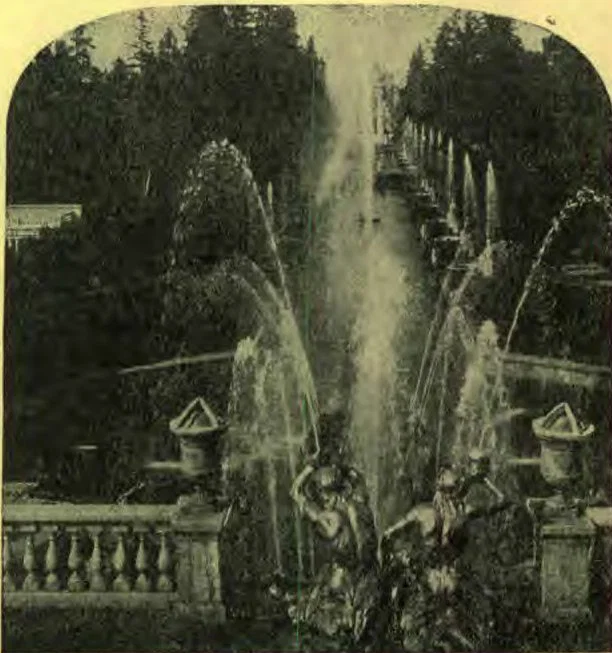
WINTER PALACE OF THE CZAR OF RUSSIA
Her departure was, for the latter, the first great sorrow of their existence. It left them entirely alone, since their mother deliberately avoided their companionship, and, although under the same roof, sometimes spent weeks without seeing them. The girls had no friends of their own age, no one to turn to, no one with whom they could have shared the pleasures, such as they were, of their existence, or its sorrows. They were not even allowed to visit their relatives, and they found themselves compelled to seek, within their own resources, the chance to live otherwise than in a purely mechanical manner.
Their days were spent mostly out of doors, in the park of Tsarskoie Sélo, where they had liked to wander ever since their baby days. Pomp and luxury surrounded them; they had fine dresses, jewels, and everything they might have wished for; but these girls required something more than that. They had generous hearts, noble souls, and minds far above those of the people with whom they lived. They had felt, without perhaps being aware of it, their ostracism by Russian society, on account of their mother, and they had suffered from it perhaps more than they had allowed the world to guess. Their existence has been an entirely unnatural one, and it is not surprising that it has transformed them into sad girls, who seldom smile, and who seem to be always expecting some misfortune or other to fall upon them.
The eldest daughter, Olga, was her father’s favorite, and has devoted herself to him ever since she could understand his position, together with her own. The unfortunate czar, who was so lonely amidst the splendors of his existence, found in his daughter the sympathy he had been unable to meet with in his wife, and the two became far more intimate than is even the case, generally, between parent and child. Olga walked with Nicholas II, she read to him, she tried to render to him every small service that she could, and she more than once declared she would never consent to marry abroad, because this would surely entail her leaving him.
The emperor, on the other hand, fond as he was of this lovely daughter, would have liked to see her settled in life. He realized how different her existence was from that of other young princesses of her age, and he felt sorry for her, as well as for her sisters. It was partly for this reason that when the idea, first of a Serbian, then of a Rumanian marriage, for Olga Nicolaiewna was suggested to him by M. Sazonoff, then Minister of Foreign Affairs, he caught eagerly at it. The two princes received a warm invitation to pay a visit to Tsarskoie Sélo, and when they arrived, every opportunity was given them to see the grand duchesses, but neither of the latter would allow themselves to be persuaded to accept the prospect opened to them, and so the thing dropped, partly because of their aversion for it, and partly because the war broke out, which put aside every thought of matrimony for the daughters of the czar.
The two eldest girls were, at that time, nineteen and seventeen years of age. They had been seen only once in society, on the occasion of the anniversary of the three-hundredth year of the accession of the Romanoff dynasty to the throne of Russia. A great ball was given in Petrograd, in celebration, at which Olga and Tatiana were both present, chaperoned by their grandmother, the Dowager Empress Marie, as their mother only showed herself for a few moments at this festivity. The girls were immensely admired, and seemed to enjoy themselves thoroughly, dancing until the early hours of the morning. It was their first and their last appearance at any public entertainment, and the world who saw them then, was never to do so again—at least not as daughters of a reigning monarch.
When the storm burst, and the war broke out, Olga and Tatiana Nicolaiewna came out in their true colors. The emperor appointed them to the head of two relief committees, one of which was to deal with the difficult question of handling the refugees from the provinces which had fallen into the hands of the enemy. It was Tatiana who undertook the latter piece of work, whereas her sister Olga busied herself with the orphans left by soldiers fallen in battle. The sisters took most seriously the duties which had devolved upon them. They worked indefatigably, night and day, giving thus the denial to criticisms which had accompanied their appointment to such responsible posts. People, hearing about it, had shrugged their shoulders and declared that girls brought up as the young grand duchesses had been, could not possibly understand anything of relief work. But the lessons of Mademoiselle Toutscheff had not been lost on her pupils, who, suddenly, to the amazement of everybody, developed qualities which no one, not even those who knew them well, had ever supposed they possessed. Tatiana, in particular, proved herself an absolute wonder. Not only did she enter into every detail concerning the activity of her committee, but she visited, personally, all the various institutions which had been opened by it in different Russian towns. She sacrificed every penny of her large private income to the relief of the unfortunates, refused to buy even a new dress for herself during the two years that she busied herself with her work; she gave up her time, her activity, her thoughts, her energy, entirely to the suffering mass of humanity whose care she had undertaken, and, when one day her father urged her to take some rest, she replied that it would be unworthy of a Russian princess to do such a thing, while so many Russian soldiers were fighting at the front, without a thought of sparing themselves, in the service of their country.
The soldiers at the front, whom she often visited, simply worshiped her. They detested the empress, whom they would scarcely consent to salute, but whenever Tatiana Nicolaiewna appeared, she was greeted with shouts of enthusiasm. They called her “Nacha Tatianouschka,” “Our little Tatiana,” and whenever they saw her pass, in her white apron and kerchief of a sister of mercy, they crowded around her, and begged her to bless them.
By the side of the two elder grand duchesses, their small sisters were encouraged to imitate their example, and, very probably, would, in time, have also tried to do good around them. But the revolution came, and, not only deprived them, together with Olga and Tatiana Nicolaiewna of their position in the world, but also robbed the latter of what was far more precious to them than their rank and wealth—of the possibility of service. The committees over which they had presided were handed over to other people, and the two girls, helpless, saw the greatest interests of their whole life taken away from them, and found themselves, not only prisoners, but also useless members of a society for whose welfare they had worked with such energy.
What will become of them now, it is difficult to guess or to foresee. According to the custom observed in the Russian imperial family, the sum of two million rubles was always deposited in the State Bank, in the name of every grand duchess on the date of her birth, and the interest of it accumulated until she had reached her sixteenth year, when it began to be paid out to her. To this sum was added whatever the reigning sovereign chose to give her out of his private pocket, when she married, or after his death. This fund has been confiscated, together with the rest of the fortune of Nicholas II, and of his family. The question arises how these unfortunate people are going to live, in the still problematical case that they are permitted to leave Russia for abroad. They have priceless jewels, it is true, but, even if they are permitted to take them with them, will their sale be sufficient to insure for them an existence anywhere approaching the one to which they have been used?
When their father was compelled to abdicate, they were both desperately ill with a complicated attack of measles. They could not even be told of the change that had taken place in their destiny; but they were, alas! to understand it all too soon. Their servants left them in haste, their attendants fled from them. They were abandoned in their splendid apartments, surrounded with the luxury which was the only thing they had ever known; but not one housemaid could be found to sweep their rooms, or one valet to bring them their food. Had not the duma sent a doctor to attend the sick family of Nicholas II, it would have missed even medical care. The ingratitude of the world never showed itself in a more brutal manner than during those days when Russia, who for centuries had been prostrated at the feet of her czars, forced the last of them to abdicate.
It is related that when Olga Nicolaiewna was told that her father had been taken prisoner, she turned her head to the wall and wept silently; then, addressing the sister of mercy who was sitting at her bedside, she simply said: “All this is nothing, provided I am allowed to be with papa; poor papa, he will be the most unhappy among us all. Let me get well, and I shall go and throw myself at the feet of the new government, and ask it for only one favor, and that is to be allowed to remain with papa.” And when the former czar at last reached Tsarskoie Sélo, and could proceed to his children’s bedsides, the Grand Duchess Olga extended her arms toward him, with just these few words: “They shall have to kill me, before they do anything to you.”
Olga and her sister regretted nothing of all that they had lost. They cared not a whit for the splendor, for the pomp, for the luxury in which they had been reared. Their only thought was for their father, and for him alone, and they did not seem to realize that they now stood in the world far more lonely and miserable than all the poor people whose distress they had applied themselves to relieve, for two whole years. They had lost everything, even the pity of others. They had to leave the home in which they had been born and reared, the palaces and parks of Tsarskoie Sélo and Peterhof, the magnificence of the Winter Palace in Petrograd, the sunny shores of the Crimea, where their vacations had generally been spent, for the solitudes of Siberia. And these girls for whom life seemed destined to be so bright, on the day when they were born, stand, at present, before the unknown future, an unknown which perhaps shall be as tragic as was the life of that other victim of the passions of a revolution, the daughter of Louis XVI and Marie Antoinette—the woman whom history was to know as the last dauphiness.—Princess Radziwill.

The Guiding Providence

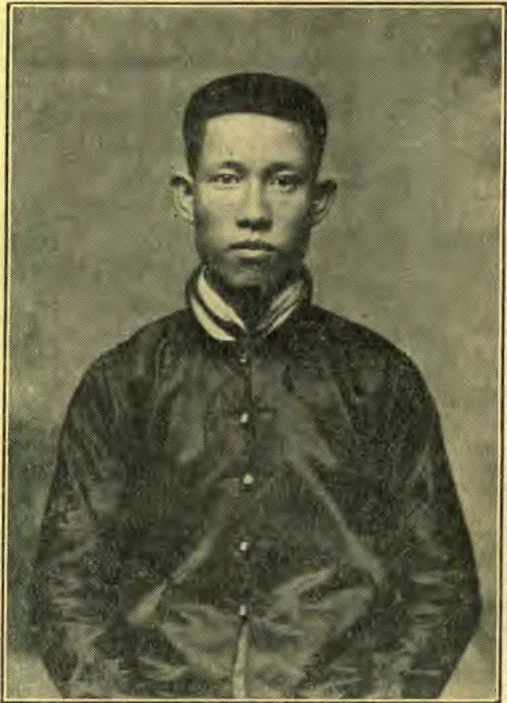
DJAO SHU SEN
DJAO SHU SEN
THE “Fu An” was scheduled to sail at five o’clock in the morning. Bound for Siang-tan, we left our island home and leisurely wended our way toward the dock, only to find that the boat had already gone. Being loaded with passengers, schedule or no schedule, why wait to accommodate a few men? Or why sail on schedule time to favor a few passengers when by waiting two or three hours, the boat may be crowded with travelers?
After a few hours a little Chinese launch steamed up, which we boarded. Going into the public cabin, we found that a number of Chinese had already preceded us. Among them was a bright, well-dressed young man of about twenty, who presently, addressing us in good English, inquired as to where we were going and what our business was. He said, “I am a Christian. My home is in Siang-tan. I was graduated from the English high school and have had two years’ college work. Now I wish to study for the ministry.”
We asked him how he would like to teach Chinese to foreigners. Procuring the services of our Chinese evangelist at Siang-tan to act as middleman, we made arrangements with the young man, Djao Shu Sen, to come to Changsha to act as teacher. He itinerated with us for three months, writing letters, arranging trips, renting buildings for chapel purposes, and helping in various ways.
Previous to his becoming a Christian, Mr. Djao traveled over Hunan, selling gold and silver idols. In this way he learned the several dialects of the province, so was able to translate for us.
At the Hankow general meeting he learned more about our message and work. He was already deeply interested in the prophecies and in the Sabbath question. At the close of the Hankow institute he decided to become a worker in this cause, and is now assisting at the union conference headquarters in Hankow as translator.
And now we are wondering if the sailing of the river boat without us was a matter of chance, or if, with the poet we may say,
“There is a hand Guides in the affairs of men.”
O. B. KUHN.
Continue reading: Music: Its Divine Origin and Perversion