We live by breathing. The first thing that anybody does in the world is to breathe; and the last thing he does in the world is to stop breathing. We can live weeks without eating, and days without drinking; but it is only the smallest number of minutes we can live without breathing; this, of itself, is sufficient to settle it that breathing is the most important part of living—indeed, that it is living.
As certainly as we live by breathing, so certainly we can live rightly only by right breathing.
What, then, is right breathing? how can we know? Upon a certain point, Inspiration cites “nature” as a sufficient teacher: “Doth not even nature itself teach you, that, if a man have long hair, it is a shame unto him?” We may lawfully, therefore, and we know successfully, appeal to “nature itself” for instruction on the subject of right breathing. We are “fearfully and wonderfully,” and wonderfully wisely “made.” And upon the great and all-important subject of how to live, “even nature itself” is a wise instructor, through the principles and hints written in our members.
The lungs are the organs of breathing, the nostrils and windpipe being merely open passages by which the air reaches the lungs. The place of the lungs is within the chest, which is the upper part of the body. Here they are strongly fenced in with the largest and most powerful ribs, these being further strengthened with the breast-bone. The breast-bone does not extend downward as far as the ribs number; the lower ribs, growing shorter as they descend, are loose at the front ends, and so are pliable. They are therefore called “floating” ribs.
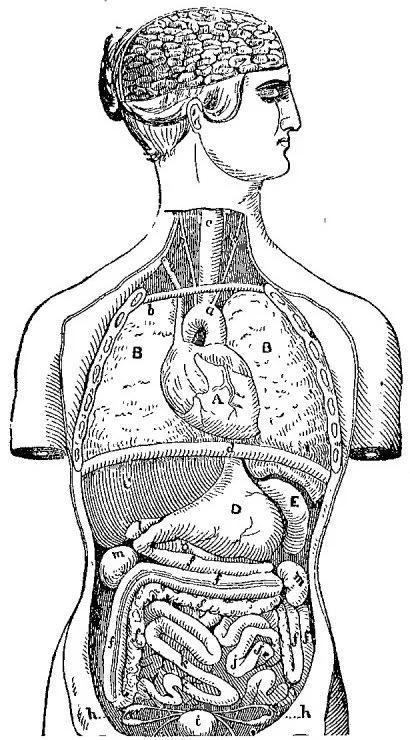
The general shape of the thorax, the inside of the chest, and of the vital organs therein, (the heart and lungs), is that of a cone, right side up; that is, the small end up. However, it is not the shape of a complete cone, but of what is called a “truncated cone;” that is, a cone with the point off,—a cone which does not end in a point at the top, but yet is considerably smaller at the top than at the base. The lungs and heart, the vital organs, completely fill this cavity, so that there is not a particle of unoccupied space there. And as the heart occupies but a very small place, it is evident that almost the whole cavity is occupied by the lungs alone.
Now, this cone-shaped body formed of the lungs and heart is not fastened at any place to any part of the chest. It is connected with the throat by the windpipe, but it does not hang from the throat by this. What, then, supports these organs and keeps them in place?—The diaphragm.
The diaphragm is a floor upon which rests this cone-shaped body formed by the lungs and heart.
The accompanying cut shows the position and general shape of this cone, and of the diaphragm which supports it. The diaphragm is that apparent band, marked d, running across the body just below the heart, marked a. And just beneath the diaphragm is the stomach, marked d.
The diaphragm is an arched, or, more properly speaking, a dome-shaped, muscle, which forms the floor of the organs in the chest-cavity, and at the same time the roof of the organs in the abdominal cavity. It is thus a lateral, or transverse, dome-shaped partition between the inside of the chest and the inside of the abdomen.
Thus the vital organs—the lungs and heart—are the contents of the thorax. The thorax has the general form of a cone right side up. This cone is formed almost wholly by the lungs, and is therefore capable of expansion, so as completely to fill, when at rest, the whole cavity of the chest. This cone is supported by the dome-shaped floor—the diaphragm.
The amount of air taken in at a full breath varies, of course, according to the various sizes of individuals; but the average is about 230 to 250 cubic inches. Here we stand, then, ready to breathe.
Now with the whole cavity of the chest completely filled already by these organs, it is plain enough that in order to get 230 cubic inches of air into the lungs, room must be made for it in some way. And it is evident enough that in order to make the required room, something has to move. To make this required room in the right way, to move the right things in the right way,—this is the whole philosophy of right breathing.
THAT TROUBLESOME AXIOM.
By D. V. Lucas
D. V. Lucas, D. D., in Union Signal.
(Concluded.)
THE Bible prohibits the use of an intoxicating beverage. You point me to one passage, or perhaps several passages, especially in the New Testament, and ask me how I am going to explain. I reply that I don't know that I am under any obligation to explain. The passage may be as difficult as any problem Euclid has given us; and, like the problem, the passage may be too hard for me, but that does not permit me to say that the shortest distance between two points is not a straight line, or that I can look on wine which has the power to produce drunkenness, when God has told me not to look. Now, the fact is, I have looked with the greatest care and the most diligent attention at all passages, in both the Old and the New Testament; and I say, most deliberately, that there is not one of them that cannot be explained and expounded in harmony with the passage in Proverbs which I have, for the sake of convenience, called an axiom.
But the reader asks, “Does not God commend the use of wine?”—Certainly; but not the same wine he condemns. Will you undertake to establish that God condemns and commends the same kind of wine? I have shown that he condemns to the extent of commanding you not even to look upon it “when” it has the power to hurt; not when it actually does hurt you, but “when” it has the power to hurt you. He does not command you to throw the viper from you after it has stung you, or even when it assumes an attitude to sting you. He commands you not to take it into your bosom, lest it may sting you, having in itself the power and inclination to injure you.
I am asked: “If there were, at least, two kinds of wine in Bible times, and these as unlike as God's condemnation and commendation (which must be as unlike as blasphemy and prayer), how can I account for these two, so unlike, being called by the same name, ‘wine’?” Pray, what would you call them? They both come from the vine, from which we have the word “wine.” Both are entitled to be called wine, because they both are the product of the vine, as all men are to be called men, because they are from Adam.
Here is a man; he claims to be such, and both his Maker and we treat him as such. But these scriptures call him a bad man, and Solomon prohibits his son from having anything at all to do with him, because his son may thereby receive injury. Here is another man; but these same scriptures call him a good man, and Solomon strictly enjoins his son to go to this man for counsel, for example, for friendship. Here are two of the same great class, condemned and commended, because they exist for the time being under two different moral conditions, the one hurtful, the other beneficial. This man is not what he was in Adam originally. Being fallen from that original condition, and continuing in it, he may injure others, especially the young; so his father warns and commands his son to avoid him.
This wine is not what it was originally; for as it was in the grape, it could not possibly produce woe, and babbling, and wounds. Being fallen from its original righteousness, it acquires the power to hurt men, and then it stands condemned and prohibited. God's ways are equal. He prohibits not merely that which actually hurts mankind, but that which has a tendency to hurt.
It is quite useless to cite any Greek or Hebrew word, as tirosh or oinos and the like, and tell me it never means this or that. Your opinion has no weight with me when you try to construe any word or any passage to mean that I may look with desire and indulgence upon that on which God has told me, in plainest terms, I am not to look. I may not be able to solve your proposed problem, yet an axiom must always remain self-evident truth.
Foundation truth, or truths for beginners, God has made so simple that wayfaring men need not stumble. The reason why your would-be wise men flounder on is because, in their conceit, they begin at the wrong end of the Book, despising, in their headiness, such simple things as axioms.
A GIGANTIC TRAFFIC.
THE size to which the liquor traffic has grown in our large cities is appalling. It was said, some time ago, that in Chicago, while there is a butcher for every two hundred and five families, there is a liquor saloon for every thirty-five families. Doubtless the patrons of the saloon do not all reside in the city; but the number of dram-shops is out of all proportion to that of other kinds of business. They are centers of opposition to all efforts for temperance and social order, the headquarters of anarchists and criminals, the tempters of city visitors to drunkenness and debauchery, the meeting-place where plans are laid to put bad men into office, and the nurseries of immorality and impiety. Here men spend the money which they ought to save, or use for the comfort of their families; then they complain because they are poor.
In whatever light saloons are viewed, they are a curse to the community. Yet men are found ready to run them, because they bring in money. And as cities increase, these places multiply, until it has become a serious question whether the gigantic proportions to which our cities are attaining is not a bane rather than a blessing to the country.—Christian Secretary.
MRS. S. M. I. HENRY
By Sarah M. I. Henry
STUDIES IN CHILD CULTURE.—NO. 33.
MRS. S. M. I. HENRY
(Sanitarium.)
“What training should be given a child who thinks himself unjustly dealt with when he is reproved for his faults, and thinks others are favored because their dispositions require a different kind of discipline?”
Any child who has proper self-respect would rebel at public reproof. Reproof, or discipline of any sort, should be administered in private, unless it be some aggravated case of public offense. It should be kept between the parents and each individual child. This does not refer to those cases which become matters of complaint between the children. Such will, of necessity, be more or less open to the family; and yet all unnecessary parade of the fault to be corrected should be avoided. Do not make one child an “example” to the others.
The practise of open rebuke, by which the foibles of the child are placed on exhibition, and he is made to feel shame when he is not so much shameworthy as needing to be shown, in kindly fashion, his wrong and how to correct it, will produce all manner of unlovely tempers. What passes in the chamber of correction should be kept sacredly between the persons involved; each member of the family should be trained to respect this privacy. It will be an antiseptic to jealousy or heart-burnings.
The only way that I can see to deal with a child in whom evil tempers of any sort have been aroused, is to make a radical change in the methods which have produced them. To correct yourself will be often the surest way to correct the child. Hold up the principle which has been violated by him, see where it is laid down in God’s word, be sure that you conform to it yourself, and then leave it between him and God; and while he is working it out in his own mind, be sure that he has no occasion to feel the chill of your displeasure. Remember that the spirit of the gospel rule breathes out the greatest tenderness for the most sinful.
“How shall the example of an older child who will not do right, be prevented from having a wrong influence on the younger children?”
By being yourself a faithful representation of every true and noble principle, making loveliness, the comfortableness, of loyalty to principle in the home, shine out, so that God can use it as a medium of salvation from the evil influence of any one whom you have reason to fear. You cannot save any soul—not even the darling in your arms—from contamination; that is between God and that especial soul alone. He can and will use your life of love, uprightness, and consecration in ways of which you cannot dream, to secure the result, provided you will give it to him for that purpose. But he alone can apply the holiest influence which you can exert to the place that needs to be healed.
He does require that there should be careful instruction in all the principles that are at stake, as well as in all the truth which you know or can learn; and that the standard, as given to us in Christ, should be lifted up in sight of the entire household, so that each one shall be obliged to measure himself by it. He requires that the atmosphere of the home shall breathe of faith, purity, and sympathy; that habits of prayer and study of the word of God shall be maintained; that there shall be frank and open confession of Christ at home as well as in the public service; and that there shall be expressions of love. In many homes the love and sympathy are economized,—kept turned off except on special occasions, like the steam from the coils, so that the only way any one knows that it is there at all is by a peculiar hissing, throbbing, and sobbing of the pent-up force, which is, to say the least, so tiresome that one would almost prefer that, if it cannot be allowed its natural expression in warmth and comfort, it should be suppressed entirely. Steam-coils that can do nothing but snap and grumble are not of much use in a cold world. Just so with love. Jealousy, in some ugly form, is always the result.
“What shall be done in a case like this: A child was pretty well grown before his parents came into the truth. He was brought up in the usual worldly church atmosphere, and does not like the change which a true spiritual belief has brought about. How is he to be brought to the Lord, with the old friends and relations pulling one way, and father and mother the other way? I suppose you will say that faultfinding will do no good, no matter what he does.”
Surely nothing is gained, and much is lost, by “faultfinding” at any time; and if it is simply a “tug of war” between the influence of the old friends and relations on one side and father and mother on the other, then probably the majority, or those who cater most earnestly to the child’s natural self-love, will win. But in this case who do you wish should win?—Surely not even your own personal influence, but rather the Spirit of God himself against all the world. One who has wholly surrendered to be used by God as he will, who is in accord with all truth that he knows, will be able to chase a thousand unconsecrated nominal “professors of religion” in the contest for a soul. The one point to be sure about is that those on the “other side” are not more in love with all the truth which they do know, even if it be but a fractional part of what you know,—that they are not more consistent in living it out, and in loving as Christ loves,—than you are with the greater knowledge which you may have. God can use one little truth, in the heart of an honest lover of it, to better advantage than he can a whole basketful that is not lived out to his glory.
One thing is sure,—if the child’s soul is ever saved, God himself will save it in the old-fashioned way—by the blood of Christ alone, instead of by any amount of “influence.” Your question does not seem to have even got sight of the fact that it is “not by might, nor by power, but by my Spirit, saith the Lord of hosts.”
It is consecrated patience that wins. This father and mother should remember how the Heavenly Father has waited, all these years, for them to see and accept truth, and surrender self—if, in fact, it is yet surrendered. How he has refrained from upbraiding or faultfinding, but has just lovingly, tenderly waited, using every experience of life in the most careful way as a means of conveying warning, reproof, and instruction! He has shined with his sun, refreshed with his rain, and given blessing upon blessing just the same during the years of sin and disobedience. Is it too much that you should follow this example of his in dealing with the child who is slow to drop the old teachings which you yourself enforced by your own example, and adopt the new, which must seem to him out of all reason until he “sees light in it” from the same Spirit that enlightened you? It argues much more of genuine worth in his character that he does not follow you as a lamb does a sheep, but stops to think and question, and wait for a higher authority than your word, before he forsakes, for any new thing, that which he has supposed was truth.
Imagine that your Heavenly Father had changed his teachings to his children, as you, who represent him in your home, have changed in yours to your child; and you can get some idea of the mist of perplexity through which the young thinker will have to grope until the light strikes through it to his soul, and clears it all up. Give him time, as much, at least, and as cheerfully, as God does. Give him the testimony of a better home, a truer life, a more consistent gladness in salvation, than he has ever known of before. Let him see that the truth is an element of added power, beauty, and tenderness; and the Holy Spirit will take care of all the rest.
PUNISHMENT IN DISCIPLINE.
By Frederick Griggs
FREDERICK GRIGGS.
(Battle Creek, Mich.)
In a paper recently read before a gathering of mothers and teachers in this city, it was advocated that it is incompatible with the self-respect and self-control of the child ever to administer punishment, and that the only proper way to overcome the evil is to strengthen the good. If the sentiments expressed in this paper were never expressed elsewhere, it might not be wise to speak of them in this connection; but they are simply an expression of a popular and rapidly growing sentiment. The great child-study movement in this and other countries is leading those who have charge of children to see the necessity of removing every cause for disobedience from the environment of the child. Improper food and clothing, a lack of exercise, nervous exhaustion from rapid growth, etc., etc., are recognized as causes of disobedience. The evil of this movement is that the attention is turned wholly to these causes, and when they are removed, the child is supposed to develop symmetrically; for according to Rousseau and others, who have either forsaken the Bible or overlooked what it has to say concerning the nature and disposition of the child, there is no evil in his nature by inheritance, but what he has he has got from his environment. There is a cause for the disobedience of children, which is so marked as to be a sign of the last days; and it seems to me that this cause is not far to seek when we so often hear theories advanced which are plainly contrary to what the Lord has said concerning the nature and training of the child.
I would not be misunderstood; for I do firmly believe that the first consideration in the training of a child is to provide those conditions of life and development from which the evil is removed and the good left. But there is evil in the child which he has inherited as a result of the fallen nature of man; this needs correction, and punishment is, at times, a necessary means of correction.
“Punishment is pain inflicted upon the mind or body of an individual by the authority to59which he is subject, with a view of reforming him or of deterring others from the commission of offenses, or both. Some have alleged that fear and shame, the two principles addressed by punishment, are among the lowest in our natures; and hence have endeavored to show that punishment is always inexpedient, if not, indeed, always wrong. To this I answer that both fear and shame are incorporated in our nature by God himself, and hence I infer that they are there for a wise purpose. I find, moreover, that God, in his word and in his providence, does appeal to both these principles; hence I infer that punishment in the abstract is not wrong, and after the highest motives have been addressed, not altogether inexpedient.”
Punishments may be said to consist of two classes: first, those which directly address the mind, such as reproof and deprivation of privileges; and second, those which affect the mind through the body, such as the imposition of a task or bodily chastisement.
It must be ever in the mind of the one who is punishing that the true purpose of punishment is to lead the child to control himself. This will do away with improper punishments, such as scolding, ridicule, nagging, sarcasm, pinching, pulling the ear, jerking, and other indignities to the mind and body so commonly employed by parents and teachers who, while attempting to control others, do not control themselves. The child learns far more by example than by precept; and the quiet, composed manner of self-controlled parents and teachers is that which, after all, gives to the child the self-control which they wish him to have.
Kind reproof is one of the most effectual means of punishment. The Lord deals with his children along the line of cause and effect. Even the little child can reason from cause to effect, and often far more readily than we would at first suppose. When the reproof is of a reasoning nature, and he is led to see, clearly and vividly, the causes and results of his course, he cannot but be affected. It is in this connection that the removal of privileges and the loss of liberties are effectual. Reflection will often enable the child to see the errors of his course more clearly; and confinement, with this result in view, is often a wholesome punishment. But it must be remarked that confinement in a dark room always defeats this purpose. Light is as necessary as is air to the effectual working of the mind during its waking hours.
It is not my purpose in what I am here saying to enter into a discussion of all the different modes of punishment, but simply to enunciate those principles which I believe should govern punishment in all its forms. I should not neglect, however, to speak of bodily chastisement; for, in certain circumstances, it is a necessity. As well as all other forms of punishment, it should be used only to enable the child to control himself. When other means of inducing the child to bring himself to do, or to refrain from doing, that which reason and better judgment clearly indicate should or should not be done, then corporal punishment should be administered. The Scripture is clear and decided upon this point, and this is the only safe guide in the whole subject of discipline and punishment.
The Lord, in dealing with his children, often permits physical disabilities to afflict them so that they will obey his reasonable requirements. These afflictions are always sent in love, but they are almost invariably the righteous result of a wrong course of action. He plainly says, in his word, and in no figurative or symbolical sense whatever, that the rod is, at times, to be used for punishment. According to Davies’s Lexicon, the Hebrew word שֵׁבֶט, translated “rod,” as found in Prov. 13:24; 26:3; 23:13; 22:15; and 10:13, means: “(1) a staff, or rod, for beating ; (2) a flail; (3) a shepherd’s crook; (4) a staff of office; a scepter.” The primary meaning of the word is “an instrument for punishment;” the others are secondary meanings. In the Old Testament the word “rod” comes from three other Hebrew words. Two of the words mean simply “twig;” the other refers almost entirely to the rod used by Moses and Aaron. The same word is used in Ps. 23:4 and in Ex. 21:20. In the Psalms the word is clearly figurative because of the figurative context; but in the other cases it is not so, as plainly indicated in Ex. 21:20.
The effect of the Lord’s rod was to comfort, and this will be the effect which will surely follow the use of the rod when administered in the spirit in which the Lord chastises. The spirit of the Lord is always one of tenderness and love. “For he doth not afflict willingly nor grieve the children of men.” The same spirit is also revealed by the pleadings of Abraham in behalf of Sodom. This same tender love is manifested toward every one of God’s children; and all who have in their own hearts this love, which is the only power of self-control, will extend the same to the children committed to them as a precious charge from Heaven. And then, right there, will be fulfilled the precious promise: “And he shall turn the heart of the fathers to the children, and the heart of the children to their fathers,” and “turn the hearts of the fathers to the children, and the disobedient to the wisdom of the Just; to make ready a people prepared for the Lord.”
Submission
By Carrie A. Jones
We are only lumps of clay, dears,
In the Potter’s skilful hand;
And so we have no need of fears,
For the Master understands,
As we lie still, without any fuss,
What kind of vessel he’ll make of us.
So lie very still, dear saints of God,
With eyes fixed only on him,
Gazing into his blessed face,
With hearts all pure within.
Though the molding be hard, and the fashioning, too,
The vessel will suit him when he gets through.
— Carrie A. Jones.
Grief and Sorrow from Forgetting God's Laws
“GRIEF and sorrow
How we borrow,
Toil and trouble find;
And all because
God’s holy laws
Bear we not in mind.”
SHOULD IT BE PRACTISED?
By A Sister
To those who keep the Sabbath, which Jesus declared “was made for man,” Friday is a very busy day, especially to the mother of a large family. Besides setting the house in order, and preparing food for the Sabbath, there is the general bath for the family. This is usually deferred until afternoon because the older children are at school. The mother aims to bathe the younger children, take her own bath, and have everything ready for the older ones to bathe on returning from school, so that there need be no crowding upon sacred time.
In homes where there are bath-rooms with cold- and hot-water appliances, this work can be accomplished with ease. But we know there are many more homes without these conveniences than there are with them. In such homes the water must be heated over the stove, and the tub brought in, and emptied after each bath. Often when the mother is about ready to begin, in comes a dear sister who has no one but her husband and herself to care for at home. She has finished her work, and taken this time to call on some of the sisters in the church, and inquire into their spiritual condition. The mother knows that if she does not sit down and enter into the conversation with earnestness, the sister will go away disheartened; so she does the best she can, although it is impossible to keep her mind from wandering as she thinks of what must be accomplished before the sun goes down. She is obliged to visit the kitchen two or three times during the call, and the result is that the caller goes away feeling that spirituality is at a low ebb in that home.
But what of the mother?—From my own observation I would say that such visits have many times deprived the mother of her bath, besides causing confusion at the beginning of the Sabbath. The Bible says, “There is a time to every purpose under the heaven,” and “for every work;” and the Lord commanded his people to prepare on the sixth day for the seventh, saying to them, “To-morrow is the rest of the holy Sabbath unto the Lord.”
Let calls be made on some other day, when the work may be more easily laid aside, and the visit will be a blessing to all concerned. The question proposed is, Should calling on Friday be practised? A SISTER.
Love Separates the True from the False
“Love mocks at all hypocrisy,
And separates the true
From false affection, as the bee
The nectar from the dew.”
CALIFORNIA FRUITS AND CLIMATES.
By Frederick H. Dewey
It will surprise most people to learn that the earliest fruits ripen, not in the southern, but in the northern, part of the State. The early apricots and peaches come from the Vaca Valley, fifty miles north of San Francisco. Yet almost adjoining this valley, and on the same parallel of latitude, are two of the latest fruit districts of the State—another illustration of the spotted character of the climate. The earliest oranges come from Butte county, away up in the northern part of the State, and seven hundred miles north of Los Angeles; the first figs come from San Bernardino, seven hundred miles south of the region that produces the first oranges; and the first grapes from Fresno, exactly half-way between the two. This paradox is positively confusing to anybody except a Californian.
You plant an orange-tree on the east side of your house, and it bears abundant crops of the golden fruit; plant another orange-tree on the west side, where the sea-breeze strikes it, and you will get hardly an orange. It is the same with flowers. The climate of your orchard is different from that of your vegetable-garden, and the climate of the latter, in turn, is different from that of your flower beds. Wherever one goes in this wonderful State, he finds a different climate. The variation may be slight, but it exists, nevertheless. On the coast it is moist and cool; in the interior valleys it is dry and hot; but this is the only general distinction that can be applied to the whole State. Indeed, an orchardist has a fine prune-orchard, which nets him handsome returns every year; so he plants another prune-orchard close by, and makes a failure, because the climates of the two orchards are different, though they are only a few hundred yards apart.—Frederick H. Dewey, in November Lippincott’s.
SEARCHING QUESTIONS.
WHAT right has a Christian woman to give herself away to a skeptical scoffer,—a man who hates her Bible, her Christ, and her God,—a man who tramples the law of her God under his feet? What right has a Christian man to become linked with a scoffing, swearing woman, who has no faith in God and the Bible? “Be ye not unequally yoked together with unbelievers.” Yet the moment you touch this question, they throw up their heads, and say, “I will marry whom I please.” Well, we give you the word of God; and if you go against that, you must reap what you sow. There are hundreds of men and women in this country weeping, and they are reaping bitter fruit. O, how many times has a broken-hearted mother come to me, and said, “I want you to pray for my drunken son.”
“How came your son to be a drunkard?”
“Well, my husband set a bad example. He insisted on having wine on the table.”
“How long have you been a Christian? Were you a Christian before you married him?”
“Yes.”
“Did you know he was a scoffer before you married him?”
“Yes, but I thought I might save him.”
“You would better ‘save him’ before you marry him; better see him converted before you risk your happiness, and possibly your own soul.”—Selected.
SEEDS OF GLADNESS.
“Light is sown for the righteous, and gladness for the upright in heart.”
Gladness is “sown.” When any seed is sown, it is that it may spring up, and grow, and increase, thirty-, sixty-, or a hundredfold, according to the condition of the soil which receives it, and the cultivation which it receives.
Now the blessed seed of gladness is “sown” for you. Then do you receive that seed into “good ground” and cultivate it?—So certainly as you do, it will grow exceedingly and multiply abundantly.
Gladness is sown for you in the works of God. “Thou . . . hast made me glad through thy work: I will triumph in the works of thy hands.” He “gave us rain from heaven, and fruitful seasons, filling our hearts with food and gladness.”
Gladness is sown for you in the worship of God. “I was glad when they said unto me, Let us go into the house of the Lord.” “Strength and gladness are in his place.”
Gladness is sown for you in the favor and salvation of God. “Remember me, O Lord, with the favor that thou bearest unto thy people: O visit me with thy salvation; that I may see the good of thy chosen, that I may rejoice in the gladness of thy nation.” “We will be glad and rejoice in his salvation.”
Gladness is sown for you in the hope of the righteous. “The hope of the righteous shall be gladness.”
Gladness is sown for you in the mercy of the Lord, in his treating you better than you deserve. “I will be glad and rejoice in thy mercy.” “O satisfy us early with thy mercy; that we may rejoice and be glad all our days.”
Gladness is sown for you in “Jerusalem which is above,” “which is the mother of us all.” “Rejoice ye with Jerusalem, and be glad with her, all ye that love her: rejoice for joy with her, all ye that mourn for her.”
Gladness is sown for you in the experience of those souls who make their boast in the Lord. “My soul shall make her boast in the Lord: the humble shall hear thereof, and be glad.”
Gladness is sown for you in favor to the righteous cause of Jesus Christ. “Let them shout for joy, and be glad, that favor my righteous cause: yea, let them say continually, Let the Lord be magnified.”
Gladness is sown for you in seeking the Lord. “Let all those that seek thee rejoice and be glad in thee: let such as love thy salvation say continually, The Lord be magnified.”
Gladness is sown for you in meditating upon God. “My meditation of him shall be sweet: I will be glad in the Lord.”
Gladness is sown for you in the fact that the “day of salvation” still shines upon the world. “This is the day which the Lord hath made; we will rejoice and be glad in it.” “Your father Abraham rejoiced to see my day: and he saw it, and was glad.”
Gladness is sown for you in the preaching of Christ. “When the Gentiles heard this, they were glad, and glorified the word of the Lord.”
Gladness is sown for you in men’s reviling of you, and persecuting you, and saying all manner of evil against you falsely, for Christ’s sake. For when they do that, you are to “rejoice, and be exceeding glad: for great is your reward in heaven.”
Gladness is sown for you in the days of affliction and the years of evil that you have seen. “Make us glad according to the days wherein thou hast afflicted us, and the years wherein we have seen evil.”
Gladness is sown for you in the great things that the Lord will do. “Fear not, O land; be glad and rejoice: for the Lord will do great things.”
Gladness is sown for you in the giving of the latter rain. “Be glad then, ye children of Zion, and rejoice in the Lord your God: for he hath given you the former rain moderately [“a teacher of righteousness according to righteousness”], and he will cause to come down for you the rain, the former rain, and the latter rain.”
Gladness is sown for you in the fact that the time of the marriage of the Lamb is come. “Let us be glad and rejoice, and give honor to him: for the marriage of the Lamb is come, and his wife hath made herself ready.”
Gladness is sown for you in the glorious truth that the Lord is coming. “Let the heavens rejoice, and let the earth be glad; let the sea roar, and the fulness thereof. Let the field be joyful, and all that is therein: then shall all the trees of the wood rejoice before the Lord: for he cometh, for he cometh to judge the earth: he shall judge the world with righteousness, and the people with his truth.”
Gladness is sown for you in the blessed promise and sure prospect that the kingdom of God is soon to be set up upon the earth, that you shall reign with him on the earth, and that he will govern the nations of the saved upon the earth. “O let the nations be glad and sing for joy: for thou shalt judge the people righteously, and govern the nations upon earth.” “And I saw a new heaven and a new earth: for the first heaven and the first earth were passed away; and there was no more sea.” And I John saw the holy city, new Jerusalem, coming down from God out of heaven, prepared as a bride adorned for her husband. And I heard a great voice out of heaven saying, Behold, the tabernacle of God is with men, and he will dwell with them, and they shall be his people, and God himself shall be with them, and be their God. And God shall wipe away all tears from their eyes; and there shall be no more death, neither sorrow, nor crying, neither shall there be any more pain: for the former things are passed away.” “And the city had no need of the sun, neither of the moon, to shine in it: for the glory of God did lighten it, and the Lamb is the light thereof. And the nations of them which are saved shall walk in the light of it: and the kings of the earth do bring their glory and honor into it. And the gates of it shall not be shut at all by day: for there shall be no night there.”
And gladness is sown for you in the promise of your own sure and eternally undisturbed inheritance and home in this glorious land where “the wilderness and the solitary place shall be glad for them; and the desert shall rejoice, and blossom as the rose. It shall blossom abundantly, and rejoice even with joy and singing; the glory of Lebanon shall be given unto it, the excellency of Carmel and Sharon, they shall see the glory of the Lord, and the excellency of our God. . . . And the ransomed of the Lord shall return, and come to Zion with songs and everlasting joy upon their heads: they shall obtain joy and gladness, and sorrow and sighing shall flee away.” “Be ye glad and rejoice forever in that which I create: for, behold, I create Jerusalem a rejoicing, and her people a joy.”
Will you not, just now and always, receive into good ground these seeds of gladness? Will you not cultivate them carefully, that they may grow exceedingly, that you may, just now and always and forevermore, reap abundantly the blessed crop of gladness from these many seeds of gladness which the Lord has sown all around you, and before you throughout eternity?
Who, then, will not “serve the Lord with gladness,” and “come before his presence with singing”?
“I will be glad in the Lord.” Amen. And let all the people say Amen.