The Youth’s Instructor, Vol. 49, No. 25.

UNDER THE WAGON-SHEET

The Youth’s Instructor

Jun 20, 1901

Review and Herald Publishing Company · Battle Creek, Mich. · Jun 20, 1901
UNDER THE WAGON-SHEET

(Concluded.)
All this was the beginning of the rain, but it was by no means the last of it. We tried to proceed the next day, but had not traveled many miles when it began pouring so violently that we again went into camp. For several days we were delayed; and when at last the sun shone out again, the roads were indescribable.
We soon became accustomed to sticking fast in the mud, and being pulled out again. Break-downs among the wagons were almost continuous; not only were swingletrees and doubletrees in constant demand, but coupling-poles parted, wheels collapsed; and once a wagon-tongue was completely broken out, leaving the wagon at the foot of a steep hill, wedged up against a stump in the middle of a running stream.
Traveling in a wagon does very well in pleasant weather, but they are gloomy little dens that the wagon-sheets cover on a stormy day. Unlike other boats, the “prairie schooner” navigates best without water. Our stuffy little bedroom seemed more uncomfortable than ever to us, but we were forced, by unceasing storms, to remain in it most of the time throughout the trip.

ON THE BORDER

We crossed the rugged Flint Hills on roads that seemed all uphill. If we made a descent at all, it was short and sharp, with a higher hill on beyond; and it has always been something of a mystery to me, how we so suddenly arrived on the banks of the mighty Arkansas. I had noticed but little descent from the summit of the hills, yet it was not reasonable to suppose that the river flowed over their tops.
Our camp here was pitched in a grove within a full-fledged village of tents and wagons, occupied by other travelers, on journeys like our own.
To gain access to some articles in the bottom of our wagon, the men removed the bed-tick, and laid it across the wagon-tongue until time to make the beds for the night. Supper was prepared, and after it was eaten, we took a little walk by the river, and out on the long bridge. It was a beautiful moonlight night—almost the only one in the whole journey. The water “lap-lapped” on the wooden piles, and the white sand and rippling current in the broad, shallow stream, sparkled brightly.
We thought of many things as we gazed at the river. We stood on the dividing-line, so to speak, between civilization and the wilderness. The next day we expected to cross the border; and what would be our impressions of our new surroundings, so different from anything we had ever known? Doubts mingled with pleasant expectations, and we returned to camp without deciding which we preferred to do—turn back, or proceed on our way.
At camp what a sight met our eyes! There stood the old cow with her head thrust into our bed-tick, up to her eyes, rapidly transferring its fresh straw to one of her several stomachs. The mere idea of increasing the discomfort of our couch by the absence of so much as one straw, filled us with indignation, and we hastily drove old “Spot” away in disgrace.

DAWN IN CAMP

Very early we were awakened by a delicious burst of melody, issuing from the topmost branches of the great elm-tree under which our wagon stood. Wondering if it could possibly be near daybreak, I raised my head, and looked out. Yes, all around was the soft, gray twilight, with a touch of pink in the east, which proved that morn was near.
Mr. Redbird, in the elm-tree, continued his vociferous, “Get up! Get up!” alternated with trills of richest music.
“Oh, do hush up, you exasperating midget!” I mentally exclaimed; “it is your privilege to get up early in the morning if you wish, but you need not waken every one else.”
But our tuneful little neighbor neither “hushed up” nor went away; instead, he lingered in the elm-tree, filling the air with music. It was evident that he had not slept in a wagon that night; had he done so, he would not have been so prompt in meeting his appointment with the sun. His efforts did not cease until every one in camp was awake. Fires were soon built, and people came from wagons and tents in great numbers; then, as if satisfied, our persistent little red-feathered monitor, with a flutter and whirr, darted off, a scarlet flash, into the depths of the forest.

ONE PLEASANT DAY

Usually, the most ardent admirer of camping-out life would hardly go into ecstasies over a mover’s wagon as a vehicle of pleasure; but on a perfect spring day, amid unfamiliar and interesting surroundings, there is a certain charm about wagon travel, which is sure to be felt if one has the slightest particle of poetry in his nature.
For miles we traveled across an undulating prairie, extending on every side as far as eye could see. No buildings marred that perfect stretch of soft, brown grass, which, as yet, spring had scarcely touched with green. The line of movers’ wagons, creeping like a white serpent across it, was the only sign of life in the landscape; while bright sunshine and soft breezes enhanced the beauty of the scene. Our admiration was boundless, and that one enjoyable day was sweet to remember.

THE FIRST INDIAN

Occasionally we met a solitary horseman or wagon, but we were constantly on the lookout for Indians, and became quite excited and impatient to catch our first glimpse of one. We expected him to appear in blanket and feathers, riding madly across the prairie on a wild little pony. Presently we noticed a covered wagon approaching; and as it came nearer, we saw it was drawn by a team of raw-boned ponies. A man and a woman sat up in front, and glancing at them as they passed, we were surprised to behold two copper-colored visages reflecting the curiosity in our own. Numerous small brown heads protruded from the sides of the wagon, revealing the existence of several papooses within. Indeed, the whole family formed a party of travelers not much different from our own, except in complexion.

“TOLE BRIGE”

Eventually we crossed a long bridge, spanning a deep and frightful-looking ravine, with a stream at its foot. A road had been cut down its steep banks; and as we passed, we saw several wagons stuck fast in the mire of the stream, with their owners working desperately to set them free, and guide them up the sharp climb on the other bank. The bridge bore the sign, “TOLE BRIGE,” in large black letters, and we preferred paying “toll” to fording the gorge.

AT THE FERRY OF THE SALT FORK

The weather turned suddenly colder, and our wagon-sheets were wet with mist, and frozen stiff, when we took our place in a line of wagons a mile long, waiting to ferry a large river. For hours we awaited our turn, gradually drawing nearer and nearer the foaming red water, while all the time the sleet was pattering on our ice-covered wagon roof.
There was a fording-place near, but the stream was high, and to cross it was a dangerous undertaking. Suddenly on the opposite bank appeared an open wagon, containing two Indian squaws, and this time they were wrapped in red blankets! We expected them to wait for the ferry-boat, but, instead, they drew their feet up into the seat, and drove straight into the roaring river. Their danger seemed fearful; but lashing their ponies furiously, they succeeded in keeping them headed for shore, and at last scrambled up the bank. They went rattling past us, laughing as merrily as if angry rivers were but playthings, and ferry-boats all nonsense.
Finally we drove down upon the boat with our vehicles and teams, but the free animals were obliged to cross at the ford. When the colt, the heifer, and the old cow saw us leaving them behind, they plunged boldly into the icy water; but the cow evidently found the bath rather too cold to enjoy, and probably thinking she saw a way out of it, turned straight toward the ferry-boat. Reaching its side, she tried her best to clamber up, but with shouts and curses the old ferryman beat her back with his pole. Again and again she tried, but always with the same result, till finally she gave it up, and swam on to the shore.
The sleet had given way to a snow-storm, and we proceeded on our way with nothing but a frozen bit of canvas between our heads and the softly falling flakes.
Travel was difficult; nevertheless, we continued to jolt slowly along the slippery roads. Presently we came to an uneven spot, and our ill-fated wagon gave a slide through the slush into a rut, snapping one axle off like a cornstalk, and letting the corner where we women sat, down on the ground.
What to do we did not know. There we were, in the middle of the Cherokee Strip, twenty miles from a blacksmith’s shop, and one wheel off the wagon. The unlucky conveyance was dragged out of the road, while the steady procession of passers-by gazed curiously at us, as we sat there, helpless, in the snow. Some called out a sympathetic word, but that was scant comfort.
Help came in such a wonderful way that I have always regarded it as a direct interposition of Providence. A passing traveler stopped to ask what our trouble was, and informed us that he was a wagon-maker, going to the new country, and having his tools with him. He offered to repair our wagon, and went into camp on a little creek near by.
Any one can imagine how pleased we were. The wagon was unloaded, and the box lifted off on the ground; the broken wheel was dragged across to the wagon-maker’s camp, where a small tree was cut to make a new axle; and the work began.
Those were dreary days for us women, encamped in the wagon-box. The snow ceased falling, but was crisply frozen by sharp, frosty weather. Covered wagons passed unceasingly, and some of the travelers seemed to think we were “sooners.” This greatly amused us, and gave occasion for one of our drivers frequently to call out to the passing throng, “Yes, we’re ‘sooners,’ but we’d sooner go on.”

THE BLOSSOM IN THE SNOW

Time passed monotonously enough while we waited to resume our journey. We were obliged to sit, wrapped up, near the camp-fire, in order to keep warm. As I sat there one afternoon, listlessly scratching the ice from the loose brown grass, I presently noticed a solitary dogtooth violet, which the recent warm weather had lured forth. Poor little flower! it was doing its best to smile, in spite of its icy surroundings, and I helped it all I could by clearing away the snow, and letting the sun shine upon it. During the three days we waited for our wagon to be repaired, that little violet was company for us.
For quite a distance we met with no further mishap of consequence; but one evening we were making a desperate effort to reach a certain new town before camping for the night. It was getting dark, but the town was near, and we continued to drive toward it. At last, when it was quite dark, the wagon in which we traveled ran into a bog, and stuck fast. This time the two back wheels went down, and it was impossible to raise them in the darkness. There was nothing for it but to pass the night there—and such a night! We rested at an angle of about forty-five degrees, and were continually slipping down, until our feet went under the wagon flap, and into the calf’s pen. And all the time, the lights of the village twinkled provokingly just ahead.

FIRST NIGHT IN THE CLAIM SHANTY

Many and varied experiences befell us before we reached our claim, but to describe them all in detail would perhaps grow tiresome. Once the wagons were fired upon by skulkers, and one of the hired man’s dogs and our own grey-hound were shot. Indians of all descriptions became familiar objects, and incidents and accidents occurred without number. As a closing trial, another wagon wheel collapsed, within two miles of the claim; but this time we were able to borrow a wagon to carry our weary party to their destination.
Poor as it was, we were glad when, at last, we drew up beside the little box-house on the claim. It was at least a start toward better things, and with thankful hearts we welcomed the opportunity for a night’s rest where we could stretch out to our full length, and turn over without compressing some other poor mortal.
Though very tired, I did not go to sleep immediately, that first night in our claim shanty. I remember that the night was clear, with bright starlight and a young moon, and I lay and gazed up at the stars through the cracks in the unfinished roof. There was a slight breeze blowing, which moaned about the eaves, making me feel rather lonely and out of the world in that vast wilderness.
But soon bodily fatigue overcame all else, and I forgot the moaning wind and the loneliness, and dropped to sleep, to awaken to a new life beneath the claim shanty’s roof.
MINNIE ROSILLA STEVENS.

HEALING THE NOBLEMAN'S SON II

“When He Heard That Jesus Was Come.”— The nobleman whose son was sick at Capernaum had probably almost given up in despair. No doubt one physician after another had pronounced his son stricken with a fatal disease. In this hour of darkness, a wonderful message reached the ear of the sorrowing father, “Jesus has come.”
The nobleman had doubtless heard of Jesus’ first miracle, performed at Cana but a short time before; and when he learned that this mighty wonder-worker was within eighteen miles of Capernaum, he immediately purposed in his heart to go and entreat him to come down and save the dying child, reasoning, no doubt, that if Jesus had power to turn water into wine, he could turn sickness into health, and suffering into happiness. And can not the father whose son is, even to-day “dead in trespasses and sins,” take courage as he hears the message, “Jesus is come”? Read what he himself has said: “For the Son of man is come to seek and to save that which was lost.” Luke 19:10. Not only does the word tell us that Jesus came, but to you and me the message is, “Jesus is come.”
Take courage, then, despairing father; do not give up, praying mother; work on, sister, for your wayward brother. The case is not hopeless: “Jesus is come.” Tell him the sorrows of your heart and the burden of your soul. He is here to-day. Seek his face, call upon him, and he will hear you.
“He Went unto Him, and Besought Him.”— The nobleman did not seek Christ until he was in serious trouble. Just so it is to-day with many who are seeking for worldly honors, riches, and pleasure. Few search for God with their whole heart until they are overtaken by trouble, sickness, and sorrow.
This miracle in a special manner illustrates the beginning, the growth, and the ripening of faith, in the nobleman’s experience. First, he had faith enough to lead him to seek Christ; second, he had faith enough to hold on to Christ in the face of delay; and third, he had faith enough to believe the Master’s word,—faith enough to accept the miracle as having been performed while as yet he could see no results; to believe the Saviour’s word, although the miracle had been worked directly contrary to all his plans and expectations. However weak the nobleman’s faith, it was strong enough to lead him to seek Christ, and offer earnest prayers. He did not plead his nobility; he did not plead the righteousness of his cause; he pleaded only his great need. “Come down ere my child die,” was his simple prayer of faith. We should ever remember that we are not heard for our much speaking; neither is prayer answered because of the righteousness of the one who prays. Our great need is the tongue that pleads our cause most eloquently with the Father.
“That He Would Come Down, and Heal His Son.”— The nobleman’s faith was so weak and imperfect that it limited Christ’s power to perform miracles and heal diseases to the sphere of his personal presence; and it was particularly in this respect that his faith had to develop until he could believe that Christ could heal the child without going to Capernaum. His faith must become sufficiently strong to believe the scripture which says, “He sent his word, and healed them.” The nobleman thought it necessary for Christ to come down to Capernaum in person, in order to heal his child, and in this he manifested a weakness of faith. But however weak and imperfect the nobleman’s faith, this one thing is clear: it was strong enough to lead him to seek Christ personally. He did not send soldiers, nor servants, nor friends, but went himself to bring the divine Healer to the bedside of his dying child. This was considerable condescension on the part of one who was in the habit of giving his personal attention only to matters of great importance; usually, servants were sent to do his bidding; and yet in view of his great need, even though his faith was not perfect, it was strong enough to lead him to go in person to the Son of God, and implore his help.
Faith which is not strong enough to lead the sinner to seek Jesus personally—to go in person to the foot of the cross—is hardly strong enough to save from the guilt of sin and the power of evil. Jesus did not rebuke the nobleman because he asked him to work a miracle of healing. He rebuked him rather because he asked him to “come down” and work it. His faith in asking for help was right; but his unbelief, which led him to think that Jesus must come down to Capernaum in order to heal his son, was wrong. Jesus wanted to teach the nobleman, and through him, all of us, that his sympathy and love are everywhere present; that the ear of the world’s Redeemer is ever open to hear the cries of his needy children. The apparent severity of the Saviour in dealing with the nobleman was not for the purpose of discouraging a soul seeking help, but rather to dispel forever the idea that the Saviour’s personal, visible presence was needed in order to secure the healing of the soul or body.
So one great lesson is learned from the nobleman’s mistake in asking Jesus to “come down” in order to save his child. To-day many souls with mistaken ideas of how rightly to receive the blessings of spiritual or physical healing, are earnestly and perseveringly beseeching the Lord Jesus Christ to come down to them, and save them from their sins or bless them with earthly joys, when, if their faith would only grasp it, they might at once go their way in peace, with the full assurance that the thing they ask for is already done, and that his healing word has already gone out in answer to the call of living faith. We must be careful not to make the mistake of the nobleman in thinking it necessary that we should see signs and wonders, together with unusual and extraordinary manifestations of the divine presence, in order to receive the healing touch of the invisible Master.
W. S. SADLER.
(To be continued.)

JOSHUA’S LAST WORDS

II
ONCE again before his death Joshua summoned the people before him. He knew that the infirmities of age were upon him, and that soon he must lay his responsibilities upon the representative men of the nation. Obedient to his summons, the tribes assembled at Shechem. No spot in the land possessed so many sacred associations. It carried their minds back to God’s covenant with Abraham and Jacob, and recalled also their own solemn vows upon their entrance to Canaan. Here were the mountains Ebal and Gerizim, the silent witnesses of those vows which now, in the presence of their dying leader, they had assembled to renew. On every side were reminders of what God had wrought for them; how he had given them a land for which they did not labor, and cities which they built not, vineyards and olive-yards which they planted not.
By Joshua’s direction the ark had been brought from Shiloh. The occasion was one of great solemnity, and this symbol of God’s presence would deepen the impression which he wished to make upon the people. Earnestly and solemnly Joshua gave his last charge to those who would soon be left without his counsel. He reviewed once more the history of Israel, recounting the wonderful works of God, that all might have a sense of his love and mercy, and might serve him “in sincerity and truth.” Briefly he mentioned the most important points of their history since leaving Egypt, reviving their faith by calling on them to remember that not one of God’s promises had failed.
After presenting the goodness of God toward Israel, Joshua called upon the people, in the name of Jehovah, to choose whom they would serve. The worship of idols was still to some extent secretly practiced, and Joshua endeavored now to bring the people to a decision that they would banish this sin from Israel. “If it seem evil unto you to serve the Lord,” he said, “choose ye this day whom ye will serve.” Joshua desired to lead them to serve God, not by compulsion, but willingly. Love to God is the very foundation of religion. To engage in his service merely from the hope of reward or the fear of punishment, would avail nothing. Open apostasy would not be more offensive to God than hypocrisy and mere formal worship.
The aged leader urged the people to consider, in all its bearings, what he had set before them, and to decide if they really desired to live as did the idolatrous nations around them. If it seemed evil to them to serve Jehovah, the source of power, the fountain of blessing, let them that day choose whom they would serve,—“the gods which your fathers served,” from whom Abraham was called out, “or the gods of the Amorites, in whose land ye dwell.” These last words were a keen rebuke to Israel. The gods of the Amorites had not been able to protect their worshipers. Because of their abominable and debasing sins, that wicked nation had been destroyed, and the good land which they once possessed had been given to God’s people. What folly for Israel to choose the deities for whose worship the Amorites had been destroyed. “As for me and my house,” said Joshua, “we will serve the Lord.” The holy zeal that inspired the leader’s heart was communicated to the people. His appeal called forth the unhesitating response, “God forbid that we should forsake the Lord to serve other gods.”
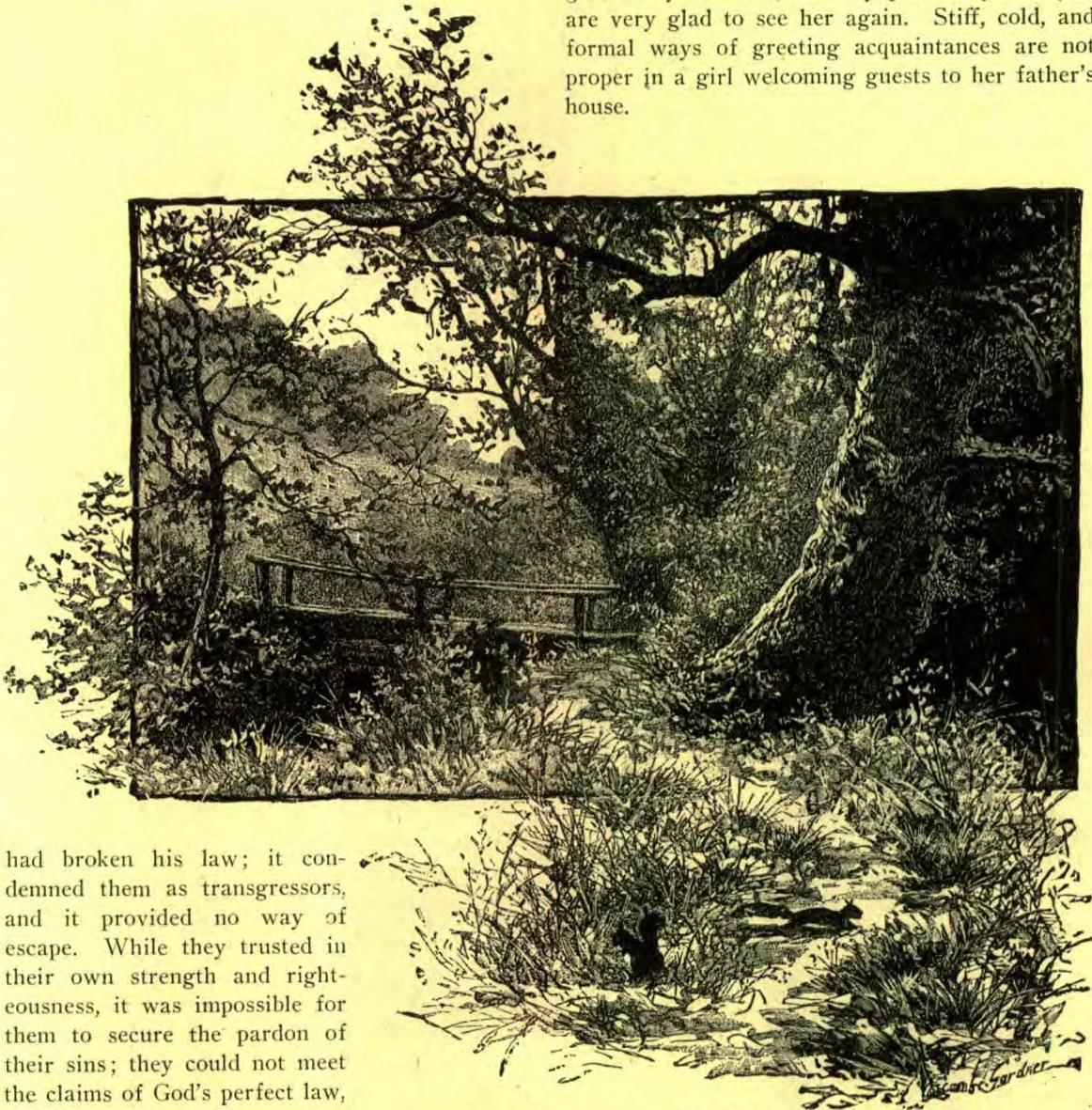
A BEAUTY SPOT
A BEAUTY SPOT
“Ye can not serve the Lord,” Joshua said; “for he is a holy God; . . . he will not forgive your transgressions nor your sins.” Before there could be any permanent reformation, the people must be led to feel their utter inability, in themselves, to render obedience to God. They had broken his law; it condemned them as transgressors, and it provided no way of escape. While they trusted in their own strength and righteousness, it was impossible for them to secure the pardon of their sins; they could not meet the claims of God’s perfect law, and it was in vain that they pledged themselves to serve God. It was only by faith in Christ that they could secure pardon of sin, and receive strength to obey God’s law. They must cease to rely upon their own righteousness, they must turn from idolatry, and trust wholly in the merits of the promised Saviour, if they would be accepted by God.
To us to-day Christ says, “Without me ye can do nothing.” He is stronger than the strongest human power. The weaker you know yourself to be, the more you should realize the necessity of leaning on the Great Teacher, and the stronger you may become in his strength. In your weakness he will perfect his strength. Sanctify the Lord God of hosts, and let him be your fear, and let him be your dread. Only trust him; and though weak, he will strengthen you; though faint, he will revive you; though wounded, he will heal you.
Men gain nothing by rushing on before the Lord. Many have thought their own endowments sufficient for an enterprise. So Moses thought when he slew the Egyptian. But he was obliged to flee for his life to the desert. Here he kept sheep for forty years, until he learned to be a shepherd of men. He learned his lesson so perfectly that though the Lord revealed himself to him, and spoke with him face to face, as a man speaketh to a friend, he did not become lifted up. “Follow me,” Jesus says. Do not run before me. Follow where my footsteps lead the way. Then you will not meet the armies of Satan alone. Let me go before you, and you will not be overcome by the enemy’s planning.
MRS. E. G. WHITE.

A DAUGHTER'S PART AT HOME

ONE of the sweetest things a girl can do is to receive friends graciously, particularly at home. In one's own house a cordial welcome is peculiarly fitting. Do not stand off in the middle of the room, and bow coldly and formally to the friend who has called. Walk over to meet her; give her your hand, and say pleasantly that you are very glad to see her again. Stiff, cold, and formal ways of greeting acquaintances are not proper in a girl welcoming guests to her father's house.
But even more important than her manner to a guest who happens in for an hour or a day, is the manner of a daughter to her father and mother. The father returns to his home after a wearying day at business. He is tired in body and mind. Coming back, he throws off care; he is joyous at the thought of the dear ones he will meet after hours of absence. His young daughter, with the bloom and freshness only girlhood wears, should be ready to give him the attention he loves—the kiss, the cheery word—to help her mother and the rest in letting her father see how much he is loved at home. Men give up a great deal for their families,—their time, their strength, the knowledge they have gained in life's experience. They spend everything freely for their home's sake, and the home should pay its debt in much outspoken love.—Harper's Round Table.

A FORECAST

UPON the earth, sin-blighted, Are many beauty spots, Wherein the eye, delighted, May read her Maker's thoughts.
Above to-day's keen sorrow We catch a song of hope, A promise for to-morrow, That bids the soul look up,—
Up to the hills of glory, Where sin shall never come,— The land of song and story, The saints' eternal home.
There blossoms never wither, And joys shall never cease; Oh, let our steps bend thither, Along the paths of peace!
Beside the happy waters, The river, calm and broad, Shall Zion's sons and daughters Forever dwell with God.
ELIZABETH ROSSER.

CATTLE

CHILDREN having an experience in life on a farm, are familiar with the call, “Come, boss! come, boss!” yet few, no doubt, have ever understood its meaning and origin.
Bos is the name of the genus, or race, to which cattle belong. This genus is divided into two primary groups,— the humped-backed cattle, or zebus, Bos indicus, and the common, domesticated, straight-backed cattle, Bos taurus.
Oxen, as domesticated animals, appear among the very earliest records of civilization, and are found sculptured on Egyptian monuments that were set up two thousand years before the Christian era. Remains of oxen have been found in the Swiss lake-dwellings, in company with the stone implements of the so-called Neolithic, or “stone-age,” man.
The forty or more breeds of cattle in Britain and on the Continent are derived it is claimed, from three distinct species, Bos primigenius, Bos longifrons, and Bos frontosus. The remains of the first of these, or the urus, have been found among the Swiss lake-dwellers, and are supposed to have run wild in the forests of Europe, Cæsar describing some he saw in the Hercynian Forest, in size as large as an elephant. As late as the sixteenth century, mention is made of these cattle being favorite subjects of the chase. A skull in the British Museum, found near Athole, measures three feet in length, and three feet six inches between the horn cores. Some of the British wild cattle, descendants of the urus, are still preserved in Cadzow Forest, Chillingham Park, Lyme Park, and Chartley.
Bos longifrons were indigenous to Sweden. Cæsar found vast herds of them in Britain, and his army subsisted on them. Even yet their remains are occasionally found. Professor Owen regards Bos longifrons as the original of the Welsh and Highland cattle.
Remains of Bos frontosus are found chiefly in the lake-dwellings of the bronze period, and are supposed to have been common in certain districts of Scandinavia, also in Irish crannoges, or stockaded islands, and to have been the progenitors of the Norway mountain cattle.
Short-horned cattle are the descendants of Bos longifrons. Polled cattle are the result of careful breeding of small-horned cattle, while the long-horned Saxon cattle are representative of the primigenius type. The Hungarian cattle of the Continent are the largest of all.
The cattle of Friesland, Jutland, and Holstein were introduced into Spain by the Goths, and were the progenitors of the vast herds of the pampas of South America. Tradition has it that the original shipment consisted of seven cows and a bull; shipped from Andalusia to the city of Asuncion in Paraguay, in 1550, and that from these have come “the polled cattle of Paraguay, the hairless breed of Colombia, and that most monstrous of existing breeds, the natas, two herds of which Darwin saw on the banks of the Plata, and which he describes as ‘bearing the same relation to other cattle that bull or pug dogs do to other dogs.’” W. S. CHAPMAN.

STANDARD TIME

“What time is it?” Few questions are more common than this, and yet each day the United States government goes to a great expense in giving it an official answer. To ascertain the instant when it is noon on the seventy-fifth meridian, and to send that information all over the country, is a great and a costly task. The Astronomical Observatory in Washington computes the true time, which is thence transmitted by electricity to every important city and town.
About five minutes before the Washington noon the telegraph companies cut off all their regular business, except on lines where they have more than one wire. They then connect all important points, from which there may be numberless ramifications, with an electric wire going into the great clock in the observatory, so that all over the country its tickings may be heard. For the ten seconds just before twelve o’clock there is silence, which is broken by the “noon beat.” Regular business is then resumed.
In some cities the wires connect with a time-ball, which drops with the noon beat. The time-ball in Washington, over the State, War, and Navy Department building, is three feet in diameter, and can be seen from all parts of the city. Crowds frequently gather about to see it fall, a distance of twenty-one feet, high in the air. The man whom some of the spectators suppose to be dropping the ball is merely there to hoist it again.
In the building beneath there are twenty-three clocks, which are each day automatically corrected by it. An electrical device “sets” them, placing hour, minute, and second hands exactly vertical at the instant the ball drops. The hands that are too fast are pushed back, and those that are slow are thrust forward.
Although Washington is on the seventy-seventh meridian, the noon hour is for convenience computed for the seventy-fifth, the time standard for the eastern part of the United States. In the central belt, which is governed by the ninetieth meridian, the signal from Washington means eleven o’clock; in the Rocky Mountain belt it is ten o’clock; and on the Pacific Coast it is nine.— Youth’s Companion.

ARE YOU HEEDING THE WARNING?

MAY 30 a party of eight young persons were swept over Flat Rock Dam, in the Schuylkill River, near Philadelphia. The party consisted of six girls and two boys, ages ranging between eighteen and twenty-one. Only one, a young man, escaped alive. They attempted to go through a lock, by the side of which was the fall of twelve feet. The lock-keeper had warned them of the dam; but the warning was unheeded, and the harvest of death followed.
What an object-lesson is this in the spiritual life! Thousands, nay, millions, are even now taking their first step in pleasurable sin. The whole thought is of having a good time, now. The present hides the future. The seed-sowing is pleasant. It may be the first glass of wine or beer, the first cigar or quid, the first step in gaming of some sort, the first companionship with questionable characters, the first ever-abasing lie to save the humility of a manly or womanly confession. Friends see our danger, and warn us of the death awaiting. They tell us that just a little beyond is the break in the smoothly placid, swiftly flowing river, beyond which no human arm can withstand its current. Do we laugh carelessly and go on? They tell us with tears that a few circles more is the maelstrom, and we shall be engulfed in its hungry heart. Is our present enjoyment too intense to heed the warning? They tell us that lying dormant in every seed of sin, is the baleful fruit of death, waiting only the seed-sowing in a young, vigorous life to bring it to sad maturity.
O friends! young men and women, who possess the God-given possibilities of useful lives, if yielded to God, heed the warning voices of your friends on every side. Note the awful sign-posts of wrecked lives, of lazar-houses of disease, which violated law is everywhere exhibiting to save you from a like fate. Be warned in time. Sow to righteousness, reap in mercy. See in the clear vision of a living faith the future in the present, and let the future fruitage and the future kingdom reign in your lives even now.
M. C. WILCOX.

THE GREATER NEED

It seemed to me that if the Lord should say, “My child, put on this martyr’s crown— The thorns are sharp, the blood will flow— But thus it is I test my own:”
It seemed that I should courage find, Nor quail nor falter at the call; But with exultant thrill could say, “For thee, my Lord, I gladly bear it all.”
And yet, alas! and yet I could not bear, With patient soul, the stress and strain Of one small day; but cried aloud And fretted sore at trivial pain.
It seemed to me that I could love, forgive,— Aye, even cherish, or uphold and tend, Him who had wrought me ill; and yet— I was impatient, faithless, with my friend.
He knows us best, the Master of the school: He portions well the task we need; Who can not wisely bear life’s petty ills, Shall he for higher lessons plead?
— Eva Williams Malone.

A QUICK RIDE

Have you ever taken a flying ride on an ice-boat? If so, it was one of the most thrilling experiences of your life, especially if you rode the beam with a hard northwest gale blowing. Now “riding the beam” is standing on the extreme windward corner, and holding on by the shrouds while fairly flying over the ice.
I will tell you of a little “mix-up” I once had with an ice-boat. The village where I lived was on the banks of old Lake Ontario. There was a small stream which ran into the lake, forming a good-sized bay, about two miles across. During the summer the farther side had grown up to rushes, cattails, etc., all of which were frozen in the ice. The old sailors in the place had just finished a fine, large ice-boat, and had left her all aslack, head to the wind, and had gone to dinner before trying it. Of course, like all boys, I wanted to try that boat all alone. So I fastened the sheets, and pushed the stern around till she caught the wind, or the wind caught her, I never knew which. But away we flew. I tried to jib the boat, but I could not budge the tiller. All I could do was to keep her head from the wind, and let her go. She went, and we were an incredibly short time traveling that two miles. And when we struck those rushes and cattails, it seemed as if a big load of hay had been blown up with dynamite. But that stopped the headway somewhat, so that when we struck the bank, the shock only broke the jib boom, strained some of the standing rigging, and threw me about forty feet into a snowdrift.
As soon as I could catch my breath, I picked myself up, and hurried around the hills for home. I did not say anything about my ride, and it has always been a mystery to those old sailors how that boat got away. THE SKIPPER.

PARTING

If thou dost bid thy friend farewell, But for one night though that farewell may be, Press thou his hand in thine. How canst thou tell how far from thee Fate or caprice may lead his steps ere that tomorrow come? Men have been known to lightly turn the corner of a street, And days have grown to months, and months to lagging years, Ere they have looked in loving eyes again. Parting at best is underlaid with tears and pain. Therefore, lest sudden death should come between, Or time, or distance, clasp with pressure firm The hand of him who goeth forth. Unseen, Fate goeth too. Yes, find thou always time to say some earnest word Between the idle talk, Lest with thee henceforth, Night and day, regret should walk.
— Coventry Patmore.
Continue reading: LAZY CATS CAN'T EAT MICE