The Youth’s Instructor, Vol. 36, No. 47.

HEROISM

The Youth’s Instructor

Nov 21, 1888

S. D. A. Publishing Association · Battle Creek, Mich. · Nov 21, 1888

HEROISM

Not on the battle-field, I deem, Are deeds the most heroic done: Not where the sword and bayonet gleam, Are victories the grandest won.
Not in the plague-infected town, Where stay the few the sick to save, And for their lives their own lay down, Shalt thou behold the world's most brave.
In acts of great self-sacrifice, Of which all men with wonder hear, A secret inspiration lies That stirs the soul and conquers fear.
To do the duty few shall know, And knowing scorn, that God requires, The menial duty far below The task to which the heart aspires,—
To do such service out of love, Unmoved by either praise or blame, And with a steadfast soul, above The reach of either pride or shame,—
Displays a courage that alone In one such act doth far outshine All other earth hath ever known, A courage Christlike and divine.
—Philip Burroughs Strong.

Glimpses of Switzerland: Canton of Bern and Its Industries

GLIMPSES OF SWITZERLAND.—NO. 4.
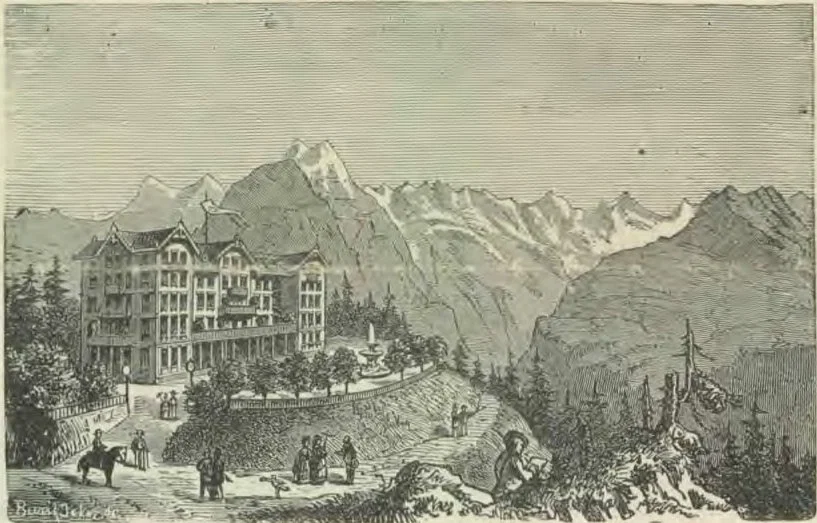
MUERREN NEAR LAUTERBRUNNEN.
In a former article, comparisons were made between some features of the broad extent of the United States and la petite Suisse. If we come a little more to details, we notice quite a contrast in some particulars. Take, for instance, the canton of Bern, which, while it is next to the largest of the twenty-two cantons, having an area of 2,652 square miles, or one-sixth the extent of Switzerland, is only 276 square miles larger than one county of the United States, where a county has thirty-six townships each six miles square. Except the counties of New York and Philadelphia, there is not one in the United States which comes within several thousands of the 532,200 inhabitants of this canton; and were they not of the most frugal in their living, subsistence would be impossible, for imports are scarce.
In the watch business, 14,000 persons gain their livelihood, making about 1,000,000 watches annually, most of them silver; 2,500 more work in linen factories, and one small section alone, at the foot of the Alps, has 2,000 sculptors in wood. Of cotton, woolen, silk, and gun factories there are more than a dozen; also several iron foundries, fifteen match factories, and the largest parqueterie in Switzerland. (A parqueterie is where the fine woods are prepared for their noted inlaid floorings.) Its plateau produces more grain than the canton uses; its nine hundred cheese-factories turn out for annual export 12,500,000 lbs. (worth over $3,000,000), and its net-work of fifteen railroad lines connect its principal towns with all points of the continent.
All these industries, as well as farming and stock-raising, are carried on by the common people, some of them with the improved methods of modern invention, others in the rude ways of their forefathers, and are located within the limits of this canton, which stretches away from the frontier of France on the north-west in irregular shape, nearly sixty miles in a south-easterly direction over the mountains, gorges, and valleys of the Jura range, across its central plateau, taking in the highest heights of the world—the famed Bernese Alps at its southern boundaries. Here we get away up into the sixth region, among the peaks of eternal whiteness and intensity of cold, the beautiful Jungfrau, Wetterhorn, Breithorn, with all the lesser horns, and Finsteraarhorn, the father of all, rising above them to the proud elevation of 14,000 feet,—up where Wurer, an American tourist, who, on the route from Zurich to Meiringen, had frequently remarked, “This is nothing to Yosemite,” standing in the presence of the indescribable grandeur and beauty of these majestic Alpine monsters, awed to silence, forever laid aside his references to even the wonderful Yosemite. Truly, to appreciate, one must see.
Leaving now these summits in their sublimity and awfulness, we descend among the great fields of ice and snow, the glaciers, which seem as immovable as the rocky peaks above them, but in reality are moving a few inches daily, carrying along in front and in their depths great rocks and quantities of soil which they have scraped off the mountain sides in their onward course to the valleys. Still lower down and farther away, we come to a section presenting the most fascinating and infinitely varied attractions to the admirer of beautiful landscapes.
Here the Aar passes through two small lakes, Brienz and Thun; and between them, situated on the river, with most romantic surroundings, is the little town of Interlaken, which, with its suburban villages, has a great number of hotels and restaurants, for the accommodation of tourists. Every summer they entertain more than 25,000 visitors, mostly foreigners, English, Americans, and others, who spend from a few days to several months here, meanwhile taking in the wonderful sights and sounds around, and out in the mountains, as they are physically and financially able to do. One of these sights is the cascade of Staubach at Lauterbrunnen, pouring its large volume down 940 feet over a perpendicular mountain wall, the rocks and velocity breaking the water into a beautiful foamy whiteness.
Near Lauterbrunnen is Murren with its hotels, up where it is so cold that in winter no one remains, and from which during summer many a party goes out to visit the Alps, whose snowy summits appear in the background.
Farther north in the canton, near its center, is the capital of Switzerland, Bern, which is also one of the largest and finest cities of the country. It is a very old city, being now on the eve of its eighth century, and has nearly fifty thousand inhabitants. Among its distinguished and learned men of the past, we notice Albert the Great. Its federal palace, the finest public building of the country, contains the assembly rooms of the National Council, the Council of States (cantons), and the Federal Council.
Some may be interested to know something of their government, and I will mention a few points. The supreme authority is vested in a Federal Assembly formed by a union of the National Council and the Council of States. Its members, of whom with the present population there are 189, are elected by the people for a term of three years. Each canton is entitled to one delegate to the former council, for every 20,000 inhabitants; and to two members for the latter, regardless of its population. The executive power is exercised by the Federal Council, the seven members of which are elected by the joint action of the National Council and Council of States under the direction of the president of the former. The president of the Republic is president of this Federal Council; but while the other six members have a term of three years, he is limited to one year, and cannot serve two years in succession. Necessarily, therefore, his influence and authority are much restricted; and do not imagine that these impulsive Swiss voters ever get into a frenzy over a presidential election. It isn't worth while.
The Swiss flag is of plain, deep red with a square, white cross in the center, and the national motto reads, Un pour tous, tous pour un, one for all, all for one.
Government, State, and city statutes regulate the conduct of citizens and foreigners down to very minute details, and are rigidly enforced; some of them to the discomfort or disgust of Americans especially, since they were never in their lives accustomed to being so much protected and governed. In general, however, the laws could not justly be unkindly criticized; and many of them, for instance those looking to the protection of life and property, might be adopted in America with great advantage.
Concerning railways, they are such that a railroad catastrophe is almost an unheard-of occurrence, and would be more startling than the news that an avalanche had buried a village, or a score of people had gone down an Alpine precipice to an unexpected grave. Walking on the railroad track is never tolerated, and at every crossing in city and country the highway is barred for each passing train, day or night.
Safety from fires is also very effectually secured by laws both as to the construction of buildings, heating included, and visits of officials to examine chimneys, furnaces, and stoves. No part of an iron stove can stand less than 60 centimetres (almost two feet) from a wall plastered on lath, or a baseboard, casing, or anything in wood; and kitchen floors must be of stone or tiling, if not of bare ground. A violation of any of these laws, or a failure to obtain permission of proper authorities even when a stove is to be set up or moved, will be punished by fine or imprisonment if discovered, which they are about as certain to be as that the births and deaths in a family will be ascertained by the census-taker.
Their heaters are earthen, glazed outside in colors, green, brown, etc., or in pure white; some are round, others square or oblong. They are built up in stories, in size and height proportionate to the rooms they are to warm. They usually stand in a corner and generally are quite ornamental with their shining surface, some of them flat and smooth, some figured or ribbed. The fireplace, suitable for both coal and wood, is in the first story, which rests either upon a flat stone laid on the floor, or is furnished with legs usually the same material as the stove. The latter style is of late coming quite generally, into use, and the brass band where the stories of the round stoves join, is not necessary with the more modern oblong and square styles, which are laid up in blocks, after the manner of brick work. A house is not complete till all its stoves are in; and they are stationary, that of the kitchen being almost invariably built into the wall at one side. Thus Swiss tenants never have vexations with fractious stovepipes when moving, as roving Americans have.
With most families, one fire in the morning is all they can afford for the day, as coal and wood are high priced; but as these fourneaux heat slowly, and with all the dampers closed hold heat for hours, the people manage to keep comfortable with their warm clothing and the double-windows hermetically sealed. But the odors within, especially in the houses of many generations—oh! I like these heaters much better than iron stoves. They do not so burn the life out of the air, nor is one in danger of singing fingers and clothing with the least touch, though they be ever so hot. However, I did not stop with a morning heating up, and besides had good ventilation; hence kept warm, and had fresh air to breathe.
I wish to tell you something about the northern part of the canton of Bern, but this must be reserved for another time. ADDIE S. BOWEN.

A MORE EXCELLENT WAY.

It all came about through Johnny's dropping the syrup-pitcher at breakfast. The table-cloth was spic and span clean, and his mother had risen with a miserable neuralgic headache, and Johnny wasn't as careful as he should have been, of course, when in his hurry he tipped the pitcher, which in its fall overturned a very small tumbler. And so, in another half-minute, there was an island of syrup, set in a small pond of ice-water. All the circumstances which I have enumerated were too much for ordinary maternal patience.
“Johnny, you are a naughty, careless boy! You shall have no syrup on your cakes this morning!”
Johnny's eyes opened in astonishment.
“Why, mamma, I didn't mean to do it!”
“But you are always doing things with such a rush. You make other people a great deal of trouble and labor, and then you say, ‘I didn't mean to!’”
A cloud of very gloomy character had suddenly fallen over the group at the pleasant breakfast-table. Just here, in the confusion consequent upon the accident, Kate, the twelve-year-old sister, who sat opposite Johnny, struck her napkin-ring sharply against the salt-box standing by her plate, thereby overturning the dainty little china device. This incident being of so trivial a nature, nobody made comment until the rebellious and tearful Johnny exclaimed:—
“Kate has been careless too, mamma, and you haven't blamed her a bit. Shan't she go without syrup, too?”
“It isn't anything to tip over a salt-box,” remonstrated the little girl.
“What a silly thing to mention,” added the mother.
But somehow, almost before the remark had left her lips, her conscience had disputed its truth.
“Johnny,” she said suddenly, “will you excuse me for speaking as I did? It was because the clean table-cloth was soiled, and the spilling made such confusion and so much work, that I was discouraged. But it was an accident, and not my little boy's fault. You did not mean to do damage any more than Kate when she hit the salt-box. You can see that yours was a much more trying accident, and it was hard to be pleasant over it. But I see that I was in the wrong, because I was really blaming you because there was syrup in the pitcher, and not for being careless in tipping it, as I said. Kate's salt-cellar didn't have any syrup in it, you see—only salt, which did no damage.”
The picture before her was chaotic, but Mrs. Way succeeded in smiling brightly into Johnny's eyes, and added:—
“I am sick this morning. I didn't sleep well last night. You know I dislike a soiled table-cloth—so, on the whole, won't you try to excuse me?”
Such a queer expression Johnny's face wore, but smiles carried the day very speedily.
“Now, children,” interposed their father, “since mamma has been so very polite, and has apologized so beautifully, don't you think a small boy and girl, not very far away, ought to be very careful as to their manners at the table, and run no risks of tipping pitchers and tumblers and salt-cellars, and making ugly spots on clean table-cloths?”
“Yes, sir,” said Johnny, with great emphasis.
“I'll try,” added Kate.
That morning, as the children were on their way to school, Kate said, in a thoughtful way, with a tender accent in her voice, “I think mamma is just the sweetest mother in all the world. She is always sorry when she does wrong, just as much as she wants us to be.”
To which somewhat confused grammar of his sister, Johnny responded with earnest loyalty, “Yes, and she owns up right out loud, too, I tell you.”—Congregationalist.

HOP PICKING.

Hops are planted in perfectly straight rows, like corn; and about a foot apart in the furrows, poles twelve feet long are planted, upon which the vines are trained, and from the top of which hang the large bunches of hops, like clusters of grapes, their light green color making a charming contrast to the dark green of the vine. The vines grow so luxuriantly, that, at a distance, a hop-yard looks like a dense young forest.
The hops are picked into boxes, and these boxes are arranged into groups of four, so that four persons can work together. Each group of boxes has a canvas awning over it, not only to protect the pickers from the sun, but also to shield the hops from the dew, or a possible rain at night. A hop-picker does nothing but pick the hops from the vine.
Each group of boxes has an attendant called a "box-tender," or "pole-puller," whose duty it is to pull up the poles with the vines attached, and lay them in bundles beside the pickers. Projecting from each box is a wooden pin, upon which the picker leans a pole, and rapidly cleans it of its hops. From time to time the box-tender gathers up the cleaned poles, and stripping off the vines, stacks them in a cone-shaped pile, in much the same manner as an Indian arranges the poles for his wigwam. When a box is full, a "time-keeper" empties the hops into a sack, and credits the amount in his book to the picker, the latter at the same time making a similar entry in his book.
There are generally four classes of pickers. The first are called "home-pickers," those who reside in the neighborhood, and pick regularly each year, whole families often being engaged in this way. As these board themselves, they usually receive 40 cents a box for picking. The season lasts but a short time, only a few weeks, but a family of four persons will earn from $130 to $250. A second class of pickers is composed of a medley of girls from cities and towns, many being shop hands and clerks in stores, who pass their vacation in this way, and while earning money, often recruit in health. Still another class are the invalids who seek the hop fields for the tonic effect from the aroma of the hops; and lastly are the young men and women who pick "for fun." Not that hop-picking is an easy task; for it is really wearisome. Neither do they pick gratis; for they receive the same wages as all the others, who, with the exception of the home-pickers, receive their board and 25 cents a box for the hops picked. Nor is there much opportunity for recreation during the day while picking, as every picker must remain at his box, and can only converse with the others who make up the group of four. The "fun" they look forward to is the "hop-dances," which are given every evening.
An expert picker can fill four boxes daily; but the average does not exceed two boxes and a "start," that is, a sufficient amount in a third box to make a good beginning the next day.
The pickers' lodging houses are long two-story buildings of rough lumber. The central part of the lower floor is devoted to culinary purposes, and has doors opening on each side into dining rooms. These are furnished with long tables, generally bare, sometimes covered with oil-cloth, with benches upon either side. The beds are arranged in the upper story in rows like a hospital. The bedsteads are simply rough boxes, or "bunks," with husk or straw ticks and pillows, and abominably dirty bed linen. No chairs or stools are provided. Two persons occupy each bed, and their satchels and clothing are slid under the bunk, or hang upon nails in the wall. All, men as well as women, make their own bed. On large farms, separate buildings are provided for married people and women. All workers are expected to be in bed at midnight, and rise at five o'clock, that being the breakfast hour, and to be in the hop-yard at seven o'clock. The home-pickers, however, come and go as they choose. W. S. C.

“BE THOU IN THE FEAR OF THE LORD.”

WHEN you think, when you speak, when you read, when you write. When you sing, when you walk, when you seek for delight, To be kept from all wrong, when at home and abroad, Live always as under the eye of the Lord.
Whatever you think, never think what you feel You would blush in the presence of God to reveal; Whatever you say, in a whisper or clear, Say nothing you would not like Jesus to hear.
Whatever you read, though the page may allure, Read nothing of which you are perfectly sure Consternation at once would be seen in your look, If God should say, solemnly, “Show me that book.”
Whatever you write, though in haste or with heed, Write nothing you would not like Jesus to read: Whatever you sing, in the midst of your glee, Sing nothing that his listening ear can displease.
Wherever you go, never go where you fear, Lest the great God should ask you, “How camest thou here?” Turn away from each pleasure you’d shrink from pursuing, If God should look down and say, “What art thou doing?”
—Selected.

“YOU STAY.”

“I REMEMBER,” said an old clergyman lately, “a careless word spoken to me in my boyhood which has influenced my character through life. Like most sickly, sensitive children, I was ready to give up hope before every trouble. An attack of illness, a long storm, a disagreeable visitor or servant in the family, plunged me into despair.
“‘Fred,’ said my uncle to me one day, ‘the tooth-ache, or the wet weather, or the boys who tease you are bad things enough, but remember they go, and you stay.’”
“It was like a new gospel to me. These great evils would pass by, and little, insignificant me—I stayed!”
“It was a wholesome idea to put into a boy’s mind. The feeling of permanence is rare with children. They are to their own feeling like anchorless boats on the sea, driven here and there. Out of this uncertainty come most of their vague miseries. It is good for them to feel that, no matter how poor, or dull, or obscure they are, in comparison with others, each of them has a life of his own, abiding and sure, which is of importance in God’s eyes. Many morbid, self-distrusting boys and girls need just the poise and confidence which that knowledge would give to them.
“As I grew older, the chance words took a wider meaning to me. The temptation, however fierce, would pass if I stood firm; the grief, no matter how deep, would lighten; the agony of self-sacrifice would be gone some day, and I would remain to finish my work, and answer my account.
“Life itself would at last vanish, as when the heavens and earth disappear, and yet my soul, this insignificant me, would stay, face to face with God.”
What are these things that we think and talk of all day long? Our neighbor’s gown, or house, or bank account, or our own cough, or china, or lucky speculation?
These are the things that go.
The kindliness in our hearts, the loving word we speak, the little gasp of a prayer in our soul, where only God sees—these are the things that stay, and enter immortal records.
Which weigh the heavier with us?—Companion.

YOUR OWN FAULTS.

Do we heed the homely adage, handed down from days of yore, “Ere you sweep your neighbor’s dwelling, clear the rubbish from your door”? Let no filth, no rust, there gather; leave no traces of decay; Pluck up every weed unsightly; brush the fallen leaves away!

THE RUSSIAN POST-WOMAN.

I should be sad if I thought that the little girls of America were to grow up to a woman's life so hard and dark as the lot which awaits many a little girl now living in some of the countries of Europe.
Just think of it! In the terrible winters of Russia, when the air is full of a fine, stinging ice-mist, and the snow is deep, and the houses on the roads are few and far between, and the Russian peasant-men care little to help a peasant-woman in trouble, and do not feel sorry to see a woman do work she is not strong enough to do,—in that terrible land, and in those terrible winters, Russian women “carry the mail” from postoffice to postoffice, with a covered sleigh and a dog-team.
Perhaps the post-woman has a passenger in her sleigh, too; and when the road is drifted full, the dogs flounder along, almost lost in the snow, and the poor woman-driver strides by their side, whip in hand, now coaxing, now scolding. I am sure she must wish that she had never been born.
In all the countries of Europe there are fine sights to see—wonderful old churches, castles, palaces, and historic places; in America there are no such fine sights; but Europe is full of poor people, who work hard and are paid small wages for it, and who suffer like the Russian post-woman; while in America, all who will work can be comfortably fed and clothed. —S. S. Gem.

“THE SABBATH-SCHOOL WORKER.”

The first number of this excellent journal was issued in January, 1885. For two years it was published as a 16-page quarterly magazine, and so far as we can learn, gave good satisfaction. Two years ago, owing to the efforts of some who did not fully understand the wants of the Sabbath-schools, the form was changed, and it was merged into the Youth’s Instructor, appearing monthly. This plan of combining the “WORKER” with the Instructor has never given general satisfaction. It defeats, in a measure, the very object for which the WORKER was established, and there seems to be a general desire to have it brought back to its original form.
As the reader well knows, the most of the matter contained in the WORKER is written especially for the benefit of officers and teachers in the Sabbath-school, and is therefore not of special interest to the younger members of the school. If put in the Instructor, the space is lost so far as the children are concerned, and many for whom it is designed fail to get it. Then again, the officers frequently wish to recommend certain plans or methods which they prefer not to lay out before the whole school. They desire a medium of communication direct with the officers and teachers, and those adults especially interested in this branch of the work.
The WORKER also contains matter that ought to be preserved for future reference; but appearing as it does monthly in the Instructor, this is not an easy thing to do. The sheet is large, and not easy to bind, and if folded up and laid away, it is liable to be lost. At best, all will agree that it is not in a convenient form for reference.
This whole matter came up for consideration at the last annual meeting of the Association, and after careful and thorough investigation the following resolution was presented and adopted without a dissenting voice:—
Whereas, The officers of the Association need a medium of communication whereby they may give instruction to the officers and teachers of the Sabbath-schools throughout the world, and,—
Whereas, This medium needs to be in a convenient form for reference, and separated from matter that is designed for general circulation; therefore,—
Resolved, That the Executive Committee be authorized to revive the SABBATH-SCHOOL WORKER, as a quarterly, in such form as they may think best.
At a meeting of the Executive Committee, held at Battle Creek, Mich., Nov. 11, 1888, this matter was again taken into careful consideration. It was finally decided to issue the WORKER as a 10-page quarterly magazine, of the same size and style as the first volume, the first number of this new volume to be dated January, 1888. Subscription price, 25 cents per year. This low subscription price places the WORKER within the reach of every officer and teacher, and we trust that every one will avail himself of the privilege of subscribing.
The WORKER will continue to be under the management of the officers of the International Association, and no pains or expense will be spared in order to make it interesting and of the greatest practical value to all those engaged in the Sabbath-school work.
Subscription blanks and full information will soon be sent to every Sabbath-school. We trust that a thorough canvass will be made in every school and church, and that a large subscription list will be made up. There are now one thousand Sabbath-schools belonging to the different Associations, and over three thousand officers and teachers. Taking these with the older members in each school that ought to subscribe, and the subscription list to the WORKER ought to reach not less than five thousand copies.
Address all communications to SABBATH-SCHOOL WORKER, Oakland, Cal.
C. H. JONES, Pres. Int. S. S. Ass’n.

INTERNATIONAL S. S. ASSOCIATION.

The eleventh annual meeting of the International Sabbath-school Association was held in connection with the General Conference at Minneapolis, Minn., Oct. 17 to Nov. 4, 1888. Five regular sessions were held, at which many important matters relating to the past, present, and future of our work came up for consideration. The interest seemed to increase from the first. Thirty-six State Associations were represented—four having been organized during the past year; viz., Georgia and Florida, Arkansas, North Carolina, and Australia.
Aside from the public sessions referred to above, several meetings were held for the purpose of giving practical instruction in the different branches of Sabbath-school work. These meetings were well attended, and we are sure that if the instruction given be put to practical use, much good will be the result.
Space forbids giving a full report of all the meetings at this time, but we hope to do so in the next issue of the WORKER.
The officers elected for the coming year are as follows: President, C. H. Jones, Oakland, Cal.; Vice-President, W. C. White, Oakland, Cal.; Secretary, Mrs. C. H. Jones, Oakland, Cal.; Corresponding Secretary, Mrs. Jessie F. Waggoner, Oakland, Cal.; Treasurer, Pacific Press, Oakland, Cal.; Executive Committee, C. H. Jones, W. C. White, E. J. Waggoner, E. W. Farnsworth, F. E. Belden, A. T. Robinson, Roderick S. Owen.
Many important resolutions were adopted at this meeting, some of them pointing to quite radical changes during the coming year. That our readers may know what these are, and thus be enabled to take hold of the work more understandingly, we print in full the resolutions that were adopted, as follows:—
1. Resolved, That we recognize the blessing of God in the prosperity that has attended the Sabbath-school work during the past year, both in the line of the organization of new schools and associations, and in the increased interest on the part of those previously engaged in the work; further,—
2. Resolved, That this blessing shall be received by us only as an incentive and an encouragement to greater consecration to the work.
Whereas, The sole object of the Sabbath-school should be to lead souls to Christ, and no one can lead another in a way which he himself does not know; therefore,—
3. Resolved, That we again recognize and emphasize the necessity of having converted teachers in the Sabbath-school.
Whereas, The formation of new schools rests largely in the hands of the ministers, and the instruction given at the time when the school is organized has much to do in shaping its future course; therefore,—
4. Resolved, That we urge all who labor in the field to become thoroughly and practically familiar with all branches of Sabbath-school work; and further,—
5. Resolved, That we request the officers of the various Conferences to insist that such knowledge shall be a necessary qualification of those whom they send out to labor in the ministry.
Whereas, The experience of the past has shown that our Sabbath-schools have made the most progress when a systematic correspondence has been kept up with them by the officers of the Association; therefore,—
6. Resolved, That while we would most earnestly encourage personal work by the officers to as great an extent as possible, we express it as our belief that nothing can take the place of regular correspondence, and that we urge the State Secretaries to keep in constant communication with all the schools in their respective associations, so that they may know the exact standing of each, and be enabled to give the instruction that is needed; and further,—
7. Resolved, That it is the sense of this Association that when a State Association has secured a competent secretary, he should be encouraged to devote his entire time to this work.
8. Resolved, That the International Association send a representative to each State camp-meeting, to direct and aid in giving instruction to officers and teachers, and to counsel with the State officers concerning the best means to advance the Sabbath-school work in the State.
Whereas, The officers of the Association need a medium of communication whereby they may give instruction to the officers and teachers of the Sabbath-schools throughout the world; and,—
Whereas, This medium needs to be in a convenient form for reference, and separated from matter that is designed for general circulation; therefore,—
9. Resolved, That the Executive Committee be authorized to revive the SABBATH-SCHOOL WORKER, as a Quarterly, in such form as they may think best.
10. Resolved, That we request the Executive Committee to issue the Senior Lesson Pamphlet in such form that it may be conveniently carried in the pocket.
11. Resolved, That we request the Executive Committee to furnish, and the Review and Herald Office to publish, in the Instructor, a continued Series of Children's Lessons, in place of the lessons for the Senior Division.
12. Resolved, That the Executive Committee be requested to have a series of lessons prepared upon the subject of Tithes and Offerings, to begin in July, 1889.
13. Resolved, That we request the preparation of lessons upon Health and Temperance, to be used as soon as practicable.
Whereas, The General Conference has voted to buy and use for missionary purposes, if found to be suitable, the ship in which Brethren Cudney and Tay sailed for Pitcairn Island; and has also voted to establish a ship and city mission in Hamburg; and,—
Whereas, The work which has been begun in Russia, and which has prospered in the face of the greatest difficulties, is much crippled for lack of means; therefore,—
14. Resolved, That we recommend that all our Sabbath-schools throughout the world devote their missionary contributions for the first quarter of 1889 to the purchase of the above-mentioned ship; that the contributions for the second quarter be given to the Russian Mission; and that the contributions for the remaining half of the year be devoted to the establishment of a city mission in Hamburg, Germany; and further,—
15. Resolved, That we request the Executive Committee to prepare as soon as possible a statement containing as much information as can be secured concerning the Missionary Ship, and also interesting items relating to the situation and work in Russia and Hamburg, which shall be sent to all the schools, in order to make more real to the pupils the objects for which they contribute.
Whereas, There is an urgent call from all parts of the field for a paper devoted wholly to the interests of the children; therefore,—
16. Resolved, That we request the Review and Herald to adapt their excellent paper, the Youth's Instructor, to meet this want.
17. Resolved, That we request the Executive Committee to secure the publication in pamphlet or book form of a series of Object Lessons, for little ones from three to six years of age, on the Life of Christ, to be accompanied with illustrations, instructions for teaching, and appropriate songs.
18. Resolved, That we request the Executive Committee to prepare at once a series of lessons for adults, suitable for use in connection with tent-meetings.
Whereas, Good results have followed the holding of Children's Meetings in connection with our camp-meetings, and the lessons and suggestions sent out in pamphlet form have contributed much to this success; therefore,—
19. Resolved, That still greater attention be given to this branch of work, and that we request that a few additional lessons and suggestions be prepared to be used in connection with those already in use, and that the subject of temperance be included in the list.
20. Resolved, That each State Sabbath-school Association order its camp-meeting supplies from the General Association, and pay for them from their State Fund.
We hope that these resolutions will not be read over carelessly, and thus laid aside to be forgotten, but that they will be studied, and thought of, and then put in some convenient place for future reference.
On the whole, we consider this one of the most interesting and profitable meetings ever held by the Association. We were gratified to see the interest manifested in this branch of the work, and the earnestness with which instruction given at private sessions was received. We trust that this same spirit of inquiry may permeate the entire body, and that the coming year may witness still greater advancement in the work.
C. H. JONES, Pres. Int. S. S. Ass'n.

SPECIAL NOTICE.

We wish to call the special attention of State Secretaries and others who may wish to communicate with the officers of the International Association to the change of officers recently made, necessitating a change in their address.
Hereafter, Quarterly Reports and all communications intended for the Secretary of the International S. S. Association should be addressed to Mrs. C. H. Jones, Pacific Press, Oakland, Cal.
Donations to the missions, tithes, and all money for the Association should be sent direct to Pacific Press, Oakland, Cal., as this office has been elected Treasurer of the Association.
Correspondence in reference to opening up the work in new fields, or relating to the advancement of the work in general, should be addressed to the Corresponding Secretary, Mrs. Jessie F. Waggoner, 1465 Castro Street, Oakland, Cal.
The permanent address of the President is, C. H. Jones, Pacific Press, Oakland, Cal.
These changes will take effect immediately; therefore all communications after this date intended for the officers of this Association should be sent as above.
Of course it is understood that this has no reference to local schools where State Associations are already organized. These schools will send their reports, tithes, donations, etc., direct to the State Secretary, as heretofore. And right here we would urge all to try to be more prompt in the matter of reporting.
C. H. JONES, Pres. Int. S. S. Ass’n.
Continue reading: MICHIGAN SABBATH-SCHOOL ASSOCIATION