The minister of Christ must obtain a direct and personal experience in the things of God if he would help others. Speaking of this, Dr. W. F. Gunsaulus says in the Advance of Oct. 10, 1912:—
And this is the message which I want to give to the pastors of the day. Preachers must experience the truth which they proclaim. They can not go into their studies and hunt truths or ideas out of books, and then go and proclaim them second-hand to their people, and expect great results. Experience can not be borrowed, and without it a sermon is only a second-hand affair. We can not have renewed strength in the pulpit until we have men who have realized in themselves the value of what they are proclaiming. I do not say that we do not already have many such men, but what I say is that we must have more of them and more of it.
The Religious Garb
It certainly must be cause for regret to President Taft that his earnest endeavor to please both Protestants and Catholics in the settlement of the religious-garb matter, has failed to give satisfaction to either side of the controversy. During the last two or three weeks there has been in religious journals much discussion regarding the President’s decision. It is regarded by practically every one of the journals coming to our desk as a clear compromise of principle, and one that seeks to avoid as far as possible taking a definite and decided stand upon the main issue involved.
Says the Continent (Presbyterian) of Oct. 3, 1912:—
The really weak spot in the government’s solution of the matter is that neither the secretary nor the President is found ready to put these conclusions into the regulations of the Indian school system. The Catholics have already taken down their Roman pictures from school walls, and they have already promised that no more monks or nuns shall apply for positions in the Indian schools. Therefore, say both these eminent statesmen, no order will be entered on these subjects. But why not? If this is to be the policy to which our Roman fellow citizens so willingly agree to conform hereafter, what is the objection to having it “nominated in the bond”? Just a little rule or two added to the regulations now, when the question has been so thoroughly thrashed out, might save a new thrashing of the old straw in a later administration.
The Standard of October 5, a Baptist journal, says:—
The President’s solution of the matter appears to be an impossible effort to please both Catholics and Protestants. Apparently it is owing to this failure to sustain his position that Commissioner Valentine resigned. . . . We shall watch the President’s choice of a successor to the brave and worthy Valentine with interest, not to say solicitude.
The Lutheran Observer of October 4 states:—
The decision straddles the question involved. It attempts to please all parties in interest, and in some ways succeeds in so doing, but the government compromises with principle, as well as with its own dignity, by permitting its approved policy to be modified and changed to meet a purely formal, ceremonial, and artificial requirement which the Roman Church imposes on members of its religious orders.
The United Presbyterian of October 3 states that “the question is not yet settled.” It feels that “the President’s decision gives too much discretionary power to be vested in an individual in a case in which a cardinal principle of our national government is involved.”
The Herald and Presbyter (Presbyterian) of October 2 criticizes the permission of the decision to allow the rooms of government schools to be used for religious instruction outside of school hours, and adds:—
These Romish teachers could ask for nothing more. They can use the buildings themselves for their sectarian purposes. It will be remembered, however, that the order, clear and ringing, went out from the government to Protestant teachers in the Philippines that they were not, even outside of school hours or even in their own homes or anywhere else, to give religious instruction. But Romanists are given the privilege of using the school buildings for their sectarian purposes, and not even the embarrassing condition of a rule or order is to inconvenience them. . . .
With all due respect, we say that all Protestant patriots do well to take due warning.
The Christian Observer of October 2 devotes a two-column article to the discussion of the religious-garb question, concluding with the pertinent question, “Could Mr. Taft have surrendered more completely to Rome?”
But the Catholics themselves do not find the decision altogether to their liking. America, the leading Catholic weekly of the United States, speaks as follows of the religious-garb decision:—
An examination of the official document announcing the decision shows plainly that the triumph really rests not with those who at the time they were “covered into” the government service, wore the religious garb, and who have been in undisputed possession of it ever since, but rather with the Protestant preachers and bigots who questioned the right of the fifty-one out of the two thousand government employees to wear the religious garb, and appealed to the Constitution against the President’s ruling when he revoked the order of the Indian Commissioner. The final decision reduced to its simplest terms means that the religious garb must go. . . . Something had to be done to appease the anti-Catholic element who hate the religious garb and all that it stands for as his satanic majesty hates holy water. . . . It is to the credit of Catholics that they frequently yield their own rights in the interests of peace and harmony, and, as they seem to have done in this instance, to save the government from embarrassment.
The statesman in his great responsibilities, as well as the man of business, the tradesman, the artisan, or the preacher of the gospel, should seek to follow the light as God gives him to know and understand it. In his decisions he should be governed by principle rather than by caprice. Doing this, he has to fear neither friends nor foes, but can look to the great Judge of all for sustaining grace in times when it is his duty to stand for vindication of the right.
We in the humbler walks of life little appreciate the great pressure brought to bear by contending interests upon those who occupy high positions in the state. We need to do more praying for our rulers. Indeed, the Scriptures of truth exhort us to pray for kings and all that are in authority. Let us remember before the throne of grace the rulers of the countries in which we live, and those that occupy high positions in affairs of state, that God may give them discernment to recognize right and truth, and then firmness and decision to take their stand on every question for principle.
Preventable Loss
Of the large amount of waste and loss arising from preventable causes the Lutheran of Oct. 10, 1912, speaks as follows:—
The annual fire loss in the United States is about $198,250,000. The loss through floods, drought, and frost is not possible to compute. The Mexican boll-weevil in a single year destroyed $30,000,000 worth of cotton. Rats, we are told, are the cause of an annual loss of $20,000,000; flies cause about as much loss, while ground-squirrels destroy half as much as the flies. About $4,000,000 worth of cows are condemned by the government because of tuberculosis, while the total loss through this cause is estimated at $13,000,000. By proper sanitary arrangements, the value of the cow and cattle products could be increased by at least $17,000,000, says an expert. Here is a total, therefore, of $24,000,000 going to waste in the cow- and cattle-yards of the country. A leading medical authority says that not less than 600,000 people die annually from preventable causes, and that each year 3,000,000 people have some illness or accident that could have been prevented. The economic loss thus caused is approximately $1,500,000,000. If all of this could not be entirely prevented, there could at least be great reductions effected. And we have only scanned half the first page of the ledger of losses through what might be called American wastefulness. If but ten per cent of this enormous waste were to flow into the missionary coffers of the churches, how these would overflow! Is it not time to plan for scientific conservation of our resources?
Returning to the Faith
Some years ago there was much discussion in theological circles due to the theories of Dr. Charles A. Briggs, and his suspension from the ministry by the General Assembly of the Presbyterian Church on the charge of heresy. It is claimed now that after following the devious wanderings of New Thought and higher criticism to the ultimate, Dr. Briggs announces once more his faith in the Scriptures of truth as the revealed will of God, and the Christ of the Bible as the only means of salvation. It is to be hoped that he has indeed truly returned to simple faith in the Bible record. If he has, he is a grand exception to the scores whose faith has been overthrown and who are to-day wandering in skepticism and unbelief as a result of the philosophy which has been taught by Dr. Briggs and other higher critics.
The Japan Meeting
By R. H. Evans
R. H. EVANS
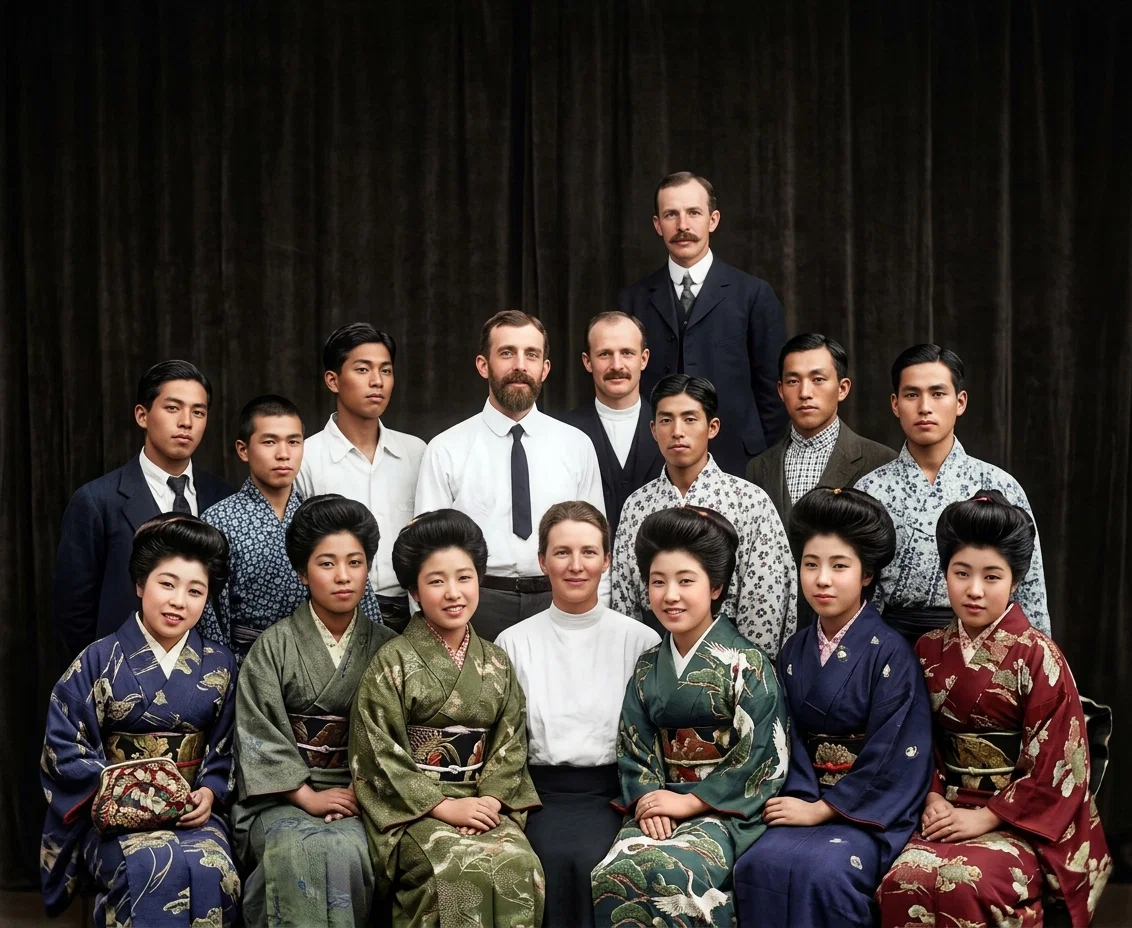
ON a little point of land projecting into the sea, with a delightful beach, and a fine grove of pines crowning the bluff just to the rear, in the little village of Awaji, our preaching tent, seating about one hundred fifty persons, was pitched, and here our general meeting for Japan was held July 11-21. As we were located near the northern entrance of the Inland Sea, we could look out from the tent, and see sailing craft of every description. Great seagoing vessels, freighted with the products of every land, were coming and going; small steamers and sailing vessels visiting the thickly populated coasts of Japan; countless small fishing-boats leaving the villages long before dawn, and returning late in the afternoon,—all these and many others were in plain view from our tent.
For two years there had been no general meeting in Japan; and it was indeed a privilege to meet again our people, with their families, and study the Word of God together. Great battles have been waged against heathenism during the last two years. Not since the empire granted religious liberty to all, has the prosecution of the gospel been attended with greater difficulties than during this period.
The attitude of the nation and of the leaders in education and the national religion have combined to make the preaching of the third angel's message to the Japanese a slow and laborious work. The attitude of the people is not one of scorn or ridicule. They do not seem to hate religion, but they are absolutely indifferent to it; they take no interest in it,—a condition that is very difficult to meet. Before an interest can be secured, an attentive audience must be gained. This requires perhaps even more skill than in the home land. Earnest per-
sonal work must follow the public effort, and must be patiently continued for a long time. In order to win the Japanese to Christianity one must search as if for lost jewels. But really, what earthly treasures can compare with the souls of men won from the realms of darkness and sin to the kingdom of God?
All the foreign workers but one, Brother John Herbolzheimer, enjoyed the privilege of attending this meeting. Brother Herbolzheimer had been called to nurse a member of a prominent missionary's family, who had been given up to die by the leading physicians of Japan.
The wonderful effects of the hydropathic treatments attracted wide interest. The leading foreign hospital in Tokio, where the patient had been cared for, was greatly pleased at the results obtained by the treatments given, and invited us to operate a small hospital in connection with their large institution, where water treatments could be given.
While this invitation showed kindly feeling on their part, it is not the province of the third angel's message to make an alliance after this fashion. It did, however, help us to see the benefits that might be gained by having well-equipped treatment-rooms in Tokio or Yokohama. The latter place has many foreign residents, and offers splendid opportunity for a successful work, if properly conducted. During the meeting it was voted to open such treatment-rooms in one of the two cities named.
Not a large number of our people could attend this meeting, because of the expense of traveling. The territory of Japan stretches out to a great length. Our work now covers an area about twelve hundred miles long; and many of our poor people never took such a journey in their lives, and could never hope to. It was thought best, therefore, instead of having a general meeting once a year, hereafter to hold three or four small meetings, so more of the people could attend. Nearly all the Japanese workers were present at this meeting, and seemed to appreciate the Bible studies held.
The canvassing work has been pushed with vigor this summer. Some have done well, and others have had hard work to make expenses. One company came down to Friday night without money and without food. Their funds were not sufficient to buy food for the next day. They then resolved to fast on Sabbath, and seek the Lord, and then go out Sunday morning and see what they could do toward getting money with which to buy food. All day Sabbath this little company of young people fasted with Brother W. D. Burden, and early Sunday morning they started on their work. In only a little time they had sold sufficient papers to buy a supply of food. Thus the Lord tries the faith of his people, and helps those who seek him with all the heart.
Dr. Riley Russell, of Korea, attended the meeting, and gave valuable help in Bible studies and in talks on health and temperance topics. Brother H. F. Benson was ordained to the work of the gospel ministry. Toward the close of the meeting considerable committee work was done. It was planned to have at least three tents in the field during the summer and fall. Altogether, the meeting was a pleasant one, and those in attendance will long remember it. The workers separated, having good courage, and trusting the blessing of God to follow their important work.
COLPORTEURS IN JAPAN
The visitor to Japan can but note the rapid progress the people are making from year to year in adopting Western customs and ways. But the more one sees of the Japanese, the more he is impressed with their need of the uplifting influences of Christianity, if permanent gain is to be made. Let us pray for the work and the workers in Japan, for the needs of the field are great. Certain it is that we must have more workers who can learn the language, and preach in the vernacular of the people, if our work is to succeed.
Waterloo, West Africa
By T. M. French
T. M. FRENCH
AFTER visiting our Canary Islands rest home, Mrs. French and I landed in Sierra Leone March 3. Brother and Sister F. S. Bolton had just left on account of their health, and it was time for Brother and Sister W. H. Lewis to take their furlough to the islands. Brother Lewis had worked very hard, and had had a long run of fever, from which he was just rallying. And from repeated attacks of blackwater fever, it was evident that Sister Lewis needed to get away from the West Coast for a while. So this disablement of these workers made it necessary for us to come to Waterloo to look after the interests of the church and the school.
We were obliged to take up the work that the two families were compelled to lay down; but notwithstanding our heavy burdens for the past five months, the Lord has enabled us to make some progress in our work here.
I organized our native workers and students, and soon all were at work on the tasks before us. Brother Smith, a native worker, together with some of the students, planted the farm to cassava, yams, sweet potatoes, groundnuts, and corn, while I took the rest of our schoolboys and began work on the new school building. We put in the windows upstairs in the school building, and, without partitions and without part of the floor, moved the boys into it, where they could be nearer their work and could be better cared for. After concreting the first floor, our money (as the natives say) “finished.” Although the rain blows in badly at the open windows and doors, we have since been carrying on our school work in this building.
There was on hand for the completion of our new church building about twenty dollars. After securing in money and pledges about twenty-five dollars more, with this small amount I began work on this building. The schoolboys and I worked hard, economizing at every step, and were enabled to complete our church for dedication on July 21. One of the last things I did was to tear up a school bench for material to make the moldings for the pulpit. However, we have a neat church building. The public gave us a thirty-dollar offering at the dedication, leaving an indebtedness of not more than ten or twelve dollars.
Since the dedication of our church building, the attendance from the outside at our Sunday and Wednesday evening meetings has steadily increased. Several village people are much interested, and we are praying and working that these souls may see the light of this glorious truth, and be saved. Our older schoolboys are organized into companies, and are visiting the people each Sunday. They report some interesting interviews.
Our hearts were made glad a few Sabbaths ago when one of our older students from the village, a young man who was an unbeliever, arose in the afternoon social meeting and gave his heart to God. He said that he was impressed the night before that he ought to visit our church services the following day. He came, and was so impressed with the truth presented in the morning that he decided to obey God. Although ridiculed by his companions in the village, he has since been faithful. I have asked him to enter our school home and prepare for our work, as he is a very bright young man and quite well advanced. He has consented to do so.
Brother and Sister Lewis have now returned from Teneriffe, and have joined us in our work. They are looking strong and healthy. Our factory will soon be opened again; and if money comes in, we hope soon to be able to finish up their home and the school building. This will greatly facilitate our school work.
Brethren and sisters, pray that God may give us health to forward his work in this dark land, and that he may give us many precious souls for our hire.
Progress in Italy
By L. ZECCHETTO
L. ZECCHETTO
I AM grateful to say that the work in Italy is slowly but steadily progressing. On Sabbath, July 27, I buried in baptism six dear believers in the Arno River. These were formerly infidels. Another in Florence has been accepted by vote, having previously been baptized. On the following Sabbath, August 3, four were baptized in the beautiful Mediterranean at Genoa, and seven at Montaldo, Piedmont. In the latter place a church of twelve has been organized. At Gravina we recently baptized nine, and these, with those already mentioned, make twenty-six who have been baptized this year in southern Italy. For these we give thanks and glory to our dear Heavenly Father. We feel deeply grateful for the precious blessing bestowed on our work, which has helped us to bring to his light and truth these few souls in the very land of the Papacy.
We have tried in different ways to do the Lord's work profitably. We have several halls where we hold meetings, but we find that the house-to-house work, systematically followed by Bible studies, is the best way to reach people, and the least expensive. People thus get much instruction, and far more benefit. When seated in the house in a simple, informal way, we can better approach individuals and have heart-to-heart talks with them, thus becoming acquainted with the people and their spiritual needs sooner than in a public meeting. People do not readily attend hall meetings. The majority know little or nothing about the Bible, and therefore are not much interested in Bible topics. Precious truth often is lost in the meetings, while it is often listened to and accepted when heard in the quiet of the home. Therefore, we give the preference to the house-to-house work, and try to follow as God leads.
People in Italy are deeply interested in the Italian-Turkish war, and when we present the Eastern question and speak of the Turkish empire in prophecy, they listen with interest. God's ways are not our ways, and we can indeed exclaim, How wonderful are his ways! Who but the Almighty can make a curse turn into a source of blessing?
W. G. BOND
By W. G. Bond
Spain
W. G. BOND
At present our force of laborers for the twenty million people of this country is composed of two ordained workers, two Bible workers, and one canvassing Bible worker; so it is not difficult to appreciate our need of consecrated laborers.
A short time ago it was my privilege to visit the workers and most of the scattered believers. Elder L. P. Tieche had planned to accompany me, but circumstances prevented his doing so, which was a great disappointment to our brethren. The first place visited was Cartagena, a city of eighty-five thousand. My brother, Elder F. S. Bond, is stationed there for the present, his only helper being the canvassing Bible worker.
However, their efforts have been blessed, and a goodly number of persons are very much interested in the truth. Four were received into the church while I was there, three by baptism and one by vote. The meetings in Cartagena are still well attended, and we trust that a strong company may soon be organized, to hold up the light of the gospel in that military center.
From Cartagena my brother accompanied me to Murcia, where we found our Bible worker, Brother Lope Nicolas, hard at work. In spite of the difficult field, several seem much interested in the message. One forenoon, about one and one-half miles from the city, the few believers gathered on the banks of the river Segura to witness the baptism of three persons. They came from the dense darkness of Romanism, but they give every evidence of having fallen in love with the gospel message.
The country surrounding Cartagena is extremely dry and barren, while that around Murcia is unusually beautiful and productive. The inhabitants of Murcia are fond of lettuce. Both rich and poor eat it while walking about the streets.
A few days were spent with the little company at Rubielos de Mora. They all seem anxious to prove faithful to the message.
Here in Barcelona, now a city of nearly one million inhabitants, the work is moving ahead slowly. I have one lady Bible worker associated with me in the efforts here. Last month two adults were baptized, and eight others are expecting to take that step in the near future, all directly from Romanism. Our crying need is consecrated laborers.
All-Conquering Faith
By George B. Vosburg
BE patient. Keep sweet. Do not fret nor worry. Do your best, and leave results with God. Believe firmly in God, in the fulfilment of his purposes, and in the march of his providences. God's laws are immutable, and work with undeviating regularity. Walk in fellowship with God, and every year you will be a stronger, better, happier, and sweeter man. Do not mar your peace or power by needless worry. Live by faith in the Son of God, who loves you and gave himself for you. On some bright to-morrow you will come to anchor under a heaven of sapphire, and a harbor of calm, with chimes ringing their welcome from the spires that sentinel the city of God, while from the battlements millions will shout, “Well done!” while God himself will say: “Enter thou into the joy of thy Lord.”—George B. Vosburg.
Have Faith in God
“AND JESUS . . . saith unto them, Have faith in God.”
A Christian Teacher's Dream
By Max Hill
MAX HILL
It rained; the wind blew damp and chill,
so chill;
The ever-dripping eaves, the muddy rill,
The misty pane, so dreary to the eye;
And over all hung low the leaden sky.
O weary, weary was the day, and long!
'Twas labor lost, for all my toil went wrong.
So slowly dragged the burdened moments past
From dull beginning to the weary last.
What weariness these mortal frames can know,
And still the goading mind will make them go!
What tax of patience can these bodies bear!
What galling burdens lift! what weight of care!
But day was done at length. I plodded home,
Wind-tossed, uncaring, like the drifted foam
Upon the surging waves that beat and roar,
And roll again, again, and o'er and o'er.
'Twas dark; the sodden, wheel-distorted street
But waited to entrap my weary feet;
And on before, beyond the cheerless gloom,
No cozy home—'twas but a dismal room.
Exhausted, by my couch I fell at length,
All gone my hope, all gone my faith and strength.
“O God!” I cried, “the way I can not see;
The burden is too great, too great for me.”
I slept and dreamed, and in my dream I saw
God's awful judgment-room. With fear and awe,
I sank with shame upon a cold, rough stone;
With none to help, I sat and wept alone.
Not long alone, for soon the room was filled
With hosts of people by that Presence stilled;
But still far, far away I sat apart,
An overwhelming burden on my heart.
My weariness and pain were on me still,
Like weight of lead, so hopeless and so chill,
And in my rain-damp, earthly dress so mean,
I shrank far down and hoped to be unseen.
I gazed about me in a strange surprise,
For there before my weary, tear-dimmed eyes I saw familiar forms around the throne,
Three companies were grouped about the hall,
And solemn stillness hovered over all;
But as I gazed, my heart sank in despair,
For some I longed to see were missing there.
Some little ones I saw with parents stand;
I gazed with joy upon the happy band.
Did I not know the travail and the care
That brought those families, unbroken, there?
Some parents stood without a single child.
O, I could tell what enemy beguiled,
What snares were laid to trap their children's feet!
Sad-faced they stood, acknowledging defeat.
Some little ones were there who stood alone;
No parents' hands had led them to the throne.
Their days of struggle, too, I knew so well;
What tales of galling trial they could tell!
The Judge was speaking. All was still, so still,
And through my weary heart there went a thrill;
For while no man my shrinking form could see,
The Judge in speaking ever looked at me.
He called for those whose children with them stood.
Such words of praise he spoke, so kind, so good!
But while he spoke to them the words benign,
His glorious eyes were looking into mine.
My heart stood still; could it be true that he
Had meant those words of loving praise for me?
For parents' hands supplied their every need;
I did but teach those little ones to read.
They all passed on. And there before the throne
I saw the childless company, alone;
Care pressed each brow, the tears coursed down each cheek,
And O, the words I heard my Saviour speak! “Where is thy flock, thy beauteous flock?” he said,
And low with shame was hung each guilty head.
“Where are the children that I gave to thee?” To them he spoke; his eyes were searching me.
I would have answered, cried for mercy then:
“Lord, let me have those little ones again;
Let me their wayward feet the pathway teach;”
But fear and guilt had sealed my lips from speech.
And they passed on. The Judge called to his feet
The little ones alone; in accents sweet
He blessed them all, and praised their faithfulness,
And gave them golden crowns and spotless dress.
Once more he spoke; this time to me alone
As I with them pressed near the splendid throne;
Forgotten all the pain, the damp, the cold;
That Presence made my fainting spirit bold.
And O, the loving words! His gentle voice
Dispelled all fear, and made our hearts rejoice;
And then the boys and girl about his knee
He blessed again, and gave them all to me.
ARTHUR W. SPAULDING
By Arthur W. Spaulding
Come, Let Us Live With Our Children — No. 4
Confidences
ARTHUR W. SPAULDING
The average child is bound to be intimate with some one; it is the parent's right to be that one. It takes time and study and patience to be intimate with one's children. Begin early. Play with the baby; be a boy with the boy, and a girl with the girl. It is worth an hour of romping every day to have your boy come running down the road to welcome you home, to have your little girl climb up into your lap and throw her arms about your neck, and to hear them prattle of the doings of their child-world that day. It is worth the time spent in making a paper balloon, or dressing up clothes-pins for dolls, or building a furnace that will bake real pies,—it is worth that to have your little son and daughter turn to you for help in every emergency. It costs less vital energy to go with them out into the fields and woods and teach them all you know (and then learn more) of birds, and squirrels, and ants, and butterflies, than it takes to be worrying and fretting about what they are learning over at the neighbors'.
If you have a shy child, to make yourself his confidant you have simply a harder and therefore a more delightful problem to solve, and you have the assurance that the results will be more permanent. For the talkative child may tell you his secrets, but he may also tell the neighbors; while, if you get the confidence of the reticent child, you have the honor of being perhaps the sole repository of his secrets. I like to lie with my children on the grass or the floor16or the bed at the close of the day, and give and take talk: if we have been apart, to learn what little simple things of importance the other has been doing; if we have been together, to get farther afield, deeper into the mysteries and the meanings of the things we have seen and heard and thought of.
Be assured, parents, that this giving and getting of confidences is one of the most important things in living with your children. You will have to begin with little things if you mean ever to get big things. There are very few parents who have this blessing. I have met a good many fathers and mothers who thought they knew their children, and yet who did not know a thing of the really important matters; and the unimportant matters they scorned.
It is no small art, this getting and retaining the child's confidence. It requires a subtle mingling of parental cordiality and dignity. A man or a woman must be able to converse delightfully with a child while they are at work together, and at the same time must preserve a demeanor that insures the child's respect. People who are silent with children never will have their confidence; and people who are childish lose the respect of children. You may mark one fact: the parent whose child does not show a preference for his society rather than that of another child or young person, has not the confidence of his child, and does not know so much of what his child is thinking and doing as some other people know.
Let us know what our children and others are talking about together. It is easy, if you are intimate with your children, to hear what Susie Jones or Jimmie Brown told them to-day. Don't despise the unimportant talk. In the prospect of more important information some day, it is highly important to-day to learn that Jimmie caught a two-pound bass with grasshopper bait last Sunday, or that Susie had the greatest fun in dressing up in her mother's red calico wrapper and purple-flowered hat. And don't be too much horrified at iniquities. You may have a decided disapproval of Jimmie's going swimming against his mother's commands, but your son may secretly admire Jimmie's diving, and condone his illegitimate means to reach a legitimate end. You may think it is not nice for a little girl like Susie to tell how she just hates that horrid Smith boy, but your small daughter may be a mild ally of Susie. Then your expressed condemnation may lose you some very important confidences later. It is well for us not to pelt with opinions or dust with platitude, but rather to discuss facts, and wait for questions that will open the way for us to instruct. We need, anyway, to teach more positively and less negatively, more in approval and less in condemnation, more in example than in precept. And if your son and your daughter see no crookedness, no criticizing, no intolerance in you, it is very possible they will choose you rather than Jimmie or Susie for their model. Wait a while, and tell some story that embodies the ideal action; it will be the seed that will sprout by and by.
It is vital that the parent know and guide his child's relation to the sexual life. It is the parent's duty, and his privilege, to induct his child into the knowledge of his bodily functions and the science of life. At a very early age (it varies with the development of the individual) the child should be taught by the father and the mother the simplest facts of his being and the mysteries of his coming into life.
But I do feel it necessary to say, from my experience as a teacher who is also a father, that the menace of sexual immorality is little sensed by the great majority of parents. I know the cases of young boys and girls who have reached depths of depravity which their parents will not credit. Yet they have come to it through comparative innocence, ignorance at least. Their state is due to the blind confidence and neglect of their parents.
I hesitate to say much on the subject, because I have learned that such revelations and appeals serve merely to stir most parents to a futile fever of apprehension and helplessness, which soon reacts in a feeling of greater indifference; whereas what is needed is a calm, persistently vigilant study and action with the children. This matter needs to be made a progressive study in parents' meetings, led by wise and experienced men and women. Do not be deceived; parents may sleep in fancied security, but the devil is ever busy debasing the minds and bodies of children through prurient thoughts and sexual abuse. There is not a child in the land whose parents (or some one as favorably situated) have not instructed and guided him, who is not suffering from a corruption of this holy instinct and power of procreation. The stupidity, the listlessness, and the perversity of children are traceable more fully to this cause than to any other. If there is any danger in life which is designed to be avoided by the parent's possession of his child's confidence, it is this; and from the earliest stages of childhood this campaign for purity must be planned for and worked upon by the father and mother. I say to you, parents, that instead of being a subject to be dreaded, it is a subject the mastery of which gives pleasure in the feeling of power in purity. Nothing in temporal life is more holy than these things; nothing in life is so filled with joy as fatherhood and motherhood; and to be the imparator to your son and your daughter of the knowledge of all this holiness and beauty and joy, to teach them the conservation and the right use of their powers, is itself a joy beyond comparison.
One more thing I say: that this joking about courtship and marriage into which many grown persons, even parents, descend; this sly innuendo of something funnily indelicate in the mutual attraction of young men and young women; this smirking and winking that greet the mention of possible attachments,—I say it is a shame to our profession of Christianity. It is a practise that lowers the lovers' conception of what they are engaged in, that drives them to undue secrecy, deception, and evil, that forbids their applying to their elders for counsel and help at the time when they most need it, and that starts them on the way of making their children a debased and godless generation. The Christian, especially the adult, most of all the parent, who permits himself to think of courtship and marriage in any way that allows lightness and joking about them, commits an offense against heaven and a crime against his fellow men. Let ministers, and teachers, and physicians, and you, fathers and mothers, take high ground in this matter.
Finally, confidence given to the parent by the child in spiritual matters, is the crown of the parent's success. Of old, the father was the priest of the family, the daysman between his children and God. To-day, if although by his weakness he has lost much of this privilege, he may regain it, and to his children he may be the interpreter of God. In this the mother stands with him; and while the father is, by his nature, to be the exemplar and the teacher of the sterner virtues, she, by her intuitive knowledge of the mysteries, her finer spirituality, is to lead her children deep into a knowledge of the love of God.
The spiritual development of the child is not to be forced: “first the blade, then the ear, after that the full corn in the ear.” Fed with the milk of the word, in the stories of the men and women of God, the children are to be brought up by the father and mother to the time of adolescence, when the mind begins to seek for reasons, and the soul is reaching out into the unknown. Then is the psychological time for the final choice and the public confession of Christ. And happy are that father and mother so closely united to their children that in that supreme moment of life their children turn to them for counsel and help.