More than forty nations have combined to make the Panama-Pacific Exposition, which represents a total value of $350,000,000, an object lesson of the triumphs of peace and industry.
The exposition covers 625 acres, and has hundreds of buildings. The Palace of Machinery is the largest one. It is 968 x 368 ft. One mile and a half of cornices were used in ornamenting the building. Four carloads of nails and fifteen tons of steel (bolts and washers) were used in its construction.
In the Amusement Zone, which covers 65 acres and represents an investment of over $10,000,000, is a “reproduction of the Panama Canal, through which, seated in comfortable chairs on a moving platform, one is carried slowly past the great dams, locks, lakes, and the Culebra Cut. Here also the impressive production of the Grand Cañon of Colorado, another of Yellowstone National Park, and an expurgated edition of a miners’ camp of ’49. In this Zone is also a lake in which one may have a ride under water in a veritable submarine.”
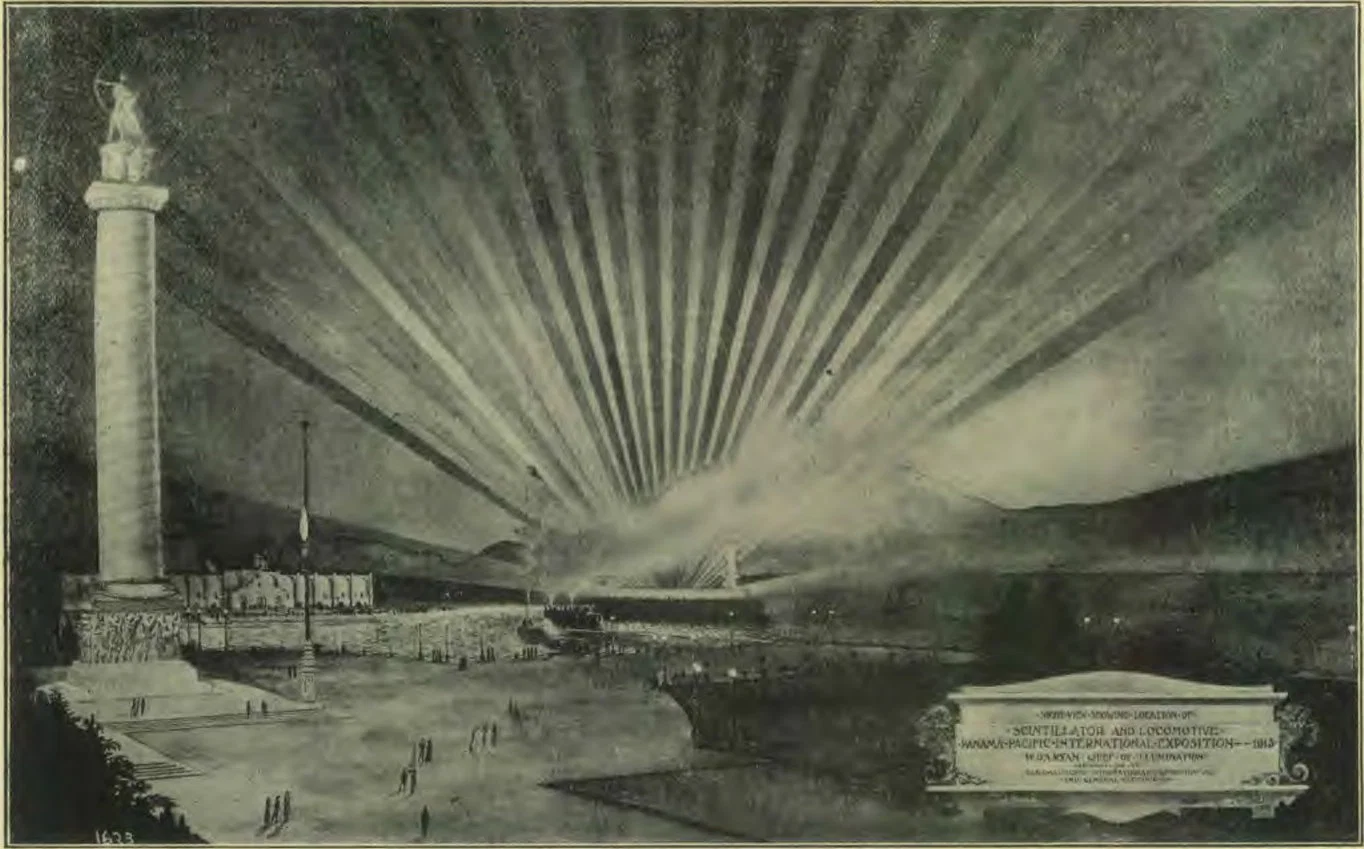
According to the country’s best art critics, the most impressive work of art at the exposition is the exposition itself. “The color scheme, illumination, the architectural unity, and the perfect adaptation of the exposition to its natural setting,” all combine to make it a spectacle of wonderful beauty. The universal verdict is that nowhere else has color and illumination been used to such satisfying effect.
The Canadian Building is perhaps quite generally acknowledged as the most attractive, though the French and the California State Building do not come very far behind it, if at all. California has exploited her resources in novel and attractive ways. Her fruits, nuts, and grains are all made into the most interesting mosaics, covering walls and ceiling. A glass refrigerator show case, with exquisite butter roses, is one of the attractions of the dairy exhibit.
The visitor to the fair from the East is entranced at the lavish display of flowers upon the exposition grounds. There are acres of pansies arranged in generous beds that the Yankee multimillionaire never dreamed of in his most extravagant night visions. In fact, all California is one great flower bed.
The exposition wall is of special interest. It is a living green on both sides. The construction is unusual, as it consists of cement boxes, filled with earth and piled one upon another until a wall eight or ten feet high is secured. The front and back sides of these boxes are missing. After the seed is sown, a strong wire netting is nailed over the box. In a short time the box is filled with a gray-green moss-like plant, which covers both netting and box, so that very soon only a wall of green can be discerned.
VIEW OF AN ELECTRICAL DISPLAY AT THE EXPOSITION
A date palm weighing twenty tons was dug from its growing place and transferred from San Jose to the exposition grounds, where it was replanted in the State horticulture exhibit. Seven men required two weeks in which to remove the large tree from the earth, crate it, and place it on flat cars preparatory for shipment. It is about forty-five years old, stands forty-five feet in height, and measures four feet in diameter. Two cars were used in hauling it a distance of fifty miles, and although difficult to handle, it showed little sign of injury after it had been transplanted.
Despite the unfavorable conditions, the fair has not been left to languish unvisited. The turnstiles registered 516,611 people for the first five days, whereas during the first five days of the Louisiana Purchase Exposition, at St. Louis, the attendance was 431,789,7and the corresponding figure for the Columbian Exposition, at Chicago, was 225,717. The 2,000,000 mark of the present exposition was reached on the thirtieth day after the opening, which greatly surpasses the record of any of the other expositions.
There are over 80,000 individual exhibits, and it is estimated that it would cost $250 for one to see all that the fair offers, and $87.50 to see all that the Zone might show one.
The Underwood Typewriter Company has a unique advertising scheme. First of all, its gigantic fourteen-ton typewriter attracts much attention. The machine cost $100,000. It is manipulated at a distance by a young woman, and “thuds out its bulletins on a giant sheet of paper high overhead.” It is equal to 1,728 ordinary typewriters, being twenty-one feet wide and fifteen feet high. Scattered all around this giant machine on the rest of the floor space are a score or more of small tables or desks, each of which holds a standard Underwood typewriter. These are for free use; hence the small boy is everywhere in evidence. There being no discrimination for age, sex, color, or clothes, the Negro lad and the grimy newsboy, together with young men, old men, and little girls all find delight in the freedom of the Underwood section. Without doubt the company will capture a number of future buyers from this incongruous company of typists now taking their first lessons in manipulating the machine.
The visitor at the Panama-Pacific Exposition can hear the Atlantic waves beat upon the shore at Coney Island by means of a telephone line from New York to San Francisco. An ordinary conversation in New York may be heard very clearly at the telephone company’s pavilion, after traversing the 3,400-mile line.
Mr. Art Smith gives frequent nightly exhibitions of his aviation skill. He now wears “the perilous crown of popularity as a dare-devil aviator.” By his aerial maneuvers he writes in the sky his name, the number 6,000,000, and performs many other equally thrilling feats.
A new phonograph using an Edison diamond disk is on exhibit at the fair. This machine has been so perfected that no trace of the metallic sound that has hitherto accompanied the human voice as it came from even the best phonographs, was discernible.
Mr. Herman Whittaker gives the following interesting description of the exposition during a storm:—
“Already I had seen the exposition bathed in golden sunlight, a fair city of the sun, a walled town of the Orient laved by blue seas, glowing like a rich topaz in its setting of street-crowned hills; and because I had a shrewd suspicion that its beauty was waterproof, not to be washed off like rouge from the face, I wished to see it in the grip of a storm. And surely I did.
My first glimpse from the Fillmore Street hill showed its miles of buildings swept by a fifty-mile gale, towers and domes sheeted in gray rain, flag halyards wildly flapping against swaying poles, the thousands of palms along the avenues and esplanades tossing with the roar and rattle of a tropical jungle in the grip of a typhoon. So strong was the wind that the forty-pound iron tassels, which hold down the great heraldic standards, swung and flapped like their silken prototypes; and it sent me spinning, a reluctant projectile, down the Avenue of Progress past the giant porticoes of Machinery Hall to the ‘Marina,’ where huge combers broke and threw fine spray clean over the top of ‘Morro Castle’ lighthouse into ‘Exposition Harbor.’
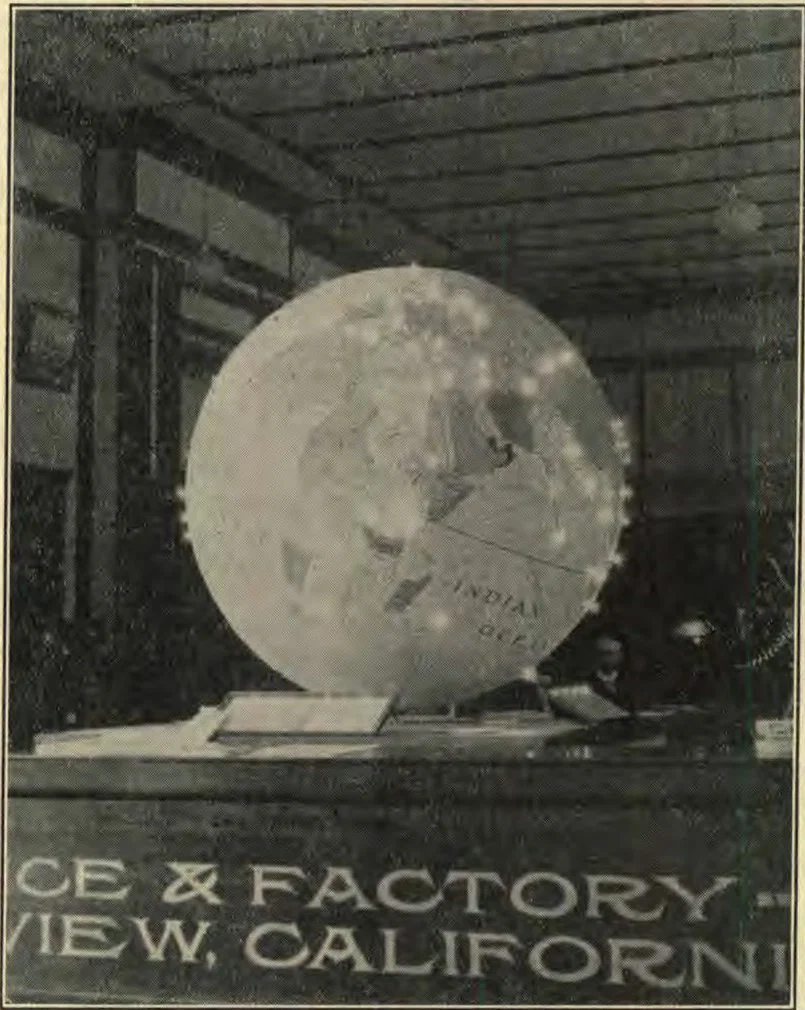
THE GOSPEL-LIGHTED GLOBE
Far out on the yeast of waters a wave would rear its green head, take a look at the exposition, then come rolling in, only to smash on the sea wall and spend itself in a last desperate leap at the rear facade of California Hall; and always its booming was spaced by the brazen complaint of a bell buoy and wild skirling of wheeling gulls.
“It was glorious! The rain that blackened the statuary and stained the long travertine facades with the green hues of time, had brought all to perfect tone and carried it back five thousand years. It was now coeval with the pyramids. Like them, it stood square on its solid bases, defying, and affording shelter from, the storm.”
Hog Island
By N. Z. Town
HOG ISLAND is a small island in the Caribbean Sea, just off the north coast of Spanish Honduras. The name does not suggest that probably all the people on the island are Seventh-day Adventists, but such is the case. The little group who occupy it do not think the name of their island matters much as long as none of the characteristics of the name are seen in the lives of those who live on it.
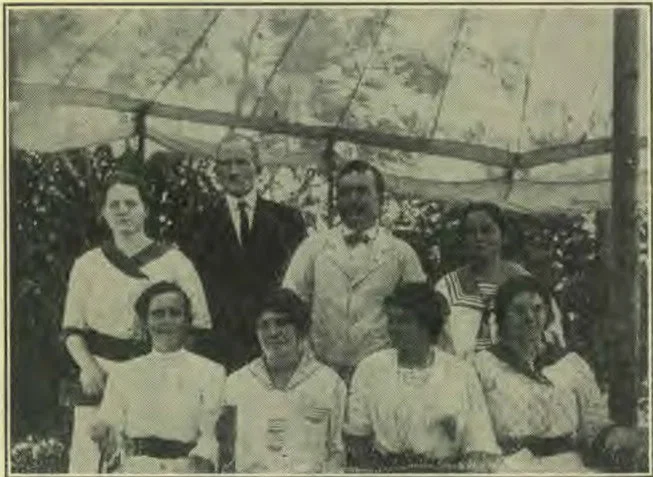
BELIEVERS FROM HOG ISLAND AT THE CAMP MEETING. THE TALL MAN IS MR. WOOD, AND THE OTHER MAN IS MR. ROSS
This island, which is largely covered with coconut palms, is rented from its owner by Brother Bentley Ross, who grows and exports coconuts.
The Sabbath school on Hog Island has a membership of thirteen. Their quota of offerings for 1914, in order to reach the standard set by the conference, was $126.75 American currency. Their actual offerings during the year amounted to $203.51. Their Thirteenth Sabbath Offerings for the year came to $59.25, an average of $1.14 per Sabbath for each of the thirteen members.
When we visited the American consul in La Ceiba, where the Central American camp meeting was held, he told us of visiting a Mr. Wood, one of our members on Hog Island. He said that when sunset Friday night came “there was nothing doing” with Mr. Wood, nor any of the others on the island, until sunset the next night. “If any man needed a ‘hand out,’ he would be able to get it all right; but as far as business is concerned, he might as well hoist sails and return to the mainland. However,” he concluded, “I have great respect for people who live up to their convictions and profession as these people do.”
We thanked God for such a testimony regarding the little group on this island, and for the message that makes just such people as these, no matter where it finds them. N. Z. Town.
Indian Mutiny
A GLIMPSE of a mutiny that occurred in India in the early spring is interestingly referred to in a letter from Mrs. A. G. Daniells. She says: “On our way to Singapore we learned there had been an uprising among the natives in that city, and that there was war. Though somewhat anxious, we were compelled to go on. When we arrived, we found that two days previously an Indian regiment of eight hundred soldiers from India, who were to be shipped to the war the next day, had mutinied and had gone about the place shooting down the European men. When this occurred the business men and European soldiers of the place quickly organized, and before our arrival they had driven out and shot the rebels, so they were not in the center of the city. There was a place called the safe or protected area, and our church was in that area, but our mission was about half a mile over in the war zone. We found our brethren camped in the church, and the sisters, with all the European women and children of the city, had taken for safety to boats lying in the harbor. About the time we arrived, Mrs. Detamore managed to get the authorities to let her come ashore, and under great difficulties she got dinner for us in the church. Then the men took a ride out to the mission home to see how things were. Mr. Daniells found that it was a large, airy place, and had a high stone wall all around the compound, with heavy iron gates; so they decided that it would be comparatively safe to go there. The authorities told them that they might go, but it was at their own risk. After thinking the matter over, we decided to try it, and moved out. We shut the iron gates at night, and slept well, notwithstanding the battle raged without. The people who were awake the latter part of the night could hear the shooting, and the second night it was so near they could hear the commander give orders to his soldiers. We did not hear any of it until the third night, when we were awakened so we could hear, too. We could hear shooting on two sides of the mission building, but we felt no fear, as the wall was about nine feet high, and the rebels were having all they could do with the soldiers without climbing our wall. After the third night we did not hear any more shooting. The rebels had been driven farther out.”
Taking the Conceit Out of Us
THE cutting through of the Panama Canal has suddenly brought us face to face with a brother, instead of one whom we had considered a distant relative. And this brother is bigger, in some physical respects, than ourselves. We could place in Brazil all the United States, excluding Alaska, and have 200,000 square miles margin. Argentina would accommodate in her borders all the States east of the Mississippi and the first tier of States west of that river. And a trip as long as from New York to San Francisco by water would be required to measure the coast line of Chile.
If you were to circle South America, as did the American tourists recently on the “Kroonland,” going through the Canal, down the long bare coasts of Ecuador, Peru, and Chile, through the Strait of Magellan, flanked on either side by glaciers, and then up the eastern coast of Argentina and Brazil, passing the Guianas, Venezuela, and Colombia, you would consume a month in continuous travel. You would go from the heat of the equator to the cold of the world’s southernmost city, Punta Arenas, on the Strait of Magellan.— The Christian Herald.
Do It Fully, Freely
“If you're told to do a thing,
And mean to do it really,
Never let it be by halves;
Do it fully, freely!”
Facts About Pellagra
WHAT IS PELLAGRA? — Pellagra is a disease caused by eating the wrong kind of food. It comes to people who eat food that does not contain the right things to keep a person in good health.
HOW DOES PELLAGRA SHOW ITSELF? — The disease shows itself by certain changes in the skin, by trouble with digestion, and by nervous and mental illness.
WHEN DID PELLAGRA COME TO THIS COUNTRY? — In 1906 or 1907 cases of the disease were recognized in several Southern States. Except for a few isolated cases of the disease, pellagra was not generally known in the United States before that date.
IS IT A COMMON DISEASE? — Yes. Since 1907 cases have been found in almost every State, and the number of cases recognized, especially in some of the Southern States, has been increasing. In Mississippi there were reported to the board of health 8,058 cases of pellagra between Jan. 1, 1914, and Sept. 1, 1914. It is estimated that there are at the present time over 50,000 cases of pellagra in the United States. The greater portion of these are in the Southern States.
IS IT A DEADLY DISEASE? — Yes. In Mississippi, during 1913, 795 persons died of pellagra — more than died of any other disease except tuberculosis, pneumonia, or malaria.
IS IT COMMON IN OTHER COUNTRIES? — In some countries. The disease is quite common in northern and central Italy, Roumania, Egypt, parts of Austria, and to some extent in Spain. It has been found in southeastern Europe, western and southern Asia, the West Indies, and South America. In 1907 there were said to be about 100,000 cases of pellagra in Italy and 50,000 cases in Roumania.
WHAT DO THESE FIGURES SHOW? — These figures give us some idea of where and how the disease occurs, not only in the United States but in other countries, and impress upon us the great importance of the disease. They also show how important it is that every person should know something about pellagra so that he may know how to avoid the disease, and see a doctor if he has it.
WHAT ARE THE CAUSES OF PELLAGRA? — We do not as yet know much about the cause of pellagra, but it seems to be due to the wrong kind of food.
HOW DO WE KNOW THIS? — Studies have been made by experts to learn whether the kind of food eaten had an effect on the number of persons who would get pellagra. It was found that those who became sick with pellagra ate too little fresh meat and beans and peas, and that they ate too large a proportion of the vegetables in which there is much corn and sirup. People who ate a better variety of food, and who ate meat, beans, and peas in larger quantities, did not get the disease.
CAN PELLAGRA BE CAUGHT BY ONE PERSON FROM ANOTHER? — No. Pellagra is not catching.
HOW DO WE KNOW THIS? — Efforts have been made to give the disease to monkeys, which are very much like human beings but not a monkey contracted the disease. The government experts who made these tests are satisfied that pellagra is not contagious (catching), and that there is no need to be afraid of persons who suffer with the disease. It is not necessary to keep the patient away from other people in order to protect the latter. In fact, if we do this, it may do distinct harm to the patient.
WHAT, THEN, DO WE KNOW ABOUT PELLAGRA? — We know, (1) That pellagra is not a catching disease (neither contagious nor infectious), but is caused by not eating enough of the right kind of food,—such as meat, beans, and peas,—and by eating too much wrong food,—cereals, such as corn, sirup, etc.,—and (2) that pellagra does not attack people who eat a mixed, well-balanced, and varied diet.
HOW CAN WE RECOGNIZE PELLAGRA? — Pellagra usually begins with indigestion and diarrhea. This is followed by a redness of the skin like sunburn. Soon afterwards there are more or less severe mental and nervous troubles. Sometimes the first signs are weakness, dizziness, headache, and perhaps slight indigestion.
The disease as a rule begins in the spring of the year. The appetite is bad, the flow of spit increases, the tongue may become bright red, the lining of the mouth is reddened and may be ulcerated. The patient often has diarrhea.
The skin soon becomes affected, generally at the same point on both sides of the body or on the uncovered parts, usually first on the back of the hands and forearms, on the face, back of the neck, chest, and upper side of the feet. At first the skin is red, and there is a sensation of burning and itching, and a slight puffiness. The affected skin at first looks very much like a severe sunburn, for which it has often been mistaken.
WHAT HAPPENS TO THE SKIN? — Although the skin trouble looks like ordinary sunburn, it does not behave like it. It does not disappear so readily, and usually goes through changes which may last many days, if not weeks. Blisters sometimes form, which, on bursting, leave raw surfaces that are painful and slow in healing. The skin trouble causes burning and discomfort, but seldom itches. As a rule, it appears in the spring and fall and disappears in the winter.
If there are repeated attacks of pellagra, the skin may become rough and thickened, or may later waste away and become scarlike. After these early symptoms have appeared, they may increase in severity and extent, and other more serious symptoms develop. The skin trouble, after going through regular changes, slowly heals.
DOES THE HEALING OF THE SKIN MEAN THE END OF THE DISEASE? — No. It has no influence on the cause of the disease or on the condition of the patient. While it is often unsightly and uncomfortable, or even painful, it has very little importance on the final result. The skin trouble often heals nicely, though the patient may die afterwards; or, on the other hand, one may suffer from a very severe skin trouble, yet not have it followed by any serious effects at all.
While the look of the skin is, in the beginning at least, the sign of pellagra most easily recognized, it is really not very important; the effects of the disease usually go much deeper.
WHAT SHOULD BE DONE? — As soon as a person has the symptoms described above, he should see a doctor10at once, in order to learn definitely whether he has pellagra, so that it may be properly treated.
HOW SHOULD PELLAGRA NOT BE TREATED? — Pellagra should not be treated by patent medicines. There is no drug of real value in the treatment of pellagra. This applies especially to the many widely advertised patent or quack medicines usually sold at a high cost to the sufferers from the disease. Do not buy or use any of these advertised preparations. They will do but little good. Many, if not all, of the good effects said to be caused by certain drugs are really due to some other cause — perhaps to a change in food at the same time.
HOW SHOULD PELLAGRA BE TREATED? — (1) By using the right kind of food. Persons with pellagra should eat a large amount of fresh milk, eggs, fresh lean meat, beans, and peas.
The patient should, if an adult, and children, in proportion, take each day not less than a pint and a half to two pints of fresh milk; this may be either sweet milk or buttermilk. Not less than four fresh eggs should be eaten each day, in addition to the milk. The meat should be fresh and as lean as possible. If chewing is painful because the mouth is sore, the meat may be given in the form of meat juice. Sometimes great improvement follows the use of beans and peas (fresh or dried) without any other change of the diet. These may be given in the form of soup or broth, or may be served in any way that suits the taste of the patient.
Do not stop this food, even though the patient has a more or less severe diarrhea. It often happens that the condition of the mouth and the diarrhea improve soon after beginning the milk, eggs, meat, and other articles mentioned.
In case there is only slight or no stomach trouble, the patient may be allowed small amounts of oatmeal, rice, potatoes and other fresh vegetables, and fresh and dried fruits, if they do not prevent the taking of the milk, eggs, meat, beans, and peas.
(2) By rest. Persons with pellagra feel tired, weary, and depressed. They should rest as much as possible. During the active period of the disease the patients should be kept in bed, and the surroundings made as cheerful as possible.
WILL DOING THESE THINGS CURE PELLAGRA? — Many persons will be cured if they follow these rules — eat proper food, drink milk, and rest. Not all cases will be cured by these means or by any others. There will always be a few persons, even in their first attack, who will be beyond the hope of recovery.
HOW CAN PELLAGRA BE AVOIDED? — The prevention of pellagra depends upon eating the right kind of good food. Do not eat too much starchy food, such as corn, oatmeal, or molasses. Eat lean meat, fresh milk, eggs or beans and peas (fresh or dried) each day; better yet, have some of all of these. They will give you the proper varied and balanced diet that you need to avoid getting pellagra.— Metropolitan Life Insurance Company.
Counterfeiting Clover
A MAN from the city riding along a country road breathed the most delicious perfume. He said, “Where does that come from?” Casting his eye to the left of the road, he saw a large field of red clover in full bloom, and the bees taking the sweets for honey. He halted his carriage to drink in the fragrance. Science has found a bean from which an extract is taken whose odor is so nearly like that of sweet clover that it can hardly be distinguished from it, and is used in the market in large quantities as a substitute for it. It is the tonka bean, found on the large forest trees of tropical South America, chiefly in the valleys of the Orinoco, Caura, and Cuchivero Rivers in Venezuela, and certain sections of Colombia and Brazil. The trees grow sometimes sixty feet high, and are three feet in diameter. In Venezuela the trees are called sarrapia, and the men engaged in the collection of the beans are called sarrapieros. These collectors usually set out for the forests in February, when the beans begin to ripen. They go up the rivers in canoes or skiffs by the hundreds, to gather the pods when they fall. The beans are taken from the pods, and after being thoroughly dried, are sent to the exporter, and thus on to the various ports of the world. By a chemical and mechanical process the extract is taken.
— The Christian Herald.
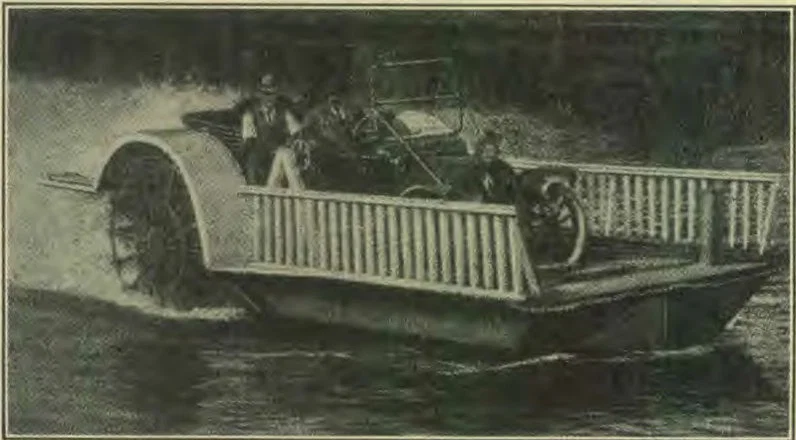
AUTOMOBILE IN PLACE FOR DRIVING BARGE ACROSS A BAY
ON THE PACIFIC COAST
Barge That Is Propelled by Automobile
FOR crossing a bay twenty miles wide connected at each end with a fine driving beach along the seashore, a motorist of Aberdeen, Washington, uses a barge built for less than one hundred dollars, and so equipped that it can be driven by the automobile that it transports across the water. A propeller wheel, which is housed for safety, is located at each side of the barge near the stern. The axle of each wheel is at the right height to come in line with the rear car axle when the end of the car is raised a few inches above the deck of the barge, and is capped with a hardwood wheel, eighteen inches in diameter and two inches thick. On each wheel are leather clamps for securing it to the spokes of the car wheel. With the rear of the car raised so that the wheels are clear of the deck and these wheels connected with the propellers by the straps, the barge is ready for operation by the engine of the automobile. The work of placing the car aboard the barge and making it ready for use requires eight minutes. The barge can easily make eight miles an hour when propelled by a light car, and considerably more than this with a high-power car.—Selected.