The Youth’s Instructor, Vol. 48, No. 18.

BEAUTIES OF SOUTHERN CALIFORNIA

The Youth’s Instructor

May 3, 1900

Review and Herald Publishing Company · Battle Creek, Mich. · May 3, 1900

BEAUTIES OF SOUTHERN CALIFORNIA

III
IN no other country in the world are there more pleasant seaside resorts than those of Southern California. Hemmed in by a chain of islands, many of them very beautiful, few storms disturb the placid waters of this semi-tropic sea; hence surf-bathing is a pastime indulged the year round. The improvements of these places make them more than resorts; they are thriving cities, with large business buildings, pleasant homes, shady streets, and magnificent hostelries.
Thousands of tourists from near and abroad leave their inland homes during the summer months, and hail with delight the beaches, where they can revel in the ocean breeze and the pleasures of a life by the sea. Rowing, riding, yachting, driving, bathing, and fishing are a few of the pastimes that make every day at the beach worth double that time at home. Everything about one speaks in playful tones. The curling surf entices the onlooker to bathe; the frolicsome old ocean says, “Swim;” the glistening bay, dotted with its white-winged boats, invites one to fly; the warm sun shining on the white sand beneath the feet whispers, in solemn tones, “I remember the days of old; I meditate on all thy works; I muse on the works of thy hands,” thus persuading the thoughtful to bask in its beams for a while, and give themselves up to meditation.
There are seven seaside resorts within easy access from Los Angeles. On a hot summer’s day one can leave the sultry city, and in an hour’s time be enjoying the cooling, gentle breezes of the great Pacific.
Santa Monica has long been known as the “Queen of the Surf.” It has a population of four thousand persons, which is largely increased during the summer. This beautiful seaside town is eighteen miles from Los Angeles, and sits upon a high mesa overlooking the ocean. The romantic cañons in the contiguous mountains, the North Beach Bath House, the great Hotel Arcadia, the magnificent eucalyptus groves and broad streets, attract many a lover of the beautiful. Following the Southern Pacific to the north end of town, and thence out into the ocean, on a pier almost a mile long, we reach the end of the famous Port Los Angeles. Here we find immense coal bunkers, into which the great coal-carrying ships empty themselves; a commodious waiting station; and a restaurant that would satisfy the appetite of an epicure.
It is useless to attempt to catalogue the attractions of Long Beach. It possesses nearly all those already mentioned, and is made the summer home of many seeking for environment moral, educational, and delightful. This is the annual meeting-place of the California Chautauquans, and a favorite spot for summer camp-meetings.
A few miles from Long Beach is San Pedro, at present a place of great activity. The government has decided to expend a million and a half dollars in creating here a free harbor, in order to give first-class “open doors” to the commerce of the whole world.
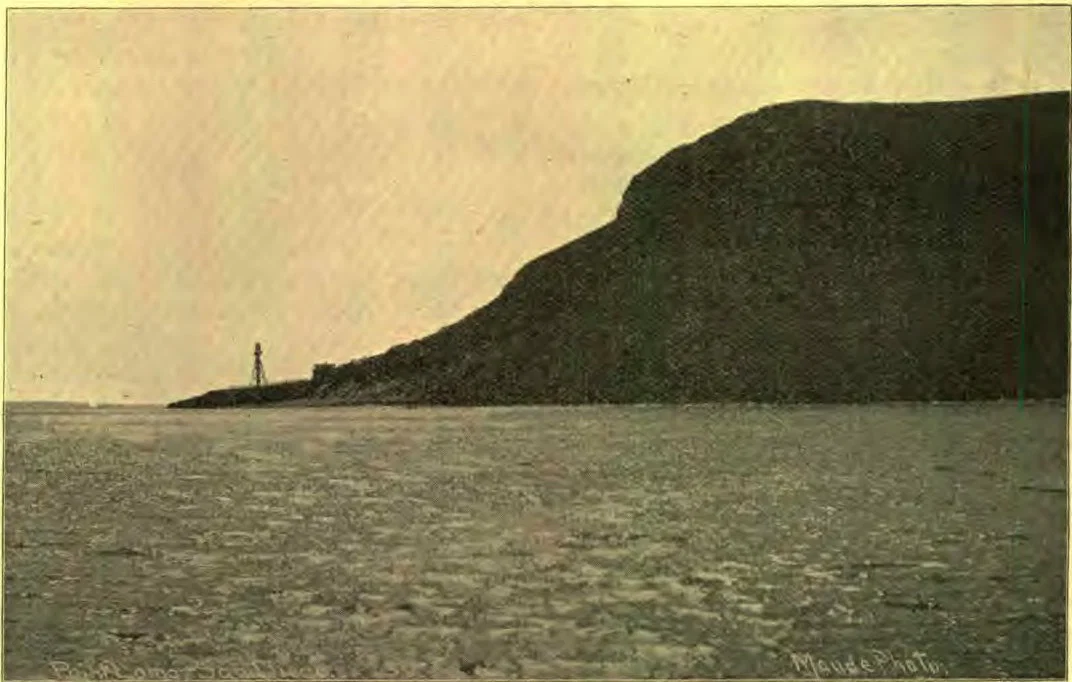
POINT LOMA, SAN DIEGO
In the southwestern corner of the United States, within a short distance from the Mexican boundary line, is a low-lying peninsula, which fronts the city of San Diego on one side and the ocean on the other; this is known as Coronado Beach. It is regarded as the finest, and is proved to be the favorite, watering-place of the Pacific Coast. Tourists flock here because of the equable climate, the resort hotel, the abundance of sunshine, and the myriads of flowers. All these attractions are supplemented by a variety of pleasant diversions. The entire beach has been made a beautiful park by the expenditure of large sums of money under the direction of expert landscape-gardeners. Here is situated the mammoth Hotel del Coronado, the largest resort hotel in the world.
Just above San Diego Bay, and serving as a mighty arm to shield it from approaching waves and winds, is a narrow neck of land stretching away out into the ocean. This is known as Point Loma. Many an angry billow has been held in check by its mighty force. Though worn by the dashing of waves upon its shores from prehistoric times, it still stands—a majestic, silent witness of the changes of the ages. Upon its heights is situated the government lighthouse, which has stood for many years to welcome incoming vessels, and guard against the approach of intruders.
MRS. KATHLEEN WAGNER-GILMORE.

ANIMAL LIFE IN THE SOCIETY ISLANDS

THERE is not a large variety of animals in these islands. In some of them horses and cattle are unknown, though in others they are quite common. The hog is found everywhere, and has been here ever since the days of heathenism. There are many wild hogs in the mountains. The woods abound in wild chickens, cats, and rats, and there are a few goats; but there are no savage beasts to fear.
Perhaps the most dreaded animal is the centipede, which, however, is not so large as the centipede of South America; and whose bite, though painful, does not prove fatal, or even serious. In fact, the effect is much the same as that following the sting of a wasp. I have been bitten once, but was asleep at the time, so did not know of it till after the reptile had crawled away. The sensation of having such a thing crawling on the body would be worse to me than the bite itself.
Wasps have emigrated to the islands, and seem to like the climate; for they are here in great numbers. They build homes, which, as elsewhere, they defend vigorously against intruders. The natives have as great a dread of the wasp as we entertain for the centipede.
A species of small scorpions is found here, but we are seldom troubled by them. I was once stung by a young scorpion, and the effect was no worse than that of the bite of a common red ant; but of course the sting of an old one would prove worse.
Lizards are much at home in such a climate as this; and though they are continually preyed upon by cats, cranes, and chickens, there are still myriads of them. There are two distinct species,—one small, with smooth skin of a bronze and striped or else a slate color, and another larger kind with a rough skin resembling that of a toad. They make their homes anywhere, outdoors or indoors; we often find their eggs on a shelf or in the corner of a box, where they have been left to hatch. They do not make nests, nor care for their eggs, as birds do. The baby lizard is left to hatch out all by himself, and has to care for himself from the very first. I have often seen a very tiny young lizard on the window-pane, trying to catch insects for his breakfast. At first the little creatures are so weak and helpless they can not run very fast, but they grow strong rapidly, and are soon able to make exceedingly lively motions, and to get out of sight almost before one can catch so much as a glimpse of them.
Their food is composed partly of insects, the smaller varieties of which they appear to catch with the tongue. They devour roaches, grasshoppers, and crickets; and we have been told that the large lizards kill centipedes. They also eat fruit—often we find holes in our bananas where they have been making a meal. Of course lizards bear scant resemblance to birds; but they add to our pleasure, and we enjoy seeing them dart here and there among the shrubbery.
There are no toads nor frogs here, though frogs were once brought to Tahiti from France. The Tahitians thought they resembled the lizard, so they called them “moo Farani,” which means “French lizard.” The native Bible gives another name for frog, but it is seldom used. There are no snakes in the islands, but plenty of eels—their relatives that live in the water. In speaking of the snake, the natives generally call it “puhi fenua,” or “land eel.” In salt water eels grow to great size; and it is not uncommon for the native fishermen to have the fingers, or a part of the hand, bitten off by these creatures. I have never heard of a person being bitten by fresh-water eels, though they catch and eat young ducks as they swim about in the water, and often bite off a duck’s foot.
All the islands are overrun with rats. These rats can climb trees about as easily as a squirrel. They will gnaw a hole in a cocoanut and eat out the meat while it is yet on the tree; oranges, mangoes, and bananas are likewise eaten on the tree. The rats also eat birds and young chickens, dig up and eat sweet potatoes, and help themselves to watermelon. They themselves do not seem to be used as food by any other animal here except the cat, and even cats prefer lizards. I have heard of several Frenchmen who use the rat as food, and consider it quite a delicacy, but have never heard of the natives eating it, though they eat dog flesh, diseased animals, and almost every abominable thing that can be found in the sea.
MRS. B. J. CADY.

THE STUDENT’S PRIVILEGES AND RESPONSIBILITIES

I
A GREAT responsibility rests upon the youth who have the privileges of school life. They are given many precious opportunities. The word of God is opened before them day after day. They have the privilege of listening to the message that God sends, and of knowing what he requires of every human being. The youth who come to school determined to obtain instruction that will fit them for the higher grade, will have ministering angels to attend them at every step. The still, small voice will speak to them, saying, “This is the way; walk ye in it.”
We read in the Word, “We are laborers together with God.” If you could only realize that the God of heaven takes those who have been rebels against his government, and says to them, You may be laborers together with me, you would this day consecrate yourselves wholly to him. You may be in living connection with Jesus. You may be channels of light. Is it not wonderful that we can receive the rich current of grace from the Deity, and work in harmony with him? What does the Deity want with us—poor, weak, and feeble as we are? What can he do with us?—Everything, if we are willing to surrender all.
When God called me in my very childhood to work for him, I used to think, What can I do? God says, Do my bidding. This is all that any of us need do. I want to tell you what each of you, from the oldest to the youngest, can do: You can co-operate with God, with your teachers, and with one another. Are you prepared to co-operate with those who carry heavy burdens? If so, you will not drift along from day to day, just where your inclination leads you. You will not study how to please yourself. You will realize that you are responsible for the influence you exert.
At the very beginning of the school term it is your privilege to understand the meaning of the words, “We are laborers together with God; ye are God’s husbandry.” Think of it! He is seeking to work the mind, just as you work the land. He is trying to sow seed that will bear fruit to his glory. “Ye are God’s building.” But he does not build without any care for you. He says to each one: “Come unto me. . . Take my yoke upon you, and learn of me; for I am meek and lowly in heart: and ye shall find rest unto your souls. For my yoke is easy, and my burden is light.” Where do we find rest?—In meekness and lowliness. In submitting to God, as a dutiful child submits to his father.
The success of the school depends upon the consecration and sanctification of the students, upon the holy influence they feel bound under God to exert. There are your teachers. Instead of complaining of them for being strict, come into line with them. Let your teachers understand that you are working on their side. Draw with Christ. Take his yoke upon you, and learn of him, the meek and lowly One. You will never need to complain of your teachers’ strictness if you will keep faithful watch over yourselves, guarding jealously the citadel of the heart. Ever remember the words: “What? know ye not that your body is the temple of the Holy Ghost which is in you, which ye have of God, and ye are not your own? For ye are bought with a price: therefore glorify God in your body, and in your spirit, which are God’s.” God longs to work in you, to will and to do of his good pleasure. Are you willing to submit to his working? The good we may accomplish by thus uniting with our Saviour we shall never know till, as overcomers, we enter the city of God. MRS. E. G. WHITE.

SATISFIED

WHAT a world of meaning in the word “satisfied”! How few know by experience what it expresses. “To leave nothing to be desired,” is one of the definitions of “to satisfy.” At first thought some young mind may say, “This can never be: I can never reach the place where I shall be perfectly satisfied.”
Outside of Jesus, satisfaction can never be attained, but in him this exalted condition may be reached. The pleasures of the world never satisfy. Young man, young woman, turn not into this worldly path, expecting to be satisfied. Satisfaction will never come that way. Turn to God, who is abundantly able to fill your soul with such a blessed fullness of his love, goodness, and power that the fleeting vanities and pleasures of earth will present no enticement.
Every longing of the soul is but a call to come to Jesus. Do not distrust him by thinking he can not understand, and will not satisfy, your need. He will. His answer to your prayer may come in a different way from what you expect. It may be that your desire, as you talk with him, will be replaced by his truer and better wish for you; but if you are in earnest, your soul longing will be satisfied in him. “Thou openest thine hand, and satisfiest the desire of every living thing.” Ps. 145:16. “For he satisfieth the longing soul.” Ps. 107:9. “And my people shall be satisfied with my goodness, saith the Lord.” Jer. 31:14.
You see the promise is satisfaction in God, in his goodness, his love, his pleasures; not outside, in the world. This is shown clearly in Isa. 55:2: “Wherefore do ye spend money [or time, or strength] for that which is not bread? and your labor for that which satisfieth not? hearken diligently unto me, and eat ye that which is good, and let your soul delight itself in fatness.” If you were in a storehouse of good provisions, with the privilege of using all you desired, you would not expect to go hungry. If you were at a fountain of pure water, you would not long for the water of the brook of the valley. So if Christ is “within you,” you have in him the “fullness” of all things; and therefore wherever you are, alone or in the crowd, you are satisfied.
If you are carried away with a strong desire to be at every gathering, to spend your evenings with foolish young persons in idle chit-chat and cheap amusements, remember that you have not the hidden Christ within. “Be not deceived; God is not mocked: for whatsoever a man soweth, that shall he also reap.”
Young servant of Christ, God needs you. There are loving deeds to be done, hopeful words to be spoken to the sick and sorrowing. Why not let him use you? In thus doing, you shall be eternally satisfied. T. E. BOWEN.

THE COST OF IT

WHAT does it cost, this garniture of death? It costs the life that God alone can give; It costs dull silence where was music's breath; It costs dead joy, that foolish pride may live. Ah, life and joy and song, depend upon it, Are costly trimmings for a woman's bonnet!
— May Riley Smith.

A PICTURE

I crossed the winding country road Before the orb of day Appeared to cheer the fresh spring morn, And drive its chill away.
The tree trunks rose in straight, brown lines Against a peach-blow sky; And on a slender topmost bough A bird swayed silently.
Just where the quiet lane curved round To enter the dim wood, Amid the tangled undergrowth, A country laddie stood.
The child, the wood, the rosy sky, The peace of dawn's sweet hush— A picture rare—a masterpiece Fresh from the Master's brush!
MINNIE ROSILLA STEVENS.

9 — Trillium

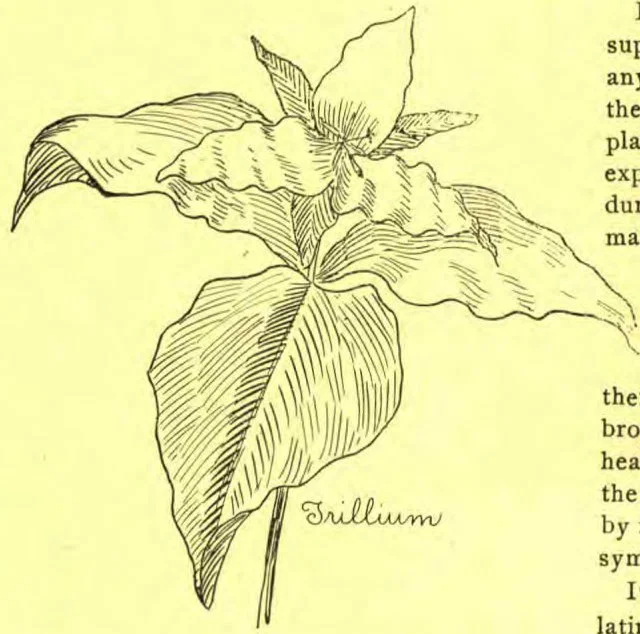
THERE are several species of the Trillium, but all have the same general appearance. The plant as well as the flower is built on the plan of threes; hence its name. There are three leaves on the stalk, forming a whorl, and in a number of the species the leaves are triple-veined. There is but one flower at the end of the flower-stalk, or, as botanists state it, the flower is terminal, solitary. The perianth, or floral envelope, consists of three green sepals and three petals. The color of the flower is usually white, sometimes marked with pink or crimson.
The largest and finest of the Trilliums is the Large White Trillium, or Trillium grandiflorum. It is of a beautiful waxy white, inclined toward pink as it grows older. It is almost invariably found in the woods. The leaves are quite broad.
The Painted Trillium is not so large as the preceding. The edges of the petals are very wavy, and there is a V-shaped crimson patch of color at the center of the flower. Schuyler Matthews recommends a study of this patch under the microscope.
The Trillium erectum is of a dull madder-red color. The leaves of this Trillium are netted-veined, while the two preceding are triple-veined. The Trilliums are poisonous to the taste. In all three there are six stamens, and one pistil with three divisions; thus we see that the plant rigidly adheres to the plan of threes—three leaves, three sepals, three petals, six (twice three) stamens, and a pistil with three divisions.

10 — Spring Beauty

One would hardly suppose that the little pink spring beauty is a kind of pusley, but so it is. The flowers are white or pink, veined with a deeper shade. The flower-stalk, bearing several blossoms grows from between two broad, grass-like, thick, dark-green leaves. The flower has five petals, two sepals, five stamens, and one pistil with a three-lobed style. If you will examine a rose, cherry, or plum blossom, you will notice that there are five petals and five sepals. But the spring beauty departs from this plan by having but two sepals back of its five petals. The flower closes in cloudy weather, and when it is picked; but in the latter case it will revive if placed in a tumbler of water, and set in the sunshine. L. A. REED.

DESTRUCTION OF THE EARTH BY FIRE

IN our study of the flood we learned that before bringing that great destruction upon the earth, God gave a warning to the inhabitants of the world through his servant Noah. The second destruction of the earth, by fire instead of water, is spoken of by the apostle Peter. After speaking of the flood, he says: “But the heavens and the earth, which are now, by the same word are kept in store, reserved unto fire against the day of judgment and perdition of ungodly men.” Then he goes on to tell how great this destruction will be: “The heavens shall pass away with a great noise, and the elements shall melt with fervent heat, the earth also and the works that are therein shall be burned up.” After speaking of the intensity of the heat that will melt the earth, he gives this exhortation: “Seeing then that all these things shall be dissolved, what manner of persons ought ye to be in all holy conversation and godliness, looking for and hasting unto the coming of the day of God, wherein the heavens being on fire shall be dissolved, and the elements shall melt with fervent heat?”
From these words we can see that the destruction by fire will be much greater than that caused by the flood; and certainly if the Lord saw fit to warn the people of the destruction that came by water, much more will he warn men of the great final destruction, which is to be brought about by fire so intense that the very earth will become a molten mass, and the elements in the earth will be dissolved.
Where do we find the warning with reference to the destruction of the earth, and all that is in it, by fire? Read Rev. 14:6-12. In these verses are brought to view the three messages that God is giving to the world just before the earth shall be destroyed. The third angel’s message, verses 9-12, speaks about those who do not heed it as having their part in the lake of fire and brimstone.
The people of God, just before the earth is destroyed, will pass through the time of trouble mentioned in Dan. 12:1; but Michael, who is Christ, will deliver his people. During the time of trouble will be poured out the seven last plagues, spoken of in Revelation 16. The whole creation, with the exception of the “little flock,” who have made the Lord their refuge, will suffer from these plagues. The ninety-first psalm tells us how those who have heeded the warning given in the third angel’s message will be delivered from the destruction of the seven last plagues.
After the plagues are poured out, Christ will come, and take his people to himself. They will reign with Christ a thousand years. At the end of that time they will come to the earth with the new Jerusalem. The wicked will then be raised, and Satan will cause them to believe that they can go up, take the city, and thus overcome the people of God. While they are surrounding the city, and endeavoring to capture it, fire will come down out of heaven and devour them. This fire will melt the earth, and so purify it that no vestige of sin or sinners will remain. Although Peter describes the terrible destruction that will be brought upon the earth by fire, he gives these encouraging words of hope and cheer: “Nevertheless we, according to his promise, look for new heavens and a new earth, wherein dwelleth righteousness.” Our next and last study will be with reference to the new heavens and new earth that the Lord has promised to give to his faithful children. M. E. CADY.

A LILY'S MESSAGE

Beautiful Easter lily, Stately as queen of old, Whence is thy fragrant whiteness, Thy charm of grace and mold?
Fair as the wings of angels, Pure as the heart of a child, Hast thou a message holy For earth, sin-driven and wild?
Softly the lily petals Stirred with a whisper low: “Upward, in silent patience Out of the mold I grow.
“Down in the earthy darkness Wove I my robe of white, Out in the night-storm's wildness Won I my strength and light.
“Weary thou not of struggle, Grow with the fleeting years; Souls are made strong by conflict, White by the dew of tears.”
— Selected.

THE PEBBLES' LESSON

How smooth the sea-beach pebbles are! But, do you know, The ocean worked a hundred years To make them so?
And once I saw a little girl Sit down and cry Because she couldn't cure a fault, With one small ‘try’!
— Selected.

ONE SECRET OF HAPPINESS

I know of a womanly girl who, left as the support of three younger sisters, never made any important decisions without consulting these children. If there was a journey to be planned, they helped plan its pleasures and expenses; if any deprivation was to be endured, they each offered some suggestion for making the deprivation easy. By taking careful consideration of their views, this older sister gained a trust from them which was a recompense in itself; and later, when the three little sisters grew older, their judgment, trained as it was to justice and broad-mindedness, was of real help; and the heavy responsibilities that so often weigh down the lives of older sisters were shared equally by four, and were made lighter by the loving sympathy of their sharing.
It is a point of nice balance not to be vacillating and yet not be too positive; and a girl may acquire this balance only by generosity of thought toward others, and a broad-minded willingness to see all sides of the question. There is, perhaps, nothing which so helps to cultivate judgment in a girl who is willing to learn as the opening up of responsibilities, the coming of emergencies.—Ladies’ Home Journal.

THE PET MOCKING BIRD

“No, my dear Mary, I can not accept the birds. I had not the courage to tell you so yesterday. You looked so tired and worn from your journey that I was afraid you would not understand me.”
“Do you not like birds?” asked Mary.
“I love them dearly,” answered Mrs. Roberts. I do not refuse your gift because I do not like birds,—but perhaps you will understand me better if I tell you of an experience that I had with a beautiful mocking bird some time ago. Sit down, and I will tell you about it. I admired my pet very much,” she continued, “and bought for him an expensive cage. I loved to sit and watch him in his new home. I had heard that these birds are the most wonderful of all songsters, and that they have the power of imitating the notes of other birds, and the cries of animals, with astonishing exactness. I watched my pet daily to see if this was true. He had a melodious voice. The thrilling strains poured forth without effort from his little throat. But oh, such sadness, it seemed to me, was in that voice! Especially was this noticeable when he sang in the late afternoon.
“One day as I lay on the lounge listening to his song, it seemed to me his notes were more sad than usual. My heart ached, but I tried to content myself by saying: ‘He has nothing to mourn over. Do I not feed him daily? He has a beautiful cage, and can sit in the sunlight all day.’ Although I tried to put those mournful strains from me, I felt there was a reason for this sadness, after all. My pet was a prisoner. What had he done that he should be shut cruelly behind prison wires, and have his bread and water dealt out to him, like some wicked person?
“My poor birdie continued his mournful lay; and I, being very weary, soon wandered off to the land of dreams. As I slept, I thought these were the words of his song:—
“I remember a home left behind, and a father and mother dear. How sad they are to-night, with one far away, taken by cruel hands they know not where. And oh, my young mate that I was learning to love! why did they take me from her? It seems as if my heart would break. Why should I have to leave the dear old home, even though it was poor compared with this gilded mansion? It was the dearest place on earth to me— dear, and sweet, and beautiful, and free!
“I see again the brook, the pretty, sparkling brook, where with my loved ones I enjoyed my morning dip. How we did splash the crystal waters with our wings and tails! And the old waterfall below us—how sweet its melody! Oh to dance to those falling waters again! Well do I remember how I, with my brother, used at night to warble some beautiful strain that seemed to be bursting from our young hearts. Sometimes we imitated the robin, the redbird, and the oriole; and sometimes, in fun, we would sound forth the dismal grunt of the old bullfrog. So perfect was the imitation that the little frogs would waken, and utter their croaking cries in response.
“How content my gentle mistress looks! I wonder how she would like to be taken away from her home, and everything that she loves, and shut up in a pretty room, to sing for her owner?”
“Of course it was only a dream, but it touched my heart. I thought of the home of my childhood, and I resolved then and there to release my pretty mocking bird.
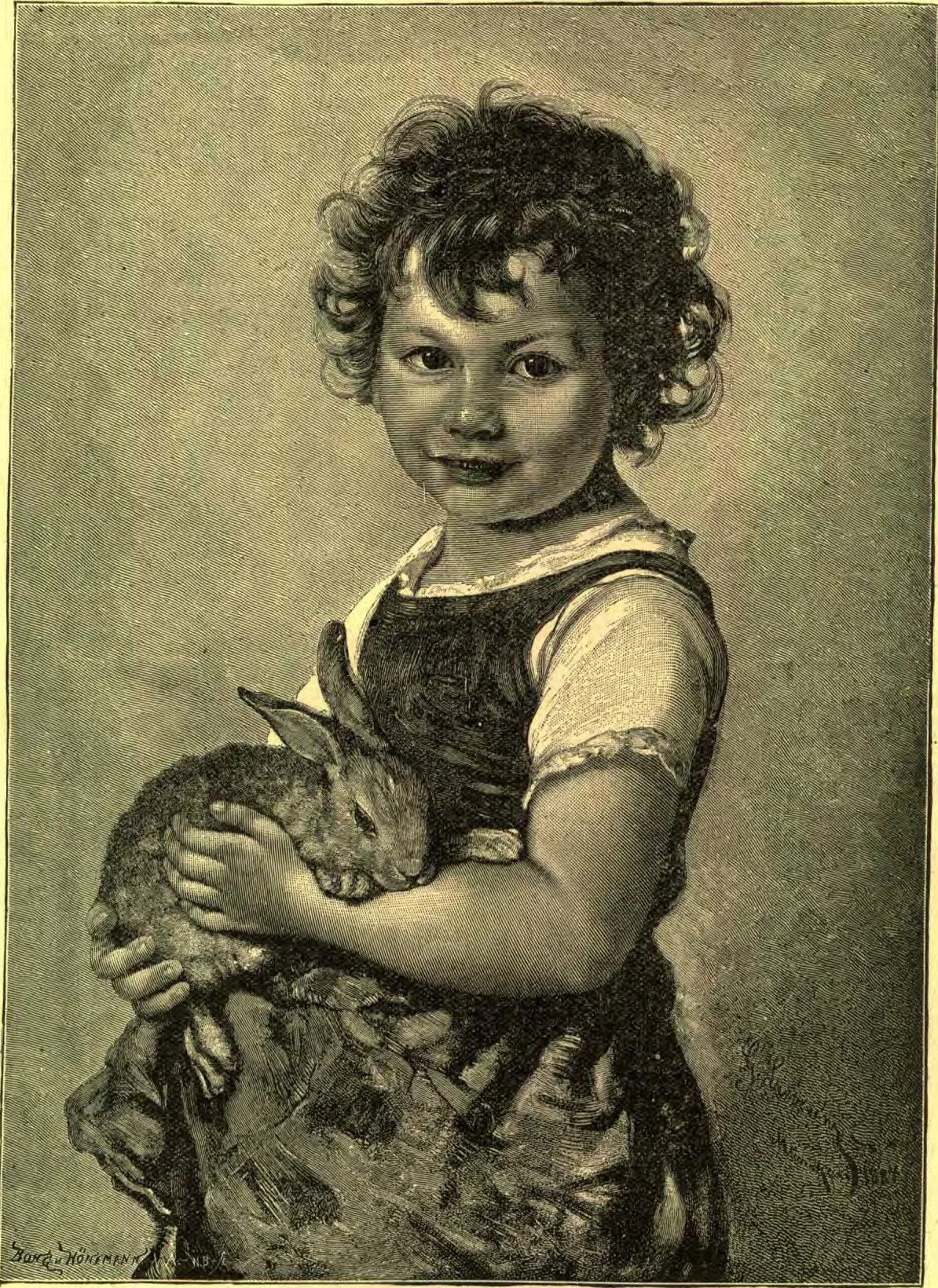
THE PET RABBIT
THE PET RABBIT
“The next day, bright and early, I took my cage with its lonely mourner, and soon was comfortably seated in a car flying southward to Old Mexico. It was here, only a few weeks before, that my brother had given me my pet. In the afternoon of the second day I found myself again in the ‘land of the mocking bird.’ With my brother I went to the old tree where he had captured our little prisoner, and opened the door of his cage. He put out his small head, and looked carefully around, as if to say, ‘Is it possible that I can fly if I will?’ In a moment away he flew, into a branch of the old tree.
“We stood and watched him. Such a beautiful song, free from all sadness, as broke forth from his throat! I stood amazed, and said, ‘Can this song come from the heart of my sad bird?’ But he was no longer sad. In a few moments bird friends were once more around him. How happy they all were! The woods fairly resounded with their rich songs.
“I said to my brother then, ‘Never will I take from its home a poor, innocent bird, that God made to have its freedom in the open air, to soar in the sky, and flit from tree to tree.’”
L. M. DROLL.

TRIMMING AND MOUNTING

My favorite mounts are plain cardboard of some dark color, such as steel-gray or dark mode. Embossed mounts are very pretty when the picture fits them, but it is often difficult to get an embossed mount to fit a picture without having it made to order. Of course it is easy enough to make the picture fit the mount; and when an embossed mount is used, one is often tempted to trim the print down to fit it. This I regard the strongest point in favor of the plain cardboard.
The mount should be considerably larger than the photograph. For five-by-seven-inch pictures, or any smaller size, there should be a margin of at least one inch all around the print. A five-by-seven-inch picture would thus require a seven-by-nine-inch mount. If the print is larger than this, it should have more margin; but this is a matter that must be regulated by individual taste. If a print has been trimmed down much below the usual size, it may still be mounted on the regular size of card, and will simply have a wider margin.
I prefer to trim my prints before toning them; but if you are undecided as to how they should be trimmed, it may be well to tone them first, and dry them unmounted. They may then be exposed to the light indefinitely, and will bear much rougher handling than before they are toned. Never try to trim prints while they are wet. If you do, you will be sure to get ragged edges. You can buy a trimming-knife for three or four dollars; but a pane of glass, an old penknife, and an iron straightedge, or even a common wooden ruler, will do just as well.
Lay the print, face up, on the glass, and place the ruler along the line where you wish to cut. Then with a firm, even pressure draw the knife quickly along the edge of the ruler, and the paper will be cut as smoothly and evenly as any trimming-machine could cut it.
Do not think that what you trim off your print is wasted. Very often a rather poor photograph may be turned into an excellent picture by a little judicious trimming. Often there is too much empty foreground, or too great an expanse of clear sky, or an unsightly object at one end of the print. These should be fearlessly cut away until everything that can be spared from the picture without detracting from its artistic merit has been removed. I have one six-and-one-half-by-eight-and-one-half-inch negative that gives me a print, when properly trimmed, measuring only one and three fourths by six inches. I regard it one of my best negatives; but if it should be printed full size, the picture would not be worth a card to mount it on.
If the prints have been dried, they must be soaked in water a few minutes before you undertake to mount them. Take them from the water one at a time, and pile them, face downward, on a piece of glass, oilcloth, or even common wrapping-paper. Do not try to place them evenly, or you will have a hard time to separate them again. When they are piled up without special care, they will usually be quite uneven, and then there will be no difficulty in picking them up separately. Press out as much of the water as possible from the pile of prints, and wipe it up with a blotter or towel.
Almost any kind of adhesive paste may be used in mounting. The one most common is made by adding cornstarch or white flour, braided smooth in a little cold water, to boiling water. It is difficult to give the exact proportion of starch and water, but sufficient starch should be used to make the paste about the consistency of thick cream. When it gets cold, it will be much more firm. It is better to have it too thick than too thin, as it can be reduced to the desired consistency by the addition of a little water. This paste may be spread with a cloth; but a regular paste-brush will cost only ten or fifteen cents.
Spread the paste smoothly and evenly over the entire back of the print. Do not use too much, or when you roll down the print, it will be pressed out at the edges on the margin of the mount. If any hairs from the paste-brush, or any other particles of foreign matter, adhere to the print after the paste has been spread, they may be removed with the point of a knife. Slip the knife point under one corner of the print, and lift it up until you can get hold of it with the thumb and forefinger of the free hand. It may then be lifted from the pile, and placed in the proper position on the mount. Cover the print with a blotter or three or four thicknesses of soft cloth, and roll down with a print-roller. You can buy a fairly good print-roller for a dollar; but an ordinary rolling-pin will answer the purpose much better, and if you can't borrow one from the pantry, you can buy one for ten cents. If there is any paste on the face of the print or mount, it may be wiped off with a damp cloth or sponge. Then the picture may be left, face up, to dry, while you proceed to mount the next one.
J. Edgar Ross.

VICTORY

When you are forgotten, or neglected, or purposely set at naught, and you smile inwardly, glorying in the insult or the oversight, —that is victory.
When your good is evil spoken of; when your wishes are crossed, your tastes offended, your advice disregarded, your opinions ridiculed; and you take it all in patient, loving silence, —that is victory.
When you are content with any food, any raiment, any climate, any society, any solitude, any interruption, —that is victory.
When you can bear with any discord, any annoyance, any irregularity or unpunctuality (of which you are not the cause), —that is victory.
When you can stand face to face with folly, extravagance, spiritual insensibility, contradiction of sinners, persecution, and endure it all as Jesus endured it, —that is victory.
When you never care to refer to yourself in conversation, nor to record your good works, nor to seek after commendation,—when you can truly “love to be unknown,” —that is victory. S. H. BOLTON.
Continue reading: A LITTLE LAD OF GALILEE