The Youth’s Instructor, Vol. 27, No. 29.

CLEOPATRA'S NEEDLE

The Youth’s Instructor

Jul 1879

S. D. A. Publishing Association · Battle Creek, Mich. · Jul 1879

CLEOPATRA'S NEEDLE.
The obelisks were among the earliest public works of the Egyptians, having been erected between the years 2000 and 525 B. C. The purpose and origin of these wonders of human skill is still shrouded in mystery. They are thought by some to have been connected with the worship of the sun; others claim that they were employed as sun-dials; but later research seems to prove that they were erected as monuments, partly religious, partly historical, and to some extent ornamental.
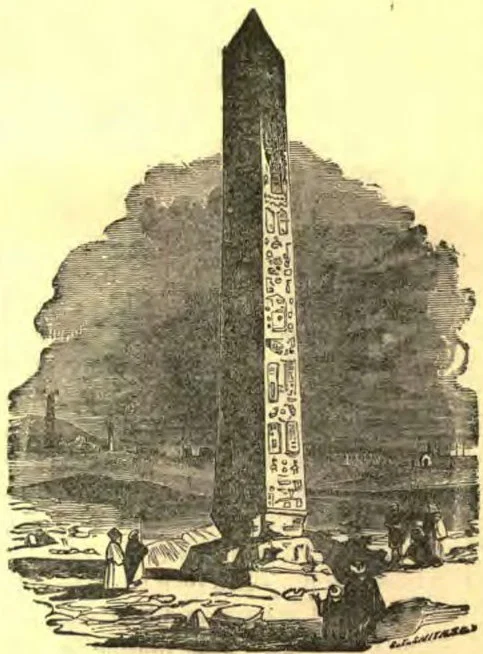
Our engraving represents one of the two giant pillars known as Cleopatra's Needles. These columns consist each of a single stone of rose-colored granite seventy feet high and nearly eight feet in diameter at the base. They were cut from the quarry of Syene, in Southern Egypt, and placed side by side before the temple of the Setting Sun, in the ancient city of On.
From this place they were transported, in the days of Cleopatra, to the temple of Cæsar, in Alexandria. The modern name, Cleopatra's Needle, was given to one of them in memory of this transfer. The other was known as Pompey's Pillar, but it has long been a disputed question which is which, and the former name is now applied alike to both.
One of these giants, “towering to the skies,” has stood in its place unmoved for twenty centuries; the other was thrown down—how or when is unknown—and for hundreds of years lay buried in the sand. It is this fallen pillar which has been the object of especial interest of late, and of which we wish to speak further here.
If you look at the picture, you will see that the sides of the obelisk are covered with what, to our eyes, appear like birds, animals, and strange marks. These figures are a kind of hieroglyphics, or picture-writing, which people of modern times could not read till about seventy-five years ago, when a French scholar studied out their meaning.
From these inscriptions we learn that the obelisk was erected, before the time of Moses, by the order of King Thothmes III., a powerful monarch and conqueror. The same record also states that the shaft was once capped with gold, but of course it has been stripped of that ornamental portion. Other inscriptions afterward added by Rameses II., preserve the memory of his conquests.
In 1819 the fallen obelisk was presented to the British government by Mehemet Ali, the pasha of Egypt. But the cost of moving it to England was so great that the project was abandoned. A few years ago, however, a wealthy gentleman offered to give a large sum toward meeting the expense of its removal. His generous offer was accepted, and a ship about two hundred feet long and thirty feet in diameter was soon after built for this grand enterprise.
This ship, or boat, was towed by a steamer, but in a violent storm the cable connecting the two was broken, and for a time the obelisk was given up for lost. It was finally recovered, however, and after many delays the ship with its precious burden arrived safely in England, and the obelisk was erected in the Thames Embankment, a beautiful park near the Parliament House in London.
M. A.

Truth Is Immortal

TRUTH is immortal; the sword cannot pierce it, fire cannot consume it, prisons cannot incarcerate it, famine cannot starve it.

THE CHILDREN.

WHEN the lessons and tasks are all ended, And the school for the day is dismissed, And the little ones gather around me, To bid me good-night and be kissed, Oh, the little white arms that encircle My neck in a tender embrace! Oh, the smiles that are halos of Heaven, Shedding sunshine of love on my face!
And when they are gone I sit dreaming Of my childhood too lovely to last; Of love that my heart will remember When it wakes to the pulse of the past, Ere the world and its wickedness made me A partner of sorrow and sin; When the glory of God was about me, And the glory of gladness within.
I ask not a life for the dear ones, All radiant, as others have done, But that life may have just enough shadow To temper the glare of the sun. I would pray God to guard them from evil, But my prayer would bound back to myself; Ah, a seraph may pray for a sinner, But a sinner must pray for himself.
The twig is so easily bended, I have banished the rule and the rod; I have taught them the goodness of knowledge, They have taught me the goodness of God. My heart is a dungeon of darkness, Where I shut them from breaking a rule; My frown is sufficient correction; My love is the law of the school.
I shall leave the old house in the autumn, To traverse its threshold no more; Ah, how shall I sigh for the dear ones That meet me each morn at the door. I shall miss the “good nights” and the kisses, And the gush of their innocent glee, The group on the green, and the flowers That are brought every morning to me.
I shall miss them at morn and at evening, Their song in the school and the street; I shall miss the low hum of their voices, And the tramp of their delicate feet. When the lessons and tasks are all ended, And Death says, “The school is dismissed!” May the little ones gather around me, To bid me good-night and be kissed!

READ GOOD MEMOIRS.

It is a pity that the reading of good biography is going so out of fashion among the young. We all know how such books are turned over and over in our libraries, but are very rarely taken out. I should like to notice the boys and girls who do read such works attentively; I feel sure they would be those who are growing wiser and better.
If a young Christian earnestly desires to grow in grace, he will find a very great help in reading the life of some faithful one who consecrated all his working powers to Jesus. We know what a contagion there is in example. It was reading the life of John Huss that had a great influence upon Luther, inspiring him to his noble work of reformation. A young man whose lot was cast in a very wicked community, chanced to read the life of James Brainerd Taylor. It led him to feel a deeper interest in those who were perishing around him, and to labor earnestly for their conversion. Some fifty persons were converted by means of his labors, and the young man himself became a minister.—Child’s World.

CHILDREN'S VOICES.

DEAR CHILDREN: I presume you will think that I have selected a singular subject to write about this time, but I am sure you will be interested in what I have to tell you. No doubt the most of you can talk. To be deprived of the faculty of speech is a terrible affliction; if any of you are dumb, you have my heart-felt sympathy, and I would direct your attention to the Great Physician, who will some day cause the “tongue of the dumb to sing.”
You have all, probably, seen many kinds of musical instruments, but man has never formed an instrument of such wonderful power as the human voice. I shall not explain to you exactly how voice is produced, for the names of the vocal organs are quite hard, and you might not remember them. I will, however, give you a little idea of the science of speech. There is in the throat an organ called the larynx, or Adam’s apple, across which are stretched two fibrous bands, called vocal chords. As we breathe, these chords vibrate and produce sound. Nearly every little boy and girl knows how to make music on a comb by covering it with soft paper and forcing the breath through the teeth. This is a rude illustration of the action of the breath upon the vocal chords.
The breath is propelled by a large muscle placed between the heart and liver and acting upon the lungs. This muscle, which is called the diaphragm, gives force and power to the voice; and in talking, singing, or reading, this muscle should be exercised, so that the strain will not come upon the throat.
If you would have sweet, pleasing voices, you must breathe correctly. I will give you a few breathing exercises, which, if practiced faithfully, will enable you to control your breath.
When you rise in the morning, run out of doors into the fresh, pure air, never mind if the weather is cold; stand erect, and draw in the breath very slowly through the nostrils as long as you can, and then exhale it forcibly and quickly through the mouth. Repeat this exercise several times, then draw in your breath and see how many times you can count before breathing again. Be careful not to continue these exercises too long at any one time, as they might prove injurious if prolonged after fatigue is felt. Properly practiced, they will awaken every air vessel into life, and make your cheeks glow with the ruddy hue of health.
I will here mention the fact that in order to have strong voices you must form the habit of standing erect with shoulders thrown back. It is a sad sight to see little boys and girls bowed over like aged persons.
ELIZA H. MORTON.

THE LAW OF GOD.

DEAR INSTRUCTOR FAMILY: Did you ever think which is the most important part of the Bible? It is the Ten Commandments, which are also called the law of God, the decalogue, etc. The longest chapter in the Bible is the 119th Psalm, every verse of which refers to this law. Will you turn to this Psalm and read the 9th verse. It will apply to girls as well as to boys, be they ever so young. Read also the 59th and 60th verses, and let us all heed the instruction there given. Then we shall be able to join in the language of the 105th verse; and oh, how blessed and comforting will this experience prove to our souls, as is so beautifully expressed in the 165th verse. Now read the whole chapter, and see how much it says about the law being true, perfect, and holy.
How many of the readers of the INSTRUCTOR can repeat this law? I fear there are some who cannot. You will find it in the 20th chapter of Exodus, but that you may better understand and memorize it, I will give it here as God wrote it on the two tables of stone.
Now will you who have not learned these commandments please to do so before the next INSTRUCTOR comes?
When our Saviour was on earth, learned men who did not love him used to bring him hard questions, hoping to puzzle him. Once a lawyer asked him, “Master, which is the great commandment in the law?” Jesus answered, “Thou shalt love the Lord thy God with all thy heart, and with all thy soul, and with all thy mind. This is the first and great commandment. And the second is like unto it, Thou shalt love thy neighbor as thyself.” Matt. 22: 36-39. If we love God supremely, we shall not violate one of the commands written on the first table; and if we love our neighbors as ourselves, we shall not break any of those on the second table.
May we all, young friends, live righteous lives,—lives in harmony with the law of God,—and then, though we may never meet here, we shall meet in the everlasting kingdom. Your friend,
PETER H. CLARK.

An Important Question.

A YOUNG Sandwich Islander while visiting this country spent an evening in a company where an infidel lawyer tried to puzzle him with difficult questions. The native manifested no annoyance, but answered as best he could the questions proposed. At last he said, “I am a poor heathen boy; it is not strange that my blunders in English should amuse you. But soon there will be a larger meeting than this. We shall all be there. They will ask us only one question, namely, ‘Do you love Jesus?’ Now, sir, I think I can say, ‘Yes.’ What will you say, sir?”
When he had finished speaking, all present were silent. At last the lawyer said that the evening was far spent, and it would be well to close it with prayer, and he asked the native to pray. He did so, and as he poured out his soul to God, the lawyer was deeply affected. When the company separated, the question, “What will you say then?” followed him home, and he could find no rest till he had given his heart to God.
Dear reader, the above is indeed an important question. It is one which all the INSTRUCTOR family will one day be called upon to answer. What will you say then?
The answer will not be given in words merely, but when “the books are opened” the record of our lives will show our love for the Saviour. And as we, day by day, make up that record, we are deciding what the answer will be. Christ has given us a rule by which we may test our love for him, so that we need make no mistake. He says, “If ye love me, keep my commandments.”
Many from heathen lands will at last be numbered with the friends of Jesus, and enjoy a home with him forever. Will they not rise up in the Judgment to condemn those who in a Christian land have heard from childhood the story of the Saviour’s love, but who have slighted his mercy, and neglected to secure his friendship?
The “great decisive day” is fast approaching. Where shall we be found then?
M. A. D.

LESSONS FOR CHILDREN.

LESSON XXIX.—SAUL ANOINTED KING.

When Samuel became old, his sons, Joel and Abiah, assisted him in judging Israel. They were not God-fearing men, like their father. They took bribes from the people, and in this way were hired to decide cases unjustly. The people were so displeased with this that they came to Samuel, and asked that they might have a king. This made Samuel feel very sad, but the Lord told him to let them have a king. “And the Lord said unto Samuel, Hearken unto the voice of the people in all that they say unto thee; for they have not rejected thee, but they have rejected me, that I should not reign over them.”
Then the Lord told Samuel to tell the people just how a king would treat them; how selfish and cruel he would be; how he would take their sons and daughters to do his work; how he would take a tenth of their grain and fruit and cattle, and the best of their fields and vineyards and olive-yards, and give them to his officers and servants. Yet the people, after being told all these things, still wanted a king that they might be like the nations around them. So the Lord chose Saul to reign over them.
The Bible says that Saul was “a choice young man and a goodly; and there was not among the children of Israel a goodlier person than he; from his shoulders and upward he was higher than any of the people.”
At one time Saul’s father sent him with a servant to look for some asses that had strayed away. After they had searched several days for the lost animals, Saul and his servant went to Samuel to see if he could tell them where they were. “Now the Lord had told Samuel in his ear a day before Saul came, saying, To-morrow about this time I will send thee a man out of the land of Benjamin, and thou shalt anoint him to be captain over my people Israel. And when Samuel saw Saul, the Lord said unto him, Behold the man whom I spake to thee of! this same shall reign over my people.”
Samuel kept Saul over night, and treated him very kindly. In the morning, when he was about to go away, Samuel took a vial of oil and poured it upon Saul’s head, and kissed him, telling him that the Lord had anointed him to be captain, or king, over his people. When Saul turned his back to go from Samuel, God gave him another heart; and that day, when he met a company of prophets, he prophesied with them, and the people who heard him were astonished.
“And Samuel called the people together unto the Lord to Mizpeh. And when Samuel had caused all the tribes of Israel to come near, the tribe of Benjamin was taken. When he had caused the tribe of Benjamin to come near by their families, the family of Matri was taken, and Saul the son of Kish was taken. And Samuel said to all the people, See ye him whom the Lord hath chosen that there is none like him among all the people? and all the people shouted, and said, God save the king. Then Samuel told the people the manner of the kingdom, and wrote it in a book, and laid it up before the Lord, and Samuel sent all the people away, every man to his home.”

QUESTIONS.

  1. When Samuel became old, who assisted him in judging the people? 1 Sam. 8:1.
  2. Of what wicked acts were these men guilty? Verse 3.
  3. What did this cause the people to do? Verses 4, 5.
  4. How did it make Samuel feel to have the people ask for a king? Verse 6.
  5. When Samuel took the matter to the Lord in prayer, what did the Lord say to him?
  6. What did he tell Samuel to do in order that the people might know how a king would treat them?
  7. What did he say a king would do? 1 Sam. 8:11–17.
  8. After the people had heard all this, did they still want a king?
  9. Why?
  10. Whom did the Lord choose to be their king? 1 Sam. 10:21–24.
  11. How is he described? 1 Sam. 9:2.
  12. How did he chance to meet Samuel?
  13. How did Samuel know that Saul was the one that God had chosen to be king?
  14. How did Samuel treat Saul?
  15. What did he do as Saul was about to go away next morning?
  16. What change took place in Saul when he turned his back to leave Samuel?
  17. What did Saul do when he met a company of prophets that day?
  18. To what place did Samuel call the people together?
  19. When the lot was cast among the tribes to see who should be king, what tribe was taken?
  20. On what man did the lot finally fall?
  21. What did Samuel then say to the people?
  22. What did they do?
  23. What did Samuel then tell them?
  24. How was this instruction then preserved?
G. H. BELL.

BIBLE LESSONS FOR YOUTH.

LESSON LV.—THE SECOND NUMBERING OF THE PEOPLE.

1. WHAT did the Lord command Moses and Eleazar to do, soon after the people had suffered from the plague brought upon them through the wicked counsel of Balaam? Num. 26:1, 2.
2. Where were they encamped at this time? Verse 3.
3. Who of the people were numbered?
4. What was the result of the numbering? Verse 51.
5. How does this compare with the number that left Egypt? Num. 1:46.
6. In the numbering on the plains of Moab, what was observed that shows how certainly God will fulfill his word? Num. 26:63-65; 14:28-32.
7. What command did the Lord give Moses in regard to dividing the land among the people? Num. 26:53, 54.
8. Were the Levites numbered among their brethren? Verse 62.
9. Why not?
10. How many males were there among them?
11. To what tribe did Moses and Aaron belong?
12. To what service were Aaron and his sons appointed? Num. 18:7.
13. What service was given to the other Levites?
14. What does the Lord say in regard to the portion of the priests? Num. 18:20.
15. How did the Lord supply their wants? Num. 18:8-20, 26-28.
16. How were the Levites supported? Num. 18:21.
17. How were homes provided for the families of the priests and Levites? Num. 34:1-12.
18. How many cities did they receive in all?
19. How many of these were given to the priests? Josh. 21:4, 19.
20. How many were cities of refuge?
21. Why were they called cities of refuge?
22. Did the man-slayer escape punishment by reaching the city of refuge before he was overtaken by the avenger? Num. 35:12.
23. How were the families of the priests and Levites enabled to keep cattle and such other animals as they might need?
24. About how many acres were thus included in the suburbs of each city?

SYNOPSIS.

Soon after the plague which was brought upon the people of God through the counsel of Balaam, the Lord commanded Moses to number all the men that were over twenty, and able to go to war.
At this time they were encamped on the east side of Jordan, in the plains of Moab, just opposite to Jericho. When the numbering was completed, it was found that the armies of Israel consisted of six hundred and one thousand seven hundred and thirty men, just one thousand, eight hundred and twenty fewer than left Egypt forty years before. It was also found that of all those who were over twenty at the first numbering, only two were now living. When the spies returned from viewing the land, and the people, refusing to believe Caleb and Joshua, murmured against God, he told them that all who were over twenty years of age should perish in the wilderness. These words had been literally fulfilled. Caleb and Joshua were not among the murmurers, and they still lived.
Then the Lord told Moses that the land they were about to possess must be divided among the tribes according to their numbers. The Levites were not numbered with the other tribes, for they were to have no inheritance in the land. Aaron and his sons were priests, and performed the services of the sanctuary. The other Levites assisted the priests in their work. So these men had no time for tilling lands. God promised to be the portion of Aaron and his sons. He sustained them by giving them the oblations, meat-offerings, sin-offerings, trespass-offerings, etc., presented by the people. He also gave them the first-born of all animals, the first-fruits of the season, and the tenth of the tithe which the people gave to the Levites.
He provided homes for the families of the priests and Levites by giving them forty-eight cities, situated in different parts of the land. In order that they might be able to keep cattle, and such other animals as they needed, he gave them, around each city, a tract of land, containing about one thousand two hundred acres.
Six of these cities were called cities of refuge; for to them one who had in anger or by accident killed a man, could flee, and be safe until his case should be properly tried. G. H. BELL.

SACRIFICES

Read these emphatic words of David Livingstone, so well illustrated by his own quietly heroic life:—
“We talk of ‘sacrifices’ until we fear the word is nauseous to God. We have no English female missionary biography worth reading, because it is all polluted by the black man’s idea of sacrifice. It ought not so to be. Jesus became a missionary and gave his life for us. Hundreds of young men annually leave our shores as cadets. When any dangerous expedition is planned by government, more volunteers apply than are necessary to man it. On the proposal to send a band of brave men in search of Sir John Franklin, a full complement for the ships could have been procured of officers alone, without any common sailors. And what thousands rushed to California from different parts of America on the discovery of gold! How many husbands left their wives and families! How many Christian men tore themselves away from all home endearments to suffer and toil and perish by cold and starvation on the overland route! How many sank from fever and exhaustion on the banks of the Sacramento! Yet no word of sacrifices there! Our talk of sacrifices is ungenerous and heathenish.”

Honoring the Word of God in Sabbath School

“We honor the word of God, that is all,” was the reply of a tireless and devoted Sabbath-school superintendent, when asked by a friend the secret of his success, with no sensational attractions and devices in his school. That answer means much. Honor the word of God in your private life and public work, and God will honor you with true success.

LETTER BUDGET.

Walnut Grove, Cal. Dear Editors: I am a little boy eight years old. I have been taking the INSTRUCTOR quite a while. I love to read the letters from the little boys and girls. We have no Sabbath-school here. I am keeping the Sabbath with my papa and mamma, and Uncle James. I have a little brother, and a sister eleven months old. I love them very much. One little brother sleeps in death. I want to live so that I may meet him in the kingdom of God. Yours truly, Sperry Dye.
Washington, N. H. Dear Editors: I take the INSTRUCTOR and like it very much. It contains very instructive reading matter. I want to be a Christian and ready to meet Jesus when he comes. I know we have no time to lose in getting ready. I mean to put away all my sins, that I may hear the words, “Well done,” when he comes, and meet my friends on the new earth. Pray for me, that I may; for I cannot bear the thought of being left out. Yours truly, Alice L. Philbrick.
Washburn. Dear Editors: I am a little girl twelve years old. I like the INSTRUCTOR very much. I go to Sabbath-school. I have three half brothers; the smallest one is two years old. I like him very much. I have one sister and one half sister. My own sister is eight years old. I go to school this winter. My teacher’s name is Emma Crowse. I have been trying to keep the Sabbath the best I could with my parents since last August. I hope to meet the INSTRUCTOR family on the earth made new. Excuse my mistakes. From your little friend, Adaline J. Haynes.

A FAITHFUL DOG.

A number of years ago there was published in various papers a story which ran somewhat as follows:—
In an eastern city there lived a merchant of considerable wealth. His family consisted of his wife and daughter, the latter a young lady of about eighteen years of age. In those days the money of rich men was not, as now, so generally deposited in the banks for safe keeping. This merchant was unexpectedly called away from home on important business, and having in his possession quite a large sum of money which he did not wish to take with him, he left it at home, charging his wife to take good care of it.
During the day the man who kept the city meat-market called to see the merchant, but was informed that he was away on business, and would not return for several days. The wife of the merchant, believing the butcher to be an honest man, and feeling some uneasiness about the money in her keeping, mentioned to him her fears. He was, as usual, accompanied by his dog, a large, savage-looking mastiff. Appearing to sympathize with the lady, the butcher offered the services of his dog to guard the treasure. This offer was gladly accepted, and the butcher gave the dog a command to watch, and then left the house.
The mastiff took his position on the hearth in front of the fire-place, and lay so quiet, and took so little notice of what was transpiring around him, that the lady began to think him too stupid to perform the duty which his master had enjoined upon him. Night drew on, and the lady and her daughter retired. About midnight they were awakened by a fierce growl from the dog. Suddenly he made a spring, and caught firmly by the throat a man who was trying to make his entrance through the window of the room in which the money was deposited.
In the morning, the wife and daughter repaired to the window from which the noise was heard during the night, and there beheld the dead body of the butcher, with his throat badly mangled and torn. Without doubt, the man had decided to turn robber himself, thinking that the dog would recognize him and allow him to enter unharmed; but the faithful animal, intent only upon performing his duty, sprang suddenly upon the intruder, and did not perceive that he was his master until he had slain him.
The above incident furnishes a striking example of the retribution which even in this world is often visited upon the transgressor. And the dishonesty of the man appears even more glaring when contrasted with the faithfulness of his noble dog.
E. Hilliard.

Early Writing on Beech Wood and the Origin of Book

BEFORE paper came into general use, our Teutonic forefathers wrote their letters, calendars, and accounts on wood. The boc, or beech, being close-grained and plentiful in Northern Europe, was generally employed for the purpose; and hence the word book.

SOMETHING TO REMEMBER.

Here is a simple verse, written by Sir Matthew Hale, a great and good man who was Lord Chief Justice of England two hundred years ago:—
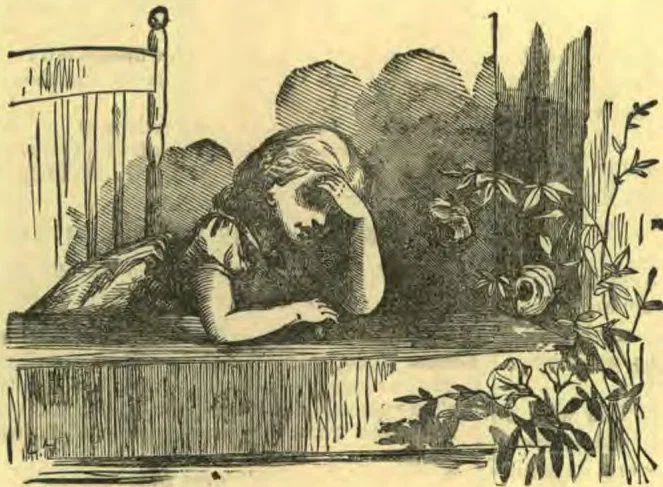
“A Sabbath well spent Brings a week of content, And health for the joys of to-morrow; But a Sabbath profaned, Whate'er may be gained, Is a sure forerunner of sorrow.”
I advise you all to commit these lines to memory. They may help you some day to resist a temptation to profane God’s holy day.

“A LITTLE SELF IN IT.”

Elsie had a weekly allowance of money given her by her papa. She kept a little account-book, and every penny she spent was put down in it. What she had over each week she put in the bank, and her bank-fund had grown to be quite a nice sum. The yearly interest she gave to a society for the poor children of New York.
She usually gave five or ten cents in Sabbath-school every week; but at one time her mamma saw by her book that she had given twenty-five cents. She did the same thing the next week.
“Are you going to give as much as that every Sabbath, dear?” her mamma asked.
“No, mamma; I don’t think I shall; though I want to, I have felt so kind of prospered lately. You see, I don’t need it for myself; and you often say that ‘what we give we have;’ so I thought I would rather give it that way than put it in the bank. But I don’t know as I shall again.”
“Why not?”
“Because, mamma, it’s more than the others give, and it looks as if I felt rich and proud, and I’m most afraid there’ll be a little self in it somewhere; and that would spoil it all, you know.”
Elsie was right to judge her motives in giving. We must never give that others may think well of us, or for display. When we give gifts to Jesus, it must be with a pure heart.—Morning Light.

MARY'S TREASURES.

IT is not in riches that happiness lies. There may be a bountiful store Of silver and gold, and treasures untold, And yet the possessor be poor.
There's a sweet little maiden whose fortunes I know; She has only hope for her dower; And yet she wins love from the birds of the air, And cherishes one little flower.
And a happier maiden is not to be found Than Mary, the gentle and true: Her riches are stores of the heart, which will last To bless her the whole of life through.
And when she must pass to the heavenly home, The treasures she gathered below Will be garnered, and kept in the storehouse above, Where all sweet affections must grow.

You have reached the end of this edition.

The Youth’s Instructor · Jul 1879