The Youth’s Instructor, Vol. 30, No. 7.

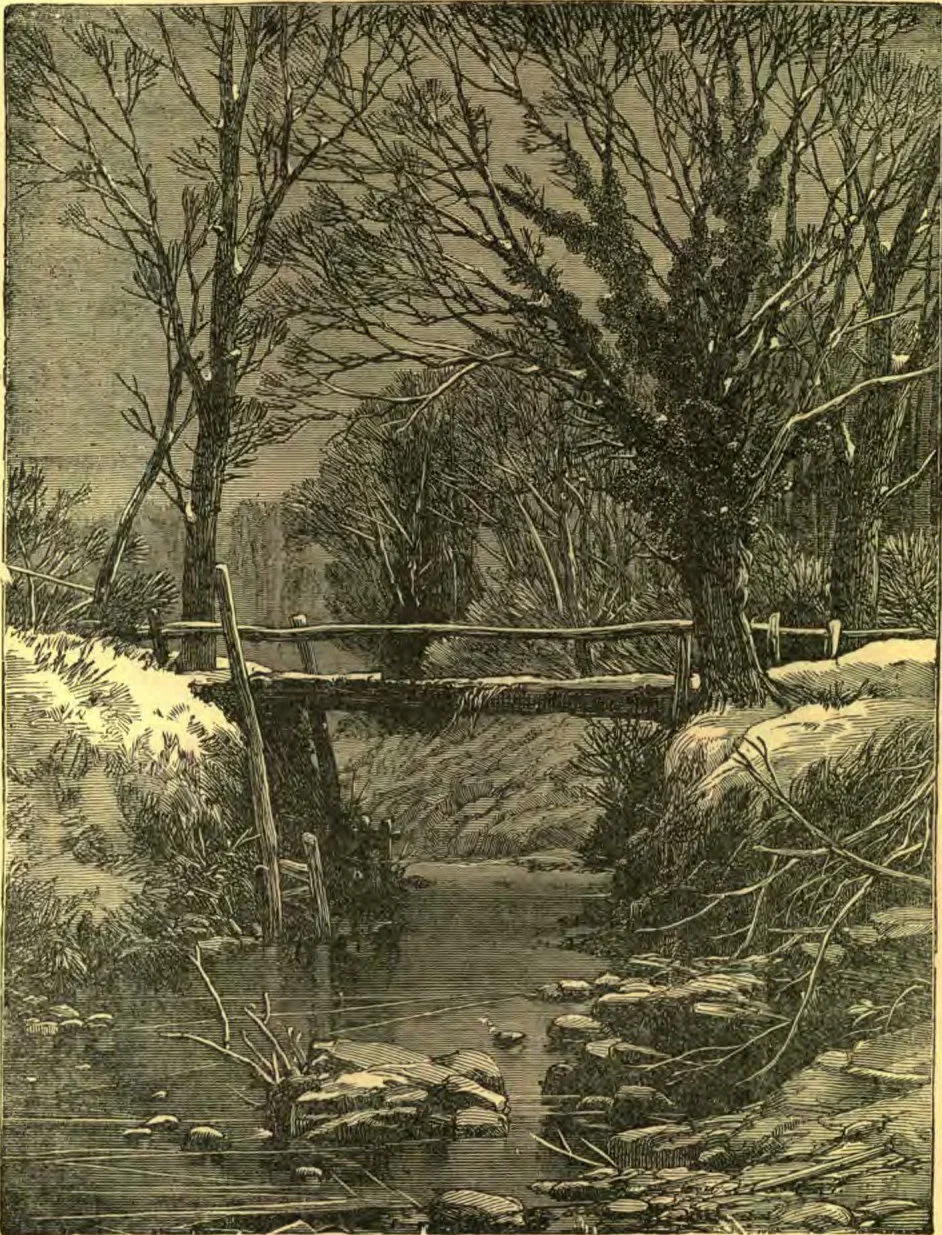
WOODS IN WINTER

The Youth’s Instructor

Feb 15, 1882

S. D. A. Publishing Association · Battle Creek, Mich. · Feb 15, 1882

WOODS IN WINTER.

WHEN winter winds are piercing chill, And through the hawthorn blows the gale, With solemn feet I tread the hill, That overbrows the lonely vale.
O'er the bare upland, and away Through the long reach of desert woods, The embracing sunbeams chastely play, And gladden these deep solitudes.
Where, twisted round the barren oak, The summer vine in beauty clung, And summer winds the stillness broke, The crystal icicle is hung.
Where, from the frozen urns, mute springs Pour out the river's gradual tide, Shrilly the skater's iron rings, And voices fill the woodland side.
Alas! how changed from the fair scene, When birds sang out their mellow lay, And winds were soft, and woods were green, And the song ceased not with the day!
But still wild music is abroad, Pale, desert woods, within your crowd; And gathering winds, in hoarse accord, And the vocal reeds pipe loud.
Chill airs and wintry winds! my ear Has grown familiar with your song; I hear it in the opening year, I listen, and it cheers me long.
— Longfellow.

HOW ENGLAND WAS REFORMED.

The names of Martin Luther and Philip Melancthon are familiar in every household, and many a winter’s evening has been spent in reading how these brave and good men brought about the Reformation among their countrymen. But their work did not affect Germany alone. Good people throughout the civilized world were, by the labors of these men, awakened to a desire for learning the true teachings of the word of God, and were encouraged to renounce the false doctrines of the Roman Catholic Church. But many were the cruel tortures suffered, many were the noble lives sacrificed in various countries, before the power of the Romish Church was so restrained that men dared to live out their own convictions.
England bore a conspicuous part in this struggle, and many of her sons left life records hardly less interesting and instructive than those who, in old Germany, first braved the wrath of the pope. But before we notice their lives, shall we not ascertain what there was so wrong in the teachings and practices of the church of that day? Now do not think that all Catholics were wicked people; for many of them were as sincere in their belief, and as pure and noble in their lives, as Christians are to-day; but they were deceived by their priests and bishops. These men told the people that the bishop of Rome, whom they called the “pope,” was the supreme head of the church; that is, that whatever he commanded, the people must reverence the same as though it came from God himself. But the Bible says that we should call no man our master, for one is our Master, even Christ, and all we are brethren, and that “whosoever exalteth himself shall be abased.” Yet this man claimed that he and those to whom he gave power, were able to forgive the sins of any who would pay money enough, or who would perform some service for the church. If the sum was a very large one, or the favor very great, the people were promised forgiveness of all the sins that they might commit during a given length of time, and sometimes even to the end of life. This, you see, was virtually telling them that they might sin all they wished to, and yet reach Heaven,—a promise God never made,—and the Bible says that “to the Lord, our God, belong mercies and forgivenesses.”
The people were also taught that all had to pass through a very disagreeable place, called “purgatory,” on their way to Heaven, and that by paying enough money to a priest they might hire him to pray their departed friends through that place, so that they would not have to stay there long. Besides this, the priests would pretend to have relics of our Saviour’s cross, his tomb, etc., and of dead saints,—all of which they would sell to the people, along with images of Christ, his virgin mother, and others. The people thought these relics were very sacred, and would bring God’s blessing to their families. They were also taught that the images would be valuable in reminding them of God, Christ, his life, etc., etc. But the people really worshiped them, just as the heathen do their idols, and so broke the second commandment. These and many other things that were contrary to the teachings of the Bible, the people were led to believe and practice. Many of the priests and some of the bishops really thought these things were true, but others who knew better were either too cowardly to say so, or enjoyed receiving the people’s money and reverence more than they valued the approbation of God. They knew that all this sham was gotten up to get money to build grand cathedrals and monasteries, and costly palaces for the bishops, so that they might live in wealth and splendor; they knew how cruel the church was to those who dared stand out and tell the people how they were deceived; they knew, too, how their lands and houses would be taken away and given to the church, and how they and their families would be cut off from all the enjoyments of life, and possibly tortured to death as heretics.
But, you will ask, why did not the people read the Bible, and learn for themselves what they should do. Ah! there was the root of the whole trouble. They had no Bible to read. In those days the Bible was not printed, but only written out with pen and ink, and those only could own a copy who could pay immense sums of money to have it rewritten for them. Even the copies that did exist were written in a language that only a few of the people could understand, for the bishops would not permit God’s word to be written in the English tongue, for fear that the people would discover by reading it how wrongly they were taught, and then the church would get no more of their money.
But we shall have to tell in another paper how the people of England were freed from this wicked power, and of some of the famous men who were God’s instruments in doing such a noble but perilous work; and how some of them lost their lives in the struggle.
CHAS. H. GILES.

THE BOYHOOD OF JESUS.

His outward life was the life of all those of his age and station, and place of birth. He lived as lived the other children of peasant parents in that quiet town, and in a great measure as they live now. He who has seen the children of Nazareth in their red caftans and bright tunics of silk or cloth, girded with a many-colored sash, and sometimes covered with a loose outer jacket of white or blue—he who has watched their games, and heard their ringing laughter as they wander about the hills of their little, native vale, or play in bands on the hillside, beside their sweet and abundant fountain,—may perhaps form some conception of how Jesus looked and played when he, too, was a child. And the traveler who has followed any of those children—as I have done—to their simple homes, and seen the scanty furniture, the plain, but sweet and wholesome food, the uneventful, happy, patriarchal life, may form a vivid conception of the manner in which Jesus lived. Nothing can be plainer than those houses, with the doves sunning themselves on the white roofs, and the vines wreathing about them. The mats, or carpets, are laid loose along the walls; shoes and sandals are taken off at the threshold; from the center hangs a lamp, which forms the only ornament of the room; in some recess in the wall is placed the wooden chest, painted with bright colors, which contains the books or other possessions of the family; on a ledge that runs around the wall, within easy reach, are neatly rolled up the gay-colored quilts which serve as beds, and on the same ledge are ranged the earthen vessels for daily use; near the door stand the large common water-jars of red clay, with a few twigs and green leaves—often of aromatic shrub—thrust into their orifices to keep the water cool. At meal-time a painted, wooden stool is placed in the center of the apartment, a large tray is put upon it, and in the middle of the tray stands the dish of rice or meat, or libban, or stewed fruits, from which all help themselves in common. Both before and after the meal, the servant, or the youngest member of the family, pours water over the hands from a brazen ewer into a brazen bowl. So quiet, so simple, so humble, so uneventful, was the outward life of the family of Nazareth.—Farrar’s Life of Christ.

“DO YOUR BEST.”

“WHEN I was a little boy,” said a gentleman, “I paid a visit one evening to my grandfather, a venerable old man, whose black velvet cap and tassel, blue breeches, and huge silver knee-buckles, filled me with awe. When I went to bid him good-bye he drew me between his knees, and, placing his hand upon my head, said: ‘Grandchild, I have one thing to say to you; will you remember it?’ I looked into his face and nodded, for I was afraid to promise aloud. ‘Well,’ he continued, ‘whatever you do, do the best you can.’”
“This, in fact, was my grandfather’s legacy to me; and it was better than gold. I never forgot his words, and I believe I have tried to act upon them. After reaching home, my uncle gave Robert and me some weeding to do in the garden. It was Wednesday afternoon, and we had laid our plans for something else. Robert, vexed and ill-humored at his disappointment, did not more than half do his work; and I began pretty much like him, until my grandfather’s advice came into my mind, and I determined to follow it. In a word, I did my best. And when my uncle came out, I shall never forget his look of approbation as his eyes glanced over my beds, or the four-pence he slipped into my hands afterward, as he said my work was well done. Ah! I was a glad and thankful boy; while Robert was left to drudge over his beds all the afternoon.”
“At fifteen I was sent to an academy, where I had partly to earn the money for my tuition. The lesson seemed hard at first, for I was not fond of study; but grandfather’s advice was my motto, and I tried to do my best. As a consequence of this, though I was small of my age, and not very strong, my mother had three offers of a situation for me before the year was out.—Selected.

Small Beginnings Lead to Great Evils

THE greatest evils in life have had their rise from something which was thought of too little importance to be attended to.

Faithfulness to Present Duty

HE who is false to present duty breaks a thread in the loom, and will see the defect when the weaving of a lifetime is unrolled.

“CLING CLOSE TO THE ROCK, JOHNNY.”

FOURTEEN or fifteen cars were passing over the Alleghany Mountains on their way eastward. They were crowded with passengers. As the iron horse snorted and rushed on, they began to feel that it had begun to descend, and needed no power but the invisible power of gravitation to send them down with terrific swiftness. Just as the passengers began to realize their situation, they came to a short curve, cut out of the solid rock—a wall of rock lying on each side. Suddenly the steam whistle screamed as if in agony, “Put on the brakes! put on the brakes!” Up pressed the brakes, but with no apparent slackening of the cars. Every window flew open, and every head that could be, was thrust out to see what the danger was, and every one rose up in his place, fearing sudden destruction—“what was the trouble?”
Just as the engine began to turn into the curve, the engineer saw a little girl and her baby brother playing on the track. In a moment the cars would be on them. Close to the rail, in the upright rock, was a little niche, out of which a piece had been blasted. In an instant the baby was thrust into this niche, and as the cars came thundering by, the passengers, holding their breath, heard the clear voice of the little sister on the other side of the cars, ring out, “Cling close to the rock, Johnny! cling close to the rock!” And the little creature snuggled in, and put his head as close to the corner of the rock as possible, while the heavy cars whirred past him. And many were the moist eyes that gazed, and many a silent thanksgiving went up to Heaven.
In a few hours the train stopped at a station, where an old man and his son got out of the cars. The father had come so far to part with his child, who was going to an Eastern city to live, while the aged father was to turn back to his home. All the dangers that would harass the son seemed to crowd into the heart of the father, as he stood holding the hand of his boy—just now to part with him. He choked, and the tears filled his eyes, and all he could say was, “Cling close to the Rock, my son!” He wrung the hand of his child, and the passengers saw him standing alone, doubtless praying that his inexperienced son might “cling close to the Rock Jesus Christ!”

A WAITING SAVIOUR.

“Behold, I stand at the door, and knock: if any man hear my voice, and open the door, I will come in to him, and will sup with him, and he with me.”—Rev. 3:20.
Knocking! knocking! Who is there? Waiting! waiting! Oh, how fair! 'Tis a pilgrim, strange and kingly, Never such was seen before: Ah, my soul, for such a wonder, Wilt thou not undo the door?
Knocking! knocking! Still he's there! Waiting! waiting! wondrous fair! But the door is hard to open, For the weeds and ivy-vine, With their dark and clinging tendrils, Ever round the hinges twine.
Knocking! knocking! What, still there? Waiting! waiting! grand and fair! Yes, the pierced hand still knocketh; And beneath the crowned hair Beam the patient eyes, so tender, Of thy Saviour waiting there!

“HE WHO SENDS THE STORM, STEERS THE VESSEL.”

So said an old ship-captain to me, when describing a fearful storm at sea. When he told of the awful gale—the vivid lightning, the billows mountain high, the ship tossed about like a plaything for the rude winds and waves to buffet—then the voice became softened, his eye glistened amid tears, as he added: “But, madam, He who sends the storm, steers the vessel; and at last we were brought safe into port.”
“That is a very comforting thought, captain,” said I. “I wish we could all remember it when storms are raging, and there seems little hope of peace and safety.”
“Yes, ma’am, it is a great comfort; and if we only believe and trust, all will be well. When the storms of adversity sweep over us, and the sunshine seems shut out forever by the clouds of sorrow—when we cry aloud, in our anguish, ‘All Thy waves and billows have gone over me,’—let this ray of light into the sinking heart, and all will be right in His good time. The clouds will disperse, the sunshine glisten over the waters, and mighty winds and waves, at His voice, will cease their raging, and there will be ‘a great calm’—that ‘peace of God which passeth all understanding.’”

Whatsoever Thy Hand Findeth to Do

“WHATSOEVER thy hand findeth to do, do it with thy might;” that is, do it thoroughly. If work is to be done so as to give satisfaction, it must be done thoroughly. Nothing must be slurred over, nothing left to chance. Your whole energy must be thrown into it; your thoughts must be given to it; your labor must be given to it. Never let any work leave your hands till you can in truth and honor say you have done your best, your very best. Thoroughness is a hard virtue, but it pays.

A SONG FOR WINTER.

Oh, what if the snows are white and cold, And the summer’s bloom is over! Oh, what if the roses blush no more, And the frost has killed the clover!
Let us turn to the winter a smiling face, And welcome the pale new-comer— Isn’t love as deep, isn’t life as sweet, As it was in the by-gone summer?
—Mary H. Williams.

SCENES IN THE LIFE OF CHRIST.

LESSON 56.—THE DEMONIAC WHOM THE DISCIPLES COULD NOT HEAL.

On the next day after the transfiguration, Jesus and the three disciples that were with him came down from the mountain. On coming near, they found that a great multitude had gathered about the other disciples. The scribes were questioning the disciples, and there seemed to be great excitement. When the people saw Jesus coming, some of them ran to meet him, and saluted him. When Jesus came up to the scribes, he said, “What question ye with them?” The scribes made no reply, but one of the multitude said, “Master, I have brought unto thee my son, which hath a dumb spirit; and wheresoever he taketh him, he teareth him; and he foameth, and gnasheth with his teeth, and pineth away: and I spake to thy disciples that they should cast him out; and they could not.” Then Jesus told the distressed father to bring forward his son, but as soon as the unfortunate young man came into the presence of Jesus, the evil spirit began to rage within him, and he fell to the ground, “and wallowed foaming.”
Then Jesus asked the father how long his son had been afflicted in this way, and the man said that the boy had been so since he was a child, and that the evil spirit had often cast him into the fire, and into the waters, to destroy him; and added, “If thou canst do anything, have compassion on us, and help us.” Then said Jesus unto him, “If thou canst believe, all things are possible to him that believeth.” Immediately the father burst into tears, and said, “Lord, I believe; help thou my unbelief.”
Great excitement now prevailed among the people; they came running together from every way; and when Jesus saw it, he rebuked the foul spirit, saying, “Thou dumb and deaf spirit, I charge thee, come out of him, and enter no more into him.” The unclean spirit was very unwilling to quit his hold upon the young man, and when compelled to leave him, put the poor sufferer into such torture that he cried out in agony, and then appeared like one dead. Many thought that he was really dead, but Jesus took him by the hand, and lifted him up, and he revived.
Afterward, when Jesus was alone with his disciples in a house, they asked him why it was that they could not cast out this demon; and he said, “This kind can come forth by nothing but by prayer and fasting.”
When Jesus departed from the place where this miracle had been wrought, he went through Galilee with his disciples, but went as privately as possible, because he did not want it known. As they were journeying, he told his disciples that he was to be delivered into the hands of wicked men, who would kill him; but that he would rise again the third day. The disciples could not understand what he meant by this, but were afraid to ask him to explain it.

QUESTIONS.

  1. When did Jesus and the disciples that were with him come down from the mount of transfiguration?
  2. As they came near the disciples, what did they notice? Mark 9:14.
  3. What were the scribes doing?
  4. What seemed to be the state of feeling?
  5. What did the people do when they saw Jesus coming?
  6. What question did Jesus ask the scribes when he came up to them?
  7. What reply did they make?
  8. What did one of the multitude say?
  9. How did he describe the case of his son?
  10. What had just occurred?
  11. What did Jesus tell the man to do?
  12. What happened to the young man as soon as he came into the presence of Jesus?
  13. What inquiry did our Lord then make?
  14. What reply did the father make?
  15. What earnest petition did he then put forth?
  16. What did Jesus say about the possibility of healing the young man?
  17. What did the agonized father exclaim?
  1. How were the people affected by these things?
  2. What did Jesus do, as he saw them come running together?
  3. What did he say?
  4. What result followed this rebuke?
  5. In what condition was the young man left?
  6. What did Jesus then do for him?
  7. What question did the disciples ask Jesus as soon as they were alone with him?
  8. What answer did he give them?
  9. Through what country did Jesus pass when he left the scene of this miracle?
  10. How did he pass through the land?
  11. What did he tell the disciples, as they were journeying?
  12. Could the disciples understand his meaning?
  13. Why did they not ask him to explain?

NEW-TESTAMENT HISTORY.

LESSON 69.—THE NARROWNESS OF THE WAY.

AFTER remaining for some time in the vicinity of the place where John baptized, our Lord began to travel through the country east of the Jordan, and opposite Judea. Making his way slowly toward Jerusalem, he stopped, and taught the people frequently, especially in the cities and villages. As he journeyed, great multitudes followed him, and he healed many of their diseases. And one said unto him, “Lord, are there few that be saved? And he said unto them, Strive to enter in at the strait gate; for many, I say unto you, will seek to enter in, and shall not be able. When once the master of the house is risen up, and hath shut to the door, and ye begin to stand without, and to knock at the door, saying, Lord, Lord, open unto us; and he shall answer and say unto you, I know you not whence ye are: then shall ye begin to say, We have eaten and drunk in thy presence, and thou hast taught in our streets. But he shall say, I tell you, I know you not whence ye are; depart from me, all ye workers of iniquity. There shall be weeping and gnashing of teeth, when ye shall see Abraham, and Isaac, and Jacob, and all the prophets, in the kingdom of God, and you yourselves thrust out. And they shall come from the east, and from the west, and from the north, and from the south, and shall sit down in the kingdom of God. And, behold, there are last which shall be first, and there are first which shall be last.”
“This same day there came certain of the Pharisees, saying unto him, Get thee out, and depart hence; for Herod will kill thee. And he said unto them, Go ye and tell that fox, Behold, I cast out devils, and I do cures to-day and to-morrow, and the third day I shall be perfected. Nevertheless I must walk to-day and to-morrow, and the day following; for it cannot be that a prophet perish out of Jerusalem.”
“And it came to pass, as he went into the house of one of the chief Pharisees to eat bread on the Sabbath-day, that they watched him. And, behold, there was a certain man before him which had the dropsy. And Jesus answering spake unto the lawyers and Pharisees, saying, Is it lawful to heal on the Sabbath-day? And they held their peace. And he took him, and healed him, and let him go; and answered them saying, Which of you shall have an ass or an ox fallen into a pit, and will not straightway pull him out on the Sabbath-day? And they could not answer him again to these things.”
“And he put forth a parable to those which were bidden, when he marked how they chose out the chief rooms; saying unto them, When thou art bidden of any man to a wedding, sit not down in the highest room; lest a more honorable man than thou be bidden of him; and he that bade thee and him come and say to thee, Give this man place; and thou begin with shame to take the lowest room. But when thou art bidden, go and sit down in the lowest room; that when he that bade thee cometh, he may say unto thee, Friend, go up higher; then shalt thou have worship in the presence of them that sit at meat with thee. For whosoever exalteth himself shall be abased; and he that humbleth himself shall be exalted.”
“Then said he also to him that bade him, When thou makest a dinner or a supper, call not thy friends, nor thy brethren, neither thy kinsmen, nor thy rich neighbors; lest they also bid thee again, and a recompense be made thee. But when thou makest a feast, call the poor, the maimed, the lame, the blind; and thou shalt be blessed; for they cannot recompense thee; for thou shalt be recompensed at the resurrection of the just.”

QUESTIONS.

  1. After remaining some time near the place where John baptized, through what country did our Lord travel?
  2. Toward what place did he slowly make his way?
  3. For what purpose did he frequently pause in his journey?
  4. Where did he spend most time in this way?
  5. By whom was he followed?
  6. What did he do besides teaching them?
  7. What question did one ask him? Luke 13:23.
  8. How did Jesus answer the man? Verse 24.
  9. How did he show the necessity of promptness and diligence in seeking the Lord? Verse 25.
  10. What plea will some make? Verse 26.
  11. What answer will they receive? Verse 27.
  12. What will cause the greatest anguish to those who neglect to secure eternal life? Verse 28.
  13. What did our Lord say that may encourage us to hope for salvation, notwithstanding the straitness of the way? Verse 29.
  14. By what remark does our Lord show that the righteous shall all enter upon their reward at the same time? Verse 30.
  15. What other scriptures have a bearing upon the same point?
  16. What warning was given Jesus by the Pharisees? Verse 31.
  17. What message did he send to Herod?
  18. On what occasion did Jesus cure a man of the dropsy? Luke 14:1, 2.
  19. What question did he ask the Pharisees before healing the man?
  20. What question did he ask them after having healed the man? Verse 5.
  21. Why did they not answer these questions?
  22. What parable did he then put forth? Verses 7–10.
  23. What lesson is to be learned from this parable? Verse 11.
  24. Why is it that we should not give dinners, etc., to our friends, our relatives, and our rich neighbors exclusively? Verse 12.
  25. Who should be called on such occasions? Verse 13.
  26. What is said in regard to the recompense for such kindly deeds?

NOTES.

Strive to enter in at the strait gate, etc.—The word strait should not be confounded with straight; the latter means not crooked; the former, pent up, narrow, difficult to be entered. This mode of expression seems to have been of a proverbial character for anything that required exertion and self-denial. The lesson taught is that we should make it the chief business of our lives to gain heaven, before the door of mercy is closed, when “many shall seek to enter in, and shall not be able.”
Eaten and drunk in thy presence.—To have eaten with one is evidence of acquaintanceship or friendship.
There are last which shall be first, etc.—The Jews who had been the first and most distinguished people of God, will in general reject the gospel of my grace, and be consequently rejected by me. The Gentiles, who have had no name among the living, shall be brought to a knowledge of the truth, and become the first, the chief and most exalted people of God.—Clarke.
Besides the national application mentioned above, this expression may teach that many who have held responsible positions in the church,—have been first,—but have not been wholly true to their trust, shall be regarded with less honor in heaven than some who on earth were more humble, and were not thought to be worthy of special honor.
Chief rooms.—The word rooms here does not express the meaning of the original. It does not mean apartments, but the places at the table. The highest room was the seat at the table nearest the head. The lowest room, the lowest seat at the table.
Shalt have worship.—The word worship here means honor. They who are sitting with you will treat you with respect.—Barnes.
Call not thy friends.—Our Lord certainly does not mean that a man should not entertain at particular times, his friends, etc.; but what he inculcates here is charity to the poor; and what he condemns is those entertainments which are given to the rich, either to flatter them or to procure similar returns.—Clarke.

GROUND SQUIRRELS.

Most of the children will recognize in the picture above, the little ground squirrel, perhaps best known to them by the name of “chipmonk.” They are smaller than the red squirrel, and are not so bright colored. You can always know them by the five black stripes running from the neck almost to the tail. The two stripes on the sides are separated by a white line, as you see in the picture. They are innocent little creatures, and do hardly any damage to the farmer, for they do not disturb the grain until it is ripe, and only gather their winter store from what is left on the fields by the harvesters. They do not climb trees as other kinds of squirrels do, but make their nests in the roots and in old stumps, where they stow away nuts, wheat, corn, cherry-stones, and grass-seed, to live on during the cold months of winter.
They are very playful, and it is amusing to see them standing upright on their hind legs on some old stump, looking as sober and dignified as a deacon, and cheeping at you like a chicken, until you come too near, when away they go to their nests before you can tell which way they went. Perhaps this is what has led the boys to call them “chipmonks.” Sometimes they will not go to their nests, but will run along the fence or stone wall, cunningly peeping out here and there, and then darting back again, as though playing hide-and-seek with you. Often, too, a couple of them may be seen racing around a stump or stone-heap, and like boys playing tag, when one has fairly touched the other, he turns and is himself chased; and so they keep up the game until tired out.
Now, boys, since these little creatures do no harm at all, and are so pleasant to watch and study, don’t you think it is cruel to kill them just to see if you can throw or shoot straight enough to hit them? And when you see a boy doing so again, will you not ask him to put down his gun or stone, and watch their play while you tell him how harmless the little fellows are; and how hard they work all through the warm weather to gather food, so that they may live to another summer to amuse us with their frolic? *

DOING GOD'S ERRANDS.

Hester was a little girl who was trying to love and serve Jesus. And she showed her love for Jesus by seeking to please him in all she did. She loved to do errands for her mother, and to have her mother say she was a faithful servant, when she did them well.
One day she had been talking with her mother about God. As they got through, she looked up with a bright thought beaming in her eyes, and said,—
“Why, mother, then God is sending us on errands all the time! Oh! it is so nice to think that I am God's little errand-girl.”
“Yes, dear,” said her mother; God has given us all errands to do for him, and plenty of time to do them in, and a book full of directions to show us how to do them. Every day we can tell him what we are trying to do, and ask him to help us. And when he calls us home to himself, we shall have great joy in telling him what we have been trying to do for him.”
“I like that,” said Hester. “It is very pleasant to be allowed to do errands for God.”
“One of my errands,” said her mother, “is to take care of you.”
“And one of mine, dear mother, is to honor and obey you. I think God gives us very pleasant errands to do.”
You know that nothing makes us more happy than to do anything for a person that we really love. This is what Jesus meant when he said, “My yoke is easy, and my burden is light.” This is what the Apostle John meant when he said that “His commandments are not grievous.” His people serve him from love, and that makes everything they do for him light and pleasant to them.

“’T WAS THE KIND WORD YOU SPOKE THAT SAVED ME.”

“Rosa! look at that horrid drunken man, sitting on the curbstone; do come across the street, for I wouldn’t pass him for anything.” And Mary ran away as fast as her feet could carry her. Now Rosa was afraid too; but the song she had been learning that day was still fresh in her memory. “Speak a kind word when you can,” she had been singing, and the man before her, with his head bent on his hands, looked so forlorn and wretched, so sadly in need of a kind word, that she went a little nearer, and said timidly, “Poor man! I am sorry for you. Can I do anything to help you?”
He raised his head, looked at her in surprise, and his haggard face and despairing eyes almost caused her to cry for pity.
“Little girl, your kind words have helped me already. I never expected to hear any again, for I am without a friend on earth.”
“But God will be your friend, if you will ask him,” said Rosa, softly, going nearer still, while Mary beckoned anxiously for her to come away. “Did you ever ask him?” continued Rosa.
“No; I have been sinning against him all my life,” groaned the man.
“Poor man! Let God be your friend. He can do everything for you. I am your friend, but I can’t do anything but speak a kind word.”
“Darling little girl, that kind word has saved me. Good-by.” And he held out his shaking hand.
Rosa was not afraid now, and she placed her plump little hand in his, and as he bent down and kissed it, two hot tears fell upon it. Then he went away, and Rosa rejoined her companion.
“O you queer creature! how could you let that awful-looking man take hold of your hand? I thought he was going to eat you up when he bent down his head,” was Mary’s greeting.
“I was afraid at first, Mary, but I am so glad I spoke to him. Only think! he says my kind words have saved him.”
“Well, he never would be saved if it depended on my kind words, for I always run away from such folks,” replied Mary.
Years after, a stranger, a noble, silver-haired old man, was addressing a Sabbath-school, and telling the scholars always to be kind to the friendless and distressed ones, especially the drunkard; “for when I was friendless, and sinful, and wretched,” said he, “God sent a dear child to speak the kind word that saved me.”
When the school closed, a young girl held out her hand to him, and with tears in her eyes, asked, “Sir, do you not know me?” He looked at her long and earnestly, and then taking both hands in his, he said solemnly and slowly, “Yes, dear child, ’t was the kind word you spoke that saved me!” And Rosa wept for gladness.—Selected.

THE LAST WORD.

Don’t try to get it. It isn’t worth trying for, and you or some one else may get angry before it is found, and that is always a great misfortune to any one. Anger is like a too hot fire. It makes everybody about you very uncomfortable, and burns out the furnace that contains it. The strife to get the last word in a dispute often stirs up the fire of anger, and makes it burn furiously. Let it go. Let some one else have it, if he will.

Truth Framed in a Pleasant Manner

ADHERE rigidly and unhesitatingly to truth; but while you express what is true, express it in a pleasant manner. Truth is the picture, the manner is the frame that displays it to advantage.

LETTER BUDGET.

MARY LANDON writes from Mapleton, Iowa: “This is the first time I ever tried to write for the ‘Budget.’ I am nine years old. I like to read the paper. I go to Sabbath-school with my papa and mamma and two brothers. We have to go about seven miles. We started to go this morning, but it was so very cold that we had to turn around and come back.”
MINNIE PERKINS writes from Minnesota. She is nine years old, and has three sisters and one brother. She says: “We can go to school in the summer, but not in the winter, for it is so far over the prairie. We go to Sabbath-school, and I study the lessons in the INSTRUCTOR. Ma gave Cora and me ‘Sabbath Readings’ for a Christmas present. I read aloud from them nearly every evening. Brother Harry got a new sled, and we have fine times sliding on the pond. There is very little snow here this winter. Our grandma lives with us. We all keep the Sabbath, and have all signed the teetotal pledge. I am making a new quilt to sell to get money for the poor.”
This is a good letter. It sounds just as if the little girl were talking to us.

CHILDREN'S VOICES.

Children's voices sweetly ringing Through the clear and silent air, Children's voices gladly singing Of a Saviour's loving care.
Children's faces brightly smiling In the darkest cloudy day, Children's laughter, care beguiling, Chasing sorrow far away.
Children's prayer for evening blessing, Kneeling at a mother's knee, Children's little hands caressing, Softly—oh, so tenderly.
Children's love—how pure, how holy, May I copy childhood's ways, Learning to be simple, lowly, Trusting, loving, all my days. —Selected.

You have reached the end of this edition.

The Youth’s Instructor · Feb 15, 1882