The Youth’s Instructor, Vol. 30, No. 35.

HUMBLE-BEES

The Youth’s Instructor

Aug 30, 1882

S. D. A. Publishing Association · Battle Creek, Mich. · Aug 30, 1882

HUMBLE-BEES
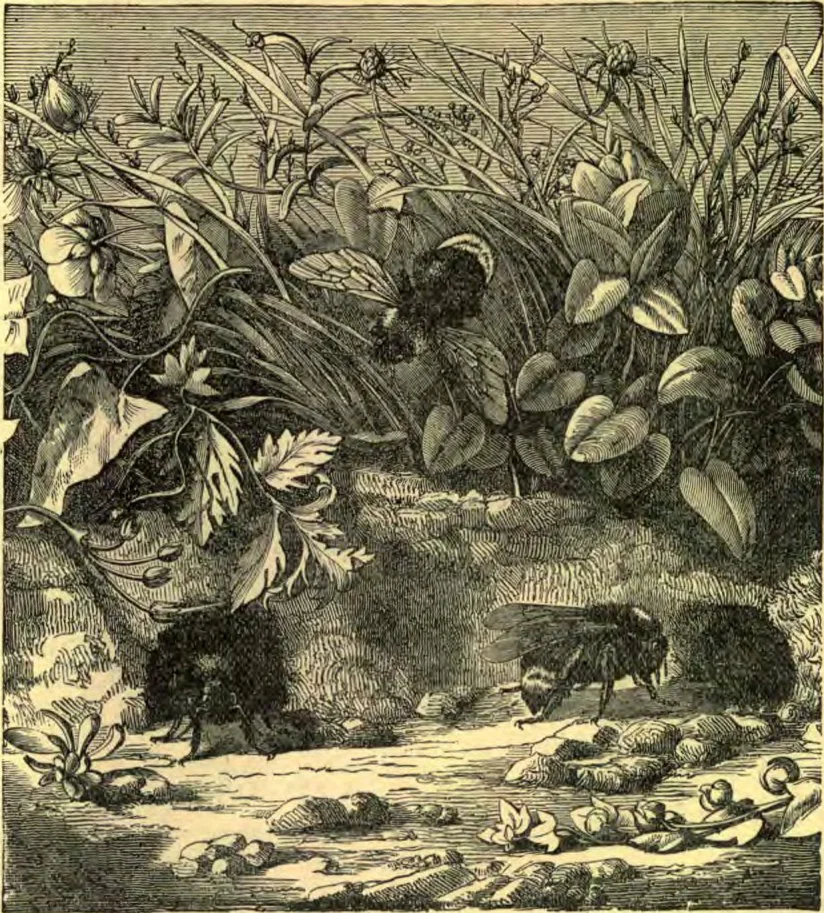
Perhaps one of the most interesting studies in connection with the animal kingdom is that of bees and their habits. Many learned men have spent hours in watching the little creatures, especially “hive bees.” To help them in doing this, glass hives have been made, through which all their curious movements can be easily seen. The picture gives a view of another class of bees, which all will recognize as “humble-bees,” or as they are often called by school-children, “bumble-bees.” There is less known concerning the habits of this class, than of the hive bees, but perhaps if they could be watched, their ways would prove as interesting as those of their neighbors.
Humble-bees are easily distinguished from hive bees, by their much larger size, their hairy bodies, and the peculiar humming noise which they make as they are flying from place to place in search of honey. They always live in families, or societies, numbering from fifty to two or three hundred. In the fall all but five or six out of each of these large families perish. Each of the few survivors that remain over winter, founds a new colony in the spring. At that time it is a common thing to see single humble-bees prying into every hole and crevice in the earth, searching for a place in which to make their summer home. These they usually build in the earth, at a depth of from one to two feet, in meadows and plains. Often, however, they make their nests in stone piles, brush heaps, piles of old straw, and places of like character. Their favorite home is in the side of some bank, into which they will burrow, and store their food. Here they adorn their house with moss, fastening it to the ceiling and walls with a kind of wax which they have the power to make. The bottom they strew with leaves, on which are placed irregularly shaped brown wax cells, which are to contain their young, and afterward their honey. The entrance to these retreats are oftentimes long, winding tunnels, which enable them to defend themselves and their young from their enemies. For bees, as well as other animals, have enemies. In the meadows their nests are made somewhat differently. There they make a hole in the ground, wider than it is deep. With the dirt they take out, aided by wax and moss, they build a dome over the excavation. Then they line and carpet it as before stated.
There is one class of humble-bees, called “carders,” that have a very amusing way of building. The dry grass and shreds of moss of which their nest is built, after being carded, or worked into rolls, is pushed by the first bee back to a second, which passes it to a third, and so on till the nest is reached. They work in long lines, the head being turned away from the nest and toward the place where they get their material. Their domes are often seen rising four or six inches above the level of the fields and meadows.
The brown wax cells first contain the young, which are liberated by the old ones gnawing at the cells. The empty cells are then filled with a kind of honey, which quite resembles hive honey in sweetness and fragrance. They obtain it by licking the sweet juices from flowers, and storing them in a little bag which they bear. When this bag is full, they return to the nest, and empty it into a cell, closing the mouth of the cell with wax when full. As the majority of the bees do not survive the winter, the nest is seldom used a second time.
As a general thing, humble-bees are quiet and harmless, though those known as the “orange-tailed humble-bees,” are quite fierce, and possess a powerful sting, which they use very freely whenever they imagine their rights have been invaded upon.
There is a class of humble-bees in Egypt, called the “banded bee,” which are raised for their honey. They are kept on board of boats, which float up and down the river Nile, so as to allow the bees to gather honey from the flowers along the banks.
C. R. G.

THE MISSIONARY POTATO.

It wasn’t a very large church, and it wasn’t nicely furnished. No carpet on the floor, no frescoing on the walls; just a plain, square, bare, frame building, away out in Southern Illinois. To this church came James and Stephen Holt every Sabbath of their lives.
On this particular Sabbath they stood together over by the square box-stove, waiting for Sabbath-school to commence, and talking about the missionary collection that was to be taken up. It was something new for the poor church; they were used to having collections taken up for them. However, they were coming up in the world, and wanted to begin to give. Not a cent had the Holt boys to give.
“Pennies are as scarce at our house as hen’s teeth,” said Stephen. James looked doleful. It was hard on them, he thought, to be the only ones in the class who had nothing to give. He looked grimly around on the old church. What should he spy, lying in one corner of a seat, but a potato.
“How in the world did that potato get to church?” he said, nodding his head toward it. “Somebody must have dropped it that day we brought things here for the poor folks. I say, Stevie, we might give that potato. I suppose it belongs to us as much as to anybody.”
Stephen turned, and gave a long, thoughtful look at the potato.
“That’s an idea!” he said, eagerly. “Let’s do it!”
James expected to see a roguish look on his face, but his eyes and mouth said, “I’m in earnest!”
“Honor bright?” asked James.
“Yes, honor bright.”
“How? Split it in two, and each put half on the plate?”
“No,” said Stephen, laughing; “we can’t get it ready to give to-day, I guess; but suppose we carry it home, and plant it in the nicest spot we can find, and take extra care of it, and give every potato it raises to the missionary cause? There’ll be another chance; this isn’t the only collection the church will take up, and we can sell the potatoes to somebody.”
Full of this new plan, they went into the class looking less sober than before; and though their faces were rather red when the plate was passed to them, and they had to shake their heads, they thought of the potato, and looked at each other and laughed.
Somebody must have whispered to the earth and the dew and the sunshine about that potato. You never saw anything grow like it! “Beats all,” said farmer Holt, who was let into the secret. “If I had a twenty-acre lot that would grow potatoes in that fashion, I should make my fortune.”
When harvesting came, would you believe that there were forty-one good, sound, splendid potatoes in that hill? Another thing; while the boys were picking them up, they talked over the missionary meeting that was to be held in the church next Thursday. An all-day meeting. The little church had had a taste of the joy of giving, and was prospering as she had not before. Now for a big meeting to which speakers from abroad were coming. James and Stephen had their plans made. They washed the forty-one potatoes carefully, and wrote out in their best hand this sentence forty-one times:—
“This is a missionary potato; its price is ten cents; it is from the best stock known. It will be sold only to one who is willing to take a pledge that he will plant it in the spring, and give every one of its children to the missions. Signed, James and Stephen Holt.” Each shining potato had one of these slips smoothly pasted to its plump side.
Didn’t those potatoes go off, though! By three o’clock on Thursday afternoon not one was left, though one gentleman offered to give a gold dollar for one of them. Just imagine, if you can, the pleasure with which James and Stephen Holt put each two dollars and five cents into the collection that afternoon. I’m sure I can’t describe it to you. But I can assure you of one thing: They each have a missionary garden, and it thrives.—
Selected.

THE LITTLE CLOUD.

THERE was once a little cloud In the clear, blue sky above: Gentle breezes held him up With the tender hands of love.
Well these breezes knew the cloud Had a work of love to do: Theirs the task to strengthen him, Help him to be good and true.
While they watched him lovingly, As he floated through the air, They would talk of noble deeds To this little cloud so fair.
Other clouds they pointed out That were floating in the sky: These, they said, would follow him, If he'd leave his home on high.
All the rivers of the earth, Brooks, and springs were nearly dry; All the grass and pretty flowers Without rain would surely die.
That the work God had for him It was time that he should do: What the other clouds might think Mattered not, if he be true
Then, this loving little cloud, With a pity full and deep, Cast a tender glance below, And began to sigh and weep.
Thick and fast, his tear drops fell On the thirsty ground below: Flowers and grasses raised their heads, Silent gratitude to show.
Then, the other little clouds Said he should not go in vain: So they all went softly down, As a summer shower of rain.
—Mrs. S. E. Eastman.

HIS PAY-MASTER.

King Frederick of Prussia, when he was out driving one day, saw an old farmer who was plowing in a field, and singing cheerfully over his work.
“You must be well off, old man,” said the king. “Does this land on which you so industriously labor, belong to you?”
“No, sir,” replied the old man, who of course had no idea that he was speaking to the king. “I am not so rich as that; I plow for wages.”
“How much do you earn a day?” asked the king.
“Eight groschen,” returned the man. (That would be about twenty cents of our money.)
“That is very little,” said the king. “Can you get along on it?”
“Get along? Yes, and have something left.”
“How do you manage?”
“Well,” said the farmer, smiling, “I will tell you. Two groschen are for myself and wife, with two I pay my old debts, two I lend, and two I give away for the Lord’s sake.”
“This is a mystery which I cannot solve,” said the king.
“Then I must solve it for you,” replied the farmer. “I have two old parents at home, who kept me and cared for me when I was young and weak and needed care. Now that they are old and weak I am glad to keep and care for them. This is my debt, and it costs two groschen a day to pay it. Two more I spend on my children’s schooling. If they are living when their mother and I are old, they will keep us and pay back what I lend. Then with my last two groschen I support my two sisters, who cannot work for themselves. Of course I am not compelled to give them the money, but I do it for the Lord’s sake.”
“Well done, old man!” cried the king as he finished. “Now I am going to give you something to guess. Have you ever seen me before?”
“No,” said the farmer.
“In less than five minutes you shall see me fifty times, and carry in your pocket fifty of my likenesses.”
“This is a riddle which I cannot guess,” said the farmer.
“Then I will solve it for you,” returned the king; and with that, he put his hand in his pocket, and, pulling out fifty gold-pieces, placed them in the hands of the farmer.
“The coin is genuine,” said the king, “for it also comes from our Lord God, and I am his paymaster. I bid you good-bye;” and he rode off, leaving the good old man overwhelmed with surprise and delight.—S. S. Visitor.

THE HARVEST IS PAST.

ANOTHER harvest season has come and gone. The fields brought forth a bountiful harvest. Barns and store-houses are full. But in order to secure the abundant crop of wheat, the farmers had to watch carefully for the right time to begin to gather it in. If left a few days too long, there was danger that much of it would get too ripe and shell out by handling, or the rain would come on it before taken into the barn, and injure it.
As soon as it was ready, the good and wise farmer gathered his hands, and started his reapers, or cradlers. From early in the morning until late in the evening they moved on, losing but little time. How happy the farmer feels when the wheat is all gathered into the barn in good condition. He knows that, unless some accident occurs, he has enough to see him through the coming winter.
Sometimes a day is spent at the close of harvest, in feasting and rejoicing over the gathered crops. In some places large meetings are held, called “Harvest Homes,” at which sermons are preached and cheerful songs sung in praise to God for the grain gathered into barns and store-houses. The harvest season is used in the Scriptures to represent our season of religious privileges.
We read in the Scriptures of those who allowed their privileges to go by unimproved, and were compelled to lament. They said, “The harvest is past, the summer is ended, and we are not saved.” Our religious privileges are great. We may gather a good harvest if we will. We can lay up treasure in the great and secure store-house of heaven, but we must, like the farmer, commence in good time, and keep at it while the season lasts.
Youth is the time to begin. “Seek ye first the kingdom of God and his righteousness.” Those who allow life to come to a close without having gathered a treasure for the future, or without having made any provisions for the future state, will have bitter regrets. They will feel the force of the lamentation already referred to, “The harvest is past, the summer is ended, and we are not saved.” But those who gathered while the harvest time of privileges lasted, will end their lives in the assurance of a home in heaven. “And we know that if the earthly house of this tabernacle were dissolved, we have a building of God, a house not made with hands, eternal in the heavens.”
Gather while you may, for the season is passing by. Death may soon end your gathering time. —S. S. Gem.

WOLVES

THE wolf is sometimes termed “man-eater,” because he is particularly fond of human flesh, and never loses an opportunity to devour women and children. Wolves have some fear of men, but when they are very hungry, they face danger and destruction in the effort to satisfy their appetites.
Wolves usually sleep during the day, or, at least, keep themselves in solitary seclusion, in the thickest coverts or hiding-places, but prowling about all night in search of prey. When they go together in packs they are not peaceable, like some other wild beasts; but they go howling, prowling, fighting among themselves, making the most hideous noise.
Sometimes wolves are compelled to go as long as four and five days before they find animal, man, woman, or child to devour. Then they become bold enough to leave their hiding-place in day-time in search of food.
Toward the close of a wintry day, a traveler was tramping through the snow along the edge of some timber land, known as the “Long Woods,” not a great distance from the mountains.
He was going along thinking of no danger, fearing not evil, when, hark! what was that? Such a peculiar noise. After a little he heard it again, more distinctly; he knew the sound only too well. From his heart came the cry, “Dear Lord, deliver me!” He commenced to run as fast as he could, but every moment the wolves gained on him, until it seemed death was sure.
Once more that cry of anguish, “Dear Lord, deliver me!” Just a very few steps and the fence is reached; one last effort!—he jumps, clinging fast to the tree, upon which he climbed, remaining until the sun shone from the eastern horizon.
“The righteous cry, and the Lord heareth, and delivereth them out of all their troubles.”
“And the Lord shall keep them and deliver them, and save them, because they trust in Him.”
—Selected.

Character Versus Reputation

CHARACTER is what you are; reputation is what people think you are.

NEW-TESTAMENT HISTORY.

LESSON 97.—THE VINE AND ITS BRANCHES.

After saying, “Arise, let us go hence,” Jesus continued his discourse; but whether it was in the room where the supper was eaten, or in some other place, it is not easy to determine; but from John 18:1, it seems that it must have been somewhere in the city. By the use of a beautiful metaphor, he taught how important it is that Christians should maintain a close connection with their Lord. He says:—
“I am the true vine, and my Father is the husbandman. Every branch in me that beareth not fruit he taketh away; and every branch that beareth fruit, he purgeth it, that it may bring forth more fruit. Now ye are clean through the word which I have spoken unto you. Abide in me, and I in you. As the branch cannot bear fruit of itself, except it abide in the vine; no more can ye, except ye abide in me. I am the vine, ye are the branches: he that abideth in me, and I in him, the same bringeth forth much fruit, for without me ye can do nothing. If a man abide not in me, he is cast forth as a branch, and is withered; and men gather them, and cast them into the fire, and they are burned. If ye abide in me, and my words abide in you, ye shall ask what ye will, and it shall be done unto you. Herein is my Father glorified, that ye bear much fruit; so shall ye be my disciples.”
Jesus then reassures them of the depth and earnestness of his love for them; tells how they may abide in his love; enjoins upon them the duty of loving one another; and teaches them that they should not be discouraged because the world shall hate them without a cause, since their Lord has been treated in the same way. He says:—
“As the Father hath loved me, so have I loved you: continue ye in my love. If ye keep my commandments, ye shall abide in my love; even as I have kept my Father’s commandments, and abide in his love. Those things have I spoken unto you, that my joy might remain in you, and that your joy might be full. This is my commandment, That ye love one another, as I have loved you. Greater love hath no man than this, that a man lay down his life for his friends. Ye are my friends, if ye do whatsoever I command you. Henceforth I call you not servants; for the servant knoweth not what his lord doeth; but I have called you friends; for all things that I have heard of my Father I have made known unto you. Ye have not chosen me, but I have chosen you, and ordained you, that ye should go and bring forth fruit, and that your fruit should remain: that whatsoever ye shall ask of the Father in my name, he may give it you.
“These things I command you, that ye love one another. If the world hate you, ye know that it hated me before it hated you. If ye were of the world, the world would love his own; but because ye are not of the world, but I have chosen you out of the world, therefore the world hateth you. Remember the word that I said unto you, The servant is not greater than his lord. If they have persecuted me, they will also persecute you; if they have kept my sayings, they will keep yours also. But all these things will they do unto you for my name’s sake, because they know not him that sent me. If I had not come and spoken unto them, they had not had sin; but now they have no cloak for their sin. He that hateth me hateth my Father also.
“If I had not done among them the works which none other man did, they had not had sin; but now have they both seen and hated both me and my Father. But this cometh to pass, that the word might be fulfilled that is written in their law, They hated me without a cause. But when the Comforter is come, whom I will send unto you from the Father, even the Spirit of truth, which proceedeth from the Father, he shall testify of me: and ye also shall bear witness, because ye have been with me from the beginning.”

QUESTIONS.

  1. How did Jesus illustrate the close relation between himself and true believers? John 15:1.
  2. How will the Husbandman treat the branches that bear no fruit?
  3. How will he treat those that bear fruit?
  4. How do the disciples of Christ become clean? Through the exercise of faith and repentance, in obedience to the words that he spoke.
  5. What earnest admonition did Jesus give? John 15:4.
  6. How does he set forth the importance of this admonition? Verses 4, 5.
  7. What will be the fate of those who do not heed it? Verse 6.
  8. What promise is made to those who do abide in him?
  9. How are we to glorify God, and prove our discipleship?
  10. What did he say about his love for his disciples? Verse 9.
  11. What did he say to them about continuing in his love?
  12. How can this be done?
  13. Why did Jesus speak these things to his disciples?
  14. What commandment did he give them?
  15. How great is his love? Verse 13.
  16. How can we prove ourselves to be the friends of Jesus?
  17. Why does he call his disciples friends, instead of calling them servants?
  18. For what purpose had he chosen and ordained the twelve disciples? Verse 16.
  19. What command did he emphatically repeat?
  20. How were the disciples to comfort themselves when they found that the world hated them?
  21. Why would they be hated by the world? Repeat verse 19.
  22. What were they to remember?
  23. Why must Christ’s disciples expect persecution?
  24. Why do men do all these things?
  25. Have they any excuse for their ignorance?
  26. What did Jesus say about the hatred which wicked men bear toward God? Verses 23, 24.
  27. What scripture is thus fulfilled?
  28. What evidence was to be furnished, besides the works which Jesus had performed?
  29. How were the disciples to be witnesses to the Messiahship of Christ?

SCENES IN THE LIFE OF CHRIST.

LESSON 34.—REVIEW.

1. For what purpose were little children brought to the Saviour? Matt. 19:13.
2. Who rebuked those who brought the children?
3. What did Jesus say to these disciples?
4. What did he say about those who would enter the kingdom of heaven? Mark 10:15.
5. After speaking these words, what did he do for the children? Verse 16.
6. How did a rich young ruler approach Jesus? Mark 10:17; Luke 18:18.
7. What did Jesus do before answering his question?
8. To what rule of action did he then point him?
9. What commandments did he bring to notice?
10. What one did he purposely skip?
11. What did the young man say about the commandments mentioned?
12. How did Jesus make him feel his lack?
13. What remarks did Jesus then make about rich men and the kingdom of heaven?
14. How did the disciples receive these remarks?
15. What explanation did Jesus make?
16. What promises were made to those who forsake all, and follow Jesus? Matt. 19:27–29.
17. As they were on the way, going up to Jerusalem, how did Jesus foretell his death? Mark 10:32.
18. What treatment did he say he would receive?
19. Did the disciples understand the true meaning of what he said?
20. For what were the sons of Zebedee reproved?
21. What question did Jesus ask them?
22. What did he say about granting their request?
23. Who were offended?
24. How did Jesus show that his kingdom was to be entirely different from the kingdoms of this world?
25. Tell how the two blind men were healed near Jericho.
26. Who was Zacchæus, and how did he obtain a view of the Saviour?
27. Describe the visit of Jesus to the house of Zacchæus.
28. Why were the Jews offended with Jesus because he visited this man?
29. When some thought that the kingdom of God should immediately appear, what parable did Jesus give them?
30. Relate the parable of the nobleman who went into a far country to receive a kingdom, and return. Luke 19.
31. Tell what this parable means.
32. Why did some Jews collect at Jerusalem before the Passover begun? John 11:55.
33. What did they say about the Saviour?
34. What commandment had the chief priests and Pharisees given out?
35. As Jesus was on his journey from Jericho to Jerusalem, at what place did he stop?
36. How long was this before the Passover?
37. How was Jesus entertained at that place?
38. Tell how he was anointed at that supper.
39. What fault was found?
40. What did Jesus say about what the woman had done?
41. What did he say about her being kept in memory?
42. What drew great numbers of people to Bethany?
43. What wicked project had the chief priests in mind?

“MEDITATE ON THESE THINGS.”

Only the other day, in the course of a conversation with a most successful teacher of a great adult Bible Class, he assured us that he never gave less than twelve hours of solid work to the preparation of each lesson.
He is a full man,—full of the rich treasures of Scripture truth; and no one can talk to him for five minutes without edification and inspiration. But he does not rely upon these resources, and so he must give at least twelve hours to each lesson.
He is a very full man in another sense; in that he is at the head of an extensive business establishment, and is occupied closely by its demands from early morning till close of day; and yet, somehow, he finds time to give twelve solid hours to the study of the Bible-lesson that he has to teach.
We know of self-sufficient, but utterly inefficient, teachers, who have far more leisure than he, and far less culture; and yet they have an absurd notion that half an hour before the session is quite enough to qualify them for the edification of their classes.—Baptist Teacher.

UNCONVERTED TEACHERS.

ONE of the oldest and most frequent queries found in the question drawer is, “Ought one who is not a Christian to be a teacher?” It has never been better answered than by one of the oldest writers on Sabbath-school teaching, in a letter to an unconverted teacher:—
“I don't ask you to stop teaching because you have an unholy heart. But I do ask you no longer to be so basely ungrateful as to cherish such a heart. You profess to teach the child what you do not understand; you try to make him love what you do not love yourself; you profess by the art of teaching, to show the child that his soul's salvation is the great object of life, when you are indifferent about your own. This is wrong every way. Would the child pray? Your example is against him. Would he work out his own salvation with fear and trembling? Your example shows him that it is not necessary. Would he weep in secret places over his sins and a hard heart? He is afraid to tell his feelings to you, knowing that you are a stranger to them.”
Says the same writer, “As a father seeking the best, the eternal welfare of my children, I could not commit such interests into hands which were not guided by a pious heart.” How, then, can we invite those who have no Christian parental care into the leadership of unhallowed teachers?—Well Spring.

Respect Yourself and Command Respect

ALWAYS respect yourself and you will command respect.
Continue reading: MARJORY