Leading Men in Council—Perfecting Plans to Reach Every Human Being on Earth—A Message of Hope and Joy to Give Them
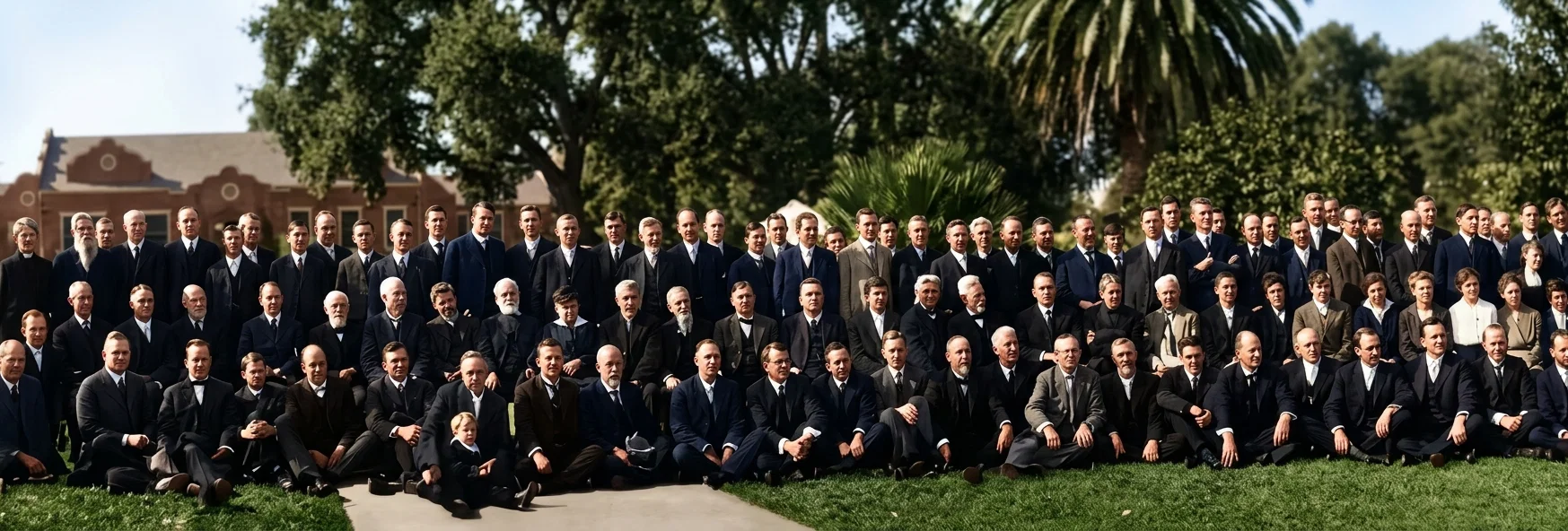
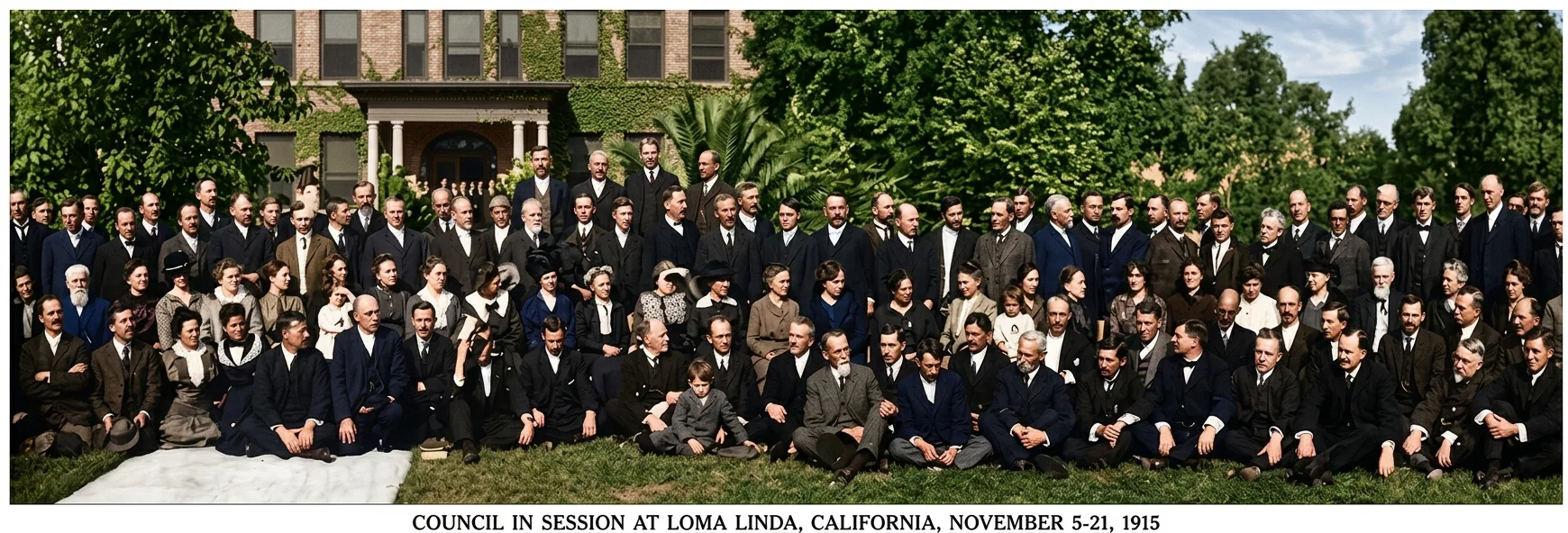
THE biennial council of our General Conference assembled in Loma Linda, California, from November 5 to 21. In connection with this meeting of the General Conference, our North American Division also gathered in council.
The General Conference meetings were held in the forenoon of each day, and the afternoons were given to the North American Division.
Committee work began at six o’clock in the morning, and every moment of the day until nine in the evening was filled with busy activities. Indeed, some of the committees continued their labors, on numerous occasions, until far into the night.
This being a biennial council merely, it was not planned to have anything like as full a representation as when the regular sessions of the General Conference are held. Nevertheless, there were representatives present from Australasia, Java, China, India, Europe, and several from Canada; while from the United States, in addition to the officers of the General and the North American Division Conference, there were present most of the presidents of the local and the union conferences.
The council was greatly pleased to have among its delegates five old veteran ministers who were in the neighborhood of eighty years of age, some of them being past eighty. They were Elders George I. Butler, J. N. Loughborough, S. N. Haskell, H. W. Decker, and J. H. Rogers. It was an inspiration to hear the testimony of these tried servants, who through a long life have devoted their powers to the promulgation of the great message of the soon coming of the blessed Christ.
The council was marked by deep earnestness, determined enthusiasm, and a spirit of world-wide aggressiveness. Every individual on earth, be he in civilized land or in far-away jungle, must be greeted with the prophetic evidence that Christ is soon coming. This is a great message of joy and hope to carry to this dark world; and with such a message actuating the life, every member of the church should be an earnest, active worker, doing what he or she can for the advancement of the great cause.
As should be expected, the central theme of the council was earnest evangelism. The time was largely devoted to the study of the most successful methods of soul winning. How may every creature be reached most quickly, and made aware of the glorious news God is sending to the world—the news of the returning Christ, who will bring an end to all sadness and sin?
Already our people have their work well established and organized in eighty-seven countries.
At the close of 1914, our total membership stood at 125,844. There had been a gain in membership, during the year, of 11,287, almost ten per cent. 113 new churches were organized during the year. Of the 125,844 members, 9,360 are devoting their entire time to the advancement of this work, as ministers, teachers, publishers, medical evangelists, nurses, colporteurs, etc. That is to say, one of every thirteen of our church members gives his entire time to the work of advancing the cause we have espoused. The report also shows that one person of every seventy-seven in our denomination is a teacher either in one of our schools in this country or else in our schools and mission stations in foreign lands.
As might be expected, when so large a percentage of the denomination devote their entire time to the work, the members who are not devoting their whole time to the cause show a correspondingly marked activity. Hence we were not surprised to have presented to the council the report that 911 persons were added to our church in a single quarter through the activities of the laity.
As showing what some of our local churches are doing, Brother Quinn, president of the Atlantic Union Conference, told of our church at Portland, Maine. There are only sixty members in the organization, and none of them are wealthy. At the beginning of 1914, they had a debt of $8,000 on their meeting house, which they paid off in the first eight months of the year. Their activities were of such a character that it became necessary for them to build an annex to the meeting house. This cost $1,700 additional. But these local expenses did not diminish their interest in the foreign mission field; for during that same year, 1914, the membership of that church gave on an average $21.84 each to foreign missions, and all this in addition to the regular tithe they paid for the support of the work both at home and abroad.
While the year 1914 throughout the field showed a big increase in every department of our work over any previous year, yet case after case was reported in which the first nine months of 1915 have shown a greater advancement than the whole of the year 1914. For instance, Elder Christian, reporting from the Lake Union Conference, stated that the baptisms in 1914 were 1,012, while in the first nine months of 1915 they were 1,202, or an increase of 190 in the first nine months of this year over the whole of last year. And this is illustrative of many similar reports.
The report of the way our people have given for the advancement of this work was one of the most inspiring things in connection with the council. We have quite complete records of our organized work since the year 1863. Since that time, our people have contributed $31,675,894.76. But let it be remembered that $3,090,484.80 of that sum was contributed in the year 1914.
The amount given by each church member during 1914 averaged, throughout the world, $35.45; while if we take our membership in North America alone, the average is $45.81 a member. Going back to the year 1863, the average per capita paid into our denominational treasury was only $2.29; but the earnestness and aggressive faith of our people have risen year by year as time has passed, until the splendid result of 1914 was reached. There has been a steady climb, and continued, earnest advancement.
It is never becoming to Christians to boast, and what they say in regard to their work should not be said in the spirit of boasting; but the presentation of fact will oftentimes serve as a stimulus, and it is with the hope of inspiring helpfulness that we make a few comparisons.
The average per capita contributions of the members of all other Protestant bodies in the United States were only sixty-three cents for the year. The figures range all the way from $1.93 a member in one denomination on down to the lowest, which was twenty-one cents a member. May it not be possible that the great difference between giving twenty-one cents a year a member and $45.81 a member, is brought about through the powerfully stimulating joy of believing that Christ is soon coming again, and the desire to impart this joy to every creature that may be reached?
The part that our Sabbath schools have played in the work of giving in support of our missions was very strikingly told by Mrs. Plummer, the secretary of our Sabbath School Department. Through charts that would appeal to the eye, as well as words that would appeal to the ear, she presented the fact that the first twenty-five years during which our Sabbath schools made a special work of donating to missions, yielded only a little over a million dollars for that purpose; but the second million was raised by our Sabbath schools in three and one fourth years, ending with March 31, 1915. And now the goal is set to raise the third million through our Sabbath schools during the last nine months of 1915 and the year 1916.
In 1903, we had one lone worker in China, who had a Sabbath school there all by himself; but now we have ninety-three Sabbath schools, with over 3,000 attendance, in that great field. Mrs. Plummer also informed us that our Sabbath school membership is greater than our church membership, which was an item that brought much good cheer into the council.
During the biennial period just closed, our9Sabbath schools had set apart fourteen different days on which special donations should be taken up for worthy objects in the foreign mission fields. These fourteen days of giving alone netted the splendid sum of $217,073.36.
Our publishing work has also shown marvelous development. With scarcely any equipment at the beginning, we now have thirty-nine well equipped publishing houses and branches, and are sending out literature in some ninety-two different languages. Our last statistical report gives the number of languages as eighty-nine, but brethren at the council reported some three other languages that have recently been entered with our publications. From 1845 to 1854, we sold only $2,500 worth of our literature; 1855 to 1864, we sold $17,500 worth; 1865 to 1874, $73,000 worth; 1875 to 1884, $371,000 worth; 1885 to 1894, $3,969,000 worth; 1895 to 1904, $3,144,000 worth; 1905 to 1914, $14,086,000 worth; or a grand total, during the time, of $21,663,000 worth of our publications that have gone to the world.
It is very interesting to observe, from the foregoing figures, that it took us forty years to sell $464,000 worth of our publications. But during the next ten years, we made the big jump to $3,969,000 worth. Then during the ten years from 1895 to 1904, we struck a period of hard times, and withal were reorganizing and changing over our work, so we did not sell quite as much as in the ten years between 1885 and 1894. But the ten years immediately following 1904 show the big increase that enabled us to reach the splendid figures of $14,086,000. Or to put it in another way, during the ten-year period from 1904 to 1914, we sold almost twice as much literature as we did in the first half century of the history of our publishing work.
While the reports showed most excellent progress in all lines, it was a source of encouragement to the council to hear the statistical secretary state that there had been remarkably few apostasies from the faith. Those who take their stand with us, almost invariably remain firm, and become active workers in the good cause.
The council voted unanimously to use the SIGNS OF THE TIMES as the medium in presenting the harvest ingathering campaign of 1916.
The council eagerly listened to the reports of Elder W. J. Fitzgerald, president of the British Union Conference, and also of Elder L. E. Conradi, president of the European Division. These brethren have been laboring right in the heart of the great war that has been going on for more than a year; but notwithstanding the difficulties, our work has made a very substantial progress.
We were prepared to hear from them that the work was very materially curtailed; but instead of receiving such a discouraging report, our hearts were made glad by the good progress that had been made. Elder Conradi, reporting for the European field, told us that 4,857 persons had been baptized into the faith during 1914, which was only 154 less than the year preceding. The tithes paid by our people in Europe for the support of their local work was $354,597, or only about $18,000 less than the preceding prosperous year. In addition to their tithe, the same brethren donated, during 1914, $96,000 for missionary operations outside their own territory, which fell only $10,000 short of the year before the war.
Our publishing houses in Europe, notwithstanding the broken up condition caused by the war, were able to sell $424,000 worth of our literature, which fell only $58,000 short of the sales of the year before. These figures show us that our work is able to make strong headway under the most forbidding and difficult circumstances.
Elder G. W. Caviness, who has labored in Mexico most of the time while the revolution has been in progress there, also reported good success, and bore his testimony to the protecting hand of God over the workers in that war-torn country. As the workers go forward bearing their message, they are made to feel the care of the heavenly Father, who is seeking to convey to the world the great message that His Son is soon to return, not only to bring an end to wars, but to bring to an eternal end every other evil thing.
Among the very important moves made was the strengthening of the organization of the Asiatic section of our work. The council organized the Far Eastern Division Conference, which will embrace Australasia, India, Burma, China, and Japan, including the many islands bordering on this territory.
Our work in that Asiatic and Oceanic field has assumed proportions which require the presence of a number of strong, experienced men, who can counsel together, and decide important questions without the delay necessary to submit them to our foreign mission board at headquarters in Washington, D. C.
Elder R. C. Porter was elected president of the Far Eastern Division Conference; Elder J. E. Fulton, of Australasia, was elected vice president and secretary; and Henry W. Burrows, of Vermont, was elected treasurer and auditor.
The work in South America was also strengthened by more fully completing the organization. Elder O. Montgomery, president of the Southeastern Union Conference, was asked to go immediately to South America, to take general supervision of the work in that field. He told the council that he had his affairs in such shape that he would be able to sail early in December. Other laborers will accompany him to strengthen further the work in that field.
The outlying mission districts of the world are calling loudly for experienced men from the home land, and the call will be louder and louder as the work advances. Never was there a cause that gave more inspiring promise to young men and young women to enter upon a career that is destined to terminate so sublimely—a career that meets its great climax when all the splendors of the universe combine to make glorious the return to earth of Him who is King of kings and Lord of lords—the blessed Christ, our divine Saviour.
Joy in Believing
By A. J. Cole
Found Her Way to God — Rejoiced to Find Him a Tender, Loving Father — The Sadness All Taken Out of Her Life
By A. J. COLE
The following extract is called “Joy in Believing,” and is from the “Chronicles of Else,” an innocent-hearted maiden, who at last succeeded in disentangling herself from the Roman Catholic Church.
The joy of an artless soul in discovering what a simple thing Christianity in reality is, and its outpouring gratitude, are drawn with great beauty, tenderness, and power.
The extract was in two parts. The first part was dated March, 1513, and this Else was described as one of the Schonberg Cotta family, who were among Martin Luther’s earliest friends, and were associated with him while he was a Catholic priest.
TAUGHT BY DR. LUTHER
MARCH, 1513.
Dr. Luther has consented to be our confessor. Thank God! I do believe at last I have found the religion which may make me, even me, love God. Dr. Luther says I have entirely misunderstood God and the Lord Jesus Christ. He seemed to understand all I have been longing for and perplexing myself about all my life, with a glance. When I began to falter out my confessions and difficulties to him, he seemed to see them all spread before him, and explained them all to me. He says I have been thinking of God as a severe judge, an exacter, a harsh creditor, when He is a giver, a forgiving Saviour, yea, the very fountain of inexpressible love.
“God’s love,” he said, “gives in such a way that it flows from a Father’s heart, the well-spring of all good. The heart of the Giver makes the gift dear and precious; as among ourselves we say of even a trifling gift, ‘It comes from a hand we love,’ and look not so much at the gift as at the heart.”
PURE, UNUTTERABLE LOVE
“If we will only consider Him in His works, we shall learn that God is nothing else but pure, unutterable love, greater and more than any one can think.
“The shameful thing is that the world does not regard this, nor thank Him for it, although every day it sees before it such countless benefits from Him; and it deserves, for its ingratitude, that the sun should not shine a moment longer, nor the grass grow; yet He ceases not, without a moment’s interval, to love us, and to do us good. Language must fail me to speak of His spiritual gifts. Here10He pours forth for us, not sun and moon, nor heaven and earth, but His own heart, His beloved Son, so that He suffered His blood to be shed, and the most shameful death to be inflicted on Him, for His wretched, wicked, thankless creatures. How, then, can we say anything but that God is an abyss of endless, unfathomable love?”
“The whole Bible,” he says, “is full of this, that we should not doubt, but be absolutely certain, that God is merciful, gracious, patient, faithful, and true; who will not only keep His promise, but already has kept, and done abundantly beyond what He has promised, since He has given His own Son for our sins on the cross, that all who believe on Him should not perish, but have everlasting life.”
EACH ONE LOVED OF GOD
“The apostles are always exhorting us,” he says, “to continue in the love of God; that is, that each one should entirely conclude in his heart that he is loved by God, and set before our eyes a certain proof of it, in that God has not spared His Son, but given Him for the world, that through His death the world might again have life.”
“It is God’s honor and glory to give liberally. His nature is all pure love; so that if any one would describe or picture God, he must describe one who is pure love, the divine nature being nothing else than a furnace and a glow of such love that it fills heaven and earth.”
“Love is an image of God, and not a dead image, nor one painted on paper, but the living essence of the divine nature, which burns full of all goodness.”
“He is not harsh, as we are to those who have injured us. We withdraw our hand, and close our purse; but He is kind to the unthankful and the evil.”
“He sees thee in thy poverty and wretchedness, and knows thou hast nothing to pay. Therefore He freely forgives, and gives thee all.”
MY GRACIOUS FATHER
“It is not to be borne,” he said, “that Christian people should say, ‘We cannot know whether God is favorable to us or not.’ On the contrary, we should learn to say, ‘I know that I believe in Christ, and, therefore, that God is my gracious Father.’”
“What is the reason that God gives?” he said one day. “What moves Him to it? — Nothing but unutterable love, because He delights to give and bless. What does He give? — Not empires merely, not a world full of silver and gold, not heaven and earth only, but His Son, who is as great as Himself, that is eternal and incomprehensible — a gift as infinite as the Giver, the very spring and fountain of all grace, yea, the possession and property of all the riches and treasures of God.”
Dr. Luther said, also, that the best name we can think of God is “Father.” “It is a loving, sweet, deep, heart-touching name; for the name of ‘Father’ is, in its nature, full of inborn sweetness and comfort. Therefore, also, we must confess ourselves children of God, since there is not a sweeter sound to the father than the voice of the child.”
All this is wonderful to me. I scarcely dare to open my hand, and take this belief home to my heart.
It is then, indeed, thus we must think of God. Is He indeed, as Dr. Luther says, ready to listen to our feeblest cry, ready to forgive us and to help us?
HAVE COME BACK
And if He is indeed like this, and cares what we think of Him, how I must have grieved Him all these years! Not a moment longer — I will not distrust Him a moment longer. See, heavenly Father, I have come back!
Can it indeed be possible that God is pleased when we trust Him, pleased when we pray, simply because He loves us? Can it indeed be true, as Dr. Luther says, that love is our greatest virtue, and that we please God best by being kind to each other, just because that is most like Him? I am sure it is true. It is so good, it must be true. Then it is possible for me, even for me, to love God. How is it possible for me not to love Him? And it is possible for me, even me, to be religious, if to be religious is to love God, and to do whatever we can to make those around us happy.
But if this is indeed religion, it is happiness, it is freedom, it is life.
Why, then, are so many of the religious people I know of a sad countenance, as if they were bond servants, toiling for a hard master?
I must ask Dr. Luther.
LUTHER UNMASKS THE DEVIL
APRIL, 1513.
I have asked Dr. Luther, and he says because it is the devil makes a great deal of the religion we see; that he pretends to be Christ, and comes and terrifies people, and scourges them with the remembrance of their sins, and tells them they must not dare to lift up their eyes to heaven; God is so holy, and they are so sinful. But it is all because he knows that if they would lift their eyes to heaven, their terrors would vanish, and they would see Christ there, not as the judge, and the hard, exacting creditor, but as the pitiful, loving Saviour.
I find it a great comfort to believe in this way in the devil. Has he not been trying to teach me his religion all my life? And now I have found him out. He has been telling me lies, not about myself (Dr. Luther says he cannot paint us more sinful than we are), but lies about God. It helps me almost as much to hear Dr. Luther speak about the devil as about God — “the malignant, sad spirit,” he says, “who loves to make every one sad.”
With God’s help, I will never believe him again. But Dr. Luther said I shall, often; that he will come again and malign God, and assail my peace in so many ways that it will be long before I learn to know him.
TOLD ME A BEAUTIFUL STORY
I shuddered when he told me this; but then he reassured me by telling me a beautiful story, which he said was from the Bible. It was about a good shepherd, and silly, wandering sheep, and a wolf who sought to devour them. “All the care of the shepherd,” he said, “is in the tenderest way to attract the sheep to keep close to him; and when they wander, he goes and seeks them, takes them on his shoulder, and carries them safe home. All our wisdom,” he says, “is to keep always near this good Shepherd, who is Christ, and to listen to His voice.”
I know the Lord Jesus Christ is called the good Shepherd. I have seen the picture of Him carrying the lamb on His shoulder. But until Dr. Luther explained it to me, I thought it meant that He was the Lord, and owner of all the world, who are His flock. But I never thought that He cared for me as His sheep, sought me, called me, watched me, even me, day by day.
WHY IS IT NOT PREACHED?
Other people, no doubt, have understood all this before. And yet, if so, why do not the monks preach of it? Why should Aunt Agnes serve Him in the convent by penances and self tormentings, instead of serving Him in the world by being kind and helping all around? Why should our dear, gentle mother have such sad, self-reproachful thoughts, and feel as if our family were under a curse?
This, then, is what the crucifix and the Agnus Dei mean. Doubtless many around me have understood all this long ago. I am sure, at least, that our Eva understood it.
But what inexpressible joy for me, as I sit at my embroidery in the garden, to look up through the apple blossoms and the fluttering leaves, and to see God’s love there; to listen to the thrush that has built his nest among them, and feel God’s love, who cares for the birds, in every note that swells his little throat; to look beyond to the bright blue depths of the sky, and feel they are a canopy of blessing, the roof of the house of my Father; that if clouds pass over, it is the unchangeable light they veil; that even when the day itself passes, I shall see that the night itself only unveils new worlds of light; and to know that if I could unwrap fold after fold of God’s universe, I should only unfold more and more blessing, and see deeper and deeper into the love which is at the heart of all!763
SAW JOY IN EVERYTHING
And then what joy again to turn to my embroidery, and, as my fingers busily ply the needle, to think, This is to help my father and mother; this, even this, is a little work of love. And as I sit and stitch, God is pleased with me, and with what I am doing. He gives me this to do, as much as He gives the priests to pray and Dr. Luther to preach. I am serving Him, and He is near me in my little corner of the world, and is pleased with me, even with me.
Oh, the change which has come over my heart, now that I have learned, through Dr. Luther’s teaching, that God is love — is our Father; that Christ is the Saviour, who gave Himself for our sins, and loved us better than life; that heaven is our Father’s house; that holiness is simply loving God, who is so good, and who has so loved us, and loving one another; that the service we have to render is simply to give thanks and to do good; when, as Dr. Luther said, that word “our” was written deeply in my heart — that for our sins He died, for mine; that for all, for us, for me, He gave Himself up!