The Youth’s Instructor, Vol. 38, No. 16.

A PRAYER

The Youth’s Instructor

Apr 16, 1890

S. D. A. Publishing Association · Battle Creek, Mich. · Apr 16, 1890

A PRAYER.

Be thou my friend, O Christ, thou Shepherd tender, When earth is fair, and all the sky is bright, When o'er my pathway falls in noontide splendor Prosperity's sweet and enchanting light.
When skies are dark and lowering, be thou near me, To clasp my weak and trembling hand in thine, And from thy throne above send down to cheer me A beam of light, an influence divine.
Then 'mid the storm and darkness round me folding, And pitfalls yawning near on every side, I will not fear while thy dear hand I'm holding; Naught can befall when thou art near to guide.
Be thou my friend when earthly friends shall fail me, And love's sweet cup be rudely dashed away; When hate's fierce darts and envy's stings assail me, When earthly idols prove but common clay.
If thou but fold thine arms of love around me, And hold me closely to thy pitying heart, How can the loss of this world's good confound me? How can I feel deserted where thou art?
In that dread hour, when, like terrific thunder, The voice of God shall shake from pole to pole, When mountains from their bases rend asunder, And e'en old ocean seems to spurn control,
O, then be thou my strength and my salvation, My strong deliverer, and my all in all; And so, amid the death-pangs of creation, I can rejoice, though thrones and kingdoms fall!
VIOLA E. SMITH.

HUDSON RIVER.

ONE of the great rivers of the United States is the Hudson, the American Rhine. It is more closely associated with the history of our country than any other large river. Many of the most important events of the Revolution took place in its vicinity.
HEAD WATERS OF THE HUDSON.
It rises in the Adirondack Mountains, and flows south, through the eastern part of New York State, to New York Bay. Around its head waters the scenery is very fine, but as we follow it southward, the graceful landscape gives place to the bold and imposing characteristics that mark its lower portion.
Many large and flourishing cities are scattered along its entire length. Going up from New York City, we pass Yonkers, where many wealthy men from the metropolis have located; Dobb's Ferry, an important point during the Revolution; Haverstraw, where Arnold and Andre met; Tarrytown, near which is the famous “Sleepy Hollow;” Sing Sing, where the State prison is situated; Stony Point, where a light-house, a keeper's lodge, and a fog-bell only are left to tell where the old fort was; West Point, the seat of the national military school; Poughkeepsie, a thriving city; Albany, the State capital; Troy, a large manufacturing city; and many others, which we have not space to notice.
There are natural and historic scenes of peculiar interest all along the route. The river itself, about four miles wide, is grand in its calmness. Scarcely a ripple breaks its glassy floor, except where the steamers, plying up and down its surface, send their gentle waves out to meet the distant shores.
The one feature of the Hudson, which is probably the most famous, is the “Palisades.” They extend along the western shore for about thirty-five miles. They rise directly from the water in a perpendicular wall, from three hundred to six hundred feet high. The highest point is opposite Sing Sing, 666 feet above tide-water. The face of the palisades is rude, columnar, and almost unbroken; but now and then a rift in the rock reveals glimpses of the beautiful landscape beyond. The top of this rocky wall is quite narrow, and covered with a thin growth of trees.
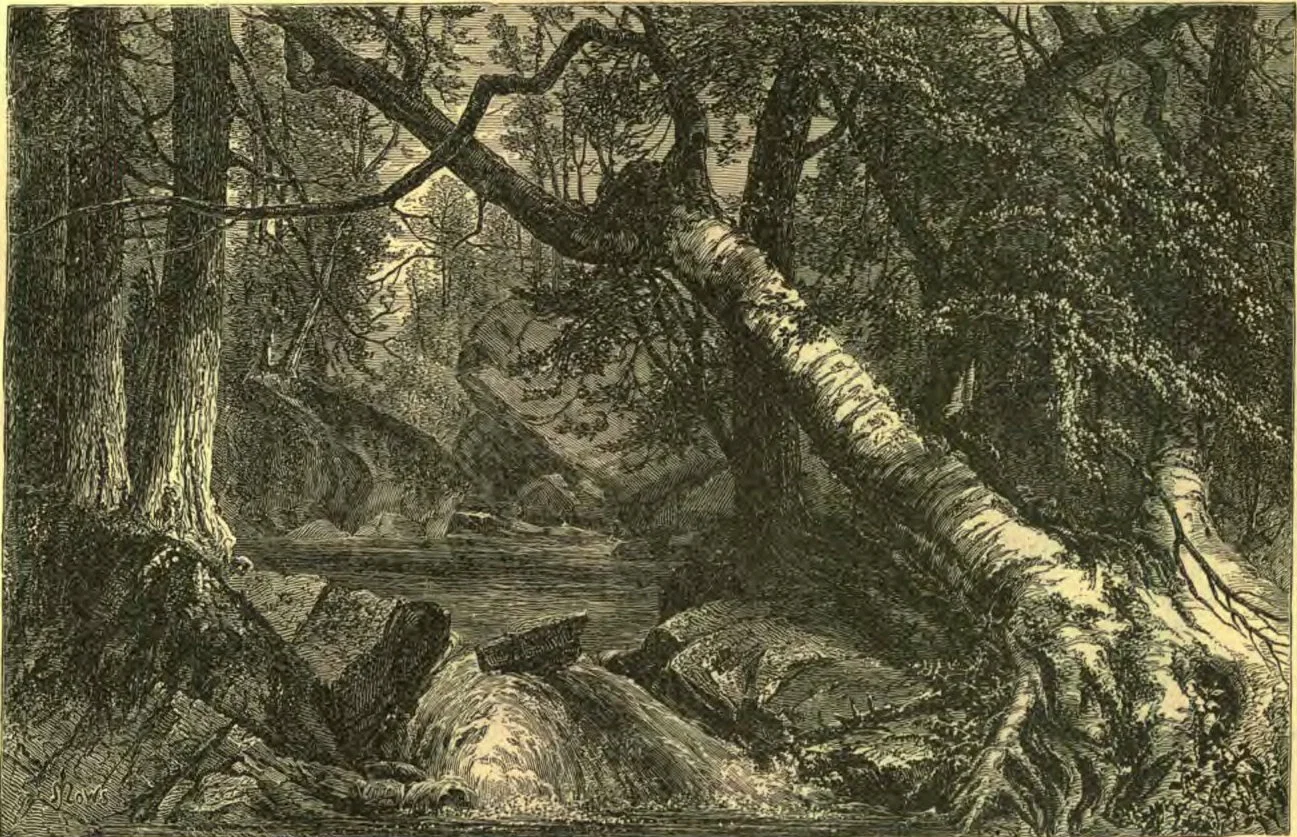
On its western bank, in full sight of its wide waters, lived Washington Irving, one of America's greatest authors. “Sunnyside” has become a household word; and in my childhood a picture of the vine-covered cottage and shaded lawns was my particular delight. A few years ago, as the train wound by the river-bank, I caught a glimpse of the reality of my dream—the same cottage, almost hidden by ivy, and stately trees flecking the slope of the grassy bank. From Mr. Lossing we quote the following description of the place:— “I visited Sunnyside, and strolled along the brook at the mouth of the glen, where it comes down in cascades before entering the once beautiful little bay, now cut off from free union with the river by the railway. The channel was full of crystal water. The delicate foliage was casting delicate shadows where, at this time, there is half twilight under the umbrageous branches, and the trees are full of warblers. It is a charming spot, and is consecrated by many memories of Irving and his friends, who frequented this romantic little dell when the sun was at its meridian. After awhile, I climbed its banks, crossed the lane, and wandered along a shaded path to a hollow in the hills, filled with water. This pond, which Mr. Irving called the ‘Mediterranean Sea,’ was made by damming the stream, and thus a pretty cascade at its outlet was formed. It is in the shape of a ‘palm-leaf’ that comes from the loom. On one side a wooded hill stretches down to it abruptly, leaving only space enough for a path, and on others it washes the feet of gently grassy slopes. This is one of the many charming pictures to be found at Sunnyside.”
The Croton Aqueduct, a huge artificial water-way, by which New York City is supplied with pure water, follows the Hudson River throughout its entire length, and about half a mile from it. Work was begun on this aqueduct in 1837, and finished in 1842. Its cost was $12,000,000. Its source is in an artificial lake, 166 feet above mean tide-water at New York, and capable of holding 500,000,000 gallons of water. From forty to fifty million gallons pass through this aqueduct every twenty-four hours.
“Its course is marked by culverts and arches of solid masonry, and its line may be observed at a distance by white stone towers, about fifteen feet high, placed at intervals of a mile. These are ventilators of the aqueduct; some of them are quite ornamental, while others are simple mud towers, and every third one has a square base, with a door, by which a person may enter the aqueduct.”
The Highlands of the Hudson are in the vicinity of Newburgh, a place situated in the midst of the grandest scenery along the river. On the lofty peaks of the Fishkill Mountains, signal-fires were lighted during the Revolution.
Catskill Mountains, on our route, are very beautiful. At every turn in the road leading up the mountains, the traveler discovers some new scene of loveliness. A coy stream dances along beside us, now peeping out like a shy maiden, then hiding its sunny face in the tangled wilds of the forest. The road is very tortuous, and in its ascent up the glen is almost inclosed by rocks and trees. Part way up this magnificent gorge is a little nook, in which nestles the cabin where Rip Van Winkle is said to have taken his twenty years' nap. This legend of Irving's, and his descriptions of the surrounding country, have made the Catskills famous.
MARY STEWARD.

MIND THE DOOR.

Have you ever noticed how strong a street door is?—how thick the wood is, how heavy the hinges, what large bolts it has, and what a firm lock? If there were nothing of value in the house, or no thieves outside, this would not be wanted; but, as you know, there are things of value within and bad men without; there is need that the door be strong, and we must mind the door, especially as to barring and bolting it at night.
We have a house; our heart may be called that house. Wicked things are forever trying to break in and go out of our heart. Let us see what some of these bad things are.
Who is that at the door? Ah! I know him. It is Anger. What a frown there is on his face! How his lips quiver! How fierce his looks are! We will bolt the door and not let him in, or he will do us harm.
Who is that?—It is Pride. How haughty he seems. He looks down on everything, as if it were too mean for his notice. No, we shall not let you in, so you may go.
Who is this? It must be Vanity, with his flaunting strut and gay clothes. He is never so well pleased as when he has his fine suit to wear, and is admired.
Mind the door! Here comes a stranger. By his sleepy look and slow pace we see that we know him. It is Sloth. He likes nothing better than to live in my house, sleep and yawn my life away, and bring me to ruin. No, no, you idle fellow! work is pleasure, and I have much to do.
But who is this? What a sweet smile! What a kind face! She looks like an angel. It is Love. How happy she will make us, if we ask her in!
Oh! if children kept the door of their hearts shut, bad words and wicked thoughts would not go in and come out as they do. Open the door to all things good; shut the door to all things bad. We must mark well who comes to the door before we open it, if we would grow to be good men and women. Keep guard; mind the door of your heart.—Selected.

Among the Pines.

When traveling north by rail, through one of our northern States, which supplies a large portion of the pine lumber used throughout the country, the forests are observed to close dense and dark about us, and the tall trunks of the trees, branchless except near the top, present a dreary aspect. The ground is strewn with the needle-like leaves, commonly called evergreen, but really never green, compared with the lighter foliage of other regions, and in winter a dingy brown. But this dismal outlook is counterbalanced to some degree by the abundance of lovely ferns springing from the sodless soil, and by an occasional glimpse of a stump or tree-trunk luxuriantly festooned with the beautiful poison ivy.
Soon we enter a tract of “burned district,” where black, charred trunks stand as somber witnesses of the ruin wrought by forest fires, or lay strewn many deep on the ash-covered ground. In some places tall weeds appear as the first tokens of life in this dead waste; while next are seen the red-raspberry bushes, replacing the blackberries, which bore profusely in the shade of the living pine.
Occasions of dire disaster are these forest fires, when for days the sun is entirely obscured by the all-pervading smoke, or appears like a copper ball in the sky; and homesteaders are sometimes compelled to find a dangerous exit from their little clearings, leaving buildings and goods to the fire’s destruction. There have been instances where those thus fleeing have been suffocated by the smoke, and fallen in the narrow wood roads; but happily such serious cases are not of common occurrence.
The land on which pine timber grows is usually very poor, and hence not generally cleared and cultivated; but hard wood is often interspersed among the pine; and accordingly we find new farms opening up in the midst of the pinery, some of them presenting the novel spectacle of a fence of upturned stumps, whose vast network of roots, if they have not been cut off, reach high in air. More commonly, however, the farm fences are of logs, two or three tiers high, and chinked with fragments of limbs and roots.
In the villages, the mills are the principal feature, there being often one or two of these to each one hundred inhabitants, while logs and lumber are generally more abundant than houses, and stumps necessitate frequent curves in driving through even the principal streets. The houses are commonly poor, paintless structures, built hastily and merely to furnish shelter, time being deemed much more precious than anything else, though we would consider it wasted in the erection of such buildings. In sections where the supply of timber suitable for lumber has been exhausted, and that remaining is utilized in the manufacture of shingles, I have often seen cull shingles substituted for siding; and not infrequently builders’ paper, fastened at the edges with laths, forms the black exterior of houses.
Nearly all laths are made from slabs and refuse boards; though in small mills this material is often wasted, being used, together with sawdust, to feed the furnace, or burned outside, or added to the immense heap of sawdust which marks the site of nearly every saw-mill.
We will not attempt to study the process of lumber manufacture, but will take a peep at domestic life in the lumber camps, where men are engaged in felling timber, sawing it into logs, and dragging it to the roads, which are often turnpiked with logs or brush, or built up with sawdust. The felling of timber is a dangerous employment; for often a tree, in falling, strikes another with sufficient force to be diverted from its intended course, or to send a limb crashing down, or even to fell the second; while sometimes a third is struck by the second, falling upon supposedly safe ground, if not upon the alert woodsman.
The buildings of a camp consist of stables, “cooks’ shanty,” and “men’s shanty,” the latter generally divided into store-room for supplies and sleeping-room for the men, the beds being mere bunks, or shelves, ranged one above another, and covered with straw, while the only bedding is coarse blankets or comfortables, over which an unmentionable insect runs riot. The cooks’ shanty is also separated by a partition into two rooms, one being a sleeping apartment, the other serving as both kitchen and dining-room. A long pine table is supplied three times a day with bread, molasses, potatoes, pork, beans, and possibly butter, crackers, and other dishes; and the men, seated on benches at each side of the table, help themselves without ceremony. A general laugh is provoked when a new hand is so exceptionally polite as to pass a dish.
Notwithstanding the roughness of camp life, a day may be very agreeably spent in such a place. True, the knot-holes in the floor sometimes invite the stealthy entrance of a snake, while bonfires, or “smudges,” are required in the evening to secure respite from the huge and myriad mosquitoes which infest pine forests; but the woods contain many attractions,—the most lovely flowers, which are nowhere found under cultivation, numerous varieties of mosses and ferns, funguses large enough to be converted into brackets, wintergreens in profusion, and, in stormy weather, the sublime music of the wind among the pines, which is often so loud as to be mistaken for the rumbling of a railroad train.
Mrs. Ada D. Wellman.

READY TO BEGIN.

EVERY fall an army of boys enters the business world. Each boy will feel sure that he is going to make a grand success, and if he does not feel that way, he is not much of a boy. A great many boys fail, not because they have not ability, but because they want to begin at the top; they are not willing to shovel, but want to make their way in cushioned chairs. The men who fill cushioned chairs with the greatest dignity, are those who never hesitated to shovel, if shoveling helped to make a path upward. The boy who wants the freedom and ease of the head of the firm will find plenty of freedom in life, but no ease. His freedom will consist in walking about trying to find a new position. The boy who is willing to be a boy, and do a boy's part in the world, keeping eyes and ears open for opportunities to learn every detail of the business in which he is engaged, will find his chance to step higher every year. Do not fear to ask questions. If you do not understand a thing, study until you do find out all there is to know about it. Do not fear to get to your business a little early, or stay a little late. Keep your mind on your share of the work; do not try to manage for the whole business firm. I remember a man who used to amuse me very much. He never earned more than fifteen dollars a week until he had passed fifty years of age, and during his married life his wife had earned more than he had. Yet he would grow intensely excited because a large and exceedingly prosperous corporation would not adopt his plans, though his connection with it was paying his fare as passenger on its cars. The firm who paid, would, if managed by him, grow wealthy in a year, he insisted. Still the firm dispensed with his valuable services, and were able to conduct business. That man had been so busy all his business life, planning affairs with which he had no connection, that he really had no time to think of his personal work. He was not lazy, but he did not know enough to mind his own business.
Some boys feel that they must wait until they find the particular kind of work they want to do. I remember a young German who was a very popular and successful teacher. He came to this country, and was cheated out of his money as soon as he arrived here. He hired out to dig a ditch on a gentleman's place in the country, and went to work as a laborer. One day the gentleman's wife wished a box marked to go by express. The box was in the barn, and when she went there, the young German was looking for a pick. The coachman and gardener had gone away to another part of the grounds. The German laborer asked if he could assist the lady, and she answered, “No; I wanted that box marked.” The young man offered to do it, picking up the paint brush. The lady was too polite to hurt his feelings, and gave him the direction. He marked the box so quickly and correctly that the lady knew at once that he must be an educated man, and found out his story. Within a week he had five pupils studying German, and to-day is the German tutor in a large school, respected and loved, though all his pupils know he entered the town a day-laborer. The boy whose feelings are so big that he must always have the highest wages for the least work, never has anything big but his feelings to take care of.—The Christian Union.

OUR MISSIONARY SHIP

A SHIP, a ship, will sail the seas; God grant her many a favoring breeze, And speed her course, 'neath Heaven's smile, To many a country, many an isle: And make her like a star of light To many a soul that waits in night— Our missionary ship.
Her sails will be of snowy white, Spread out like wings in heaven's light; She'll sail away like some bright bird, Bearing the lamp of God's own word; Over blue seas to ports afar Will go our glorious morning star— Our missionary ship.
Upon her decks sweet hymns will rise, And float like incense to the skies; And prayers from day to day be heard, To spread the tidings of God's word: And oh! our prayers will follow too, O'er all the reach of waters blue, Our missionary ship.
People will gather to the strand To see her crew and cargo land, And men will scatter precious seed, Papers and tracts and books to read; And thou shalt see with joyful awe, How islands wait for Heaven's law— Our missionary ship.
How glad they'll be at Pitcairn's Isle! How brows will light, and lips will smile! How men rejoice, and clap glad hands, When brethren meet from distant lands, When, as we'd greet in courts above, They welcome with unselfish love Our missionary ship!
And angels will be glad, I know, To see our pretty ship soon go. Each child in her may have a part, And send God's truth to some sad heart. Oh, give and plan and have no fear, The ship may sail within a year— Our missionary ship.
FANNIE BOLTON.

THANK YOU.

WHEN you receive a gift or a favor, even if it be a small one, be sure to say, “Thank you.” Be polite in little things, for thereby you show a well-trained character, and that is surely not a little thing. Do not act as if all your friends were bound to do you favors, as if you were a king, and they only obedient subjects. If you fail to express kindness for favors shown, your friends may get tired of your constant demands, and raise the standard of rebellion.
It does not always follow that one lacks heart who fails to show gratitude for gifts received. He may lack thought, or his education in the home circle may be faulty. If you have failed in the past, improve without delay, and thank the giver in a pleasant voice and with an unstudied smile.—Selected.

Duty Rather Than the Pursuit of Happiness

THERE is nothing more contemptible, unmanly or unwomanly, and craven, than the everlasting sighing for “happiness.” Those who have the most of it think the least about it. But in thinking about and doing their duty, happiness comes.

BETH AND THE FLOWERS.

4. "SPRING is here!" exclaimed little Beth. "Papa said so last night. It touched my cheek, and woke me up With pretty sunbeams bright. It woke the flowers up, too, I guess,— I'll run right out and see; I s'pose they're sticking up their heads. Thinking how s'prised I'll be!"
But when our sweet, wee lass came in, Tears filled her eyes so blue,— "Mamma, it's spring, and not one flower Has put its head up through." But soon her face was all aglow: Tears gone like April rain. A happy thought had come to her, She hastened to explain.
"Mamma, I think that they're all right: Perhaps they woke up cold, And just turned over in their beds, And to each other told, 'Let's take another nap, and wait Until we surely know It's nice and warm up there, and then We'll jump right up and grow.'"
"I've felt just so myself, sometimes, So they are not to blame. I won't say, 'cause they lie in bed, 'O sleepy heads, for shame!' For, dear mamma, I've truly had To shiver and to shake When I've been up before the fire Was burning in our grate." —Selected.

THE CHILDREN OF THE SNOW.

Some years ago, Elisha Kent Kane, the Arctic traveler, wrote much about the children of the regions which he visited. Since then, other explorers have added to Dr. Kane’s account, until we know a good deal about the boys and girls of the snow. The igloo, which is the funny name of the ice-house of the Eskimo, is the narrow play-ground of the children when the snow is deep, and the weather is bitter cold.
“The girls amuse themselves with queer-looking dolls, whose heads may have been carved out of walrus ivory; for there is no wood where the long, cold nights are. They dress the dolls in soft deer-skins, and take the ears of the Arctic fox for doll hoods. Sometimes these little ladies of the cold will go visiting, just as the little misses of our country do; and when they go, they always take the doll along. Dolly rides in a sled, which the girls, wrapped in their garments of bear-skin, pull over the snow in high glee. These visits are often made at night, and for hours a group of Eskimo girls will make an igloo resound with childish talk and laughter. They don’t know anything about the great world that lies warm and pleasant beyond the boundaries of their ice-locked homes—nothing about the May parties, the forest festivals, and the merry nuttings. They have no knowledge of the handsome dolls that fill the windows of our stores. An Eskimo girl would hold her breath if she could be set down in one of our toy stores, stocked with grand things for the holidays. They know nothing about them.
“When they learn to sew, it is with a sharp piece of ivory for a needle, and a sinew for a thread. It is slow work over the poor fire, which is never allowed to go out on the hearth of the igloo, and the stitches are not very even; but the little seamstress works patiently, and the hours pass away. When she has dismissed her callers, she may think she can improve the looks of her doll. One of her visitors may have shown an improvement in doll fashions, and forthwith the Arctic girl adds something to the costume of her own pet. And thus it goes. The Eskimo girls do not know the wilder sports indulged in by the boys; but for all this, they have very merry times, for God meant children to be happy, wherever he has placed them.
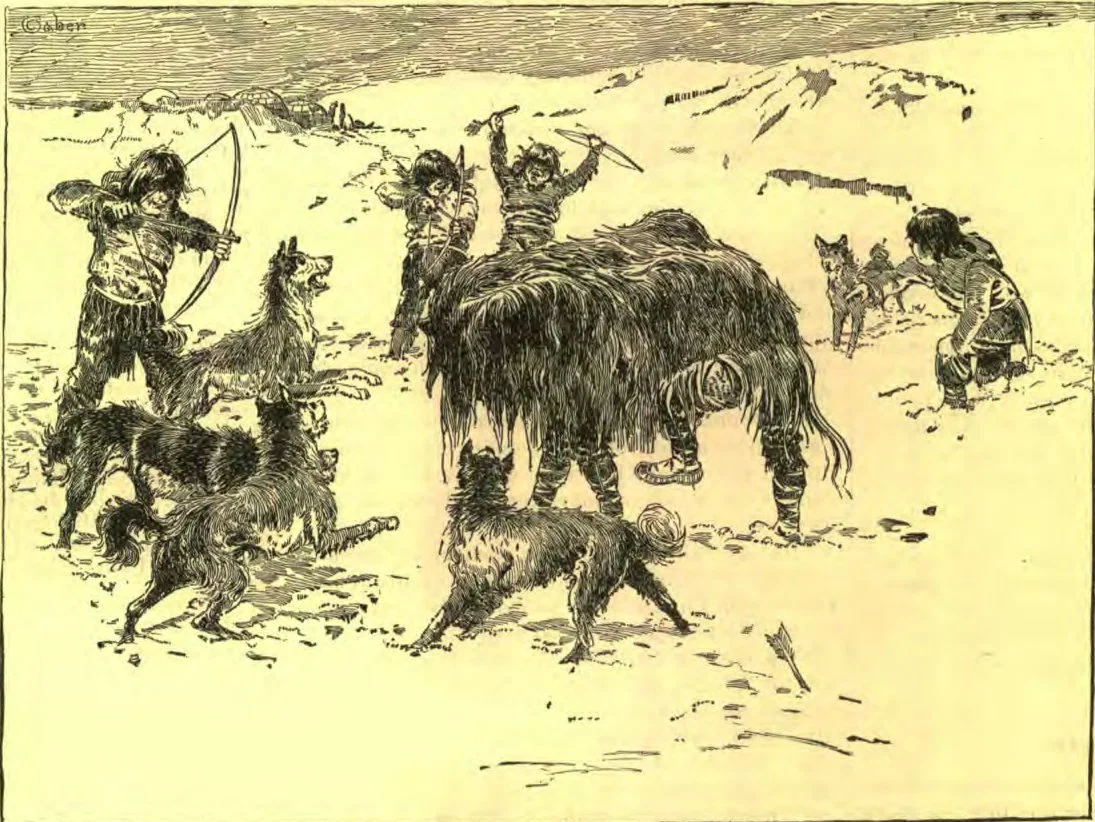
“The minds of the boys of the polar world run to sports that suit their natures. They are generally found in the open air, no matter how cold it is. At night, when the moon is full, and when the snow looks like a vast field of burnished silver, a company of Eskimo boys will engage in a game of ball. The ball is sometimes as large as a boy’s head, and is covered with a piece of hide sewed with sinews. Each boy carries a crooked stick, which is the rib-bone of some Arctic animal, and the whole company will play ball among the drifts till tired.
“They learn early to drive dog teams over the snow, and often, under the moon, they will race back and forth in this manner. The Eskimo boy is always a good driver, and he is not very old when he watches near the seal-holes with a harpoon. The seal, you know, furnishes the Arctic people with food, clothing, and light, and is, perhaps, the most important animal of the country. The boy who manages to spear a seal is a hero, and night after night he recounts the story of his exploit to his companions by the igloo fire. His playthings, from the time when he first forms a taste for such, are rudely fashioned sledges, harpoons, boats, and lances, and when alone, he will pass many happy hours amusing himself with them.
“The far northland is one without picture-books; but the Eskimo boy will draw rude pictures on the skins that hang on the walls of the igloo. He draws no beds of flowers, because he sees none. His pictures represent the animals of the snow, and dog-trains, and ball-playing. The children of the snow have merry times, just like other little people. They never complain of their isolation, nor of their lot. They are patient and thankful for what they have, as we all should be; for the care of the Father is over them, even in their land of endless winter.—The Sunday-School Times.

BERT AND THE BEES.

Bert had three buckets of water to bring from the spring.
They were pretty big buckets, and the spring was at the foot of the hill. The weather was getting warm too. He tugged away at one bucket, and got it up; then he lay down on the back porch to rest.
“Halloo, Bert! sun’s not down yet,” said his father, coming in to dinner from corn planting.
“I wish I were a big man,” said lazy Bert, “and didn’t have to carry water.”
“But you would have to plant corn and sow wheat, and cut, and reap, and thresh, and grind,” laughed his father.
“I don’t mean to work when I am big,” grumbled Bert.
“Then you’ll be a drone,” said his father.
“What is a drone?” asked the little boy.
“A bee that won’t work; and don’t you know that the bees always sting their drones to death, and push their bodies out of the hive?”
The farmer went off to wash for dinner, and Bert dropped asleep on the steps, and dreamed that the bees were stinging his hands and face. He started up, and found that the sun was shining down hotly on him, stinging his face and hands sure enough.
He hurried down to the spring, and finished his job by the time the horn blew for dinner. “Father,” he asked, while he cooled his soup, “what makes the bees kill their drones?”
“God taught them,” answered his father; “and one way or another, God makes all lazy people uncomfortable. Doing with our might what our hands find to do is the best rule for boys and men, and I wouldn’t be surprised if the angels live by it too.”—Presbyterian Journal.

A BAD HABIT.

IF any one had said that Benny Brown was untruthful, and if Benny had heard it, or heard of it, he would have been very indignant. He kept his promises, and never denied a fault. George Washington himself could not have been more ready to “own up.” He was not deceitful. You could tell that if you only looked once into his frank face. And yet he told wrong stories.
Let me illustrate.
One day he came home from school, and talked to his mother about the coming examinations.
“I just dread them,” said he. “It’s enough to kill a fellow to ask him such questions. They’re so awful hard it takes about ten hours to answer one, and they give us about a thousand.”
Benny’s mother looked grave and made no reply, and Benny, who had learned her expressions and the meaning of them, knew that she was not pleased.
It made him uncomfortable, for he was fond of his mother; and he stood near her chair, twisting the toe of his tennis-shoe against a hassock, and wondering what he would better do about it. Even the best of boys are apt to hesitate before they make an apology. But after the hesitation, the best of boys always conclude to be manly, as did Benny.
He had a coaxing way with him. Not because he wanted to “get around” his mother, but because he followed the impulses of an affectionate heart. So it was like him to make his first move by putting his strong arm around his gentle mother’s neck, and his next by putting a hearty kiss on her soft cheek.
Of course she returned the kiss, and that opened the way for the rest of it.
“I’m perfectly dreadful, mamma!” he exclaimed. “I’m the carelessest boy in the world about using big figures, and I know it. I’ve resolved to reform about a million times, and then I forget all about it.”
Mrs. Brown laid her hand across the offending mouth.
“Be still a minute,” she said, “and think before you speak. You are like the man who, being reproved for the habit of exaggeration, said he realized it, and was so sorry about it that he had shed barrels of tears when he reflected on it.”
“Is that true?” asked Benny, laughing.
“I do not know,” replied his mother; “but it well illustrates what those come to who do not correct the unworthy habit.”
“But I am not nearly so bad as that,” said Benny.
“You are just as bad,” answered his mother, “only you realize the absurdity of barrels of tears, while such great numbers as you have expressed are beyond your comprehension.” She reached for the drawer of a little stand near her, took from it a sheet of paper closely written, and continued, “Sit down, and I’ll read you something.”
Benny dropped upon the hassock, and looked at his mother with curiosity. She immediately began to read as follows:—
“‘Old Mr. Welch was plowing in his orchard, and plowed into a bumble-bee’s nest, and about a million bees flew out and stung him.’”
“‘When the fire-bell rung, a thousand or two boys cut across our lawn, and broke down some of the shrubbery.’”
“‘I tried the last example a hundred times before I could get it.’”
“‘I just hate that barking dog of Joe Warren’s. I’d rather go ten miles farther any day than come past the yard where he is.’”
“‘Jimmy Gorman is the slowest poke! A snail could beat him going anywhere, and have time to take naps on the way.’”},{

WHO KNEW BEST?

ABOUT some things Florence was sure she knew better than her mother, although she was but ten years old. One was about her new spring coat and hat. Florence wanted to wear them at once, but her mother said she must wait for some time yet. This made her quite cross, but her mother did not allow her to wear her new clothes any the sooner for that.
One bright, sunny morning her mother was in bed with a headache, and Florence had to get ready for school by herself. She went to the closet for her old coat and winter hood, and there on the nail was the new coat, and on the shelf lay the hat all ready to put on.
“I do believe I will wear it to-day,” she said to herself. “I am most sure mamma would let me, it is so bright and warm.” But she was really not at all sure. She would not have put on the new coat and hat, and gone so quietly down-stairs for fear Mary, the nurse, would see her, if she had been.
When she arrived at school, all the little girls came about her to admire her new clothes, and she felt very proud.
At recess the children were playing in the yard. The ground was damp and muddy, for it had rained all the day before. Florence was having a fine game of tag, quite forgetting her new coat. Suddenly, as she was running, her foot caught, and down she fell in the very muddiest part of the yard! The others ran to help her, and laughed merrily when they saw the plight she was in. But Florence did not laugh; she was much nearer crying! The front of her pretty light coat was black with mud, and her hat was bent out of shape. While the older ones were brushing off the mud and trying to console her, the bell rang, and they had to go in to school. Florence was able to pay very little attention to her lessons, and received a number of bad marks, the first she had had that week. To make matters worse, when she came out of school, the rain was pouring down, and she had no umbrella. With her old coat and hood on, she would have liked the fun of running home in the rain. Now it was anything but funny, particularly as her mother opened the door when she got home.
“You may go upstairs,” said her mother, “and wait till I come.”
The waiting was dreadful. Mary came and took her coat and hat away, but did not speak to her. At last her mother came, and Florence would have preferred any punishment to her mother’s way of talking; it made her feel so small and so ashamed.
She cried a great deal, and said she was very sorry. But that did not take the stain off the coat. She was obliged to wear it, however, stain and all, until it was out-grown, to teach her that wrong-doing has lasting effects.
I am glad to say that it did teach her.—Anna M. Talcott.
Continue reading: THE SPIDER'S WAYS