The American Sentinel, Vol. 11, No. 32.

THE SPIRIT OF THE CRUSADES
Earlier text: THE SPIRIT OF THE CRUSADES

PRAYERS FOR THE DEAD AND SUNDAY OBSERVANCE.

[Present Truth (London, Eng.), July 30, 1896.]
At the late annual meeting of the English Church Union the special subject discussed was that of prayers for the dead, and the Union strongly urged that this custom should be more fully recognized in the services of the Church of England. To this all Protestants are, of course, strenuously opposed. Prayers for the dead, associated with offerings for the dead, known in Catholic phraseology as masses for the dead, come from the ancient pagan custom of sacrificing for the dead and the worshiping of demons, against which the Scripture specifically warns all. But it is not of the doctrine itself that we shall speak, but of the argument by which those who urge it silence the objections of those in the Church of England, and Protestants generally, who oppose it.
Protestants say that the practice is without Scripture warrant, founded merely on tradition, which has always made void the Word. It is so, and the objection is unanswerable. But those who favor prayers for the dead do not take the Scriptures as authority so much as ecclesiastical tradition. They adopt the Catholic position. But then they turn on their objectors and retort that Protestants, while pleading for the Word as the standard, themselves reject the Word and take tradition when it so pleases them. The Dean of Lichfield, Dr. Lucock, in his speech at the meeting of the E. C. U., replied to the Protestant controversialist as follows:—
Just because there is no direct evidence in so many words in Holy Scripture enjoining prayers for the dead, he maintains that as members of the Reformed Church, believing Scripture and Scripture alone, we have no right to revive them. I want to point out to you what inconsistency is involved in this position. Take the case of Sunday as an illustration. There is not a single text in the whole Bible which teaches us in so many words that the seventh day was to be superseded by the first. It is perfectly true that in the New Testament we find religious associations connected with the first day. But if there was a single text directing the change we should not have found in certain portions of the church in the early centuries both the seventh and the first day observed. In justifying the change, we appeal to the Primitive Church, being perfectly certain that the rulers and bishops of the church would never have sanctioned such a revolution as that unless they had received by tradition such directions as they believed to have come from our blessed Lord himself. What, then, is the rule of authority in the one case must be made the rule in the other.
The Church Times endorses the Dean’s argument editorially, saying, “No distinct direction is given in the gospel for the observance of the first day of the week in lieu of the Sabbath.” This of course is not a matter of argument. It is a matter of fact. The argument based upon the fact simply amounts to saying, “There is no scripture for prayers for the dead, neither is there for Sunday keeping; but we do both according to the primitive tradition, which we follow instead of the Word.” The answer silences the Protestant who finds himself keeping the Sunday and refusing prayers for the dead, which practice comes on the same authority as Sunday observance.
It is a fact, everywhere made prominent in ecclesiastical history, that what is called primitive tradition begins after the “falling away” of which the Apostle Paul warned the early church. The apostasy had already begun to work in his day, he told them, and immediately after the days of the apostles the errors which crowd the Roman Church came in as a flood. As Dr. Killen says in his preface to the “Ancient Church”:—
Rites and ceremonies, of which neither Paul nor Peter ever heard, crept silently into use, and then claimed the rank of divine institutions. Officers, for whom the primitive disciples could have found no place, and titles, which to them would have been altogether unintelligible, began to challenge attention, and to be named apostolic.
It is to these times that men appeal whenever they appeal to primitive tradition in support of doctrines and practices for which they find no warrant in the Scripture. And it is interesting, in this special connection, to note the fact that in the earliest times prayers for the dead, or offerings for the dead, and Sunday observance were associated together. In accounting for these practices, the manner of observing the Sunday, offerings for the dead, and the sign of the cross, Tertullian, who wrote about the year 200, said:—
If for these and other such rules, you insist upon having positive Scripture injunction, you will find none. Tradition will be held forth to you as the originator of them, custom as their strengthener, and faith as their observer. That reason will support tradition, and custom, and faith, you will either yourself perceive, or learn from someone who has.
That was all that could be said for these practices then, and it is all that can be said for them now. But the retort that silences those who cling to one unscriptural practice and object to another, based on the same authority and associated with it in origin, will not silence the protest of those who take the Bible as God’s word to men, and test all these perversions of the truth and adaptations of ancient pagan rites and observances by “the law and testimony.” By this test it is seen that “there is no light in them.” Isa. 8:20.
Notice how generally this question of the authority of Sunday is being made the test of the authority of the church aside from the Word. It was on this point that the Council of Trent based its condemnation of the reformers’ appeal to the Bible alone, as against church authority. It is just here that the Church of Rome is constantly charging the Protestant world with inconsistency in accepting Sunday observance by authority of the church, while rejecting that authority in other matters where it pleases them to do so.
And the Anglican Catholics are also learning the weak spot in the armor of popular Protestantism. This is why we cannot do otherwise than continually call attention to the Sabbath question. On the side of human authority the Sunday is being made the test and the mark of such authority. On the side of divine authority and the word of God the Sabbath is the sign or mark of allegiance to God. Ezek. 20:12, 20. The issue is joined. It is the word of God against the word of man. On which side will you choose to stand?

IGNORING CONSCIENCE IN OTHERS.

[New York Observer, August 6, 1896.]
INDIVIDUALISM was emphatically a product, if not the sole product, of the Reformation, which was but the unmistakable assertion of the freeness of the human unit to find and to worship God after the dictates of its own conscience. What the Reformation did was to once more set souls face to face with the Bible, and to bid them discover therein their God and their duty. It meant the education of the individual conscience on Bible lines. And it was natural that in view of the intolerable burdens which an unwieldy ecclesiasticism had previously imposed upon human consciences, the reaction from all control of opinion should have been extreme. Rome had stolen men’s consciences away from them; and when its former slaves regained their rights of private judgment it was quite to be expected that they would in some cases turn their new-found freedom into license. But spiritual independence, however precious a privilege, must evidently have certain limits. It is not for a pretentious hierarchy like Rome to set those boundaries, nor can these limitations be imposed by any religious body against the will of the communicant. We do not live in an age of Test Acts. And yet it would be absurd to suppose that the conscience is free to form for itself any morality it desires, without let or hindrance from any principles existent objectively in the moral frame of the universe. There must be regulative influences somewhere about.
These outside criteria are found primarily, of course, in the Word of God, “the only infallible rule of faith and practice.” But how shall that Word be interpreted? Suppose that my neighbor and I derive a different lesson from the same Word? Shall I then assume with a calm serenity that I am absolutely enlightened in my judgment of Scripture, or shall I use his conscience a bit for purposes of comparison both with mine and with the Word itself? The fanatic, whose creed is built up of the assumption that there is only one side to every question, namely, his side, would answer this last question in the negative, so absolutely convinced is he of his own infallibility. We are always out of patience with the bigot, who never uses any conscience save his own, but we cannot convince him. He is the spiritual protectionist, who completely encircles himself with a high tariff wall in order to exclude from his soul all disturbing ideas of a contrary nature to his own. It was out of a somewhat extended experience with such conceitedly convinced and often erratic believers that the godly and sensible Charles Spurgeon was once moved to remark with a fine though gentle irony: “It is strange that some persons, who think so much of what God’s Spirit has revealed to them, should think so little of what he has revealed to other men.”

CHURCH AND STATE IN AUSTRIA-HUNGARY.

[New York Tribune.]
MONSIGNOR AGLIARDI has his revenge. For meddling too much in Hungarian politics he has been compelled to retire from the office of papal nuncio at Vienna. But before doing so he has been made a cardinal, and the king of Hungary has been called upon to place the red cap upon his head. In addition he has hurled a Parthian shaft into the camp of his foes which is certain to cause vast trouble. This latter takes the form of a long “code of instructions,” issued in the pope’s name to the Roman Catholic clergy and laity of Hungary. It has been issued without the sanction of the king, which the law requires, and without the agency of the Hungarian primate, which custom and courtesy seem to demand. That is to say, it has been issued in the most defiant and irritating manner possible, as though its object were to annoy and to punish the Hungarians for their refusal to accept Monsignor Agliardi’s dictation in political affairs.
Nor are the provisions of this document less aggressive than the manner of its issuance. Catholics are commanded to obey the rules of the church rather than the laws of Hungary, in civil as well as religious matters. The clergy are commanded to continue without cessation their opposition to and agitation against the civil marriage, religious equality, and other reform laws enacted by the Hungarian government. To this end brotherhoods and church societies are to be organized everywhere. Clerical newspapers are to be circulated everywhere. A vigorous propaganda is to be maintained among all classes. Especial attention is to be paid to regaining control of the schools and colleges. And, finally, the terrors of excommunication are to be threatened against all who seem inclined to obey the civil rather than the clerical laws.
There can be no mistaking the purport of this. It means war. The “code of instructions” is almost identical with that issued to the Roman Catholics of Germany as a response to the Falk laws, and we all know what that meant and what it accomplished. This differs from it only in the addition of certain vigorous clauses directed against Hungarian nationality and against Hungarian laws. By the national press of Hungary it is regarded as a challenge, which Hungary must accept, and which will surely precipitate a bitter struggle between Church and State. There is also a strong suspicion that the notorious reactionist, Dr. Lueger, has a hand in the matter. He is one of the most bitter foes of religious liberty, and an implacable enemy of Hungary. Whether or not he was concerned in the issuance of the mandate, therefore, he is certainly in sympathy with it, and will receive from it much aid and comfort in his efforts to break up the dual empire and to re-establish religious despotism.

THE POWER OF CONSCIENCE.

“Christianity and Patriotism,” by Count Leo Tolstoi.
THEY [despotic governments] know that power lies not in force, but in thought and in its clear expression, and consequently fear it more than armies. Therefore they institute censorships, bribe the press, monopolize the direction of religions, of schools. Yet the spiritual force which moves the world evades them nevertheless: it is not in the book, nor on the paper, it is always free and out of reach, it is in the conscience of men. That most powerful and free force manifests itself in man when he is alone, when he is pondering over life’s phenomena, when he is sharing his thoughts with his wife, with his brother, his friend, from whom he considers it a sin to conceal what he thinks to be the truth. No billions of dollars, no millions of soldiers, no institutions, nor wars, nor revolutions can achieve what can be achieved by the simple expression by a free man of what he considers right.

A REVIVAL OF THE “STOCKS” LAW.

[Bible Echo (Melbourne, Australia), July 6, 1896.]
It may be a surprise to some to learn that the old Sunday law of Charles II., enacted in 1677, is in force in Victoria, but such seems to be the case.
On May 28, 1896, David and Zalie Nettleberg, furriers, of Port Melbourne, were prosecuted “under the provisions of section 1 of Act 29 Charles II.,” for “following their usual occupation on Sunday, 17th May,” and each fined 5s. So says the Melbourne Age, of May 29. The report further states that “Miss Nettleberg, owner of the business, who was also present, expressed her surprise that members of a family ‘could not do as they liked on their own premises.’”
Not only Miss Nettleberg, but a great many other Victorians, will no doubt be surprised to learn, when Sunday laws are revived and enforced in this and other colonies, that such laws have no regard for individual rights either at home or abroad. This same section 1 of the Sunday law of Charles II., not only prohibits “worldly labor, business, or work” on Sunday, but requires “that all and every person and persons whatsoever shall, on every Lord’s day, apply themselves thereon in the duties of piety and true religion publiquely and privately.”
“That all the laws enacted and in force concerning the observation of the Lord’s day, and repairing to the church therein bee carefully put in execution.”
And then it imposes a fine of 5s. for every offense, or in default “to be set publicly in the stocks for two hours.” And the provisions for “repairing to the church,” “applying themselves to the duties of piety and true religion,” and the “two hours in the stocks,” are as much a part of the law as that forbidding “worldly labor.”
And if a person chooses to observe the Bible Sabbath, the seventh day, instead of the Sunday, falsely called the Lord’s day, that will make no difference, as was demonstrated two years ago in Sydney. The law says the day “commonly called Sunday” is the day of rest, and individual responsibility, conscientious convictions, and personal rights must all bow in submission to this religious man-made law. All Sunday laws are in direct opposition to the law of God.

RELIGION IN PUBLIC SCHOOLS.

[Christian Register, August 6, 1896.]
It seems likely that an effort will shortly be made by the united evangelical bodies to have a certain time set apart for regular religious instruction. The recent attempt made by the party of the Established Church in England to force sectarian instruction into the Board Schools proved a disastrous failure, but only because there all the evangelical forces united with the Unitarian in opposing a measure which was not their own. In this country the conditions will be entirely different; and, should the sects which now unite in Young Men's Christian Associations and Christian Endeavor Societies, both of which exclude Unitarians, join in a great popular clamor for sectarian education in the public schools, they would probably have a numerical majority. Already one of the influential magazines of education, the School Journal, which has heretofore advocated secular and religious training, has come out strongly in favor of special religious instruction.

Freethought Versus the True Liberty of Christianity

“FREEDOM” is an alluring word, but one which is often ignorantly appropriated where it does not belong. “Freethought” has a pleasant sound to many minds, but there is no freedom in the name. The child wishes to be “free,” not realizing to what an extent it is the slave of circumstances. Given its “freedom,” it would very soon come to grief through its inability to cope with surrounding difficulties. It could get nothing in comparison with what it would receive through parental care. “Freethinkers” are like children who do not want their parents to tell them anything. They want to enjoy the “freedom” which can be attained by their own wisdom and abilities. They forget that the very air which they breathe is not supplied by any wisdom or ability of their own; that these have not caused one heart-beat within their breasts. They forget that their creed provides no way of escape from that worst of all slaveries—the slavery of passion, which compels a person to do that which he would not, and which he knows to be dragging him to ruin. It is Christianity alone that stands for perfect liberty.

Nature and the Sabbath Argument

Speaking of the Sunday-in-nature argument, an exchange forcibly says: “If we found flowers closing their petals, fowls seeking their roosts, and animals their habitations every Sunday, and not emerging until Monday morning, some support for seventh-day idleness could be drawn from nature; but as long as vegetation continues to grow on the Sabbath and animals know no difference between Sunday and Monday, the argument will be without force.”

Spiritualism's Appeal to the Senses Versus Faith

It is predicted in Scripture (Matt. 24:24; 2 Tim. 3:8; Rev. 13:13, 14, etc.) that the time will come when false religions will appeal in a special manner to mankind through the avenue of the senses. False religions have always appealed to men in this way, having indeed no other means by which to gain their converts; but as the conflict between false and true reaches its climax, these appeals and the “evidence” on which they rest will be made as strong as possible, and there will be witnessed manifestations of a wonderful and startling character. These will present “evidence” which to the senses will be absolutely convincing, and will logically compel all who reject any other means of evidence to accept the doctrines for which they vouch. And thus will Spiritualism finally sweep into its ranks the atheists and “freethinkers” and all others of whatever party or creed who reject that other and most essential avenue for receiving religious truth—namely, faith. Here is the essential difference between Christianity and false religions; the one makes faith in the word of God the highest and most essential means of religious knowledge; the others seek always to convince by presenting something which appeals to the senses.

A FIRST-CLASS HIGH-GRADE BIBLE

$7.00 WORTH FOR $3.50.

We propose to make it possible for each and everyone to be the possessor of

A FIRST-CLASS HIGH-GRADE BIBLE.

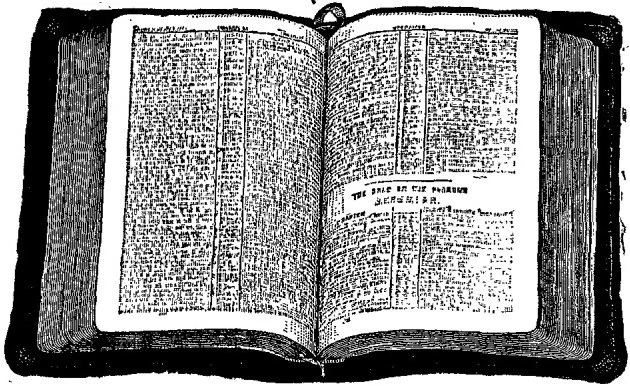
The book we offer has large clear type (see specimen page) and is what is known as the

AMERICAN OXFORD SELF-PRONOUNCING REFERENCE TEACHERS’ BIBLE,

Bourgeois Type, Bound in Imperial Seal Leather, Divinity Circuit, Extra Linen Lined to Edge, Round Corners Red Under Gold Edges, Silk Headband, Silk Marker, Binding of the Best Quality,

REGULAR PRICE, $6.00

OUR PREMIUM BIBLE OPEN.

WITH SENTINEL, ONE YEAR $3.50

With this book reading is made easy. No more stumbling over the hard words. All proper names are divided into syllables, and the accent and diacritical marks render their accurate pronunciation a simple matter. With a little study of the Key to Pronunciation to be found in every copy of this Bible, the reader loses all fear of the long, hard names of Scripture, and pronounces them with ease.
OUR PREMIUM BIBLE CLOSED.
As is indicated by the name, this is a teachers’ Bible. It contains fifteen maps and 64 pages of illustrations and diagrams, copious helps of the latest revision, Bible index, concordance, dictionary of Scripture proper names with their pronunciation and meaning, and many other excellent features.
It is only by special arrangement with the publishers of this Bible that we are able to make this

UNPRECEDENTED OFFER.

REMEMBER, the price of this Bible is $6.00. ANYONE, OLD OR NEW SUBSCRIBER, SENDING US $3.50 WILL RECEIVE THIS BIBLE POSTPAID, AND THE SENTINEL ONE YEAR.
Or WE WILL GIVE ONE OF THESE SUPERB BIBLES for seven new names at the regular subscription price, $7.00.
For 25 cents extra we will mark on the Bible in gold letters any name desired.
Address all orders to AMERICAN SENTINEL, 39 Bond Street, New York City.

Christianity as the Foundation of Good Government

THERE can be nothing better calculated to aid in the establishment of good government than Christianity. The best form of government is that which imposes the least burden upon the people, and that form will be least burdensome which is simplest and leaves to the people the largest liberty of individual action. “That government is best which governs least,” consistently, of course, with the maintenance of order and justice. Christianity, by teaching an individual to live peaceably with all men, to be honest and just in his dealings with all, and to do unto others as he would wish others to do to him, tends directly to the establishment of individual self-government, and thus to the diminishing of the machinery of civil government, which means the lightening of taxation and the removal of many public burdens.
Then, it may be inquired, ought not a government to promote Christianity in order that these benefits may accrue to its people? The answer is, No; for the simple reason that Christianity, operating as it does through faith in the Word of God, is something wholly beyond the control or direction of the civil power. When the civil authority can put faith into a man’s heart, it can then promote Christianity, and not before. But faith is altogether voluntary, and hence a forced faith is not faith at all, but only hypocrisy, and hypocrisy is the very opposite of Christianity. However much, therefore, Christianity may promote those ends which good government seeks to secure, the latter must keep “hands off,” and leave Christianity to be directed and enforced by the agent divinely appointed thereto,—the Holy Spirit.

Sunday Bathing Dispute at Lake Bluff Camp

The Sunday question is developing friction between the Methodist camp-meeting and summer campers at Lake Bluff, near Chicago, Ill. The Chicago Times-Herald, of July 31, says:—
There will be quite a rivalry, it is hinted, between the campers and the summer visitors for supremacy, and the contest promises to be an interesting one. The seaside devotees declare they will enjoy their Sunday swim while the revivalists quietly assert their opposition. The officers of the association refuse to make public their opinions on the bathing wrangle, and refer all questions to the association trustees. The latter say the matter will be settled by the village trustees at their meeting next Monday evening. Both sides are gathering their forces for the battle, and the meeting is expected to be a lively one.
On every side we hear of opposing forces being called up in battle array, or engaged in combat, over the question of enforcing Sunday. When the Church thus descends into the arena of civil strife, the standard of Christianity is trailed in the dust.

Religion in Politics: The Independent and Catholic Review

The Independent of August 6 explains “for the benefit of the Catholic Review” and other Catholic journals, that its statement that “we need God in our politics as well as in our business and amusements,” “did not mean that the General Conference of the Methodist Church should declare for the gold standard, nor that the Presbyterian General Assembly should give a deliverance on the tariff, nor that the Bishops of the Catholic church should direct all good Catholic voters to support Bryan and Sewall or McKinley and Hobart.” Very true. Still, if it is proper to have “religion in politics,” why should not the matter be taken up by the representative religious bodies, and managed by them in a way to make religion most effective in the political sphere? Perhaps there would be less contention among clergymen over political issues if they had some authoritative church pronouncements by which to be guided in their political discourses.

Bryan's Vote Against Sunday Closing Condition

An exchange calls attention to the attitude of the Democratic nominee for President, Mr. W. J. Bryan, toward Sunday enforcement, by pointing out that as a congressman in July, 1892, he voted “No” on the question of making the congressional appropriation for the World's Fair conditional upon Sunday closing.

Monday Drunkenness Arrests in Washington, D. C

It is asserted by one who has been an observer of the facts, that in Washington, D. C., there are more men arraigned in the courts on Monday mornings for drunkenness than in any other three days of the week. And yet Washington is a city which has Sunday prohibition. This is the way Sunday closing works in the interests of temperance.

Missionary Mr. Knapp Surrenders His Revolver in Turkey

SPEAKING of the recent experience of Mr. Knapp, an American missionary in Turkey, with some officials of the Turkish government, the Independent of July 5 says: “He was compelled to give up his revolver, and was treated throughout as a criminal.” There is usually some degree of connection between a criminal and a revolver; but it is not so evident what hardship there should be to a missionary in being obliged to part with such a weapon. Would it be that he would consider it a fatal blow to his success in missionary work?

Spiritualists Hope to Convert Ingersoll

THE Spiritualists are said to entertain strong hopes of converting the noted “freethinker,” Ingersoll, to their belief, and it is quite possible that their hopes are well founded. “Freethought,” as represented by Ingersoll, is guided by the “evidence” of the senses, the same as is Spiritualism, and when sufficient “evidence” shall have been presented to the apostle of “free thought,” in favor of the doctrine that the dead are alive and can communicate with their living friends, he cannot consistently refuse to accept it. And as this same doctrine is also a fundamental dogma of “orthodox” belief, we can see no logical reason why Mr. Ingersoll should not erelong be reckoned as belonging to “the church.”

Gloucester Debates Sunday Law Enforcement

The question of Sunday enforcement is stirring the people of Gloucester, Mass. On the evening of July 23, the mayor's room at the city hall was packed with an audience gathered to hear arguments on the subject, pro and con. The meeting was the result of a trial of Sunday enforcement, and the great majority of those present voted in favor of its discontinuance. Several clergymen were present to argue for civil support of this church ordinance, but their words did not carry much influence, and they were considerably discomfitted when one speaker inquired what it was they preached for on Sunday if not for their salaries. Certainly, if it is right for a preacher to earn money on Sunday by following his accustomed vocation, it is right for other persons to enjoy the like privilege.

Chicago Post Office Delivery Never Closes Sunday

FROM the Chicago Times-Herald we learn that in Chicago, by virtue of a recent decision of the post-office authorities, the delivery of mail never ceases, not even on Sunday. “The general delivery window at the Chicago post-office,” says the Herald, “never closes. The key has been thrown in the lake.” Until very recently Chicago observed the common custom of one-hour opening of the post-office to the public on Sundays.

Rev. W. J. Kershner on Sunday Labor and Society

THE substance of an address made by Rev. W. J. Kershner to a Sunday-school convention held at Wernersville, Pa., Aug. 1, 2, is thus reported in part in the Reading Herald (Reading Pa.), of August 3:—
The continual teaching by employers that men can work in defiance of God on Sunday is a cause of strikes. Iron men and railroad companies are punished, destroyed and ruined because of their unwillingness to obey the divine command No. 4. The terrible condition of the iron industry and of the railroads is due to Sunday working. The world is restless and feverish to-day because the Lord’s day is desecrated. That home of yours is not secure if you are not obedient to the Lord. Divorces, murders, suicides, are due to the neglect of God and his work. The man who takes of the Lord’s day is a thief.
Remembering that these assertions are made with reference to the first day of the week, let the reader turn and read “Command No. 4” of the divine code (Ex. 20:8–11) and see where the charge of “Sabbath desecration” really belongs.

You have reached the end of this edition.

The American Sentinel · Aug 13, 1896