The Youth’s Instructor, Vol. L, No. 35

Words: The Power and Weight of Language

The Youth’s Instructor

September 4, 1902

Review and Herald Publishing Company · Battle Creek, Mich. · September 4, 1902

Words: The Power and Weight of Language

Words

A word is the sign, or symbol, of an idea. In itself it may express a complete thought. Usually to do this, it is joined with others in a combination called a sentence. All the words used by a race of people to express their thoughts, and to communicate with one another, is called a language. The English language is that system of words used and misused by the English-speaking race.
As words are signs of ideas, it is evident that the formation and use of words is generally controlled by the ideas. But this is not always true; frequently thoughts—ideas—are born of words.
Words may be empty, mere babble, idle prattle, light and frothy as the wind-swept foam. They tell us of empty minds and shallow thought.
Words may be weighty. A mere word has changed the course of empire, dethroned kings, broken hearts. One word has often turned the purpose of a life, thrust a living sting into the heart, and cursed a soul forever.
A little word has encouraged the despairing, brought joy to the disconsolate, sweetened many a bitter cup, checked the downward career, and heartened and gladdened a whole life.
Words are living things, not only controlled by our thoughts, but in turn controlling them. Lord Lytton says:—
“Words, however, are things; and the man who accords To his language the license to outrage his soul, Is controlled by the words he disdains to control.”
And Sir Walter Scott sings:—
“O many a shaft, at random sent, Finds mark the archer little meant; And many a word at random spoken, May soothe or wound a heart that’s broken.”
The wisest man of earth said: “A word fitly spoken is like apples of gold in pictures of silver.” And a wiser than he has solemnly declared: “Every idle word that men shall speak, they shall give account thereof in the day of judgment. For by thy words thou shalt be justified, and by thy words thou shalt be condemned.”
How important, then, are words! It is important that we secure a sufficient number of words—a vocabulary—to enable us to express ourselves properly, clearly, forcibly, on any subject upon which we wish to speak. We obtain a vocabulary by study, by converse with others, by good reading.
Words are our friends, so to speak, comrades in tribulation, in conflict, in helpfulness, in enjoyment, whom we can summon at any time to aid us,—companions with whom we eat, walk, talk, think, and live.
As we prize eternal life, how careful should we be in selecting these companions! How sedulously do we avoid the low and base and degrading among our fellows, unless God has called us to lift them up. How we avoid those whose characters are so thoroughly formed that we can not affect them for good. We instinctively fear for the safety and purity of our friends who mingle with them.
But almost always the character of a word is fixed permanently by long usage. It generally affects the user more than the user affects the word. It is a mold, so to speak, into which our warm thoughts are cast, and constant usage tends to imprison, and ossify (turn to bone) the mind with the thought if the word be mean and narrow, or expand it and give it life if the word be lofty and great,—not lofty in sound nor great in syllables, but lofty in sentiment and great in meaning, inviting the thought to greater heights and larger fields.
A mean word applied to a good object belittles it, not only in the estimation of him who uses it, but in the minds of the unthinking. Politicians and religious partisans take advantage of this power of words. We do not know how many were prejudiced against the originally noble purposes of the Republican party by the terms “Black Abolitionist” and “Black Republican.” A union laborer despises a man more whom he has denominated a “scab” than he did before, and so also do many other unthinking souls. We do not think so much of a foreman by calling him a “boss;” and our love for our father and mother is adulterated when we speak of them as “old man” or “old woman.”
The words may seem “smart,” and may cause the unthinking to laugh; but they have belittled our own soul, and lessened the regard we should have for those whom the great God has commanded us to honor.
What is the lesson? For our own character’s sake, which we are building for eternity; for the sake of those who hear, let us never apply to a human being a term that will make him seem less in our estimation. Choose good words, and fill them with pure and holy thoughts.
Truly each reader of the INSTRUCTOR can pray no better prayer than that taught by the sweet singer of Israel: “Let the words of my mouth, and the meditation of my heart, be acceptable in thy sight, O Lord, my strength, and my Redeemer.”
M. C. WILCOX.

His Part

THAT the supper had been an unusually belated one, and that Theresa Valmer, spry little housekeeper that she was, was still in the kitchen, washing up pots and pans, when the clock struck eight, was her brother Loring’s fault. Supper had waited until the busy father had at last eaten alone, and departed to his evening work; but Theresa had waited and waited, slipping out to make fresh the cooled dishes when the laggard’s step was at last heard, and speaking not a word of reproach, although Loring offered no apology for his tardiness.
Loring had, indeed, little to offer in the way of conversation of any sort. Theresa was only a girl, and she could not be expected to understand the great schemes which were at that moment ripening in his fertile brain. Nevertheless, when supper was over, he waited rather disconsolately for Theresa to finish her after-supper work and join him.
She came at last, slipping off the big apron and rubber cuffs which protected her pretty dress, and stopping with them in her hand, while she answered brightly some of Loring’s questions, before she turned to put them away.
“You’ve been such a long time getting through to-night,” Loring grumbled, ignoring the fact that it was he who had caused the delay.
Theresa ignored it, too.
“I had a great deal to do,” she answered. “I’m glad to sit down—I’m tired to-night.”
“I’ve been waiting for you to have a game of crokinole,” Loring explained. “Don’t you want to?”
“I don’t believe I can play, Loring. I cut my finger to-day, and it would interfere with my playing.”
“That’s too bad. Well, can you play the accompaniment to my new violin solo, then?”
“Please excuse me to-night, Loring, I don’t feel as if I could.”
“Then don’t you want to help me classify my flowers?”
Theresa’s face clouded.
“All that litter down here, to-night!” she exclaimed. Then, hastily, as she caught her brother’s expression, “O, all right, Loring! I don’t really mind.”
“Of course, if you don’t want to,” Loring replied, a little stiffly, “I’ll not bring them down. They do make a litter, I suppose. That can’t very well be helped.”
“Let’s just have a quiet chat,” Theresa pleaded. “Tell me all about what happened at the store to-day, and what you did, and whom you saw.”
“Tell you over a whole lot of gossip, eh?” Loring’s voice was not quite unkind, but the suggestion was not a pleasant one. “I’m not very good at that business.”
Theresa made a few rather futile attempts at conversation, but Loring was fidgety. At last he got his hat.
“I guess I’ll run round to Clarence Gregory’s a little while,” he said. “He has some flowers that he got on the marshes, and I want to see them.”
Theresa made no protest. It would be an hour or more before his father’s return, and Theresa was left quite alone, but Loring did not think of that. He felt, in fact, that he himself was rather ill-used. Surely, it was Theresa’s fault that there had been nothing amusing to occupy him at home. He believed it was a sister’s duty to make home pleasant for her brother in the evening.
He found his chum, who was a widow’s only child, reading aloud to his mother, but the book was put down at his arrival.
“Flowers?” Clarence queried, as Loring mentioned his errand. “You’ll have to come upstairs with me, old chap. Mother doesn’t object to fresh flowers, but she seems prejudiced against having their desiccated remains down here. They are scrupulously confined to the attic.”
The two boys spent a pleasant half-hour in the attic. Then Clarence said: “That’s all. Let’s go down to the sitting-room. Mother doesn’t like sitting alone in the evening.”
For a moment a vision of Theresa, sitting alone at home, floated through Loring’s mind, but it was soon forgotten in their pleasant chat. Mrs. Gregory, while apparently enjoying their lively conversation, did not often join in it, until Clarence was called for a few minutes from the room.
“How is Tressie, this evening?” she then asked, using the pet name by which she often called Theresa.
The query took Loring by surprise. “She is well, thank you,” he answered.
“I am glad. Her headache isn’t affecting her unpleasantly then, this evening?”
“I guess not. I didn’t even know she had one.”
“I ran in for a few minutes this morning, as I passed, and she was looking so miserable that I made her own up to a headache. Tressie is too good to you folks. She keeps on going when she isn’t able.”
“She didn’t mention the headache. She pleaded a cut finger when I asked her to play crokinole, but she didn’t give any reason when I asked her to try my new piece over with me.”
Mrs. Gregory smiled. “I fancy one of her nervous attacks doesn’t leave her feeling like trying new violin solos,” she said.
“Perhaps my violin performance is rather nerve-racking,” admitted Loring, good-naturedly. “And a new piece may be particularly so.”
“O, I didn’t mean anything like that,” Mrs. Gregory protested, laughing. “I wish you had brought Tressie with you this evening. But I suppose your father is at home to-night?”
Loring’s face flushed. “No; he isn’t. Tressie is quite alone. But she isn’t at all nervous about being alone.”
Mrs. Gregory hesitated a minute. She did not want to be officious, but after all, Loring was the son of one of her oldest and dearest friends. She decided to speak.
“Isn’t it just possible, Loring, that her nervousness may be like her headache—that she may never have spoken of it? I do not mean that she is afraid to stay alone. The neighborhood is a perfectly safe one, and Tressie is much too strong and sensible for idle fears. But I don’t think you realize how much Tressie is alone. All day long, she sees you and your father only at meal-times, and for the rest of the time, no one, unless a neighbor chances to drop in. Tressie is quite young, Loring, and her loneliness is not easier to bear because it is so recent. She has not complained. I assure you, but I am giving you a little bit of my own experience. I know what it is to spend all day in household tasks, and then to spend my evening in silence and alone.”
Loring was silent for a minute. Then he spoke slowly and thoughtfully. “I think I see what you mean, Mrs. Gregory. I guess I’ve been thinking that I was a pretty decent sort of fellow when I was willing to stay at home, and let Tressie amuse me. I never thought that she might sometimes not feel like being amusing.”
“Yes,” Mrs. Gregory smiled back; “I think that it is just possible that so much has been said about the duty of girls to make home a pleasant place for their brothers, that the duty of the brothers to make home pleasant for their sisters is quite overlooked.”
“You must help me, please, Mrs. Gregory,” Loring begged. “I don’t remember ever having seen any literature on the subject.”
Mrs. Gregory laughed outright. “No, I don’t remember any myself. Perhaps Tressie might write an article about it.”
“I wish she would. Can’t you coax her to, Mrs. Gregory?”
“I’m afraid she’s much too busy a little housewife to find time for it,” his friend answered.
“Then will you please write it? And I’d like a private reading from the advance sheets.”
Mrs. Gregory hesitated. “Duty number one,” Loring suggested, merrily; “never to leave one’s sister alone from supper till bedtime.”
“Number two,” Mrs. Gregory added, catching his tone; “to remember that she likes to hear what goes on in the world outside, which she so seldom sees. That would make conversation a standard evening amusement.”
“Clarence suggested number three to me,” Loring said; “that is not to make her tasks harder by needless litter, late meals, and unnecessary demands on her time and attention.”
“You’re getting on famously. I see you will soon be ready to write this article yourself. You might add that you will consult her taste at least half the time about games and amusements. It’s just possible, you know, that she detests crokinole and likes halma. I’ll warrant you you know as little about her likes and dislikes as you do about her headaches.”
“She knows all about mine,” Loring said, with keen self-reproach.
“Yes, and she has found great pleasure in conforming herself to them, Loring,” Mrs. Gregory said, sympathetically. “You must not think that they have burdened her. But I think it only fair that you should have some of the pleasure of considering her whims, and that she should have some of the delights of finding herself being considered. You will double your own pleasure, Loring, as well as hers.”
“I wish you would tell me more,” he pleaded. “No; your eyes are open, now. You will see them for yourself. But I will tell you one thing more,” she added, after a minute’s thought. “It is as I told you, the outcome of my own experience in loneliness. You don’t know how pleasant it will be for Tressie to know that she need not hesitate to ask for your escort if she wants to go out in the evening, to see a friend, or to go to an entertainment or lecture. I know it seems pleasant to you to stay in the house, after being out all day, but you will remember that Tressie has been in all day, and that it will seem just as pleasant to her to get out.”
Clarence came in just then, to find Loring on his feet. “I thought that fellow was going to keep me there all night,” he exclaimed. “You’re not going, Loring? It’s early yet.”
“I left Theresa alone,” Loring explained, briefly, and made a somewhat hasty departure.
It was several weeks later that Mrs. Gregory, who had been in to see Theresa, met Loring Valmer at his own gate. “We never see you any more,” she said, holding out her hand, cordially.
For answer, Loring only laughed as he clasped the hand.
“I want to tell you something,” she said.
“You must never tell Tressie that I told. She has just been telling me about how good you are about taking her to places, and about helping her in the house. She says she is going to find time to join the Reading Circle, and that will mean so much to Tressie. She looks so bright and well, and seems as happy as a bird.”
“Neither father nor I realized how hard it was for Tressie to give up all her girlish pursuits,” Loring remarked, gravely. “I don’t think that we even realized that she had given them up. And the management of the house was hard for her inexperience. I saw it all, after you began to show me. But you were right, Mrs. Gregory. The pleasure has been on my side, I think, in this experiment.”
“Not all of it, I am sure. But I am certain that the young man who does his part in making home pleasant, will appreciate to the full the blessings of a pleasant home.”—Agnes E. Wilson, in Well Spring.

ELIZABETH ROSSER

Happiness

She passed: I saw her smiling face While sewing in my cottage door; That I might give her footsteps chase, I dropped my work upon the floor. I hurried up the busy street,— Almost I touched her shining dress; But swifter still sped on the feet Of that fair phantom, Happiness.
Long did I seek her, far and wide, By mount and stream, by land and sea, In halls of fame, in courts of pride; Yet still she hid herself from me. Footsore and sad, I homeward turned, And passed again my cottage door; The humble work that once I spurned, I gathered up from off the floor.
Each stitch I set with patient care, And smiled to see the long, straight line; And then, before I was aware, My heart had ceased to fret and pine. Swift flew the needle to and fro,— 'Twas but a common, little dress,— There came a gentle tap, and lo! Upon my doorstone, Happiness.

ELIZABETH ROSSER

A Gift Misused

God permitted one young man to have an almost unlimited store of that which all boys and young men covet, physical strength. It was the plan of the Giver of this strength to have it used for the deliverance of his people from servitude to the hostile Philistines. The father and mother of Samson were godly people, and regarded the gift of such a son as a special favor, which indeed it was. They earnestly sought guidance and wisdom in the training of their child. This was given them, and included the stipulation that he was to be dedicated to God from his birth.
Whether or not the divine directions were carried out, it is certain that the youth developed a strong tendency to mingle with evil associates. He walked deliberately into the snare of female enticement, and through his attachment to a young woman he surrendered to the enemies of the Lord and his own foes the secret of his power. He sold the favor of God for the favor of his enemies. They used this secret for his destruction. To prevent his ever returning to the service of God, they put out his eyes; and as his strength returned, they harnessed it to their own mill. One of the saddest sights we witness in this world is the strength God gives his children used in serving the devil and turning his mill. So it fills our hearts with pity to see, in our imagination, poor, blind Samson, who possessed such a wonderful gift of strength, with which he might have done so much good, toiling day after day in the enemy’s treadmill, utterly devoid of hope or light, with no more reward than that received by a blind mule. It was a happy avenue of relief that presented itself in the destruction of himself and his enemies together. But it was an awful outcome of what was a glorious opportunity.
One reason that more people are not intrusted with extraordinary gifts by our Heavenly Father is that Satan seeks by every means to lead those so intrusted to lend themselves to his service. And he often succeeds. Says the apostle John, “I have written unto you, young men, because ye are strong.” God has endowed all young men with strength, and he desires that this strength shall be consecrated to him. But there is no class of people for whose services Satan bids so high as for young men. To them he holds out every kind of allurement, not excepting the fashionable Delilahs that haunt our streets and public places of amusement. Those who yield to their wiles are sure very soon to sell out their birthright of God-given talent to Satan. That which was intended of God to be an honor to himself is turned to the advantage of Satan, and the dishonor of God.
But what does the enemy pay for such service? Surely one who sells out to an enemy, and turns traitor to the principles of righteousness, should demand a large price for so great a sacrifice. But Satan has no good things to give. His object is only to deceive and then destroy. He holds out a tempting bait of self-indulgence; but when he has lured his victim from the path of purity and truth, he quickly withdraws the promised pleasure, leaving no portion but bitter regrets and despair. He chains his victims as galley-slaves to his own craft, and glories in their ruin.
O that every youth could see the heartless cruelty of Satan, and the folly of bestowing upon his wretched service the talents that God has intended to be used only for himself! To take such a course is worse than ingratitude. It is the most grievous wrong that one can commit. No crime is punished more severely than treason. No one is more justly despised than a traitor. What, then, shall we say of the young men and young women who equip themselves with God-given talents and abilities, and then desert to the enemy of God? G. C. TENNEY.

Calvary

ALONE, undone, upon the earth, Bankrupt I stood, By sin impoverished from my birth; None understood But Jesus, and in pity he Redeemed my soul on Calvary. MRS. P. ALDERMAN.

A Square Yard of Lawn

The portion of ground allotted to it for a lawn is, like our house itself, very tiny. About four feet of wooden walk, reaching from piazza to street, with perhaps a square yard of turf on each side, constitutes the greater portion of our front dooryard. Against the house, for most of the summer, are banked crimson petunias, which cling to the weather-boarding, while bordering the alley a mass of portulaca smiles at the sun and pouts at the clouds. I mean no sarcasm when I say that we enjoy our lawn as well as other people in the neighborhood enjoy theirs, especially at the cool of the day; it is large enough to put our feet upon, and the feeling of the fresh sod is pleasant as we sit on the steps, enjoying the cool air, which, at least, is as abundant upon grass-plots a yard square as upon those of greater size.
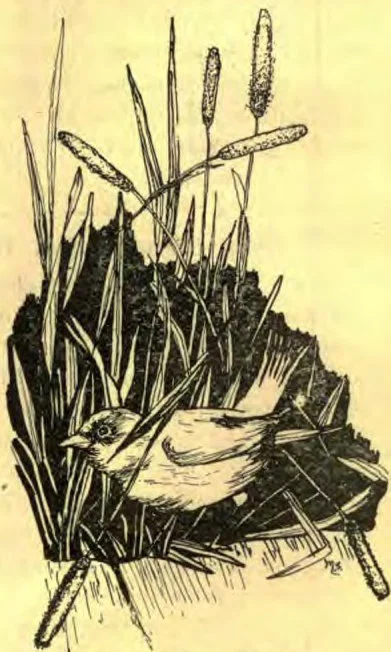
UNDER THE BENT-OVER
TIMOTHY HEADS
UNDER THE BENT-OVER TIMOTHY HEADS
But we who live in the cottage are not the only ones who appreciate our square yard of lawn. This summer the grass was allowed to remain uncut until its seed had fallen, and along in June it became a luxuriant tangle, a rendezvous for many sorts of visitors. Near the ground assembled the creatures fond of coolness, darkness, and dampness. Ants came at first, but when the grass began to grow thick and tall, they left for more warm and sunny spots; yet there remained spiders and crickets, besides many bugs and worms, all lively and interesting, and dozens of those funny little mouse-colored insects that we children used to call “sow-bugs.” All these kept closely hidden unless the uprooting of weed-stalks among the grass-roots brought them to light for an instant, only immediately to glide away again, and disappear within the nearest shady shelter.
But the things of light and air seemed most appreciative of our square yard of turf. Insects galore went their busy way among the blades, and butterflies innumerable flew about over the clover. Once I saw two white cabbage-moths hovering around some full-blown timothy heads covered with their yellow fuzz, and I marveled that the butterflies did not spot their white wings, while wondering if they could find honey in the timothy heads as well as the clover clumps.
Grasshoppers often whirred by to perch on a grass stem, which sank abruptly beneath the sudden weight, then sprang up again, like a miniature ducking-stool dipping the rippling grass waves instead of mill-pond or river-pool; but in this case, all the ducking failed to affect the culprit until the impulse of flight took possession once more, when away he would go to some other supple stem, and repeat the performance.
Then there were the birds. Sparrows ransacked our lawn in search of material for nests, and, later, to find wherewith to feed their progeny. Indeed, the feathered visitors made life hard for those more humble ones I have already mentioned: death by beak and talon lurked there on all sides for unwary bugs or beetles that made themselves at all conspicuous, until it seemed as if they would be obliged to seek more retired haunts, or despair of living at all.
Occasionally a daring jay dropped to the walk, becoming “monarch of all he surveyed” at the first flip of his tail, since all the less pretentious creatures dared not face him. Swallowing a morsel here and there, thrusting his inquisitive beak into the cracks of the walk or among the grasses, twisting his head sidewise, backward, and upside down, to peer curiously into every possible cranny within reach, the saucy fellow would remain until all had been investigated to his satisfaction; then he would dart abruptly to the veranda roof, where, for a moment, I could just see the fork of his blue tail before he vanished into the maples behind the house.
Once or twice, when there was nothing about to alarm him, I caught a glimpse of a wren, stealing a visit to our dooryard,—along the piazza, down the edge of the walk, in and out under the bent-over timothy heads, he shyly darted, as tiny and quiet as a feathered mouse; but he was all alertness, and woe to the unlucky insects that chanced to fall within range of his beads of eyes. I remembered having seen the midget before, up over the well, singing to his mate. It took some time to locate their nest, but finally I decided it was hidden in the gable of an adjoining house, where ill-matched boards had left an opening. Only wren’s eyes would have noticed the aperture, and only wren wisdom would have utilized it; but for all his cunning, that inconsistent wren often betrayed the whereabouts of his nicely concealed home by making it a shrine before which he perched to pour out his songs of admiration,—songs which always remind me of the strings of bubbles that follow blowing with a pipe into a bowl of soap-suds. But though I always had to smile when I heard him sing, our square yard of lawn had no more beloved visitor than this same wise, self-reliant, little wren.
Minnie Rosilla Stevens.

Are You Divinely Led?

Just as it is absolutely essential for the ship captain to discern the lighthouse signals as he nears the dangerous rocks along the shore, so there come moments in every life when success demands that we recognize the divine voice within us.
Because of his failure to hear this voice at a supreme crisis, Moses was doomed to spend forty years herding sheep. But after he had learned the blessedness of listening to the divine voice, nothing could swerve him from carrying out its wishes. The unreasonable demands of the sin-loving mob, the attitude of his own brother, or even the regard for that sister who had watched over him in infancy, did not influence him.
After the divinely led Elijah had seen the very elements of the universe yield to his command, there came a moment when he failed to listen to this voice; and then he became a trembling, fleeing coward from the wrath of one wretched, weak, wicked woman. It required the shaking of an earthquake and the fierce blasts of a storm sufficiently to arouse him again to listen to the still, small voice which had been speaking to him so constantly for years. Do you want God to send an earthquake into your life, to shake down some of your pet idols? Are you inviting Providence to send you such a storm of trouble as shall blow away in a breath a host of your selfish schemes? or are you trying to be true to the divine voice of conscience which dwells within you?
Paul, in his mad career of destruction, swept on, guided by reason instead of the divine voice; and it became necessary for the Lord to blind his physical eyes before he could see with his spiritual eyes. Are you taking such a course that the only way a loving God can help you will be by sending upon you some terrible misfortune?
It is a divine instinct that shows the bird how to construct its nest, that guides the pigeon hundreds of miles over land and sea to its home. The desire for water when we are thirsty, for food when we need it, and for rest when we are tired, are all echoes of the divine life which dwells within us. This same instinct makes us hungry for heaven. Why refuse to satisfy it? Why starve yourself any longer? Let the same Guide that brings the pigeon to its home bring you to your eternal home.
DAVID PAULSON, M. D.

The First of Autumn

LAST week the sun was shining bright; 'Tis shining bright to-day; The atmosphere is pure and clear, The clouds have sailed away.
But ever since the thunder-storm That raged the other night, The breezes moan that summer's gone Upon her yearly flight.
The birds now sing a sadder strain; The katydid's shrill call Rings in the ear; the time is near When leaves begin to fall.
The woods still keep their summer green, The brook still hurries on, The crows in jet are cawing yet; But summer-time has gone.
And in my heart a sadness dwells, As if I'd lost a friend; It seems the measure of this year's pleasure Is gone with summer's end.
But hope with summer does not fade, And in my heart 'twill sing That happier hours and brighter flowers Are coming in the spring.
WILLIAM ARCHER WRIGHT.

September Study of the Field

Suggestive Program for Young People's Meeting
(September 7–13)
I. OPENING EXERCISES.
2. Responsive Scripture reading.—Isaiah 55.
3. Testimonies. (Let each one bring a message from one of the workers in the regions beyond, mentioning some special item of progress or appeal, published during the month, that was particularly impressive.)
4. Field Study:—
(a) Introduction of Christianity into China.
(b) Elder J. H. Krum’s trip through Asia Minor.
(c) Report of the Educational Work in the German Union Conference.
5. Remarks by the Leader.—The Present Opportune Time for Our Work in Foreign Fields.
6. Closing Exercises:—
Prayer, singing, benediction.
NOTE.—Material for the study this month will be found in the August issues of the Review. Special effort should be made to encourage every one to participate in the meeting. If the young people will not volunteer to take part in the testimony meeting suggested, let the leader prepare a brief message from the different workers in the field, and hand the items to those who will read them. Such an exercise could be made very interesting. We have had reports from a large number of fields this month,—China, Trinidad, Switzerland, Central America, Barbados, Jamaica, India, British Guiana, Chile, Mexico, British America, Lesser Antilles, Argentina, Porto Rico, River Plate Conference, Saba, Burma, Singapore, and the Society Islands. Each of these might be represented in this exercise.
E. H.

The Larkspurs

There are many species of larkspur native to the United States, although but few, perhaps not more than half a dozen, are usually found in any one locality. The different kinds cultivated in flower gardens have come mostly from Europe, Siberia, and China.
All the larkspurs have leaves of the form known as palmately lobed. The incisions between the lobes are directed toward the apex of the petiole, and not toward the midrib. Leaves of this kind are also palmately veined, the principal veins, or ribs, diverging from the apex of the petiole, like rays from a common center.
The flowers are of various colors, usually some shade of blue, sometimes pink or white, and in one cultivated species from California, scarlet and yellow.
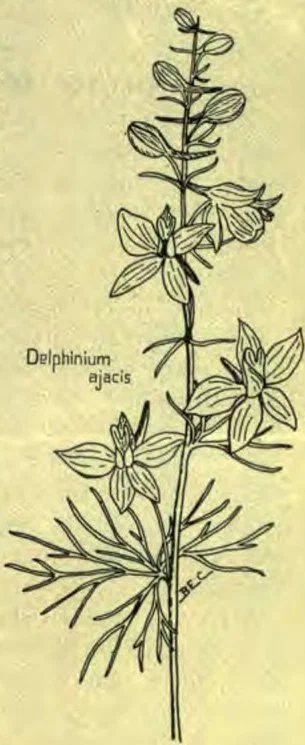
The sepals are colored like the petals, and, indeed, are the most showy part of the flower. In most of the forms there are four separate petals, and from two to five pistils. Others have only two petals, which are united more or less into one piece, and but one pistil. Of this form is the one shown in the illustration, Delphinium Ajacis, or Rocket Larkspur, found in flower gardens.
Delphinium ajacis
Delphinium ajacis
All the species agree in having the upper sepal produced into a long spur, which is sometimes straight, sometimes curved. The popular name is an allusion to the long hind claw so characteristic of the larks.
Several kinds of Larkspur have been reported to the United States Department of Agriculture as plants poisonous to cattle and sheep. Delphinium tricorne, the Dwarf Larkspur, has been reported, especially from Ohio, to be fatal to cattle in April, when the fresh leaves appear. Delphinium geyeri, a common plant of the high prairies of Wyoming and Colorado, is reported to be the most troublesome of all the poisonous plants of Wyoming, causing considerable loss to ranchmen, especially in early spring. Delphinium menziesii, the Purple Larkspur, is found from San Francisco to British Columbia, and eastward as far as the Dakotas, being very common throughout Montana. The botanist of the Montana Agricultural College reported a case of poisoning that occurred in May, 1897, in which over five hundred sheep were affected.
It is advised as an excellent precaution that animals be permitted to graze in pastures containing larkspur only when well-fed, and then only for short periods, until they become acquainted with the nature of the plant.

Questions

Of what form are the leaves of all the larkspurs? What is meant by “palmately lobed” and “palmately veined”? What is the usual color of larkspur flowers? What part of the flower is the most showy? In what special characteristic do all larkspurs agree? What trouble is caused by some of the species? B. E. Crawford.

My Service

It is not mine to run With eager feet Along life's crowded ways My Lord to meet.
It is not mine to pour The oil and wine, Or bring the purple robe And linen fine.
It is not mine to break At his dear feet The alabaster box Of ointment sweet.
It is not mine to bear His heavy cross, Or suffer, for his sake, All pain and loss.
It is not mine to walk Through valleys dim, Or climb far mountain heights Alone with him.
Yet, Master, if I may Make one pale flower Bloom brighter, for thy sake, Through one short hour;
If I, in harvest fields, Where strong ones reap, May bind one golden sheaf For Love to keep;
May speak one quiet word When all is still, Helping some fainting heart To love thy will;
Or sing one high, clear song, On which may soar Some glad heart heavenward, I ask no more!
— Julia C. R. Dorr.

The Present the Opportune Time

A number of years ago I was awaiting the arrival of a train in a railway station in England. There were many present on the same errand, and while we were all in a state of expectation, some one said to me, pointing to a great bell: “In a little while you will hear that ring; for when the train is five miles off, it will run over a pneumatic valve, and set that bell in motion.” In a few minutes it began to ring violently, and in an instant the whole crowd was excited; the train was just five miles away. I have often thought that the Lord Jesus has been ringing his bell for some years back, just to waken up his sleeping church, and tell its members that he is coming, and that his advent draweth nigh.
Let us look at the proof of this. A hundred years ago there was in the church little or no missionary light. It is quite true that our Lord’s great dictum that his gospel must first be preached to all nations for a witness before the end would come was perfectly well known; but this sublime and soul-stirring truth was neither grasped with the mind nor acted on in the daily life of the church. It was allowed to lie there among its great unused treasures; and what was the result?—That we could only say that there was no sign whatever of our Lord’s actual coming. China was one dense mass of heathenism; Africa only a geographical name; India, Tartary, and the islands of the sea in the darkness that might be felt; while all the time the church was slumbering in her earthly splendor, forgetful of the call of her Lord. How different is it to-day! There is hardly a land that has not been interpenetrated by the heralds of the cross. Vast oceans have been crossed, mountains climbed, and difficulties overcome, in order that Christ might be made known to the ends of the earth. Even in Central Africa, where forty years ago the name of Christ had not even been heard, there is a living and glorious church, so that to-day by the placid waters of Victoria Nyanza they are singing with joyful hearts the sweet hymns of Keble, Bickersteth, and Lyte. Surely these are signs of His coming, and sounds of his advancing feet.—Dr. M. S. Baldwin, Toronto, Canada.
Continue reading: Young People's Society at Birnamwood, Wisconsin