The Youth’s Instructor, Vol. 33, No. 39.

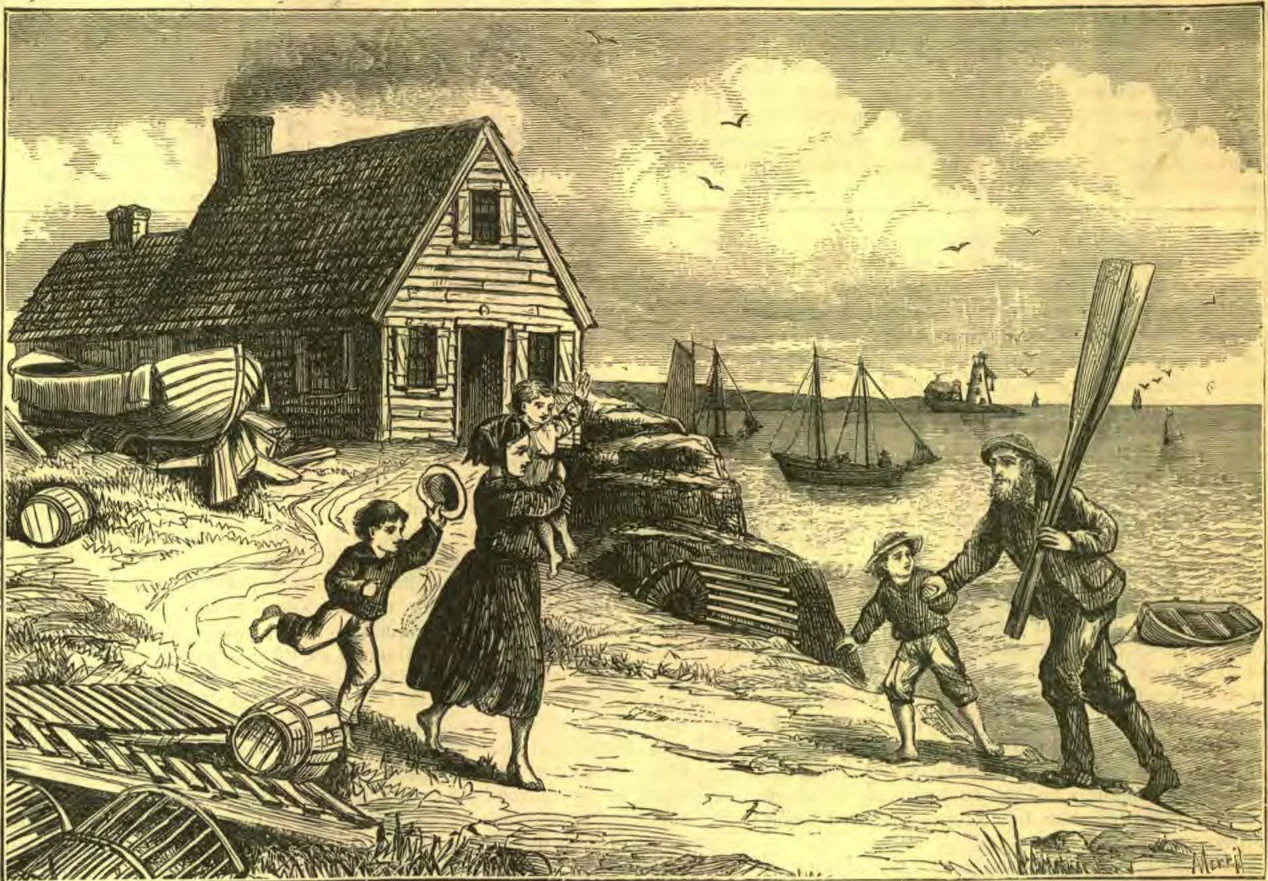
THE FISHERMAN'S RETURN

The Youth’s Instructor

Oct 14, 1885

S. D. A. Publishing Association · Battle Creek, Mich. · Oct 14, 1885

THE FISHERMAN'S RETURN.

It's time that the fishers were coming back, Coming laden with shining spoil; The oars are bent on the homeward track, And the rowers are weary with all night's toil. The rose of dawn, so pearly and red, Unfolding, has made the round earth sweet, The boats are bringing the children's bread, And we must be waiting our men to greet.
So, father, gaze through the trusty glass, And scan the waves of the foaming bay, You will catch them soon as the Point they pass, Your eye is keen, though your hair is gray. And, wife, with bairn in your arms asleep, Keep up your heart, he will soon be here, The sea's rich harvest he went to reap For the sake of the babe you hold so dear.
Fair lass, with blush on your nut-brown cheek, Your sailor is hastening across the wave; For lack of a word that you would not speak, His heart is sad and his brow is grave. Yest'reen is gone, but you have to-day; Let a welcome beam on your parted lips; For theirs is a perilous, stormy way, Who needs must go to the sea in ships.
There was One who stood on a grassy shore In the morning's beautiful opening glow, And watched the boats with their quivering store, And said to a fisherman soft and low, “Lovest thou me?” And still he says To the men who toil on the billowy sea, “You, most of all, should be full of praise, If over the billows you go with Me.”
The night was chill, and the toil was hard, But the boats are bringing the children's bread: The Lord is ever the sailor's guard, And under his smile are our tables spread. So, baby, wake, for thy father's near, And, grandsire, say when the Point they round, For sweet in the fond wife's waiting ear Is the sound of the keel as it scrapes the ground.
—Margaret E. Sangster.

A FAMOUS MUTINY.

“Uncle John,” said Eddie suddenly, one afternoon, looking up from his spelling-book, “what is a mutiny?”
Uncle John, who is our “sailor uncle,” was reading a letter with a big, red seal on it, and did not at first hear the small voice. As he folded up the letter, Eddie repeated his question.
“A mutiny, my boy? mutiny? mutiny?” said Uncle John, slowly. “I’m afraid I don’t know. It must be a new word. How do you spell it?”
“Why, m-u-t, mut, i-n, in, y, mutiny,” was the confident reply.
“Ha, ha!” laughed Uncle John. “That’s a word of a very different ring. A seaman ought to know what mutiny means, for he is likely to swing at the yard-arm if he gets confused about it. A mutiny at sea, my boy, means a refusal of the sailors to obey their commanding officers, or a seizure by them of the ship, and is punishable by death. A mutiny is the most dreadful thing that can happen on board ship, outside of wreck or capture by pirates.”
“Were you ever in a mutiny, Uncle John?” said the eager little listener. “Oh, do tell us about one!”
“Yes, please do,” said Ella, who had come in just in time to hear the last question.
“No,” said Uncle John, “I am glad to say I have never been in a mutiny, or in a place where there was one. Mutinies are not very common nowadays, for sailors are much better treated than they used to be. Laws have been passed of late years which inflict severe penalties on brutal captains who maltreat their men, and so there is not so much cause for mutinies now. But in former times, things were very different, and cruel captains could do pretty much as they liked; and as they very often liked to do very mean and hateful things, it is not much wonder that sometimes sailors would rebel rather than endure ill-treatment, and take the chances of escape, though they knew that they were committing a very grave offense, and that the law would have no mercy on them if they were captured. But if you want to hear about a real mutiny, I will tell you about one, and perhaps the most famous and remarkable mutiny that ever occurred at sea. It took place on the British man-of-war, ‘Bounty,’ a good many years ago. But first you must get me your big atlas, Ella, so that we may trace our course, and see where we are sailing to.”
Ella soon returned with her atlas, and Uncle John told her to open it at the map of the world. He stuck a pin in the map at a projecting point on the southern coast of England, and another at an unnamed little black dot in the South Pacific, way off at the other side of the book; then continued:—
“In the year 1769 the Society Islands were discovered by the famous Captain Cook. The largest of these, called Tahiti, is where I have stuck the pin. It was a beautiful little island, and inhabited by a race of strong and handsome but gentle and peaceable people. An important product of the island is the bread-fruit tree, whose fruit is very nutritious, and looks and tastes somewhat like white bread. This tree furnishes the principal food of the islanders; and its thin and flexible bark supplies them with clothing.
About the year 1787, the planters of the British West Indian Islands heard of the bread-fruit tree, and petitioned the British Government to send a ship to get a load of it for them to plant. So in December, 1787, the good ship ‘Bounty’ was fitted out for the expedition, and sailed for Tahiti from Portsmouth, England, where you see I have put the other pin. She was commanded by a man by the name of Bligh, who had sailed with Captain Cook, and knew all about the South Seas; and she carried a crew of forty-four men. The voyage was a very long one. They first sailed down here by South America, and tried to round Cape Horn. But after terrible storms for over a month, they gave it up, and steered for the Cape of Good Hope, South Africa, and then way across the Indian Ocean to the Society Islands. It was nearly a year after their voyage began when they finally reached Tahiti, and they had traveled over twenty-seven thousand miles.
“But long before they had reached the island, the crew had begun to be discontented. Captain Bligh was a very stern and overbearing man, and did not treat his crew fairly. He accused them unjustly of stealing the provisions, and put them on short allowance; and when they complained that even the short allowance was not fit to be eaten, he called them all on deck, made each one say he was satisfied with the food, and swore that he would make them all eat grass, or anything else he chose to give them, before the voyage was over. Things kept getting worse and worse after they arrived at the island. Some of the crew were flogged by his orders, and he often insulted his officers. Among these officers was one by the name of Fletcher Christian, who was first mate. He was a quiet man, but very sensitive; and the captain treated him worse than any of the others.
“At last, when they had been more than six months at the island, and had got their cargo of plants, they started for home. They were three hundred miles from Tahiti, when, one morning, Fletcher Christian determined to bear his lot no longer, but to seize the ship. He gathered around him some of the men who had been flogged, put arms in their hands, stationed them at the officers’ cabins, and seized and tied the captain. In a twinkling the ship was in Christian’s hands. The captain tried to win the mutineers back, but they laughed at him, and hurried him and those who would not join them over the side of the ship, and into an open boat. Nineteen men were thus crowded into a small boat, with a cask of water, a few tools, and some bags of ship-bread. They were then cast adrift on the great Pacific. However cruel Captain Bligh may have been, he could not have been more cruel than were the mutineers in abandoning a boat-load of men to the mercies of the wind and waves in the middle of a great ocean. You see, the mutineers did not reflect that they were doing just what they themselves had found so hateful.
“Christian and his comrades immediately turned the ‘Bounty’ about, and sailed for Tahiti. But it was not Christian’s intention to stay there. He knew that, even if Captain Bligh should not succeed in reaching England, a ship would be sent out to search for the missing vessel; and he determined to seek some isolated and rocky island where he would not be found, and where he could spend the remainder of his life in safety. Sixteen of the ship’s company, however, preferred to remain at Tahiti. The rest, nine in all, with twelve Tahitian men and women, who were induced to follow their fortunes, set sail in the ‘Bounty’ for a safe haven, which they found in Pitcairn’s Island, a craggy islet five or six hundred miles from Tahiti, which at that time was not put down on any of the charts, and was far out of the course of the few vessels that ever sailed in those waters. They ran the ship on shore, and, after removing everything of value, destroyed her, that there might be nothing to attract the curiosity of any vessel that should happen to pass within sight of the island. So perished the good ship ‘Bounty.’ Not a soul except those on the island knew what became of her; and they were apparently never to leave their rocky fortress. Christian lived in a kind of stronghold in the interior of the island, where he remained, a moody, resolute man, determined to resist to the death any attempt at capture. But soon the islanders began to quarrel and fight; and in four or five years, all of the mutineers but one, including Christian himself, and all of the Tahitian men, had been killed. The one Englishman left became a very good man, and spent his time in teaching the children of the mutineers what he knew of the Christian religion, and in laboring in all ways for the welfare of the little community; so that when the island was at last visited by Europeans, it was quite a model Christian settlement. It was not till 1809, twenty years after the mutiny, that a vessel touched at the island. At that time the population had increased to thirty-four. They now number some hundreds; some of them still live on Pitcairn’s Island, but two companies of them have moved to other islands in the South Seas.
Captain Bligh, in his open boat, resolved to take the forlorn chance of reaching Timor, the nearest land inhabited by white men. For forty-one days he guided the little shell through storm and calm on the great ocean, his men half starved and half drowned all the time, and at last reached land, having sailed over 3,600 miles, and without losing a man—one of the most wonderful voyages ever made under such conditions. Some of the poor fellows died, however, after reaching shore. The rest of them finally reached England in 1790.”
“And what became of the ones who stayed at Tahiti?” asked Eddie.
“That is the saddest part of the story. A ship called the ‘Pandora’ was sent to Tahiti to retake the mutineers; and though many of those who had remained on the island had not taken any part in the mutiny, and surrendered themselves to the captain of the ‘Pandora’ as soon as she arrived, they were all put in irons, and thrown into a ‘cage’ built for them on the ship, which they jokingly called ‘Pandora’s box,’ where they were treated with the most horrible cruelty until the ‘Pandora’ was wrecked on her home voyage, when four of them, still in irons, were drowned. The remaining ten were tried for their lives in England, and seven of them were acquitted; three were hanged. Some of those who were acquitted afterward rose to distinction; but they will be best known from their connection with this famous mutiny, which peopled an island, occasioned a wonderful open-boat voyage, wrecked two vessels, created great excitement in England at the return of Captain Bligh, and the trial of the mutineers, and has been the subject of many books, and of a long poem by Lord Byron, called ‘The Island.’”—The Christian Union.

THE SAMOAN ISLANDS.

These islands, sometimes known as the Navigators, comprise nine inhabited islands, with a population of nearly 50,000. Savaii is the largest island of the group, but by no means the most important. Tutuila and Upolu are the ones most frequently visited by foreigners, on account of the commercial relations existing between them and some of the countries of Europe. A gentleman who came on board our ship from these islands told me of many of the native customs and the resources of the country, a few of which I will here try to reproduce, with some facts gathered from other sources.
The island of Tutuila has a number of villages, the houses of which are built in the shape of a dome, and standing on a raised platform of gravel or rock. Posts are driven into the ground in a circle the size desired, and poles laid from the tops of these to a high post standing in the center. The whole is securely fastened together with neatly braided thongs, made from the dried fiber of the cocoa-nut husk, and the roof is thickly covered with the long leaves of the sugar-cane. The eaves reach to within about four feet of the ground, forming a draft for the air, which keeps the inside of the house comfortably cool. The floor is covered with white mats made of the bark of a tree, and the sleeping apartments are separated from the principal one by gaily colored curtains of the same material.
Pango-Pango is the chief town and harbor of the island, and was once quite a depot for cocoa-nut oil. The grated kernel of the nut was placed in some sort of a wooden trough, and exposed to the rays of the sun. As the oil oozed out, it was scraped up and preserved for shipment to other countries. But instead of this process, the cocoa-nut kernel is now sliced into strips, and is then called “copra.” In this form it is shipped to foreign countries, and there the oil is extracted by machinery.
Apia is not only the metropolis of the island of Upolu, but it is the chief town of the entire Samoan group. The scenery of this island is said to be very grand. From the water’s edge, the land rises gradually until it reaches the height of about four thousand feet. The lofty cocoa-nut trees may be seen along the entire distance, waving their plumes in great profusion; while the deep foliage of the bread-fruit tree hides the bare, straight bodies of the cocoa-palms, and with the trees of lesser note, the mountain slope presents one solid growth of the richest tropical plants.
The Samoans are broad shouldered, and of rather lofty stature. Their features are very regular, and the color of their skin is a rich bronze. They have also amiable dispositions. This may be accounted for from the fact that they were never cannibals; and until the white man went among them, it is said they were ignorant of any mode of warfare, a sad commentary indeed on the morals of the Caucasian race. The most noticeable feature of a Samoan is his hair, of a bright red color. Their hair is originally of the color of tow, and the red color is obtained by putting coral lime upon the head, which destroys the native color, and produces the desired tinge. Some of the men allow their hair to grow to great length; a string is then tied around it close to the back of the head, and it hangs down behind in one huge bunch. This is decorated with pomegranate blossoms, and other bright flowers, and then they appear in the latest fashion.
But these islanders are victims to some bad habits; they are very fond of strong drink. The universal beverage among them is a preparation called “kava.” It is prepared from the root of a species of pepper shrub, which grows to a height of five or six feet, and has leaves of a purple tinge. The root is cut into small pieces, then distributed to young men and women who have perfect teeth. The root is munched by them until it is reduced to very small particles, and then thrown, mouthful after mouthful, into a large wooden bowl. Water is added to the pulpy mass, and it is then worked about with the hand, till all its strength is pressed out. It is then strained through a handful of the fiber, and the vile stuff is made.
When drunk in excess, “kava” has a stupefying effect similar to that produced by opium. Those who become accustomed to the use of it cannot seem to break the habit. Disagreeable as perhaps the thought of even touching so filthy a preparation may seem to the readers of the INSTRUCTOR, yet it is stated that some white men who go there, become so excessively fond of the beverage that they drink great quantities of it, and think they cannot get along without it. The habitual “kava” drinker can generally be recognized by the dull, glassy look of his eye, and the scaly appearance of his skin. The natives attribute many of their diseases to its use, yet they say they cannot refrain from using it. Poor creatures! They are in nearly the same condition as the white man who is confirmed in the use of whisky and tobacco.
J. O. CORLISS.

FALSE PRIDE

Written for the INSTRUCTOR.

FALSE PRIDE.

PEOPLE ought to cultivate pride in certain directions. They should take pride in being neat and orderly, and in doing as good work as they can possibly do. They should take pride in being honest and upright in dealing with other people.
But there is a kind of pride that it is very wrong for people to cherish; and that lies in thinking you are too good to do any honest kind of work, or that it is a disgrace for you to speak to those who are not so well off as you are. Such pride is an abomination to the Lord; and that we might know how bad it looks to him, he sent his Son into the world to teach us how to live. Christ came in great humility, and had no place that he could call his own. Every day, for the greater part of his life, he worked hard with his hands at the carpenter's trade. He left many precepts which we would do well to follow. When you accept an invitation, he said, don't take the highest seats; that is, don't do anything to make a show; others will give you all the honor due. Some people are slow to learn this truth, as the following incidents will show:—
One day a clerk in a hardware store was told to take a wheelbarrow and some hardware to a certain place. “I wish you wouldn't sell wheelbarrows for me to wheel right through the streets,” said the young man. The proprietor told him that if he felt too proud to take a wheelbarrow through the streets, he could get his pay; and in a short time he was discharged.
The Chief Justice of the United States was at one time in a market, when a man came up to buy a turkey. Completing his purchase, he haughtily inquired for some one to carry it home for him. The Judge, who was a plain-looking man, volunteered to carry it for him. Down the street they went, to the proud man's house, the Judge walking in the rear, carrying the turkey. The man thought it strange that every one should turn to look at them; so, after the turkey had been delivered, he inquired who the person was. “That,” replied they, “is Chief Justice Marshall, of the Supreme Court of the United States.” The man's feelings can be better imagined than described, and we hope he had wisdom enough to profit by the lesson that the wise Judge taught. J. R. CALKINS.

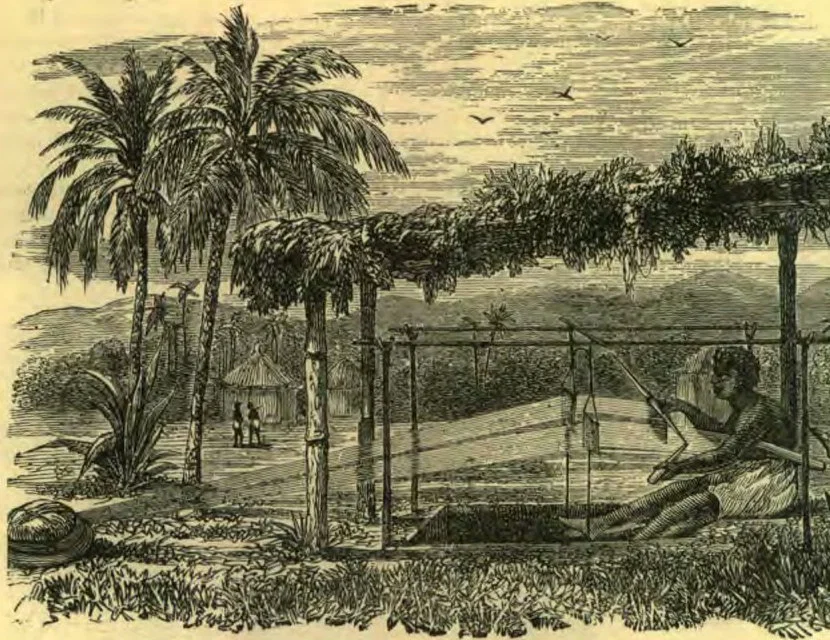
Hindoo Weavers.

It is wonderful with what simple contrivances some of the best cloths are produced. Fanny Roper Feudge, in the Illustrated Christian Weekly, tells some interesting things about Hindoo weaving, and our engraving represents one style of their looms. She says:—
“In Hindostan, which is supposed to be the original birthplace of the loom, the natives still employ this useful machine in its most primitive form. Sometimes two trees growing near together form their standing-frame. Usually palms are selected, on account of their straight, slender trunks; and a few slats of bamboo, with some pieces of cord, complete the simple apparatus. The weaver makes four stakes of bamboo to support his warp, and a sufficient number of pegs to fix his head-ropes securely, and thus equipped, will shake his turbaned head disdainfully at the bare mention of foreign innovations.
“Sometimes a loom is suspended from the rafters of a room in the dwelling, or a shanty near by that is kept for the purpose. Then the machine will be composed of a number of stakes fixed a few feet apart for the entire length of the building, or perhaps in front of it, for a distance of thirty or forty yards, and the thread is carried between the stakes by the warpers running round and round them with their spindles till the work is done. The warp is dressed with congey, or rice water, to serve as starch, and the weaving is almost as simple an operation as the preparation of the warp.
“The operator sits with his legs in a hole in the ground, and keeps his toes busy in regulating the cords attached to the work upon which he is engaged. A machine of this sort, with all the requisite apparatus, costs only a rupee and a half, or about sixty-eight cents of our money. Yet by the aid of so simple a contrivance, these Hindoo weavers produce not only the renowned Cashmere shawls that have in almost every land been regarded as among the specialties of costly and beautiful attire, but also the lovely India silks and muslins so highly prized, even in Europe, for that wonderful fineness and smoothness of texture that no other nation has yet been able to produce. The most skillful imitations of the shawls have been made in France, but even the very best are readily distinguished, by experts, from the genuine India article, of which they are too clumsy an imitation to meet with ready purchasers.”

The Virtue of Cheerfulness

THERE is no greater every-day virtue than cheerfulness. This quality is like sunshine to the day, or gentle, renewing moisture to the herbs. The light of a cheerful face diffuses itself, and communicates the happy spirit that inspires it. Be cheerful always. There is no path but will be easier traveled, no load but will be lighter, no shadow on heart or brain but will lift in the presence of determined cheerfulness.

MAKE IT A BUSINESS.

THE only way to succeed in Sabbath-school work, or anything else, is to make a business of it. Taking it up a little while on the Sabbath-day will accomplish just about as much as it would be to follow any other business in the same way. How would a farmer or a merchant expect to prosper who should give merely the odds and ends of time to planning and managing his work?—intervals when from weariness or some other cause he was unable to do anything else. How would the professional man flourish who should pursue such a course? When a teacher, a physician, or a clergyman prospers in any business besides his profession, he is at once suspected of a lack of faithfulness and diligence in his calling.
As a rule, the successful man of business devotes the best of his time and thought to its management. He thinks of it when he rises up, and when he lies down, when he goes out, and when he comes in. Almost every event of the day suggests something that he can turn to practical account.
Just so it must be with the successful Sabbath-school superintendent. The work for which he is chosen is an important one. It must lie very close to his heart. He must care more for its success than he does for gaining wealth or fame. Although he is not expected to give the most of his time to it, he ought certainly to give it his best moments and his best ability. He may not be able to secure a regular teachers' meeting with full attendance, but he can have an informal teachers' meeting almost every time he meets a teacher. In an easy, conversational way he can draw from the teacher his plans, hopes, trials, and successes. By looking over the teacher's class record, and by special inquiry, he can learn the condition and prospects of every member of the class. He can give words of encouragement that will seem precious in time of need. He can have a smile and a kind word for every scholar he meets; and although some may dislike him for his pertinacity, many will live to bless him for his faithfulness. Such a course will cause the teachers to treat their scholars as the superintendent treats them; and thus great good is accomplished.—G. H. Bell, in S. S. Worker.

SAND

One would hardly think a detective could trace a crime by a few grains of sand; but this common substance varies so greatly in different localities that it is said a close observer can locate himself by its quality. The following is an extract from what Ellen Bertha Bradley has written about sand. She says:—
“An old sea-captain, nearing the Atlantic coast, will tell exactly where he is by the sand which the lead brings up from the bottom; and once an important robbery in Prussia was traced by means of a bag of sand. A box of treasure belonging to the Royal Bank, which had been sent from Berlin to Münster, was found, on being opened, to contain one thousand dollars’ worth less of gold coin than when it started, the money having been taken out, and its place filled with a bag of sand. The robbery had been skillfully executed, for the box showed no signs of having been disturbed, and all efforts to find the thief were unsuccessful, until a famous geologist suggested that some of the sand should be sent to him, with specimens of that near all the stations through which the box had passed. This being done, he quickly told where the robbery had been committed; and the police, having this clue, soon secured the thief.
“Varied as are the minor elements in sand, the main body of it is always quartz. We may get some idea of the amount of this mineral by remembering that it not only forms the vast deposits of sand along our coasts and in the deserts, but also the great, underlying strata of sandstone rocks; that it is present in all soils, and is necessary to all animal and vegetable life. Rock crystals and many of our favorite jewels, such as topaz, chalcedony, bloodstone, chrysoprase, and jasper, are also quartz; and it enters largely in the shape of veins into rocks, in the composition of which it has no part.
“Sand is never long stationary, for the grains slip over each other so easily that the firmest appearing banks are moving slowly in the direction of the prevailing winds. We have all heard of the terrible sand-storms which travelers meet in crossing deserts, and of Memphis, once the Egyptian capital, lying for centuries so deeply buried by drifted sand, that until within a few years its site has been unknown. Nor is it in the neighborhood of great deserts alone that sand-floods are destructive. In the eastern part of Scotland, many large tracts of once fertile land are covered with sands as unstable as those of Arabia. Early in this century, a parish in Aberdeen county was reduced to two farms, and not a vestige of any of the buildings was to be seen, unless it might be a fragment of the church. At another place, a large and valuable tract was covered by an inundation so rapid, that, in a single season, an apple-tree was covered so that only the very summit could be seen. This flood was caused by the cutting down of some trees that had served as a barrier to the sand, and the pulling up of the bent, or star, a species of mat-grass, whose long roots creep into the sand, and bind it together. So useful is this plant in checking sand-floods, that in the reign of George II., an act was passed by Parliament, forbidding its destruction; and the planting of it has been earnestly recommended wherever a flood threatens. It grows best in pure sand.”
She gives other interesting descriptions of sand-floods, which we have not space for at this time. She says also:—
“It must not be supposed that the work of blown and drifting sand is all evil. Between Eccles and Winterton it has closed the mouths of several small estuaries, and rendered possible the reclaiming of many acres of land. In the days of the Saxons, Norwich stood upon an open estuary, leading up from the sea. About the time of the Norman Conquest, the sands upon which Yarmouth is built became firm enough to be habitable, and they have since been steadily increasing. The closing of the wide estuary and reducing it to a river, shut back the tides, and rendered fit for cultivation many thousand acres, in which upward of sixty fresh-water lakes have been formed, varying in depth from fifteen to thirty feet, and in size from one acre to twelve hundred acres.”

IMPORTANT BIBLE SUBJECTS.

LESSON 6.—THE KINGDOMS OF DANIEL VIII.

[NOTE TO THE STUDENT.—Do not consider the lesson learned until you can give at least the substance of every text, with the correct reference for each. The references in black letters indicate those texts that should be committed to memory. A little diligent application each day will enable you to learn them, although this need not be considered a test of scholarship.]
  1. When did Daniel receive another vision? Dan. 8:1.
  2. Describe the first beast of verse 3.
  3. In what directions and with what success did he push his conquests? Verse 4.
  4. What did the prophet see coming against the ram? Verse 5.
  5. Describe the rough goat. Ibid.
  6. What did he do to the ram? Verses 6, 7.
  7. What change took place in the goat? Verse 8.
  8. What came forth from one of these horns? Verse 9.
  9. How powerful did this horn become? Verses 9, 10.
  10. In the interpretation, what did the ram denote? Verse 20.
  11. What did the rough goat symbolize? Verse 21.
  12. What did the great horn between his eyes denote? Ibid.
  13. Who was the first king of Grecia? (See note.)
  14. What did the four horns represent? Verse 22. (See note.)
  15. How many great earthly governments are brought to view in Daniel 2?
  16. How many in Daniel 7?
  17. How many in Daniel 8?
  18. What is the first kingdom in chapter 2?
  19. What in chapter 8?
  20. Why is Babylon omitted in chapter 8? (See note.)
  21. By what kingdom was the Babylonian Empire overthrown? Dan. 5:28, 31.
  22. By what was the Medo-Persian Empire succeeded? Dan. 8:21.
  23. Then what were the first three great universal empires?

NOTES.

The first king.—“Grecia attained its greatest glory as a unit under the leadership of perhaps as vile a man and as great a king as the world has ever seen. This part of her history is represented by the first phase of the goat, during which time the one notable horn symbolized Alexander the Great.” Alexander died at the age of thirty-two, in a drunken debauch, which is well represented by the breaking of the horn. His kingdom was then taken by his four generals,—Cassander, Lysimachus, Seleucus, and Ptolemy, and divided among themselves, which is represented by the four horns taking the place of the one that was broken.
Question 20.—In the symbols of chapter 8, it will be seen that the kingdom of Babylon is not introduced. It is reasonable to suppose that sufficient characteristics of this kingdom had been introduced in chapters 2 and 7; and as it was nearing its overthrow, the prophet’s mind was called to the contemplation of those which were to follow.

MY FELLOW-CREATURES.

YOU love your fellow-creatures? So do I,— But underneath the wide, paternal sky Are there no fellow-creatures in your ken That you can love except your fellowmen? Are not the grass, the flowers, the trees, the birds, The faithful beasts, true-hearted without words, Your fellows also, however small? He's the best lover who can love them all.
—Charles Mackay.

ILLUMINATED NEST OF THE BAYA.

There is seemingly, no end to the beautiful and wonderful things that the study of nature furnishes; and he is a great loser who gives them no attention. The following is but one of the thousands of pleasing discoveries that the naturalist has made; is it any marvel that he is fascinated with his work? This is what a late Harper’s Weekly says:—
“The nest of the Baya is in itself an ingenious piece of work. The upper portion is divided into two chambers, one for mother baya while she is sitting, and one for father baya when he has earned the right to rest by providing his wife with food. The lower portion of the nest is a general living-room for the whole family as soon as the little ones have grown strong enough to leave the upper chamber.
“Here is a home that might well be all that the most exacting could require; but having provided for creature comfort, the baya has yet to gratify its sense of the beautiful. The little mother is hardly settled down, when the male bird, having put the finishing touches to the nest, darts forth and returns with a fresh lump of clay, which he affixes to the inner wall of the nest. Then quickly away again, to capture one of the living sparks of which there are myriads in the tropics. The fire-fly is secured to the lump of clay, and lights up the little home with its phosphorescent glow. Another and another are added, until the patient little mother has light enough to cheer her during the long, dark night. After that, one or more of the animated diamonds are fastened to the exterior, there to glitter and flash for the delectation of the outside world, for the baya is no selfish lover of art. He does not lock his treasures up in his gallery, but is willing to share his enjoyment with all.
“And what pleasure he does give can be easily comprehended by a slight effort of the imagination, which has only to picture a quaint little hut with overhanging eaves, nestling in the gloom of a tangled tropical forest. From the eaves gently wave the gaily illuminated bird-nest lanterns, shedding a soft, happy home light on the poor little cottage, which loses its wretchedness for the time being, and is transformed into a fairy palace.”

CRUSOE'S ISLAND.

From the Philadelphia Press we gather some interesting facts about Robinson Crusoe's, or Alexander Selkirk's, island as it is to-day. They are these:—
“Opposite the harbor of Valparaiso stands the island of Juan Fernandez, sacred to the memory of Robinson Crusoe and his man Friday, who kept things tidy, and listened to the tales that his master told. The little harbor is there, with its rocks and caves, just as it was when Robinson went ashore; the cave is in good order still, and the cliffs up which he and Friday used to chase the mountain goats. The goats are there, and the armadillos, the birds of wonderful plumage, and the crawfish among the rocks. Every boy in the United States who has read the story recently could go all over the place without a guide, and could find everything except Robinson himself and the faithful Friday.”
“The island belongs to Chili, and is leased to a cattle company, who have 20,000 or 30,000 head of cattle and as many more sheep grazing over the hills. There are about fifty or sixty inhabitants, ranchmen with their families, under the charge of a Frenchman named Crawe; and besides the stock, they raise a quantity of poultry, and ship chickens and eggs, with some vegetables, to the Valparaiso market. The timber on the island is said to be of an excellent quality, but is not much used. No one ever goes there without bringing away a cane or two as a memento; and the brush from which these canes are made is of a very beautiful fiber, and polishes well. Excursions go over frequently from Valparaiso, and the interest in Robinson Crusoe's experience is much stimulated by those who come this way.”

MEXICAN HOTELS AND SERVANTS.

BEFORE going to Mexico, our readers would do well to read the following, clipped from an exchange:—
“The hotels in Mexico are so bad that those who have to remain there any length of time invariably go to housekeeping, and can thus live as comfortably and economically as anywhere in the States. There is no aristocratic quarter in Mexico, and it is fashionable, not only to live on a business street, but to have a saloon or a meat market on the ground floor. Everybody lives in flats. The houses are usually three stories, and the top floor is considered the best. It will rent for $100 a month, while the second floor rents for $40. When a house is to be let in Mexico, the owner sticks an old newspaper in the window. It isn't very tasteful, and seldom improves the appearance of the house; but it is economical, and understood by the community. Servants are cheap and plenty, and you are pretty sure to have several descendants of the Aztec kings about the house if you hire one, for it is the rule here that the whole family go with the father or mother when they go out to service. Your cook brings her husband, her children, and pretty nearly all her relations, and they are fed from your table and sleep under your roof. The husband may be a shoemaker, or a saloon-keeper, or a hack-man, but he lives where his wife works. There are usually rooms enough in the house for them all, and the only food they want is plenty of beans and what is left from your own table.”
Continue reading: A LOUD WHISTLE