The Youth’s Instructor, Vol. 32, No. 11.

MEDUSÆ

The Youth’s Instructor

Mar 12, 1884

S. D. A. Publishing Association · Battle Creek, Mich. · Mar 12, 1884

MEDUSÆ
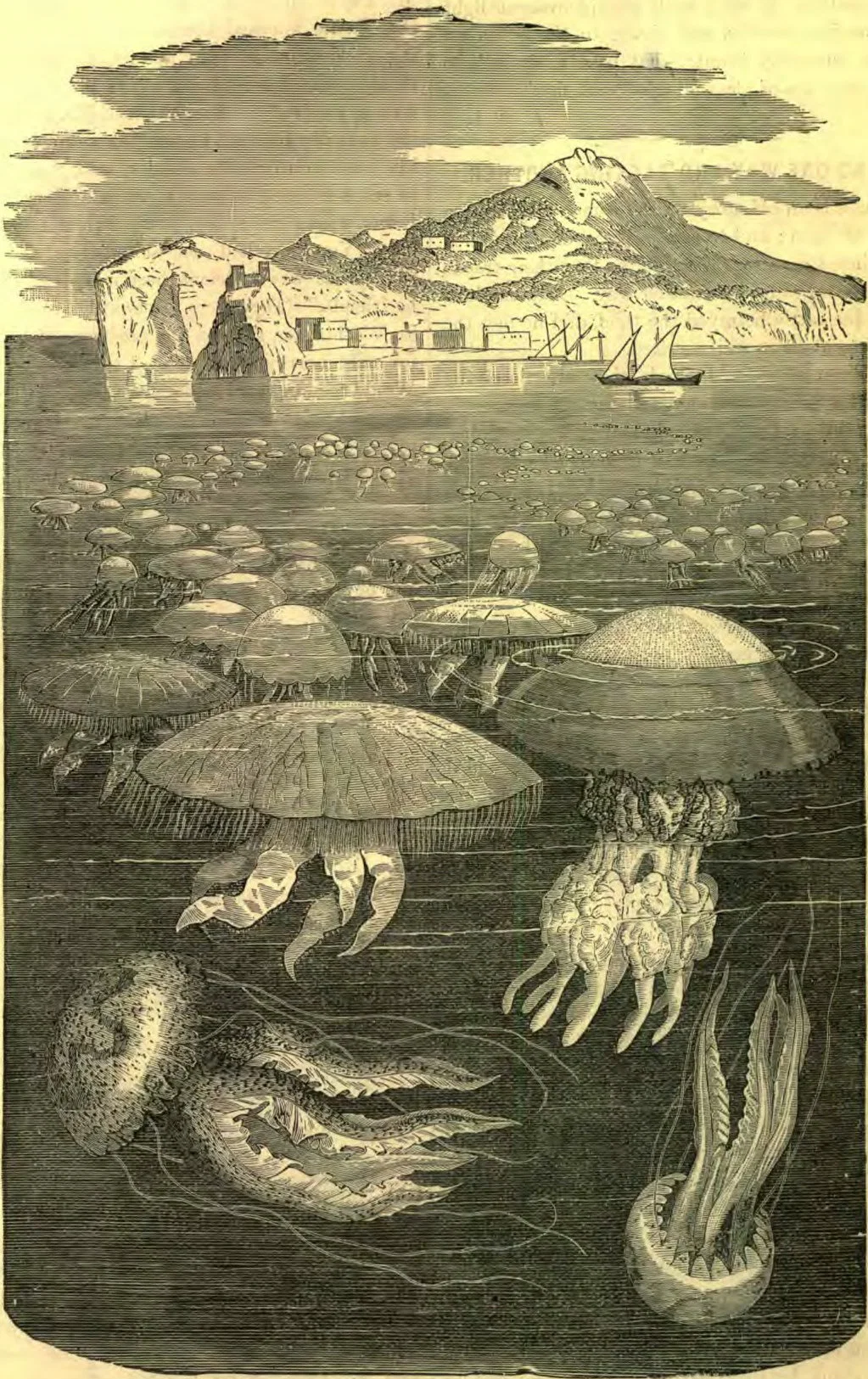
WERE we to walk along the sea-shore after the tide has gone out, we might often see, “lying immovable upon the sands, gelatinous, disc-like masses of a greenish color and repulsive appearance, from which the eye and the steps instinctively turn aside.” And were we to carefully put one of these seemingly dead bodies back into its watery home, we would doubtless be more than surprised to see it, after a few minutes, riding the waves like an azure bell, fringed with delicate silvery threads.
These beautiful and graceful little creatures are called Medusæ, because the ancients thought the dainty fringes hanging around the edge of the umbrella-shaped animal, resembled the snake-like locks of a fabulous person called Medusa, who was said to change all who looked at her into stone.
The Medusæ are composed of a jelly-like substance, mostly water. They are frequently as clear as crystal. Sometimes they are opaline, and occasionally of a bright blue or a pale rose color. So delicate are these little creatures, that a morsel of one might be dissolved into water by the mere heat of our hands. When cast upon some inhospitable beach, the sun’s rays are sufficient to dry up these living soap-bubbles. In the lower part of the animal is the mouth. Though these little creatures are so soft and delicate, they are very voracious, and devour the small molluscs that come in their reach, at one mouthful.
These animals are so soft that they could not rest on the ground, so they are obliged to keep in constant motion. To do this, the edges of the disc approach quite near to each other, forcibly ejecting a part of the water contained in the body, and so moving the animal in an opposite direction. It then expands, and repeats the motion; thus they make long voyages over the water. This expanding and contracting movement has given them the name of Sea Lungs.
But notwithstanding the Medusæ are such innocent looking creatures, they inflict on sea-bathers and fishermen who may happen to come in contact with them, the most terrible stings. Says a popular writer, who had the misfortune to come in contact with one of these creatures: “Its presence is so much to be dreaded that no one who has once suffered from the lash of its envenomed filaments will venture to bathe without keeping a careful watch on the surrounding water. At its first infliction, the pain is not unlike that caused by the common stinging-nettle, but rather sharper, and with more of a tingling sensation. Presently it increases in violence, and then seems to attack the whole nervous system, occasionally causing severe pain to dart through the body, as if a rifle-bullet had passed in at one side and out at the other. Both the heart and lungs suffer spasmodically, and the victim occasionally feels as if he could not survive another minute. These symptoms last for ten or twelve hours before they fairly abate, and even after several days the contact of the clothes is painful to the skin.”
Medusæ are found not only in our own seas, but under the burning sun of the equator, and in the cold waters of the Arctic Ocean. They are seldom seen alone, but generally travel in large fleets, as is shown in the picture on the first page. Says a naturalist: “There are few more beautiful sights than to stand on a pier head or lie in the stern sheets of a boat, and watch the Medusæ passing in shoals through the clear water, pulsating as if the whole being were but a translucent heart, trailing behind them their fringes, and rolling gently over as if in excess of happiness. At night, the Medusæ put on new beauties, glowing with phosphorescent light like marine fire-flies, and giving to the ocean an almost unearthly beauty, that irresistibly calls to mind the ‘sea of glass mingled with fire.’”
W. E. L.

HAVE FAITH.

A SWALLOW in the spring Came to our granary, and ’neath the eaves Essayed to make a nest, and there did bring Wet mud and straw and leaves.
Day after day she toiled With patient art; but, ere her work was crowned, Some sad mishap the tiny fabric spoiled, And dashed it to the ground.
She found the ruin wrought; But, not cast down, forth from the place she flew, And with her mate fresh earth and grasses brought, And built her nest anew.
But scarcely had she placed The last feather on its simple floor, When wicked hand or chance again laid waste, And wrought the ruin o’er.
But still her heart she kept, And toiled again; and last night, hearing calls, I looked, and lo! three little swallows slept Within its earth-made walls.
What truth is here, O man! Hath hope been smitten in its early dawn? Have clouds o’ercast thy purpose, trust, or plans? Have faith, and struggle on!
—Selected.

GOING ONE WAY AND BACKING ANOTHER.

THERE is an old story told of a man who stole a drove of oxen; and to escape discovery, he pulled them into a cave by their tails, so that their tracks should seem to lead the other way. But the lowing of the cattle betrayed the thief, and he met the punishment he so well merited.
Children sometimes think they are deceiving others by going one way and facing another,—getting into all sorts of mischief or wrong doing and yet contriving to make their tracks look all right to their parents and teachers. Let me tell you of one such boy and girl, and you will see how easy it is to get into a wrong course, and how even children need to “watch and pray” lest they also yield to temptation.
Eddie Holt stayed out playing the other evening an hour after his usual supper time, and then accounted for his tardy appearance at the table by saying he had been walking with his teacher in the fields collecting botanical specimens. This was true, so far as it went; but he should have added that, after his return from the walk with his teacher, he called to see two of his school-mates, and had been with them flying kite from five to seven o’clock, though he knew he ought to be home by six. His father’s reply, “I am glad you were so well employed, my son,” sent a blush of shame to Eddie’s face. Had he told the whole truth, he would probably have received from his parents a just reproof for his tardiness; but he would have had the consciousness of acting honorably in confessing his fault, instead of a sense of inward shame in accepting praise where he well knew he had merited only blame. Added to this, Eddie had a constant fear that some time his deception might be found out, and the dread of discovery robbed him of far more enjoyment than the two hours’ stolen pleasure had given him. Was it not a hard bargain, this going one way and backing another?
Minnie Weston received the first prize for composition in her class, greatly to the delight of her parents and brothers, while her teacher publicly congratulated her on the progress she had made in this branch of study. But none of them knew that Minnie’s cousin Walter, who lived in the country, had taken her prize essay home with him on his last visit, and had so revised and improved her work that when Minnie came to copy the composition, she could hardly recognize its original features. She had not asked him to do this, but she had told him how very anxious she was to win the prize, and from the depths of her heart she had thanked him for helping her to do so. But it was not honestly won; and to secure this small triumph over her class-mates, Minnie lost the approval of her own conscience, and, more than all, had sinned against Him who looks into the heart, and sees every secret thought of evil-doing, though to the outward appearance all may be fair and good. Did the gain equal the loss?
Both of these children were going one way and facing another, and from just the same motive of deception as was the man who pulled the stolen oxen into the cave backward instead of forward.—The Child’s Paper.

KEEP THE LIFE PURE.

Once upon a time, an Arabian princess was presented by her teacher with an ivory casket, exquisitely wrought, with the injunction not to open it until a year had rolled round. Many were the speculations as to what it contained, and the time impatiently waited for when the jeweled key should disclose the mysterious contents. It came at last, and the maiden went away alone, and with trembling haste unlocked the treasure; and lo! reposing on delicate satin linings, lay nothing but a shroud of rust. The form of some beautiful trinket could be discerned, but the beauty had gone forever. Tearful with disappointment, she did not at first see a slip of parchment containing these words:— “Dear Pupil,—May you learn from this for your life. This trinket, when inclosed, had upon it only a single spot of rust; by neglect it has become the useless thing you now behold, only a blot on its pure surroundings. So a little stain on your character will, by inattention and neglect, mar a bright and useful life, and in time leave only the dark record of what might have been. If you now place a jewel of gold within, and after many years see the result, you will find it still as bright as ever. So with yourself; treasure up all the pure and the good, and you will ever be an ornament to society and a source of true pleasure to yourself and your friends.”—Religious Herald.

EDITOR'S CORNER.

Each day has its opportunities. If we let them slip by, they are lost forever. We cannot go back and pick them up, for our life is an onward march from the beginning till its close. Too often we suffer loss because waiting and hoping for something better to come to us; but should other and better opportunities present themselves, they cannot atone for what we have lost. One of the great lessons of life, which we should learn early, is to know our opportunities.
Probably no generation has had so favorable opportunities for acquiring marks of distinction as the present one; but because so many overlook or fail to improve them, but few, comparatively, rise to any high standard. Facts reveal that those men and women who have made the greatest attainments in knowledge or excellence were usually children who had but few opportunities. They made the most of what Providence placed within their reach, and oftentimes struggled with poverty and temptation till success crowned their efforts. No doubt President Garfield had this fact in mind when he remarked, “I never meet a ragged boy in the street without feeling I may owe him a salute, for I know not what possibilities may be buttoned up under his coat.”
But here is our special work—God has intrusted us with important truths which he would have us impart to others. And here is our opportunity—to warn and save. May we ever know our opportunities for doing good, and allow none to go by unimproved.
In God's providence we come in contact with all classes of persons, some of them very disagreeable, and some of them very wicked; but down deep in their hearts they may have longings to know a better way. They are all God's creatures. He loved us while we were yet sinners, so he would have us love them, and reach out our hand to save them. The task may seem unpleasant, and in consequence we may put it off, and think to do the work of to-day on the morrow. But we “know not what shall be on the morrow.” The present moment is all that we have any claims upon. Then do the work at once; don't miss the opportunity.
Dear young friends, your opportunities for warning sinners will soon cease; the work of probation will soon close up. Will you see any thrust out of the kingdom of God in consequence of your neglected opportunities? or for this reason will the blood of souls be found upon your garments when it is too late to have it removed? Seek wisdom from God to know all he requires of you, and then do the work faithfully and well, that you may have an abundant entrance into the everlasting kingdom of God.
M. J. C.

INCIDENTS IN THE LIFE OF WASHINGTON.

It is said that when Washington was a young man, a dispute took place between himself and Mr. Payne, in which Washington spoke so sharply that Payne knocked him down. Instead of sending a challenge to fight a duel, as was usual in those days, Washington, seeing he was in the wrong, resolved to ask pardon of Mr. Payne. So the next day he went to see him, and reaching out his hand in a friendly manner, said, “Mr. Payne, to err is nature; to rectify error is glory. I find I was wrong yesterday, but I wish to be right to-day. You have had some satisfaction, and if you think that was sufficient, here is my hand; let us be friends.” They were afterward strong friends. So Washington showed the greatness of his heart, for only narrow natures seek to resent an insult. Would we might all remember to follow the course the poet points out in the following verse:—
“O little souls, that have no strength to rise Above an insult, choose the better part; Cherish the noble feeling of the soul That crushes hate when rising in the heart.”
Washington was very considerate of his soldiers, and never forgot that they were men with feelings, like himself. At one time, while his army lay at Valley Forge, and many, for lack of food and clothing, were perishing from cold and hunger and disease, Washington told one of the hungry men to go to his table and eat, while he took his gun and performed the duties of a common soldier, a sentinel.
Washington was a great man. Edward Everett said of him, “Of all the men that have ever lived, he was the greatest of good men and the best of great men.” Frederick the Great declared his deeds to be “the most brilliant of any in the annals of military achievements.” Even his enemies admired his noble character, and when he died, sincerely mourned for him.
John R. Calkins.

A PLEASING INCIDENT.

Sitting in a station the other day, I had a little sermon preached in the way I like; and I'll report it for your benefit, because it taught one of the lessons which we all should learn, and taught it in such a natural, simple way that no one could forget it.
It was a bleak, snowy day; the train was late; the ladies' room was dark and smoky, and the dozen women, old and young, who sat waiting impatiently, all looked cross, low-spirited, or stupid. I felt all three, and thought, as I looked around, that my fellow-beings were a very unamiable, uninteresting set.
Just then a forlorn old woman, shaking with palsy, came in with a basket of wares, and went about, mutely offering them to the sitters. Nobody bought anything, and the poor old soul stood blinking at the door a minute, as if reluctant to go out into the bitter storm again. She turned presently, and poked about the room, as if trying to find something; and then a pale lady in black, who lay as if asleep on a sofa, opened her eyes, and seeing the old woman, instantly asked, in a kind tone, “Have you lost anything, ma’am?”
“No, dear; I'm looking for the heatin' place to have a warm 'fore I goes out again. My eyes is poor, and I don't seem to find the furnace nowhere.”
“Here it is,” and the lady led her to the steam radiator, placed a chair, and showed her how to warm her feet.
“Well, now, an't that nice!” said the old woman, spreading her ragged mittens to dry. “Thanks, dear; this is proper comfortable, an't it! I'm almost frozen to-day, being lame and wimbly; and not selling much makes me down-hearted.”
The lady smiled, went to the counter, bought a cup of tea and some sort of food, carried it herself to the old woman, and said, as respectfully and kindly as if the poor woman had been dressed in silk and fur, “Won't you have a cup of tea? It's very comforting a day like this.”
“Sakes alive! do they give tea at this depot?” cried the old lady, in a tone of innocent surprise that made a smile go around the room, touching the glummest face like a streak of sunshine. “Well, now, this is jest lovely,” added the old lady, sipping away with a relish. “This does warm the cockles of my heart!”
While she refreshed herself, telling her story meanwhile, the lady looked over the poor little wares in the basket, bought soap and pins, shoe-strings and tape, and cheered the old soul by paying well for them.
“As I watched her doing this, I thought what a sweet face she had, though I had considered her rather plain before. I felt ashamed of myself that I had grimly shaken my head when the basket was offered to me; and as I saw the look of interest, sympathy, and kindness come into the dismal faces all around me, I did wish that I was the magician to call it out. It was only a kind word and a friendly act, but somehow it brightened that dingy room wonderfully. It changed the faces of a dozen women, and I think it touched a dozen hearts, for I saw many eyes follow the plain, pale lady with sudden respect; and when the old woman got up to go, several persons beckoned to her, and bought something, as if they wanted to repair their first negligence.
Old beggar women are not romantic; neither are cups of tea, boot-laces, and colored soap. The lady's kind act wasn't done for effect, and no possible reward could be received for it except the thanks of a ragged old woman. But that simple little charity was as good as a sermon to those who saw it, and I think each traveler went on her way better for that half hour in the dreary station. I can testify that one of them did, and nothing but the emptiness of her purse prevented her from “comforting the cockles of the heart” of every forlorn old woman she met for a week after.—Louise M. Alcott.

NEW-TESTAMENT HISTORY.

LESSON 178.—REVIEW ON ACTS 17 AND 18:1–17.

1. How did Paul first find an audience in Berea? Acts 17:10.
2. How were his teachings received by the Bereans? Verse 11.
3. What was the result of their diligent searching of the Scriptures? Verse 12.
4. How were the apostles disturbed in their work at Berea? Verse 13.
5. How was Paul's safety secured? Verses 14, 15.
6. What stirred the spirit of Paul as he waited in Athens for the coming of Silas and Timothy? Verse 16.
7. With whom did Paul first talk at Athens? Verse 17.
8. How was his preaching ridiculed? Verse 18.
9. Before what body of men did they bring him? Verses 19, 20.
10. How did Paul begin his discourse? Verses 22, 23.
11. What did he say of the true God? Verses 24–26.
12. What did he say about seeking for God? Verse 27.
13. How did he further show the folly of worshiping idols, the work of men's hands? Verses 28, 29.
14. What does God require of all men as soon as they receive the light of the gospel? Verse 30.
15. What has God appointed? Verse 31.
16. What assurance has he given that the dead shall be raised?
17. What caused the Areopagites to break out into open mockery? Verse 32.
18. Was the discourse wholly fruitless? Verse 34.
19. Where did Paul next preach? Acts 18:1.
20. With whom did he take up his abode? Verses 2, 3.
21. How did he spend his Sabbaths? Verse 4.
22. How was this custom broken up? Verses 5, 6.
23. What friends did Paul find? Verses 7, 8.
24. How was he encouraged by the Lord? Verses 9, 10.
25. How long, at this time, did Paul continue his work in Corinth and the country near it? Verse 11.
26. What attempt was made to put a stop to Paul's preaching? Verses 12, 13.
27. How were they defeated in their attempt? Verses 14–17.
28. To what church did Paul write letters while he was at Corinth?—To the church at Thessalonica.
29. In what did these letters chiefly abound,—reproof, or praise? condemnation, or encouragement?

GENERAL EXERCISES IN THE SABBATH-SCHOOL.

Some seem to have conceived the idea that one of the main objects of the general recitation in the Sabbath-school, is to furnish the members an opportunity to recite in public, and to show how well they have learned the lesson. And so we find that in some localities this exercise has been made to serve the purpose of fostering pride and vanity in the children, instead of being a means to benefit and profit the school.
We conceive the true object of the general recitation to be this: To furnish an opportunity for a review of the day's lesson, and to still more deeply impress upon the hearts of the scholars the truths and practical instructions which may be drawn from the scripture lesson under consideration.
In order to successfully attain to this object, it is necessary: 1. That there be a thorough preparation of the lesson on the part of the scholars; and, 2. That the one conducting the exercise be thoroughly conversant with every part of the lesson. If these conditions are not met, the exercise will be neither interesting, profitable, nor instructive. In short, thoroughness and faithful work are as necessary to successful general recitations, as they are to make a success of anything.
The one conducting the recitation should have the lesson so thoroughly prepared that he can be entirely independent of the lesson paper. The matter of the lesson should be so deeply rooted in his mind and heart that he can ask questions, draw out answers, and impress practical lessons of truth and duty upon the minds and hearts of the scholars, without once referring to the text.
But this cannot be done without making the lesson a subject of close study and earnest prayer. The word of God should be faithfully studied, lesson helps and commentaries should be consulted, and everything that can throw light upon the lesson should be looked up. But without the help of the Spirit of God to enlighten the mind, to enable it to discern the lessons taught in the scripture under consideration, and to devise ways of presenting and applying these, all other efforts will be of no lasting effect.
The manner of conducting the recitation may be varied at different times, to suit different circumstances. In many schools the general exercise is simply a repetition of the class recitation, the questions being asked exactly as given in the paper. This we consider to be the least desirable plan, and to many it becomes very monotonous. Where this plan is varied with a repetition of the principal part of the story of the lesson, the recitation becomes more interesting.
The recitation might sometimes be conducted in this way: The superintendent may begin asking questions about the lesson, until a certain point is reached; then ask several persons to continue reciting still further without any questions; then some more of the questions can be asked, and so on alternately until the lesson is finished. This can be interspersed with questions as to the practical lessons taught, and other related subjects.
A very profitable way of conducting the general exercise is to have three or four of the scholars give briefly and connectedly the main points of the lesson. Then the division can be questioned as to what practical thoughts may be drawn from the lesson under consideration, at the same time requiring them to state definitely what part of the lesson is the basis for the practical instruction brought out. In this way scripture truths may be impressed upon the mind, at the same time that the substance of the lesson is given.
Long reviews, that cannot be gotten through with during the regular time for general recitation, may be made interesting if the one conducting the exercise begins the review at the regular time for class recitations, carrying the lesson on to a certain point, and then stopping short, and requesting the division to finish up the lesson in the classes.
Map and blackboard exercises serve to make the recitation interesting and instructive, especially among younger scholars.
The superintendent will find many different ways of making the recitations interesting, profitable, and instructive, if the conditions of success are observed: Thorough, faithful study of the word of God, interest for the welfare of souls, and earnest prayer to God for wisdom, help, and guidance in the work.
A. B. O.

MARCH

Ah, surly March! you've come again, With sleet and snow and hail and rain; Cold earth beneath, dark sky above you, What have you, pray, to make us love you? No month is half so rough as you, December winds less harshly blew; What churlish ways! what storm-tossed tresses! Your presence every one distresses! Haste, haste away! We longing wait To greet fair April at the gate; Cold earth beneath, dark sky above you, Surely you've naught to make us love you!
“Ah! see these blossoms!” he replied, Tossing his hail-torn cloak aside; “Though other months have flowers a-many, Say, are not mine as fair as any? See peeping from each dusky fold The crocus with its cup of gold; Violets, snowdrops white and stilly, Sweeter than any summer lily; And underneath the old oak leaves Her fragrant wreath the arbutus weaves— Whatever sky may be above me, Surely for these all hearts will love me.”
—Exchange.

Better Budget.

FRANKIE FRANCIS writes us from Sandusky Co., O. He says: “This is the first time I have written for the INSTRUCTOR. I was thirteen years old last July. I will try to be a better boy this year. One week before Christmas I went out to sell the book called ‘Sabbath Readings.’ I love to canvass. I think next summer I will try to do more of this kind of work, and I want you all to pray that the Lord will help me in my work. I love the Sabbath-school. I love the Saviour, and he loves me, and I will keep his commandments.”
EDDIE MASON writes from Meeker Co., Minn. He says: “Dear INSTRUCTOR, as I am one of your family, I thought I would write and tell you that I, too, like to read the paper. I was nine years old last June. Last summer I joined the Vigilant Missionary Society so that I could send my papers to some of my old schoolmates who do not have them. One of the boys writes that he wants to take the INSTRUCTOR himself. So you see I have gained one subscriber for the paper. I will try to get more. I go to Sabbath-school nearly every Sabbath, and learn my lessons in Bible Lessons No. 2. My mother is our teacher. I want to be a good boy so as to meet Jesus when he shall come.”
MARY A PRESTON, of Jones Co., Iowa, says: “I think the INSTRUCTOR is well worthy of its name; and it will instruct the old and middle-aged, as well as the youth and children. My ma says she likes to read it as well as the children do. After we have all read it, I let my Aunt Mattie have it to read. She likes it very much. I think I can get her to subscribe for it. I shall try to do what I can in canvassing for this much-loved paper. You may send our paper in my brother’s name, as I think we will then get it more regularly.”
The above letters are all from canvassers. If we could say the same of all who write for the Budget, what an army of workers we should have.

WORK FOR THE CHILDREN.

When children hear how much Jesus has done for them, they most always want to do something in return, though they often think they are too young to try. But God needs little hands, as well as large ones, to carry on his work. The Bible says many things to encourage the children to begin to serve God while they are very young. “Even a child,” the wise man says, “is known by his doings, whether his work be pure, and whether it be right.”
We read that when Jesus was here upon earth, and mothers brought their little children to him, the disciples said, “Take them away; Jesus is too busy teaching grown people to notice little ones.” But Jesus did not like to have them talking so; for he wanted to help all, and he never thought of leaving the dear children out. So he called them to him, and putting his hands on their heads, said, “Suffer little children to come unto me, and forbid them not, for of such is the kingdom of heaven.” Jesus meant to show by this that he came from heaven to call children to love him, and to get ready to live in the mansions he has gone to prepare for us all.
How often— “I wish that his hands had been placed on my head, That his arms had been thrown around me, And that I might have seen his dear face when he said, ‘Let the little ones come unto me.’”
The Bible speaks of four things that are little upon the earth,—the locusts, the spiders, the ants, and the coneys; and it says that they are “exceeding wise,” that is, they are so willing and faithful that they accomplish as much as if they were large. We should be as willing and faithful in our work for the Master, as these little animals are in their work for themselves. But while we are willing to work, we must not forget to put away our bad habits, and keep the heart pure; then we can have the blessing that the apostle says Christ gives to the little ones. HELEN L. MORSE.

“YE HAVE DONE IT UNTO ME.”

Ye have done it unto me, ye have done it unto me,” sung Jennie, one Monday morning. “There! I’ll remember it this time, sure. But, dear me! I’m forgetting, after all. The teacher said we must learn the words, and think of what they mean, and try to do them.”
“Let me see, now,” and she pressed her hands to her forehead; “teacher said, ‘If we gave a cup of cold water to one of his little ones, for the Saviour’s sake, he would say, “Ye have done it unto me.”’ I don’t s’pose I know any of his little ones, but I’ll try if I can find ’em.”
She ran into the kitchen, where, on the dresser, she spied a large bowl, which was used to mix cake in.
“Ah!” thought she, “the Saviour is pleased if we give his little ones a cupful of water; he’ll like a bowlful better still. Bridget, may I take this bowl awhile?”
Bridget, who was busy with her washing, did not turn her head, but said,—
“Oh, yes; take what you like.”
Jennie lifted the big bowl down very carefully, but how to fill it was the question. She did not want to trouble Bridget; besides, she thought she ought to do it all herself. At last she spied the cup that always hung on the pump; so, taking that, she filled it several times, and poured it into the bowl. “It’s cupfuls, after all,” she thought.
It was almost more than she could carry without spilling; but she walked slowly to the front gate. There was no one in sight, and Jennie set her burden on the grass, and swung on the gate while she waited.
Pretty soon two little girls came along on their way to school.
“Want a drink?” called Jennie.
“Yes, indeed; it’s so hot, and I’m dreadful thirsty. I most always am. But how are we to get at it?” laughing, as they saw the great bowl.
“Oh, I’ll soon fix that!” and Jennie ran for the tin cup, with which they dipped out the water.
“It tastes real good,” they said, and kissed her as they ran off to school.
The next that came along was a short, red-faced Irishman, wiping his face with the sleeve of his shirt, while an ugly dog trotted at his side.
“He don’t look much like ‘one of the little ones,’” thought Jennie, doubtfully; but she timidly held out her tin cup. He eagerly drained it, filling it again, and drinking.
“And it must be a blissed angel ye are, for it’s looking for a tavern I was, and now I won’t nade to go nigh one at all. And sure, afther all, water’s better nor whisky. Might I give some to the poor baste?” pointing to his dog.
Jennie hesitated; she did not like the idea of having the dog drink from her cup or bowl. But the man settled it by pouring the rest of the water into his dirty old hat, and the dog instantly lapped it up.
After they were gone, Jennie filled her bowl again. I can’t tell you now of all to whom she gave cups of cold water that hot day. But when she laid her tired head on her pillow that night, she thought,—
“I wonder whether, after all, any of ’m were his ‘little ones!’”
And the dear Saviour, looking down, and seeing that the little girl had done all that she could for his sake, wrote after her day’s work, “Ye have done it unto me.”—Selected.

At the Fireside.

The nightfall by the firelight’s cheer My little Margaret sits me near, And begs me tell of things that were When I was little just like her.
Ah, little lips you touch the spring Of sweetest sad remembering, And hearth and heart flash all aglow With ruddy tints of long ago.
At my father’s fireside sit Youngest of all who circle it, And beg him tell me what did he When he was little just like me.
John D. Long

You have reached the end of this edition.

The Youth’s Instructor · Mar 12, 1884