HOW frequently we hear mothers asking, “What can I do with the children on Sabbath afternoon?” Many earnest mothers want to make Sabbath a pleasant and religiously profitable day for their children, and would do so if only some one would show them how.
Mrs. Brown says, “Johnnie is so restless and Mary won’t pay attention. I really have tried to teach them Bible verses and their Sabbath school lessons, but I just can’t do anything with them.”
Mrs. Goodwin says, “I have bought books for the children that tell them what to do on Sabbath afternoon. They will not use them.”
Is there nothing that can be done for the children in the home that will make them familiar with Bible characters, scenes, and events, and give them a rich fund of memorized verse as a foundation for the deeper religious life that is to come later only with experience? Mrs. Stoner has well said, “The path of knowledge should be a joy to all children.” If this is true of the attainment of secular knowledge, how much more true is it of things pertaining to God and our relationship to him!
Let us visit a home where the parents have met with some success in attempting to solve this problem.
Dinner is over at two-thirty, and five eager little faces are looking questioningly at mother, waiting for something to do. Does she put them on five straight-backed chairs in the parlor and stand stiffly before them, Bible in hand, frowning on the least evidence of overflowing of spirits, as she drills them on the commandments and Psalms? Oh, no! She says, “Grant; run and bring your blocks—the wooden construction blocks and the stone building blocks.” The dining room table is cleared while the children crowd eagerly around it.
“What shall we make?” says mother.
“The temple,” answers twelve-year-old Fred.
Quickly the little children form Solomon’s porch, while the older ones build the temple proper out of the stone blocks.
When it is completed and each child has passed judgment on it, mother says, “When do we first hear of Jesus in the temple? Where was he, and what was he doing?”
Elizabeth points to Solomon’s porch, saying, “Here he was found in the porch talking to the doctors when he was twelve years old.”
“What happened here?” asks mother, pointing to the court of the Gentiles.
“I know, I know,” cries Fred enthusiastically, jumping up and down and almost tilting the table. “Jesus drove out the cattle, overturned the tables, and expelled the money changers.”
“Can any one tell me what he said?”
“I think I know,” says thoughtful little Grant. “My house shall be called a house of prayer for all nations, but ye have made it a den of thieves.”
“In what part of the temple did Jesus spend his time during the Passover week?”
“In the court of the Gentiles, teaching the groups of people who gathered about him,” answers Elizabeth.
“Now,” continues mother, “who can tell me what happened in the temple during the dark hours of the crucifixion?”
There is a moment’s pause, then Fred says, “I don’t know, but I can find out.” Running for his Bible, he turns to the last of Matthew, then says, “I have found it, ‘The veil of the temple was rent in twain.’” Elizabeth shows the little ones where the veil was—separating the holy of holies from the court of the priests.
Leaving the temple on the table for father to see, they turn to the blackboard. Mother draws a shepherd’s crook, and the first one who can give a verse suggested by it says, “There were shepherds abiding in the field, keeping watch over their flocks by night.”
Next a star is drawn, and that suggests the story of the wise men.
Baby Mary is elated when mother draws a picture of the rushes and a basket, for she knows it is baby Moses.
Before the blackboard game was over, father came downstairs, and, thanking the happy family for letting him have a good nap, said he had a new game to suggest. So all went into the parlor and entered enthusiastically into father’s plan. Then with songs and a Bible verse contest the happy afternoon went quickly by.
Another Sabbath afternoon mother brings out the box of Perry Pictures showing scenes in the life of Christ. She lays them all face down, and then raises one at a time just long enough for the children to guess—“The Sistine Madonna,” “Three Fishermen,” “Christ Teaching from a Boat.” When they have grown tired of these, they take turns in giving word pictures. I see a sick man by the roadside, and a man with a donkey who is going to help him. They all shout, “The Good Samaritan.” Or they have living pictures in which the children represent Bible characters.
“But,” says some one, “does this not take a great deal of the mother’s time? Does it not involve sacrifice?” What has the Lord given the mother time for? To answer the letters that have accumulated through the week, to make a social call, or take a nap so that she may be better able to do the drudgery of the coming day? No; she might better take a half day off through the week, or neglect some household duty. It will mean so much to the boys and girls to have these hours to look back upon when they are far from the home nest.
One mother, in speaking of her four boys, says: “My time with them is short. The church and society will have them when my nestlings are gone from the home9forever.” Is it too much of a sacrifice to ask of mothers that they give themselves to their children?
Two women reared their children in the same town, the same church, the same school. Today one mother welcomes back to the old home a distinguished pastor, an able lawyer, and a capable business man, all paying to her the highest tribute. They say, “Mother made us what we are by her unselfish devotion and love.” The other, in sorrow, reads of the unprincipled business transactions of her two boys. She had little time to give them when they were children. Now they bring to her only sorrow.
Which mother, think you, made the greater sacrifice?
— May H. Barclay, in the Western Christian Advocate.
A Boy’s Prayer Answered
THE vicarage drawing-room on this November afternoon looked warm and cozy, its fire burning cheerily, and its thick curtains drawn over windows and doors as if to defy the cold winds outside.
The gas had not yet been lighted, for the little group gathered around the hearth loved to have the children’s hour with just the bright flames of the log fire.
The vicar, who had returned from his Sunday school, had thrown himself into the big armchair, while his little son of five had scrambled up on his knee and nestled down into his arms, quite prepared for this hour which the children loved best of all in the whole week. His brother, a boy of eight, was sitting on the floor by his mother, stroking his white Persian kitten.
With a bright, intelligent face the elder boy looked up and said, “Now we’re ready, father.”
“Well, what shall we talk about this afternoon?”
“Oh, do tell us about our Miss Price, daddy,” broke in little Freddie, the younger.
So once more the story, of which they never tired, was poured into their listening ears, of how Miss Price (who was formerly their much-loved governess and friend) had given up home, friends, and indeed all, that she might go and carry the blessed news of Jesus Christ’s love into a land where few had heard of him, and fewer still had learned to love him; how she had become their own missionary, representing their parish in Ceylon.
The children well remembered the day when she came to say good-by to them. Their own hearts were sad, and as Fred untwined his little fat arms from her neck, there were tears in the big brown eyes. But there was that about her which struck the children with something like awe, for while they were sorry for her to go, she seemed so glad, and her face beamed as she spoke of her future work.
Then they remembered that for two Sundays after that they had joined the large congregation in church in singing a hymn “for those at sea,” and they had learned that it was for their own missionary, that God would take care of her on the voyage. It all came back vividly as they listened.
And now the vicar had come to a part in the story which interested the boys above measure, and which sounded to them more like one of their nursery tales than sober, everyday fact,—how their friend had no home of comfort as she had in England, but lived in rough surroundings, in a house where the rain often came through the roof, and with no such thing as carpets; how, too, she had to put up with large rats, big spiders, and other creepy things as companions in her room, and how even out of doors she was not safe, because of the venomous snakes and reptiles.
The very sound of all this struck a note of adventure in the elder boy’s heart, but in little Fred’s it was rather one of fear, and his face changed from interest to sadness as he thought of his missionary with snakes about her.
Tea had long been cleared away, and the vicar was ready for his evening service; but, as was his custom, he just looked into the nursery to say goodnight to his baby Fred. The sight which met his eyes was a familiar one, and yet it appealed to him with more than ordinary force tonight. By the fire sat his wife on a low chair, and at her knee knelt a little white-robed figure saying his evening prayer; and as the vicar waited a moment, this is what he heard:—
“God, bless dear mother and father, and make me a good boy, for Jesus Christ’s sake. Amen.”
And then in a quivering but earnest voice:—
“And, O dear God, take care of my Miss Price, and oh, please do keep her safe from the snakes.”
The vicar’s eyes met his wife’s in a loving glance, and he kissed the little curly head. Then with eyes suspiciously moist, but with a new and valuable lesson in his heart, he went joyously on his way to preach to his congregation on “The Power of Prayer.”
Far away in Ceylon a lady missionary is wending her way to a house she calls “home.” Her arms are full of books, and she has just come from her little Tamil children. She seems tired, and yet she has that look of brightness and joy which is characteristic of her.
As she nears her house, she thinks of the dear ones in the homeland, and for a moment she longs for a glimpse of them and for the opportunity of joining once more in their evening worship; and in a stronger way than usual her mind lingers on that cozy vicarage, with its two dear little occupants.
But she is brought back to her present surroundings by a sudden and unexpected danger; right across her path she sees to her dismay one of the small but most venomous snakes of that district, its neck and head raised and arched, its eyes gleaming with a malignant fire, ready with a lightning stroke to spring upon her with its awful poison fangs. What can she do? To escape seems impossible, and for one terrible moment she is riveted to the spot in mortal dread.
Was it the look of terror in her eyes that cowed the fearful creature? She knew not, but to her inexpressible relief, as well as to her utter astonishment, it seemed suddenly to change its mind, and turning round in an opposite direction, it deliberately and noiselessly resumed its way among the long, thick grass.
With a cry of thankfulness the tired worker reached her room as fast as her trembling limbs would carry her, and going on her knees, she poured out her heart to God, who had saved her from such a terrible and certain death.
The days passed quickly away, but the incident still kept fresh in her mind, and the more she thought of it the more she marveled and wondered.
Mail day, which brought her news of her loved ones in England, was ever a day of delight to the missionary, and among her little pile of letters was one from her vicar. As she read it, her heart was cheered to know that since she had become their missionary, greater interest had been stirred up in the parish, and more zeal manifested in the work which was so dear to her Master’s heart. But the postscript at the end of the letter thrilled her as she read it.
(Concluded on page thirteen)10
A Boy’s Prayer Answered
(Concluded from page nine)
“Little Fred never forgets to pray for you. Two Sundays ago I was telling the children of your life of danger and hardship, and the dear little fellow was so upset to think that his ‘dear Miss Price’ was in danger of anything that, of his own accord, he prayed earnestly that God would take care of you, and keep you safe from the snakes. He prayed for this with such simple faith, and with such a natural and an eager expectancy for an answer, that he quite put me to shame.”
The missionary read this over and over again, and her eyes were dim as she laid the letter down.
Yes, it was that very day! Now she understood; and with a new meaning she read the text hanging over her couch:—
“Before they call I will answer, and while they are yet speaking I will hear.” Isa. 65 : 24.
It was a happy little boy who went to bed in the vicarage some three weeks later. He had that day received a letter from Miss Price, telling of her experience with the snake, and how God had protected her.— The Silent Evangel.
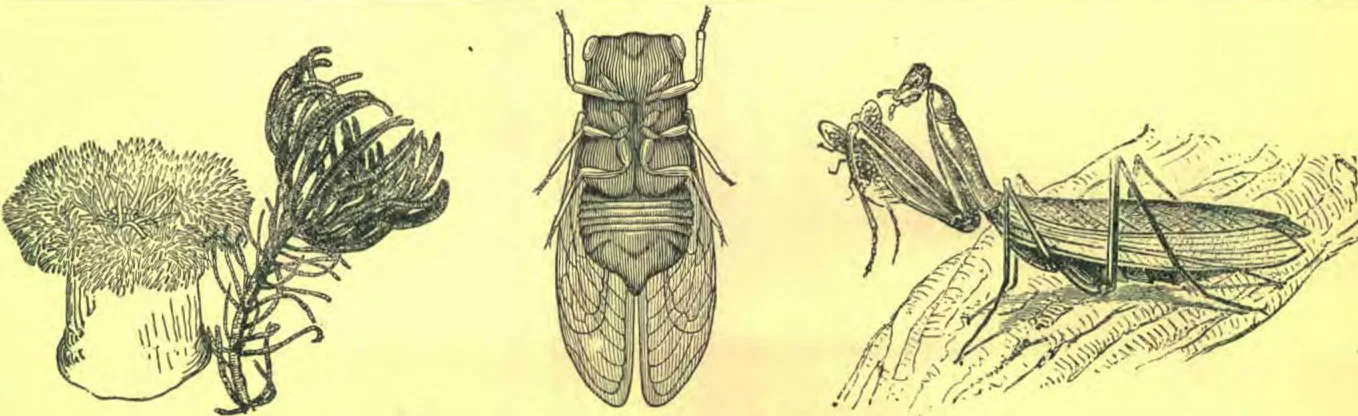
ANIMALS FOR THE FINDING-OUT CLUB TO NAME
ATLANTIC UNION
By M. E. Kern
Summary of Missionary Volunteer Work in the North American Division Conference for Quarter Ending September 30, 1915
CONFERENCES; No. Societies; Present Membership; Conf. Society Members; Missionary Letters Written; Missionary Letters Received; Missionary Visits; Bible Readings; Subscriptions Taken; Papers Sold; Papers Lent or Given Away; Books Sold; Books Lent or Given Away; Tracts Sold; Tracts Lent or Given Away; Hours of Chr. Help Work; Clothing and Meals Given; Banquets Given; Scripture Cards Given; Treatments Given; Signers to Temperance Pledge; Offerings for Foreign Missions; Offerings for Home Missions; Conversions.
ATLANTIC UNION
E. New York — 6; 60; 13; 19; 25; 24; 14; ..; 61; 266; 33; 6; 6; 147; 39; 28; 24; 10; 2; ..; $8.08; $1.79; 10.