The Youth’s Instructor, Vol. 64, No. 9.

Historic Gothic Building Destroyed by Night Fire

The Youth’s Instructor

Feb 29, 1916

Review and Herald Publishing Assn. · Takoma Park Station, Washington, D. C. · Feb 29, 1916

Historic Gothic Building Destroyed by Night Fire

CANADIAN HOUSE OF PARLIAMENT, OTTAWA, CANADA
This historic building was largely destroyed by fire on the night of February 3. The loss is estimated at $5,000,000. The building is said to have been the finest example of Gothic architecture in the Western world. The corner stone was laid in 1860 by the Prince of Wales, later King Edward VII. The fire is supposed to have been incendiary.

Brief News Items on Industry, Science, and Invention

TRIPOLI has received its first American linotype machine.
THE United States is shipping to Europe an average of fifteen aeroplanes a day.
MOST of the shadows that cross our path are caused by our standing in our own light.—Dinger.
A PATENT for a pair of suspenders was granted Samuel E. Clemens (“Mark Twain”) in 1871.
FIVE hundred billion cubic feet of natural gas was produced in the United States during the year 1914.
A DEPOSIT of cinnabar, from which mercury, or quicksilver, is obtained, has been discovered in western Nevada.
A PROMINENT English scientist has published a book in which he gives many reasons for believing that the planet Venus is inhabited.
THE United States exported ten times as much cotton yarn to Argentina in three months of 1915, as she sent in the whole year 1914.
A SOUTHERN man has patented a substitute for eggs, to be used in pastry and cakes. It is made of dried and powdered yams, suitably flavored.
AN Oregon man has invented a device which can receive, record, and relay wireless telegraph messages at a speed of nearly two hundred words a minute.
ONE of the new war industries is the manufacture of “Turkish” carpets in Ireland. They are reported of such high-grade design and color as to win the favor of experts.
THE Germans have built a mosque for their Moslem prisoners from French Africa in the camp near Berlin. The minaret is over ninety feet high, and a khoja prisoner recites the prayers.
THE record for long-distance wireless transmission was broken Nov. 29, 1915, when a station at Honolulu copied a message sent from Nauen, Germany, a distance of nine thousand miles.
IT is estimated that in the States of Indiana, Illinois, Kansas, Iowa, Ohio, and Nebraska, an increase of one inch above three inches of rainfall during the month of July, increases the value of the corn crop $160,000,000.
AN entirely new method for producing pure iron has been discovered by Dr. Trygve Yenson, an assistant in the experiment station of the University of Illinois. No patent will be taken out on the process, which will save about $15,000,000 a year to the electrical industries alone.
THE vibrations of the earth, caused by the firing of the artillery in Europe, are recorded by seismographs long distances away. Different types of guns produce tracings of a different appearance, which experts are studying, to establish a table of reference which may prove of great practical value.
THAT the beautiful trees which surrounded his old home might not be destroyed, Charles M. Schwab had his home, “Immergrün,” elevated to a height of thirty-four feet, and moved over them. It was moved at this elevation a distance of about one thousand feet, before its location was reached. Mr. Schwab will build a million-dollar summer home on the old site.
ALTHOUGH aluminum is the most abundant of all the metals, constituting about fifteen per cent of the earth’s crust, its price until a few years ago was fourteen or fifteen dollars a pound. This was on account of the extreme difficulty encountered in reducing it to the metallic state. At the present time electrical methods of manufacture have been found which have reduced its price to about twenty cents a pound.
THE engineering department of the University of Illinois has made experiments which show that concrete which has been allowed to set at temperatures of from sixty to seventy-five degrees has about twice the strength of material which sets at temperatures of from thirty-two to forty. The experiments also show that uniform temperature gives a steady increase in strength with age.

Things to be Remembered

Aim high.
Being is even more important than doing.
Cultivate cheerfulness.
Do it now.
Every thought, word, and deed leaves some impression behind.
Fear nothing but your own weakness.
Good intentions alone are worthless.
Hold fast the right; reject the wrong.
Indolence means failure.
Judiciousness is required in choosing associates.
Keeping at it wins success.
Live only one day at a time.
Make each day worth while: something accomplished, something done.
Nothing good comes without striving.
One in the right is equal to one hundred in the wrong.
Put not off till tomorrow what you should do today.
Quietness in public places is a mark of refinement.
Rule yourself before you attempt to rule others.
Silence usually accompanies strength.
Truth must be welcomed as such, or we lose sight of her.
Union is power.
Vice is best vanquished with virtue.
Wishbone never takes the place of backbone.
Xercise is the prime essential of growth.
Youth is the time when habits are fixed.
Zeal should be preceded by definite knowledge.
CORA FERRIS.

Dare to Do Right

DARE to do right; dare to be true! The failings of others can never save you; Stand by your conscience, your honor, your faith,— Stand like a hero and battle till death. — Wilson.

Elijah — the Man of Invincible Courage

(Continued)
C. C. LEWIS
TURNING to Ahab, who had looked on with helpless and horrified amazement, Elijah said, “Get thee up, eat and drink; for there is a sound of abundance of rain.” The sensual, pleasure-loving king needed no second suggestion. He quickly repaired to the feast, while the prophet of God went to the top of the mountain to pray. There he cast himself down upon the ground, put his face between his knees, and said to his servant, “Go up now, look toward the sea.” The servant obeyed, and returning, reported that there was nothing to be seen. The effectual, fervent prayer of the prophet was continued, and seven times the servant was sent on the same errand, and returned with the same report until the seventh time, when he said, “Behold, there ariseth a little cloud out of the sea, like a man’s hand.” That was enough. To the inhabitant of that country, then as now, it was and is the sure precursor of a violent storm. The prophet commanded his servant, “Go up, say unto Ahab, Prepare thy chariot, and get thee down, that the rain stop thee not.” And then, under a divine impulse, Elijah arose and girded his sheepskin robe about his loins; and while the heavens became black with clouds, the lightnings flashed, the thunders roared, the wind blew, and the rain fell in torrents, as an advance courier before the chariot of the king he ran through the darkness of that tempestuous night the eighteen miles to the entrance of Jezreel—a feat of astonishing endurance, and an act of loyalty in proof that his mission was one of reform and righteousness, and not of treason to the government of the nation.

The News Broken to Jezebel

Exhausted from the strain of the tremendous ordeal through which he had passed, Elijah sought some humble lodging place, while the king was borne to his luxurious palace, where the queen was impatiently awaiting his return.
“What is the news?” we can imagine her saying. “It must be favorable, as indicated by such a glorious rain!”
“Unfavorable enough, I am sorry to say.”
“What do you mean? What can have happened? Where are my prophets?” she cried.
“Where you will never see them again; for by this time their bodies are carried out to the sea.” And then he told Jezebel the whole story of the awful events of the day.

The Queen’s Cunning Plot

The anger of the wicked queen knew no bounds. Like a lioness bereft of her cubs, she paced up and down the floor while the story was being told, interrupting the narrative with exclamations of rage and vows of vengeance. But even in her frenzy her cunning did not desert her. She might easily have taken the life of the prophet, but she saw that in the present state of the people revolution would be sure to follow, and her own life and the lives of her family would be forfeited. She saw, also, that unless something was done to rid the land of this man who exercised such wonderful power over the people, the cause of Baal was forever lost. And she laid her plans with satanic cunning. Before she slept she sent this message to Elijah: “So let the gods do to me, and more also, if I make not thy life as the life of one of them by tomorrow about this time.”

Elijah Flees for His Life

We are unprepared for the result. Elijah, the invincible one! Elijah, with the courage of a lion and nerves of steel, who had stood alone and single-handed against the prophets of Baal, ready to take his life—we would have expected him to listen calmly to the queen’s message, send her back a note of defiance, commit his cause to the God of Israel who had hitherto preserved him, and quietly return to his much-needed rest. But not so. The shaft of the queen seems to have pierced the joints of his armor and to have found a vulnerable and vital part. He had thought the battle was over and the victory assured. Aroused from his slumbers, and listening to the blood-curdling threat of Jezebel, a reaction seemed to set in; a nameless terror seized him; and the strong man, who seemed to know nothing of fear, arose and fled, panic-stricken, from the wrath of a wicked woman. Out into the darkness he went, over hill and dale, with no thought but to get as far as possible from the object of his terror. On he fled for his life, nor paused until he reached Beersheba, the southernmost village of Judah, on the borders of the desert, a hundred miles away from the cause of his alarm. Nor did he stop here, but, leaving his servant, plunged a day’s journey into the desert, until, completely exhausted, he cast himself under a broom tree, the most welcome bush of the desert, and longed for death. “It is enough!” he cried, in bitterness. “Now, O Lord, take away my life; for I am not better than my fathers.”

The Kindness of the Lord

Behold, now, the goodness and mercy of God. He gave to his worn servant what he most needed—sleep, “nature’s sweet restorer, balmy sleep.” And then he prepared for him food, and sent an angel to gently touch him and say, “Arise and eat.” He ate and drank, and again he slept. Once more the angel touched him, and said, “Arise and eat; because the journey is too great for thee.” Once more he ate and drank, and in the strength of that food he continued his journey one hundred and thirty miles farther, to Horeb, the mount of God. This seems to have been his objective point from the start,—the mount of God, where Jehovah so wondrously manifested himself in the days of Moses. Here, if nowhere else, perhaps he might find God.

Elijah at Mt. Horeb

Here the word of the Lord came to him. O that he had waited for it before he fled from Jezebel!— It pierced him through and through with the question, “What doest thou here, Elijah?” Elijah could not answer directly, for the word of the Lord had not sent him there. He could only beat about the point with lame excuses. He had been very jealous for the Lord; but the people of Israel had forsaken God’s covenant, had thrown down his altars, and had slain his prophets; only Elijah remained, and he had fled away to save his life. Evidently his faith in God was shattered, and the Lord must make such a revelation of his character to his servant as would restore his confidence and set his feet again in the right way. And so he sent a strong wind that rent the mountains and broke in pieces the rocks, and after the wind an earthquake, and after the earthquake a fire; but to Elijah the Lord was not in these. Then came a still, small voice, which softened his heart, and he went out and stood with bowed head and covered face at the entrance of the cave. And the voice repeated the former question. “What doest thou here, Elijah?” Although his heart had been touched, there was still lacking that deep, thorough-going repentance and confession that the Lord desired to see in his servant. In the same self-justifying spirit he reiterated his former complaints and excuses, and the die was cast. The work which he might have completed was transferred to another. Tenderly but sadly the Lord still dealt with his wayward child. He assured him that he was not the only faithful one, that there were still left in Israel seven thousand who had not bowed the knee to Baal, and told him to go and anoint Elisha to be prophet in his stead. Elijah obeyed, and cast his mantle upon Elisha, who understood the symbolic act, and followed him as his minister to the glorious end of his career, to which he must now hasten.

Last Meeting with Ahab

Once more Elijah appears, to denounce upon Ahab the judgments of God because of his murder of Naboth and his ruthless seizing of Naboth’s vineyard. “Hast thou found me, O mine enemy?” And Elijah replied, “I have found thee: because thou hast sold thyself to work evil in the sight of the Lord. . . . I will bring evil upon thee, and will take away thy posterity.” And again, we see him calling down fire upon the soldiers sent by Ahaziah to take him, when Elijah was sent to rebuke the king for sending to Baal-zebub, the god of Ekron, to inquire whether he would recover from his sickness. Then comes the evensong of his life, spent in fostering the schools of the prophets, an institution founded by Samuel and later revived for the training of young men for the work of the Lord. At Bethel, Gilgal, and Jericho, during his declining years, he gathered around him the most promising of the youth who still remained true to Jehovah, and educated them in the truths of God’s Word. These schools were the missionary seminaries of those times, and in them some of the later prophets may have received impressions that have since thrilled the entire world. The last picture we obtain of Elijah is that of visiting these schools in order before he was caught up to heaven in a whirlwind of fire.

Lessons from Elijah’s Life

“The Coming of Elijah”

We are now ready to see what lessons may be drawn from Elijah’s life that may be appropriate to the present occasion. And here we are embarrassed by the wealth of material from which to choose, for every page of the narrative is studded with precious gems of experience and truth, to gather a tithe of which would be beyond the possibility of the hour. We may be guided in our choice, however, by remembering the prophecy of Malachi in the last verse of the Old Testament, “Behold, I will send you Elijah the prophet before the coming of the great and dreadful day of the Lord: and he shall turn the heart of the fathers to the children, and heart of the children to their fathers, lest I come and smite the earth with a curse.”
Interpreting this prophecy as applying to the person of Elijah instead of his work, the people at the time of the first advent of Christ looked for the literal return of Elijah before the manifestation of the Messiah. Nevertheless, the angel of the Lord, in announcing to Zacharias the birth and the work of John the Baptist, declared that he should go before the Lord in the spirit and power of Elijah, to make ready a people prepared for the Lord. And Jesus himself said of John, “If ye will receive it, this is Elias, which was for to come.” And when the scribes objected to his Messiahship on the ground that Elias must first come, Jesus admitted their claim, but declared that Elias had come already, in the sense of the prophecy, in the person and work of John the Baptist. But this was only a partial fulfilment of the prophecy. The coming of “the great and dreadful day of the Lord” includes also the events connected with the second advent of Christ; for Jesus said of Elijah that truly he would first come “and restore all things,” and Peter declared on the day of Pentecost that the heavens must receive the Messiah “until the times of restitution of all things,” thus positively connecting the Elijah prophecy with the times of the second advent. Moreover, on the mount of transfiguration, when there was given for the instruction and encouragement of the three leading apostles a miniature representation of the future kingdom of Christ in its glory, there appeared Moses, the representative of those who shall be raised from the dead as subjects of that kingdom; and also Elijah, the prototype of the living saints who at the coming of our King shall be translated into his glorious kingdom without tasting death.
With confidence, therefore, we believe the Scriptures teach that as the message of John the Baptist fulfilled in a measure the prophecy of the coming of Elijah, and prepared a people for the first advent of Christ, just so another message of warning and repentance, proclaimed in the spirit and power of Elijah, will prepare a people for the full accomplishment of the great and terrible day of the Lord at the second advent of our Lord Jesus Christ. And we believe that this final message is now going to the world, and that the very object of our existence as a separate people is to contribute to its proclamation. What great moral and spiritual lessons, then, can we draw from the story of Elijah that will be especially helpful to us who go out to battle with the myriad forms of idolatry of the present corrupt generation? From the multitude of such lessons we shall have time for but four that stand out in strong relief.

Courage and Loyalty

And first, let us learn to have courage in the Lord and be loyal to his cause. If there is one thing more than another that is illustrated in the character of Elijah, it is his invincible courage and his loyalty to the truth. An unlettered child of nature, taught only by the Spirit of God, he had courage to stand in the presence of royalty, surrounded by all the pride and pomp and luxury of a wealthy and corrupt court, and denounce the crime of kings in language so unanswerable and with manner so impressive that they quailed and shriveled before his presence, and though longing to have his life, dared not lift a finger against him, but did what he commanded them. Single-handed and alone, armed only with right, he stood in the midst of the prophets of Baal, who would have torn him limb from limb in a moment if they had dared, and conducted to a successful triumph a trial that won a nation back to God, and has challenged the admiration of the world. Nor was his courage merely that which has no fear of death. There is a physical courage, inherited or acquired by cultivation, which enables the soldier to march without flinching into the very jaws of death, or the criminal to meet his just deserts upon the scaffold without a sign of fear; but such courage does not command our highest admiration. True courage rises no less superior to the fear of death, but it contains also a moral element. Its value is measured by the virtue and nobility of the object that calls it forth. Thus measured, how can we admire enough the courage of Elijah? It stood against luxury and corruption and licentiousness and idolatry. It stood for purity and honesty and manhood and God. It stood for loyalty to the spiritual worship of the true God when all the nation were going after the senseless forms and corrupting practices of Baal worship. And it was born of the indwelling presence of the Holy Spirit and the abiding consciousness of responsibility to God. “As the Lord of hosts liveth, before whom I stand,” reveals to us the secret of his power. May the Lord raise up more of such men for the issues of today,—men who cannot be bought nor sold, men who are as true to duty as the needle to the pole, men who are afraid of nothing but the taint of sin and the displeasure of the Almighty, men who are filled with the Spirit of God, who will be loyal to his sacred cause, and who will go forth in the spirit and power of Elijah to proclaim the knowledge of a crucified, risen, and soon-coming Saviour, into the farthest and darkest corners of the earth.
(To be concluded)
ODULIA CASTRO, OF URUGUAY, SOUTH AMERICA

The Story of Odulia Castro and Her Bible

THIS remarkable story was told in personal letters from Brother James T. Thompson, one of our missionaries in Uruguay, South America. Surely, any boy or girl who has already fallen behind in the Bible Year will take it up with new enthusiasm after reading this interesting story of devotion to the Bible. Doubtless we shall find food for thought in the way this poor girl kept the morning watch. Perhaps, too, some young person who has an abundance and to spare would like to answer the appeal in Brother Thompson’s last sentence.
“I must tell you of a recent experience that I have had with my Sabbath school class. The members of the class are very good missionaries, and frequently bring strangers with them to the class. About three months ago a girl of sixteen was brought in this way. She seemed to be very timid, for nothing that I could do would induce her to look up. I thought it was only another case of where they come one or two Sabbaths, and then we see no more of them, their curiosity being satisfied.
“About the third Sabbath the girl that brought her told me that the new member had learned her lessons so well that she had committed all the texts to memory. So I said to the girl, ‘How am I to know that you have learned your lesson? You never look up, and I have been unable to get you to answer. Next week I am going to see how much you know.’ The next Sabbath she was there, and greeted me with a friendly smile. As I promised, she was given her share of the questions to answer, which she did by promptly repeating the words of the text. As we got acquainted with her, I began to make inquiries about where she lived and how she came to the Sabbath school. Imagine my surprise to learn that the girl had for two years been trying to come to our Sabbath school, and only recently had gained the consent of her parents. During this time she had been subjected to the fiercest persecution by her family.
“Two years ago a family living near them accepted the truth, and were subjected to the usual ridicule and persecution by their neighbors. This little girl joined them, and one of her pranks was to throw mud on the white clothes that this sister had washed, in her efforts to support the family. The sister said nothing, but patiently washed the clothes again. After a time the girl became conscience smitten, and came confessing her wrongs with many tears. Our sister readily forgave her, and talked to her about the gospel. The girl was very much interested, and wished to know more, so our sister gave her a Bible.
“But when she brought the Bible home, her father demanded that she return it or he would destroy it. Instead, she took it out into the garden and hid it in the grass beneath the bushes. Then early in the morning she would rise before any one else was up, and go out there to read her Bible, all the time praying that the Lord would change the hearts of her parents. After several months, they consented to her having the Bible, but she must not go anywhere near those evangelistas.
“Little by little they have relented, though all the time her sisters and brothers have made life very unpleasant for this girl, until about three months ago the mother consented to her coming to Sabbath school. You may be sure there is not a happier member in our school than she.
“Last week Mrs. Thompson and I went to visit her. She was alone when we arrived, but expected her mother to return in a few minutes. We waited about an hour, but she did not come. So the girl went across the street to see if she had stopped at her sister’s house. She soon returned, and said that her mother refused to come while we were there. With shame and disappointment she burst into tears, and begged us to pardon the conduct of her mother. Then she said, ‘What shall I do to win them to the Lord? The day of probation may close and they be lost.’ We comforted her as best we could, and after a season of prayer she was quite cheerful again.
“Here is a diamond in the rough. She has little education; she and a younger sister are the only ones in the family who can read. But she is reading her Bible and endeavoring to learn all that she can. She works in a candy factory, wrapping caramels, at which she earns about eleven or twelve cents a day. She has to give that to her mother, but every night when she brings the money home, she puts down eight or nine cents, and then says, ‘Now, mother, here is the greater part of my earnings for you. Won’t you let me have these two or three cents for myself?’ These little savings she places in the care of the sister who gave her the Bible, until she has enough to buy a book. In this way she has purchased ‘The Coming King,’ ‘Steps to Christ,’ and a hymn book, and is now saving money to buy ‘The Great Controversy.’ Don’t you think a girl like that ought to be helped to go to school?”
M. E. Kern.

Efficiency Rules

Stop talking. Learn to speak only in such a way that you and your friends will somehow profit thereby.
Stop worrying. When you can handle the present as well as God will handle the future, you will laugh at your worries.
Stop wishing. A wish is a confession of weakness. Want what you want hard enough to get it, or else feel superior to the need.
Stop criticizing. Only an ass wastes energy in braying.
Stop hesitating. It is the plunger who goes to the bottom of things. And whether gold or mud is at the bottom, the man who has found it rests.
Stop imitating. A real ruby is worth more than an artificial diamond.
Stop idling. Either work or play, sleep or travel; in short, make even your rest period a thing of ambition, volition, system.
Stop hurrying. When you teach your brain to outrun your body, your body will stay quiet.
Sit up straight, walk with your chest out, look every man in the eye, and declare yourself as good as the best. Humility is not hump-shoulderedness.
Go to the open window and take a dozen huge breaths, deeply and slowly, stretching your legs and arms at the same time, and feeling the purified blood leap through your veins and arteries. Do this whenever you have a headache or a grouch.
Read books that build, not the mush in the six “best sellers.” Read the writings of men who produced food for the minds of real men. And of all literature of action, biography is best. You can judge the progress of your neighbor on the achievement path by the heroes whose lives he studies.
Eliminate idlers from your acquaintance. This includes all who enjoy play more than work.
Lose yourself in your work. Come early and stay late. Use every spare moment in developing methods, first to work better and then faster. If there is a man higher up in the same business, devote an evening a week to studying how he got there.
Analyze your average day, and find how many hours a week you waste. Then consider that your time outside of working hours is worth twice as much, because that belongs to you, while the other is only your employer’s. Thus, if you earn ten dollars a day, every hour outside the office routine is worth at least three dollars — too much to squander.
Line your walls with portraits of the world’s conquerors. Traits of character map themselves on the face. The countenance of a winning pioneer is of itself a heaven-born stimulus.
Picture yourself in absolute command of the place you aspire to, in permanent possession of the thing you want, with every ambition satisfied and every aspiration met. Failure is a fool’s name for lack of grit; not being a fool, you will not talk of failure.
Face to the front, unceasingly and unqualifiedly. Consider that the past never was, except in the lessons it has brought. No man regrets while he marches on.
Attack the hardest job in sight. Do this first. A little reflection will show what it is—probably a slipshod habit or ugly propensity or chronic weakness that needs handling without gloves. The man of might is he who was merciless to himself.
If you have done all these things, and whatever else occurs in the doing, then look for a chance to help somebody who is down, lift a burden that has grown too heavy, whisper a word of love and sympathy to the lonely, the forlorn, the misunderstood. For the sad and poor and helpless can most appreciate, and will most bless, the prompt and generous nature of the Man Who Acts.—C. E. Parrinton.

Deceitfulness of Sin

SIN is the most deceitful thing in the world. The tempter never would have any patronage did not his goods deceive. All he can ultimately give any one is death; for “the wages of sin is death.” So he sugarcoats his pills of poison and puts a false label on them. He handed Eve the fruit, and to her it looked pleasant, good, and harmless. He hands the boy a cigarette or a glass of liquor and whispers, “You will have to take this to prove you’re a man. It won’t hurt you. Others won’t know.” He places a sensational novel in the hand of a girl and assures her that it contains help that is unjustly withheld from her. So he goes on and on, peddling his wares among young people, and you may be sure he does not fail to dangle some of his most tempting goods before the eyes of young Christians.
Little sins are the most deceitful of all; they look so harmless. But do not forget that little foxes spoil the vines. One day a majestic-looking tree which had been the pride of its owner came down with a crash. Why did it fall? The reason was soon discovered. Evidently a little worm had entered long ago, and soon an army was at work. The tree had been honeycombed until only the bark remained to hold it up, and now a gentle breeze sent it to the ground with a crash.
The promising young man who shocks the community by committing some dreadful crime has been honeycombed by small sins. The charming young girl who disappoints her friends by plunging into a sinful career has been deceived into thinking that little hidden sins are harmless.
Every sin in your heart makes a difference in your life. Every sin, however small, invites all other sins; it is a magnet drawing them in. This is one of the most deceitful things about sin. You cannot keep one isolated long. No pet sin can be hidden away in the heart but that it will smuggle in a whole host of evil companions.
Sometimes when young people begin to realize the sinfulness of sin, Satan changes his tactics. They have learned that the pleasures he promises end in grief, and that his opportunities are filled with bitter regrets. So next he tries to discourage them with their sins. “You have made so many mistakes,” he whispers, “there really is no use of your trying again. You know you will fail.” But this, too, is the deceitfulness of sin. Here, too, the tempter lies, for God “is able also to save them to the uttermost that come unto God by him.”
When you are tempted to sin, think of the eagle. It swooped down on a big black snake and was carrying it triumphantly up to its nest. It rose higher and higher, until it seemed only a speck in the sky. But, alas, the king of birds was deceived. The serpent twined itself around the body of the bird, and the two began to fall; faster and faster they came down, and soon the crushed body of the eagle lay on the rocks below. For a time a sinful course may seem to bring success and happiness. But “the end is not yet”—it is only the prelude to final and ignominious failure. Sin is too dangerous a thing to play with, and the young person who persists in gambling with the tempter forfeits the best things in this life, and all hope of life eternal. MATILDA ERICKSON.

As a Volunteer: Song for Missionary Volunteers

No. 15. As a Volunteer.
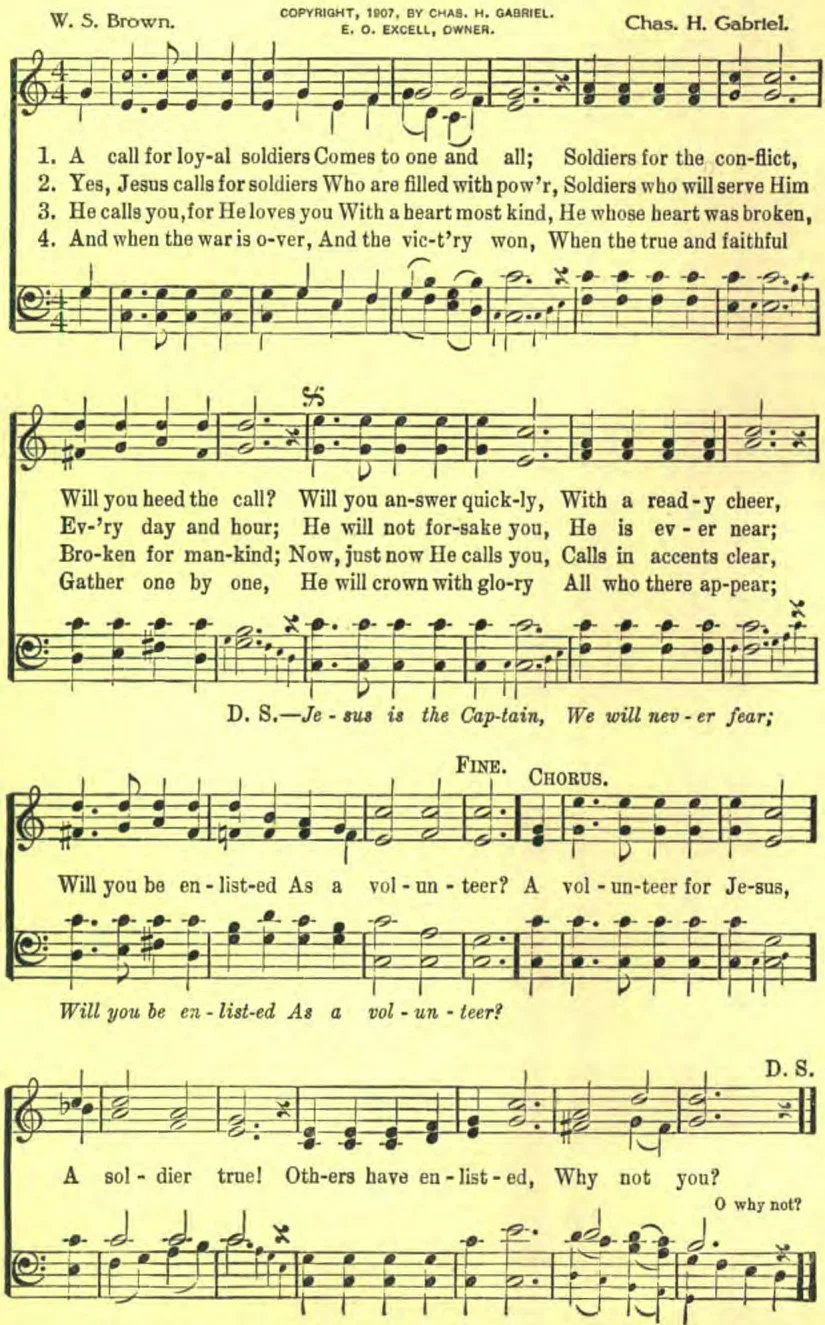
While the song “As a Volunteer” was not written especially for our Missionary Volunteers, it may be very appropriately adopted by them. We hope it will find so much favor among them that it will be sung in our homes and churches throughout the country.

High Testimony

A LETTER with the signatures of Lord Roberts, Grenfell, and Methuen, three marshals of the British Army, is now being circulated among British officers. Among other things it remarks:—
“Holding His Majesty’s commission, you will probably before long serve abroad among non-Christian peoples. We would venture to remind you of the great influence of such a position and the serious responsibility it entails.
“Whether we recognize it or not, our personal lives materially affect the estimation in which the claims of Christianity are held by numbers of natives around us. A thoughtless word or careless behavior may give them wrong and unfavorable impressions as to beliefs and institutions which we are sure you, at any rate in your heart, really value and would wish to honor. Respect for the Christian Sunday and the attitude of a British officer toward Christian worship are closely observed, and have great effect on the native mind. During his recent visit to India, the high example of His Majesty the King in these two particulars has made a profound impression.
“Besides this (somewhat unconscious) personal influence there is the fact that you will almost certainly come into contact with the representatives of various Christian missionary societies whose special work it is to show to non-Christian peoples the love of the Christ you profess to serve. We commend these missionaries to you as a body of men and women who are working helpfully with the government, and contributing to the elevation of the people in a way impossible to official action. Some object to Christian missions, in ignorance of their real value. We would suggest that you use all opportunities of making yourself personally acquainted with the work they are doing and the character of the converts. Most missions will bear looking into, and we are convinced that if you do this you will never afterward condemn or belittle them.
“Some of the noblest characters we have met have been missionaries, and the friendships we have made with them are among our cherished memories. We venture to hope you will make the acquaintance of such men, thus showing a fellow countryman’s sympathy in what is very frequently a very difficult and discouraging effort, sometimes sorely trying to health and spirits.”
This suggests a different story from that which Carey and the other pioneers had to tell of the officials of the East India Company a little over a century ago.—Record of Christian Work.
Continue reading: Making the Most of Sabbath Afternoon