The Youth’s Instructor, Vol. 31, No. 12.

JOHN BUNYAN

The Youth’s Instructor

Mar 21, 1883

S. D. A. Publishing Association · Battle Creek, Mich. · Mar 21, 1883

JOHN BUNYAN.
In the little village of Elstow, near Bedford, England, in the year 1628, was born John Bunyan, the author of “Pilgrim’s Progress.” His father was a tinker, and brought up his son to the same trade, giving him but little education. While a mere child, Bunyan seems to have had very serious thoughts and questionings about life, death, and the hereafter.
He had been taught the doctrine of eternal punishment in hell fire, and so keenly did his imaginative mind take hold of the reality that its mere mention would set him into a fit of violent shaking. As he grew older, however, he says that he was so much taken up with the village sports and pastimes with young companions that he forgot his former terrors, and came to be the gayest among the gay.
At the age of seventeen Bunyan enlisted in the parliamentary army; but all that is known of this part of his life is that in an important siege at which he was present, he allowed another soldier who wished to do so, to take his place as sentinel. The soldier lost his life, while Bunyan was spared. He always regarded this as a direct interposition of Providence.
At the age of twenty he returned home, and married one as poor as himself. But though they had not between them so much household stuff as a spoon or a dish, his wife Elizabeth had two books left her by her father when he died. These were, “The Plain Man’s Pathway to Heaven,” and “The Practice of Piety;” they proved to be to Bunyan “meat in due season.” By the reading of these books he again became much exercised in regard to religious things. He had a very tender conscience, and suffered much because of the sins of his past life, the most ordinary of which were exaggerated in his mind to great heinousness; and because of his expression of these feelings in some of his writings, many have been led to think that he was at one time a very wicked and dissolute man. He was sorely tempted and buffeted by Satan for some time, but gradually his mind became more quiet, and he found peace in believing. In this he was much helped by reading an old book of Martin Luther’s, which he chanced to find in one of his journeys.
But Bunyan was not satisfied with finding the Saviour precious to his own soul; he must needs teach the gospel of salvation to his friends and neighbors. So he began to preach to the poor people of Bedford; and as he went about the country in his occupation of tinker, he talked and preached to those who would hear him of religious things. From his own experience, he was well calculated to help and encourage the doubting sinner who would fain seek Christ. For five years he kept on with his good work, when a change in the political affairs of the kingdom put him in prison, together with many other good people.
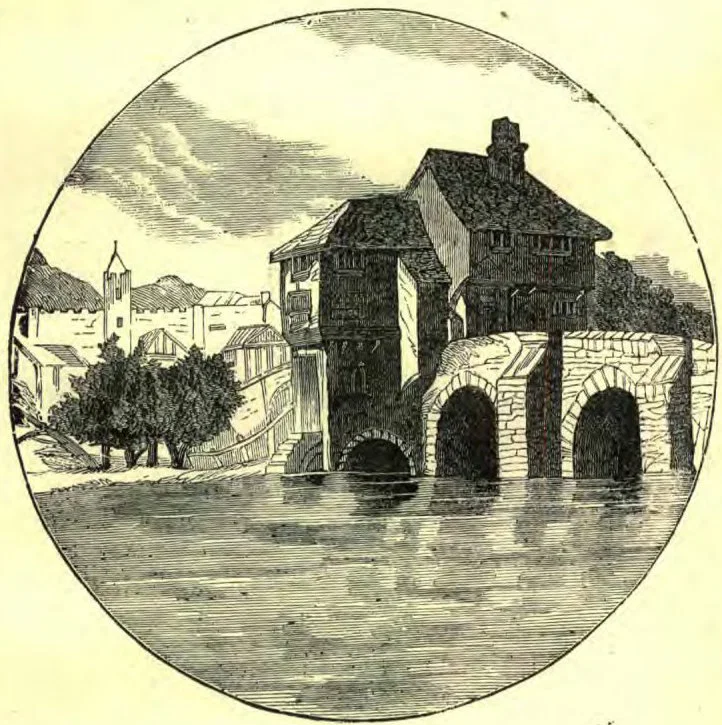
The first picture on this page is of Bedford Jail, where this good man was confined for twelve years. His persecutors continually told him that if he would promise to stop preaching, he should immediately be released. This must have been a severe trial of his faith, especially as he knew his wife and six small children, one of whom had been blind from her birth, were suffering for the necessities of life. But neither sneers, threats, nor poverty could shake his resolution; he always firmly answered, “If you let me go to-day, I will preach again to-morrow.” Not being able to work at his old trade in the prison, he made tagged laces, which were furnished to peddlers, and so helped to support his family. But while his hands were thus employed, he lost no opportunity of preaching to the prisoners. He also spent what time he could get in writing. Indeed, it was during this twelve years of imprisonment that he wrote “Pilgrim’s Progress,” which has given him such a world-wide fame.
The misery of Bunyan’s family and his own courage at last seemed to prevail on his persecutors; and the rigor of his confinement was relaxed, and in 1671 he was released altogether. In 1678 he published the first part of his great work, and in 1684 the second part. At first it was read by only humble people, but they received it gladly. It soon, however, had a very rapid circulation. During the life of the author ten or fifteen editions were published, and he had the satisfaction of knowing that it was eagerly read and reread by English-speaking people in all parts of the world. It was also translated into other languages; and probably no book except the Bible has been so universally read and admired by all classes,—the rich and the poor, the learned and the ignorant.
After his release from prison, Bunyan continued to preach without further molestation. He finally came to be quite a popular preacher, and the people of Bedford built him a chapel to speak in. Every year he was in the habit of making a journey to London, where large crowds gathered to hear his sermons. In the summer of 1688, though in feeble health, he set out on a labor of love,—to reconcile an angry father to his son. His errand accomplished, he was on his way home, when he was caught in a heavy rain-storm and completely drenched. He rode on, however, to London where he intended to spend the night, and continue his way home the next day. But he was taken with a violent fever, and died there after a few days, at the house of a friend, who did all in his power to save the life of the good man. His constitution had been so enfeebled by his long imprisonment that the disease found him an easy prey.
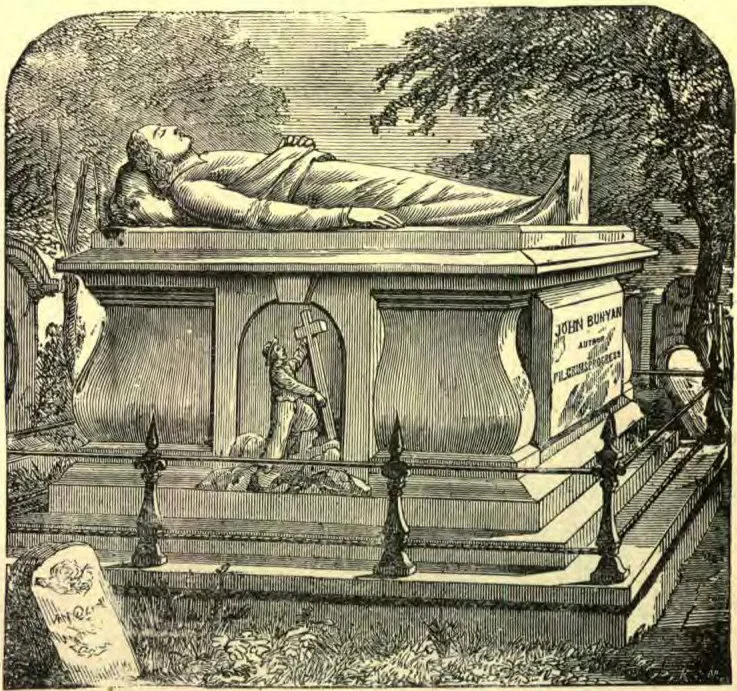
He was buried in a humble graveyard in the suburbs of London, now known as Bunhill-fields. His friends had an appropriate monument put over his grave, with his own sculptured form lying on the top. The second picture on the first page of the paper will give you an idea of this tomb. The great and good Dr. Watts, the author of so many of our favorite hymns, also rests in this graveyard, near John Bunyan. E. B. G.

THE CHILD MARTYR.

A TRUE INCIDENT.
ACROSS the sunlit Scottish hills The fragrant breezes sighed, And on the slopes the buds were fair Where many a martyr died. And still God’s chosen ones were called To seal the truth with blood, And right seemed overborne and lost In hate’s resistless flood.
A child, with tender, wistful eyes, Tripped softly through the shade Of whispering trees, nor sought the spots Where sunbeams brightly played. Too well she knew some trait’rous eye Might watch, through boughs entwined, To trace that rocky cavern’s mouth Which none but she might find.
A spray of heather-bloom was held Within her slender hand; And as she reached a denser shade, She paused, and swiftly scanned The sloping hills and rocky gorge, Each ledge and sharp defile, Then drew the sheltering vines apart, And entered with a smile.
But in the cavern’s gloomy shade The dimple left her cheeks; “O father, father, are you here? ’T is Margaret’s voice that speaks.” And then with sobbing, quick-drawn breath, She sprang to his embrace, And hid against his sheltering breast Her quivering, tearful face.
“Dear father, oh, I thought—I feared The soldiers might have found The cavern’s mouth, and dragged you hence; What is that muffled sound?” “’T is nothing, Margaret, but the wind! Where is your faith, my own? Does not our Father guard us still?” He asked, in chiding tone.
She sighed, and placed within his hand The spray of heather-bloom, Then smiled to see the dainty things So bright, where all was gloom. He praised their beauty, speaking still Of One who made them fair; “And he who gives the blossoms rain, Has he, for us, no care?”
She felt the gentle, fond rebuke, And knelt with reverent air, While through the cavern’s gloomy shade His voice went up in prayer. And then he placed with loving touch, His hand upon her head; “My Margaret, is your trust in Him?” “Yes, father!” soft she said.
“Dear Lord, oh, lead this lamb of thine Safe to thy heavenly fold! Let not her footsteps turn from thee! Let not her love grow cold!” And then with kisses on her brow He sent her on her way, Nor knew what dangers, dark and dread, Along her pathway lay.
But soon adown the grassy hills Rode horsemen fierce and bold. “Ha! there’s the cub! the bear is near!” They cried; then shouted, “Hold!”
She stood with meekly folded hands, And eyes upon the sky, And from her lips a silent prayer Was softly borne on high.
“Speak! tell us where your father hides,” The foremost soldier cried; “Or, by my soul, a pistol-ball Shall pierce your stubborn side!” She answered clearly, “I can die; I will not tell!” and then A sharp report woke echoes wild Through mountain gorge and glen.
The troopers rode in haste away, And on the soft green sod Another martyr’s blood was spilled To cry aloud to God. The pitying sunbeams decked her brow With gems of living gold; But who may paint the crown she’ll wear In God’s fair upper fold? —Child’s Paper.

A VISIT TO ST. AUGUSTINE.

THIS city is the oldest settlement in the United States. In 1565, Phillip II., king of Spain, sent a fleet of vessels to the coast of Florida, with orders to occupy the territory in his name. They landed at this point on August 28 of that year, which chanced to be St. Augustine’s day. Pedro Menendez, commander of the fleet, therefore named the settlement in honor of that patron saint, whose name it has ever since borne.
It is a very quaint old city. After visiting the place, it is easy to believe it was half a century or more old when the Pilgrim Fathers landed at Plymouth Rock. To view the strangely built houses, with their overhanging balconies at the second story, which in some instances nearly touch each other over the center of the narrow streets; to note the high, solid, stone walls built along the front of lots on principal thoroughfares; to pass through the old city gateway, and gaze upon its lofty, ornamented towers and loop-holed sentry boxes; to examine the portions of the old wall left standing—one almost imagines himself in some distant city of continental Europe.
The city is situated on a sandy peninsula, which is nearly surrounded by the St. Sebastian River and St. Augustine Bay. On the bay side of the city along its entire length is a very strong sea-wall, built of cut stone. The principal streets of the city were formerly paved with small ocean shells mixed with mortar or cement, which formed a very hard, smooth floor. Portions of this are still to be seen above the sand. The streets are extremely narrow, one which we measured being only nine feet between the sidewalks. It is said that the reason of this is that when the city was under Spanish rule, no wheeled vehicle was allowed inside the city gate. In passing each other, carriages crowd upon the sidewalks, and thus pass within a foot or two of the doors and windows of the houses, nearly all of which open directly upon the street.
Many of the buildings are made of what is known as coquina (ko-kē-na) rock. This stone is a curiosity in itself. It is formed of very small shells and sand, which are cemented together so firmly as to form a solid rock. This stone is found in large quantities on Anastasia Island, at the entrance of the harbor, and is used for every purpose for which stone is used, as there is no other to be found here. It is easily cut into blocks of the size and shape desired for building purposes. The old Spanish fort and cathedral are built of the same material. The cathedral is a very ancient building which stands opposite the plaza, or public square, near the center of the city. It stands end to the street, and the front wall towers above the roof. Here, in apertures made for them, are four stationary bells. Back of these is a landing, or platform, where the bell-ringer stands while striking the bells. The inside of the edifice is in the form of a cross, and will probably seat about four hundred people. Services are held here every morning at five o’clock, and candles are kept burning on the altar every day. For more than three hundred years the Catholics have celebrated mass on this spot. It is said to have been the first church built in the United States.
The old fort, too, is a place of much interest to the visitor. It is located just inside the sea-wall, at the northern extremity of the town. It is built of the inevitable coquina stone, and is said to have been one hundred years in building. Though now fallen into decay, it evidently was once a formidable means of defense. We walked about its walls and viewed the dismounted cannon and half-filled moats, and trod the well-worn staircase that led to the bastion. We crossed the bridge and entered the fort itself. The doors of some of the apartments were ajar. Peering in, we beheld the same marks of desolation seen in other parts of the fortress. Everything seemed hoary with age. Through a narrow doorway we viewed the arched dungeon, damp and moldy. A death-like stillness reigned there that made the very echoes of our footfalls sound sepulchral. Dark stories are told of the numbers, who, as victims of the inquisition, have miserably perished within these dungeon walls.
The climate of St. Augustine is mild and agreeable, and the old city is a favorite winter resort for people from the North, especially invalids. Vegetables and all tropical fruits grow here freely and in great perfection. There are several orange-groves and many scattered trees in and about the city. In the bearing season, it is a beautiful sight to wander through these groves laden with their beautiful globes, peeping on all sides from the bright green foliage and bending the branches low with their weight. Blossoms, young oranges, and ripe fruit may at this season of the year be seen hanging on the trees together. Florida oranges are very delicious; but it is seldom, if ever, that any of the best of them reach the North.
J. O. CORLISS.

A BRAVE AND BEAUTIFUL DEED.

SOME years ago a young lady in one of our great cities became an earnest Christian. Her parents were very worldly people, and determined to make their daughter like themselves. Thinking that the best way to divert her attention from the Bible and the church was to surround her with worldly pleasures, they gave a grand party, to which they invited the gayest and most fashionable people in their large circle of friends. From this company she naturally shrank, and would much have preferred to be at the quiet prayer-meeting, held the same evening. But she made no objections to her parents’ wishes, and cheerfully assisted them in receiving and entertaining the guests.
During the course of the evening some one asked her to sing. As she had a beautiful voice, and was known to have been a singer of many popular songs, this request was taken up by others, until, at last, it became general. At first she declined; but, being urged, she at last consented, and went to the piano. A hush fell upon the gay assembly. All present knew of the change in her feelings, and were wondering what she would sing. She herself felt that the moment was a crisis in her life. If she sang one of her old songs, she would be regarded as denying her profession, and she would dishonor her Saviour. But what else was there for her to sing? For a little time there was a great conflict in her heart; and then, almost forgetting where she was, and realizing her own need of help more than anything else, she began, in a low, sweet voice:—
Jesus, lover of my soul, Let me to thy bosom fly;
and sung it to the close.
The effect of this on the gay company was extraordinary. Every heart was touched. Not a few found relief for their feelings in tears. The young lady herself became the object of the greatest respect. Even her parents admired her courage and devotion; and, shortly afterward, gave their own hearts and lives to Christ. Nor did the good work stop with them. Many of the votaries at the altar of worldly pleasure, who had witnessed this instance of the power and sweetness of faith in Christ, turned to Him who is the soul’s true refuge, and found forgiveness and peace at his hands.
Such is the power of a holy example.—Selected.

NEW-TESTAMENT HISTORY.

LESSON 127.—REVIEW: FROM THE LAST SUPPER TO THE ASCENSION.

1. How did Jesus reprove the ambition of his disciples, as he sat down with them to the Passover supper? Luke 22.
2. Tell how the ordinance of feet-washing was introduced? John 13.
3. Describe the institution of the Lord’s supper. Luke 22; 1 Cor. 11; Matt. 26; Mark 14.
4. Tell how confident Peter was that he would prove constant, and what Jesus predicted concerning him.
5. Give some of the leading points in the last discourse that Jesus gave his disciples before his crucifixion. John, chaps. 14-17.
6. Describe the anguish of our Lord in the garden of Gethsemane. Matt. 26; Mark 14; Luke 22.
7. Tell how Jesus was made prisoner, and taken before the high priest.
8. Tell how Peter denied his Lord.
9. How was Jesus treated by Caiaphas? Matt. 26; Mark 14; Luke 22; John 18.
10. Tell how he was condemned by the Sanhedrim.
11. Where was he then taken?
12. Describe the repentance and death of Judas. Matt. 27.
13. Relate what passed between the Jews and Pilate when Jesus was first brought before him. John 18.
14. Describe our Lord’s first interview with Pilate.
15. What decision did Pilate make?
16. What caused him to send Jesus to Herod? Luke 23.
17. What treatment did our Lord suffer at the hands of this base man?
18. What formal declaration did Pilate make when Jesus was brought back to him?
19. By what stratagem did he then seek to release Jesus?
20. When this plan failed, what action did Pilate take?
21. Tell how Jesus was mocked by the soldiers. Mark 15; Matt. 27.
22. Describe Pilate’s final effort to release Jesus. John 19.
23. Tell how our Lord was led forth to be crucified.
24. Describe the scene of the crucifixion.
25. Tell how he was mocked while on the cross.
26. Tell what words passed between him and one of the thieves that were crucified with him.
27. What provision did he make for his mother?
28. Describe the noon-day darkness, and the events that followed until our Lord expired on the cross.
29. What phenomena occurred at his death?
30. Describe our Lord’s descent from the cross, and his burial.
31. How was the sepulchre secured against the possibility of intrusion?
32. Tell how Jesus was raised from the dead.
33. Describe the visits of different ones to the sepulchre.
34. How were the disciples informed of their Lord’s resurrection?
35. How were the soldiers bribed that were on watch?
36. Describe the journey to Emmaus. Luke 24.
37. Describe our Lord’s first meeting with his disciples. Mark 16; Luke 24; John 20.
38. Tell how Thomas was convinced.
39. Tell how Jesus met the seven disciples at the Sea of Galilee. John 21.
40. Relate his conversation with Peter.
41. Where did he next meet his disciples?
42. What instruction did he afterward give them at or near Jerusalem? Luke 24; Acts 1.
43. Describe his ascension.

THE GREAT SIN.

THERE is a story told in Arabic of a just and good man, Ben Amon, who in wandering over the hills met the devil in the form of a big giant. The good man turned to fly, but the spirit of evil drew a sword and prevented him. Ben Amon fell upon his knees, and begged for life. “Give me life, only life,” he pleaded.
“Promise me one thing,” said his arch-enemy, “and I will spare your life.”
He was ready to promise anything.
“Then one of three things you must do, either murder your aged father, curse the name of Deity, or drink rum.”
He very faithfully promised, and the devil turned and left him.
“Now,” exclaimed Ben Amon, “I cannot kill my dear parent, who has done so much for me, nor can I curse the name of the God I love and worship; but I can drink of the inebriate’s bowl, and none will ever know it.”
Turning his steps homeward, he sought his chamber and alone he partook of the fatal beverage. Becoming wild and frantic in his mirthful revels, he awakened his aged father, who, finding his good Ben Amon in such a state, reproved him for his sinfulness. Becoming angry, Ben Amon fell upon his gray-haired parent and killed him instantly. Infuriated at what he had done, he cursed the name of Deity, then dashing down a precipice, he went headlong into eternity. So in choosing what he thought to be the least of all these sins, he chose them all.
Thus you see what the great sin of intemperance can do; it leads to others more heinous,—a whole catalogue black enough to sink the soul to the lowest hell.—S. S. Advocate.

CAN’T RUB IT OUT.

“Don’t write there,” said a father to his son, who was writing with a diamond on the window. “Why not?” “Because you can’t rub it out.”
Did it ever occur to you, my child, that you are daily writing that which you can’t rub out?
You made a cruel speech to your mother the other day. It wrote itself on her loving heart, and gave her great pain. It is there now, and hurts her every time she thinks of it. You can’t rub it out.
You whispered a wicked thought one day in the ear of your playmate. It wrote itself on his mind, and led him to do a wicked act. It is there now; you can’t rub it out.
All your thoughts, all your words, all your acts, are written in the Book of God. The record is a very sad one. You can’t rub it out.

SCENES IN THE LIFE OF CHRIST.

LESSON 113.—REVIEW.

1. How was the stone taken away from the door of the sepulchre? Matt. 28.
2. How did the angel look, and how were the keepers affected at the sight of him?
3. Who were the first to go to the sepulchre? Mark 16.
4. How were they surprised on drawing near to it?
5. Who ran to tell Peter and John that Jesus was not in the sepulchre? John 20.
6. Relate the experience of the three women at the sepulchre? Luke 24.
7. Describe the visit of Peter and John. John 20.
8. After they had gone, who still stood weeping at the door of the sepulchre?
9. How was she comforted?
10. How were the soldiers that guarded the sepulchre kept from telling that Jesus had been raised from the dead?
11. Under what circumstances did Jesus appear to two of the disciples on that day? Luke 24:13-15.
12. What instruction did he give them?
13. How did they finally discover that it was their Lord?
14. How did they immediately inform their brethren of what had happened?
15. What news had the brethren for them?
16. Tell how Jesus appeared among them and what he said to them.
17. Which of the disciples came in after Jesus had departed?
18. What did he say when he heard that Jesus had been there?
19. How was he afterward convinced that his Lord had really risen from the dead?
20. Where did Jesus next show himself to his disciples? John 21.
21. Where and when did they first see him?
22. How had they been spending the night in fruitless labor?
23. How did he first greet them?
24. What did he promise them if they should cast the net on the right side of the ship?
25. How were they rewarded for obeying this suggestion?
26. How were Peter and John affected by this miracle?
27. What did the disciples behold as they came to the land?
28. Describe their interview with their Lord.
29. Tell how he questioned Peter.
30. How did he reprove him for being so inquisitive?
31. How did Jesus fulfill the appointment given out by the angels and by himself to the women who fled from the sepulchre? Matt. 28:16-18.
32. What did he charge his disciples to do?
33. What was to be the result of this preaching? Mark 16:16.
34. What signs were to follow them that believed? Verses 17, 18.
35. For what purpose did Jesus open the understanding of his disciples when he had again met with them at or near Jerusalem? Luke 24:45.
36. What did he make especially plain to them? Verses 46, 47.
37. For what were they to wait before going out to preach?
38. How did he answer them when they asked him if he would at that time restore the kingdom to Israel? Acts 1:6-8.
39. Where did Jesus lead his disciples just before he ascended to heaven? Luke 24:50.
40. Tell how he was taken from them.

The Value of Studying the Bible Together

It is a great gain, for the maturest and the best informed Christian to study the Bible with his fellow-Christians; and it cannot be fairly questioned, that to have a place and a part in weekly Bible-class study both indicates and secures a higher standard in the Christian life on the part of almost any church-member. No man can get as much out of the Bible, or into himself, by any system of study all by himself, as by wise study with his fellows. The gain of the Sabbath-school to grown-up scholars is fully as great as to the little folks.—S. S. Times.

The Book That Makes You Think

“The book to read,” says Dr. McCosh, “is not the one which thinks for you, but the one which makes you think.” No book in the world equals the Bible for that.
Continue reading: WINDING UP THE CLOCK