The Youth’s Instructor, Vol. 48, No. 43.

LEMONCITO TO JUTIGALPA

The Youth’s Instructor

Nov 1, 1900

Review and Herald Publishing Company · Battle Creek, Mich. · Nov 1, 1900

LEMONCITO TO JUTIGALPA
There is a trail from Lemoncito to Bonito, and thence to Jutigalpa; but our route took us to the Bay Islands of Honduras, and, touching the coast again at Truxillo, we started inland to find the trail before mentioned. Those long days in the saddle, under the tropical sun, and the longer nights, were more interesting to us than their narration can ever be to any one else.
The faithful mules had borne their burdens patiently, and the last steep mountain ridge was almost over, when man and beast, by common consent, stopped to rest. “Machaw! moola! moola!” failed this time to urge the pack-train up the sky-scraping trail that we followed in its alternate turnings from right to left over the mountains. One of the young mules refused to go farther with his burden of two hundred pounds, and sank into the ditch, making a complete blockade. The guide told us that it was the same mule that had insisted on running with his load in the morning,—such is the folly of youth.
The mozos loosed the rawhide cords, and laid the two bundles beside the trail. Our saddle-mules fell to eating the grass that was close by their heads on either side; for the winter torrents had cut the bridle-path so deep that oftentimes we could not see over the sides of it, even when mounted. At this place we could see over the banks and beyond the deep-cut valley, where in the distance the green of the mountains appeared almost blue, and blended with the sky.
“Machaw! machaw! moola! bruton!” The mules snatched a final mouthful, and began to grunt in time with their labored footsteps; and the lad with the conch-shell trumpet joined in with a sweeter part, that echoed far among the hills. We were off.
Beyond the crest a little way the caravan stopped at the door of a hut. Señor Francisco dismounted, and, folding his yellow umbrella, declared that he could go no farther, as he would have to send a mule back for the cargo left behind. It was not yet three o’clock, and our mules were in good spirits; the hut was small, and some of its inmates were suffering with native fever. Therefore we took one of the men, and rode on.
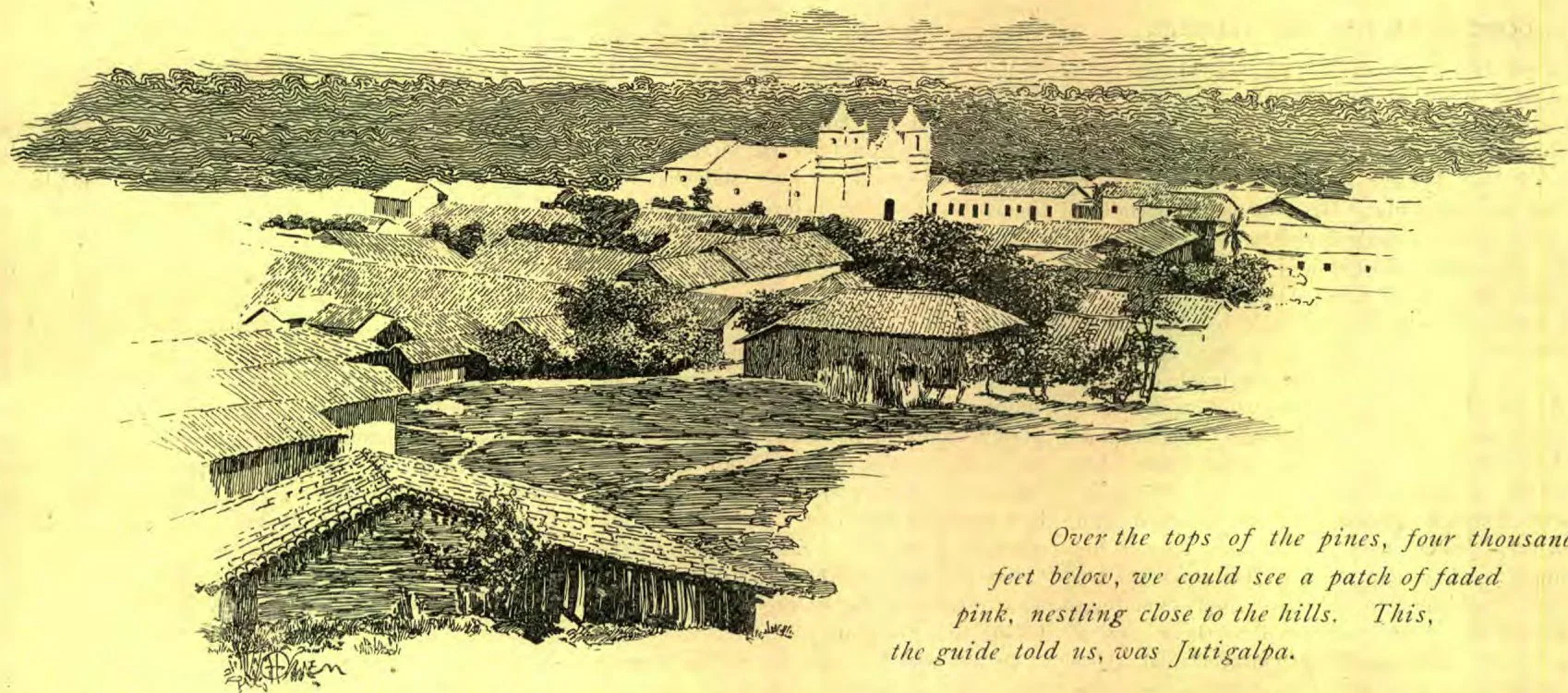
Over the tops of the pines, four thousand feet below, we could see a patch of faded pink, nestling close to the hills. This, the guide told us, was Juticalpa.
The trail began a gentle descent as we wound around a ridge; and we saw, far below us, the plains of Olancho. Eastward, there was nothing to break the horizon: the view was such as one obtains in the foothills of our own Rockies. Over the tops of the pines, four thousand feet below, we could see a patch of faded pink nestling close to the hills. This, the guide told us, was Jutigalpa, the capital of the department of Olancho. To the south stretched a flat expanse of green, broken by lighter patches of the same close to the hills. This, the guide told us, was to discern the houses of the cattlemen. The descent was made rapidly, when we turned off on a south-bound ridge, and zigzagged down a path that we hoped never to be compelled to climb. The mules kept their footing, but sometimes the leaps they made seemed leaps to death. The saddle-girths were strong, not a buckle nor stitch gave way, or, even with the beasts on their feet, we should have followed the stones, that, started by their hoofs, sometimes went bounding down the mountain-side.
From the grass-covered ridges we descended rapidly through the pine belt, where the sweet scent of myrrh mingled with that of the evergreens, and, two hours later, found ourselves among the dense forest growth of the valley. The river was not spanned by any bridge,—few of the rivers of Honduras are. The mules plunged in, and picked their way among the boulders, the water coming to the stirrups, and, in mid-stream, to the saddle-girths. Then came a smart climb up the opposite bank to the Camino Real, one of the best cart-roads in the country, though seldom fit for a cart. Three centuries of neglect have taken away nearly all the good qualities of this road, if it ever had any; but it was better than none,—far better, indeed, than the path we had followed for twenty days.
It was not yet dusk when we rode into the city of Jutigalpa. The first houses we saw were the mud-walled huts of the country, but these were displaced by the more substantial adobe walls in the better parts of the town. The sound of the mules’ feet, though unshod, on the cobblestone pavement attracted the attention of Spanish-Indian faces in windows screened by wooden gratings. Many a kindly greeting made us feel that we were among friends, as indeed we were.
Señora Garcia, to whom we carried a note of introduction, led us to her guest-chamber, and ordered tortillas prepared. A large door opening on the street let in light and the glances of passers-by, who stopped in small groups to show their interest in the strangers. Mrs. Owen and the baby were of special interest. Few North American women, and fewer North American babies, ever visit this “Sleepy Hollow” of Central America. The children were especially expressive in their admiration of the little white traveler. Some of these children were selling sweetmeats, others were leading donkeys laden with water. Barefooted, and for the most part happy, these children of Olancho will always be remembered with pleasure. They have inherited the Spanish courtesy, and many of them are really helpful to their parents, bringing water from the river for cooking, and wood for the clay stoves. Some of the older boys are intrusted with the care of an ox-team and cart, and encouraged to take upon themselves other responsibilities.
These children are taught some things, though very imperfectly, about God and heaven; and each night they repeat the prayers taught them by their mothers. But there is small comfort for them in what they learn of Jesus; for they do not learn so much about him as about his mother, and even that does not give them hope, or help them to lead better lives.
H. A. OWEN.

GOD'S CARE FOR HIS CHILDREN

UNDER the reign of Darius, Daniel was exalted to a position of great honor, because the king saw in him an “excellent spirit.” But when the leading men of the kingdom saw Daniel thus favored, they became jealous of him, and soon envied and hated him. His course of unbending integrity was in marked contrast to their own lives. The more upright and righteous he was, the more they hated him. Long they sought to find something whereby he might be condemned. It angered them to think that they could lay nothing to his charge. But he was prime minister of the kingdom, and they knew they would have to prove any charge they brought against him.
Daniel’s position was not an enviable one. He stood at the head of a dishonest, prevaricating, godless cabinet, whose members watched him with keen, jealous eyes, to find some flaw in his conduct. They kept spies on his track, to see if they could not in this way find something against him. Satan suggested to these men a plan whereby they might get rid of Daniel. Use his religion as a means of condemning him, the enemy said.
Daniel was a man of prayer. Three times a day he knelt before the Lord; and Satan told his enemies that his destruction must be compassed on this ground.
A large number of the princes and nobles were in the secret, but the king was kept in ignorance of their purpose, they went to him, and asked him, in honor of his kingly dignity, to pass a decree commanding that for thirty days no one in the kingdom should ask anything of any god save Darius.
“All the presidents of the kingdom, the governors, and the princes, the counselors, and the captains have consulted together,” they said, “to establish a royal statute, and to make a firm decree, that whosoever shall ask a petition of any god or man for thirty days, save of thee, O king, he shall be cast into the den of lions. Now, O king, establish the decree, and sign the writing, that it be not changed, according to the law of the Medes and Persians, which altereth not.”
The king’s vanity was flattered. Not for a moment did he think that Daniel, his beloved and honored servant, would in any way be affected by the law. He signed the decree, and with it in their possession, the presidents and princes went forth from his presence, evil triumph depicted on their countenances. They deemed that the man they hated was now in their power.
Daniel heard of what had been done, but he made no protest. He could see the design of his enemies. He knew that they would watch closely his going out and his coming in, but he calmly attended to his duties, and at the hour of prayer he went to his chamber, and kneeling by the open window, with his face toward Jerusalem, he prayed to his God. From his youth he had been taught that in prayer his face should be turned toward the temple, where by faith he saw the revelation of Jehovah’s glory.
Daniel prayed more fervently than was his wont, that He who understands the secret working of Satan and his agents would not leave his servant, but would care for him. He prayed for strength to endure the trial.
Some may ask, Why did not Daniel lift his soul to God in secret prayer? Would not the Lord, knowing the situation, have excused his servant from kneeling openly before him? Or why did he not kneel before God in some secret place, where his enemies could not see him?
Daniel knew that the God of Israel must be honored before the Babylonian nation. He knew that neither kings nor nobles had any right to come between him and his duty to his God. He must bravely maintain his religious principles before all men; for he was God’s witness. Therefore he prayed as was his wont, as if no decree had been made.
“Then these men assembled, and found Daniel praying and making supplication before his God.”
Eagerly they hastened to Darius, concealing their cruel joy under a cloak of regret that they were obliged to inform against Daniel. But they declared that by Daniel’s act the king’s position as sovereign of the land was endangered, and his authority despised. “That Daniel, which is of the children of the captivity of Judah, regardeth not thee, O king, nor the decree that thou hast signed, but maketh his petition three times a day.”
“Then the king, when he heard these words, was sore displeased with himself.”
Too late he understood the snare that had been laid for the destruction of his favorite servant. Sorely troubled, he tried in every way to rescue Daniel. Till the going down of the sun he labored to deliver him. But Daniel’s accusers had managed the matter so well that there was no way of escape. “Know, O king,” they said, “that the law of the Medes and Persians is, That no decree nor statute which the king establisheth may be changed.”
Daniel was brought before the king and his princes to answer the accusation brought against him. He had opportunity to speak for himself, and he boldly acknowledged his belief in the living God, the maker of heaven and earth. He made a noble confession of faith, relating his experience from his first connection with the kingdom.
In his perplexity and distress, Darius said to Daniel, I have done all I can to save you. I can do no more. “Thy God, whom thou servest continually, he will deliver thee,” he added, as he bade him a sorrowful farewell.
Daniel was cast into the den of lions. “And a stone was brought, and laid upon the mouth of the den; and the king sealed it with his own signet, and with the signet of his lords, that the purpose might not be changed concerning Daniel.” Full of satanic exaltation, Daniel’s enemies returned to their homes. They drank freely of wine, and congratulated themselves on their success in putting out of the way one whom they could not bribe to forsake the path of integrity.
Not so did Darius pass the night. Daniel’s testimony had made a deep impression on his mind. He had some knowledge of the dealing of God with the people of Israel, and Daniel’s conduct sent home to his heart the conviction that the God of the Hebrews was the true God. He was filled with remorse for having signed the decree brought to him. His conscience was awakened, and he passed a sleepless and troubled night. The chamber of royalty was one of sorrow and prayer. All music was hushed. All amusements were laid aside. No comforters were admitted.
During that sleepless night the king thought as he had never thought before. Early the next morning, hoping and yet despairing, condemning himself, and praying to him whom he began to recognize as the true God, Darius went to the lions’ den, and cried aloud: “O Daniel, servant of the living God, is thy God, whom thou servest continually, able to deliver thee from the lions?”
With intense anxiety he waited for an answer, and unspeakable thankfulness filled his heart as a voice came up from below: “O king, live forever. My God hath sent his angel, and hath shut the lions’ mouths, that they have not hurt me: forasmuch as before him innocency was found in me: and also before thee, O king, have I done no hurt.”
“Then was the king exceeding glad for him, and commanded that they should take Daniel up out of the den. So Daniel was taken up out of the den, and no manner of hurt was found upon him, because he believed in his God.” And we read of him, “Daniel prospered in the reign of Darius, and in the reign of Cyrus the Persian.”
Thus the Lord cared for his faithful servant, and thus will he care for all who put their trust in him. “The angel of the Lord encampeth round about them that fear him, and delivereth them.”
MRS. E. G. WHITE.

Shamgar, the Ready

The last verse of the third chapter of Judges tells, in brief, the story of a man who had an opportunity. “And after him was Shamgar the son of Anath, which slew of the Philistines six hundred men with an ox goad: and he also delivered Israel.”
We can imagine Shamgar at work with his oxen in his field. Hearing a noise, he looks up, and beholds the Philistines descending upon him in full force. He is astounded—terror-stricken—for a moment. What shall he do? What can he do, one man against so many? There is no help within call; he has no weapon. Stay! there is the homely old ox goad! He catches that up, and charges upon the enemy. Six hundred are slain; and, as the verse declares, “he also delivered Israel.”
A great chance came to Shamgar that day, and he was ready for it. A chance is coming to all of us, and we must see to it that we are ready. Otherwise, it will pass us by, and we shall go sorrowful all our days. The wail of many a person to-day is, “I had a good chance; but I was not ready for it, and now it is too late!” The ne’er-do-well, swinging his legs with the loafers on the wall, and complaining that he never had a chance like other people, knows he does not speak the truth. He had his chance, and lost it. It may not have been a chance to distinguish himself in one day, as Shamgar did, and make his name immortal, but he had a chance to do honest work of some kind. The trouble is, we despise the common tasks of life, and waste time and strength wishing for the big occasions. Many a boy thinks that he has the making of an Admiral Dewey in him, but he can scarcely be dragged out of bed mornings, and he always forgets his mother’s errands at the store. A girl thinks she would be a Grace Darling or a Clara Barton if she had the chance, but she pouts and sulks if mother asks her to take care of baby for an afternoon.
Our chance is coming to us when we have learned to take up resolutely the common duties of life. Shamgar was not leaning on his plow, dreaming of the hero he would be if he only had the chance. He was simply concerned to keep his furrow true, and to do a faithful day’s work; and it was this resolute honesty of purpose that gave him a clear head, a steady hand, and a brave heart, to think and to act when the great chance came to him.
Is there a more pathetic story in all English history than that of poor Ethelred, the Unready? He had a king’s chance to do fine things for his country, but the hapless fellow made only a pitiful record of shame and defeat. Shamgar and Ethelred—one a plowman, the other a monarch—one a hero, the other a shirk. Which shall we be?
I read the other day that the manager of an immense business declares that it costs his house twenty thousand dollars a year simply to correct errors in invoices and other papers—all due to the mistakes and carelessness of employees. What does this mean? Just this: that a great number of people have accepted positions for which they are not ready. When they were in school, they were too indolent to learn to spell correctly, they were too heedless to learn to copy accurately. There are scores of young people employed in our cities to-day who are sources of annoyance and expense to their employers, for the simple reason that they are not equipped for their work. The chance for promotion will come; but they can not take it, because they are not ready for it. Then, perchance, they will whine about fate and favoritism. Oh, I wish we might know that “opportunities are opportunities only to him who is ready for them”!
When Daniel Webster was congratulated upon his great speech in answer to Hayne in the United States Senate, he replied: “I have been all my life preparing for that speech.” All his life! Think what that meant. Not while he was in school, merely, not for an hour or two when he felt like it, but all his life. All his life picking up knowledge, all his life training his brain to think logically, all his life compelling his tongue to utter clearly. Then when the great opportunity came, he was ready for it. What an incentive to us to make the most of our powers, never bothering our heads about the opportunity to use them. That will come fast enough.
Why, the other day I picked up a history belonging to a Boston schoolgirl, and on the title-page read this legend, “America is another name for opportunity!” Does it not make our hearts swell to think that we are living in this wonderful America? The opportunity is coming to us as surely as it came to Shamgar of old, as surely as it came to Daniel Webster. Oh, let us begin to get ready for it now, by doing the thing we ought to do this very minute. Get that hard lesson: don’t wait for the girls to help you out before school to-morrow morning. What we do for ourselves is worth a million times more to us than what somebody else does for us. Go fetch that wood for the morning fire: don’t skulk off, and think that father will bring it rather than bother with you. The habit of doing small duties punctually and faithfully has made the general and the millionaire. Let us get into our blood and sinews the stuff that successful men and women are made of, by taking up our tasks and sticking to them day in and day out, year in and year out; and some day we shall thank God that we did this, for we shall be able to answer, “Ready!” when our opportunity comes.—Well-Spring.

THE DAY'S ROAD

Answer, soul of mine!—which way Hast thou made a road to-day? Hast thou followed Love’s sure chain Over hill and over plain? Whichsoever choice thou’st made, There another road is laid— Not a transient, fading trail, But a path that shall not fail. Evermore some foot shall stray O’er the road thou madest this day.
Ah, let each of us beware How his thoughts and motives bear! Every road that we shall choose, Other pilgrim feet will use. Some will follow where we lead Long as life shapes life, indeed. Have a brother’s care, and pray God to mark thy road each day.
—Selected.

MATERIALS

At the present time the public look as much to the pictures in the magazines and papers for instruction and amusement as to the reading-matter. Most illustrations must be regarded as part of the decoration of the printed page, and therefore should harmonize with it in color and line. Perhaps nothing harmonizes so well with type as bold pen-drawings, photographically reproduced.
It will be best first to explain to the reader the photo-engraving process (the process by which drawings are reproduced for printing), that he may understand what class of work is necessary to make a successful reproduction.
Pen-drawings are generally made larger than they are to appear on the printed page. By the photo-engraving process, they are reduced to any required width, this width being marked under the drawing. When a drawing is reduced, the proportions always remain the same.
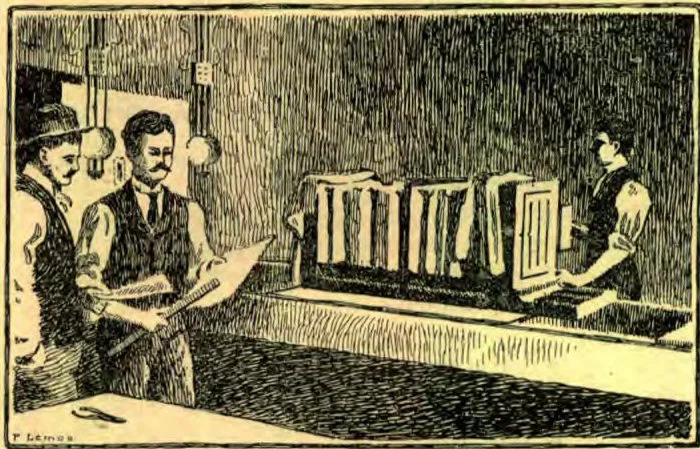
When a drawing is made for reproduction, it is sent to the photo-engraver. Here it is photographed and “printed” by electric light on a sensitized zinc plate. By chemical action the lines of the drawing, as they appear on the plate, are impervious to the action of nitric acid. Into this acid, then, the plate is immersed until the zinc around the lines is eaten away, leaving the lines in relief. (If the reduction of the drawing be too great, the smaller lines are eaten entirely away by the acid. All small and weak lines are lost; therefore one of the principal requirements in pen-drawing is firm lines.) More of the zinc is then removed from around the lines and open spaces by the “routing machine;” a few touches are sometimes given by a hand-engraver; the zinc is nailed to a block to make it “type high,” and is then ready for the printer.
In the following lessons I shall endeavor to give the student some instructions and suggestions in the making of pen-drawings. It will be supposed that he already has some knowledge of the rudiments of drawing, so very little of that part of the subject will be touched upon. These lessons may be taken as supplementary to the previous series, “Drawing from Nature,” or studied as a separate series; but in either case the student must look to them only as a guide. No teacher can be more than that. The student can be taught the use of materials, what work is necessary, etc.; but unless he has a love for the work, and the true artistic sense, he will not reach the mark.
It is impossible to tell another just how to go to work with pen and ink, or any other medium. True art is, above all things else, a matter of individual expression. All that is expected of the student is that he shall get out of these lessons suggestions for work, which he will do in his own way.

Now as to materials.

One naturally finds a difference of opinion among artists as to which drawing-ink is the best. Some still use the old-fashioned imported India-ink cake, and rub it down with a little water in a saucer. While this ink is excellent for wash-drawings, I would not recommend it for pen-work, as with its use the point of the pen becomes clogged, and requires constant attention; it is almost impossible, also, to keep the fluid a uniform black.
“HERE IT IS PHOTOGRAPHED AND ‘PRINTED’ BY ELECTRIC LIGHT”
The best drawing-ink is a little thicker than writing-ink, and of a perfect black. Most writing-inks have a more or less blue tone, which is unsuitable for photographic purposes, as blue can not be reproduced. A good drawing-ink, recommended by all pen-artists, is that known as Higgins’s drawing-ink.
A Gillot pen, No. 200, is suitable for the fine lines in a drawing, while a Gillot pen, No. 170, can be used for the heavier lines. For filling in large spaces of solid black, a brush is often used instead of a pen.
Bristol-board or any paper with a smooth, hard surface should be used to work on.
For the preliminary pencil outline, I would suggest a medium pencil. The lines from a soft pencil can not be easily and completely erased, and will leave a smudge that may interfere with the reproduction, and a very hard pencil is liable to scratch the surface of the board.
A soft eraser will be best, as a hard eraser will spoil the surface of the paper for ink.
A water-color pigment known as Chinese white can be used for putting in sharp lights or for correcting slight errors. It can be thinned down with water to the consistency of the ink, and used on the pen, or it may be used with a small brush.
These materials can all be purchased in any store that deals in artist’s materials, and are all that it is necessary for the student in pen-work to equip himself with. PEDRO LEMOS.

Contentment and Quiet Trust in God's Providence

God hath provided a sweet and quiet life for his children, could they improve and use it; a calm and firm conviction in all the storms and troubles that are about them, however things go, to find content and be careful for nothing.— R. Leighton.

SINGING AWAY THE PAIN

A PARTY of tourists was driving along the country road leading to Killarney, that fine old town among the Irish lakes. As they came within sight of a cottage standing back from the road, with a lovely garden of flowers in front, there reached them the sound of singing.
The voice was full of sweetness, rich and strong, now and then rising into such lofty strains it seemed like an angel’s song, then dropping into the mellow softness of a mother soothing her babe to sleep.
The little company was entranced. What genius in obscurity was here? Some one, surely, born to win fame and fortune when brought forward and trained by suitable teachers.
“If I could ever hope to sing like that!” exclaimed the young man who was driving, himself a student of music; and then, stopping his horses, he said, “Let us find who he is; perhaps I might be of help;” but here he paused, as a young girl came out of the garden gate toward them. She had a basket on her arm, as if going to market. As she was passing, dropping a slight courtesy as she did so, he asked: “Will you please tell us who is singing so sweetly in the cottage?”
“Yes, indeed,” said the girl, turning a bright face toward them. “It is only my Uncle Tim, sir; he’s after having a bad turn with his leg, and so he’s just singing the pain away the while.”
For an instant the company was speechless; then the young man asked: “Is he young? Can he ever get over the trouble? Tell these ladies about it, please.”
“No, the doctors say he’ll never be the better of it in this world, but”—and her voice dropped into tender pathos—“he’s that heavenly good, it would come nigh to making you cry sometimes to see him, with the tears running down his cheeks with the pain, and then it is that he sings the loudest.”
“Amen!” said the young man, reverently; and with a “Thank you, dear,” from the ladies, they drove slowly on.
“And there shall be no more pain, and all tears shall be wiped away,” said Aunt Myra, softly.—Christian Life.

THE GIFT OF SPEECH

THE wonderful gift of speech is one of the greatest blessings bestowed by God upon man. The power to communicate ideas; the ability to describe the workings of the pure Spirit of love and life in ourselves; to be able to tell of the blessed effect of yielding to the molding influence of that Spirit which brings all passions under its sway,—these are themes that saints and angels might dwell upon, praising the name of him from whom we receive “every good and perfect gift,” and to whom we are accountable for the use of every blessing.
In private or social intercourse it needs watchful care to guard against speaking evil of any. Rehearsing in promiscuous gatherings the things that have a tendency to weaken the faith of the inexperienced in the power of God, is also a danger to be avoided. In criticising the weaknesses of our fellow beings, we weaken our own characters, disgust our listeners, and become stumbling-blocks to the sincere seekers after truth.
I have often been made heartsore by those who publicly advocate the possibility of bringing every thought into captivity to the obedience of Christ, and yet themselves give way to unjustifiable latitude in censuring and condemning others in more private social circles. How much better that our words be few and savory, that they may minister grace to those that hear, and that subjects be chosen for conversation that are instructive in their nature, tending to stir up the pure and suppress the evil.
Let us dwell upon the workings of God in nature. This beautiful world is filled with objects of interest, from the smallest pebble upon the low beach, to the mighty rocks that rise majestically on mountain heights; from the lowliest flower in the valley, to the giants of the forest; from the reflected radiance in the humblest pool, to the great sun, moon, and stars. The oceans, lakes, and rivers, with their surrounding hills and plains; the vapors that collect and form clouds, distilling rain and dew,—all these, and countless others, are themes that may be profitably dwelt upon. Such topics of conversation will bring us nearer him who is our life, our length of days, and our portion forever.
JOSEPH S. JOHNSON.

SEASONS

'Tis April in November, If you will make it so, Or Maytime in December, Despite the falling snow, If only you'll remember Your smiles make roses blow.
'Tis spring in autumn weather, If you will sing all day, And smiles and songs together Turn winter into May; The snow will be like heather, If only you are gay.
— Selected.

Saved to Be Lost

ONE reason so many make but little advancement in divine things is that they fail to impart to others the truths that God has given them. The manna that was saved overnight spoiled. When Christ fed the multitude, the bread did not begin to increase until he began to break it to the people.
A certain woman found that she was hopelessly in debt, and the creditor, in a business-like way, suggested the taking of her two sons to become slaves, in order to satisfy the debt. She appealed to Elisha; and he, instead of giving her something more, told her to make good use of what she already had. In other words, he suggested that she borrow a large number of empty vessels, and pour oil in them from her small quantity; and just as long as there were any empty vessels to fill, the oil continued to flow. If God has given us only a very little oil, it is our duty to hunt up some empty vessels, in the form of thirsty, sin-sick souls, into which we can pour the little we have; and as long as we continue on this plan, we shall be happily surprised by finding how wonderfully it has multiplied in our hands.
There is a special reflex blessedness in store for those who try to teach others. “And they that be teachers shall shine as the brightness of the firmament.” Dan. 12:3, margin. This does not mean merely accepting a position as Sabbath-school teacher, but to be willing to share some God-given truth with others, under all circumstances and on all occasions. It is not necessary that we feel good or perfect before we undertake to help others; for Christ is the propitiation, not merely for the sins of the good people, but also for those of the wicked. No one will be kept out of heaven because of anything God has against him, but because he will not be willing to be cured of a disposition to sin; and with this disposition in him, God knows he would not be happy in heaven, and, like Satan, would soon mar its perfect harmony. Christ has already paid the debt against us; now why not let him as freely cure us of the disposition to sin? Let us invite heaven inside of our souls here below, to transform them, so we may be fitted to appreciate heaven outside of us as well.
David Paulson, M. D.

TRANSFORMATION VERSUS REFORMATION

Reformation is a good thing, but transformation is far better. Reformation has to do with going in from the outside, seeking to regulate the inside; while transformation first sets matters right on the inside, and thus gains power to control the outside. Reformation of character may be accomplished by man’s own efforts, aided by the power of his will; but transformation, while it demands all these as co-operation on the part of man, is effected by the grace and Spirit of God. To undertake to strengthen and develop the character by reformation is very much like trying to kill a tree by picking off the leaves. You may appear to make some headway, but it will require but a short time to show that your efforts were in vain,—the tree of selfishness and sin will blossom out again. Transformation is the laying of the ax to the root of the tree, thus effecting the death of the old nature, and making it possible to receive a new nature.
W. S. Sadler.

LOVE'S COST

WE hear much of the sweetness of love, of the joy of loving; but it has another side also, and that is why it is forever the antithesis of selfishness—love costs. “Every love that enters the heart opens the door to sorrow.” No pain can touch the one dear to us, and we not suffer also; no danger can threaten, and our heart not keep anxious watch. Every cloud that darkens that other sky throws its shadow across our sunlight. Every sin that stains the beloved soul hurts and aches in ours as if it were our own—aye, worse! for our own sins we may cast aside and seek pardon for, but who can repent for his brother?
Love’s pain lies in its powerlessness. To long to bring relief, and to be unable to suffer with, because we can not suffer for, to watch from without the battle we can not help to fight, and to share every heartache, disappointment, and loss,—this is the cost of loving. But only so does our human life grow deep, and take on worth and dignity. Only so can we ever be akin to Him who bore our griefs, and carried our sorrows; and who, “having loved his own which were in the world, loved them”—through all their blundering, their blindness, their sins—“unto the end.”—Selected.

A GOOD SCRAP-BOOK

ALMOST every one who reads extensively will find it convenient to have some way of preserving scraps of useful and interesting information. There are several methods, the most common being with scissors and paste. Then come the large indexed envelopes; and a step further is found the “card system,” now so widely used by business men for memoranda. These systems are perfectly adapted to certain classes of work. For preserving pictures, whole speeches, and poems, the two first mentioned are excellent.
But for most purposes I have found nothing better than a large, well-bound, ruled blank-book. Whatever I read that seems worth keeping goes into that storehouse. It matters little where I see it, whether in newspapers, magazines, or bound books, out it comes, and is ready for instant reference. “Do I cut the books?”—Oh, no; that is one great advantage of this method. Suppose I read a long article about some bird. It is the work of only a few minutes to condense it into a brief, suggestive word-sketch, and write it under its proper heading in the “sketch-book.” When I desire information on such a subject, I turn to that sketch, and instantly my mind recalls the whole article. By this method can be preserved, in a small set of books, the valuable reading of a lifetime.
EDISON J. DRIVER.
Continue reading: HOW AILSIE SAVED THE BIBLE