The Youth’s Instructor, Vol. 29, No. 13.

THE LOTUS

The Youth’s Instructor

Mar 30, 1881

S. D. A. Publishing Association · Battle Creek, Mich. · Mar 30, 1881

THE LOTUS.

THERE are several distinct species of plants which bear the name of lotus, but the singular beauty and usefulness of the large water-lily called by this name have in all ages attracted to it an extraordinary interest; and combined with the fables of the Egyptians, the Hindoos, and the Chinese, have exalted it in the East to honors almost divine.
It was held sacred by the ancient Egyptians. Representations of it were sculptured upon the monuments; the sun was seen rising from it, and Osiris and other deities sat upon it, or were crowned with it.
In India and Ceylon the flower is held very sacred. When princes enter the idol temple, they have this flower in their hands; and when the priests sit in silent thought, it is placed in a vase before them. It is related that a native, upon entering Sir William Jones’s study and seeing flowers of this beautiful plant lying upon the table for examination, immediately prostrated himself before them.
The Buddhists of China and Japan also greatly venerate the flower, and associate it with all the leading deities, who are represented in the images in the temples as seated upon it.
The power attributed to the lotus is in nothing more marked than in its imagined helpfulness to the souls of the deceased. It figures in Chinese paintings of the punishment of the dead. In these pictures the deceased are represented as suffering tortures of various kinds. By their children, however, such valuable gifts are offered as to induce Kwanyin, the Goddess of Mercy, to appear upon the scene, and cast the lotus upon the miserable sufferers. This at once ends their punishment, and the evil spirits are unable to torment their victims any more! Such pictures are shown by the Buddhist priests to move the compassion, terrify the consciences, and open the purses of the friends of the dead.
But, notwithstanding the sacredness in which the lotus is held, and the fables and superstitions which are associated with it, it is largely cultivated by many of the Chinese. The fragrant blossoms reach a diameter of ten inches, and find a ready sale. The seeds, or beans, are eaten as they are, or are ground and made into cakes; the fleshy stems supply a popular nourishing vegetable; while the fibers of the leaf stalks serve for lamp-wicks.
The ancient Egyptians also largely cultivated the lotus on the waters of the Nile, the beans, the stems, and even the roots, being extensively used for food. The seeds of the plant were inclosed in balls of clay or mud, mixed with chopped straw, and cast into the Nile. In due season the beautiful petals appeared, shortly followed by buds, flowers, and seeds.
From this practice the inspired writer draws the beautiful figure by which he illustrates the duty of zeal and faith: “Cast thy bread upon the waters; for thou shalt find it after many days.”

Ancient Britain: Roman Towns and Diocletian's Persecution

ANCIENT BRITAIN.—NO. 4.

Down to the opening of the fourth century the Romans went on improving scores of towns in Britain, among which York and Bath were the largest. At the latter place, which was a pretty site, they had excellent gardens, and built many beautiful houses to live in, and constructed fine places for bathing. The great men, and many of the Roman ladies delighted to live in Bath.
While these temporal improvements were going on, those who had embraced the Christian religion were zealous in their work of spreading the gospel. Rapidly the Britons gave up their idols, and erected churches in various parts of the Island. Everything seemed to be flourishing and prosperous until Diocletian commenced his, the tenth of the Pagan persecutions against the Christians. It was in A. D. 303 that he began this ten years of terrible slaughter of all such as adhered to the religion of Christ. He avowed his determination to hunt up and put to death every Christian in his kingdom, and to establish again the worship of Jupiter. He was so confident of accomplishing this that he caused some of his medals to be struck with this inscription on them, “Having everywhere subdued the Christian superstition, and restored the worship of the gods.”
Of this persecution of the Christians in Britain the historian says, “Diocletian, by striking the disciples of Jesus in Britain, only increased their number. Many took refuge in Scotland, where, under the name of Culdees, they prayed for those who sheltered them. When the surrounding Pagans saw the holiness of these men of God, they left their sacred oaks, and abandoned the worship of the sun and serpent, to obey the gentle voice of the gospel.”
These Christians went also to the little island of Iona (this island we have mentioned in another article as the island of the Druids). Here they built a church, and called it the Church of the Saviour. Its walls still exist among the stately ruins of latter ages.
Some of the Christians were driven into Ireland. Among them was a youth by the name of Succat, who was set to keeping swine. “Here,” says the historian, “as he led his herds over the mountains and through the forests, by night and by day, he called to mind the instructions of a pious mother, which, up to this time of distress, he had forgotten.” Here he found the Saviour, and when liberated from his captivity, he went to the Island to preach Christ. He would call the pagan tribes together in the open fields, by beat of drum, and tell them in their own language the history of the Son of God. In short, he evangelized the Island, so that it was afterward called “The Island of Saints.” The Catholic Church has since canonized Succat as the “Patron Saint” of Ireland, under the name of St. Patrick. Succat was no Catholic, but did his noble work before the “Emerald Isle” had heard of such a thing as the pope as Christ’s vicar.
Soon after Diocletian’s persecution, Constantine came to power in Rome; and great changes, both civil and religious, occurred in the Roman kingdom, which, as we shall see, gave a different turn to all the affairs of Britain. J. N. LOUGHBOROUGH.

SOMEBODY'S MOTHER.

The woman was old and ragged and gray, And bent with the chill of the winter's day;
The street was wet with the falling snow, And the woman's feet were aged and slow.
She stood at the crossing and waited long, Alone, uncared for, amid the throng
Of human beings who passed her by, Nor heeded the glance of her anxious eye.
Down the street, with laughter and shout, Glad in the freedom of “school is out,”
Came the boys like a flock of sheep, Hailing the snow piled white and deep.
Past the woman so old and gray Hastened the children on their way,
Nor offered a helping hand to her, So meek, so timid, so afraid to stir,
Lest the carriage-wheels or the horses' feet Should crowd her down in the slippery street.
At last came one of the merry troop,— The gayest laddie of all the group:
He paused beside her and whispered low, “I'll help you across if you wish to go.”
Her aged hand on his strong young arm She placed, and so, without hurt or harm,
He guided the trembling feet along, Proud that his own were firm and strong.
Then back again to his friends he went, His young heart happy and well content.
“She's somebody's mother, boys, you know, For all she's aged and poor and slow;
“And I hope some fellow will lend a hand To help my mother—you understand,
“If ever she's poor and old and gray, When her own dear boy is far away.”
And “somebody's mother” bowed low her head In her home that night, and the prayer she said Was, “God be kind to the noble boy, Who is somebody's son and pride and joy.”

The Enduring Pleasures of the Mind

MENTAL pleasures never cloy; unlike those of the body, they are increased by repetition, approved by reflection, and strengthened by enjoyment.

THE MOON.

“Oh, what a beautiful moon! Look, papa!” said Frank Benton, as the full moon came out from behind a cloud and shone over the waters of New York Bay and the row-boat in which were seated Mr. Benton and his two children.
“Tell us about the ‘man in the moon,’ papa.”
“Don’t be so silly, Frank,” said Gertie. “But tell us all about the moon, papa dear. Are there any people in it?”
“Well,” said Mr. Benton, “how large does the moon look to you?”
“As big as a bucket,” said Frank.
“Yes; it looks small,” said papa, “because it is so far away. It is really a large round world—as large as North and South America together. We might suppose it to be filled with people. But astronomers—men who have studied all about the sun and moon and stars—have found out that the moon has no atmosphere, or air, around it; that there are no clouds for the rain to come from, and there are no oceans, rivers or lakes—not even little springs—in the moon; and because there is no covering of clouds and air, there is nothing to keep off the heat of the sun, so that when it shines during the day, the moon is scorched and burnt, almost as if it were in a furnace; then, when the sun sets, it grows suddenly colder than it is at the North Pole; and these days and nights are fourteen times as long as our days and nights. So you see, with no air to breathe and no water to drink, and such dreadful heat and cold, the moon would not make a very comfortable home. Hence it is believed that there are no people living in it.
“Then the moon is covered with wild, rocky mountains, and has no trees or anything green upon it. All those bright places you see are mountains, and the dark spots are valleys. When we go up to the city, I will show you how it looks through a telescope. Some of the mountains are five miles high, and some of the valleys are so deep that the sunlight can never reach the bottom of them. The entire surface presents a scene of the wildest desolation. In every direction are circular caverns or pits, many of them of enormous size. In the center, commonly rises a conical mountain. All this plainly points to a volcanic origin.
“Now, suppose you could fly through the air and should come to the moon, you would look around over the wild, bare rocks and say to yourself, ‘I don’t think the moon is of any use in the sky.’ But suppose then you should light upon this earth, and the people should tell you what a great comfort and help the moon was to them, you would change your mind and think it was of a great deal of use in the sky.
“In the first chapter of the Bible we are told that God made the moon to give light upon the earth, and we know that the earth would not be nearly so beautiful without the lovely moonlight nights.
“There are other ways in which God commands the moon to be very useful to us. One is in causing the tides. The moon attracts the water of the ocean—that is, it raises part of it higher than all the rest—and so, wherever the moon goes, the water rises, and that is called the tide. The tides are very useful to man; they send the salt water of the ocean into the rivers and keep them pure and healthful; they also fill the rivers and make them deep and broad, so that large vessels can sail on them; and so the tides are a great help to the trade and business of the country.
“Then the moon is a very good friend to the sailors. They look to see where it is in the sky, and can tell from that just how far out on the ocean they are. It has saved many a ship from going in the wrong direction and being dashed to pieces on the rocks.
“When we think of all the help the moon is to us on this earth, it makes us understand how very good our Heavenly Father is to give it to us. Some one has said that ‘the moon is one round of a ladder that leads to God.’ By this is meant that to learn about the moon and all the wonderful things that God has made makes us better children and better men and women, and so it is like climbing up a ladder and getting nearer to God. It makes us better because we think if God is so good as to make all these things for our happiness, we ought to do everything we can to show him how much we thank and love him for it.
“Well, here we are at the landing-steps. We have drifted home, you see, without rowing, for we have been carried along by the tide that is following the moon in from the great ocean.”—S. S. Visitor.

TO-MORROW

“TO-MORROW never comes!” Said my little child one day. To-morrow is so long to wait, So very far away.
“To-morrow never comes!” I've thought it o’er and o’er; To-day is all that we can claim; We must not look for more.
“To-morrow never comes!” Although, before our face, The shadow of another day Is always on our race.

SPRING COMING.

In the snowing and the blowing, In the cruel sleet, Little flowers begin their growing Far beneath our feet. Softly taps the spring and cheerily, “Darlings, are you here?” Till the answer, “We are ready, Nearly ready, dear.”
“Where is winter with his snowing? Tell us, Spring,” they say; Then she answers: “He is going, Going on his way. Poor old winter does not love you, But his time is past; Soon my birds shall sing above you, Set you free at last!”

GOOD MANNERS.

NOTICE some reasons why the young should earnestly endeavor to cultivate good manners.
1. Because the rights of others demand it. Courtesy is simply a carrying out of human rights. Men have a right not only to life, liberty and property; but to recognition, respect, the comfort and enjoyment of life. We have no more right to deprive them of these by our conduct, than to rob them of their good name or of their property. A boy owes it to his elders to treat them with respect, and to all, to behave toward them with thoughtfulness for their welfare. If he is insolent on the street, or disorderly in a lecture or at school, he is a kind of swindler. A girl owes it to society to act with kindly care for the feelings and enjoyment of others; if she is rude and boisterous in public places, or if in a concert she disturbs others by munching candy, or whispering and giggling, she is a cheat. She defrauds others of the pleasure they have a right to.
2. Because the manners of our youth will cling to us through life. The habits of language and the gait in walking to which one accustoms himself in the first twenty years of life, are likely always to go with him; so a coarse, rude spirit, or a selfish disagreeable manner indulged in for the first twenty years, will flavor the whole after-life.
3. Because our manners will influence others powerfully, for good or for evil. Behave nobly, and you draw others toward a noble life; behave meanly or rudely, and you inevitably demoralize others. One rotten apple will spoil a dozen sound ones, and “evil communications” from one bad example will “corrupt the good manners” of those who would otherwise be noble.
4. Because our manners make us attractive or repulsive to others, and so affect our success in life. Many lads owe their positions to their courtesy; others have lost excellent chances, because they were known to be unprincipled, selfish, and coarse.

THE STONE LAMB.

A GERMAN minister, Pastor O’Feucke, tells a story in a very interesting book of his, about things which have really happened to him, or which he has met with, in his travels. In 1865, he stood with a little band of travelers, before the beautiful Roman Catholic chapel of Werden an der Ruhr, in Germany, waiting for the key to be brought, that the door might be unlocked for them to enter. While they waited, they saw something on the ledge of the roof, which they found to be a carved stone lamb, and began to wonder what it meant up there. So they asked an old woman who was hobbling along a little way off, if she could tell them about it, and she replied, “Yes,” and related why it had been put in that strange place.
“Many, many years ago,” she said, “where that lamb now stands, a man was busy repairing the roof of the chapel, and he had to sit in a basket fastened by a rope, as he worked. Well, he was working in this manner one day, when suddenly the rope which held the basket gave way, and he fell down, down from that great height to the ground below! Of course, every one who saw the dreadful accident, expected that the man would be killed; especially as the ground just there was covered with sharp stones and rocks, which the workmen were using for building. But, to their great astonishment, he arose from the ground and stood up quite uninjured. And this was how it happened: a poor lamb had wandered quite up to the side of the chapel, in search of the sweet young grass which had sprung up among the stones, and the man had fallen exactly on the soft body of this lamb—it had saved his life, for he had escaped with the mere fright, and with not so much as a finger broken. But the poor lamb was killed by his heavy fall upon it. So, out of pure gratitude, the man had the stone lamb carved, and set up for a lasting memento of his escape from so fearful a death, and of what he owed to the poor lamb.”
Do you not think this is a beautiful story? Does it not remind you of the story of the Lord Jesus,—the Lamb of God, who was slain for us that we might live forever? Never forget that “he was wounded for our transgressions, he was bruised for our iniquities.” And let us copy the poor man’s example in being truly thankful, and in showing that we are so. He could not do anything more for the lamb which had so wonderfully saved his life, than make a little monument or memento of what it had done. But there is much that we can do for the Lamb of God who was slain for us. We can love him for what he has done, and we can give him the one thing he wants from us. Do you ask what it is, for which the God of glory asks,—he who has all the riches of the world, and to whom Heaven and earth belong? He says, “My son, give me thine heart.”—N. Y. Observer.

Doing Your Best Where You Are

Do the best you can where you are; then you will see an opening for something better.

SCENES IN THE LIFE OF CHRIST.

LESSON 10.—THE JORDAN, AND THE BAPTISM OF CHRIST.

As John was preaching, great crowds of people came out to hear him. The Bible says, “Then went out to him Jerusalem, and all Judea, and all the region round about Jordan.” Now this is figurative language, and means that the people from Jerusalem, and from all parts of Judea, and the region about Jordan, went out to hear him. For some part of the time, at least, John must have been preaching near the Jordan; for the Bible says that the people “were baptized of him in Jordan, confessing their sins.”
The Jordan is the largest river of the Holy Land. It rises in the mountains of Hermon and Lebanon, and flowing south through Lake Merom and the Sea of Galilee, empties, finally, into the Dead Sea. Its general course is very straight, but it has so many short turns that its actual length, following the stream, is more than twice the distance in a direct line from its source to its mouth. It is a rapid stream, and through the greater part of its course, flows through a deep valley, that is in some places very narrow, and in others, four or five miles wide. Where it empties into the Dead Sea, it is over one hundred feet wide, and usually about twelve feet deep. The Dead Sea is about forty-five miles long, and receives several other streams smaller than the Jordan; yet it has no outlet, and indeed, it could not have, for it is thirteen hundred feet lower than the ocean. It is surrounded by barren, mountainous cliffs, rising from twelve hundred to two thousand feet or more above its waters. The climate of this deep, rocky basin is so hot and dry that, although the Jordan and other streams pour millions of tons of water into the Dead Sea every day, it rises no higher; for the water evaporates as fast as it runs in. It was somewhere on the margin of this river, probably not many miles above its mouth, that John was baptizing when Jesus came from Nazareth to be baptized of him. “But John forbade him, saying, I have need to be baptized of thee, and comest thou to me? And Jesus answering said unto him, Suffer it to be so now; for thus it becometh us to fulfil all righteousness. Then he suffered him. And Jesus, when he was baptized, went up straightway out of the water; and, lo, the heavens were opened unto him, and he saw the Spirit of God descending like a dove, and lighting upon him; and, lo, a voice from Heaven, saying, This is my beloved Son, in whom I am well pleased.”
John had been teaching the people many useful things. He had taught them to be kind and generous, and to share their good things with the needy. He told the publicans that they must not make the people pay higher taxes than the law required; and to the soldiers, he said, “Do violence to no man, neither accuse any falsely; and be content with your wages.”
But the chief theme of his preaching was the coming of Christ as the Saviour of the world. And now Christ had presented himself to be baptized; and all that great multitude of people who had assembled to hear the preaching of John had heard the voice of God from Heaven, saying that this was his Son, and had seen the emblem of the Holy Spirit descending in glorious light, and resting upon him.

QUESTIONS.

1. What does the Bible say about the attendance on John’s preaching? Matt. 3.
2. What may we say of this language?
3. What does it really mean?
4. What evidence have we that, for a part of the time at least, John must have preached near the river Jordan?
5. How does the Jordan rank with other rivers of the Holy Land?
6. Where does it rise?
7. Which way does it run?
8. Through what bodies of water does it flow?
9. Where does it empty?
10. What may be said of its general course?
11. How does the distance in a straight line from its source to its mouth compare with its actual length, following the windings of the stream?
12. Describe the valley through which the Jordan flows.
13. How large is the river where it empties into the Dead Sea?
14. How long is the Dead Sea?
15. What peculiarity has this sea?
16. By what is it surrounded?
17. How high are these cliffs?
18. What is said of the climate of this rocky basin?
19. Why does not the Dead Sea rise higher, since such vast quantities of water are poured into it daily?
20. Where was John baptizing when Jesus came to him to be baptized?
21. What did John say to him?
22. What reply did Jesus make?
23. What happened as Jesus came up out of the water after his baptism?
24. What admonitions had John given the people, as he was teaching them?
25. What caution had he given the publicans [tax-gatherers]?
26. What had he said to the soldiers?
27. What had from the first been the chief theme of his preaching?
28. What evidence did the people now have that John’s predictions were true?

LESSONS ON NEW-TESTAMENT HISTORY.

LESSON 23.—CHRIST TEACHES THE TRUE USE OF THE SABBATH.

About this time, as Jesus was one Sabbath day passing through the corn-fields, his disciples, being hungry, began to pick off the ears [heads] of corn [grain], and to eat the kernels, which they disengaged from the chaff by rubbing in their hands. The Pharisees, noticing this, asked Jesus why he allowed his disciples to do that which it was not lawful to do on the Sabbath day.
Then Jesus said unto them, “Have ye never read what David did when he had need, and was an hungred [hungry], he, and they that were with him: how he went into the house of God in the days of Abiathar the high priest, and did eat the shewbread [showbread], which is not lawful to eat but for the priests, and gave also to them which [that] were with him?”
“Or have ye not read in the law, how that on the Sabbath days the priests in the temple profane the Sabbath, and are blameless?”
“But I say unto you, That in this place is one greater than the temple. But if ye had known what this meaneth, I will have mercy, and not sacrifice, ye would not have condemned the guiltless.” “And he said unto them, The Sabbath was made for man, and not man for the Sabbath. Therefore the Son of man is Lord also of the Sabbath.”
“And it came to pass also on another Sabbath, that he entered into the synagogue, and taught; and there was a man whose right hand was withered.” And the scribes and Pharisees watched him to see whether he would heal the man on the Sabbath day. Finally, they began to question him, saying, “Is it lawful to heal on the Sabbath days?” This they did because they wanted to find an accusation against him; but he said unto them, “What man shall there be among you, that shall have one sheep, and if it fall into a pit on the Sabbath day, will he not lay hold on it, and lift it out? How much then is a man better than a sheep! Wherefore it is lawful to do well on the Sabbath days.”
But still these selfish and conceited men were not convinced. Jesus was grieved for the hardness of their hearts, and looked round upon them with great displeasure. “Then saith he unto the man, Stretch forth thine hand. And he stretched it forth; and it was restored whole, like as the other.” “And the Pharisees went forth, and straightway took council with the Herodians against him, how they might destroy him.”
It was not the intention of our Lord to detract in any way from the sacredness of the Sabbath. The Sabbath was given to man to be a blessing to him,—a day in which he might rest from the ordinary cares of life, and give his thoughts to God, meditating upon his goodness, his wonderful works in creation, and his tender care for his creatures. But the Pharisees, with their false views, and unreasonable exactions, had made the Sabbath day a burden. They did not keep it as the Creator designed it to be kept, and our Saviour was trying to show its true use. He said, “Man was not made for the Sabbath.” Man was first created, and afterward the Sabbath was set apart for his use,—to be a blessing to him, not a burden. Hence it was right to do on the Sabbath such good deeds as Christ had done,—to relieve suffering, whether caused by hunger, sickness or infirmity.

QUESTIONS.

  1. What did the disciples do one Sabbath day as they were passing through the corn-fields, with their Master? Mark 2:23.
  2. What objection was raised by the Pharisees?
  3. What question did Jesus ask them in regard to an important event in the life of David?
  4. How were these priests cruelly punished for their kindness to David? 1 Sam. 22.
  5. What finally became of the wicked king that inflicted this punishment? 1 Sam. 31.
  6. What question did Jesus ask the Pharisees in regard to the services of the priests on the Sabbath? Matt. 12:5.
  7. What work did the priests have to perform every Sabbath? Num. 28.
  8. What did Jesus say to these short-sighted men in regard to his presence with them?
  9. What did he say to them about condemning the guiltless?
  10. What did he say to them in regard to the design of the Sabbath? Mark 2:27.
  11. With what evil intent did the Pharisees watch our Saviour on another Sabbath as he went into the synagogue to teach? Luke 6:6, 7.
  12. What question did they finally ask? Matt. 12:10.
  13. Did he make them a direct answer?
  14. What questions did he propose?
  15. What statement did he then make?
  16. Were these selfish and conceited men convinced by the plain words of the Saviour?
  17. How did their hardness of heart affect him? Mark 3:5.
  18. How did he look upon them?
  19. What did he then say to the man that had the withered hand? Matt. 12:13.
  20. How did the afflicted man show his faith?
  21. What was the result?
  22. What did the Pharisees then do? Mark 3:6.
  23. Was it our Lord’s intention to detract in any way from the sacredness of the Sabbath?
  24. For what purpose was the Sabbath given to man?
  25. What opportunities does it afford?
  26. What had the Pharisees done by their false views and unreasonable exactions?
  27. Did they keep the day as the Creator designed it to be kept?
  28. What was our Saviour trying to show?
  29. Which was first made, man or the Sabbath?
  30. Why was the Sabbath instituted?
  31. What work is it right to do on the Sabbath day?

Sunday-School Children in Syria

THERE are 12,000 Sunday-school children in Syria.

A QUESTION ANSWERED.

SEVERAL have written in substance as follows:— “In INSTRUCTOR No. 4, present volume, Lessons for Children, the statement is made that the sojourn of the children of Israel in Egypt lasted 215 years. How do you reconcile this with the following scriptures: Gen. 15:13; Ex. 12:40, 41; Acts 7:6; Gal. 3:17.” Some have been answered by private letter; but as a favor to others, who may be troubled over this point, we print the following, which is a copy of the answer to one of these inquiries:—
“By the last passage you quote (Gal. 3:17), it is plainly seen that it was only 430 years from the time the promises were made to Abraham to the time the law was given on Mount Sinai. By referring to Genesis, chapters 11, 12, it will be seen that the promises were given Abraham before he went into Canaan, about 215 years before the bondage in Egypt commenced.
“If any doubt the date of these promises, they must admit that they were made before the birth of Isaac; and that was 180 years before the bondage in Egypt. 180 from 430 leaves 250, so the bondage in Egypt could not have continued more than 250 years. Bible histories, chronologies, charts, etc., all agree in placing these promises 215 years before the bondage,—at the time when the Lord first called Abraham to leave his native country,—and in giving 215 years as the length of the bondage in Egypt.
“Again, Gen. 15:13 puts the time of sojourning at 400 years. Now this was before Isaac was born and soon after Abraham came into the land of Canaan; so the 430 years of Gal. 3:17 must date 30 years earlier than the time referred to in Gen. 15. This harmonizes with the view taken above.
“Now for the other passages that seem to contradict this view. The 400 years of Acts 7:6 dates at the same time as the 400 years of Gen. 15. Abraham and his descendants were all this time in a strange land, and to some degree under bondage. Ex. 12:40 does not say that the children of Israel were in Egypt 430 years, but, ‘The sojourning of the children of Israel, who dwelt in Egypt, was four hundred and thirty years;’ that is, they sojourned (were without a home and a country) 430 years from the time of leaving Ur of the Chaldees to the time of leaving Egypt; but their sojourning was only a part of it in Egypt.” E. B.

PLAN TO COME.

“How is it you always manage to get to the Sabbath-school early?” asked one boy of another. “I am always late; half-past nine comes quick Sabbath morning.”
“I always plan to come,” said the other. “I put the shine on my boots on Friday; I have my books put together where I can lay my hand on them; I brush and put on my Sabbath clothes before breakfast; then after prayers I have nothing to do but walk to Sabbath-school, and I always start in time to be there before the last bell begins to ring.”
Nearly every boy and girl could be in season if they would only do as Willie did,—earnestly “plan to come.”
Think over on Friday just what you need to do in order to make yourself ready. Lay out your clothing and see that all is in order. It is very sinful to take God’s holy day to make small repairs that have been forgotten through the week; yet many do it. I have even known an iron to be set on the stove to smooth out a wrinkled dress. Remember the verse that says, “Thy commandment is exceeding broad.” God requires us not even to think our own thoughts upon his day.
So let the six day’s work be all done when its hours are over; and when once you get into this habit of “planning” beforehand, you will find it very easy and pleasant. If you begin the week right, you will be likely to end it right.

THE STORK

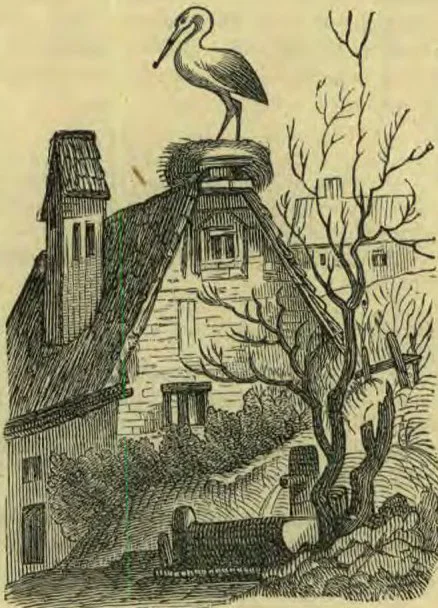
The stork is a very large bird, and all its feathers, except the ends of the wings and tail, are white. His long bill is a bright red, and his legs are the same color, but are not as brilliant. In the Holy Land the stork was well known, and its flesh was not eaten by the Jews. It built its nest on the tall trees, as we learn from the one hundred and fourth psalm: “As for the stork, the fir-trees are her house.” And Jeremiah says, “The stork knows her appointed time,”—the time to go south, and also the time to return. Its winters are mostly spent in Africa, but its eggs are laid, and its young are reared, in the north of Europe and Asia. When the time comes for them to migrate, they go to the appointed gathering-place; but we do not know by what means God makes them to understand this. When all are ready, and night comes on, the leader starts up, and, soaring high in the air, moves off with the flock toward its new home. These flocks often number thousands.
Its name in Hebrew is said to mean mercy or piety, and the character of the bird agrees with its name. According to some writers, the old and infirm storks are assisted on their journey by the younger ones, which allow them to lean their heads, when weary, upon them; or, if the old ones are likely to give out, and begin to lag behind, the others take them on their backs and bear them easily on.
The stork is mild and quiet in disposition, and for ages has been held in a kind of superstitious reverence by the people of the East. When he comes with his materials for a nest, and lights down upon the tops of their houses and begins to build, they call it a good omen, and think it will bring good fortune. The Hollanders erect a false chimney, and the Germans a platform on their houses, to receive these welcome guests.
Children may learn a useful lesson from this strange-looking bird. What is it?—Selected.

WORK AND PLAY.

Don't loiter, boys and girls. When you know what you ought to do, then go about it promptly; work at it diligently, and finish it. Work first and play afterward. Work first and rest afterward. Never dawdle. Is there a garden to be weeded, corn to be hoed, hay to be raked, coal to be brought up, an errand to be done, a lesson to be learned? make that the first thing, and, if possible, the only thing, until it is finished. Your comfort and your success in life depend very much upon the habits you form in this matter.
You find some people who are always saying they have so much to do, and yet they seem to accomplish very little. They are not comfortable, and they are not successful. Perhaps they have a letter to write, and they worry over it every day for a week, exhausting as much strength in this useless worry and “dread to go about it” each day, as another would in writing and posting half a dozen letters. The successful men—railroad presidents, bankers, manufacturers, merchants, farmers—are men who have what we call executive ability, or “dispatch.” It is the power of forming an accurate judgment quickly, doing a thing, or giving orders for it, at once, and then dismissing it from the mind, so that the next thing may be taken up and dispatched. “The hour’s duties are done in the sixty minutes, the day’s duties within business hours; and then the man may read, ride, talk, sleep, rest, with a mind free from care. If the boys and girls manage their work thus, then they will enjoy their play. —Scholar’s Companion.

ALSATIAN PEASANTS GOING TO CHURCH.

THE border-land of Alsace is a country of contradictions. We find a people whose customs and manners, speech and costume, attest their German origin, and who are, for the present, at least, under German rule; yet they call themselves French, and look longingly for the time when they shall be restored to the nation which they claim as their own.
The Alsatians have long been noted for many curious customs, some of them of French, but more of German, origin; and not the least peculiar of these is the one selected for illustration.
Clad in the picturesque, if not very handsome, costume of the province, on Sunday morning the old men and matrons, young men and maidens, and joyous, laughing groups of children may be seen traversing the highway toward the parish church, which is usually so located as to accommodate the inhabitants of several neighboring hamlets. As they pass along, they chant in unison the familiar hymns of the church, and the effect, as their voices rise on the still air, is singularly pleasing to the tourist or traveler who chances to meet the little party of worshipers. The walk home is frequently beguiled in the same manner; and the custom is surely a charming one and worthy of imitation elsewhere.
—Selected.
Continue reading: GOD'S PICTURES