From persons in various countries I have received inquiries about the inscription, Vicarius Filii Dei, which is commonly believed to be inscribed upon the tiara of the pope. And with the view of responding to these various inquiries and settling a much discussed question, I have made a special effort to gain the desired information.
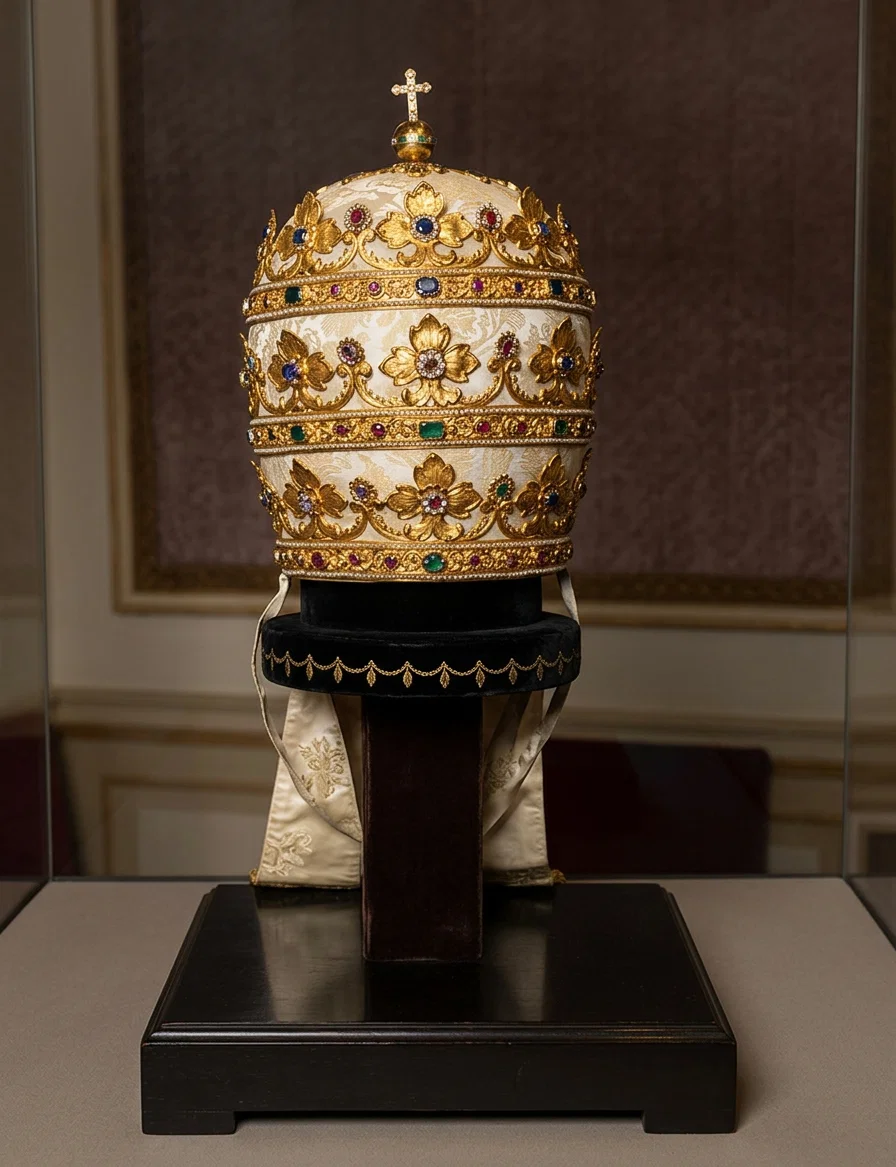
THE POPE'S TIARA, FRONT VIEW
I have seen the tiara upon the head of the pope on various occasions, when great functions were held in St. Peter's Cathedral, such as the Jubilee of Pope Leo XIII, the coronation of the present pope, etc. And on the occasion of the fiftieth anniversary of the Declaration of the Immaculate Conception, I had a position in the church very near where the pope passed, and with the aid of an opera-glass saw the tiara quite plainly. Also on a later occasion, when two “saints” were canonized, I had a reserved seat near the front of the church, and then saw the tiara exceptionally well. But in order to leave no possible room for doubt in this matter, I sought to gain the opportunity of seeing the tiara privately and of examining it minutely.
Through the aid of a friend who is well acquainted with officials of the Vatican, I obtained a personal card from the private secretary of Cardinal Rampolla, which requested the person in charge of the pope's wardrobe to show us whatever favor we might desire. Armed with such a document, we felt sure that we would easily gain the desired privilege. But when we presented the card to the person in charge, we were informed that this pope had forbidden absolutely any one's seeing privately his apparel, and no argument would induce the officer in charge to grant us the favor, and so the case looked hopeless. However, we did not give up the task, but went here and there, and finally saw the official photographer of the pope.
We told him that we desired a photograph of the tiara, and also the opportunity of seeing the tiara close at hand. He said that he would try in some way to pass us in to see the tiara. When we returned, he said that he had asked the authorities in charge about the matter, but they said that it was absolutely impossible for any one to gain an admission to see the tiara, as it is kept in the private apartments of the pope. But finally an agreement was made with the underlings, without the knowledge of the higher authorities, whereby we might gain an entrance into the inner recess of the Vatican and see the tiara.
One morning quite early we ascended the long staircase leading to the apartments of the pope, traversed the hall where the pope holds his private audiences, passed through the Sistine Chapel and other noted rooms, and finally arrived at the private apartment of the pope, and stopped in the room where the pope dresses himself for the great functions in Sistine Chapel. Here we were given an opportunity of seeing the tiara close at hand. We also saw two other tiaras that had been presented to the pope, one from France and the other from Bologna, as well as the miter of the pope. I might say at this point that many persons confound the pope's miter with his tiara. The miter of the pope is the tall cap that he wears on occasions of minor importance, and is similar to miters worn by the bishops all over the world, only that it is more beautifully adorned. He wears his miter as bishop of Rome, while his tiara is the triple crown which he wears as the sign of his authority as pope. That there has never been an inscription upon the miter is evident in the nature of the case, and therefore a careful examination of it revealed no writing whatsoever.
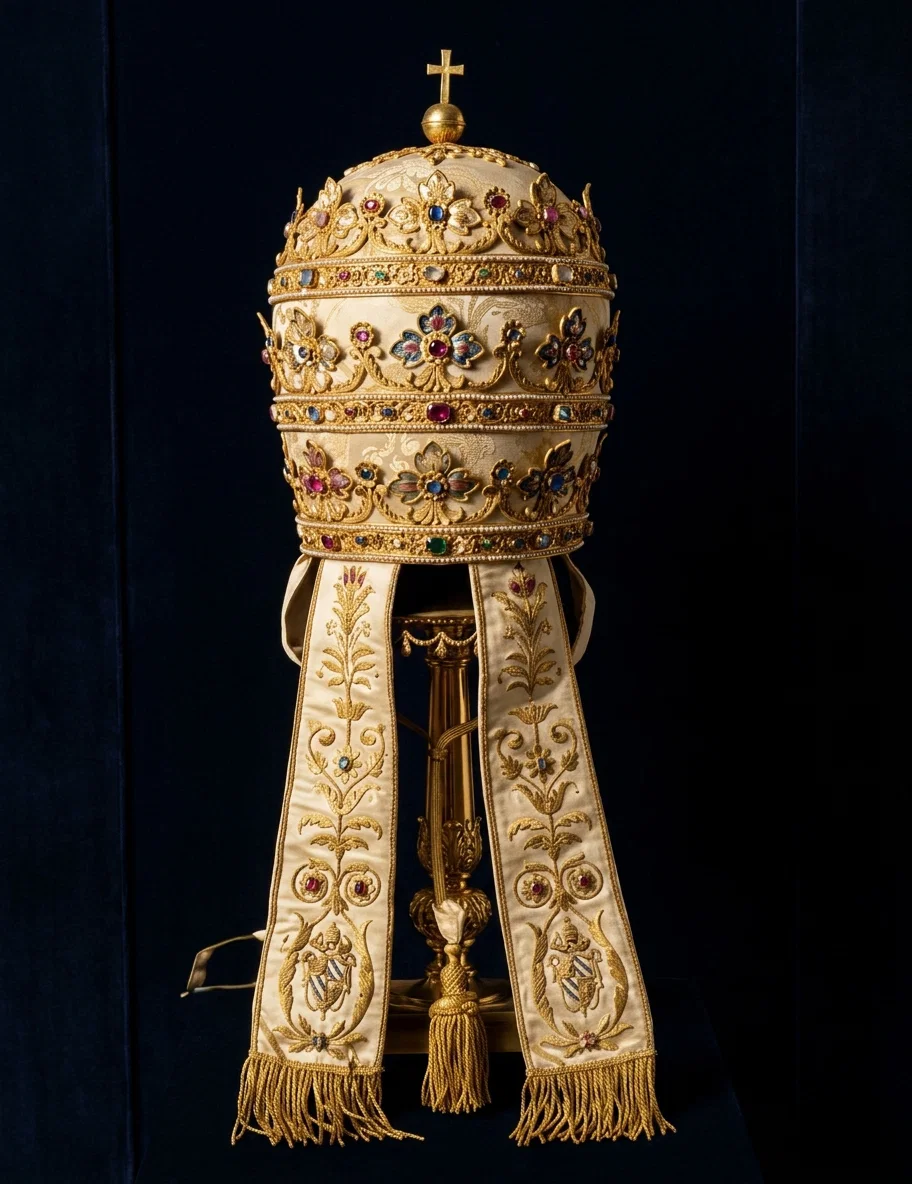
Now as to the tiara, which is the triple crown worn solely by the pope, I shall say a few words. The present tiara has been in use since 1836, and was worn by Pius IX, Leo XIII, and Pius X. This is the official tiara with which the popes are crowned, and which they wear on great occasions. There is no tiara extant that was worn before 1836; for when Napoleon came to Rome on his famous pillaging tour, he destroyed all the tiaras existing, in order to utilize the jewels and the precious metals contained in them. The present tiara, however, is a beautiful piece of workmanship. By observing the accompanying photographs one will readily appreciate the following description of it: On the inside it is lined with white silk well padded. The groundwork on the outside is a silver netting, and the three crowns are of gold set with many precious stones, among which are the following: the amethyst, the garnet, the emerald, the sapphire, the ruby, the topaz, etc., and each crown is lined with two rows of Roman pearls. On the top of the tiara is a cross of diamonds.
But while we were pleased to see this brilliant crown, yet we were disappointed in not finding the object of our search; for the inscription Vicarius Filii Dei was nowhere to be found inscribed upon the tiara, as the accompanying photographs show very plainly. On the back view will be seen the coat of arms of Pius IX, but it contains no inscription. We must therefore conclude11that there has not been any inscription upon the official tiara at least since 1836.
THE POPE'S TIARA, REAR VIEW
The tiara presented to Pope Pius IX on the occasion of his jubilee in 1865 also failed to reveal any inscription. The tiara presented to Leo XIII in 1903 is of gold and silver, and contains three inscriptions, but none of them reading Vicarius Filii Dei. The inscriptions that it contains are written upon the three crowns, and read as follows: (1) Omnis Regis Christi Pastorum Pastor Ovilis (Chief shepherd of the whole fold of King Christ); (2) Nescius Errandi Fide Morumque Magister (Incapable of erring in the faith and master of customs); (3) Sacerdos Maximus in Terris Divino Jure (High Priest in the earth by divine right).
Even these inscriptions are useful in showing the titles that the pope assumes. But it is evident that the tiara in actual use, and officially recognized at least since 1836, reveals no such inscription as Vicarius Filii Dei. The question naturally arises as to whether this fact that the tiara fails to reveal any inscription has any real bearing on the interpretation of the number six hundred and sixty-six as applied to the pope. It seems to me that this fact in no way changes our interpretation of the text in Rev. 13:18. For this verse does not indicate that the inscription must be written necessarily upon the tiara, but, to fulfil the specifications of the text, it is sufficient that this inscription is recognized by the pope as his title. And that this title is officially applied to the pope is unquestionably true. However, I shall not leave the question at this point, but shall endeavor to prove in another article that also upon the tiara was found the inscription Vicarius Filii Dei at one time.
Rome, Italy.
Loyalty to the King of Kings
By K. C. RUSSELL
K. C. RUSSELL
GREAT and decisive questions sometimes hinge upon seemingly the most ordinary and common circumstances in life. This is illustrated in the experience of Mordecai when he was delivered from an ignominious death on the gallows, which had been plotted by wicked Haman.
It will be remembered that in the book of Esther it is recorded that upon a certain night Ahasuerus the king could not sleep, and hence ordered his private secretary to read from the book of the chronicles. It so happened that the act of loyalty by Mordecai toward the king was read. It was the instance where two assassins had planned to take the king’s life; and the thing becoming known to Mordecai, he made it known, and they were hanged.
It will be well to note in this connection that the king’s inability to sleep upon that memorable night, and the selection of that particular instance from the records of the book of chronicles, were not by mere chance, but were unmistakably the direct working of the Spirit of God in bringing about the deliverance of Mordecai and his people.
The feature of chief importance in this thrilling experience, and also the pivotal point upon which the deliverance of Mordecai and his people turned, was because of this remarkable act of loyalty in behalf of the king which was found recorded in the book of the chronicles.
If, on that eventful night, nothing had been found written in these records concerning Mordecai and his noble deed which resulted in saving the king’s life, it will be readily seen that his own life and the lives of his people might have been sacrificed.
A practical lesson for God’s people can be drawn from this experience in the closing days of this work. Much of the experience of God’s faithful people recorded in the book of Esther is to meet a parallel in our time, and each soul should make sure that some acts of loyalty to the King of kings are being recorded in the book of chronicles (remembrance), so that when the time of deliverance comes, he may be among those of whom the prophet speaks in Dan. 12:1, “Thy people shall be delivered, every one that shall be found written in the book.”
Now is the time for us to hasten and have something recorded in the “book of chronicles,” for it will be too late should we delay until the day of final deliverance comes.
There are many ways in which we can show to God our loyalty; among these might be mentioned the feeding of those who are suffering from temporal hunger and thirst, and also those who are in dire need of spiritual food.
Through the spirit of prophecy the Lord has recently told us that “if the forces of the enemy gain the victory now, it will be because the churches have neglected their God-given work.” In the light of this instruction from heaven let no soul ask to be excused from being marshaled into line when orders are received from the “Captain of our salvation,” for the victory is as certain for us as it was for Mordecai and his people; for the spirit of prophecy says, “Now, as in the days of Mordecai, the Lord will vindicate his truth and his people.”
Washington, D. C.
A Visit to Our India Missions
By Della Burroway
DELLA BURROWAY
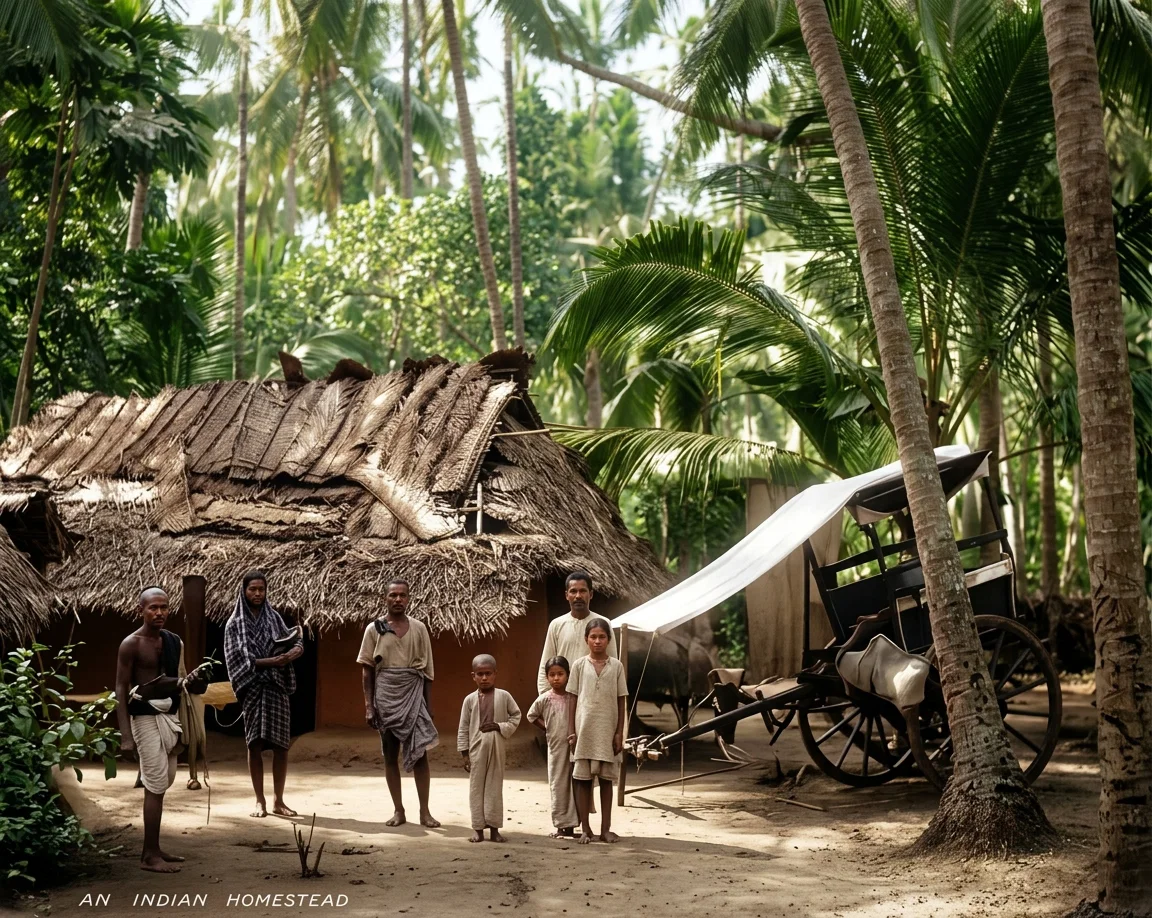
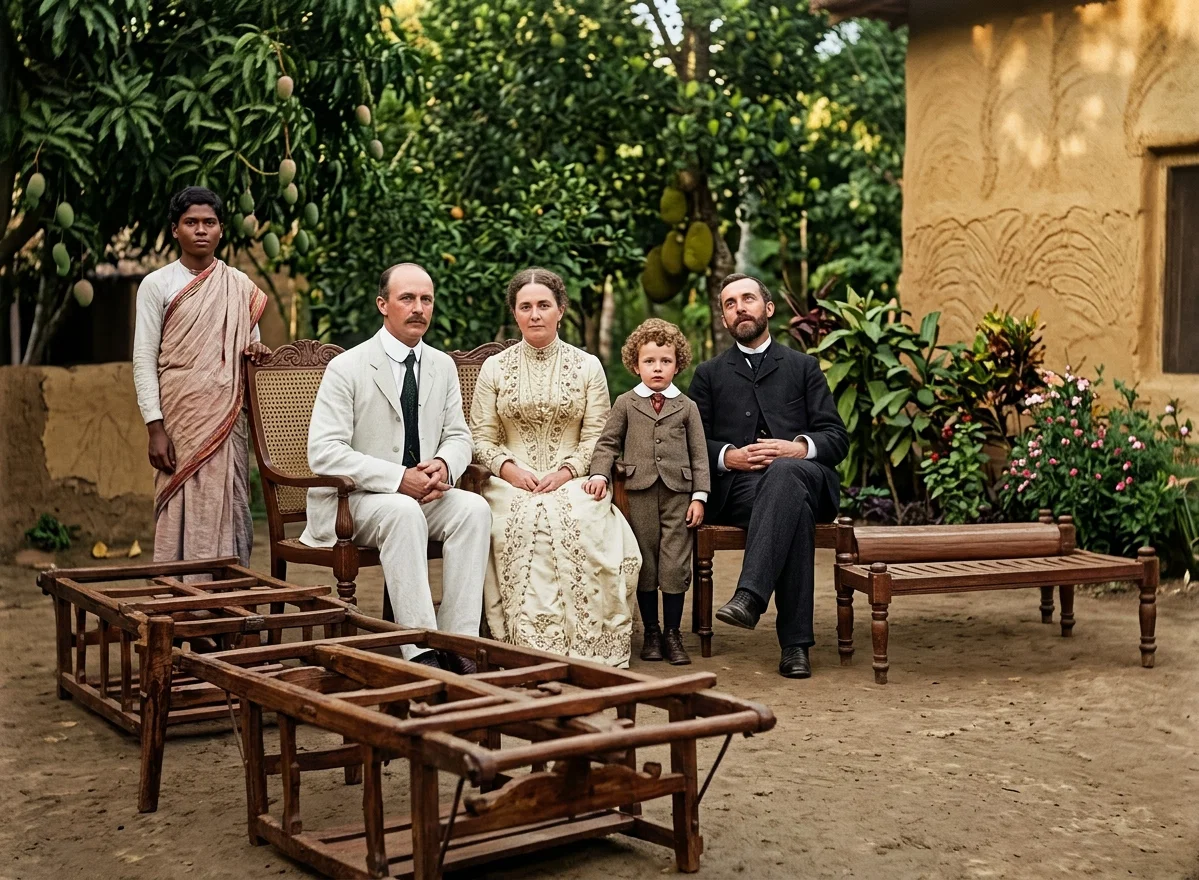
During the past week it was my privilege to visit our two mission stations—one located at Simultala, the other at Karmatar. Brother Barlow is doing a good work among the Santals at Simultala. He is living with his family in a large mud bungalow. The three large living-rooms are very comfortable, although the walls are papered and the floor carpeted with mud. Instead of scrubbing the floors as we do at home, they cleanse them with a fresh coat of mud. On either side of the bungalow is a large veranda. A short distance from the house is a long mud building, where the native students live. Near this is a mud hut in which the school is held. In a compound surrounding the buildings are fruit-trees and flowers. Altogether, it is a homelike place.
There are twenty boys in the school, ranging in age from eight to twenty years. Two languages—Hindi and Santali—are taught. The boys are very anxious to study English, but it is not possible to teach it at present. In addition to the language, they study Bible, arithmetic, reading, writing, and spelling. Two native teachers are employed to assist. A foreigner is not at all favorably impressed as he enters the native school. Upon the floor, with books in their hands, sit the students, studying out loud; and strange to say, they do not disturb one another. Most of these boys are earnest Christians, paying tithe on the few pices they earn.
AN INDIAN HOMESTEAD
I was very anxious to visit the native village, so Brother Barlow dismissed the school for one day, to let the boys take us about the villages, and to a new mission station that is just being opened ten miles from Simultala. The cart owned by the mission was undergoing repairs, and there was no other means of conveyance through the jungles. After considering a number of ways, Brother Barlow decided that two of our party could ride horseback, and the third member could be carried on a dulay (a rude couch), on the shoulders of four of the students. We started early in the morning, in order to cover as much of the ground as possible before the terrible heat of the day.
W. A. BARLOW AND FAMILY
The small Santal villages are located here and there in the jungle. As we entered the villages, the natives crowded about us, bringing their sick to be helped. If we rode past them, they would catch hold of the horses' bridles, and hold us until we would do something for their sick. A man dying with hunger and disease was brought to us. He was a living skeleton. His wife knelt by the side of our horses, grasping our feet, and said, “See my poor husband; can't you help him?” We went to the place where they lived. It could not be called home—a wall of brush and straw on two sides, no covering over their heads. Here we found three small, hungry children. Brother Barlow thought the best medicine he could give them would be food, so he sent one of the boys for some rice. As he gave it to them, he called their attention to their Heavenly Father who supplied their need. The women gathered about Miss Haegert and me, begging for help. They will not tell their troubles to a man. Some came sick with fever, wanting us to feel their pulse. One poor woman drew aside the rag that covered her, and showed me her leg, double its natural size, covered with open sores. We did what we could for them. But how helpless we felt! How we longed for the power of Christ and the early disciples to rebuke disease. Brother Barlow gave the people a simple lesson from the Bible. He first called their attention to the heavens, the earth, the trees, fields of grain, the garments they wore, showing them that all they had came from the true God who dwells in the heavens.
By the time we reached the new mission, the sun was high in the heavens, and we were glad for a shelter from it. Brother Barlow called the villagers into the small mud hut, and gave them a lesson from a picture of the ten virgins which hung on the wall. He uses pictures often in his work, as they enable him to teach the lessons much better. These people are much like children, and must be taught as children. When we returned, Brother Barlow left one of the native teachers in charge of the school at this place.
The Santals worship devils, and very often they become possessed with them. Brother Barlow has a servant who became13ill; and in spite of all they could do, he went home. As he passed a heathen temple, his jaws locked, and his body became rigid. The people gathered about him, saying he was possessed with a devil. The chief of the village was called. He told the boy the devil would leave him if he would give two goats and a piece of red cloth used in heathen festivals. By a look, the boy acknowledged he would, and immediately the devil left him. As we go among these people, we can see something of the conditions existing when Christ was on earth.
Some months ago a native Christian erected a hut in the vicinity of Brother Barlow's home. Brother Barlow visited him, giving him readings. He has accepted present truth, and is rejoicing in the light. He is well educated, having been a teacher, is able to read English well, and is reading all our books. He says Mrs. White's writings help him spiritually. There is just one fault to be found with him—instead of telling the good news to others, he thinks he must purify self first. He takes the life of John the Baptist to substantiate his views. He sits in his rude hut the entire day, reading the Bible and our books.
It is about fifty miles from Simultala to Karmatar. Here the work is more advanced. The buildings and grounds are more on the European plan. Our printing-press was moved recently from Calcutta to Karmatar. One reason for this was to give the students work. We have about twenty native boys and girls in the home. A number come from the village for recitations each day. Brother Little has charge of the printing-office, Miss Knight of the school, and Miss Whiteis does medical missionary work in the villages. The office is receiving calls to print tracts in the different languages, but is hindered because of lack of means. Our brethren in the missions are of good courage, and are laboring earnestly to fit the young people committed to their care to give the message to their own people.
Calcutta.
Sabbath-Keepers of New Guinea
By L. BROOKING
L. BROOKING
Among the cannibal head-hunters of New Guinea, which is a country little explored, there is a tribe of black Sabbath-keepers. The English traveler Bainbridge thus describes them: “They worship on Saturdays, and use very peculiar tablets in their house of prayer, marry only in their own caste, circumcise, eat only fish that have scales, hate pork, practise the same benevolent ideas in relation to the widows and unfortunates, and even to the minutest details they resemble the Jews.” “Among them were a number of albinos of superior physique and intellect, whose white skin, light eyes and hair, made them decidedly conspicuous among their black parents and companions.”
Here is another testimony among the most degraded people to the knowledge of the worship of the true God and of his rest day. May the day soon come when the gospel messenger will take the everlasting gospel to them that they may know Jesus and wait for his appearing.
Caterham, England.
The British Union Conference
By Guy Dail
GUY DAIL
February 14-19 delegates from England, Scotland, Ireland, and Wales assembled in London, to attend the winter session of the British Union Conference. The committee meetings were held in our publishing house, in the college building, or in Duncombe Hall, where the larger number of our public meetings were held.
In Great Britain we have two conferences and three mission fields: the South and North England Conferences, and the Scotch, Irish, and Welsh mission fields.
South England Conference
Last summer a tent effort was carried on in Bristol, another at Edmonton, and a third at Catford. Sixty-nine were baptized during the year, and thirty-four were added by vote, bringing up the membership to 536. The tithe amounted to $6,923.46, the offerings to $915.77. Thirteen gospel workers were in the field. The Duncombe Hall College, the International Tract Society, Limited (both in London), and the Caterham Sanitarium are located in the territory of this conference.
About ninety were in attendance at the school. A number of the younger students have been able to live in the school home, which, with the recitation rooms, may be reached by a five minutes' walk from our publishing house on Holloway Road. Thirteen of the pupils were converted and baptized during the year. Ten of the older students assist in the Sabbath and Sunday meetings held in various parts of the great metropolis, and fifty-five of them are paying a whole or a part of their school expenses by canvassing. The coming of Brother H. C. Lacey, from California, provided a welcome addition to the teaching force of the college.
As to the influence of the publishing work, it was shown that in nearly every instance where we have heard of an interest being aroused, the circulation of our literature has at least been connected with it, if it has not been the real cause of the religious awakening. The importance of the godly life of each individual laborer as he goes from house to house with the publications laden with present truth, was emphasized. In Manchester a little girl has been selling thirty copies of Present Truth each week, going to a class of houses that the other workers could not enter. For the seven months ending Jan. 31, 1905, our publishing house sales amounted to $40,946. Among the publications sold were 20,175 subscription books, 859 health books, 413 trade books, 607 pamphlets, 86,762 tracts and leaflets; and of periodicals, 537,200 copies of Present Truth, 350,000 of Good Health, 22,000 of Our Day, and 40,000 of Coming King.
The Caterham Sanitarium had a gain of about $577 for the six months ending Dec. 31, 1904. It has had a good run of patients, who have generally been very well pleased with the treatments they have received, and with the diet provided. The spiritual side of our work is especially emphasized at this institution, and the increasing patronage compels us to add constantly to our rooming facilities. There seems a very steady and healthful growth.
North England Conference
This field has closed the best year in its history. Five new churches were organized, eighty-seven persons were baptized, and the membership arose from 357 at the beginning to 433 at the close of the year. Fourteen workers were employed. The year's tithe was $5,219.59; the offerings were $785.
There are two institutions in this field—one is the Leicester Sanitarium, and the other the plant of the International Health Food Company, at Birmingham. Our health work in Leicester has made fair progress. The sanitarium is located on a quiet street in the city, and yet it has some difficulty in working up a first-rate patronage, because it is not located in the country. Especially helpful to the public have been the number of health schools conducted by our workers, as thus the masses are becoming acquainted with correct principles. During the last six months of 1904 the health food factory reduced its indebtedness from $3,825 to $2,633; this is very encouraging to us all, especially if we consider some of the difficulties with which our brethren here have had to contend.
Scotland Mission
This mission reports many openings, so that the question there has ceased to be so much, “How shall we present the truth?” the query being rather, “How can we meet the demands of the people upon us?” The work of our colporteurs has been very successful, their sales being $10,262 for the year. The tithe of Scotland was $1,011; donations, $128; eleven workers were employed; forty-two persons were baptized, our membership at the close of 1904 was 131.
Ireland Mission
The only institution we have in Ireland is the Belfast Sanitarium. It has had fair patronage, but here, as in Leicester, the work must be carried on in the city, and so our location is not so favorable as we could wish. The six months ending Dec. 31, 1904, show a gain of $287; all considered, this is a favorable report. Our evangelical work in Ireland has met very bitter and determined prejudice and opposition; still about twelve members were baptized during the year, bringing up our membership to 124; tithe, $1,809; donations, $152.
Wales Mission
The great revival which has swept14over Wales of late, has so engaged the popular mind that it has made our work somewhat difficult. While we do not doubt the sincerity of a great many who have taken part in this movement, yet it would seem that, tested by the simple and plain word of God, we can not look upon it as the genuine working of the Holy Spirit, for our brethren have found that so soon as the question of obedience to the Scriptures was specifically brought home to converts, and the binding claims of the law of God were emphasized, there was not that willingness to do as the Master requires which joyfully listens to his behests. However, we have lost but one member as a result of this great religious enthusiasm. Eight workers have been engaged here; fifty-nine have been received by baptism during the year; our tithe was $945; donations were $128; and the membership at the close of the year was 140.
Six workers are on the British Union pay-roll. The entire income of the British field for 1904 was: Tithe, $15,909; donations, $2,090; book sales, $30,749. Total members received, by baptism, 269; by vote, 100. There were sixty workers and 1,364 church-members.
These union conference officers were elected: President, O. A. Olsen; Vice-President, E. E. Andross; Secretary and Treasurer, A. Bacon; Auditor, S. S. Barnard.
All were glad for the help of Brother E. W. Farnsworth, who had lately been laboring in the field. The counsel of Brother Conradi was also appreciated.
In the committee meetings many difficult questions came up for consideration. We are still seeking for a suitable location in the country, but yet near enough to the great center of population, for our publishing, school, and health food work. It was decided to hold a joint meeting of the North and South England Conferences and the Welsh Mission at a centrally located city, early in August. Because of the present Sunday agitation, a special Sabbath Campaign Committee was appointed, to take charge of presenting the truth to the people in every possible manner, upon this important topic. Gradually, yet almost universally, is this question coming to the front.
With the best of courage, and bright hopes for the future, the delegates left the place of meeting, determined to take up their work with new energy and faithfulness. God met with us at the British Union meeting, and it was felt by all that precious indeed is the meeting of his people. The religious instruction imparted was eagerly received. The discussion showed a brotherly spirit. We believe the ground is being well prepared, and that the organizations which have so recently been effected are becoming more and more a working power in these various conferences and missions, and that the future has still greater results in store for God's faithful followers in Great Britain.
China
By E. H. Wilbur
CANTON.—It has been several months since we moved back to Canton. We were exceedingly busy after our arrival here, but had a good rest during the Chinese New-year’s season. The past month has been unusually cold. The frost killed some of the house plants that were left out of doors.
It was hard for us to leave Hongkong with no worker to take our place there, but under the circumstances it was the best thing that we could do, and we have been very happy to be here.
Our schools reopened last week. Miss Thompson has already received forty applications for the girls’ school. Our English boys’ school opened with more students than we had at the beginning of the school last summer. It is too soon to form any idea of the attendance of the boys. This school is conducted by Brother A. C. Tidbury. I study the English Bible one-half hour each day with the advanced section, and our native preacher conducts a one-half-hour Bible study in Chinese, with the beginners. The two sections meet for Bible study together one hour on Sabbath.
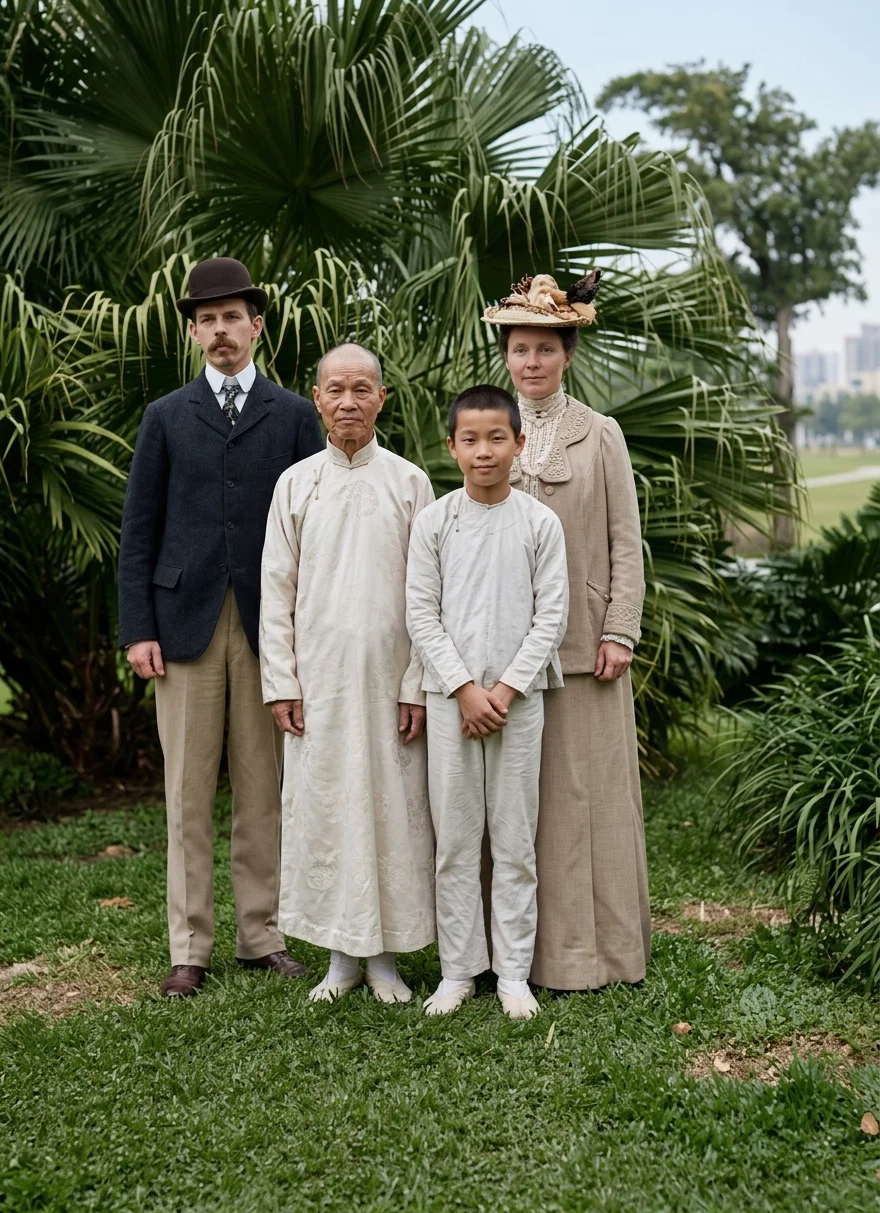
E. H. WILBUR AND WIFE, WITH LANGUAGE TUTOR AND "BOY"
About two weeks ago we again opened evening services in the chapel. Before Chinese New Year we had from fifty to one hundred people attending every night. But now we are having cold, rainy weather, and only a few come in. However, we are trying to get a little nearer the few, by sitting down and reading the Bible with them. I know our brethren in America have been waiting to hear of the fruit of these meetings, but the Lord has not permitted us to see much fruit from this work as yet. I can truly say that the one grace of all others needed in China is patience.
Our Chinese Friday evening prayer-meeting is encouraging, as we have a regular attendance of fifteen to twenty. On Sabbath the attendance at the preaching service runs from about forty to sixty. We have been badly handicapped because of our limited knowledge of the language and customs of the people. There is not one of our company here but has lost time because we had no one to tell us some of the things it was necessary to know. Now, if new workers are sent to Canton, they can learn as much in one year as we did in two. Our hearts have been made glad at the prospect of more workers.
Next to the demand at Amoy [which has since been supplied by Brother and Sister Hankins] is that a man and his wife be sent to Canton to prepare for ministerial and Bible work. We are glad Dr. Law Keem and his wife are coming, but we have urgent need also for a European worker who is thoroughly established in the truth. He must study at least two years before he can take up regular work, though in a few weeks he might be able to sell tracts, Bibles, etc., on the street. Remember there are two million people in this city, and thirty million in this province, and those who work for the Cantonese must come to Canton to learn the correct language.
Then there is Hongkong, a most important field, a gateway to the world. After Brother La Rue “held the fort” there for so many years, it seems a pity for no one to take his place. Now that we have laborers in Canton, Singapore, and Ceylon, it is even more important that we have a connecting link in Hongkong. We still have on hand a quantity of books, and no one here has time to sell them. Perhaps there is in America a man who is past the age when it would be practicable to begin the study of a language, yet who feels a burden for this field. Such a man, I think, whether he be a minister of long experience or an energetic canvasser, would find a pleasant field in Hongkong. He might not have any large audiences to preach to, but if he were a good man in personal work, canvassing, or house-to-house work, he would find a good field in that city. If he could have literature to supply the passengers on the mail steamers, he could reach a very influential class of people.
My wife and I are still keeping up our language study. Recently Mrs. Wilbur has begun Bible work with women in15their homes. At one place where she is now giving readings, about fifteen women meet with her daily to study the Bible and learn to sing. These women can not read, so they are taught to read and commit to memory portions of Scripture. They never knew anything about the Bible. If you speak of Peter or Paul, or any other Bible name so familiar to us, they have no idea of whom you are talking. They are more familiar with the name of Confucius or those of other Chinese sages. The women of China are faithful in their worship of idols. What a pity they have so few to teach them how to worship the true God!
We have been glad to begin the publication of tracts, and hope means may be supplied so that the good work can go on. I hope we may be able to begin the publication of a small Chinese monthly paper after Elder Anderson returns from America. Such a paper would be an important means of instruction among our native brethren, both in China and in other lands. I know of no better means of giving them a knowledge of the fundamental truths of the message than by the printed page.
We have watched with deep interest the recent developments in the work at Washington, and realize that we are living in a most important time. It is our desire to be up and doing while it is called to-day, for “the night cometh, when no man can work.”
E. H. WILBUR.
Bermuda
By James A. Morrow
HAMILTON.—Last Sabbath we had an excellent meeting. Two families of our Crawl brethren met with us in Hamilton. This seemed to be a great encouragement to all. Our visits at Crawl this week were good. I feel sure that several will very soon be ready for baptism. We have not urged this before, as we wanted to give them plenty of time to rid themselves of tobacco, become established in tithing, etc. We can see that most of them are growing in the message, for which we praise God.
By the last mail I had a letter from Brother Fortner, of Cape Town, South Africa, in which he said that he had kept in touch with the four brethren who returned to South Africa twelve months ago, and that they were all faithful to the cause. Brother Dumini, he says, is especially active in missionary work among the farmers in his neighborhood. One family is already keeping the Sabbath, and others are deeply interested, as the result of his work. Elder Freeman has been to see him twice, and will soon go that way to hold some meetings. This is very cheering to us. We hope to meet these dear brethren in the kingdom. We learned to love them as our own lives.
The Lord has remarkably blessed us in finances. We have a balance on hand of $112.57. Aside from this, we have raised a special offering of $75.99 for the Washington fund this month, for all of which we praise the Father above.