Your ShelfYour Projects

Signs of the Times, Vol. 31, No. 39.

MARRIAGE OF THE LAMB

Signs of the Times

Sep 27, 1905

Pacific Press Publishing Company · MOUNTAIN VIEW, CALIFORNIA · Sep 27, 1905

MARRIAGE OF THE LAMB

The marriage-feast is ready, The marriage of the Lamb, He calls the faithful children Of faithful Abraham; He calls them from their sojourn To come to their abode— The children of the promise, The Israel of God.
He calls them from their prison Fast bound in iron chains, Whose cup is mixed with weeping, Where sin with Satan reigns; And from the golden portals The sounds of triumph ring— The triumph of the Incarnate, The marriage of the King.
Nor sigh nor sorrow enter Where Jesus leads them in, Nor death may cross the threshold, Nor pain, nor fear, nor sin; And shades of night and darkness Are past and fled away, Before the irradiant brightness Of everlasting day.
They come! the saints of Zion With dance and timbrel come, Where gleam the emerald meadows, The meadows of our home. Nor eye hath seen the glory, Nor heart of man may tell How bright the plains of Zion, The meads of Asphodel.
No tear-drops stain that threshold, No weeping eyes are there; For God hath wiped all tear-drops, And God hath stilled all care; The sunlight of the Presence, The bright Shekinah flame Lights up the bridal banquet Of God and of the Lamb.
The rainbow of the promise Around the throne hath gleamed, To welcome them forever To joys of the Redeemed; They enter to their glory, The feast for them is spread, The bridal feast of Jesus, The first-fruits of the dead. —Gerard Moultrie.

The SURE WORD OF PROPHECY

SIGNS OF THE TIMES LEAFLET—No. 1.

The SURE WORD OF PROPHECY

1. The Holy Scriptures are given as a light and guide to man.
"The secret things belong unto the Lord our God: but those things which are revealed belong unto us and to our children forever, that we may do all the words of this law." Deut. 29:29.
"For the commandment is a lamp; and the law is light; and reproofs of instruction are the way of life." Prov. 6:23.
"Thy Word is a lamp unto my feet, and a light unto my path." Ps. 119:105.
2. The Scriptures are a witness to Christ and His work.
"Search the Scriptures; for in them ye think ye have eternal life: and they are they which testify of Me." John 5:39.
"All things must be fulfilled, which were written in the law of Moses, and in the prophets, and in the psalms, concerning Me." Luke 24:44.
3. The Scriptures are given by inspiration [God-breathed], and to express the thoughts of God.
"The Spirit of the Lord spake by me, and His word was in my tongue." 2 Sam. 23:2.
"Which things also we speak, not in the words which man's wisdom teacheth, but which the Holy Ghost teacheth." 1 Cor. 2:13.
4. The Scriptures contain all that is needful to fit the minister of God for his work.
"The prophet that hath a dream, let him tell a dream; and he that hath My word, let him speak My word faithfully. What is the chaff to the wheat? saith the Lord. Is not My word like a fire? saith the Lord; and like a hammer that breaketh the rock in pieces?" Jer. 23:28.
"From a child thou hast known the Holy Scriptures, which are able to make thee wise unto salvation through faith which is in Christ Jesus."
"All Scripture is given by inspiration of God, and is profitable for doctrine, for reproof, for correction, for instruction in righteousness: that the man of God may be perfect, throughly furnished unto all good works." 2 Tim. 3:15-17.
5. The prophecies all are a part of the Holy Scriptures, and, therefore, are "profitable." 2 Tim. 3:16.
6. The prophecies were inspired by the Spirit of Christ.
"For the prophecy came not in old time by the will of man: but holy men of God spake as they were moved by the Holy Ghost." 2 Peter 1:21.
"Of which salvation the prophets have enquired and searched diligently, who prophesied of the grace that should come unto you: searching what, or what manner of time the Spirit of Christ which was in them did signify, when it testified beforehand the sufferings of Christ, and the glory that should follow." 1 Peter 1:10, 11.
7. The prophecies are one of the strongest evidences of the in-

Terms of Subscription.

Per Year, post-paid . . . . . . . . . . . . . . . . . . . . . . . . . . . . . . . . . . . . . . . . . . . . . . . . . . . . . . . . . . . . . . . . . . . . . . . . . . . . . . . . . . . . . . . . $1.50 Six Months, 75 cts. Three Months, 40 cts. To Foreign Countries, per year, $1.75.

SPECIAL TERMS.

1. One new yearly subscription and one renewal, or two new yearly subscriptions, sent at one time, $2.50.
2. Two new yearly subscriptions and one renewal, or three new yearly subscriptions, sent at one time, $3.25.
3. Three new yearly subscriptions and one renewal, or four new yearly subscriptions, sent at one time, $4.00.
Sample copies sent on application.

TO OUR PATRONS.

Please be careful to write all names of persons and places plainly.
Send money by Post-office Money Order, Express Order, or Bank Draft on New York, Chicago, or San Francisco.
Orders and Drafts should be made payable to the Pacific Press Publishing Co.
Paper money or silver should be sent in a registered letter.
Registered mail is safe. Unregistered mail is at the risk of the sender.
Postage-stamps in five or ten cent denominations will be accepted for small amounts.
The address label on your paper will indicate the time to which your subscription is paid. In case of non-receipt of papers, or any other irregularity, please notify us immediately.
When subscriptions expire, no more papers are sent to the party except by special arrangement.
You are requested to watch the date on your label, and renew early, and save the loss of papers. We can not always furnish missing numbers.
When requesting change of address, be sure to give both old and new addresses.
Important.—If you order Signs, Our Little Friend, books, etc., at the same time, use a separate sheet of paper for each. If this request is complied with, it will materially assist in the prompt and accurate despatch of the business.
When writing to the editor, be sure to use a separate sheet of paper.

Subscription for the Signs

Wellsburg, W. Va., Aug. 31, 1905.
Editor, SIGNS OF THE TIMES,—
Dear Sir: I very much feared that I should miss some of the numbers of your most valuable paper, but thanks to your great magnanimity, I am the happy possessor of the “only” paper. Please find enclosed money order for one year’s subscription.
I wish to thank you expressly for your leniency in permitting me to subscribe in this irregular manner. I have not missed one copy.
Wishing you unlimited success, I remain,
Yours respectfully,
(Signed) Mrs. S. V. Simpson.

The Best Paper I Have Read

"The SIGNS is absolutely the best paper (of any description) that I have ever read. I never shall be satisfied without its inspiring visits."

A Young Paper Seller’s Request

Tacoma, Wash., 406 South N Street. THE SIGNS OF THE TIMES, Mountain View, Cal.
Dear Editor: We received the papers you sent, and had good luck selling them. My brothers helped me sell them. Please find 35 cents to pay for twenty more this week.
I have two brothers. One is ten years old and the other is eight years old. I am twelve years old. Send the papers as soon as possible.
Yours very truly.

Uncertainty

Is written on the face of all things earthly, "nevertheless the foundation of God standeth sure." To acquaint all more fully with this Sure Foundation, we have arranged a series of sixteen studies in two-page leaflet form, covering interesting and important Bible subjects that relate especially to our day.
We herewith give a reproduction of the first page of Number One of the series, which serves as an introduction to the fifteen others.

Pacific Press Publishing Company

The prices are so low that no one can excuse himself from using them liberally. Hundreds of thousands have already been sent out, and we confidently expect that millions will be circulated in a very short time. Let us, indeed, scatter them "like the autumn leaves."
Not Post-paid Post-paid Not Post-paid Post-paid
100 (All one kind) $0.15 . . . . $0.15 1600 (100 each of 16 kinds) $1.50 . . . . $1.95
1000 (100 each of 10 kinds) 1.00 . . . . 1.30 1 lb. (about 20 of each kind) .42 . . . . .50
No small assortment sold, except in pound lots.
If not familiar with all the numbers, ask for a full list. Order of any Tract Society, or of

Pacific Press Publishing Company

Mountain View, Cal.
1109 E 12th St., Kansas City, Mo. 285 Salmon St., Portland, Ore.

TAKEN UNAWARES.

THE strong man may be taken unawares and overcome. The great army may be taken unawares and defeated. Even the temporary victor may become too much elated and be cast down. So the Christian worker who for a moment forgets his dependence, lays aside his faith, and exults in any achievement as a result of his own effort, is liable to be taken unawares and thrown into discouragement and doubt. Hence the Saviour's counsel, "Watch and pray, lest ye enter into temptation."
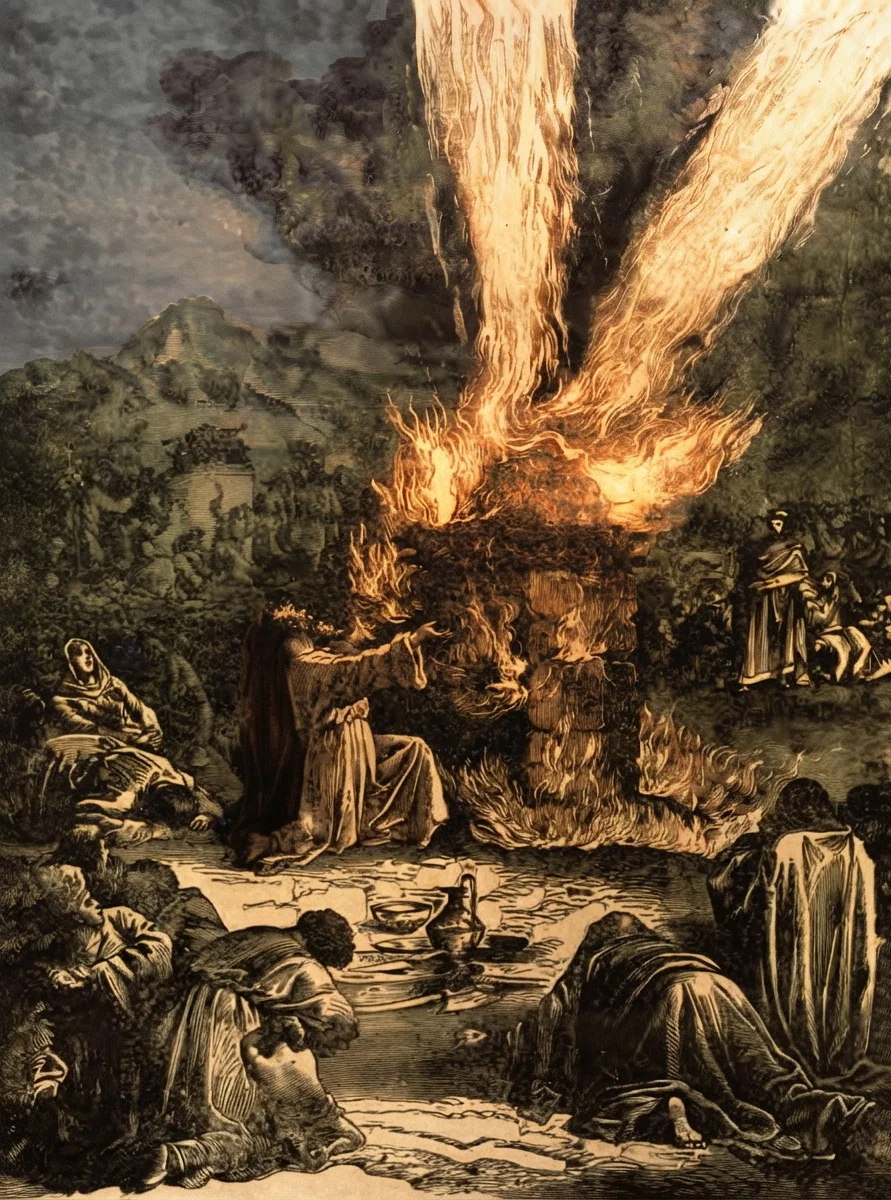
ELIJAH was a strong, courageous man of faith. He was a man mighty in prayer, at whose petition the heavens were closed that it did not rain for three years and six months; and again when he prayed, they gave forth rain in abundance. Elijah had been miraculously fed during the famine, and had himself been the instrument of miraculously providing food for others; he had even been instrumental in raising the dead. He had met, single-handed, eight hundred and fifty priests of Baal, and after proving by a test of fire from heaven that the God of Israel was greater than Baal, he slew the priests of Baal in the presence of the king, who was their special patron.
AFTER thus humiliating the king before his people, Elijah took the position of a servant and ran before Ahab's carriage from the top of Mount Carmel to the gates of Jezreel. It was now night, and as the king went into his palace to relate the story of his own humiliation and the fate of Baal's priests to Queen Jezebel, Elijah wrapped himself in his mantle and lay down for a much-needed rest. He evidently felt that the victory was complete,
and that the morrow would witness the beginning of a great revival in Israel—even the vindictive Jezebel yielding to the overwhelming evidence that Jehovah was God over all.
So, WHEN he was awakened by a messenger from the queen bearing the threat that on the morrow his life would be forfeited, Elijah was taken unawares. He was not expecting such an attack from the enemy just then, and was not prepared for it. Alas! after all, Elijah was "subject to like passions as we are" (James 5:17); therefore, in the surprise and confusion of the moment, he "arose, and went for his life." Taking his servant with him he fled to Beersheba, about seventy-five miles southward. Leaving his tired servant there, he went on a day's journey farther, on into the wilderness country.
HAVING fled to the wilderness, he "sat down under a juniper tree, and requested for himself that he might die." What a strange request, after such a race to save his life! but discouraged people always do the most inconsistent things. In this condition the poor man went to sleep. But God did not forget His servant, nor did He leave him to his fate, even if he had run away at a most critical moment in the conflict with the enemy. As He slept, "an angel touched him, and said unto him, Arise and eat." Looking around, "behold, there was a cake baken on the coals, and a cruse of water at his head. And he did eat and drink, and laid him down again."
AFTER another refreshing sleep, the ministering angel came and fed him again, and he "went in the strength of that meat forty days and forty nights unto Horeb the mount of God." When one is taken unawares, and fails and runs away from the work just on the eve of victory, the best thing for him to do is to go to the mount of God and take a new start. God will help him on the way, if he is still willing to be led.
ARRIVING at Horeb, Elijah found a cave and lodged in it. "And, behold, the word of the Lord came to him, and He said unto him, 'What doest thou here, Elijah?' Sure enough, what was the minister of God doing so far away from the scene of his victory, and the place of the revival for which he had so earnestly prayed and worked, and of which God had given him the earnest? Why was he there?—Because he "was a man subject to like passions as we are," and he was taken unawares.
The Answer by Fire on Mount Carmel.
ELIJAH further illustrated this passion like unto us in his answer to the Lord's query. He began at once to accuse the brethren. He said: "I have been very jealous for the Lord God of hosts; for the children of Israel have forsaken Thy covenant, thrown down Thine altars, and slain Thy prophets with the sword; and I, even I only, am left; and they seek my life, to take it away." Like all discouraged people, the poor man thought that, because he had fled from the battlefield, the cause must be hopelessly lost. But God showed him his mistake, and assured him that there were yet seven thousand in Israel who had not worshiped Baal. So the standpoint of the discouraged man is not the place from which to estimate the Lord's forces or the prospect of His cause.
But Elijah had taken up his abode in the mount of God, and there was hope for him. The Lord reinforced him and set him to work again. Elijah was never taken unawares again; God used him to the glory of His name, and to the advancement of His cause, and translated him without his seeing death. In this the Lord has given us two lessons: (1) How to treat a brother who is taken unawares and becomes discouraged; (2) if one should become discouraged, he should not begin to find fault with his brethren, or suppose that the cause of God is lost; but go straight to the mount of God, and take a new start. The Lord does not change. His sure promise is, "Him that cometh unto Me, I will in nowise cast out."

TAKE THE BEST THERE IS.

A NOTED preacher was quoted not long since as saying, "I want something better for America than the Sunday of Continental Europe." Then why not take "the Sabbath of the Lord thy God"? It is the best there is. It has His own blessing. God Himself has given nothing better in that line—He has not even given anything else in that line. Next to Christ Himself, the Sabbath of Jehovah is God's best and most blessed gift to the human race. It was blessed and hallowed when given to the world. That blessing and that sanctification were never repealed by the One who only had the right to repeal them. The institution itself was never set aside by a command of the One who only had the right and the power to make such a change. One of the purposes of its establishment was to keep in men's minds the memory and love of the "Maker of the heavens and the earth." God pronounced a blessing upon those who would remember to "keep it holy." Christ kept it. He neither changed it nor intimated that He ever intended to change it. His disciples kept it. There is no record, sacred or profane, that they ever ceased to keep it, or that they ever kept any other day. No statement of the New Testament can, by any fair or impartial interpretation, be made to teach that they kept any other day as a Sabbath or sought to teach others so to do.
We are free to admit that the world needs something better as a Sabbath than the "Continental Sunday;" and we know there is something better. It is the Sabbath of Jehovah given in Eden; given with His seal; protected by Him through all the ages; still in force as when He spoke the law concerning it; never to be repealed. "Blessed is the man that doeth this, and the son of man that layeth hold on it; that keepeth the Sabbath from polluting it, and keepeth his hand from doing any evil."
Isa. 56:2. This is God's own promise to the man who honors His holy Sabbath day. He who does it God will cause to ride upon the high places of the earth, and he shall be "fed with the heritage of Jacob." Isa. 58:13, 14.
That is better than anything which the "Continental Sunday" has to offer. There is no promise in all God's Word of a blessing with the keeping of a "Continental Sunday," or an "American Sunday," or any other kind of a pseudo-sabbath. Look it up, and find out for yourself, if you are not sure already that this is true. Man is not a source of divine blessing. So no Sabbath that he can institute can possibly carry a blessing with it.
The speaker above referred to declares that "there is no difference in the days;" and he proposes to have the Sunday preserved "one-half for religious culture, and the other half for real rest and recuperation." Now that is a man-made arrangement, pure and simple. There is no blessing pronounced upon it by the One who only can bless humanity with spiritual blessing. No one who has the right and power to hallow a day, or a Sabbath, has hallowed that one. It can carry no divine blessing with it; for none has been put into it by the One who only could do it. More than that, it is a distinct defiance to the Author of the true Sabbath; for the would-be founder of this half-and-half Sunday sabbath has declared that there is no difference in the days. To him (and to many others) it makes no difference in the days for God Himself to declare one blessed and hallowed, and command it to be kept. But God has put a difference between the days of the week; and in the body of the law which He wrote with His own finger He has declared that difference. He is the same unchanging God, "yesterday, and today, and forever." "I am the Lord, I change not." Mal. 3:6. The difference is still there; and he who honors God in the keeping of His holy day will receive and know the blessing; and will have "something better than the Continental Sunday." Then, why not take Him at His word, honor the day He appointed for the Sabbath—the only one He ever did appoint—and get the blessing He has in it for you? Let us be loyal to the great King now if we expect to dwell forever under His government by and by.

Gold as a Symbol of God’s People

Gold is an appropriate symbol of the true child of God, for the reason that it is indestructible by fire. The fire will only purify gold, while it will destroy hay, wood, iron, and most other substances. Gold is wonderfully tenacious. The particles of gold can be beaten together while cold, and no other metal can be made into so thin a sheet. So the more the true votaries of the Christian faith are beaten by the hammer of the enemy, the more they are subjected to the fire of persecution, the more closely they will cling together, and the brighter the luster with which they will shine out in the midnight darkness of this sinful world. Of His people, the Lord says, "I will . . . refine them as silver is refined, and will try them as gold is tried; they shall call on My name, and I will hear them; I will say, It is My people; and they shall say, The Lord is my God." But of the wicked He says, "Behold, the day cometh, that shall burn as an oven; and allthe proud, yea, and all that do wickedly, shall be stubble; and the day that cometh shall burn them up, saith the Lord of hosts, that it shall leave them neither root nor branch." Reader, in which class do you expect to be found in the day of awards? Will you bear the fire of chastisement and refinement, coming out pure gold for eternity? or will you resist the purifying process, and become as "stubble," to be turned into ashes? Now is the time to make the decision. "Choose you this day whom ye will serve."

SUGGESTIONS ON THE MELCHIZEDEK PRIESTHOOD.

IN our concluding article on the priesthood of Christ we simply summarize a few of the essential things which have been covered, and which seem to us abundantly proved by the Scriptures:
1. That Christ was from the beginning the eternal Son of God, one with the Father, the active Agent in creation. John 1:1-3; 1 Cor. 8:6; Col. 1:16; Micah 5:2.
2. In that very creation He gave His life for all His creatures, for with Him is the fountain of life. Ps. 36:9. Therefore, as Creator and Life-giver, He is the Head and Priest of the universe, ministering of His own fulness and life to sinless, tho dependent and immature, intelligences. He was righteous; He was king; and therefore King of Righteousness, Melchizedek; and as the fruit of righteousness is peace, He was also King of Peace, which is King of Salem.
3. As God's plan is one and harmonious, the heads and fathers of inhabited worlds, like Christ the preeminent One, were called sons of God, even as Adam was of this world. Luke 3:38. As fathers and teachers under Christ, each became king of the world of which he was the primal created head; as a righteous being he also became a king of righteousness, king of peace, to all his children, bearing the name Melchizedek, the priest of his world, ministering and teaching of the life bestowed in him through Christ. From time to time these representative kings of their various worlds met together. Job 38:7; 1:6; 2:1.
4. When sin entered the universe of God, the preeminent Son of God emptied Himself of all His glory, took upon Himself the form of a servant, and descended even to nothingness, that He might vindicate the character of God to be love, and to save all who would be saved. In the early part of His humiliation He was Michael the Archangel, the servant of God. During this time He fought the great spiritual warfare with Satan, yet bringing no railing accusation against him, ever meeting his attacks with "The Lord rebuke thee, O Satan."
5. His next step in humiliation was to become man, "God with us," suffering as man suffered, meeting temptation as man must meet it, and conquering that man may conquer. Made perfect through suffering, He became unto all them that obey Him the Author of the eternal salvation of God, a High Priest after the order of Melchizedek. Heb. 5:5-10. The Melchizedek of the universe, become also the Melchizedek of this world, its second father, the place lost by Adam.
6. In His priesthood for sinful man He not only fills the Melchizedek priesthood, but is also antitype of the Levitical priesthood. Hebrews 8, 9.
7. In the Melchizedek priesthood we found the following essentials: Righteousness, sonship, fatherhood, and eternal life, and therefore an everlasting priesthood. Hebrews 7.
All these and many other thoughts have been offered in the suggestions in the past. We are sure they will bear study, and the more they are studied the more will we see the glorious depth of the great plan of God in the salvation of men.

ANNIHILATION OF THE WICKED.

It is not worth while to argue with any one who refuses to accept the plain Word of God as final. So it is not for the sake of argument with a certain "holiness" journal that we notice its failure to find in the Word of God the doctrine that He will annihilate the finally impenitent sinner. We give a few very plain references for the benefit of those who are willing to heed the Word when it is brought to their attention.
1. "The wages of sin is death; but the gift of God is eternal life through Jesus Christ our Lord." Rom. 6:23. Here death is set as the opposite of life.
2. To Adam God said: "In the sweat of thy face shalt thou eat bread, till thou return unto the ground; for out of it wast thou taken; for dust thou art, and unto dust shalt thou return." Gen. 3:19.
3. "Evil-doers shall be cut off; but those that wait upon the Lord, they shall inherit the earth. For yet a little while, and the wicked shall not be; yea, thou shalt diligently consider his place, and it shall not be." Ps. 37: 9, 10. "The wicked shall perish, and the enemies of the Lord shall be as the fat of lambs; they shall consume; into smoke shall they consume away." Verse 20.
4. "Behold, the day cometh, that shall burn as an oven; and the proud, yea, and all that do wickedly, shall be stubble; and the day that cometh shall burn them up, saith the Lord of hosts, that it shall leave them neither root nor branch." Mal. 4:1.
5. David compares the wicked to chaff (Ps. 35:5), and John the Baptist said of Christ, "Whose fan is in His hand, and He will thoroughly purge His floor, and will gather the wheat into His garner; but the chaff He will burn with fire unquenchable." Luke 3: 17. That is, no power will be able to avert the utter destruction of the wicked. They will be "burned up" as chaff, just as Malachi says of the "stubble."
6. To the same effect it is said that "their worm dieth not, and the fire is not quenched," thus showing that their utter annihilation is sure, because the instrument of their destruction is invincible. The fact that the power by which the wicked are destroyed is indestructible, or can not be stayed, is a proof that its work will be thorough and complete. This is illustrated by the destruction of Sodom. Jude tells us that "the angels which kept not their first estate, but left their own habitation, He hath reserved in everlasting chains under darkness unto the judgment of the great day. Even as Sodom and Gomorrah, and the cities about them in like manner, giving themselves over to fornication, and going after strange flesh, are set forth for an example, suffering the vengeance of eternal fire."
Note particularly that the "everlasting chains" (unbreakable chains) only hold those fallen angels unto the day of judgment—when they will be destroyed in the "everlasting fire" (Matt. 25:41), in the same manner that Sodom was destroyed, a destruction from which they never can recover. The destruction is by fire from God, which is a "devouring" fire. Heb. 10:27; Ps. 50:3.
7. The righteous will be "recompensed in the earth," where the wicked also will receive their "wages." Prov. 11:31; Ps. 37:22. The Lord will then have a clean universe, according to His "eternal purpose." The antediluvian world was destroyed by water; "but the heavens and the earth, which are now, by the same word are kept in store, reserved unto fire against the day of judgment and perdition of ungodly men. . . . Nevertheless we, according to His promise, look for new heavens and a new earth, wherein dwelleth righteousness." See 2 Peter 3:5-13. And the place of the wicked "shall not be." They will have consumed away into smoke.
All the foregoing scriptures perfectly harmonize. There are no contradictions in the Word of God, if the plain statements regarding which there can be no misunderstanding, if taken at their face, are allowed to stand as the basis of interpretation. There is one other expression, "forever," which men have used extensively in the endeavor to overthrow the plain statements which we have quoted. We will state briefly that "forever" is a word limited by the existence of the thing to which it is applied. For examples, see Ex. 21:5, 6; Lev. 10:15; 16:29-31; 24:3; Joshua 4:7, and many others too numerous to mention here.
Attention is called to a very comprehensive little tract, entitled "Tormented Forever and Ever," for sale at this office; price one cent. It is a full and clear exposition of the meaning and use of the phrase. G.

CHRISTIAN PATRIOTISM.

PATRIOTISM, according to the common use of the word, is a species of selfishness. If I should hold myself or my possessions up to be lauded above any other person or any other person's possessions, no one would doubt that I had a selfish motive in view. So when I hold my country up as the one to be always sustained, right or wrong, there is in such action the element of selfishness.
According to the common idea of patriotism, it was just as much the duty of the Spaniard to uphold Spain in the war with the United States as it was the duty of the American to uphold the cause of this government. But there were Christians, professedly at least, on both sides, and this common idea of patriotism made them enemies, seeking to kill each other.
Therefore the theory of patriotism as taught in our public schools, and even in Sunday-schools, would teach Christians of different nationalities to take one another's lives, if their governments should go to war. This may be patriotism, but any one who has the most rudimentary knowledge of Christianity, knows that such patriotism is not Christian. Sowing discord among brethren is one of the things the Lord hates. Prov. 6: 16-19.
Christian patriotism acknowledges allegiance to the kingdom of Christ. Christians are debtors to men of all nations. They are subject to "the powers that be" in all nations, with the exception that they are "to obey God rather than men." They are not to set governments against governments, nor to take sides in the conflicts of the world.
The Spirit enjoins us: "Thou therefore endure hardness, as a good soldier of Jesus Christ. No man that warreth entangleth himself with the affairs of this life; that he may please Him who hath chosen him to be a soldier." This is Christian patriotism. "And if a man also strive for masteries, yet is he not crowned, except he strive lawfully"—according to the law of God: "Thou shalt love the Lord thy God with all thy heart, and with all thy soul, and with all thy mind," and "thou shalt love thy neighbor as thyself." The Christian is a warrior for God, against the common enemy of God and man; but, like his Master, he is to labor to save men. This is Christian patriotism. G.

Question Corner

1721.—When Did the Feet-Washing Occur? John 13:2.
Does not John 13:2 show that the feet-washing was after the supper? . . . If Jesus had washed Judas’ feet, Judas would have part with Jesus; for he said to Peter, “If I wash thee not, thou hast no part with Me?”
We have not space to quote all our correspondent’s letter. But he will receive help if he will remember that there were two suppers mentioned, the Passover and the Lord’s Supper. It was after the disciples were seated at the Passover table, evidently, that the strife arose as to which should be greatest. Then came the lesson taught. The better translation of John 13:2-4 is, “And during supper . . . Jesus . . . riseth,” etc., A. R. V. Having “part with Jesus” depended on more than a hypocritical, formal ceremony. See what Jesus said in John 13:10, 11: “Ye are clean, but not all. For He knew who should [not had or had gone to] betray Him.” Surely, Judas was then present.
1722.—A Question of Judging. Rom. 14:5, 6.
Kindly explain Rom. 14:5, 6.
One great lesson of Romans 14 is judge not. The apostle is speaking of those within the church. There are some who were weak as to diet, some as to days. Some of the converted Jews still felt that they must eat the bitter “herbs” of the Passover, and also keep its days. Others saw more clearly and esteemed the appointed days of the typical feasts the same as other days. But neither must judge his brother; each must stand for himself before God’s throne. Verses 10-12. Another lesson: Let each one take especial care that he place no stumbling-block in his brother’s way. The passage has no reference to God’s moral requirements; for that righteousness He requires. Verse 17; Rom. 2:12.
1723.—Soul in Hell. Acts 2:27.
Please explain Acts 2:27.
The passage is a quotation from Psalm 16, prophetic of Christ in His death. He was cheered as into the Father’s hand He committed His spirit, or life, resting upon the promise in scripture: “Because Thou wilt not leave My soul in hell [the grave]; neither wilt Thou suffer Thy Holy One to see corruption.” The word rendered “hell” is Hades, Greek; Sheol, Hebrew, meaning the grave, or the common abode of the dead. The grave could not hold Christ, because He was righteous. Acts 2:24; Rom. 1:4. God could not leave His righteous Son in the power of the grave.
Continue reading: NATIONAL CHRISTIANITY EXEMPLIFIED