The Youth’s Instructor, Vol. LII, No. 44

Experiences in Egypt

The Youth’s Instructor

November 1, 1904

Review and Herald Publishing Assn. · Washington, D. C. · November 1, 1904

Experiences in Egypt
ALTHOUGH we are experiencing many difficulties, we are not discouraged; for we have many evidences of God’s guidance. He has given me good friends, and one of them gave me two very desirable rooms for a clinic in a thickly populated native quarter. He also interprets for me in this clinic, and in the homes, and often when the people are not able to pay for the prescription, he gives them the money. He is very glad to help, and calls me his American son.
Every morning I spend two hours in the clinic, examining, prescribing, treating by massage, and teaching correct habits of living. On my way back, after leaving the large modern streets and entering the dark, narrow native streets, I am greeted by the children, who salute me and say, “Sayeedah! Sayeedah!” meaning, “Good day! Good day!” and hold out their hands to me. Many of them at first were afraid when I spoke to them, and would run away. This made me sad and almost homesick. But now I am happy in their friendship. These little ones are bright and loving, but very dirty, and are often sick and in need of nursing and medical supplies. For performing a slight operation, dressing and bandaging the wound, I receive nothing from many; some pay two and one-half cents, a few ten cents, and occasionally one pays as much as twenty-five cents. A large share of the mothers are widows, who were married when ten or fifteen years old; and many are divorced. Many fathers earn but from five to ten dollars a month.
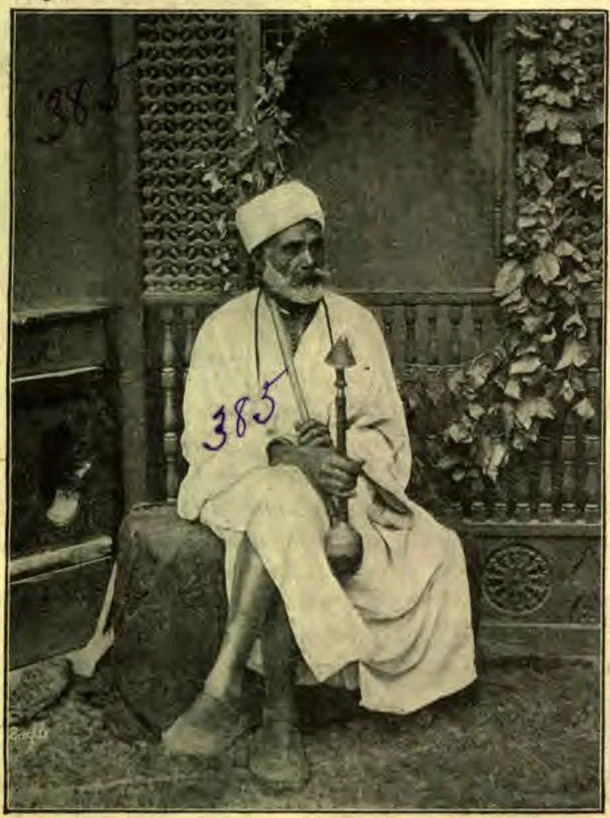
A MOHAMMEDAN SMOKER
A MOHAMMEDAN SMOKER
Now you must remember that this is not a village. Cairo has a population of nearly eight hundred thousand, and in the modern part it is impossible to get a nice apartment of six rooms and bath and kitchen for less than fifty dollars a month. There are finer residences here than in Chicago; they are built of beautiful stone and marble. There are also large apartment houses such as you see in cities in the States. There are large bank buildings, stores, and government buildings, similar to those in the State capital cities of the same size.
You can perhaps realize that the expenses attendant to my work are great, and that it would be far cheaper to work in a small town. But I prefer Cairo because it contains the schools of Egypt, in which are thousands of young men and boys from all parts of the country, and I hope to meet many of these and teach them the truth, that they in turn may help their people in other cities and villages. Outside of Cairo, perhaps only two or three in a hundred can read or write. The consequent ignorance and superstition is deplorable. For lack of proper care, eighty out of every one hundred babies die. I have a rich old friend who had twenty-four children; one of them still lives.
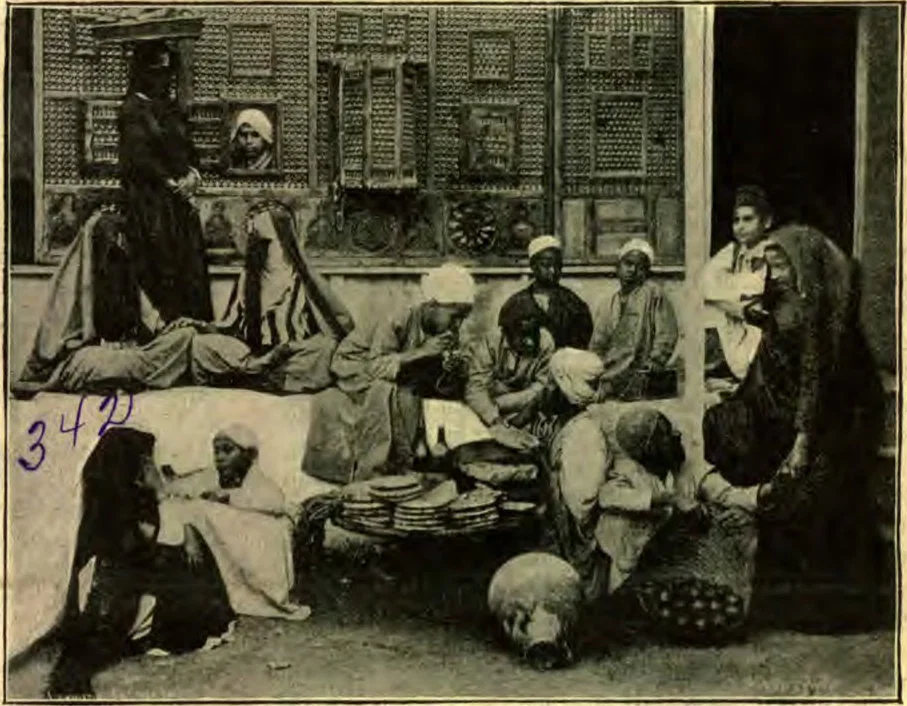
CAIRO VENDERS OF REFRESHMENTS
Last week a friend brought me his sister, to certify to her age and health, that she might enter the school of medicine and learn to be a woman physician (hakimah). She has the equivalent of a grammar-school education, and speaks English and Arabic, and is an exceptionally fine girl. She wished that I had a training-school. I hope there will be one some day, in which the young men and women may be taught the beautiful and helpful truths God has given us.
This morning I arose at three, and went to my student friend’s house for breakfast, after which we walked through the streets to the burial ground; for this is the month of Ragab, when the Moslems visit their dead relatives’ resting-places. This Friday morning was the especial day for the poor and middle-class people. The streets were filled with carts loaded with women and children, men on donkeys, and many private and hired carriages. We passed women carrying on their shoulders children, or large baskets filled with cakes, dates, and other sweetmeats. At five o’clock the native streets were crowded.
On our way we stopped and bought some bouquets for the graves. We reached the cemetery after being nearly suffocated by the dust. Those who are able erect a house, beneath which are built the underground vaults for the dead. The body is lifted from the wooden box, and placed in the vault, which is then covered by large stones; above is placed a broad headstone and a slender footstone. Many of these houses are beautiful, and some are elegantly furnished. We reached the one belonging to my Egyptian friend, which contained the tombs of his grandmother, sister, and some cousins. We placed the flowers on the gravestones, and then my friend called for some one to read the Koran. Four young men, students from the religious university, came; they squatted cross-legged, and, rocking their bodies and moving their heads, repeated for about twenty minutes chapters of the Koran. He gave them some small money, and they moved on to “read” at other places.
After locking the house, we visited the graves of some of his friends, and examined inscriptions on old tombs which had been built as many as five hundred years. I was pained to see fakirs on the ground, selling trinkets and candy, and showing panoramas. In one part of the cemetery was a temporary sheesha, where men could smoke.
The majority of the thousands I saw in the burying-ground (karafa) were native Egyptians—a people I love very much, and who have my fullest sympathy. They are simple and gentle, but ignorant and superstitious.
J. M. KEICHLlNE.

Word from China

With thankful hearts will every worker in the foreign mission field learn of the action taken by the people of Iowa at their last annual camp-meeting—an action to devote one half their tithe and workers to the foreign mission fields. This means that those who sit “in the region and shadow of death,” soon shall receive the light; and surely this step was not taken too early. The Lord says, “Enlarge the place of thy tent, . . . lengthen thy cords, and strengthen thy stakes.” This step will not only enlarge Iowa’s mission field, but it will enlarge the hearts of the people, as through their workers they are brought into contact with the needy souls in other lands.
At this time the one who really believes this message and is a part of it, should have an ear open to the cry that comes from the millions who not only have never heard the third angel’s message, but have not so much as heard that there is a Saviour.
As we here are far removed from the happenings which are of daily occurrence in the countries that boast of Western civilization, it is with the deepest feeling that we read of the fast-fulfilling signs taking place in Europe and America. Where crimes and fearful catastrophes are of every-day occurrence, they may lose their significance because of their frequency; but persons, looking on these things in the light of God’s Word, must know that the day of the Lord is near at hand. The situation in this land, where there is such a great work yet to be done, and where there is but one messenger to every forty million people, urges us to pray the Lord of the harvest to quickly send forth more laborers. How can any young man or woman who loves this truth, and who loves the soon-coming King, be content to settle down in the face of the present situation, at some mere mercenary occupation? The cry from these neglected fields surely is loud enough for all to hear, and the work great enough and varied enough to engage the talents of all who have an interest in the salvation of their fellow men.
There may be some persons planning to go to the foreign field in a year or two with the thought that they can at once enter into the work. A year or two after entering the field is necessary to acquire a working knowledge of the language, and to become acquainted with the customs of the people; hence delay not in starting. In order to work successfully, the missionary must come in close touch with the people, and be one among them; and to do this, he must be well acquainted with the language and the life of those among whom he is working.
Others may be looking forward to coming to the foreign field when they have taken some additional school work. There is the greatest need in a field like Central China for workers who have had the instruction that is given in the missionary course in our schools. Such a worker will be well prepared for the work; and when he reaches the field, and begins the study of the language, he will have many opportunities to study the missionary methods as they are outlined in the teaching of the Great Missionary. There is opportunity now to do as Paul desired; that is, to “preach the gospel, not where Christ was named, lest I should build upon another man’s foundation.”
At present there is opportunity to enter many regions where the gospel has not been preached. But these opportunities may last for only a short time, for there is great activity in missionary circles, and men are being scattered far and wide, and located in vantage places.
Let no one wait to be urged to come. When the Lord has specifically commanded us to carry this gospel to every nation, we should be anxious to respond. A. C. SELMON, M. D.

Who Changed the Sabbath?

In previous studies it has been shown that the Sabbath has never been changed. Being entrenched behind the precept of that law of which the great original is in heaven; being a memorial of creative power, and made and kept by the Redeemer of the world, it is impossible to change it. It is therefore misleading to speak of it as being changed, except in the practises of the people.
It is the result of apostasy, and was foreshadowed by the seer in Babylon, who spoke of a power that would arise and “speak great words against the Most High, and shall wear out the saints of the Most High, and think to change times and laws [“the law,” Douay Bible]; and they shall be given into his hand, until a time and times and the dividing of time.” Dan. 7:25. This system is known in Scripture as the “man of sin,” and in history as the papacy. It engulfed the world in gloom for centuries, and literally wore out the saints. Every conceivable means of torture was used, and millions of God’s people sleep in martyrs’ graves. Sitting in the church and blasphemously assuming to be God, he has impiously thought himself able to change the precepts of Jehovah, and in the catechisms of the church the second commandment of the decalogue, which forbids the worship of images, has been omitted, and the tenth commandment divided, to make up the required number. The papacy has gone further, and torn from the bosom of the law God’s memorial of creation, the seventh-day Sabbath, and placed instead a human substitution, the first day of the week, Sunday.
This iniquitous system was working even in the days of the apostles. Paul says, “The mystery of iniquity doth already work” (2 Thess. 2:7), and warned the church at Ephesus against those who from among themselves would arise, “speaking perverse things, to draw away disciples after them.” Acts 20:28-30. Peter warned the church against those who would bring in “damnable heresies” (2 Peter 2:1-3), and one of these “heresies” is mentioned in 2 Tim. 2:16-18. Others crept in, and following the death of the apostles the church, little by little, yielded to the prevailing power of paganism by which it was surrounded, until, as Dr. Killen says in his “Ancient Church:” “In the interval between the days of the apostles and the conversion of Constantine, the Christian commonwealth changed its aspect. The Bishop of Rome—a personage unknown to the writers of the New Testament—meanwhile rose into prominence, and at length took precedence of all other churchmen. Rites and ceremonies, of which Paul nor Peter ever heard, crept silently into use, and then claimed the rank of divine institutions.”
During this time many “pious frauds” crept in, such as sprinkling for baptism, purgatory, prayers for the dead, observance of heathen festival days, etc. That showy fabric, the papacy, grew rapidly, every thread of which is ancient heathenism. In his efforts to reconcile the pagan and Christian factions, Constantine, emperor of Rome, heralded to the world, in A. D. 321, an imperial edict, the first Sunday law. Sunday for ages had been the outward token of sun worship—the “wild solar holiday of all pagan times.” Being clothed with the armor of an imperial edict, it was exalted as never before, and destined, for a time, to overshadow the true Sabbath of the Lord.
It is not possible to give the exact date when the change in Sabbath-keeping came in; for it was a gradual work. The eminent commentator, Dr. Scott, in his comment on Acts 20:7, truly says: “The change from the seventh to the first, appears to have been gradual and silently introduced, by example rather than by express precept.”
The papacy being, as one writer says, simply “baptized heathenism,” it is not strange that the heathen festival, Sunday, should be received into her bosom. Other laws followed the edict of Constantine; and during all the years leading up to the world’s midnight, the Dark Ages, and during the darkness of that time, everything possible was done to hide the true Sabbath, and exalt Sunday. Catholic writers freely admit that the church changed the Sabbath, and openly set it forth as a sign of her power. Pages of testimony in proof of this could be quoted, but a few citations must suffice as a sample of many:—
“The Catholic Church for over one thousand years before the existence of a Protestant, by virtue of her divine mission, changed the day from Saturday to Sunday.”—Catholic Mirror, Sept. 23, 1893.
“Ques.—By whom was it changed?
“Ans.—By the governors of the church.
“Ques.—How prove you that the church hath power to command feasts and holy days?
“Ans.—By the very act of changing the Sabbath into Sunday which Protestants allow of, and therefore they fondly contradict themselves by keeping Sunday strictly, and breaking most other feasts commanded by the same church.”—
“Abridgement of Christian Doctrine,” page 57.
“Ques.—Have you any other way of proving that the church has power to institute festivals of precept?
“Ans.—Had she not such power, she could not have done that in which all modern religionists agree with her—she could not have substituted the observance of Sunday, the first day of the week, for the observance of Saturday, the seventh day, a change for which there is no Scriptural authority.”—“Doctrinal Catechism.”
Further evidence seems hardly necessary. Suppose a man was arrested for stealing. Circumstantial evidence unmistakably points to him as the culprit, witnesses unanimously testify that they saw him commit his depredations, and, lastly, he comes on the witness stand and confesses that he did all he is charged with. No judge or jury would hesitate to convict him at once. So here: the Bible points out a power which would arise and seek to change the times and law, authentic historians come forward and unitedly testify that the papacy did change the Sabbath, and, as a final climax, the Catholic Church steps forward and confesses that she is guilty, and boasts of the fact. No further evidence is needed to show that the innovation has the impress of the human, and should be rejected by all true Protestants who adhere to the Bible, and the Bible only, as their rule of faith and practise.
Jesus says, “Every plant which my Heavenly Father hath not planted, shall be rooted up.” Matt. 15:13. Instability is written upon all things earthly. “O thou enemy, destructions are come to a perpetual end: and thou hast destroyed cities; their memorial is perished with them.” Ps. 9:6. But the things established by the Most High endure through eternal ages. “Thy name, O Lord, endureth forever; and thy memorial, O Lord, throughout all generations.” Ps. 135:13.
“What says the Bible, the blessed Bible? This should my only question be; Teachings of men so often mislead us, What says the Book of God to me?”
G. B. THOMPSON.

Promise Little, and Do Much

“PROMISE little, and do much.”

Losing in an Hour the Work of a Lifetime

“ONE may lose in an hour the work of a lifetime.”

Keeping Thoughts and Guarding the Heart

“KEEP your thoughts, and you keep your heart.”

A Life in the Ocean

O WONDERFUL, mighty Ocean! How many secrets are borne in thy bosom! Thy wild waves dash and foam, but, safely hidden in thy depths, are myriads of lives, each kept by a loving Father.
“Full many a gem of purest ray serene, The dark, unfathomed caves of ocean bear.”
The waves wash ashore many empty houses, or shells, and, in the delicately tinted walls, are seen evidences of the abounding goodness of Him who has filled even the sea with beauty. Had the little workers that secreted these beautiful homes which are now empty no secrets that we may learn?
SECTION OF NAUTILUS SHELL
The story of one of the ocean’s treasures, the pearly nautilus, is especially interesting. It is a relative of the familiar oyster, both being mollusks. The nautilus lives mostly in the Indian Ocean. Parts of the shell, and sometimes whole shells, have been found on the shores of the East Indies, Australia, and the South Sea Islands. The shell, being thick and strong, is used in many ways by the natives, and is also made into various ornaments in China and elsewhere. Living specimens of the animal are rarely seen. The first one known to scientists was discovered by Dr. Bennett, in 1829, near New Hebrides.
A tiny baby mollusk was not as tenderly cared for as you and I. Its mother lived by herself in a shell, both curious and beautiful. It was shaped like a flat coil, and although only about four by five inches in size, it had many rooms. The largest and outer one was the dwelling-place. She could put her head and arms out of the open front door when it was necessary for her to swim about, or to catch her food which consisted mostly of crabs. With a pair of large, staring eyes, a powerful mouth, and about forty arms, she would seem well able to care for the little one. But dangers were many. It was a struggle to live; so baby nautilus at the very first started out for himself.
It then had a plain little house of one room, just large enough for its small body. But the baby ate and ate, and soon it outgrew the room. Then it built another room, larger than the first, and fastened it to the old one; and as the new room formed, he gradually moved into it. Time passed; another still larger room was added and occupied. It was impossible to ever get back to the small rooms, but the animal kept in touch with all of them by means of a slender tube that passed through each partition and ended in its first tiny home. Dr. Holmes beautifully describes this habit of the nautilus:—
“Year after year beheld the silent toil That spread his lustrous coil; Still, as the spiral grew, He left the past year’s dwelling for the new, Stole with soft step its shining archway through, Built up its idle door, Stretched in his last-found home, and knew the old no more.”
Thus the shell of the pearly nautilus is “chambered.” The empty rooms are filled with nitrogen gas. By cutting open the shell these rooms are seen to be arranged in the form of a spiral. They grow smaller and smaller toward the center, and have curved partitions. Scarcely could a king’s palace be more glorious, the inner walls having the luster of the most exquisite pearl. Outside there is another layer—porcelain white, streaked with reddish chestnut.
The pearly nautilus bears the family title of Cephalopoda, a long name both for the little creature and for us.
This pearl of the ocean by its life has taught man many lessons of value.
“Build thee more stately mansions, O my soul, As the swift seasons roll! Leave thy low-vaulted past! Let each new temple” truly be “nobler than the last,” till there is built a character, fit for eternity. MARY RICE.

Something More about Weaving

With what tireless patience the weavers of Israel must have wrought the golden thread through the purple and crimson curtains that draped the holy place, only we can imagine who have watched some primitive people bending over their threads to-day—not that Israel was a primitive people, but that the machinery with which they worked was exceedingly so. Of course every one knows that weaving has been, and is, nearly as universal among all peoples as language itself. We may go into the farthest north, and there the Esquimau weaves his nets of sinews and hides, or in some lone island of the southern seas we buy the palm fibers plaited into a hundred forms of usefulness and beauty.
LIVING NAUTILUS (ARGONAUT)
But it is in our own time and country that weaving has reached its highest perfection. Those same curtains, so wonderfully and beautifully wrought with angel forms by the artisans of the children of God, could doubtless be woven to-day without the touch of a hand, and with much of their pictured beauty. The great Jacquard loom that would do it, once seen at work, is a sight never to be forgotten. It is almost incredible that an artist can set a mere machine on the portrait of a man like Lincoln or Washington or Columbus, and go away and leave it to itself to multiply in woven threads those portraits by the hundred; and yet I have seen it done.
The Jacquard loom is really not a new form of weaving machine, but rather an attachment applicable to any loom. It consists of a great series of cards, or combs, so arranged and moved by a chain belt that they control each individual thread of the warp, holding it under or over any desired length of time; thus hiding or displaying the colored wool as the need may be. With some patterns of elaborate brocades, as many as twenty-five thousand separate comb-cards or plates must be employed.
JACQUARD LOOM
JACQUARD LOOM
The old hand loom was slow, but, one by one, labor-saving devices have been added, till in many cases human care is scarcely needed now, save to supply new material when the old is exhausted. For instance, instead of slowly passing the shuttle between the sets of warp by hand, it is actually thrown back and forth by machinery at the rate of two hundred fifty times a minute. This speed, of course, quickly exhausts the shuttle's thread, but an automatic arrangement in a recent loom hands a new bobbin to the shuttle without the loss of an instant's time, or the skipping of a single thread. Of old the warp threads were slowly and expensively threaded through the combs, or “heddles,” by hand; now this, too, is done with almost lightning rapidity by a modern invention; and the different colors of gingham and checkered goods are fed automatically, just the right number of each thread, without a thought from the operator.
And this wonderfully complex machine, with its thousands of intricate parts and its shuttle moving half a mile a minute, is so delicately and ingeniously arranged that on the breaking of a single tiny thread the whole mechanism instantly stops to await the renewing hand of its master. EDISON DRIVER.

The Delicate Shell of the Argonaut

THE shell of the argonaut, or paper nautilus, is a marvel for delicacy and beauty. The most careful handling is required, else it will be shivered to pieces.
SHELL OF CHAMBERED NAUTILUS

Autumn Song

Were a poet born to sing All that autumn’s glories bring, He, with pen of beryl spun, E’en must pierce the ruddy sun, And his burning thoughts enroll On the shining golden scroll Of a stretch of evening sky Bound with low-hung clouds, that lie Curled in opalescent strands, Wound by sunset’s skilful hands, And, by wind’s deft fingers caught, Tied in perfect lover’s knot; While the glowing evening star, With the new moon’s silver bar, Fit concluding touch reveal, Royal star and crescent seal.
O, elusive autumn time! Praised so oft in note and line! What, in my faint warble, lies Of thy wondrous harmonies? How can I hope to portray What the wise have failed to say? As thy crimson sun is led To his purple, mist-hung bed; And the pine woods’ faint perfume Blends with scent of dying bloom; While the chirp of lonely bird Through the solitude is heard, And each sense is ravished by Beauty waiting but to die, God, alone, could e’er express, Sing, or speak thy loneliness.
MINNIE ROSILLA STEVENS.

FIELD STUDY

(November 12)
Opening Exercises:—
Singing.
Scripture Reading — Isaiah 52.
Prayer (let a number take part).
Field Study:—
(a) Our East African Mission. Review and Herald, September 22 and 29.
(b) Travel in Honan. Review and Herald, October 6 and 13.
(c) Remarkable opening in Korea.
General Exercise: Let each one take part in answering the following questions:—
1. Where is Norfolk Island? Give the number of Sabbath-keepers. How many attend Sabbath-school?
2. What city of Egypt has recently been entered? Name the workers located in that country.
3. How has the work in Fiji recently been strengthened?
4. How many new Sabbath-keepers are reported from Arima, Trinidad? Locate the island of Trinidad.
5. Relate how our work in Honan, China, has been enlarged.
6. Tell something of the work in Simultala, India.
7. How many Chinamen have asked for baptism in Sumatra?
8. What is the area of Brazil? The population? In how many of the twenty States do we have Sabbath-keepers? How many organized churches are there? Tell where the laborers are located. Relate some of the difficulties our workers meet. What appeal comes from this field?
Closing Exercises.

Note

The answers to the questions will all be found in the issues of the Review of September 22 and 29 and October 6 and 13. Before the hour of meeting, the questions should be handed to the individuals who will answer them, so that all may be ready to make prompt responses. A map would add to the interest of the meeting.
E. H.

What Two Books Did

THE readers of the Gleaner will not take it as family praise if the writer relates the following incidents which have just come to his notice. Seeds of truth are sown here and there, in this way and that, by young and old, not knowing what the results will be.
A few days ago the State agent of the Virginia Conference was passing through Washington, and during a conversation in the Review and Herald Office, asked, “Was the Walters that sold books in Pittsburg years ago, your father?” “Yes,” was the reply. “Well,” he continued, “it was he who sold me the first Seventh-day Adventist book I had. He asked me to have Bible readings, to which I consented, with the result that I accepted the truth.”
In a letter dated September 26, from the State agent of the Western Pennsylvania Conference, is the following paragraph:—
“Say, Brother Walters, I have just discovered that it was your father that sold me my first Adventist book, about thirteen years ago. I want to say I am more grateful now than I was when I received it, as this was one of the causes of my being an Adventist to-day.”
So here were two books, sold thirteen years ago by a humble canvasser. As a result we have two active workers—State agents—in the field, engaged in enlisting others to join this noble work. How little we realize what will result from placing our publications in the hands of the people. May these incidents be an encouragement to those who are engaged in the good work of distributing our literature.—W. B. Walters, in Atlantic Union Gleaner.
Continue reading: The Triumph of the Third Angel's Message