The Youth’s Instructor, Vol. 30, No. 10.

WHAT WAS THE TROUBLE?

The Youth’s Instructor

Mar 8, 1882

S. D. A. Publishing Association · Battle Creek, Mich. · Mar 8, 1882

WHAT WAS THE TROUBLE?
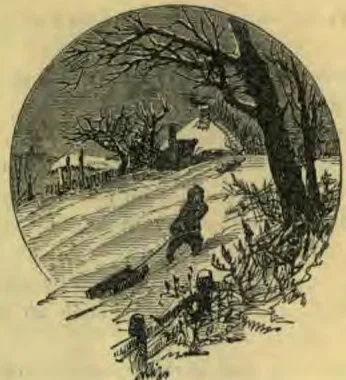
“Cleanse thou me from secret faults.”
“COME, Win, hurry! You won’t be back before noon!”
Win tied on the faded blue bonnet over her brown hair, picked up her basket, and started. She was going blackberrying; and unless she found the berries plenty, they would have nothing for dessert at dinner that day.
Win liked desserts, pies, and puddings, as well as you do; but money was scarce in her home, and the blackberries grew all along the wayside, “without money or price,”—“just grew,” as Robbie, her brother, said; but it always seemed to Win as if God furnished them for poor people who could not afford desserts, just as he did manna to the Israelites in the desert.
Win was a thoughtful child. She noticed everything as she walked along. The whole outside world seemed as much hers as if there was no one else alive: the pretty birds, flying so close over her head; the trees, with their shining leaves stirring with every breath; the beautiful blue sky, bearing the great, fleecy, white clouds upon its bosom; the very air she breathed, sweet and pure and clear, as if it had just come from God’s hand; and the soft meadows, starred with white daisies and yellow buttercups and pink clover, with dainty sheep feeding here and there.
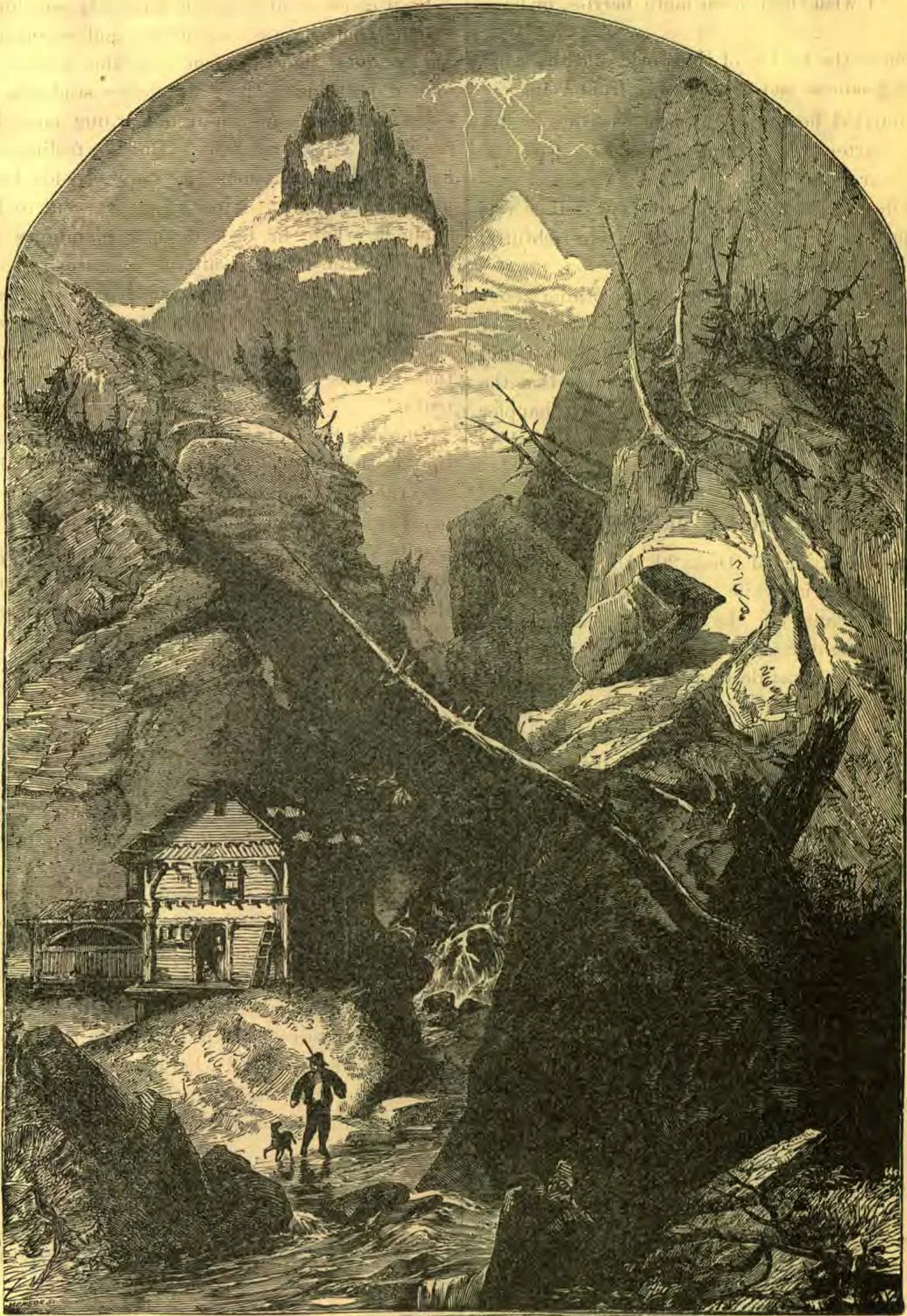
A SCENE IN THE ALPS.
“This is such a beautiful world,” said Win aloud, as she sauntered along. “I wonder how Heaven can be any nicer. I don’t believe ’tis!”
Sin, which so often spoils this lovely world, seemed very far away as Win spoke. But she was passing the blackberry bushes with every moment, and had not yet picked one. Was Win doing right?
She sat down under the shade of a big tree, with wide-spreading branches, in the very midst of great, golden-hearted daisies, and lay back among them, saying:—
“O you pretty, pretty things! How good God must be to make so many of you! only to look pretty, and for nothing else!”
Then she pulled off the white petals from the biggest within her reach, and said over the little rhyme,— “One I love, two I love,” etc., so dear to the heart of school girls. Then she rose, and strolled on, passing the little school-house where she had spent so many hours, leaning up against its friendly side, and looking off across the hills toward home.
“Why, it’s getting late!” she said, coming at last to her senses, and looking down into her empty basket.
“Real late, and not one picked yet! How does it happen?” And, hurrying along, she set down her basket, and began to pick with both hands at once. The sun was high over her head when she began, and the cruel thorns scratched her brown hands; for she could not stop to move the bushes gently aside.
One caught her dress as she was hurrying away, and tore a ragged hole in it. The big basket filled slowly, for the season was growing late; and she should have culled the best from every bush as she passed.
“Oh, dear, dear!” she cried, snatching her dress away, and making the ugly rent worse as she spoke. “I wish there were more berries, or none at all!”
Somehow, the beauty of the world and the sense of God’s goodness had passed away from Win.
She hurried homeward at last with her basket only a quarter full, to find it was long past the dinner hour.
“No dessert to-day, Win, and your father was so disappointed!” said her mother, reproachfully. “What hindered you, child?”
Win gave an evasive answer, something about the berries being scarce, and then sat down to her cold dinner, feeling out of sorts with herself and every one else. Win found out that day that the world seems better, and everything in it happier and brighter, when we are in the way of duty.
—Well-Spring.

ALPINE HEIGHTS.

On Alpine heights the love of God is shed; He plants the morning red, The flowerets white and blue, And feeds them with his dew. On Alpine heights a loving Father dwells.
On Alpine heights, o’er many a fragrant heath, The loveliest breezes breathe; So free and pure the air, His breath seems floating there. On Alpine heights a loving Father dwells.
On Alpine heights, beneath His mild blue sky, Still vales and meadows lie; The soaring glacier’s ice Gleams like a paradise. On Alpine heights a loving Father dwells.
Down Alpine heights the silv’ry streamlets flow, There the bold chamois go; On giddy crags they stand, And drink from His own hand. On Alpine heights a loving Father dwells.
On Alpine heights, in troops all white as snow, The sheep and wild goats go; There, in the solitude, He fills their hearts with food. On Alpine heights a loving Father dwells.
On Alpine heights the herdsman tends his herd; His shepherd is the Lord; For He who feeds the sheep Will sure his offspring keep. On Alpine heights a loving Father dwells.
—Krummacher.

THE EMPEROR'S DAUGHTER.

On the morning of Dec. 20, 1881, the royal family of Austria, while at breakfast, were busy in making plans for the holidays. Marie, the youngest daughter, aged thirteen years, on being asked what she most desired for a Christmas present, surprised every one, and brought tears to her father's eyes, by asking permission to adopt one of the children made orphans by the Ring Theater fire. Noble girl! I seem to see the look of pardonable pride on the father's face, and to hear his tender tones, as he grants his little daughter's request.
Doubtless the child thus rescued from suffering and poverty, will joyfully receive the news, and will make every effort to please her kind benefactors, and show them all the honor which a grateful and loving heart can bestow. At least, this is what they ought to expect from her in return for their kindness. But what would we think of that poor unfortunate child, if when the emperor's servants, commissioned by His Majesty, bring her the glad tidings, and show her the beautiful garments sent to clothe her, she should turn a deaf ear to their message, and refuse to put on the rich robes? And as the messengers still plead with her, and tell her of the king's lovely daughter, who asks her to come and live with her in her beautiful palace home, the child of want will not listen, but again scorns the proffered kindness. What would you think of all this? I think I hear you all cry out, “Ungrateful child, she deserves to suffer hunger and cold.”
Now Jesus, the Son of the great King of Heaven, is daily beseeching his Father to adopt into the royal family those who are suffering from sin. The Father's heart is melted to tenderness by his earnest requests, and he commissions his servants to offer the “robes of righteousness,” a “crown of glory,” and heirship with his Son in an eternal inheritance, to the sorrowing children of earth. Surely they will gladly accept so precious a gift! But sad to say, thousands daily turn in scorn and derision from these gracious offers of love and mercy; and yet we hear no cry of surprise uttered at their folly and ingratitude. What wonder that angels veil their eyes, and weep at the sight!
MRS. R. WEATHERBY.

THE OLD TREE.

Thud! thud! went the ax, brought down by John's strong right arm, and young Webster stood watching.
“What are you cutting that tree down for?” he asked at last.
“Dead!” said John promptly—“not worth a red cent! We've coaxed it and puttered around it for weeks, and it did n't do a mite of good—kept getting more dead-looking all the time; and it made the other tree look bad, and kept the sun from it, and was a nuisance generally; so down it comes!”
“What are you going to do with it?”
“Chop it up for kindling-wood. It will start the kitchen fires for ever so long. It is good to burn, and that's about every identical thing it is good for. ”
“Yes,” said Webster; “I read about it.”
“Read about it?” said John, much astonished. “You do n't say this old tree has got into the papers, do you?”
“It's in a book,” said Webster: “‘Every tree that bringeth not forth good fruit is hewn down and cast into the fire.’ That's exactly what it said, and that's what you are doing.”
“That's true enough,” said John; and he said not another word, but he thought about it a good deal; for away back in his childhood, one day when he sat in a chair that was too high for him, and swung his feet, he studied over and over those words in his Sabbath-school lesson; he knew just who said them, what came next, and how Jesus made the trees stand for men, though he had not thought of it before in years.
“John,” said Webster, “it wouldn't be nice to be chopped down good for nothing, would it?”
“No more it would n't,” said John.—The Pansy.

“THE MAN WHO TELLS THE TRUTH.”

Many years ago there was a little boy, eleven years of age, who had lost both father and mother by death. He had no near relative or friend to take an interest in his welfare. He was a thoughtful, delicate child, and one day, as he walked along the road, a lady in her carriage overtook him, and asked him to ride. She was much pleased with his intelligence, and asked what he intended to do when he became a man. “I’d like to become a scholar, and make a living by writing,” he replied.
So it came about that this kind lady sent him to school, where he was so studious, and so correct in his conduct, that he soon won the esteem and love of both his teachers and fellow-students. In a few years he had acquired learning enough to teach in a village academy. But not feeling satisfied with his attainments, he improved his leisure moments in study. After a time he went to Philadelphia, where he formed an acquaintance with Dr. Franklin. This resulted in an intimate friendship, which ever remained unbroken. He took a deep interest in the Indians, and earned such a reputation among them for integrity of character, that he was known as “the man who tells the truth.”
One day he found a portion of the first translation of the Scriptures from the original Hebrew into the Greek language. He sought for the remainder, and when he had secured it, became anxious to master the entire work. He again applied himself to the study of Greek, and became one of the best scholars in that language in America. He resolved to translate the Septuagint into English, which was a work of no small magnitude, as nearly forty years were required for its completion. He held the position of Secretary of the Continental Congress fifteen years, but refused to take pay for his services. Such was the accuracy of his official documents, that when any question arose upon which there was a diversity of opinion, he would be referred to as, “Here comes Truth—here comes Charles Thompson.”
His home was a quaint stone house, in the country, a short distance from Byrn Mawn, on the Pennsylvania Railroad. Here his later years were spent in literary labor, chiefly of a religious character. His success in life was owing to his regard for right, his faithful discharge of duty, and his indomitable perseverance, rather than to any fortunate combination of circumstances.
MARY MARTIN.

LIFT A LITTLE.

A NUMBER of girls formed a society called the “burden bearers.” They were each pledged to try to do something to help those around them, to lighten their burdens; and their excellent motto was, “Lift a little.” Once a week they met and related their successes. One little girl had risen an hour earlier in the morning and taken care of a fretful baby, so that her mother could get a little rest after being disturbed by the crying child during the night; another had tried to keep from making unnecessary noises with hands and feet, which she had a habit of doing, and thus disturbing the household; a third had endeavored to keep a playmate from whispering in school-time and annoying her teacher; and thus in many ways they “lifted a little” of the care and weariness from their friends and neighbors. Such an excellent suggestion should have the widest possible circulation, and we therefore recommend the plan to all our young readers. The boys as well as the girls can easily find many ways to “lift a little.” Many of those gray hairs and lengthening wrinkles which you may see changing the features of father and mother, are marks made by little cares and troubles, many of which might be prevented by thoughtful children. Few persons are called upon to perform a great deed, but it will be just as noble to abound in “little acts of kindness.” Begin to-day to do your part, and try to “lift a little.”—Selected.

ONLY, YET ALL.

Only a mortal's powers, Weak at their fullest strength; Only a few swift, flashing hours, Short at their fullest length.
Only one heart to give, Only one voice to use, Only one little life to live, And only one to lose.
Poor is my best, and small; How could I dare divide? Surely my Lord shall have it all, He shall not be denied.
All, for far more I owe Than all I have to bring; All, for my Saviour loves me so; All, for I love my King.
All, for it is his own; He gave me the tiny store; All, for it must be his alone; All, for I have no more.
All, for the last and least He stoopeth to uplift; The altar of my great High Priest Shall sanctify my gift.
— Francis Ridley Havergal.

SCENES IN THE LIFE OF CHRIST.

LESSON 59.—FORGIVENESS.

“Then came Peter to him, and said, Lord, how oft shall my brother sin against me, and I forgive him? till seven times? Jesus saith unto him, I say not unto thee, Until seven times; but until seventy times seven.
“Therefore is the kingdom of heaven likened unto a certain king, which would take account of his servants. And when he had begun to reckon, one was brought unto him which owed him ten thousand talents. But forasmuch as he had not to pay, his lord commanded him to be sold, and his wife, and children, and all that he had, and payment to be made. The servant therefore fell down and worshiped him, saying, Lord, have patience with me, and I will pay thee all. Then the lord of that servant was moved with compassion, and loosed him, and forgave him the debt. But the same servant went out, and found one of his fellowservants which owed him a hundred pence; and he laid hands on him, and took him by the throat, saying, Pay me that thou owest. And his fellow-servant fell down at his feet, and besought him, saying, Have patience with me, and I will pay thee all. And he would not, but went and cast him into prison, till he should pay the debt. So when his fellow-servants saw what was done, they were very sorry, and came and told unto their lord all that was done. Then his lord, after that he had called him, said unto him, O thou wicked servant, I forgave thee all that debt, because thou desiredst me; shouldst not thou also have had compassion on thy fellow-servant, even as I had pity on thee? And his lord was wroth, and delivered him to the tormentors till he should pay all that was due unto him. So likewise shall my Heavenly Father do also unto you, if ye from your hearts forgive not every one his brother their trespasses.”
“Now the Jews’ feast of tabernacles was at hand. His brethren therefore said unto him, Depart hence, and go into Judea, that thy disciples also may see the works that thou doest. For there is no man that doeth any thing in secret, and he himself seeketh to be known openly. If thou do these things, show thyself to the world. (For neither did his brethren believe in him.) Then Jesus said unto them, My time is not yet come; but your time is alway ready. The world cannot hate you; but me it hateth, because I testify of it that the works thereof are evil. Go ye up unto this feast; I go not up yet unto this feast, for my time is not yet fully come. When he had said these words unto them, he abode still in Galilee. But when his brethren were gone up, then went he also up unto the feast, not openly, but as it were in secret.” And he sent messengers before him; and they, going forward, entered into a village of the Samaritans, to make ready for him. But the Samaritans would not receive him, because his face was as though he would go to Jerusalem. “And when his disciples, James and John, saw this, they said, Lord, wilt thou that we command fire to come down from heaven, and consume them, even as Elias did? But he turned, and rebuked them, and said, Ye know not what manner of spirit ye are of. For the Son of man is not come to destroy men’s lives, but to save them. And they went to another village.
“And it came to pass, that, as they went in the way, a certain man said unto him, Lord, I will follow thee whithersoever thou goest. And Jesus said unto him, Foxes have holes, and birds of the air have nests; but the Son of man hath not where to lay his head. And he said unto another, Follow me. But he said, Lord, suffer me first to go and bury my father. Jesus said unto him, Let the dead bury their dead; but go thou and preach the kingdom of God. And another also said, Lord, I will follow thee; but let me first go and bid them farewell, which are at home at my house. And Jesus said unto him, No man, having put his hand to the plow, and looking back, is fit for the kingdom of God.”

QUESTIONS.

  1. What question did Peter ask? Matt. 18:21.
  2. What answer did he receive from his Master?
  3. When a certain king had begun to reckon with his servants, how much was found due from one of them?
  4. When it was known that this servant had nothing to pay, what commandment did his lord give?
  5. What did the servant then do?
  6. How was the lord of the servant affected by this humble petition?
  7. What did he do?
  8. How did this servant afterward treat one of his fellow-servants who owed him only a hundred pence?
  9. How did this fellow servant humble himself?
  10. What did he promise to do?
  11. What course was then pursued by the servant whose lord had just forgiven him such an enormous debt?
  12. How did the lord of this cruel servant find out what he had done?
  13. What did he say to him?
  14. How did he punish him?
  15. How did Jesus apply this parable? Verse 35.
  16. What feast was now at hand? John 7:2.
  17. Where was this feast held?
  18. Who urged Jesus to attend it?
  19. What reasons did they give for wanting him to go?
  20. Did they believe that he was the Messiah?
  21. What did Jesus say to them about going up to the feast?
  22. Why did the world hate him?
  23. When did Jesus go up to the feast?
  24. How did he go?
  25. For what purpose did he send messengers before him? Luke 9:52.
  26. How were they treated by the people of a Samaritan village?
  27. How did James and John wish to punish these people?
  28. What did Jesus say to them?
  29. For what did he say he had come?
  30. What reply did he make to one who said, “Lord, I will follow thee whithersoever thou goest”?
  31. What did he say to one who wished to go and bury his father before following the Saviour?
  32. What did he say to one who wished first to go and bid his friends farewell?

NEW-TESTAMENT HISTORY.

LESSON 72.—THE PRODIGAL SON.

“And he said, A certain man had two sons; and the younger of them said to his father, Father, give me the portion of goods that falleth to me. And he divided unto them his living. And not many days after, the younger son gathered all together, and took his journey into a far country, and there wasted his substance with riotous living. And when he had spent all, there arose a mighty famine in that land; and he began to be in want. And he went and joined himself to a citizen of that country; and he sent him into his fields to feed swine. And he would fain have filled his belly with the husks that the swine did eat; and no man gave unto him. And when he came to himself, he said, How many hired servants of my father’s have bread enough and to spare, and I perish with hunger! I will arise and go to my father, and will say unto him, Father, I have sinned against Heaven, and before thee, and am no more worthy to be called thy son; make me as one of thy hired servants.
“And he arose, and came to his father. But when he was yet a great way off, his father saw him, and had compassion, and ran, and fell on his neck, and kissed him. And the son said unto him, Father, I have sinned against Heaven, and in thy sight, and am no more worthy to be called thy son. But the father said to his servants, Bring forth the best robe, and put it on him, and put a ring on his hand, and shoes on his feet; and bring hither the fatted calf, and kill it, and let us eat, and be merry. For this my son was dead, and is alive again; he was lost, and is found. And they began to be merry.
“Now his elder son was in the field; and as he came and drew nigh to the house, he heard music and dancing. And he called one of the servants, and asked what these things meant. And he said unto him, Thy brother is come; and thy father hath killed the fatted calf, because he hath received him safe and sound. And he was angry, and would not go in; therefore came his father out, and entreated him. And he answering said to his father, Lo, these many years do I serve thee, neither transgressed I at any time thy commandment; and yet thou never gavest me a kid, that I might make merry with my friends. But as soon as this thy son was come, which hath devoured thy living with harlots, thou hast killed for him the fatted calf. And he said unto him, Son, thou art ever with me, and all that I have is thine. It was meet that we should make merry, and be glad; for this thy brother was dead, and is alive again; and was lost, and is found.”

QUESTIONS.

  1. What request did the younger of two sons make of his father? Luke 15:11, 12.
  2. Was his request granted?
  3. When the younger son had received his portion, what did he do?
  4. How was he brought into distress?
  5. How did he seek relief?
  6. What employment did this man give him?
  7. How great was the young man’s suffering?
  8. What thoughts finally came to him? Verse 17.
  9. What did he conclude to do?
  10. What did he think to say to his father?
  11. How was he met by his father?
  12. What confession did the son make?
  13. What did the father order the servants to do to him?
  14. What preparations were they to make for celebrating the return of the prodigal?
  15. Why did the father deem the occasion worthy of such demonstrations? Verse 24.
  16. Where was the elder son when his brother returned?
  17. What did he hear as he drew near to the house?
  18. What inquiry did he make?
  19. What answer did he receive?
  20. How was he affected by this intelligence?
  21. What did he say when his father entreated him to come in?
  22. What reply did the father make?
  23. What class of persons is probably represented by the younger son? What by the elder?
  24. What useful lessons may be learned from this parable?

NOTES

The husks.—The word husks with us denotes the outward covering of corn. The original word, as here used, however, denotes not only husks, but also leguminous plants, as beans, etc. It is also used to denote the fruit of a tree called the carob, or kharub-tree, which is common in the countries of the East. The tree is more bushy and thick-set than the apple-tree, and the leaves are larger and of a much darker green. Dr. Thomson says in “The Land and the Book”: “The husks (which is, however, a mistranslation), are fleshy pods, somewhat like those of the locust-tree, from six to ten inches long and one broad, lined with a gelatinous substance, not wholly unpleasant to the taste, when fully ripe. I have seen large orchards of this kharub-tree in Cyprus, where it is still the food which the swine do eat.”
He came to himself.—This is a very expressive phrase. It is commonly applied to one who has been deranged; and when he recovers, we say he has come to himself. In this place, it seems to denote that the folly of the young man was a kind of derangement,—that he was in a manner insane. So it is of any sinner. Madness is in their hearts (Eccl. 9:3); they are estranged from God, and led, by the influence of evil passions, contrary to their better judgment and the decisions of a sound mind.—Barnes.
I will arise.—This is a common expression among the Hebrews to denote entering on a piece of business. It does not imply that he was sitting, but that he meant immediately to return. This should be the feeling of every sinner who is conscious of his guilt and danger.—Ibid.
The confession.—We have here an example of a true confession. “I have sinned against heaven and before thee, and am no more worthy to be called thy son.” This is clear, strong, unequivocal. No ambiguous if introduces it. He is fully convinced of his sin, and finds relief in confessing it. The father can accept such a confession. He kisses the penitent, puts the best robe upon him, and celebrates his return.

WHAT BESSIE COULD DO.

“O DEAR,” said little Bessie, as she sat on the steps watching the girls set out for the woods, to gather autumn leaves. “I wish I was big enough to go too. Mother said I’d get tired, and Edith said I’d be in the way, and Lily said I was so little I might get poisoned.”
Just then Will went across the yard, basket in hand, and Bessie called out,—
“O Will! let me go too after nuts.”
But Will only laughed, and called back, “No, indeed; you’re too little. A big chestnut might knock you down. I’ll bring you some.”
Poor Bessie looked very much as if she was going to cry, but she bravely smoothed her little face, and went into the house to find something to do.
“Can’t I make pies too?” said she, standing at Bridget’s side, and watching her roll out pastry.
“Oh, it’s too little you are for that,” said Bridget, just like all the rest.
Perhaps mother in the dining-room heard the little questioner, and felt sorry for her; anyway she called,—
“Bessie, don’t you want to put away the cups for mother?”
Bessie ran in, and soon was most happy, carefully putting away the pretty china tea-cups.
“And now,” said mother, “we’ll go up stairs and see what we can do there.”
How that we helped Bessie.
“I am going to put away the clean clothes, and you can pick out all the socks and stockings which need mending.”
Soon Bessie was busy looking for thin places and holes. When that was done, there was the morning paper to carry to grandma’s room, and a skein of worsted to hold for Aunt Mary, and all the empty spools to take out of her work-box.
Someway dinner-time came very early that day, and little Bessie’s face was as bright as the fair autumn day when the girls came back. And Will brought her the promised chestnuts, too.
“Mother,” said Bessie that night, as she was put to bed, “didn’t Jesus mean real little children when he said, ‘Suffer little children to come unto me!’”
“Yes, dear; why?” said mother.
“’Cause,” says Bessie, “I’m so glad Jesus loves children like me, too little to do much or go anywhere without their mothers.”
“And you are not too little to love Jesus, too, Bessie.”
“Yes,” said Bessie, “I can love him and you, and I can mind you and help you too, mother, can’t I?”
“Yes, indeed, darling,” said mother, kissing her, and Bessie fell asleep thinking it not so hard to be little. Little reader, are you not big enough to love Jesus and mind mother?—Lucy Randolph Fleming.

A VERY USEFUL BIRD.

“WHAT did Captain Walker mean, when he told papa he always kept a ‘secretary’ when he was in South Africa? Did he mean he had so much writing to do?”
“No,” said auntie, laughing softly, “he meant a bird called the secretary.”
“A bird,” exclaimed Allan; “what was the good of that? He said he could not do without it.”
“The secretary bird is a most useful creature. He is a real blessing to all who live in South Africa, for he destroys a vast quantity of insects and reptiles, which are a great annoyance.”
“Why is he called ‘the secretary’? It is such a funny name for a bird.”
“So it is. I believe he is so called from a long tuft of feathers which hangs from the back of his head, and which is supposed by some people to resemble a writer with his pen stuck behind his ear. He is also called the serpent-eater, but the first is his most usual name.”
“Is he a very large bird?”
“He is about the size of an eagle, but he has very long, strong legs. The secretary, like other large birds of prey, builds his nest on the tops of the highest trees. He always kills his prey before eating it, and the way he does so is curious: he invariably crushes it with the sole of his foot, and with such skill does he give the blow that he seldom has to strike twice. If the snake is large and makes a strong resistance, the secretary seizes it by the back of the neck and flies up with it to a great height, then dropping it on the ground, the snake is stunned by the fall, and the secretary gives it a heavy blow with his foot before it is recovered, which kills it. Is it not a clever way?”
“Yes,” said Allan, quite interested; “are they very fierce?”
“No, not at all, and they are easily tamed; they are worth making friends of, for they are so useful to man.”
“Well, auntie, if I go to Africa when I am a man, I shall try to get a secretary to live with me, as Captain Walker did. I should be frightened with the snakes, and should like to have them killed for me.”
“Yes, I have no doubt you would; and you should thank God, too, that he has provided such useful birds.”—Bond of Hope Review.

TRUE BRAVERY.

A LITTLE boy was going from Chicago to Buffalo on a lake steamer. In his play on deck one morning, he ran too near the edge of the vessel, and fell overboard into the water. The cry, “A boy overboard!” was made. Every one rushed on deck, but no one knew what to do.
There was on board a young sailor, a very slender, timid young man, who, because he wouldn’t fight nor drink nor gamble like the other sailors, went by the name of “the coward.” At that moment he came on deck, saw what was the trouble, and saying, “I’ll save him if I can!” threw himself overboard to fight with the waves and save a life. It was a desperate fight; but at last he rose near the side of the vessel, bearing in his arms the tender young life he had risked his own to save. A shout of joy arose from every lip as both were brought on board.
That was an example of true bravery, and showed that the young sailor had more true courage than those who so tauntingly called him a coward. We may never have a chance to risk our lives as this young man did, but every day we may show true bravery by doing right, by helping others when we can. Jesus gave us that kind of example when he came down to earth and died upon the cross that he might save us.—Missionary Visitor.

Letter Budget.

Della Draper writes from Brighton, Ohio. She says: “I am a little girl nine years old. I went to school this winter. I liked the teacher we had last summer very much. Our dog went to school with us every day. One day he took his place in the spelling class, with his toes on the mark, and when the teacher numbered, she counted him with the rest. I go to Camden Sabbath-school. We have a school of forty-five. I have just finished Bible Lessons No. 1. There are eleven in our class. My mother is the teacher. I have four brothers and two sisters. We live on a farm, and have a new brick house. We have a good orchard and plenty of apples. I hope you will think this worth printing.”
Seymour Marvin writes from Onondaga Co., New York. He says: “I am eleven years old. I have a brother and two sisters, and we all keep the Sabbath with our parents. We have a Sabbath-school at home, and some of the neighbors’ children come to it, too, sometimes. We give them Instructors. We have two brothers and two sisters sleeping in the ground. We are trying to live so as to have a home in the earth made new.”
Hannah Rose writes us a letter from Wisconsin. She says: “I am twelve years old. I came to this country from Sweden two years ago last June. I live with my uncle and aunt. There are five of us here who keep the Sabbath. We have meetings, Bible Class, and Sabbath-school. There are only two of us in the Sabbath-school, my little cousin and myself. I want to live right, so that I can meet you all in Heaven.”

OLD KING WINTER'S SONG.

OH, I am the friend of the boys and girls! I am the fellow they love When there's plenty of frost on the earth below, And plenty of sunshine above. To me they look for the frozen pond, All ready for skate and slide; To me they turn with their sleds so swift For a coasting hill so wide.
There is snow for the sleigh-rides far and near, And the bells are ringing a chime— Of the merriest music in all the world, As a tribute to winter-time. If I kiss the cheeks of the lassies so That they tingle awhile, what then? I must have my share of the fun before The summer shall come again.
I deck the trees with a fringe so bright That they glisten in sun or shade; And I scatter my snowflakes in the air Till they fill each valley and glade; And, climbing up to the mountain-top, Each shrub and tree I crown, And I spread the whitest of covers o'er The ground so barren and brown.
I'm hoary-headed and old, I know, But the boys won't care for that; They're bound to welcome the jolly old King Who wears the snow-brimmed hat. For I am the friend of the young and strong, And a merry old soul am I When there's plenty of snow on the frozen ground, And over it all blue sky!
— Youth's Companion.

You have reached the end of this edition.

The Youth’s Instructor · Mar 8, 1882