The Youth’s Instructor, Vol. 34, No. 27.

A SONG OF SUMMER

The Youth’s Instructor

Jul 7, 1886

S. D. A. Publishing Association · Battle Creek, Mich. · Jul 7, 1886

A SONG OF SUMMER.

THE flowers are fringing the swift meadow brooks, The songsters are nesting in shadowy nooks; The birds and the blossoms are thronging to meet us, With loveliness, perfume, and music they greet us,— For Summer, the beautiful, reigns!
The bobolink tilts on the tall, nodding clover, And sings his gay song to us over and over; The wild roses beckon, with deepening blushes, And sweet, from the wood, sounds the warble of thrushes,— For Summer, the beautiful, reigns!
The white lilies sway with the breeze of the morning, In raiment more fair than a monarch's adorning; The bright-throated humming-bird, marvel of fleetness, Comes questing for honey-blooms, draining their sweetness,— For Summer, the beautiful, reigns!
High up in the elm is the oriole courting, A new suit of velvet and gold he is sporting; With gay bits of caroling, tuneful and mellow, He woos his fair lady-love, clad in plain yellow,— For Summer, the beautiful, reigns!
The blossoms and birds bring us, yearly, sweet token That Nature's glad promises never are broken. Then sing, happy birdlings, nor ever grow weary! Laugh on, merry children, 'tis time to be cheery!— For Summer, the beautiful, reigns!
—Emma C. Dowd, in St. Nicholas.

ONE OF NATURE'S NOBLEMEN.

With maternal kindness, Nature offers to all her children the chief, the most innocent, and the most universal of all pleasures,—one which may be enjoyed without expense, and is equally accessible to the poor and the rich. Yet how many there are who disregard the ennobling and soul-inspiring charms of nature, and constantly seek for other, and often harmful, pleasures and recreations! They forget that true pleasure and happiness are received from a knowledge of God; and this knowledge is not obtained from his divine word alone, but also from the manifold works of his hands spread out before us. Here we can also more fully learn to understand the gospel of Jesus Christ; for in teaching his disciples, our Saviour often made use of the works of nature to illustrate his teachings and to lead them to reflect on heavenly and spiritual things. It is a noble employment, and well worthy of man, continually to study the book of nature, from which he can gain some conception of the goodness, wisdom, and power of the Creator. The mind soon tires of worldly pleasures and amusements, but there is an ever-growing enjoyment in contemplating the wonderful works of the Lord. Were we to reflect on them for a million of years, we would not become weary, but would ever find new charms in them.
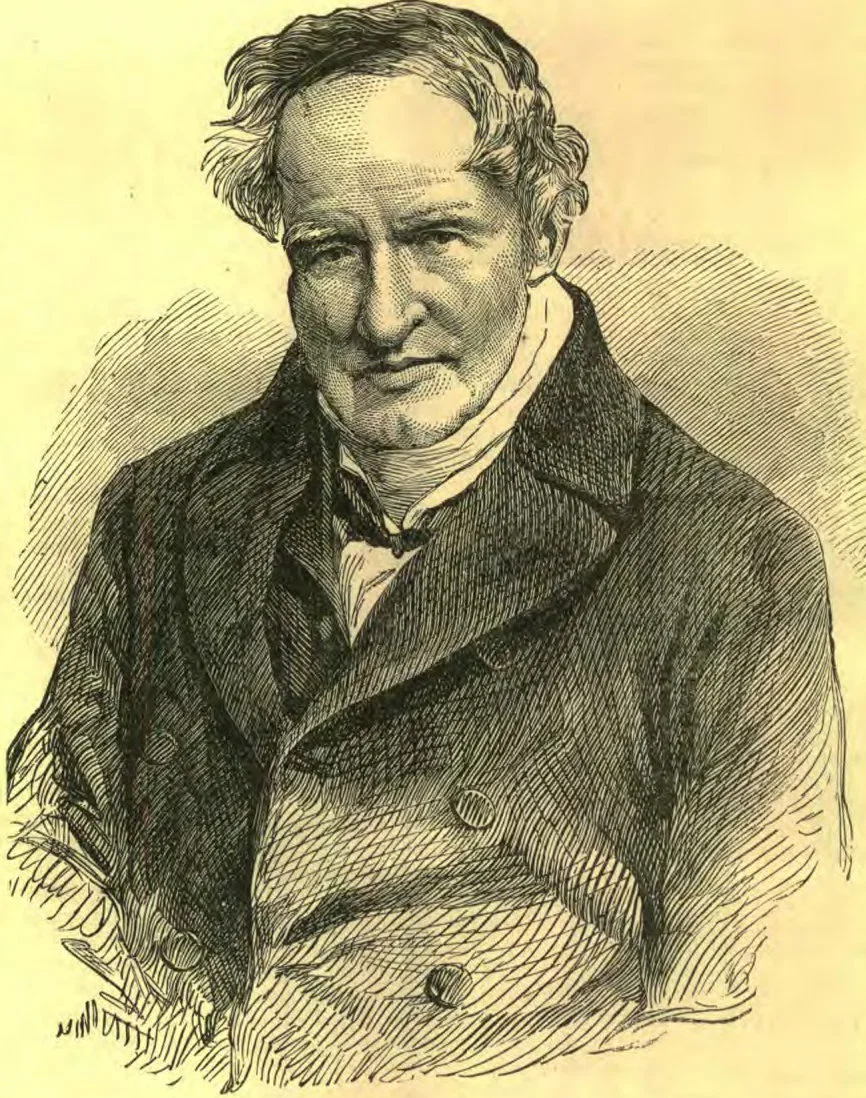
In all ages of the world there have lived men who have been inspired with such a love of nature that they have devoted their lives to the study and investigation of its beauties and wonders. And one of the greatest and noblest of these in modern times—one who has contributed more, perhaps, than any other naturalist to the progress of physical science, is the one whose picture appears on this page, and of whom we will here give a short sketch.
Alexander von Humboldt was born at Berlin, Germany, Sept. 14, 1769. His father, whom he lost when he was not quite ten years of age, was chamberlain to the king of Prussia. Being a studious boy, and having ample means to pursue the path of knowledge, he acquired a good education at the universities of Frankfort-on-the-Oder, Berlin, and Göttingen. His love of natural history was strongly manifested at an early age, and during his residence in Göttingen he made visits of scientific exploration. During one of these he explored the banks of the Rhine, the fruit of which is his first publication. In accordance with the wishes of his father, he followed business occupations for a number of years, filling at one time an office in the mining department, spending several years in this capacity. His researches here were published in a work of two volumes.
At the death of his mother he came into possession of a considerable fortune, which enabled him from that time on to devote himself to his most loved work of studying nature. He accordingly, at the age of twenty-seven, resigned his office in connection with the mining department, and entered upon a series of exploring tours. He spent three months at Jena, where he was the intimate associate of Goethe and Schiller. Circumstances now led him to Paris, where he became intimately acquainted with a distinguished young botanist, Aimé Bonpland, who afterwards was his companion in many and various scenes. Some time after, he succeeded in obtaining permission from the Spanish government to visit all the Spanish settlements in America and the Indian Ocean, with every additional favor which could promote his researches in the various departments of natural science. This tour was undertaken in company with his young botanist friend, and consumed five years, during which time he explored a vast extent of territory in Venezuela, Granada, Ecuador, Peru, Mexico, Havana, and North America. This course of travels is unparalleled for variety and importance of scientific results, not only in the different departments of natural history, but also in geography, statistics, and ethnography. It has been truthfully said that America was discovered anew by Alexander von Humboldt, as it was through his researches that the people of the Old World became acquainted with its plants, animals, natives, and many other natural resources.
Humboldt now took up his residence in Paris for a number of years, and occupied himself in arranging his collections of manuscripts and in experimenting on the chemical constitution of the atmosphere. In 1807-17, his great work, embodying the chief results of his travels, appeared in two forms, folio and quarto, in each consisting of 30 volumes, and containing 1425 illustrations.
In the year 1829 he again entered upon a tour of exploration, this time to the northern part of Asia, exploring principally the Ural and Altai mountains, the Chinese Dsongarei, and the Caspian Sea. The principal results of this expedition were the scientific examination of the beds which produce gold and platina, the discovery of diamonds in an extra-tropical region, the astronomical determination of positions, magnetic observations, and geological and botanical collections. The whole journey occupied nine months, and extended over 10,000 miles. This expedition has led to increased knowledge of the earth's magnetism and of meteorology; for it was through the earnest proposal of Humboldt that a net-work of magnetic and meteorological stations has been spread out over the whole world, by means of which the general condition of the earth in this respect is constantly ascertained.
It is impossible to estimate the amount of Humboldt's contributions to science. During his journey in Spanish America he determined astronomically more than 700 positions with regard to its geography. His barometrical observations were very numerous. To him we are indebted for the most important generalizations concerning magnetism and climate, some results of which are exhibited in the isothermal and other lines which have begun to be drawn in our maps. The botanical discoveries made by himself and Bonpland are given to the world in a number of valuable works. He is the founder of the new science called vegetable geography. He discovered not less than 3,600 new species of flowering plants. It is said that his knowledge was one of the most profound and covered the widest range of scientific investigations of all scientists that have lived on this earth. His works comprise the sciences of astronomy, zoology, botany, mineralogy, vegetable and animal geography.
Humboldt died in Berlin, May 6, 1859, after having spent all of his fortune in travels and scientific works.
Let us, like this great naturalist, endeavor more and more to become acquainted with the God of nature; let us think of his greatness, and admire his wisdom and power, which we behold in all the works of his hands. This employment will not only make us happy, but tend to make us good also; for a constant view of God through his wonderful works will surely inspire us with love and veneration for so glorious a Being. And let us prepare ourselves for a home in the new earth, where we shall have a mind and heart that can fully comprehend and appreciate the wonders of creation, not only on this earth, but throughout the immensity of the whole universe. A. SWEDBERG.

THE SWEETEST PERFUME.

“See, Amy, I have found a four-leaved clover,” shouted little Minnie, waving a clover stalk over her head. Amy sat reading by the open window, the sunshine falling on her pale, sweet face and golden hair.
At the sound, she closed her book, and looking up, smiled a welcome to the children as they came laughing up the lane, and into the room where she sat.
Minnie was first, eager and breathless. “Now you can have a real good wish,” said she, laying the clover on Amy’s book, “and it will be sure to come true.”
Ben, coming close up to Amy, whispered softly, “Wish that you may get well and strong again, sister, that’s the best wish.” But Amy replied: “I have a wish far better than that, Bennie. But don’t you want to know what my wish is?”
“If you tell, it won’t come true,” suggested Minnie.
“Tell us, any way,” said Ben, “if you think it is the best wish, I know it is.”
“It is that you may learn to know what is the sweetest perfume of this world.”
“What a strange wish, Amy!” exclaimed Ben in wonder; “why, I know already—it is the scent of the flowers: roses, pinks, woodbine, and sweet-brier.”
“Oh, yes,” said Lucy, “and heliotrope, and violets, and lilies of the valley, and mignonette.”
“These are all very sweet, but they are not the sweetest,” said Amy, “and not what I mean.”
Ben thought a moment, and then asked, “Do you mean that precious oil that is made from roses in the East? I think Cashmere is the place where the roses grow, and it is so costly that they sell it by the drop.”
“Yes,” said Lucy, “I remember Aunt Mary once showed me a little long vial, covered with gold flowers, and with a glass stopper and white kid over it; she said it had never been opened, but the smell of the rose was so strong through it, that I did not like it half as well as the roses under our porch. You don’t mean that, do you, sister?”
“No, my perfume is far, far more precious than the famous attar of roses,” was Amy’s answer.
“Do you mean any of the perfumes that ladies use?” asked Lucy, thinking this must be right, since it was not the flowers Amy meant.
“Oh, I know,” shouted Ben, in triumph: “it is musk. I learned about it in my lesson yesterday; it says a grain of musk will make a room sweet for twenty years, and not grow any smaller or lose any of its fragrance.”
“Wrong again, Ben,” said Amy, “the perfume I speak of will last forever, and always grow richer and sweeter.”
“Ah, now you are laughing at us, you do not mean it,” said he.
But Amy answered, “The perfume I mean comes from earth, but ascends to heaven. Our great poet, Longfellow, sings about a beautiful angel, who stands at the gate of the golden city, listening to the sounds that come up from earth:—
“He gathers the prayers as he stands, And they change into flowers in his hands, Into garlands of purple and red; Beneath the great arch of the portal— Through the streets of the city immortal Is wafted the fragrance they shed.”
“It is not a true story about the angel, only a beautiful fancy of the poet; but I love it, because it shows how sweet and precious our prayers become after they reach heaven. To-day I found that the thought of the poet is true, for it came from the Bible. I was reading, when you came home, about heaven, as John saw it in his wonderful dream. You know when ‘the disciple whom Jesus loved,’ had grown to be an old, white-haired man, and was a prisoner on a lonely island, God gave him a vision of heaven so glorious that none of us can rightly understand it. Our prayers are represented to him as the sweet perfume of heaven; the white-robed angels, before the throne of God, bear in their hands this precious fragrance treasured in golden vials, like the rare and costly Eastern essence, but whose priceless value no tongue can tell. Read for yourselves,” and Amy, opening the book, pointed to the words, “having harps in their hands, and golden vials full of odors, which are the prayers of the saints.”
“Who are the saints, sister?” asked Lucy.
“All those who love the gentle Jesus,” said Amy.
“This is my wish, the very best wish I could make. May you never forget that the most precious perfume of earth and heaven is prayer from those who love the meek and lowly Jesus; and may the sweet fragrance of your prayers go up to heaven every day of your earthly lives. One far more lovely than the poet’s angel, Christ the Son of God, shall bear these to the Father’s throne, and for his dear sake the answers will come quietly down in ‘showers of blessings.’”
The four-leaved clover has dried away to dust; sweet sister Amy faded like the flowers; but the odors of her constant prayers live in heaven, and her wish is granted, for the ones she loved are living lives of daily prayer.—Selected.

A BOY GROWN UP.

Young people rarely realize, when criticising their elders, that the traits or habits that seem to them obnoxious were formed in early life. If their manners are rude, if they lack tact, if they are not well informed, it is because they have not made use of their opportunities. Manners are the truest indications of character. A discourteous person is both careless and selfish, for the best manners are but the expression of the Golden Rule; they are the card of introduction to strangers. A friend can introduce you to good society, but he cannot keep you there; that depends on yourself.
A boy of kindly nature is rarely rude. A boy of selfish nature is polite only when his own desires are not interfered with.
Every man is the result of his own boyhood and youth. If he has read good books, kept himself informed of passing events, he becomes what the world terms a well-informed, intelligent man. If he has wasted his time in trifling conversation, read only sensational books and papers, neglected to develop the talent which he surely possesses, he becomes a superficial, a tiresome, if not a wicked, man.
If, as a boy he has not cultivated the graces and amenities of life, he cannot expect to become that most delightful of men, a polished gentleman. If, as a boy he has not studied to avoid collisions with those about him, has not recognized the rights of others, has not cultivated a desire to lead men to higher motives, to give to others the benefit of his own opportunities, he becomes that most unfortunate person, a tactless man; a nuisance wherever people are brought together. One of the lessons every boy can learn is to watch those men who arouse adverse criticisms, and carefully avoid their habits both of mind and body. Remember the old adage, “By others’ faults correct your own.”—Sel.

A CREAMERY.

I WONDER how many of my readers have seen a creamery, or can tell what it is. We have one in Otsego, just a few doors from my house. I have just been all through it, and will tell you about it. A creamery is really a great churn, where butter is made. I think I hear Johnny say, “Oh, I know all about churning butter, more than I wish I did. I have to help mother do that every week, and it nearly breaks my back.” Well, this is not that kind of a churn. This one I am telling you about cost five thousand dollars, and is as large as a small house. In fact, it is a house. It has four rooms. First, is the office, which is about as large as a good sized bed-room; and this is furnished with chairs, table, steam-heater, etc. Second, is the engine room, where there is a nice little steam engine; for the whole machinery is run by steam, instead of a boy’s arms. In the third room, which is the largest, the butter is made.
But we will go to the farm first, and see how they get the cream. Every farmer is provided with nice, large pails, of galvanized iron, holding about as much as an ordinary pail. Up in the center of the pail runs a tube. The milk is poured into this pail, and the pail set in cold water. The water comes up all around the pail and up in the tube, so that the milk is kept cool and sweet. There is a little glass gauge in one side of the pail, where you can look right through and see just how thick the cream is. Every day a man with a team comes around from the creamery and gathers this cream. About one inch thick of cream will make a pound of butter. This cream is taken off, leaving all the milk with the farmer. This is quite sweet and good, and is fed to the calves, or used in other ways. The cream is poured into large, galvanized iron cans, which will hold about a barrel. Nothing but the clear cream is taken into the creamery.
At the creamery it is emptied through a large strainer into a great vat, or trough. This will hold about two hundred gallons of cream, or about six barrels. Every morning the cream is strained again out of this vat into a large churn. So, you see, it is strained three times. It ought to be very clean by this time. The churn is simply a square box, like a large dry good’s box. It will hold about six barrels. It is filled two-thirds full of cream, and shut up perfectly tight; and then it is turned over rapidly, just as you would turn a grindstone, and the cream dashes against the sides. In a few minutes the butter comes, but it does not look as it does in ordinary churning. It comes out in little round globules, or lumps, about as large as buck-shot, or small currants. The buttermilk is drawn off, and the butter is left alone. Then clean salt water is poured on to this, and it is washed two or three times, till all the buttermilk is out of it. Now it is put into tubs about as large as a pail, and is weighed. The salt which is put into the butter is also weighed, so that an exact amount of salt is always put in, to just so much butter. This varies from one ounce to an ounce and a quarter, according to different markets.
Here stands a round table, perhaps five feet across. The outer edge is higher than the middle, and there is a hole in the center, towards which it all slopes like a tunnel. On this table are two rollers, larger than a stove-pipe, and they run by machinery. The butter is put on this table, which turns around, and the rollers run right over the butter and work out all the milk. A man stands by with a ladle and keeps it in shape, but the machine does the work. That, you see, is a good deal easier than it is for your mother to do it by hand with a ladle and a butter bowl, and the butter is worked much better. After it is worked over nicely, it is put into a tub again and set away in a cool room, till the next day. Now it is taken out and worked all over the second time. A very little coloring matter is worked in with the butter, to make it look yellow. The oil of cotton-seed and some other harmless things are used. The butter is then packed in large tubs, holding about sixty pounds, and it is now ready for market. Butter made in this way is much better than that made in the ordinary way. It is worked more thoroughly; it is kept cleaner, tastes much sweeter, and is always just the same. It does not vary in color, which is always a rich, fine yellow. Being worked just right, it does not become oily, or greasy, does not look white and flaky, and is not streaked. Hence, creamery butter sells much higher than other butter. Dairy butter, or ordinary butter, now brings from twelve to fifteen cents, while creamery butter brings from twenty to twenty-four cents. If you will look in any city paper, at the market reports of butter, you will find creamery butter marked a good deal higher than dairy butter.
With the big churn run by steam, one man can make six hundred pounds of butter in a day. That is pretty good work, isn’t it, at butter making? A cow that will make one pound of butter a day does pretty well,—better than most cows will do; hence you see this one man can do all the churning for six hundred cows every day. This is a great improvement on old-fashioned churns. Away back in Bible times, they used to put the milk in a sheep-skin sewed up tight, hang it on a pole, and churn it that way. I do not think I would like that butter. Then they invented our common wooden churn, which was worked with a dasher, up and down, as you children all know. That was hard work. A great many churns have been invented to make churning easy. Probably you have seen some of them. Sometimes they are fixed so that a dog can do the churning. Sometimes they are run by horses, but I think that our modern creamery churn beats them all; and if I were to use any butter, I think I would like the creamery butter the best. D. M. CANRIGHT.

Wherever You Go: God's Question, What Doest Thou Here?

(2) WHEREVER you go, never go where you fear, God's question being asked you, “What doest thou here?” Whatever the pastime in which you engage For the cheering of youth or the solace of age, Turn away from each pleasure you'd shrink from pursuing Were God to look down and say, “What are you doing?”

MENDING A PEN.

WHEN our grandfathers and grandmothers were young, they wrote with pens made of goose-quills, and these pens after a little while became worn, and needed mending. Then the schoolmaster used to take a pen, and press his thumb nail up against the point until the pen split down the back. Afterward he whittled it down to a proper point, and made a very good pen of it. Nowadays quill pens are mostly out of use; and boys and girls use pens made of gold, steel, rubber, and other material.
The trouble with many of these pens is that they have bad points. They do not write easily, but scratch the paper instead of running smoothly over it. Such pens need mending, and they are very easily mended by a careful hand. The trouble is with the point, which is roughly cut, and not properly finished and polished.
Would you like to know how I mend my pens? When I buy a new gold pen, I try it; and if it does not glide smoothly over the paper, and make a good mark, I take a fine oil-stone, or whetstone, and rub it gently over that, holding the pen much as if I were writing with it, turning it over and over, and pushing it backward and forward until it will pass over the oil-stone in any direction smoothly, and without catching or scratching. Then I thrust the point of the pen into a raw potato, and pull it out, and no matter how greasy it has been, the ink at once flows readily.
Steel pens may be treated in the same way, and may be made to glide over the paper as smoothly as costly gold ones, simply by polishing off the points, which have been left rough in the haste of machine manufacture. Many pens that have been thrown aside as useless, because they scratch, may thus, by having their points polished, be made almost as good as new; only care must be taken not to polish them too much, as there is some danger of grinding off the point of a pen, especially of a gold pen, the point of which is made of iridium, a very hard metal, which is soldered into the pen, and if it is loosened from its place, the pen is spoiled, and must be re-pointed. But with patience and care it is quite easy for people to mend their pens, so that writing with them will become a pleasure.
When your pen is mended, be careful what you do with it. If you are insulted, outraged, and wronged, and wish to give a man a piece of your mind, you can write it all down, and see how it looks. Put it into the drawer and let it lie there awhile, and then take it out and examine it carefully, to see what you think of it. You may conclude to burn it up.
The pen is mightier than the sword, but it is an instrument that cuts both ways. Many politicians have written letters which have ruined them politically; and many a man by writing his name on the back of another man's note, “just to accommodate,” has been stripped of everything he possessed in this world. Many a man by writing another man's name on a piece of paper has got himself into trouble, and been confined within prison walls for long and tedious years. Learn how to mend pens, and then take great care how you use them.—The Little Christian.

ONE SIN.

If one note in the organ be out of key, or harsh of tone, it mars the whole tune. All the other reeds may be in harmony; but the one defective reed destroys the sweetness of all the rest. In every tune it makes discord somewhere. Its noise jars out into every other note. And so one sin destroys the harmony of the whole life. A boy or girl may be obedient, filial, industrious, and honest; but ill-temper is a jarring reed that touches every grace with chill and discord. Let every affection be right; then there is music in the life.—Selected.

Primitive Time-Pieces.

The following interesting paragraphs on primitive time-pieces we quote from an article on “Primitive Clocks” by Frederic G. Mather, in Popular Science Monthly:—
“The story is that King Alfred had no better way to tell the time than by burning twelve candles, each of which lasted two hours; and, when all the twelve were gone, another day had passed. Long before the time of Alfred, and long before the time of Christ, the shadow of the sun told the hour of the day, by means of a sun-dial. The old Chaldeans so placed a hollow hemisphere, with a bead in the center, that the shadow of the bead on the inner surface told the hour of the day. Other kinds of dials were afterward made with a tablet of wood or straight piece of metal. On the tablets were marked the different hours. When the shadow came to the mark IX., it was nine o’clock in the morning. The dial was sometimes placed near the ground, or in towers or buildings.”
“But the dial could be used only in the daytime; and even then, it was worthless when the sun was covered with clouds. In order to measure the hours of the night as well as the hours of the day, the Greeks and Romans used the clepsydra, which means, ‘The water steals away.’ A large jar was filled with water, and a hole was made in the bottom through which the water could run. The glass, in those days, was not transparent. No one could see from the outside how much water had escaped. So there were made, on the inside, certain marks that told the hours as the water ran out; or else a stick with notches in the edge was dipped into the water, and the depth of what was left showed the hour. Sometimes the water dropped into another jar in which a block of wood was floating, the block rising as the hours went on. Once in awhile, some very rich man had a clepsydra that sounded a musical note at every hour.”
“Another way of measuring time among the ancients was by the sand, or hour-glass. This was made of pear-shaped bits of hollow glass with a very small opening between them. It held just sand enough to run from the upper into the lower pear in the space of one hour. The glass was then turned the other side up and the sand ran back, also taking an hour. You have seen glasses of this kind where the sand runs out in three minutes. They are used for boiling eggs. King Charlemagne, a thousand years ago, had a glass of this kind that ran for twelve hours without turning. It was marked on the outside with red lines to show the escape of the sand. Hour-glasses were so common after this that they were carried in the pocket like watches. Every minister had one to mark the length of his sermon, which was a very serious matter in England during the protectorate of Cromwell, very few sermons being as short as one hour. It is said of one minister that when the sand ran out of his glass, he turned it over, saying, ‘I know that you are all good fellows, so let’s have another glass.’ Once, when the preacher had turned his glass a second time, showing that he had already preached two hours, the sexton asked him to lock the door and put the key on the nail when he was through, because the few people that were left wanted to go home to dinner. We also read that, in the early history of New York, the soldiers who defended the city used hour-glasses to tell when they should go on guard.”

IMPORTANT BIBLE SUBJECTS.

LESSON 14.—THE LAW THAT WAS ABOLISHED, AND THE LAW OF GOD.

1. What has Christ abolished in his flesh? Eph. 2:15.
2. What is love? 1 John 5:3.
3. Can the same thing be both love and enmity?
4. In another place what testimony did Paul give concerning the law of God? Rom. 7:12.
5. How did he feel towards it? Rom. 7:22.
6. Then can it be the law of God, or ten commandments, that is spoken of as “the enmity” in Eph. 2:15?
7. What did God speak to the people from Sinai? Deut. 4:12, 13.
8. Did he speak any other words in the hearing of the people, besides the ten commandments? Deut. 5:22.
9. When the Lord had finished speaking the ten commandments, what did the people say? Ex. 20:19.
10. What did Moses and the people then do? Ex. 20:21.
11. How did the Lord, after he had given the ten commandments, give other instruction to the people? Neh. 9:14, last part.
12. Where do we find some of the things which the Lord gave through Moses? Exodus, chapters 25-30.
13. Is there any part of the instruction that has reference to flesh? Lev. 4; 6:25-30; 10:16-18.
14. Did these offerings really take away sin? Heb. 10:4.
15. Who only can really take away sin? John 1:29; Heb. 9:26.
16. How did Christ bear our sins? 1 Peter 2:24.
17. Of what must we be partakers in order to have eternal life? John 6:53, 54.
18. Were the sacrifices to be continued after Christ suffered? Heb. 10:4, 5.
19. Then how are they done away?—Christ abolished them “in his flesh;” that is, they found their fulfillment in the body of Christ.
20. Were these ordinances a cause of enmity between the Jews and the Gentiles? Acts 11:2, 3.
21. After Christ, did this cause of enmity exist? Gal. 6:15.
22. Through Christ what union was effected? Eph. 2:16-18.
23. Are those thus brought together planted on a new foundation? Eph. 2:19, 20.
24. After circumcision and the ceremonies connected with it had passed away, what still remained in full force? 1 Cor. 7:19.

A SERIOUS QUESTION.

We want to ask a serious question. How do our teachers deal with the children, or the fellow-teachers, who fall into sin? Our question applies chiefly, of course, to our young men and young women. We all know how again and again our hearts are wrung by the failure of those who were the subjects of high hope. But how do we act toward them? Do we at once give them up? Do we push them further on in their evil way by our neglect? Do we suspect all signs of penitence as fatal? Do we settle it in our own minds that one slip is a fall, and one stumble a ruin? Or do we pursue them into their evil ways? and solemnly vow before God that we will not rest until we have won them back? Do we watch for them? Do we fan the slightest spark of returning life? Do they feel that they cannot get away from us? And are they encouraged to try again for the pure and right, because they know that we shall stand beside them to help them? Fellow-teachers, make the downward road nearly impossible for your scholars, because your love cannot wear out, but spends itself in watchings, and persuasions, and helpings. After Christ, and for him, let us “seek and save the lost.”
—Sunday-School Chronicle.

THE TEACHER’S AUTHORITY.

To many little children, the teacher’s word is final authority. The primary teacher can hardly realize how completely she is enthroned in the confidence of the child. One teacher of our acquaintance one day taught her class that Jesus was born in the City of David, omitting to mention that it was Bethlehem of Judea. After Freddie came home, his father asked him what the lesson was about.
“About Jesus and where he was born,” said Freddie. His father read to him about the birth of Jesus.
“One thing, papa,” said Freddie, “you said wrong. Jesus wasn’t born in Bethlehem.”
“Why, yes, Freddie, here it is, right here in the Bible.”
“I don’t care,” said Freddie, “my teacher said he was born in the City of David; and I guess she knows.”
Next Sabbath, the teacher reviewed the last lesson, and said, in passing: “Jesus was born in Bethlehem of Judea, sometimes called the City of David.” Just here, Freddie broke out: “Then the Bible was right, after all.”

The Cup and the Burden of the Cross

If your cup seems too bitter, if your burden seems too heavy, be sure that it is the wounded hand that is holding the cup, and that it is He who carries the cross that is carrying the burden.

MAN’S PLEA.

MAN’S plea to man is, that he never more Will beg, and that he never begged before; Man’s plea to God is, that he did obtain A former suit, and therefore sues again; How good a God we serve, that, when we sue, Makes his old gifts the examples of his new. —Quarles.

THOSE CLEVER GREEKS.

Perhaps our readers do not know what care has to be exercised in the construction of a column or building to give it the right appearance to the human eye. By giving attention to what Arlo Bates says, in the October St. Nicholas, as printed below, you will become satisfied that the architect has to calculate with great nicety to give beauty and perfectness to his workmanship; and in examining the letter s, as he directs, you will see what a great difference in appearance a slight change makes. The following quotation will afford entertainment and instruction to the reader:—
“If you turn a book upside down and look at the letters, every s will seem much smaller at the bottom than at the top, although, when the book is properly held, both halves appear the same size to the eye.
“The upper part of the type that prints the letter s is made smaller than the lower half to correct the fault of the eye, which always slightly exaggerates the former. When the letter is turned over, this same trick of the sight makes the difference seem greater than it really is; and, of course, were it of the same width all the way, it would still look uneven.
“In greater matters, the false report of the eye is greater. If a tapering monument, like that on Bunker Hill or like the obelisk in Central Park, were made with perfectly straight sides, it would look to us—for, you see, we really cannot trust our own eyes—as if it were hollowed in a little; or, as we should say in more scientific language, its sides would appear concave.
“Those clever Greeks, who did so many marvelous things in art, thought all this out, and made their architecture upon principles so subtle and so comprehensive that we have never been able to improve on them since. They found that their beautiful Doric columns, if made with straight sides, had the concave effect of which I have spoken; and so, with the most delicate art in the world, they made the pillar swell a little at the middle, and then it appeared exactly right.
“This swelling of the column at its middle was called entasis. Of course it had to be calculated with the greatest nicety, and was actually so very slight that it can only be detected by delicate measurements; but it added greatly to the beauty of the columns and to their effectiveness.
“Then the lines which were to look horizontal had to receive attention. If you look at a long, perfectly level line, as the edge of a roof for instance, it has the appearance of sagging toward the middle. The Greek architect corrected this fault by making his lines rise a little. The front of the Parthenon, at Athens, is one hundred and one feet three and a half inches long, and, in this, the rise from the horizontal is about two and one-eighth inches. In other words, there is a curvature upward that makes it a little more than two inches higher in the center than at the ends, and the effect of this swelling upward is to make the lines appear level. Indeed, this same Parthenon—the most beautiful building in the world—when delicately and carefully measured, was found to be everywhere made a little incorrect, so that it may appear right, which is certainly what may be called an architectural paradox. The graceful columns, which seem to stand so straight, are made to lean inward a little, since, if they were perfectly true and plumb, they would have the effect of leaning outward. The pillars at the corners slant inward more than the others, and everywhere the corners are made to look square by being in truth a little broader angled, and lines are curved in order that they shall appear straight to the eye.”

GREAT COST OF THE FIRST PENS.

It is only a few years since Bulwer gave expression to the thought that “the pen is mightier than the sword;” yet in the short time which has since elapsed, these words have acquired a new truth and a new application; the pen has conquered the sword in the field of commerce, as completely as it had formerly triumphed in the fields of high policy and world government. The little civilizer (as it may well be called) is now in every hand; but within the memory of many men still living the steel pen was simply a curious and costly toy, noticeable as an ingenious mechanical fad, but not at all as an invention likely to come into practical use. The earliest form of this article was certainly not promising. A piece of sheet steel was bent into a tubular form, and cut or filed away to imitate the shape of a quill pen, the junction of the two edges forming the nib, which, of course, extended all up the back of the pen. These were known as early as 1810, but were regarded as articles de luxe to be given away as presents, and not for use. They were highly polished, perhaps gilt or silvered, and sold for as much as five shillings each. In 1824 Mr. James Perry, the founder of a system of education once famous as the “Perrian” system, took up the steel pen as a practical invention, and by indomitable energy overcame the difficulties in its construction and the objections to its use. He patented several varieties, and spared no expense to attain perfection. His brother informed Mr. Samuel Timmins, of Birmingham, that he paid seven shillings per pound for his steel, and five shillings per pen to the first workmen he employed, and that for years afterward the price given to his workmen was thirty-six shillings per gross.—Exchange.
Continue reading: DO DOGS COUNT?