The Youth’s Instructor, Vol. 27, No. 32.

JOSEPH’S DREAMS

The Youth’s Instructor

Aug 13, 1879

S. D. A. Publishing Association · Battle Creek, Mich. · Aug 13, 1879

JOSEPH’S DREAMS.

In the thirty-seventh chapter of Genesis there is an account of two remarkable dreams which Joseph had while he still lived with his father in the land of Canaan. Joseph was then seventeen years of age, an upright young man, and especially beloved of his father.
Joseph was one of a family of thirteen children, twelve sons and one daughter. The sons of Jacob at that time were not all righteous young men. They were, to a certain extent, idolaters, and possessed of a cruel and revengeful spirit. Joseph listened to the teachings of his father Jacob, and feared the Lord. He was more obedient to his father’s instructions than any of his ten older brothers.
He was especially grieved at their wicked conduct, and sought to induce them to pursue a righteous course. This only imbittered them against him. He then went and laid the matter before his father, not as a mischief-making talebearer, but as a faithful brother. This exposure of their wrongs enraged his brethren against him. Jacob’s love for Joseph made his brethren envious, and now that envy turns to malice, and finally to murder.
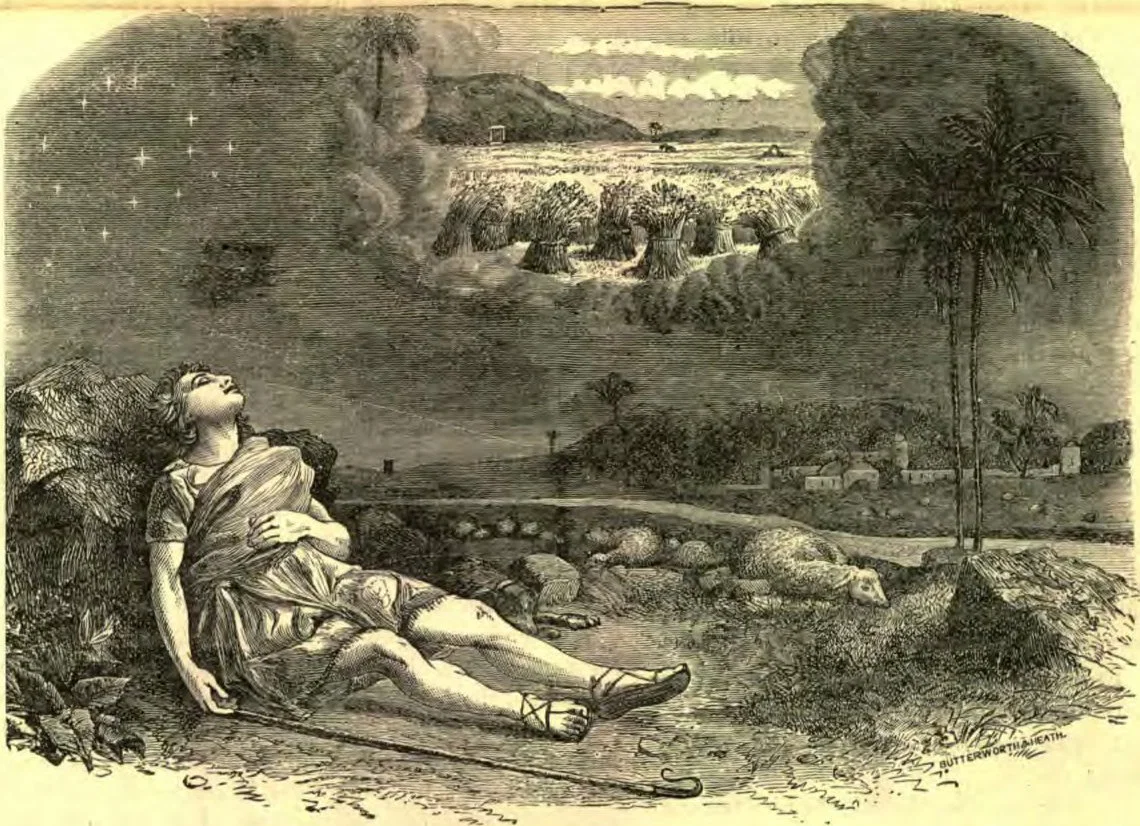
Joseph, as well as his brethren, was a shepherd. But the angel of the Lord taught Joseph in dreams. These he innocently related to his brethren:— “For, behold, we were binding sheaves in the field, and lo, my sheaf arose, and also stood upright; and, behold, your sheaves stood round about and made obeisance to my sheaf. And his brethren said to him, Shalt thou indeed reign over us? or shalt thou indeed have dominion over us? And they hated him yet the more for his dreams, and for his words. “And he dreamed yet another dream, and told it to his brethren, and said, Behold, I have dreamed a dream more; and, behold, the sun and the moon and the eleven stars made obeisance to me. And he told it to his father and to his brethren; and his father rebuked him, and said unto him, What is this dream that thou hast dreamed? Shall I and thy mother and thy brethren indeed come to bow down ourselves to thee to the earth? And his brethren envied him, but his father observed the saying.” Gen. 37 : 7–11.
In the engraving the artist has given a beautiful illustration of Joseph’s dreams.
The overruling providence of God now permits circumstances to transpire so that Joseph’s dreams in regard to his brothers are most remarkably and literally fulfilled.
While pursuing their vocation as shepherds, his brethren sometimes wandered quite a distance from the paternal home. Jacob, with the solicitude of a true father, sends Joseph to see if they are all well. Joseph dutifully performs quite a journey to find his brethren, but how wickedly is he requited for his faithfulness and love!
When they behold him, even afar off, they conspire against him to slay him. But Reuben proposes to cast him into a pit, hoping that he may be able to deliver him to his father. While Reuben is absent, however, his brethren, having relented at the thought of letting Joseph perish by starvation, lift him out of the pit, and sell him to a band of Ishmaelite merchants.
Joseph is now carried down to Egypt, and sold as a slave to Potiphar, a chief officer of the king. But God was with him, and he grew in such favor with his master that he intrusted all that he possessed to Joseph’s care.
Soon, because of his integrity to the law of God, Joseph is unjustly thrust into prison. But even there the Lord was with him, and Joseph was given a position of some importance. After a time the Lord used him to interpret the two dreams of the chief butler and the chief baker; and eventually he is brought in before Pharaoh to interpret two singular dreams that disturbed him. Joseph explains to Pharaoh that there will be seven years of remarkable plenty, followed by seven years of severe famine. Pharaoh now gladly takes Joseph from prison and makes him grand vizier of all Egypt. During the seven years of plenty, Joseph lays up vast stores of food throughout Egypt, for the coming famine.
In the years of famine the surrounding nations came to Egypt to purchase food. They had doubtless heard how the king of Egypt had been providentially directed in a dream to make preparation for the famine. As the dreadful scarcity reached into Canaan, even the patriarch Jacob and his sons are in danger of starvation, so the ten sons of Jacob also go down to Egypt to buy food. “And Joseph was the governor over the land, and he it was that sold to all the people of the land. And Joseph’s brethren came AND BOWED DOWN THEMSELVES BEFORE HIM WITH THEIR FACES TO THE EARTH.” Gen. 42 : 6.
Joseph knew his brethren, and remembered the dreams he had dreamed about them. He then tested them by a variety of proofs to see if they were as wicked as when they sold him into Egypt. Again the narrative says: “And Judah and his brethren came to Joseph’s house (for he was yet there), AND THEY FELL BEFORE HIM ON THE GROUND.” Gen. 44 : 14.
After making himself known to his brethren, Joseph sends to Canaan for his father and the whole household. For, said he, “God sent me before you, to preserve you a posterity in the earth, and to save your lives by a great deliverance.” Gen. 45 : 7.
After Jacob and his sons came to Egypt, “Joseph placed his father and his brethren, and gave them a possession in the land of Egypt, in the best of the land, in the land of Rameses, as Pharaoh had commanded. AND JOSEPH NOURISHED HIS FATHER AND HIS BRETHREN, AND ALL HIS FATHER’S HOUSEHOLD, WITH BREAD ACCORDING TO THEIR FAMILIES.” Gen. 47 : 11, 12.
We now see a most literal fulfillment of Joseph’s two remarkable dreams. Those who desire to learn all the interesting incidents of this wonderful story, should carefully read Genesis, chapters thirty-nine to forty-seven inclusive.
From this part of Joseph’s history we may observe the following things:—
  1. The purposes of God will be fulfilled.
  2. It will be well with the righteous.
  3. Though Joseph did not at first have any of his relatives in Egypt, yet the Lord was with him.
  4. The diligent man shall stand in the presence of kings; he shall not stand before mean men.
G. W. A.

From Sea to Sea: Railroad Journey Through Colorado and Nebraska

FROM SEA TO SEA.—NO. 12.

From Cheyenne a railroad runs south to Denver, Colorado. This city is only a few miles distant from the Snowy Range of the Rocky Mountains, of which we had a glimpse at Sherman station. The scenery among these mountains is magnificent; and because of its great beauty, Colorado has been justly denominated the Switzerland of America.
Passing out of Wyoming Territory, we enter the State of Nebraska, where are found vast and extensive prairies covered with grass of living green. In contrast with the barren rocks and desert wastes previously witnessed, these plains presented a welcome relief to weary eyes. Large herds of cattle, sheep, and horses were feeding on the rich growth of grass; in some instances there were more than a thousand cattle in a single drove. They are here fattened for the large Eastern markets. From the prairies they are transported in the cars to the cities of Chicago, Boston, New York, etc. At Julesburg we waited for eight long trains of cars to pass, filled with hundreds of these creatures, on their way to the Eastern slaughter-houses.
On the prairies the Indians used to chase the wild deer, the elk, and the buffalo. We looked out eagerly for awhile, hoping to be favored with the sight of at least one buffalo, but were told that these, like the poor Indian, had left the line of the railroad, and receded from civilization.
As the darkness of night again creeps upon us, we behold one of the most awful yet grandest scenes of frontier life,—a prairie on fire. Full in the distance is seen the long line of bright flame, with its broad band of dark smoke-clouds above. The fire jumps with the wind, and the flames leap twenty to thirty or more feet into the air, and for miles brighten the prairie with their terrible glare. We have no fears for our own safety, as the wind is blowing from us toward the fire; but no words can describe the feeling of terror with which the settler beholds advancing toward him the fire-fiend for which he is unprepared and unprotected.
In the fall of the year these fires are most frequent; and, creating a strong current or breeze by their own heat, they often advance with the rapidity of a locomotive, twenty or more miles an hour, and their terrible lurid light by night, and the blackened path left behind, as seen next day by the traveler, are sights never to be forgotten. Nearly every night in autumn the prairies of the boundless West show either the near or distant glow of a fire which in extent has the appearance of another burning Chicago.
But on we speed, passing thrifty villages, cultivated farms, and the beautiful Platte River. At midnight on the eighth day after leaving California, we reach Omaha, a city on the west bank of the grand old Missouri River, about nineteen hundred miles from San Francisco. Here we learn that we are to stop for a few hours at a good hotel in Council Bluffs, a city on the east side of the river. Our ponderous train moves slowly over the great iron bridge, which crosses the river from bluff to bluff. This bridge is a great work of art; it is about a mile in length, but is so strongly constructed that passengers go over it with little fear of harm.
We now find ourselves in the large and fertile State of Iowa. Our train stops directly in front of the hotel, and without delay we secure a room and make ourselves comfortable for the remaining hours of the night. How refreshing the change after riding so many days in the dust and smoke, and what a luxury a real bed is, even for a few hours. The rest we obtained here enabled us to perform the remainder of our journey without becoming over-fatigued.
J. N. L.

“I’D GO WITHOUT PUSHING.”

MOTHER was once showing her little daughter an engraving representing mothers pushing their children to Jesus when he held one of their number in his arms, whereupon the little girl said, “Mamma, I would not want to be pushed to Jesus; I’d go without pushing.”
It is not so strange that very small children, in their retiring modesty, should need urging to the arms of even the lovely Saviour; but it is a mystery, not easily solved, that Christ’s urgent invitations to accept of eternal life at his hands are scorned by so many, and that any who have once appreciated his loving-kindness should go back to the world.
It seems an easy matter to interest individuals in worldly affairs; and if their attention is directed to opportunities for speculation, frequently, without urging, they will venture everything, at all hazards, to obtain earthly riches. It is a fact, too, that none need pushing to their best earthly friends; on the contrary, it is their greatest delight to urge their own way into the presence of those they love. But when the subject of greatest moment is introduced, which involves their eternal destiny, there is a hanging back, as if afraid to venture.
My dear young friends, Satan is exerting his great power to stupefy you, that you may not sense your situation until too late to recover yourselves from his snare. You might better, by far, be deprived of all earthly comfort than remain one day outside the fold of Christ. The Saviour offers you life, eternal life. For your own soul’s sake, “go to him without pushing,” and cling to him with your might, that he may carry you safely over life’s tempestuous sea, into the haven of eternal rest.
“I would not be urged to the arms of His love, Who comes with rich gifts from the Father above; But flee to him ever from danger and fear, Whose voice is most sweetly inviting me near.”
M. J. C.

To God Be All Glory Forever

To God be all glory forever!—we bear To the Lord of the harvest the wheat with the tare; What we lack in our work may he find in our will, And winnow in mercy our good from the ill! —Whittier.

BIBLE LESSONS FOR YOUTH.

LESSON LVIII.—REVIEW ON LESSONS LV–LVII.

1. How many men of war were there when the people were numbered the first time?
2. How many when they were numbered the second time?
3. What had the Lord said should be the fate of all who were above twenty years old at the time of the murmuring at Kadesh-barnea?
4. How had this prediction been fulfilled?
5. Who alone remained of all that vast number, when the second numbering took place?
6. Why were they spared?
7. Why were not the Levites numbered with the other tribes?
8. Who had promised to be the portion of the priests?
9. How did he sustain them?
10. How were the Levites furnished with a livelihood? Num. 18:21.
11. How were their families, as well as those of the priests, furnished with homes? Num. 35:1–12.
12. How many cities were given to the priests and Levites?
13. How many to the priests alone?
14. What provision was made for their cattle?
15. After the numbering of the people was completed, what did the Lord tell Moses about going into the land of Canaan?
16. What did Moses ask the Lord to do, in order that the people might not be left like sheep without a shepherd?
17. How was his request granted?
18. What did Moses do to secure the happiness and welfare of the people?
19. After he had called attention to some of the great things which the Lord had done for them, and had repeated many of the laws which had been given them, what did he call upon the people to do?
20. How were these laws preserved?
21. How often were they to be read to the people?
22. When the time drew near for Moses to go up into the mountain, what urgent request did he make?
23. Why could not God grant this request?
24. Describe the death and burial of Moses.
25. What words of encouragement did the Lord give Joshua?
26. Describe the crossing of the Jordan.
27. Tell how Jericho was taken.
28. Why could not Ai be taken at the first attack?
29. How was Achan punished?
30. Who planned the attack by which Ai was taken?
31. Describe the ceremonies at mounts Ebal and Gerizim.
32. Tell how Joshua and the elders of Israel were deceived by the Gibeonites.
33. How were the Gibeonites punished?
G. H. BELL.

SABBATH-SCHOOL MEETING AT POTTERVILLE, MICH.

This meeting was held Sabbath and Sunday, July 26, 27, and although in such a hurrying season of the year, it was quite fully attended. Many of the people came from five to fourteen miles, and showed their interest by staying through a two days’ meeting.
Sabbath morning at ten o’clock the Sabbath-school was held. The members of the Potterville and Dimondale schools were nearly all present, and there were representatives from several other schools. Arrangements had been previously made, so that each school took seats as quietly as if only one school had been present. After prayer by Eld. Jones, and singing, a secretary’s report for each school was read. Then followed the class recitations, in which both schools joined. All others present were invited to take part in the exercises, and classes were formed for them; so there were few, if any, spectators. There seemed to be a very good interest in most of the classes, though some were gazing absently about while the teachers were talking. This might have been partly remedied, if the students had been asked to stand while reciting. The little ones appeared to have their lessons well, and seemed anxious to tell them to their teachers. Their animated faces presented a pleasant picture. Then followed the general exercises, Eld. Jones questioning the Bible-class division, and Bro. Bell the children.
After a short intermission, Eld. Jones gave a discourse upon the importance of the study of God’s word.
In the afternoon Bro. Bell talked upon the object and aims of the Sabbath-school, showing that the legitimate work of the Sabbath-school is to promote the study of the Bible. The study of the Bible has many advantages,—it not only makes us acquainted with the true God, his requirements, and his dealings with men, but it also disciplines the mind, diverts it from vain things, leads it to think upon God and his works, and thus prepares us to escape the temptations and deceptions of the last days. In short, it enables us to make the most of this life, and to gain the life to come.
W. C. White then talked on, “How to Get the Lesson Learned.” First, provide good lessons, and classify according to age and ability. Parents as well as teachers have a part to act in this work. Parents can do much to aid the teacher by their influence at home. They should furnish favorable opportunities for study, and see that the children improve them. Study with the children; let them see that you regard the study of the Bible as an important work. At family worship read such chapters as have a bearing upon the lesson, and question the children upon them. The teacher should gain the confidence of the pupil; visit him, study with him; make him ambitious of being a worker rather than a drone in the Sabbath-school. Talk courage and life to the pupil, and try to work with the same earnestness and energy yourself.
Then followed a few remarks by Eld. Jones on the influence of example upon children. Parents should be careful to observe a frame of devotion in all parts of the worship of God; otherwise the children cannot be expected to have reverence for it.
Bro. Bell then spoke of “How to Learn the Lesson.” Begin early in the week; do not hurry; be calm, deliberate, and meditative, in study; try to see the purpose of the lesson, and where in the chain this link belongs. Seek to understand and appreciate the lesson. Do not try to learn it; but keep reading it, and thinking about it, till you can easily tell it to yourself, or ask and answer questions on it. He then took a class of little ones, and taught them a lesson which they had never studied before. The children became quite animated, and all present seemed very much interested in hearing the children learn their lesson.
The exercises of the afternoon were interspersed with singing and two intermissions. The general meeting closed at five o’clock, but after this a teachers’ and officers’ council was held, at which questions relative to the work were freely asked by those interested. Many of the questions were to the point, and seemed to get at the heart of things.
Sunday morning another meeting of the same nature was held, at which questions were asked and answered, as before. This was followed by remarks upon the duties of the teacher by Bro. White. The teacher should have a preparation of the heart as well as of the lesson; he should not lecture his class upon religion, but should have such an earnestness and anxiety that the love of the truth which he teaches, will shine out through all his work. Thus, unconsciously, an impression will be made upon the pupil.
He also spoke of the importance of a regularly-appointed teachers’ meeting, that opportunity may be afforded to discuss new plans, ways of increasing the usefulness of the school, etc. After these remarks, he organized and conducted such a meeting. It was then voted that the two schools present should each have a teachers’ meeting on the fourth Sabbath in every month.
After an intermission of ten minutes, the subject of, “How to Teach Infant Classes” was taken up. Attention was called to the importance of studying the nature and wants of children, that we may better understand how to teach them. Some suggestions were then made in regard to special management of children in recitation, when the class that had been called forward the day before, to study the lesson, were brought forward to recite it. It was quite evident that both the teacher and the class forgot that there was an audience present.
In the afternoon the children had some special exercises which they had previously prepared. These exercises consisted principally of recitations of different portions of Bible history. The children did well, and certainly no one throughout the meeting had a more interested audience.
W. C. White improved the next hour by giving an interesting lecture on “General Exercises, and the Best Way of Conducting Them.” The attention given showed a deep interest in the subject, and an earnest desire to profit by what was said.
The last hour of the afternoon was given to remarks on “Class Exercises, and the Best Methods of Conducting Recitations.”
In the evening Eld. Jones spoke to an attentive audience, quite a large number of whom were people not of our faith.
Throughout the two days, no one lecture or exercise was allowed to occupy more than forty-five minutes, the remaining fifteen minutes of each hour being occupied by opening exercises and singing, or by an intermission to allow the children opportunity for fresh air and out-door exercise. In this way weariness was prevented, and the meeting grew in interest as it progressed. Many seemed anxious to learn as much as possible in regard to the Sabbath-school work.
E. E.

LESSONS FOR CHILDREN.

LESSON XXXII.—REVIEW ON LESSONS XXIX-XXXI.

1. Who was the last of the judges among the children of Israel?
2. Who was the first king?
3. What led the people to desire a king?
4. How was Samuel reconciled to having a king appointed over Israel?
5. Tell how Saul was anointed.
6. Tell how he was chosen at Mizpeh.
7. Tell how he delivered the people of Jabesh Gilead from the Ammonites.
8. Tell how he was proclaimed king at Gilgal.
9. What did Samuel call upon the people to witness?
10. How did he convince the people that it was sinful for them to desire a king?
11. What did they ask Samuel to do?
12. On what condition did he say that they and their king might follow the Lord, and have this blessing? 1 Sam. 12:14.
13. By what miracle did he cause the people to fear the Lord and acknowledge their sin? 1 Sam. 12:17, 18.
14. What brought on a war with the Philistines, after Saul had reigned about two years?
15. Describe the army that the Philistines gathered. 1 Sam. 13:5.
16. What did the men of Israel do when they heard that the Philistines had gathered such an army?
17. Where was Saul at this time?
18. What did Saul do, after waiting seven days for Samuel to come and make an offering?
19. Why did he do this? Verses 8, 11, 12.
20. What did Samuel say about this when he came?
21. If Saul had been obedient, what would the Lord have done for him?
22. What was to be the consequence of his disobedience?
23. Describe the attack of Jonathan and his armor-bearer upon the Philistines at Michmash.
24. Describe the trembling and terror that prevailed in the camp of the Philistines. 1 Sam. 14:15.
25. When the tumult was heard, who joined in the battle?
26. Who joined in the pursuit?

MISS VANITY.

MISS VANITY is very prettily arrayed in her white dress, gaiter-boots, and jockey hat, with its graceful feather, beneath which flows her wealth of curls. And there she stands upon a chair, before the large mirror on the marble slab over the fireplace, with a tall vase on either side of her, while she daintily holds out her dress. Yes, there she stands admiring herself. She seems to be saying,
“Well, I am pretty. My cheeks are round and plump; my mouth is real handsome; and my eyes are black as huckleberries, and bright as diamonds; and my hat is just splendid. I don’t wonder Mrs. Loveland, when she called this afternoon, told Aunt Susan that I was a sweet child.”
Yes, yes, you are pretty; but, oh! you are also vain; and, if you are not careful, your vanity will spoil all your beauty.
Remember, the time will come when
“The blush will fade, The light grow dim which the blue eyes wear, The gloss will vanish from curl and braid, And the sunbeam die in the waving hair.”
And what will you do then? Seek now to become “beautiful within,” to be useful, to be good, kind, and truthful, and you will have a beauty that will never fade.

ANECDOTE OF CYRUS.

CYRUS, when a youth, being at the court of his grandfather, Cambyses, undertook one day to be a cup-bearer at table. It was the duty of this officer to taste the liquor before it was presented to the king. Cyrus, without performing this ceremony, delivered the cup in a very graceful manner to his grandfather. The king observed the omission, which he imputed to forgetfulness. “No,” replied Cyrus, “I was afraid to taste, because I apprehended there was poison in the liquor, for not long since, at an entertainment which you gave, I observed that the lords of your court, after drinking of it, became noisy, quarrelsome, and frantic. Even you, sir, seemed to have forgotten that you were a king.”

THE MILK-TREE.

THERE is a milk-tree in Venezuela that yields a liquid very much like cow’s milk or cream. The natives go each morning to the forest, make some deep cuts in the trees, and in less than two hours their vessels are full. They use it to drink, and to mix with tapioca and maize. The tree is from forty-five to sixty feet in height, and has long, alternate leaves. The government of Venezuela sent to the Paris Exposition several bottles of this milk, which has been analyzed by prominent scientific men. It contains sugar, caseine, and other things found in cow’s milk, but is richer, and much more nutritious.

THE THREE HARDEST WORDS.

A VERY learned man once said, “The three hardest words in the English language are, ‘I was mistaken!’”
Frederick the Great once wrote to the Senate: “I have just lost a great battle, and it was entirely my own fault.”
Goldsmith says, “This confession displayed more greatness than all his victories.”
Do not be afraid to acknowledge your mistakes, else you will never correct them; and you are really showing how much wiser you are than when you went astray.

A HOUSE-BUILDING FISH.

IN Lake Nyassa, in the far interior of Africa, is a kind of black fish which every year builds what the natives call “a house.” In the mud at the bottom of the lake it makes a hole some two or three feet broad, allowing the earth removed from the hole to form a little wall around it. The depth of the hole and the height of the wall, measured together, make a basin from fifteen to eighteen inches deep. In this lake within a lake, the fish feels secure from all enemies, and very quietly keeps house until the eggs are laid, when it becomes restless, and leaves the house as a nursery for successors, while it roams about again at will. —St. Nicholas.

Gauze: Origin of the Name

“GAUZE” derives its name from Gaza, where it was made.

LOVE ONE ANOTHER.

“LITTLE children, love each other;” ’Tis the blessed Saviour’s rule; Every little one is brother To his playfellows at school.
We’re all children of one Father, That great God who reigns above; Shall we quarrel? No; but rather Would we dwell like him in love.

LETTER BUDGET.

Gowen, Mich.
Dear Editors: I receive the INSTRUCTOR from week to week, and it is always welcome. I love to read it, especially the letters from its friends. I thank you, dear editors, for the good instruction which you give through your paper; and I hope, by the help of the Lord, to be benefited by it. I am eleven years old, and am trying to keep the Sabbath with my parents. I want to live so that I may meet the INSTRUCTOR family on the other shore. I would like the privilege of meeting with a few here on the Sabbath, to recite the lessons in the paper. I hope we may be able sometime to have a class.
Yours truly, Annie Larsen.

ALLEGAN, MICH

DEAR EDITORS: This is the first letter I ever wrote for the INSTRUCTOR. I like the paper very much, especially the “Letter Budget.” I am nine years of age. I keep the Sabbath with my father and mother. I like to go to Sabbath-school very much. We are going to have a picnic in a few days, on the banks of a nice lake. I want to be a good boy, that I may be saved when Jesus comes. Yours truly,
CLIFFORD A. RUSSELL.

NAPOLEON, MICH

DEAR EDITORS: I am a little boy six years old. I have two sisters older, and one brother younger, than myself. Little Arthur and I get our lessons in “Bible Lessons for the Little Ones,” and recite each Sabbath to our teacher, Mrs. Thayer. Arthur was two years old last January. We love to go to Sabbath-school and sing the beautiful hymns in the Song Anchor. I like to have ma read the INSTRUCTOR to me.
I hope the INSTRUCTOR family will all be good and love Jesus, so we can play together with the lambs and all the pets in the earth made new. I want to be a good boy. Pray for your little friend, VERNIE A. SPAULDING.
Continue reading: LITTLE GLEANERS