The Youth’s Instructor, Vol. 29, No. 23.

LUDWIG OF BONN

The Youth’s Instructor

Jun 8, 1881

S. D. A. Publishing Association · Battle Creek, Mich. · Jun 8, 1881

LUDWIG OF BONN.
LONG ago, in the quaint Rhenish city of Bonn, the bells rang out for a wedding, which caused a great chattering among the gossips gathered for their morning talk in the market-place; for the tenor singer in the Electoral Chapel at Bonn was to marry the daughter of the head cook in the castle of Ehrenbreitstein. It was thought to be a great match for the girl, though the tenor’s grandfather was only a gardener, as his name, taken from two German words, beet (root), and hof (garden), would signify. The young couple seemed very happy in spite of the gossips, and the years rolled pleasantly by until in 1770 a baby-boy came to the old house in the Bonngasse where they lived.
Ludwig they christened him, and carefully they cherished him. He had a quiet boyhood; for there was little to amuse him in his quaint home besides the clavier, or piano, on which his father played. Before this, Ludwig would often stand, finding out chords and melodies with his wee fingers. When about four years old, he teased his father to give him lessons. Half in fun he consented, and Ludwig worked away faithfully, enjoying it, for he worked from love.
Meantime, the father was growing reckless. Something stronger than lager was now his favorite drink, and harsh words, even blows, were sometimes the lot of his wife and little Ludwig. The evil spirit of drink took possession of the man.
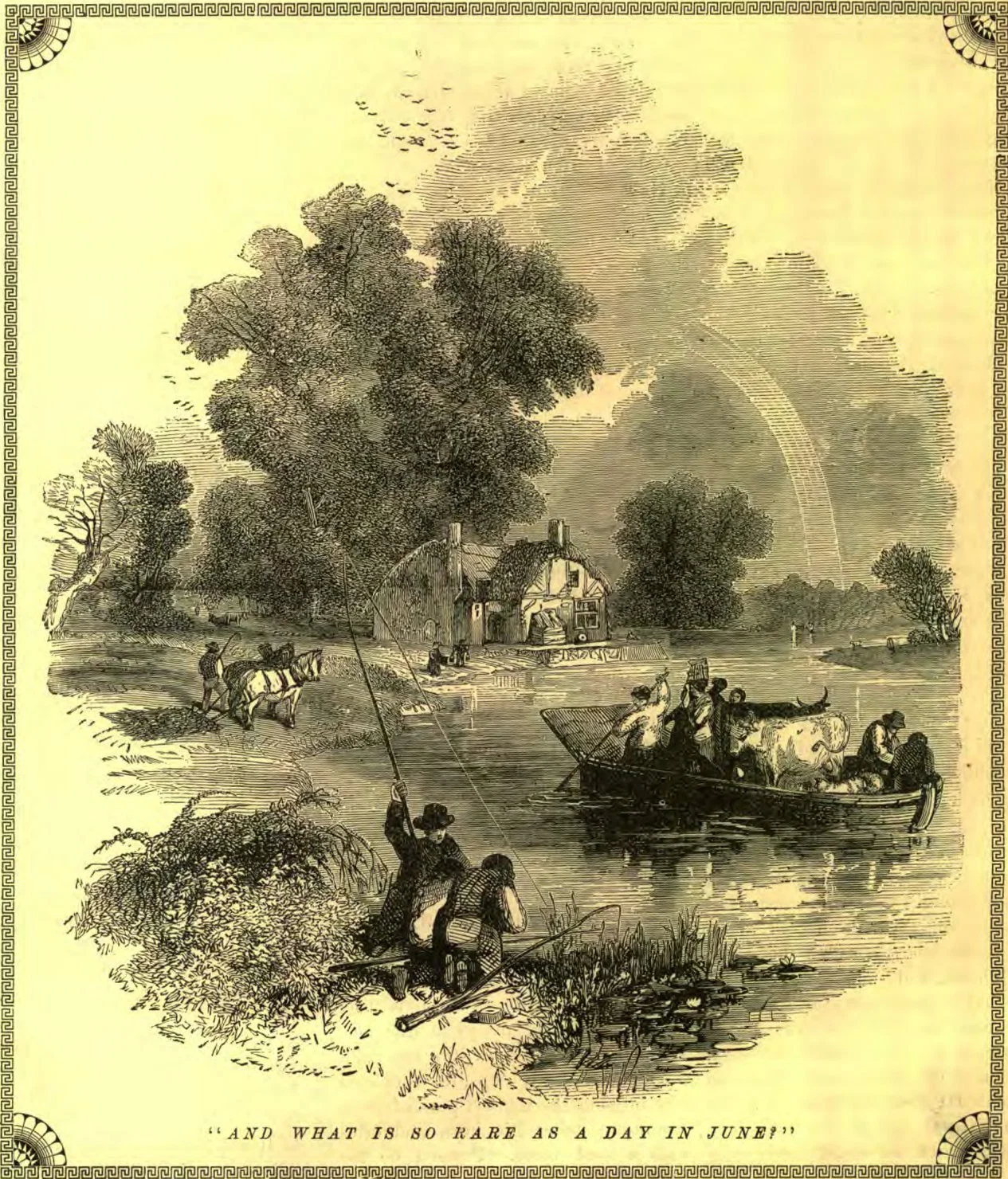
AND WHAT IS SO RARE AS A DAY IN JUNE?
Then came hard days for the poor little boy. His father was pitiless in compelling him to practice, and many a time he made him get up before daylight, to go over the scales. The child cried and pleaded all in vain. His father was determined to make money by exhibiting the wonderful talents of his boy. When Ludwig was thirteen, he led the Court orchestra at Bonn, and pretty soon he became assistant organist. The salary he received was a great help to his family, for the father was now drunk most of the time, and did nothing for their support.
He had hardly been cheered by his success when the good Elector, who ruled Bonn and encouraged its musicians, died, and Ludwig lost his place. He had then to give lessons. This he hated. It was prosy work to stand and count, “One, two, three, four,” to the same exercise he was once dragged out of bed to practice. However, he was a sturdy little man.
“Help thyself” was always his motto, and a good one it is for any boy or girl; so he worked on till some great men found him out, and he was once more made organist, this time with a salary of a hundred thalers, about $750. But did he boast over it? Not he. “Mother,” he said, “now you need not work so hard, we can have bread, and perhaps, oh, perhaps! I can yet go to Vienna.” For Vienna was then, as now, the home of music-lovers. There Haydn lived and Mozart composed, and of them the boy wanted to learn.
Poor Ludwig! Vienna could not comfort him for his mother, who just then sickened and died, while his father was reeling home from one of the Bonn gardens. I think he loved his mother more than most boys love theirs. He wrote to a friend from Vienna, for he was there at last: “Ah! who was happier than I, so long as I could still pronounce the sweet name of mother and hear the answer? and to whom can I say it now? To the silent images resembling her, which my fancy presents to me!”
After her death this ambitious young man of seventeen did something most noble. He tried to support his drunken father and young brothers while he worked on in Vienna, learning and composing. A funny life he led there. Sometimes he tried to keep house and cook for himself, but the composer was no cook, and as for keeping a house in order, he knew not how.
Sometimes he tried boarding; that was no better. He left one place because the landlord was too polite, and another because he could not get water enough; for he had a queer habit, when thinking of his new music, of bathing his head and face, and then pacing up and down the room like a wet Newfoundland dog, while he hummed and growled away to himself. At last a friend, a prince with the Polish name of Lichnowski, invited Ludwig to make his home at his palace; and there he lived happily for ten years, composing, and meeting the great men of the day. He was no longer poor young Ludwig, but a famous composer, whose grand music the world will always admire.
But he was no longer to enjoy it. Little by little, the gateway through which all sound enters had been closing, until at last he was entirely deaf.
He wandered about in the fields and gardens around Vienna as he had done around Bonn when a boy. He saw the tempest, he saw the birds singing in the sunshine; but he heard them not. He was wretchedly unhappy. “If I had not read that man must not of his own free will end his life, I should long ago have done so by my own hands,” he said.
Once, when traveling, he was caught in a storm and compelled to spend the night in a peasant’s cottage. After tea they brought out some music and played it on their violins. Ludwig saw by watching them that the music was difficult, and judged by their actions that it was beautiful, for at its close, tears stood in the eyes of the performers as they embraced each other in their enthusiastic German fashion. He rose and glanced at the music; it was one of his own symphonies, which he could never hear again. As this thought came to him, he sat down and wept long and violently before he could tell the amazed peasants his name.
No one need be afraid to love and enjoy his music. There is music which brings bad, coarse thoughts into the mind, and there is music which helps one up to pure thoughts and hopes; his is of the latter sort. There are bird-calls and sweet melodies in his symphonies, which remind you as you hear them how well he who wrote them knew all the delicious wild songs of the woods.
There are grand harmonies like angel hymns, which you do not wonder he could write when you read that he once said: “Nothing can be more sublime than to draw nearer to the Godhead than other men, and to diffuse here on earth these God-like rays.” Yet he did not mar the effect of his grand music by boasting of it, for he said near the end of his life: “I feel as though I had written scarcely more than a few notes of music.”
He had many things to trouble him besides his deafness. He had no home. His brothers, now grown up to men, courted him only for his money. A nephew whom he adopted, and loved devotedly, proved to be an ungrateful fellow, who when his uncle was very sick, went out to get some medicine for him, but, meeting some friends, went off for a spree, leaving his errand with a servant. Two days later the medicine came, but it was too late. One faithful friend, who could little spare the time from earning his own bread, cared for the composer in this his last illness.
Now, his great name and the love we bear him, would surround him with every comfort. I think he would even die as did that famous Frenchman, Mirabeau, literally covered with flowers, each of which would show the affection of some heart. Then, though many loved him, this greatest of all musicians died wanting many comforts, in his humble quarters outside of Vienna. While a violent thunderstorm swept over the city one spring night, the soul of the deaf composer “went away”—his last, plaintive words: “I shall hear!”
If you go to Bonn, you will see in the market place a tall marble statue of this great man, who once trod its streets in poverty and shame.
If you visit Vienna, and drive out from the city a few miles, you will see in the beautiful cemetery of Wahring, where many famous men lie, the last resting-place of the man whom the world honors, on whose plain white head-stone is this one word,—
Beethoven.

JUNE

AND what is so rare as a day in June? Then, if ever, come perfect days: Then Heaven tries the earth if it be in tune, And over it softly her warm ear lays: Whether we look or whether we listen, We hear life murmur, or see it glisten: Every clod feels a stir of might,— An instinct within that reaches and towers, And grasping blindly above it for light, Climbs to a soul in grass and flowers.
Now is the high tide of the year, And whatever of life hath ebbed away, Comes floating back with a ripply cheer Into every inlet, and creek, and bay: Now the heart is so full that a drop overfills it; We are happy now because God so wills it: No matter how barren the past may have been, 'Tis enough for us now that the leaves are green; We sit in the warm shade and feel right well; How the sap creeps up and the blossoms swell! We may shut our eyes, but we cannot help knowing That skies are blue and grass is growing.
—James Russell Lowell.

The Alpine Horn.

The Alpine horn is an instrument made of the bark of a cherry tree, and, like a speaking trumpet, is used to convey sounds to a great distance. When the last rays of the sun gild the summit of the Alps, the shepherd who inhabits the highest peak of these mountains takes his horn and cries with a loud voice, “Praised be the Lord!” As soon as the neighboring shepherds hear him, they leave their huts and repeat these words. The sounds are prolonged many minutes, while the echoes of the rocks repeat the name of God.
Imagination cannot picture anything more solemn or sublime than such a scene. During the silence that succeeds, the shepherds bend their knees and pray in the open air, then repair to their huts to rest. The sunlight gilding the tops of these stupendous mountains upon which the vault of heaven seems to rest, the magnificent scenery around, and the voices of the shepherds sounding from rock to rock the praise of the Almighty, fill the mind of every traveler with enthusiasm and awe.

WAITING

LEARN to wait,—life's hardest lesson, Conned, perchance through blinding tears, While the heart-throbs sadly echo To the tread of passing years.
Learn to wait hope's slow fruition; Faint not, though the way seem long; There is joy in each condition, Hearts though suffering may grow strong.
Constant sunshine, however welcome, Ne'er would ripen fruit or flower; Giant oaks owe half their greatness To the scathing tempest's power.
Thus the soul untouched by sorrow, Aims not at a higher state; Joy seeks not a brighter morrow— Only sad hearts learn to wait.
Human strength and human greatness Spring not from life's sunny side; Heroes must be more than driftwood, Floating down a waveless tide.

KEEP AN ACCOUNT.

ONE hot summer day we saw a wealthy man buy a glass of soda-water. And before he left the store, he took out a little pass-book and made this record: “July 6th, soda-water, 5 cents.”
When asked why he, a man worth tens of thousands of dollars, kept an account of every nickel spent, he replied:—
“It was by saving my nickels that I got a start in the world; and I never let one go without giving it honorable mention.”
Whether money recorded as spent for soda-water receives honorable mention or not is a question that would bear discussion; yet it is certain that the plan of keeping a strict account of all moneys received and paid out is a very excellent one.
Young men often spend money unnecessarily, and sometimes to their own injury. We know one young man who was paying four dollars per week for board, and yet for oysters, fruit, and other eatables he spent over two dollars per week. Another, getting good wages, told us he did not know what became of his money, but he was sure he was not saving any of it.
Now, young men, begin to keep an accurate daily record of all receipts and expenditures, and you will find it greatly to your benefit in many ways.
  1. It will enable you to keep track of all you receive.
  2. It will be a check on spending money foolishly.
  3. It will be useful in teaching you how to take care of what you get.
  4. It will help to train you to “put your money where it will do the most good.”
Try it, young men, and make a record that you would not be ashamed for anybody to see.—The Young Christian.

A SAD LESSON.

“Then, Doctor, there is no hope? Must I see my husband thus helpless the rest of his life? Are you sure there is no help for him?”
“No, Mrs. E—— I am sorry indeed for you, but I cannot withhold the truth. This severe stroke of palsy, brought on by the incessant use of tobacco, has left him a cripple for life, both in body and mind. He will never be able to utter one sentence, and can never talk any more than you now hear him.” “Oh, dear!” and Mrs. E—— stopped her ears, as oath after oath of the most terrible character came from the mouth of the wicked man. Having always been a profane man, uttering scarcely a sentence without an oath, now the judgment of God, as the neighbors said, seemed to rest upon him, and he could utter nothing but oaths.
Mrs. E——, a timid woman of high birth, looked into the future with sadness. No friends were near to advise, and being unused to business, and no assistance to be expected from her only son, the picture was indeed dark. Her husband, a strong, healthy man, had been that morning brought home entirely helpless. He must be cared for; the farm must be tended; their only son, about fourteen years of age, must be controlled, and taught to bear the burdens and attend to the business of the farm,—and all rested upon her, the father and husband being unable even to advise. Anxious that her son should make life a success, all the advantages of a good education, regardless of expense, were bestowed upon him. After finishing his studies, the farm was given into his hands; but things did not prosper.
“What does ail my boy,” inquired the fond mother, of a neighbor; “his health is so poor, and have you noticed what a swollen, bad nose he has?”
“Do you not know the cause?”
“No, I have thought of many things that might cause it, but cannot find the real cause.”
“Do you not know of the saloons and the great temptation that is brought to bear upon the young, and that your son has yielded?”
“Tobacco and rum, oh would such evils had never existed! One has ruined my husband, and must I live to see the other destroy my boy?”
With a heavy heart Mrs. E—— finished her work for the evening. Her heart ached as she saw Tom start for town in the evening, and as she watched him day by day, the words of her neighbor were proven too true.
A few years after as mother and son stood by the lifeless form of husband and father, who had been only a care and a burden all those long years, how his worthless life rose before them! Given up to that cruel monarch, tobacco, his manhood had been ruined, his son almost wrecked, and himself sunk into a hopeless grave,—hopeless, because no bright hope for the future was his, nothing but the lot of the blasphemer.
MRS. I. J. HANKINS.

NEW-TESTAMENT HISTORY.

LESSON 25.—FURTHER INSTRUCTIONS AND ILLUSTRATIONS.

“When the unclean spirit is gone out of a man, he walketh through dry places, seeking rest; and finding none, he saith, I will return unto my house whence I came out. And when he cometh, he findeth it swept and garnished. Then goeth he, and taketh to him seven other spirits more wicked than himself; and they enter in, and dwell there: and the last state of that man is worse than the first.” “Even so shall it also be unto this wicked generation.”
One of the women standing by, when she heard the words of Christ, and saw his miracles, began to talk about what an honor it was to be the mother of such a man; but Christ said, “Yea rather, blessed are they that hear the word of God, and keep it.”
“No man, when he hath lighted a candle, putteth it in a secret place, neither under a bushel, but on a candlestick, that they which come in may see the light.”
“The light of the body is the eye; if therefore thine eye be single, thy whole body shall be full of light. But if thine eye be evil, thy whole body shall be full of darkness. If therefore the light that is in thee be darkness, how great is that darkness!”
“Then came to him his mother and his brethren, and could not come at him for the press. And it was told him by certain which said, Thy mother and thy brethren stand without, desiring to see thee. And he answered and said unto them, My mother and my brethren are these which hear the word of God, and do it.”

QUESTIONS.

1. What was the first miracle that our Lord performed after the sermon on the mount?
2. What other noted miracles had been performed at Capernaum?
3. Why did the centurion think himself unworthy, and that Jesus would not wish to come under his roof?
4. What way did he take to secure the aid of the Saviour?
5. How did he manifest such faith as to call forth a remark from our Lord?
6. What did Jesus say to him?
7. Describe the miracle performed at Nain.
8. How did this miracle affect the people?
9. What course did Jesus pursue with the disciples sent by John to ask if he was the Christ?
10. What message did he send by them to their master?
11. When these messengers departed, what did Jesus say of John?
12. To what did Jesus compare the Pharisees and lawyers that refused the baptism of John?
13. Give the circumstances of Christ’s anointing by a woman in the house of Simon, the Pharisee.
14. How did Jesus instruct and reprove Simon?
15. Where did Jesus next preach?
16. Who accompanied him?
17. What did his friends say of him when they saw how he astonished the people by his miracles?
18. Of what did the Pharisees and scribes accuse him when he healed the demoniac that was both deaf and dumb?
19. How did Jesus show that this accusation could not be true?
20. What did he say of blasphemy against the Holy Ghost?
21. By what teaching did he show the importance that is to be attached to our words?
22. How did he answer those that asked for a sign?
23. How did he reprove them for not heeding his instruction?
24. How did he illustrate the condition of that generation? Matt. 12 : 43-45; Luke 11 : 24-26.
25. Who are to be regarded honorable and happy above all others? Luke 11 : 27, 28.
26. By what figure did he show that we must give the world the benefit of our example, and of whatever truth we have received? Luke 11 : 33.
27. By what figure does he show that we must look wholly to God for wisdom if we would avoid error and deception? Matt. 6 : 22, 23.
28. Whom does Christ regard as his true kinsmen? Luke 8 : 19-21; Mark 3 : 31-35; Matt. 12 : 46-50.

NOTE

“If thine eye be single; namely, so perfect in its structure as to see objects distinctly and clearly, and not confusedly, or in different places to what they are, as is often the case in certain disorders of the eye; one object appearing two or more, or else in a different situation and of a different color from what it really is. . . . We aim at happiness: it is found only in one thing, the indivisible and eternal God. If the line of simple intention be drawn straight to him, and the soul walk by it, with purity of affection, the whole man shall be light in the Lord; the rays of that excellent glory shall irradiate the mind, and through the whole spirit shall the divine nature be transfused. But if a person who has once enjoyed this heavenly treasure permit his simplicity of intention to deviate from heavenly to earthly good, and his purity of affection to be contaminated by worldly ambitions, secular profits, and animal gratifications; then the light which is in him becomes darkness; i. e. his spiritual discernment departs, and his union with God is destroyed; all is only a palpable obscure : and like a man who has lost his sight, he walks without direction, certainty, or comfort. This state is most forcibly intimated in our Lord’s exclamation, How great a darkness! Who can adequately describe the misery and wretchedness of the soul which has lost its union with the fountain of all good, and in losing this, has lost the possibility of happiness till the simple (single) eye be once more given, and the straight line once more drawn !”—Clarke.

THE PRIMARY CLASS.

[The following, from Mrs. M. K. White, in Signs of the Times, contains so much practical and timely instruction for our Sabbath-schools just now, that we feel like placing it in the hands of every Sabbath-school worker; and in no way can this be so effectually done as by reprinting it in the INSTRUCTOR].
“Probably there is no department in the Sabbath-school in which there is greater chance for improvement, both in numbers and in ways of working, than in the primary department; nor is there a field which yields better returns. But the best season in which to work is fast passing away, and we would ask of each teacher, What are you doing to make your school more interesting for the children? How does the attendance compare with last year? and what is being done at the present time to increase it?”
“ ‘Well,’ says one, ‘where we have so few children as in our church, it cannot be made interesting for them, and I have no heart to try to get those outside of our church to join.’ If this is the case, the very first thing that ought to be done is to increase the number; and then make it interesting for them. It is entirely possible to have an interesting time with only three or four scholars. Give them a corner by themselves, no matter how few there are, and then select for them one of your best, most earnest, and pleasing teachers. If there is a separate room to which they can repair after the opening exercises, so much the better. We have known cases where a school-house was used in which a very successful class was held in a room devoted during the week to hats and cloaks. Sometimes they are held in the entrance hall of the church, although here they are more liable to interruptions. A very good way is to partition off a portion of the church with curtains, or with blackboards and maps on standards, which can easily be removed before time for church service. This, however, does not allow the exercises to be varied by singing, as could be done in a separate room.
“At all events, a class of active children should not be required to wait while the older ones are questioned in general review. It is a constitutional necessity for children to be active. Therefore if obliged to keep perfectly still, they will soon dislike to come; and if allowed to whisper and play, they will learn a lesson of irreverence for the house of God, and form habits which it will be difficult for them in after-years to overcome, and which if continued will surely ruin the school. Better control their restlessness by giving them something to think about, and by so changing the exercises that they will not become wearisome. This we are aware is not an easy thing to do, but by patience and perseverance on the part of the teacher, and a careful preparation of the lesson, it can be done.
“The three years’ study laid out in Lesson Books Nos. 1, 2, and 3, is very interesting. We have just completed book No. 1 in our school, and although at first very anxious to study the New Testament lessons, I can truly say that the past has been a very profitable and pleasant year’s study, and now, having learned better how to study those lessons, I believe I could learn more by going over them a second time than at first. In the brief record contained in the book of Genesis, and covered by book No. 1, we have almost the only history of our world for over two thousand years. But because this part of the Bible is quite familiar, most think they do not need to study in order to teach it. Here is where they fail. They have a general knowledge of the subject, but a close study into the condition of the world at that time, and into the habits and customs of the people, would add at least one-half to the interest of the study and to their efficiency in teaching.
“Visiting the scholars at their homes will also be found a great help in this work. No matter what the size or age of the pupil, the teacher will be better prepared to teach, and know better how to govern, after having become acquainted with his home training. Unless the parents can be induced to spend some time every week in teaching the little ones their lesson and in assisting the older ones, the Sabbath-school will accomplish very little good for them.
“The question is often raised, How old ought a child to be before entering a class? That depends, of course, upon the nature and development of the child; but a safe answer to this question is: As soon as the parents are willing to undertake the task of teaching him the lesson at home; if the entire lesson is too hard, a few questions will answer at first.
“Some people adopt the same rule in regard to the Sabbath-school that they do in regard to the day-school; that is, send the little ones along to get them out of their way. As I once heard a lady remark concerning her little boy who did not want to go into a class: ‘He is so troublesome that when he is with me I cannot take any sense of what is said, and he must go.’ Conversation with her afterward revealed the fact that he was so small she never had been able to teach him any of the lesson. And yet she would impose upon some primary teacher the task of not only keeping him still, but teaching him something, and at the same time doing the same by half a dozen others. If the mother who is with her child day after day and week after week is unable to do this, of what avail will it be for the teacher to try for an hour or less once a week? We love to see the little ones in the school as soon as they can talk plain, but it will do them no particular good unless their parents will take pains to drill them a little every day upon the lesson. The school is the place for the infant classes, as well as for the older ones, to come to recite and not to learn, their lesson. An occasional visit from the teacher will greatly help in bringing this about. It will also afford the teacher an excellent opportunity to learn what impressions are made upon his pupils from week to week by his teaching.
“If a new scholar is placed in the class, special pains should be taken to make it interesting for him. Take this opportunity to let the older members tell in a connected story what they have learned about a certain subject. By all means have a piece of paper and a pencil ready to take down the full name and address; and, if possible, call upon him during the week. This will link the mother to the school; and knowing more about it, she will have a more personal interest in it, and the chances will be greatly increased for doing her good.
“Thus in innumerable ways will the earnest, faithful teacher find opportunity to work for the school. It is not always the most talented who succeed in this department, but it is those who are most observing and willing to work and learn, those who have a cheerful, animating nature, and who have the love of God beaming in the countenance and actuating the life.
“At some future time we may consider some of the ways by which the attention and interest of children can best be secured and held.”

SCENES IN THE LIFE OF CHRIST.

LESSON 20.—REVIEW.
1. ABOUT how long did Jesus and his disciples preach throughout the country of Judea?
2. What caused them to return into Galilee?
3. At what place did they stop on their way north?
4. How long did they tarry there?
5. What did Jesus do while at Sychar?
6. What was the result of his labors?
7. What did Jesus do on coming into Galilee once more?
8. How did his countrymen receive him?
9. Why were they now so willing to listen to him?
10. To what place did Christ come in the course of his preaching?
11. Describe the miracle which he performed while here.
12. On what occasion had Jesus and his disciples been to Cana before?
13. To what place does Christ seem to have come soon after the healing of the nobleman’s son?
14. From what did Christ read to the people in the synagogue on the Sabbath?
15. Repeat the words which he read.
16. How did the people regard Christ at first?
17. As he began to talk to them more plainly, what did they do?
18. What prevented the enraged people from killing Christ, as they no doubt intended to do?
19. Into what three parts was the Holy Land divided in the time of Christ? See Lesson 7, INSTRUCTOR No. 10.
20. Describe the general surface of the countries of Judea, Samaria, and Galilee.
21. What great plain is situated in the southern part of Galilee?
22. In what part of the country is Nazareth?
23. Describe its situation.
24. How far and in what direction is Nazareth from Jerusalem?
25. What little village lies about six miles south of Jerusalem?
26. Tell what you can about its situation.
27. What happened at this place many years ago, which will always make it interesting to us?
28. What other little village lies between Bethlehem and Jerusalem?
29. What inland sea lies south-east of Jerusalem?
30. What river empties into it?
31. Through what lakes does the Jordan flow, before reaching the Dead Sea?

THE SEED.

Once upon a time, a gardener went out into his garden to sow seed. Some of the seed dropped by accident on the hard, gravel walks, where it could not sink into the earth, so the sparrows hopped down and picked it up.
Some of the seed fell near the gravel walk, where there was a little mold, but not much; and it sprang up in a single night. But it had not earth enough to take root in, so it was soon scorched up by the sun.
Some fell among weeds; and when the weeds and seeds grew up together, the seeds were covered up by the weeds and became weak and thin, so that they never flowered.
Some fell on the garden mold, where there were no weeds; and these seeds sprang up, and each seed grew up to be a plant by itself, strong and tall, and put forth first leaves, then flowers, and then pods full of seeds.
When the seeds were gathered in the autumn, there were many more than had been sown in the spring. One plant had as many as ten pods, each with ten seeds in it; so, you see, that seed gave the gardener a hundred seeds. Another had six pods, with sixty seeds, and another gave fifty seeds; and every seed that had fallen on the mold where there were no weeds, gave the gardener more than one seed back again.
Jesus sows his seed every day in our hearts. He speaks to us by our parents, by our books, and in other ways. He says to us quietly in our hearts: “Be kind to your brothers and sisters,” “Obey your father and mother,” “Do your lessons well,” “Do not be greedy,” “Never tell a lie.”
These little messages are his seeds that he sows in our hearts. But some children will not listen to him; they make their hearts hard like pavement, or like a hard road, so that the seed cannot sink in. So there lies the message idle, till some game or some work drives it out of their minds; and so the message is gone before they have thought about it. These children are like the gravel walk.
Some children think a little, but not enough. They hear Jesus saying, “Do not be selfish, do not be ill-tempered,” and they say at once, “I will do as Jesus tells me.” But then presently they find it very hard to give up their toys and pleasures for others, and sometimes they’re laugh’d at by their school-fellows for not doing like the rest. Then, just as the sun scorches up the seeds, in the same way the laughter makes all their good resolutions wither. These children are like the earth where there was not much mold.
Other children are not so forgetful. They remember what Jesus says to them, and think of it, but they think more of other things. Their games and pleasures interest them much more than the messages of Jesus. They hear a good voice saying: “Obey your father and mother;” but they hear a bad voice saying: “It is pleasant to do as we like,” and the bad voice is louder than the good voice. So by degrees their good thoughts are conquered by their bad thoughts, and become weaker and weaker; and when the time comes that the good thoughts should bring forth the fruit of good deeds, the good thoughts are dead. These children are like the earth filled with weeds.
But some children hear what Jesus says, and remember it and think often of it, and try to obey his messages; and they do what is right and good, and Jesus is pleased with them. These children are like the good earth.—Parables for Children.

GO AWAY, SATAN! GO AWAY!

A LITTLE girl sat upon the large stone door-step of her father’s house, and beside her was a boy of about the same age. He had been eating a fresh, rosy apple, and had thrown the core in the gutter beyond the walk, and watched it as the muddy water carried it from his sight; then turning back to his playmate, who seemed absorbed in the pictures of a new book, he said: “Give me your apple, Katie; mine is all gone.”
“Not now, wait a little,” was the reply.
But the greedy little fellow, not willing to wait, took the apple up, turned it round and round, smelled it, and then tossed it up lightly in his hands, each time catching it again. I expected his teeth would go into it, but he was too honest for that. His cry brought the eyes of the little girl upon him. The blood mounted to her brow; she was at once upon her feet with one hand raised, apparently to strike the shrinking form beside her. But the hand did not fall; and as she stood, her face and form showing the struggle within, I prayed that she might not be too strongly tempted. A moment more, and her voice fell on my ear—
“Go away, Satan! Go away!”
The mother within the door heard the words too, and coming out, asked what they meant. A blush was upon the brow of the child, but it was humility and shame that caused it, while with drooping head she answered: “Satan wanted me to strike Freddie; but I did n’t.”
The mother drew her within her arms and kissed her, saying: “That is right, my child; resist him and he will flee from you.”
Would that all might learn in childhood to resist the power of temptation by the help of the Holy Spirit! Truly, the world would be better for it.
Continue reading: THE CLIFF HOUSES