The Youth’s Instructor, Vol. 32, No. 6.

A SONG FOR THE WORKER

The Youth’s Instructor

Feb 6, 1884

S. D. A. Publishing Association · Battle Creek, Mich. · Feb 6, 1884

A SONG FOR THE WORKER.

How would it seem, I wonder, If the meadows near and far Had never a buttercup, And never a daisy star? Never a sweet, wild violet, And never a primrose gay? Only the grasses needful For making the useful hay?
If in the still, green forest There wasn't a wild song-bird; If robin and thrush and wren Nobody ever heard; If all was for simple use, Nothing for beauty or joy— Oh! how weary were life Without some pleasant alloy!
But nature teaches us ever A lesson that's far more sweet. See how the crimson poppies Follow the golden wheat! Wheat for the bread of the world, Poppies for beauty alone; Wheat and poppies together In every age and zone.
Always the morning-glories Cling to the cotton plant, While over the snowy harvest Thrushes and blackbirds chant. The strength of the forest trees To the duties of life belong; But their cool, green palaces Are for the wild bird's song.
Take to thy heart the lesson, Man with the downcast eyes! Many an innocent joy Bright in thy pathway lies. Still let thy daily labor Beauty and pleasure greet, Just as the idle poppy Brightens the fields of wheat.
Just as the morning-glories Climb up the cotton plant, Just as the birds when building Unto their labor chant; The stress of thy daily labor With beauty and love renew; Busily toil in the wheat field, But gather the poppies too.
—Lillie E. Barr.

CORALS

Far away in the warm waters of the great tropical seas is a little marine creature, scientifically called a polyp, or zoophyte, which in its operations completely outstrips all the works of man. This tiny animal produces the beautiful corals, red, white, black, and other shades, which are sold in the shops of the jeweler and lapidary, or are preserved in cabinets. Although so small and helpless, this little bunch of jelly produces the most astonishing results.
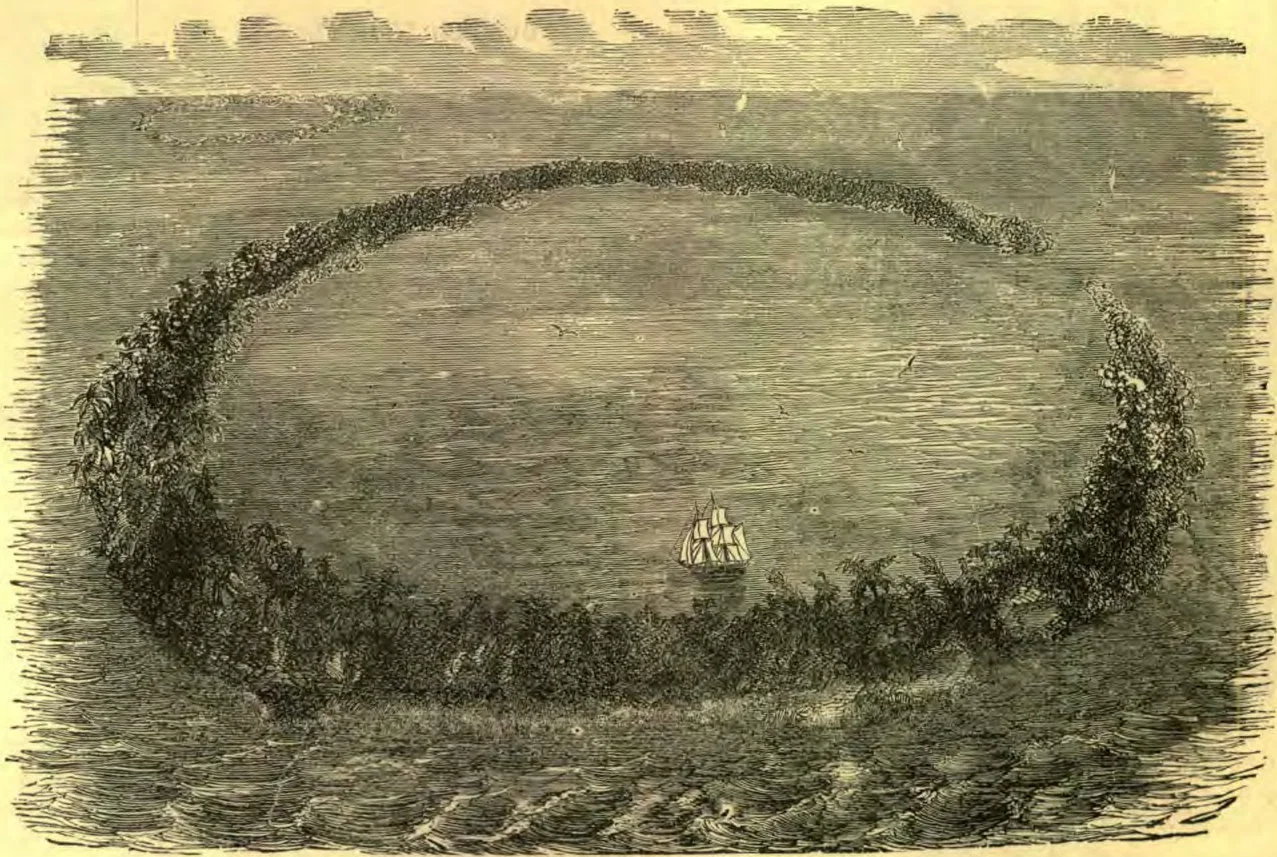
In that part of the Pacific Ocean called Polynesia which equals the continent of Asia in size, are found groups of low islands, and great reefs of rocks, hundreds and hundreds of miles in length, which owe their existence entirely to the coralline polyp. Frequently these little workers will push up out of the water a coral reef of a circular form, varying in diameter from a few hundred rods to twenty-five or thirty miles. These regularly-formed islands are called by the natives atolls, a word of Malay origin meaning “order.” Inside of these reefs is a lake, or lagoon, many fathoms in depth, where ships may sail, or ride at anchor. These reefs are seldom more than a few hundred yards in width, yet there the cocoanut tree readily takes root, and sends up its tall trunk skyward, presenting a very picturesque appearance. Here, too, the natives often erect their fragile huts, and repose in the shade of the cocoanut branches.
The atolls usually have one or more openings, through which small vessels may come in and pass out. The engraving represents one of these lagoons in the great South Sea, with a ship on its quiet waters. However much the sea outside may rage and foam, all is comparatively quiet on the inner side of the atoll. The waters are said to be dark green. There are thousands of these atolls, large and small, in the great Pacific and Indian Oceans, which the little reef-builders, the coral-producing polyps, have pushed up out of the depths below.
Could we descend into the heart of the seas where the coral insect dwells, we would be in ecstasy at what we saw. Here we would behold vast sea-gardens rivaling the shrubbery of our most beautiful parks in grace and beauty. The brilliant hues of red and white and pink, and other beautiful tints, which adorn the vegetable world, are found in their perfection in the coral gardens down in the ocean.
Frequently they imitate the form of trees, and excel them in beauty. Some species develop their coral product in the form of large leaves, rolled around one another like a huge cabbage. Other kinds are foliated, and look more like a bunch of lettuce. Some of the clustered varieties remind one of the acanthus and oak. One species is like an asparagus bed. The appearance of mushrooms and mosses and lichens is imitated by other kinds, while a certain other variety reminds one of asters and carnations and pink beds. Still others, with their beautiful tints and hues, call to mind the most lovely flowering vines.
But while we may be interested in the countless wonders of the coral kingdom, let us not forget that this little polyp is one of the divinely-appointed agents to help keep pure the waters of the great seas. The waters of the ocean are purified by passing through the great coral forests of the sea depths, as the air is purified by being driven through natural forests and among mountain gorges. Here we see the wisdom of the One who made the sea and the dry land.
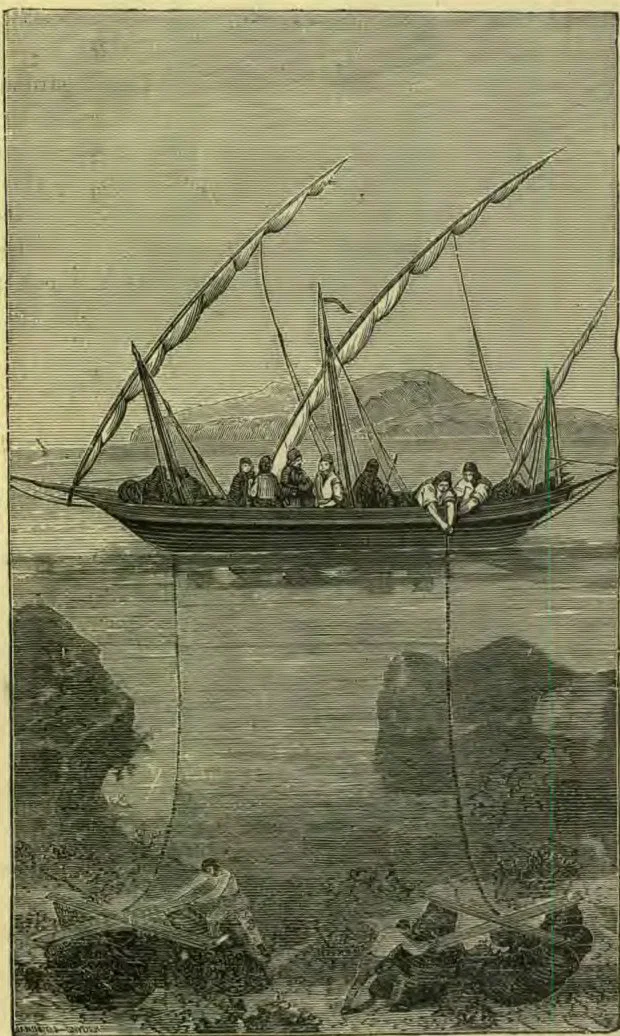
From time immemorial, coral has been a well-known article of commerce. And for obtaining this product of the sea, there are noted coral fisheries in different parts of the world. Most of the corals which adorn our cabinets, or are made into necklaces and beads, come from the Mediterranean Sea. The manner of securing these coveted treasures is well shown in the engraving. A great cross of wood loaded with stones, and carrying at the end of each arm a sort of net, is lowered from a schooner, with a man to manage it, and secure the precious substance. The branches of the coral are readily caught in the net, and with the man, speedily drawn to the surface. Sometimes a boat’s crew will make a hundred dollars or more a day in this perilous kind of fishing. The business is carried on from April to September, in which there may be a hundred days when the men can work.
There are large coral fisheries off the Cape Verde Islands, controlled by the Spanish fishermen, who gather in more than a hundred thousand dollars’ worth of coral annually. There are also fisheries of importance off Algeria, Tunis, and Morocco. Red coral is obtained in the vicinity of Naples, and along the coast of Sardinia and Corsica. Extensive coral beds have also been discovered near Japan.
The Italians appear to take lead in coral manufactures. The province of Genoa alone employs five or six thousand persons in coral fishing and in manufacturing the raw material. There are many engravers of cameos and coral. To be valuable, coral must be in large pieces, of a delicate, pinkish, flesh-like hue, and uniform in tint. The flesh-colored is sometimes sold at fifty dollars per ounce. Red coral is frequently classified by dealers into five grades, as froth of blood, flower of blood, and blood of first, second, and third grades. Many of the finest specimens of red coral are sent to China, where they are used by the mandarins as buttons, to show their rank of office. Other kinds less valuable find their way to India, where they are highly esteemed by the natives, who imagine that the gods dwell in what look like the worm-eaten cavities. The writer once saw a magnificent bunch of coral, some three or four feet high, which a persevering sea-captain brought from the Indian Ocean. He secured it by ropes between the tops of the masts of his ship, and was thus able to get it home without breaking. There are very many interesting facts about coral, which the young readers must look up for themselves.
But while we have written so lengthily about coral, we would not close without reminding the reader that there is one thing which is far more precious than coral, and much more to be sought. It is true wisdom. The patriarch Job says: “But where shall wisdom be found, and where is the place of understanding? Man knoweth not the price thereof; neither is it found in the land of the living. The depth saith, It is not in me; and the sea saith, It is not with me. It cannot be gotten for gold, neither shall silver be weighed for the price thereof. It cannot be valued with the gold of Ophir, with the precious onyx, or with sapphire. The gold and the crystal cannot equal it; and the exchange of it shall not be for jewels of fine gold. No mention shall be made of coral, or of pearls; for the price of wisdom is above rubies.” Job. 28:12–18.
That every reader of the INSTRUCTOR may secure this priceless treasure, is the fervent wish of the writer. G. W. A.

DUST ON YOUR GLASSES.

I DON'T often put on my glasses to examine Katy’s work; but one morning, not long since, I did so upon entering a room she had been sweeping.
“Did you forget to open the window when you swept, Katy?” I inquired. “This room is very dusty.”
“I think there is dust on your eye-glasses, ma’am,” she said modestly.
And sure enough, the eye-glasses were at fault, and not Katy. I rubbed it off, and everything looked bright and clean, the carpet like new, and Katy’s face said:—
“I am glad it was the glasses, and not me, this time.”
“This has taught me a good lesson,” I said to myself, upon leaving the room, “and one that I shall remember through life.”
In the evening, Katy came to me with some kitchen trouble. The cook had done so and so, and she had said so and so. When her story was finished, I said, smilingly, “There is dust on your glasses, Katy. Rub it off; you will see better.”
She understood me, and left the room.
I told the incident to the children, and it is quite common to hear them say to each other, “Oh, there is dust on your glasses.”
Sometimes I am referred to: “Mamma, Harry has dust on his glasses. Can’t he rub it off?”
When I hear a person criticising another, condemning, perhaps, a course of action he knows nothing about, drawing inferences prejudicial to the persons, I think, “There’s dust on your glasses. Rub it off.” The truth is, everybody wears these very same glasses.
I said this to John one day, some little matter coming up that called forth the remark. “There are some people I wish would begin to rub, then,” said he. “There is Mr. So-and-so, and Mrs. So-and-so; they are always ready to pick at some one, to slur, to hint; I don’t like them.”
“I think my son John has a wee bit on his glasses just now,” I replied.
He laughed, and asked, “What is a boy to do?” “Keep your own well rubbed up, and you will not know whether others need it or not.”
“I will,” he replied.
I think, as a family, we are all profiting by that little incident, and through life will never forget the meaning of “There is dust on your glasses.”—Observer.

EDITOR'S CORNER.

HERE is nothing which we can come into the possession of, dear reader, so valuable as a good character, and he is truly wise who puts forth his best efforts to acquire one. What we mean by character, however, is not merely what people think of you, but what you really are at heart. You may have the reputation, or the name, among your associates, of being very good, while yet your character is very defective; and there are instances, though not so common, where persons unfortunately get a bad reputation, when their motives are pure, and their actions are right.
To help you understand better what we are saying, we will give you the meaning of the two words, as follows:—
“Character is the sum of those traits or qualities, either good or bad, which are peculiar to a person.” To have a good character, one must be in possession of none but good qualities, while the opposite traits in a person would constitute a bad character.
“Reputation is what is generally thought of character, so far as it is known.” We judge a person's character by the way he appears to us, without knowing his motives; and we do not always judge righteous judgment. He may have succeeded so well in covering up his faults, that he is in good repute undeservedly; and on the contrary, he may be entitled to a much better reputation than we have meted out to him.
It is pleasing to almost any of us to have a good name among our fellows, whether we are deserving it or not; but it is decidedly more satisfactory to possess good characters, to feel assured that it is not only as measured by man that we are thought well of, but that if we should be weighed in God's scales, we should not be found wanting. A good reputation, if undeserved, will be of no account when God shall judge the secrets of men; it is the character which will be brought in review before him, for God looketh at the heart.
The heart being naturally corrupt, and character being of slow growth, you cannot expect to attain to excellence of it suddenly. Evil traits will show themselves at every turn, and you have but patiently to continue the process of lopping off this and that defect, and of cultivating the good qualities. As “wise master-builders,” my dear readers, build your characters on a good foundation. “Other foundation can no man lay than that is laid, which is Jesus Christ.” Having begun on this foundation, which is faith in our Lord Jesus Christ, that he will purge you from your iniquities, and sustain you by his grace in trying to attain to excellence of character, may you give all diligence to climb Peter's ladder, round by round (2 Pet. 1: 5-7), and so have an abundant entrance granted you into the everlasting kingdom of God.
M. J. C.

THE KING.

Dick had broken his jaw, poor fellow! The doctor said that it must be bound up for six weeks, so, of course, Dick could talk only by signs or by writing on a slate.
He begged for stories and to be fanned, and that the troublesome flies might be kept away.
“Shall I tell about a king and his beautiful palace?” asked Dick’s sister, Helen.
Dick nodded; he was always glad to hear about a king. He thought right away of Alexander and Cæsar and Napoleon, or of some other warriors, with armies and banners.
“My king lived almost three thousand years ago, in a land far away across the sea,” said Helen. “Put on your guessing-cap, Dick, and listen very sharp. One day this king resolved to build himself a palace. He had many men and ships, that he sent to distant countries for gold and precious stones and beautiful wood with which to build his palace. I must just say, though, that before he began his own house, he was busy building one for another great King; it was very beautiful—the stones were large and many of them costly; the whole house was overlaid with gold, and the walls were covered with figures of heavenly beings and with representations of palm trees and flowers. The king spent seven years in building that house.”
“Tell me about his own palace,” wrote Dick.
“He was thirteen years in building it,” said Helen. “Wouldn’t you like to shut your eyes and open them again quickly, and find yourself in one of the rooms of that palace? You would look with wonder at the curious doors and windows, at the carvings on the walls and the beautiful hangings of linen and silk, and at the ivory throne. The ivory had been brought in ships from a land far away.”
Dick tried to remember some things that he had read about ivory. He supposed that Helen was telling about some old king of India. He would listen awhile, though, before he would venture to guess.
“Do you want to hear about the ivory throne?” asked Helen. “It must have been raised quite high; one had to go up six steps to reach it. There were lions on either side of the steps, Dick; not live lions, you know; only figures of lions.”
“Was the king Alexander the Great?” wrote Dick.
“Oh no; that is not near to a true guess. Besides having thirty thousand men to work for him, the king had as many horses and chariots as he wished—enough, indeed, to lend to his friends, the kings of other lands. How many chariots, now, do you suppose that he had?”
Dick did not know.
“More than a thousand. Sometime I will show you a picture of such chariots as they used in these days. The king sent far away to another country for fine horses. He gave one hundred and fifty silver shekels apiece for these horses. A silver shekel would be about fifty-nine cents of our money. How many dollars would one of his horses cost?”
Dick did the sum in a moment, and wrote, “Eighty-eight dollars and fifty cents.”
“Besides chariots and horses and grand palaces, the king had beautiful ships. Once in three years these ships would come home, bringing gold and silver and ivory and apes and peacocks.”
Dick thought that he had heard enough about the king’s gold and silver and ivory, but his eyes brightened at the mention of apes and peacocks. “Queer things to have in a palace!” he thought.
“One day the queen of another country came to see the king. He was very polite to her. He showed her everything about his beautiful palace, and answered all her hard questions.”},{
“Did she see the apes and the peacocks?” asked Dick.
“I suppose so,” said Helen. “The king could tell her all about their curious ways; for it is said that he had studied about trees and flowers and grass, and that he could tell about beasts and birds and fishes, and even about creeping things.”
Dick sighed. “That king must have been happy,” he wrote. “There wasn’t a thing he couldn’t buy.”
“True, Dick! He as much as says that he got everything he set his heart upon; still he was not happy. I have been telling you about King Solomon. If he could come back to this world and walk into this room, I am almost sure as to what he would say. He would lay his hand on your head, and speak just the words that he wrote so long ago: ‘A good name is rather to be chosen than great riches, and loving favor rather than silver and gold.’ I think, too, that he would add those other words: ‘The fear of the Lord is the beginning of wisdom; a good understanding have all they that keep his commandments.’ Perhaps he would not go away till he had said to us—almost the last words that he ever wrote for the world—‘Hear the conclusion of the whole matter: Fear God and keep his commandments; for this is the whole duty of man.’”—Meade Middleton.

Courage: Luther's Dare and Erasmus's Caution

Courage.

The value which men set upon courage was shown in the recent celebration of Martin Luther’s four hundredth birthday. People of all opinions joined in honoring the memory of the man who dared.
The urbane and scholarly Erasmus was a Protestant, in an intellectual sense, when Luther was a baby in his mother’s arms; but he kept his opinions to himself, or he uttered them only at the dinner tables of the learned men of England and Germany. He was politic and prudent. With a circle of Oxford professors and liberal noblemen about him, he would ridicule the follies of the monks, the pretensions of the church, the corruptions of Rome, and the pompous behavior of the bishops. He even wrote of these things in elegant Latin, and wrote so amusingly that priests themselves laughed at his satire, knowing well that it was as harmless as it was just.
But Luther dared! He took his life in his hand, and defied the power of the church in open assembly. He struck at the ill-gotten revenues of the church. He declared publicly, and in plain German, his objections to its doctrines and claims. He used every known means to make himself understood by the masses of his countrymen, not disdaining the comic anecdote and the penciled caricature.
He did not know whether he should be honored as a hero, or burned as a heretic. He took the risk. He dared!
To-day, after four hundred years, his name is one of the three or four most honored throughout the wide realm of Christendom. He is honored, not simply because he held this or that opinion, but because, holding his opinion, he dared face the stake in support of it.
History proves to us that courage is the royal quality of human nature. If we trace the careers of ruling men, we shall generally be able to find a moment, an act, like the daring of Luther at the Diet of Worms. There comes, perhaps, to many gifted men a similar chance—a time when they choose the easy path of commonplace security, or the difficult and perilous one that leads to commanding eminence. Mr. Emerson uttered a serious truth when he said, in his half-jocular way,— “The success of an empire, or of a peanut-stand dates from an act of courage.”
It was in this spirit that the Pilgrims founded Plymouth Colony; Penn, Pennsylvania; and Roger Williams, Rhode Island. They were all men who had the courage of their convictions.—Youth’s Companion.

NEW-TESTAMENT HISTORY.

LESSON 173.—REVIEW ON ACTS 8:25 TO CHAPTER 10.

  1. How were other parts of Samaria benefited by the tour of Peter and John? Acts 8:25.
  2. What miraculous call did Philip receive? Verse 26.
  3. Why was Philip called to take this journey? Verses 27, 28.
  4. What scripture was the eunuch unable to understand? Verses 32, 33.
  5. When Philip had shown the application of this scripture, and that Jesus was the Messiah, how did the eunuch show his faith? Verse 36.
  6. What profession of faith did Philip require of him in order that he might be baptized? Verse 37.
  7. What was the evident mode of baptism on this occasion?
  8. Who, after the death of Stephen, was very active in persecuting the disciples of Jesus? Acts 8:3; 9:1, 2.
  9. How was he suddenly checked in his cruel career? Acts 9:3, 4.
  10. What questions did he ask? Verses 5, 6.
  11. How were they answered?
  12. By whom was Paul instructed and healed? Verses 10, 17, 18.
  13. What did the Lord say to him about Paul, or Saul, as he was then called? Verses 15, 16.
  14. On receiving his sight, what did Paul immediately do? Verse 18.
  15. In what work did he at once engage? Verses 20, 22.
  16. How did he escape death at the hands of the Jews? Verses 23–25.
  17. In the meantime, where had Paul been? Gal. 1:17.
  18. What difficulty did Paul encounter on arriving at Jerusalem? Acts 9:26.
  19. How were the brethren at Jerusalem led to accept Paul as a fellow-disciple? Verse 27.
  20. How did Paul’s boldness lead him into danger? Verses 28, 29.
  21. How was Paul saved from sharing the fate of Stephen, whom he had helped to martyr three years before? Acts 22:17, 18.
  22. When Paul remonstrated, what decided answer did the Lord give him?
  23. When the brethren had taken Paul to Cæsarea, to what place did he continue his journey?—To Tarsus, his native city, in the province of Cilicia.
  24. What is said of the prosperity of the churches at this time? Acts 9:31.
  25. As Peter was passing through all quarters, what miracle did he perform at Lydda? Verses 32–34.
  26. From what place did Peter receive an urgent invitation as soon as the news of this miracle had spread abroad? Verse 38.
  27. What worthy disciple of that place had lately died?
  28. For what was she noted?
  29. How was Peter greeted when he entered the room where the dead lay? Verse 39.
  30. Describe the miracle which he performed. Verses 40, 41.
  31. Where did Peter then take up his abode? Verse 43.
  32. What was the probable cause of his remaining there? Verse 42.

God Gives Strength for Every Work

WHEN God calls us to a work, he always gives the needed strength. When the conflict is deepest, he always stands ready to help.

SPECIAL PREMIUM OFFER.

For every new subscription, accompanied with 85 cents, we will give

THE SUNSHINE SERIES,

consisting of a package of ten beautiful pamphlets of 32 pages each. These comprise a choice collection of sketches, stories, poems, etc., adapted to the wants of children, and contain more reading matter than can be found in many dollar books.
Our young friends will certainly be able to obtain many new subscriptions by calling the attention of their schoolmates and friends to this liberal offer. For only 10 cents in addition to the regular subscription price, each new subscriber obtains the paper one year and the above mentioned valuable premium. Will not each one of our readers determine to obtain at least one new subscriber to the INSTRUCTOR the present season? Many can accomplish more than this. Let all do something.
As an inducement to our readers to begin this work of gathering in subscribers, we publish the following

LIST OF PRIZES,

To agents and canvassers who obtain new subscribers to the INSTRUCTOR, either at full subscription price, 75 cts. without the premium, or 85 cts. with the premium.
For TWO NEW SUBSCRIBERS, your choice of any one of the following books:—
The Story of Jack the Cat, 20
The Little Traveler, 20
The Story of Good Dog Rover, 20
For THREE NEW SUBSCRIBERS, your choice of any one of the following:—
Words of Guidance, a package of Bible texts on 12 cards, with floral border, very beautiful, 25
Miniature floral text cards, a package of 96 cards, handsomely illuminated, 25
Beautiful birds, a package of 12 cards of tropical birds, in oil colors, 25
Advent Keepsake, 25
Child's Poems, 25
For FOUR NEW SUBSCRIBERS, your choice of any one of the following books:—
Stories for the Play hour, 30
Bright Pictures for Dull Days, 30
Pleasing Pictures and Stories, 30
For SIX NEW SUBSCRIBERS, your choice of any of the following books:—
Sabbath Readings, Vol. 1, 60
Smith's Diagram of Parliamentary Rules, 50
Blanche Gamond, a Heroine of Faith, 45
Charlotte Elizabeth, 45
May Coverly, 60
For TEN NEW SUBSCRIBERS, your choice of either of the following books:—
Revised New Testament, both versions on opposite pages, 75
Life of St. Paul, by Conybeare and Howson, $1 00
For FIFTEEN NEW SUBSCRIBERS, your choice of any one of the following books:—
Giant Cities of Bashan, $1 25
Bunyan's Pilgrim's Progress, illustrated, and elegantly bound, Porter and Coates' edition, $1 50
Story of the Bible, adapted to all, but especially for the young, $1 00
Palestine for the Young, $1 00
History of the Waldenses, 90
For TWENTY NEW SUBSCRIBERS, your choice of any one of the following books:—
Cruden's Complete Concordance, $1 75
Dr. Wm. Smith's New Testament History, $1 75
Dr. Wm. Smith's Old Testament History, $1 75
For TWENTY-FIVE NEW SUBSCRIBERS, your choice of either of the following books:—
Oxford Teacher's Bible, No. 502, pearl type, round corners, gilt edges, $2 25
Ride through Palestine, a most interesting and instructive work, $2 00
The prizes and premium will be furnished by us if the money and subscriptions are sent directly to this Office; but if the business is done through the Tract Society, the State secretary of said society will furnish them.
Any person working for a prize must state his intention when the first subscriptions are sent, that an account may be kept of the names.
A canvasser's outfit, consisting of sample copies of the INSTRUCTOR, circulars describing the paper, and a set of the Sunshine Series, will be mailed for 35 cents to those who wish to work for the paper.
We trust that many will begin this work at once. Who will be the first?
PUBLISHERS.

A VISIT TO THE ENGRAVERS.

“Papa, I wonder how they make the pictures in this paper,” said Harry one day after breakfast, as he handed the “Illustrated News” to his father.
“Well,” replied his father, “I can tell you; but as I have time this morning, I will do better than that by taking you with me, when I go down street, to a printing office where they make engravings. Ask your mother to get you ready, and we will go as soon as I have looked over the ‘News.’”
Harry ran off to find his mother, and returned in a few minutes, ready for the walk. It was a bright, frosty morning in midwinter, and the snow covered everything around. After a brisk walk of twenty minutes, they came to a wide street with tall buildings on either side. Stopping before a five-story building, they went up stairs, and at the top met a tall, gray-haired man, who, when he found out what they wanted, took them into the Art Room. This was a pleasant, sunny room, facing the street. Beautiful paintings hung on the walls, and statues and busts stood in different parts of the room. There was a desk before each one of the long windows, and at each desk sat a man busily drawing pictures. Each man had before him on the desk a picture drawn on paper, and he was copying it on a block of yellow wood about an inch thick. Harry couldn’t remember that he had ever seen any wood like this before, and asked the gray-haired man what it was.
“That,” he replied, “is box-wood. It is the best wood for cutting pictures on that we know of. Some people use pear wood and sometimes apple wood, but we never use anything except box-wood. When it has become well seasoned, these blocks are sawed off cross-ways of the grain, and planed very smooth, ready for use.”
“But this picture is just finished,” he continued, “and if you will go with me into the Engraving Room, you can see how we get pictures ready for printing.”
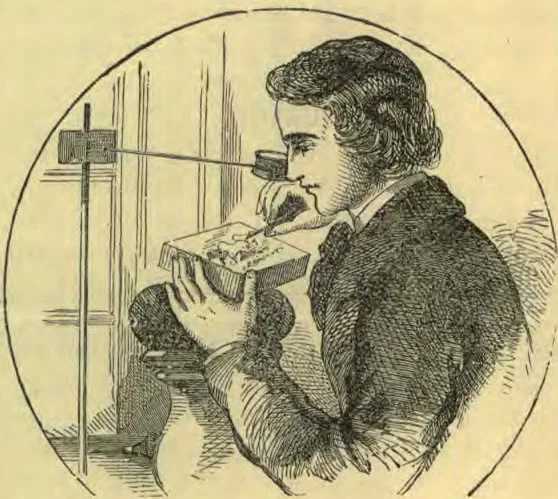
Then they went upstairs, to a room right over the Art Room. The gray-haired man gave the picture to a short man who had charge of this room. The short man looked at the picture carefully to see if it was all right, and then unscrewed some little bolts, and took the picture to pieces. Harry had not seen these before; he thought the picture was drawn on a large piece of wood. Now it looked like a picture puzzle that he had at home, only the blocks were square and all the same size. The man then gave these blocks to the workmen, letting each one have the part that he could do the best. The workmen sat at benches close to the light. Scattered over the benches were tools of every sort,—gravers, picks, and knives. The men rested the blocks on leather cushions, and looking through a magnifying glass, commenced very carefully to cut around the outlines of the parts they wanted to remove. That part of the picture that was to print black they left up higher than the rest, cutting away the part that was to be white. The gray-haired man said that they did not always make their pictures on little blocks screwed together, but only the large pictures that they were in a hurry for; the smaller ones were made on one smooth piece of wood.
When they had finished the blocks, which took them over an hour, they handed them back to the short man, who looked at their work to see if it was done well, and then bolted the pieces together again so that it made one nice picture.
Then the man sent it upstairs to the type room, so that it could be put in with the type, and printed from.
Two more pictures came in while they were there, and Harry wanted to stay and see them made; but as it was getting very near dinner-time, his father told him that they would better go home, and come again some other day. So, after thanking the gray-haired man for showing them about the work, they went home to tell mamma what they had seen. W. E. L.

NEW PRIZES.

We are still at work for our young friends; what are they doing by way of canvassing for the paper? Some are reporting progress, shall we not hear from many more soon? For your further encouragement, we have added six new books to the Prize List since it was last published. By reference to it you will notice that for two new subscribers we furnish any one of the three following books from Nelson’s Sparkling Eye Series: The Little Traveler, Story of Jack the Cat, and the Story of Good Dog Rover, price 20 cts. each. These are beautiful stories for children, with handsome illustrations in oil colors. For four new subscribers we will furnish any one of the following books: Story for the Playhour, Pleasing Pictures and Stories, and Bright Pictures for Dull Days, price 30 cts. each. These books are bound in muslin, each containing thirty-two illustrations, and a story with each cut. M. J. C.

A LITTLE THING.

It was such a little thing— One slight twist of crimson string; But ’twas stealing, all the same; And the child who took it knew That she told what was not true, Just to screen herself from blame; First a theft and then a lie— Both recorded up on high.
It was but one little word, Softly spoken, scarcely heard, Uttered by a single breath; But it dared to take in vain God’s most high and holy name, So provoking wrath and death. Soon the lips, once fresh and fair, Opened but to curse and swear.
It was but one little blow— Passion’s sudden overflow— But scarcely heeded in its fall; But, once loosed, the fiery soul Would no longer brook control; Laws it spurned, defied them all, Till the hands love clasped in vain Wore the murderer’s crimson stain.
Ah! it is the foxes small, Slyly climbing o’er the wall, That destroy the tender vines; And it is the spark of fire, Brightening, growing, curling higher, That across the forest shines. Just so, step by step, does sin, If unchecked, a triumph win.

You have reached the end of this edition.

The Youth’s Instructor · Feb 6, 1884