The Youth's Instructor, Vol. LIII, No. 28

Traces of Sabbath Observance in Olden Time

The Youth's Instructor

July 11, 1905

Review and Herald Publishing Assn. · Washington, D. C. · July 11, 1905

_Traces of Sabbath Observance in Olden Time_

_I—In Ancient Ireland_
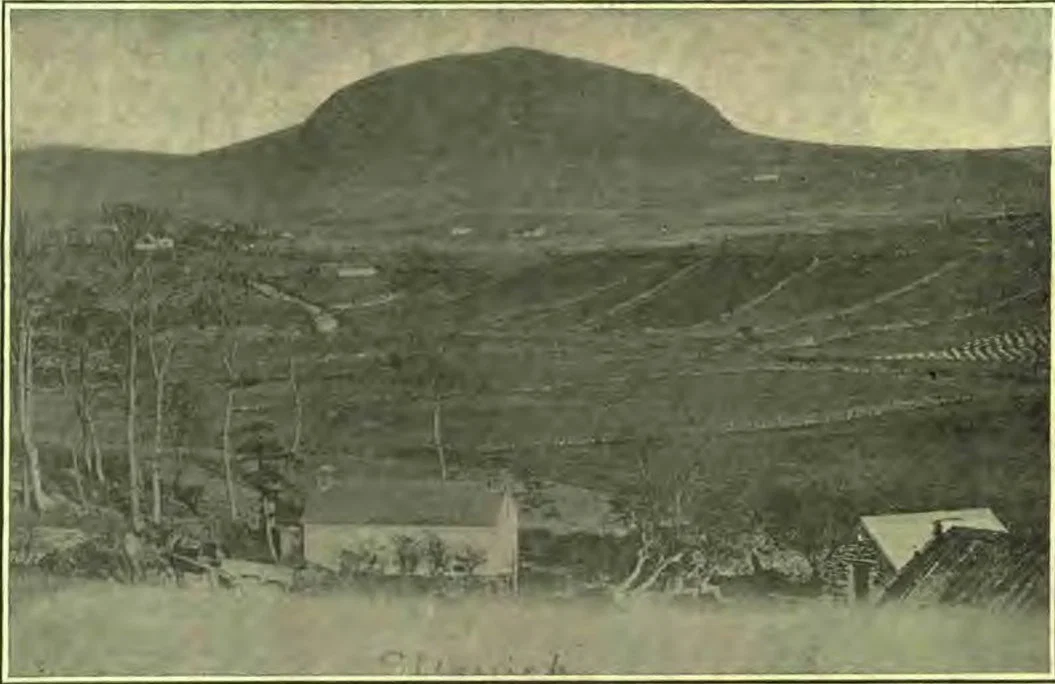
THE most interesting memorial of the beginning of Christian work in Ireland is Slemish Mountain, looming up amid the Antrim Hills. Here it was that Patrick led his flocks in ancient days. Then Ireland was mostly a wild tangle of forest. Now the mountainsides slope down into well-cultivated valleys, beautiful in the bright green of the Emerald Isle.
The name of Patrick has come to stand for all that is intensely Roman Catholic. As a matter of fact he was never a Roman Catholic at all. It was long after his death that they made him a Catholic, and put him in the calendar of “saints.”
SLEMISH MOUNTAIN
SLEMISH MOUNTAIN
Long before Catholic missionaries came down upon Britain, the gospel had been carried there. A portion of Britain was included in the Roman world of apostolic days. In that early time Paul could say that already the gospel had been carried into all the world. Col. 1:6.
In the year 208 Tertullian declared that there were Christian churches in the British Isles, even beyond the regions ruled by the Romans. The farther beyond the reach of Rome, the purer these churches were, too; for even within less than a century of apostolic times the mystery of iniquity had spread abroad like a plague, preparing to supplant God’s truth and Sabbath by heathen philosophy and observances.
About the year 411 a band of Irish pirates swept down upon the Scottish coast, south of the Solway, pillaging, slaughtering, and taking captives. Young Patrick, the son of Christian parents, was then carried away into slavery. The lad was set to herding his pagan master’s swine and cattle amid the hills of Antrim. Many a time from the top of Slemish he must have looked lovingly toward the sea that separated him from home and dear ones.
His sad lot was turned to his soul’s profit, however. “I was sixteen years old,” he wrote, “and I knew not the true God; but in a strange land the Lord brought me to the sense of my unbelief, so that, although late, I minded me of my sins, and turned with my whole heart to the Lord my God.” After six years of slavery he escaped, and made his way to his own home. But the herdboy had already begun his missionary training on the slopes of Slemish. He could not forget the darkness and ignorance of the land of his captivity, where he himself had given his heart in loneliness to God. As he meditated over it, he imagined voices crying to him across the sea, as Paul in vision heard the call from the coast of Macedonia. The cry from the Irish coast rang in his ears, “We beseech thee, child of God, come and again walk among us.”
Yielding to the missionary call, in spite of the entreaties of his friends, Patrick entered upon his life-work in Ireland. He knew the language of the people. He preached the word and pleaded with souls to receive it. Converts began to gather round him. Druidism was the religion of the land. The chief seat of this nature-worship was the royal capital on the hill of Tara, in Meath. There Patrick appeared one day, on the great spring sun-festival of Easter, and preached the gospel before the king in his own halls.
Arrayed about were the druid priests and ancient bards, who would gladly have put him to death, no doubt, had they not been restrained. There has survived a hymn, said to have been composed by Patrick as he prepared to face this great crisis in his early work. It is a prayer to God. “At Tara to-day, in this awful hour,” he pleads:—
“Christ be beside me
  • On left hand and right!
Christ be before me, behind me, about me! Christ this day be within and without me! Christ, the lowly and meek, Christ, the all-powerful, be In the heart of each to whom I speak, In the mouth of each who speaks to me! In all who draw near me, Or see me or hear me! . . . . . . . Salvation dwells with the Lord, With Christ the Omnipotent Word.”
He was delivered in that day, and lived to see the power of the druid worship shattered in all Ireland. No doubt Patrick’s view of truth was much obscured by tradition; but we are apt to do him injustice because of the fables and inventions by which later Romish writers covered the real Patrick. All the evidence goes to show him a preacher of the word, holding no allegiance to Romish authority. He reduced the ancient Irish language to writing, and gave them the Scriptures. He established schools, which became centers of missionary activity. Irish missionaries went out into Scotland and northern Europe, founding churches so free from tradition that Rome found them dangerous rivals, never ceasing until she had overcome and ruined them.
The historian of the Celtic church, Skene, traces the Sabbath-keeping of later times in Scotland to this early Irish church, founded by Patrick. He says that the later generations in north Britain “seem to have followed a custom of which we find traces in the early monastic church of Ireland, by which they held Saturday to be the Sabbath on which they rested from all their labors.”
The history of those early times is obscure. It was written by those steeped in Romish tradition. But it is evident from Skene’s testimony that as yet the primitive north British church had not lost the knowledge of the Sabbath, and Patrick, as he went over to Ireland from Britain, taught Sabbath rest by the fourth commandment to the people of Ireland as they forsook their native pagan worship. With his teaching, no doubt, were mingled elements of weakness, for the leaven of ecclesiasticism had early worked out into the remotest bounds.
Now again the Sabbath truth is being preached in Ireland, and with no admixture of tradition. Last summer I met with Elder Hutchins and others at Ballymena, where he was preaching the third angel’s message, almost within the shadow of Slemish, where Patrick so long ago led his herds.
There is now a great statue of Patrick on the hill of Tara, where once the druid altars blazed. It shows him with crook and mitre and bishop’s cape—a typical saint of Rome’s creation. I prefer as his memorial the green hill of Slemish, where a slave boy’s troubled heart was touched with a sense of God’s mercy and forgiveness. That was the Patrick who preached the word of salvation through all Ireland so long ago. It is the same word that Erin needs to-day.
W. A. SPICER.

The Christ-Formed Man

No picture ever painted, no statue ever carved, no cathedral ever builded, is half so beautiful as the Christ-formed man.— Rev. N. D. Hillis, D. D.

Good Angels

(Concluded)
THE Bible is filled with a record of the precious visits of angels who have come from the glory land to minister blessing to the children of the Lord or to execute his judgments upon the wicked. Jacob in vision beheld a ladder reaching from heaven to the earth, and the angels of God ascending and descending upon it. Gen. 28:12. Please read and carefully study the following scriptures:—
Angels revealed things to the prophets. Rev. 1:1; 22:8; Dan. 8:16; 9:21-23.
They superintend the proclamation of the gospel. Rev. 14:6, 7.
They announced the birth of Christ. Luke 2:10, 11.
They encamp around every child of God. Ps. 34:7.
Angels write in books the history of each person, even the most secret thing. Eccl. 5:6; Job 16:19; Eccl. 12:14; 11:9.
They assist in the judgment. Dan. 7:9, 10.
They are sent to answer the prayers of God's people. Dan. 10:3-13; 9:23.
An angel delivered Peter from prison. Acts 12:1-11.
Angels were with Paul on the stormy sea. Acts 27:23.
They cared for Elijah in the hour of trial and discouragement. 1 Kings 19:5-7.
An angel delivered Daniel in the lion's den. Dan. 6:22.
Angels opened the prison doors, and bade the Lord's servants go and preach the words of life. Acts 5:18-20.
They protected Job and all his substance. Chap. 1:9, 10.
They delivered Elisha and his servant in Dothan. 2 Kings 6:13-17.
They rejoice when sinners repent. Luke 15:10.
Angels were sent as messengers of destruction to Sodom. Gen. 19:13.
They were also sent to destroy Jerusalem. 1 Chron. 21:14-30.
An angel destroyed 185,000 warriors in the Assyrian army in one night. 2 Kings 19:35.
An angel smote King Herod. Acts 12:23.
Angels will pour out the seven last plagues. Rev. 15:1; 16:1-17.
They cast the wicked into a “furnace of fire.” Matt. 13:39-42.
They gather the saints. Matt. 25:31; 24:30, 31.
Many more texts could be cited to show the wonderful manner in which angels are interested in the affairs of mankind in this world.
They love fallen man. “Angels were so interested for man's salvation that there could be found among them those who would yield their glory and give their life for perishing man.”—“Early Writings,” Supplement, page 40.
“I saw angels over the saints with their wings spread over them. Each saint had an attending angel. If the saints wept through discouragement, or were in danger, the angels that ever attend them would fly quickly upward to carry the tidings, and the angels in the city would cease to sing. Then Jesus would commission another angel to descend to encourage, watch over, and try to keep them from going out of the narrow path; but if they did not take heed to the watchful care of these angels, and would not be comforted by them, but continued to go astray, the angels would look sad and weep. They would bear the tidings upward, and all the angels in the city would weep, and then with a loud voice say, Amen. But if the saints fixed their eyes upon the prize before them, and glorified God by praising him, then the angels would bear the glad tidings to the city, and the angels in the city would touch their golden harps and sing with a loud voice, Alleluia! and the heavenly arches would ring with their lovely songs.”
—“Early Writings,” Experience and Views, pages 31, 32.
We should continually praise the Lord for the care of the good angels, and live each day so they can make the record of our lives with joy and not with tears. It is a solemn thing to know that an unseen, heavenly secretary is making a faithful daily record of our lives!
G. B. THOMPSON.

Our Friends the Trees

To know the trees, especially our fine American forest trees, is to possess friends whose character can always be depended upon, and whose intimate acquaintance brings continual and increasing pleasure.
As one becomes acquainted with these noble and beautiful plants, he soon finds that each tree differs from every other tree just as each human being differs from his fellows, and yet there are families and classes of trees just as there are races and nations among men.
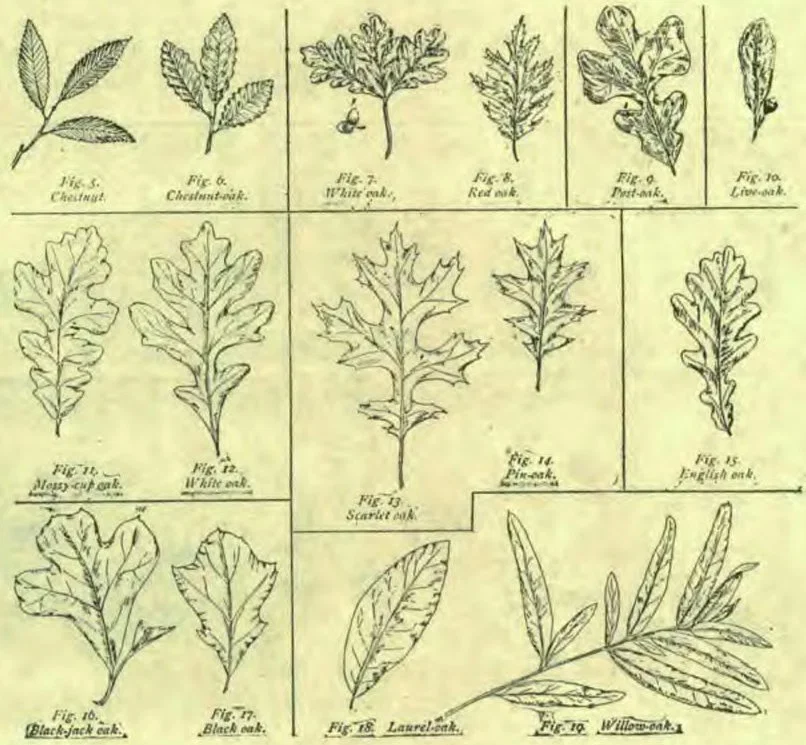
Fig. 5. Chestnut. Fig. 6. Chestnut-oak. Fig. 7. White oak. Fig. 8. Red oak. Fig. 9. Post-oak. Fig. 10. Live-oak. Fig. 11. Alleghany oak. Fig. 12. White oak. Fig. 13. Scarlet oak. Fig. 14. Pin-oak. Fig. 15. English oak. Fig. 16. Black-jack oak. Fig. 17. Black oak. Fig. 18. Laurel-oak. Fig. 19. Willow-oak.
It is quite a wonderful thing to know that in a forest containing thousands of trees, with their millions of leaves, no two leaves are exactly alike, and yet we can readily distinguish the maple leaves from those of the oak, the beeches from the birches, and so on through the list, just as we can tell Chinese from negroes, and Indians from white men, in the human family.
On the other hand, some leaves are so nearly alike that we must observe them very carefully in order to discover whether they belong to the same kind of tree. For example, in Figs. 5 and 6 we have two leaves, which, at the first glance, seem quite similar, but which, on closer examination, prove quite different. The one on the left is the chestnut, so dear to all of us, while the other, which is wider and has rounded instead of sharp teeth along its edges, is the chestnut-oak.
Of course if we had the two trees standing side by side, we could distinguish them immediately by their fruit, because one would bear burs containing chestnuts and the other acorns. The chestnut-oak is a true oak, and is so named simply because its leaves so closely resemble those of the chestnut. It is a noble tree, and grows to a great size, often being found a hundred feet in height. There is one near Fishkill-on-the-Hudson famous for its age and size. This tree is seven feet in diameter. It is claimed that in 1783 Washington used to mount his horse under it when he rode from his headquarters to the army encampment at Fishkill.
Sometimes we better appreciate the value of a tree if we know of what use it is to us. The chestnut-oak, besides being one of our most beautiful trees and valuable for the timber it furnishes, has a bark which is rich in tannin, a substance used extensively in tanning leather.
The chestnut-tree needs no description to American boys and girls, as we all have spent glorious days in the crisp autumn weather searching for the plump brown nuts in the dry leaves, and afterward roasting them over blazing hot fires during the long winter evenings.
The boys may be interested to know that chestnuts prove a very profitable crop. Experts claim that an orchard of chestnuts will bring greater returns to the owner than an apple orchard of the same size, as the nuts are retailed on the street corners at about six dollars a bushel, while the Italian who sells roasted chestnuts receives pay for them at the rate of at least eight dollars a bushel. The tree is one of our most rapid growers, and has been known to bear fruit at five years of age.

The Oaks

The large family of American oaks is one of which we are justly proud, and it is difficult to say which is the finest. Among trees the oak stands for all that is sturdy, reliable, hardy, and useful—a symbol for the honest, true, and patriotic citizen among men. Although it is perhaps not as graceful as the elm, nor as luxuriant as the magnolia or the palm, its strong and heavy trunk, its gnarled branches, and its clean, healthy foliage give it a prominent place among our American trees. Its wood ranks high as valuable timber, being strong, hard, and durable, with a handsome grain which takes a fine polish.
Figs. 7 and 8 show the leaves of the two oaks which are the best known and most common about New York City. Their leaves are so different that they can never be confounded. The white-oak leaf is deeply indented and has rounded lobes; there is not an angle nor sharp point anywhere on the leaf; while the red-oak leaf on the right is sharply toothed and bristling with points. Both of these leaves are large, the white-oak being of a beautiful light-green color, while the red-oak is darker, stiffer, and very glossy.
Both trees grow to a very large size, and their timber, which is used extensively in shipbuilding, carriage-making, cooperage, and cabinet-work, is the standard among woods for strength and durability.
There are several kinds of oak closely related to these two trees. For instance, the post-oak (Figs. 2 and 9) has a leaf resembling the white-oak in shape, yet it is a simple matter to distinguish either the trees or individual leaves. The leaves of the post-oak are very much darker, thicker, and more leathery than the delicate and refined leaf of the white oak, and the indentations are not so deep. The whole tree is rougher in its bark, leaves, and general appearance, and the leaves have a habit of clothing the entire branch, from the point where it leaves the trunk out to the very tip. The wood is so hard that the tree is often called the iron-oak. It is very common on Long Island and all along the eastern coast of the United States.
Another tree which resembles the white oak is the magnificent mossy-cup or overcup oak, with its long, shiny leaves, which are sometimes a foot in length. Figs. 11 and 12 show the difference between the two leaves; but the principal points of difference are the peculiar, corky ridges found on the young branches of the mossy-cup, and the beautiful, single acorns of the latter, with the heavy fringe around the nuts, from which the tree takes its name. This tree is primarily a Western oak, and reaches its finest development in the Mississippi Valley, but is occasionally found in the Eastern States. It grows to a great height,—one hundred and fifty feet being not unusual,—and its wood is of a superior quality.
The great oak family might be divided into two classes; those that ripen their acorns in one season, such as the white, post, and mossy-cup oaks just mentioned, and those which require two full years, such as the red, scarlet, and black oaks. To the first class belong the chestnut-oak and the live-oak of the South. This latter tree for generations played an important part in shipbuilding, but has now been superseded by iron and steel. The leaf, which is an evergreen, is entirely without indentations, and is thick and leathery. The wood is very heavy and strong, has a beautiful grain, and is susceptible of taking a high polish. At one time this wood was so valuable that our government paid two hundred thousand dollars for large tracts of land in the South, that our navy might be sure of a supply of live-oak timber.
To the second class of oaks we are largely indebted for the gorgeous colors of our autumn leaves. The red, scarlet, and pin oaks, with their brilliant reds, scarlets, and browns, are close competitors with the maples in giving our American landscapes the most wonderful autumn colorings to be found anywhere in the world. These three trees have leaves which at first glance are quite similar, but by careful examination may always be distinguished.
The red-oak is an unusually large one, of a dark-green color and very shiny. By comparing the sketch of it with that of the scarlet oak, it will be apparent that the indentations are not nearly so deep in the former, which has a broad, massive appearance, while the latter is so deeply indented as to give a skeleton effect. The deeply cut foliage of the scarlet oak makes it the more handsome tree of the two, but each of these oaks grows to a large size, and is valuable both as a shade and a timber tree.
The novice at tree study is much more apt to confuse the scarlet and pin oaks than the red and scarlet. Referring again to the diagram of leaves, one sees at a glance that the pin oak has a smaller leaf than the scarlet oak, and this difference in size appears to even better advantage on the trees than in the drawing.
The pin oak, which has recently become a favorite among nurserymen as an ornamental tree, takes its name from the pin-like appearance of the tiny branches which sprout from the main trunk and the limbs; its timber, however, is not so valuable as some of the other oaks. No list of oaks which are common about New York would be complete without the black-oak and the black-jack varieties. These two trees—the latter being sometimes called the barren oak—thrive in exposed and sterile regions, such as the sandy flats of New Jersey and Long Island, where no other tree except a stunted pine seems able to live. Their whole appearance, from the individual leaf to the framework of the stripped tree, is summed up in the two words “tough” and “rugged.” The leaves are tough and leathery, while the wood is gnarled and strong, and altogether these trees are in perfect harmony with their wind-swept surroundings. The leaf of the black-jack oak (Fig. 16) may be easily recognized by its three lobes or rounded points, from which it rapidly tapers to a point at the stem. The leaf of the black oak (Fig. 17) is very slightly indented for an oak leaf, the sharp points being few, far apart, and separated by shallow recesses, as shown in the sketch.
Occasionally one will find in the parks or along the roadside an oak which bears fine, large acorns, with a leaf which somewhat resembles our white oak, but is poorer, smaller, and very inferior in size and symmetry. This is the famous English oak (Fig. 15), which has been imported into this country as a shade-tree. A curious thing in connection with this leaf is the fact that practically all of the wood-carving we use, in which oak leaves and acorns are prominent features, represents the English oak. Our artists will find a mine of wealth in our American oaks and acorns that has hardly been touched.
Then, too, we find some interesting freaks in the oak family: such as the willow-oak, whose leaves closely resemble the long, narrow, and familiar leaves of the willow; and the laurel-oak, whose thick, glossy, and dark-green leaves remind us of our evergreen laurel. These two varieties are not common around New York, however, but reach their highest development in the South and West; the willow-oak being a remarkably beautiful shade-tree, familiar to all dwellers below Mason and Dixon’s line.—Edwin W. Foster, in St. Nicholas.

Wonders of the Depths of the Sea

“THAT one animal can devour another twice its own size, at a single swallow, is a statement that may seem as incredible as any fish story ever invented,” writes Dr. Sanderson Christison. “Nevertheless, it is true of certain fishes. The chiasmodus niger, six and five-eighths inches long, has been found to have swallowed another fish ten and a half inches long. The stomach of the devourer is stretched as thin as goldbeater’s skin. It has sharp, hooked teeth, which cross each other from opposite sides of the mouth, and usually point backward. According to Gunther, the fish, after having seized its victim with its capacious and very movable jaws, partly presses it down as a snake would do, and partly draws itself over it. The prey is received into an esophagus and stomach the membranes of which are as extensible as an india-rubber pouch.
“When a deep-sea fish is brought to the surface, how gradually and carefully soever, its bones are often like so much touchwood, and its muscles like rotten pulp, while its eyes are burst from their sockets, and its viscera are often blown out of the body cavity by the expansion of the air-bladder.
“Deep-sea fishes are commonly black or dark brown. But although it is claimed that light is essential to the formation of colors, some deep-sea fishes are scarlet in parts, or uniform red or rosy. Others are silvery white, while, according to Alcock, the neoscopelus is ‘one dazzling sheen of purple and silver and burnished gold.’”

The Dream Composition

A CLEAN white sheet of paper, With “Trees” written up at the head. “What else can I say?” sighed little May. “Why, trees are just trees,” she said. “There’s oak-trees, and maples, and cedars, And grandfather’s willow-tree, And hemlocks and spruces, but all of their uses I never can tell!” sighed she.
Then something wonderful happened, So strange it was like a dream, For into the nursery came trooping All the trees, in a steady stream! And one at a time before May Each stopped and merrily spoke. “It’s I make your chairs and your tables and stairs, And your sideboards and beds,” said the oak.
“I’m at my best making shingles,” The cedar-tree smiled and said. “And my special use,” spoke up the spruce, “Is to make the house over your head.” “Any kind of a box I can make you, Except a bandbox,” laughed the pine, “And whenever you ache, you have only to make A pillow with needles of mine.”
The ash-tree was swinging a basket. “I made it!” he gaily cried. “Any other basket—you’ve only to ask it— I’ll make with the greatest of pride.” “Shall I make you a beautiful whistle?” Grandfather’s willow smiled. “Just tap me and see,” cried the maple-tree, “What makes maple-sirup, my child.”
The last in the merry procession The birch-tree proved to be. And he smilingly said, as he nodded his head, “I’m the spool manufactory!” Then—deary me!—did you ever? Mistress May’s eyes open flew, And the dream was o’er, but no matter, for Every word in the dream was true! —Eleanor Woodbridge.

A Water Observation Boat

CAPT. J. LARSEN, a sailor on the Great Lakes, has just received patents on a new form of pleasure boat. The boat is supplied with a glass bottom, and under the bottom is an electric light, which will illuminate the water and the bed of the stream for some distance around. A hooded reflector makes it possible to sit comfortably in the boat and witness the curious things in the water below with great ease, and pictures may be taken also by means of a mirror. The captain has in his possession a number of photographs which were taken by this means, and these are said to be quite satisfactory, although they were made when the water was clouded with dirt washed down into it.—American Inventor.

Fortunate Countries

DENMARK claims that there is not a single person in her domain who can not read and write. On the northwest coast of New Guinea, the island of Kutaba, surrounded by a wall of coral three hundred feet high on one side and from fifty to one hundred feet on the other, maintains thirteen villages of natives, to whom war, crime, and poverty have been unknown since the beginning of their traditions. The most peaceful and comfortable community in Europe is the commune of the Canton Vaud, in Switzerland. Nearly every one is well off, and there are no paupers. Finland is a realm whose inhabitants are remarkable for their inviolate integrity. There are no banks and no safe deposits, for no such security is essential. You may leave your luggage anywhere for any length of time, and be quite sure of finding it untouched on your return, and your purse full of money would be just as secure under similar circumstances. The Finns place their money and valuables in holes in the ground and cover them with a big leaf. Such treasure is sacredly respected by all who pass it, but, in the rare event of a man’s wishing to borrow of his neighbor during his absence, he will take only the smallest sum he requires, and place a message in the hole telling of his urgent need, and promising to repay the amount on a specified date. And he will invariably keep his word, for the Finn is invincible in his independence.—Golden Penny.

Enterprise of the Age and the Slow Church

This is the age of world-wide enterprises. Everything moves with a rapid foot, and time and space are annihilated. With a swiftness, credible only when witnessed, men push to the confines of the globe to find treasures or to bear inventions. The church of God alone moves slowly!—A. T. Pierson.

China’s Cry, “Come Over and Help Us”

[THE following letter was read by Brother J. N. Anderson to the General Conference. It is from a Chinese brother who has recently received the truth in Amoy.—Ed.]
To the Seventh-day Adventist General Conference, Pastors, Teachers, Venerable Sirs, Great Men, A. Eng sends Greeting:—
I thank God for his great mercy in sending his Holy Spirit to give me an understanding of the important truth of the Sabbath. Although the Presbyterian Church has cast me out, yet I know that I have gained the favor of my Heavenly Father, and this is a comfort to me.
Having heard Pastor Anderson say that your venerable conference will soon convene, I am happy, although I have not had the privilege of seeing your faces, for the love of God binds us together as one body. I humbly pray that God will show mercy to you all that you may be filled with the Holy Spirit as on the day of Pentecost. See Acts 2:1-4.
At this time in my country, Fukien Province, there are many people, but God’s true church has not yet been fully established. They are scattered abroad “like sheep having no shepherd. The harvest truly is plenteous, but the laborers are few. Pray ye therefore the Lord of the harvest to send forth laborers into his harvest.” See Matt. 9: 36-38. I ask each one of you, reverend pastors, to consider God’s love for man and select many clean, hot-hearted pastors, doctors, and lady missionaries to come to Amoy that the church may be established in every prefecture and district of Fukien Province, that all may hear the Saviour’s true word, so when Jesus comes again, the gospel will have been preached to all. Amen.
With love and greetings to you all.
KEN TSU ENG.

Young People's Conventions

ON Sabbath, May 13, a Young People's convention was held in Alameda, California. This was attended by nearly all the young people of the San Francisco, Oakland, Berkeley, and Alameda churches, and there were also present delegates from Healdsburg, Mountain View, and Calistoga. Our Alameda friends had the pleasure of seeing their church filled to overflowing for the first time in its existence. We saw a demonstration of the fact that a small church filled is more pleasant and inspiring than a large one with half its seats vacant.
Three sessions of the convention were held; the first being from 11 to 12:15. After words of greeting from the leader of the first Young People's Society ever organized in Alameda, the State secretary spoke briefly of the objects of the convention, which were to arouse all to a deeper sense of our need of spiritual power, to unite hearts in more earnest effort to spread the gospel in both home and foreign fields, to help those of our number who are growing cold, and are in danger of drifting away from the fold of Christ, and to lay plans for making the soon-coming camp-meetings seasons of great blessing to our young people.
The remainder of the morning session was devoted to stirring reports from the secretaries of the various Societies. This was the most interesting part of the program. As we listened to reports of what has been, and is being done, every heart must have thrilled with thankfulness for the privilege of having a part in this great gospel message for the end of the world.
All had come provided with lunch, so as to avoid the possibility of being late to the afternoon services. The weather was everything that could be desired, and the surroundings most favorable for a pleasant hour. In the large yard back of the church, numerous tables and chairs had been placed in the shade of wide-spreading trees. Here some repaired for lunch, while others carried their baskets to the ocean beach only a short distance away.
At two o'clock all were again gathered in the church, ready for a study of plans for earnest, active work. Three general subjects were presented and discussed: What the Young People Can Do in the Home Field, The Needy Foreign Field, and What We Can Do at Home to Help the Fields Abroad. As the contrast was drawn between our privileges and the privileges of those lands across the sea, many felt that they would gladly give themselves and all they have to help carry the good news to those needy foreign fields. The missionary secretary of the conference read an interesting summary showing how nearly six hundred persons have been brought to a knowledge and acceptance of the third angel's message, mostly through reading. This suggests to us one very important way in which we can help the fields abroad, as all that we do to bring others to the truth, helps, not only in the home field, but in the foreign field as well.
The third and last session was held from 3:45 to 5 P. M. An excellent paper on the Privilege, Importance, and Necessity of Prayer was followed by a recital of personal experiences in blessings received through prayer. The next two subjects were Cultivation of Christian Courtesy, and Consecration of Our Voices. Excellent points were presented, and Bible examples were cited on both these subjects. The writers suggested that our own people had neglected to give the attention to these subjects which they deserve.
The exercises of the day were interspersed and enlivened by vocal quartets, duets, solos, and several productions as well as by congregational singing.
A substantial proof of the interest of our young people in the work was given in the form of a donation of $32.56 to the Washington One Hundred Thousand Dollar Fund.
The convention closed with earnestly expressed wishes for another to be held in the near future. But even after so long and busy a day, the young people lingered about the place, and twilight found groups, here and there, discussing ways and means for carrying forward the missionary work which has been so nobly begun in California. May this spirit increase and strengthen till all our young people shall be enlisted under the banner of the greatest Missionary the world has known.
MRS. CARRIE R. KING, State Secretary of Young People's Work.

THE WEEKLY STUDY

Paul’s Defense Before Felix

OPENING EXERCISES.
SCRIPTURE FOR STUDY: Acts 24: 10-23.
REFERENCE STUDY: “Sketches from the Life of Paul,” pages 237-239; “Great Controversy,” chapter 38.
TOPICS FOR STUDY:—
Paul permitted to speak.
Makes his defense.
Denies the charge of sedition.
Believes the law and the prophets.
Teaches two resurrections.
Clear conscience.
Came to bring alms.
Accusers should be present.
Felix deferred sentence.
Paul left in charge of centurion.

Notes

The events of this lesson occurred about the year A. D. 58. Felix had been governor for six years.
Now, as in the days of Paul, to believe “all things which are written in the law and in the prophets” is deemed heresy by many of the professed people of the Lord.
“The apostle spoke with earnestness and evident sincerity, and his words carried with them a conviction of their truthfulness. Moreover, his statements were in harmony with the letter of Claudius Lysias. Felix himself had so long resided at Cæsarea—where the Christian religion had been known for many years—that he had a better knowledge of that religion than the Jews supposed, and he was not deceived by their representations. The words of Paul made a deep impression upon his mind, and enabled him to understand still more clearly the motives of the Jews. He would not gratify them by unjustly condemning a Roman citizen, neither would he give him up to them to be put to death without a fair trial. Yet Felix knew no higher motive than self-interest, and his love of praise and desire for promotion controlled him. Fear of offending the Jews held him back from doing justice in the case, and releasing a man whom he knew to be innocent.”
“Paul was again placed in charge of a centurion, but with orders that he should enjoy greater freedom than before his examination. While it was necessary for him to be strictly guarded, as a protection from the plots of the Jews, and also because he was still a prisoner, his friends were to be allowed to visit him and minister to his comfort.” G. B. T.

The Second Advent

“A TIME shall come when Nature’s laws Will from their course be turned, And then the proud, rebellious ones Will see ambition spurned. The midnight gloom o’erspreads the sky, Such gloom was never known, When Christ, himself in cloud of fire, Shall come to take his own.”

The Young People Are Helping

An organized effort is now being made in Pittsburg and Allegheny to have the Pennsylvania Sunday laws more faithfully enforced. The Young People’s Society of the Pittsburg church has planned to take an active part in the work opposing the movement. They have ordered one thousand of each of the religious liberty leaflets that have been recently published. These four tracts are, “Principles Too Little Understood,” “Sunday Laws,” “The Logic of Sabbath Legislation,” and “The Civil Sabbath.”
The Society purposes distributing these leaflets to ministers, business men and civil officers of the cities of Pittsburg and Allegheny.
It is encouraging to see our young people awake to the opportunity afforded them by the agitation of this question.
MRS. L. FLORA PLUMMER.

Words Are Things of Little Cost

“WORDS are things of little cost, Quickly spoken, quickly lost; We forget them, but they stand Witnesses at God's right hand, And their testimony bear For us or against us there.”

Orderly Habits

“A DISTINGUISHED scholar and writer, whose clear and powerful speeches and essays are no less noted than the vast amount of work for which he has time, says that when he began to study, he was very careless about the order of his room and his belongings. A teacher gave him the following advice, which he heeded, and to this he attributes much of his success: ‘If you want facts and ideas arranged in your head so as to find them, put your hat and shoes and books in some sort of order around you. Orderly habits cultivate orderly brains.’”
Continue reading: Insects and Their Habits, and What Harold Learned About Them