Your ShelfYour Projects

Signs of the Times, Vol. 42, No. 10.

And There Was Violence in the Land

Signs of the Times

Mar 9, 1915

Pacific Press Publishing Association · Mountain View, California · Mar 9, 1915

“And There Was Violence in the Land”

The Unemployed and the Voice of Discontent—Will These Conditions Be Improved? What Will Be the Solution of Our Social Problems?
THE problem of the unemployed has been increasing in perplexity. Last winter it reached acute and violent conditions in quite unprecedented proportions. But this winter the problem has returned greater and more distressing than ever. Governors of states are calling councils to consider it. The central government at Washington is giving it attention. Ex-president Roosevelt has proposed to stump the United States in the interest of the unemployed.
The North American Civic League for Immigrants, through its legislative committee, said as early as December 12 that “there are already ominous signs that unemployment this winter is far greater than last. If it is not proved by trade records, it is attested by municipal lodging house superintendents and mission managers. Already the municipal lodging house in New York is taxed to its capacity. . . . It is no time to preach the salutary influence of a firm belief that the world goes well. The first north windstorm of the winter is insistently sounding a different note. Thousands of men without work, without homes, are turned loose on communities. In full possession of abilities, of decent manhood and womanhood, they are nevertheless helpless. There is no work. They have no money and no home. Are they to look to jails and charities for shelter and aid, and to these only? What is the reason for their situation, what the real nature of their need?”
“The divine Book . . . foretells the fact that violence would characterize the last days.”
It is estimated that New York alone has half a million men out of employment. Hundreds of men in different sections of the country are roaming about asking for work and begging for bread. It will not do to throw this situation aside with a wave of the hand and the remark that “they are nothing but tramps.” If you will take the pains to mingle among them, you will find many of these men refined, educated, and industrious. They are willing to work if they could find something to do. But this generation has educated millions of men into the habit of working under the direction of some one else; and when they are thrown out of employment, they are in a pitiable, even hopeless condition. They know not which way to turn or what to do.
But to state facts of this kind, will not relieve the distress; and to say that such conditions ought not to exist in a so-called Christian land, will not cure the social malady. These conditions are here, and are becoming more aggravated and chronic month by month. There may be a little relief in the summer, only to have the recurrence of the problem of unemployment in more distressing forms the following winter. We have well-nigh reached the breaking point in this country.
Conditions similar to these existed in the Old World. England, just previous to this great European war, was floundering about in a hopeless effort to weather the storm of unemployment. Parliament was seeking to enact laws and devise ways and means to dispel the discontent that was within her borders through a lack of bread and clothing. In like manner Germany, and practically all the other nations of the continent, and of the far East as well, were grappling with similar situations. There was distress and discontentment everywhere.
When Europe’s war came, it burst forth like an explosion. People were not expecting it. Yet if they had been studying the conditions closely, they would have seen that just such a thing might be expected in view of the conditions that prevailed.

THE WAR SEEMED A RELIEF

Rulers, without much question, have found the war that is now in progress to be in some respects a relief from the perplexities and the distresses that preceded it; and many individuals are expressing the hope that immediately following the war, there will be a great change for the better. But we must not allow our hopes to becloud our judgment, and especially must we guard against setting aside the prophecies that speak so plainly concerning the conditions that will prevail throughout the world until the end of time. It may seem pleasant to us to think of matters being greatly improved after this war; but we will find, instead, that bitterness and hatreds have been created that will quickly make conditions far worse than they have ever been before. And in view of the constantly increasing discontent in this country, our nation may not hope to escape a social storm.
There is a possibility of a brief interval of prosperity, particularly in the nations that have remained neutral during this war; but that prosperity will be suddenly broken if it comes at all. There are deep-seated principles of immorality and selfishness working in the world with an unprecedented intensity, and these things that are working are bound to produce their results.
God’s word has compared the days in which we live to the days of Noah; and of that time the record in the Bible says: “The end of all flesh is come before Me; for the earth is filled with violence through them; and, behold, I will destroy them with the earth.” Gen. 6:13. And, “As it was in the days of Noe, so shall it be also in the days of the Son of man.” Luke 17:26.

THE VIOLENCE IN NOAH’S DAY

In Noah’s time, the inspired history informs us, the earth was “filled with violence.” And if there is any one thing that marks the days in which we live, more strongly than anything else, it is the violence that prevails to so large an extent. The war that is now raging in Europe is simply the expression of the violence that men had been storing up in their hearts.
The one paramount factor in creating sentiments of violence is the controversy between the capitalist and the laborer. Upon this topic the apostle Paul has said to us: “But know this, that in the last days grievous times shall come. For men shall be lovers of self, lovers of money.” 2 Tim. 3: 1, 2. In other words, men will be selfish and greedy for gain; and this selfishness and greed will be so marked, and so colossal in its proportions, that it will create perils in the last days.
This greed and love of self is not confined to the men of wealth by any means, for the disposition of those who are unsuccessful in the race for money and pleasure is in most cases the same as that of the ones who succeed. The disappointment through failure creates bitterness. Oftentimes the failure of the unsuccessful one is charged to some trickery or fraud on the part of those who have succeeded in seizing the wealth and who are reveling in luxuries and wantonness. This breeds the bitterest and the most deep-seated discontent. Hence we see that the divine Book not only foretells the fact that the spirit of violence would characterize the last days, but it also shows us what will be one of the leading causes that underlie it.

JUSTICE IS LACKING

The sentiment is strengthening every day, that the privileged classes are increasing in power, and that there is no justice for any one unless he is able to command it with money. And as affirmed by a lord chancellor of England, “There is nothing which will so dissociate men, which will drive nations to madness so quickly, as the belief that the justice of the country is not honestly and impartially administered.”
Not only is the stress of industrial wars in this nation a menace to the lives and the holdings of wealthy men, but a cataclysm of revolution is threatened that will strike every part of society; for once the violent forces are turned loose, the man of modest means who has honestly acquired every dollar he possesses, is liable to become the target of the excitable mobs, whose movements are directed rather by flighty sentiment than by reason and judgment.
Every nation has her contending elements. Solidity and union in society can be found in no country. And while this has always been true to a limited extent, there have never been presented such conditions and such social dangers as to-day. And where so many influences are working, and all at cross-purposes with one another, it is evident that this seed sowing will produce a harvest of anarchy and violence the like of which the world has never seen.

WILL A REVOLUTION PURIFY?

Some have suggested that these conditions betoken a great revolution that will purify the world. But a revolution of purification could never come out of this murky sea of discontent and strife; for not only is society broken up into these warring factions, but there is such a prevalence of immorality and criminality that the only result that could come from the breaking loose of these forces would be the absolute chaos of anarchy itself.
“Are They to Look to Jails and Charity for Shelter and Aid?”
God is not the author of the distressing, perplexing conditions that are in the world; but through His prophetic word, He is seeking to impress upon every heart that the situation to-day demands something very unusual. Furthermore, this Word of inspired prophecy shows us that the thing that will bring an everlasting end to the reign of sin is the second coming of Christ, and the event cannot long be delayed.
While we may have a brief time of apparent peace, and little periods of prosperity, yet the prevalence of violence, bred by the conditions through which the world is passing, will become worse and worse until the climax is finally reached. “So Christ was once offered to bear the sins of many; and unto them that look for Him shall He appear the second time without sin unto salvation.” Heb. 9:28.

In a Desert

Apropos of a recent Sabbath lesson, the English translation has it that Jesus was led into the “wilderness.” Other languages give this as “led into the desert.” Many associate the idea of trees or forest with the word “wilderness.” It is improbable that in such a place Jesus would have to starve. John found locusts and wild honey there. But one can realize the awfulness of being in a “desert” forty days — nothing near but sand and rocks. And Satan, pointing to rocks, says, Turn the stones into loaves of bread. Had this occurred in a forest, he would have been more likely to say, Turn those trees into food. J. H. H.

Everlasting Love

“THE Lord hath appeared of old unto me, saying, Yea, I have loved thee with an everlasting love; therefore with loving-kindness have I drawn thee.”

Our Abiding Inheritance

By A. M. DART
“BLESSED are the meek; for they shall inherit the earth.” This earth is not a safe place to dwell under existing conditions. One’s life is endangered by evil men, by storms, floods, fires, earthquakes, disaster by sea and land, not to mention sickness and disease in numerous forms. Indeed, where shall we stop if we begin to enumerate the dangers to life in this world? But when “the eyes of the blind shall be opened, and the ears of the deaf shall be unstopped”; when the lame man shall “leap as an hart, and the tongue of the dumb sing”; when “the parched ground shall become a pool, and the thirsty land springs of water”; when righteousness covers the earth as the waters cover the sea,—it will be quite a different place. Then “the ransomed of the Lord shall return, and come to Zion with songs and everlasting joy upon their heads: they shall obtain joy and gladness, and sorrow and sighing shall flee away.” See Isaiah 35.

How to Possess It

The apostle Peter speaks of our inheritance as “incorruptible, and undefiled, and that fadeth not away.” Now to come into possession of such an inheritance means that the possessor shall be “incorruptible and undefiled”; so we read: “Now this I say, brethren, that flesh and blood [mortal state] cannot inherit the kingdom of God; neither doth corruption inherit incorruption.” 1 Cor. 15: 50. So in considering our inheritance, we must solemnly consider the steps to be taken to become pure. There is one source only of purity—one fountain alone into which we may plunge to gain this much to be desired end.
Paul was sent to the gentiles “to open their eyes, and to turn them from darkness to light, and from the power of Satan unto God, that they may receive forgiveness of sins, and inheritance among them which are sanctified by faith that is in Me.” Acts 26: 18. This inheritance is obtained only through forgiveness of sins. Forgiveness of sin includes the forsaking of sin. “What shall we say then? Shall we continue in sin, that grace may abound? God forbid. How shall we, that are dead to sin, live any longer therein?” Rom. 6: 1, 2.
Sin is death. Col. 2: 13. As we would avoid one, so must we avoid the other.

Death Is Swallowed Up

Not in this mortal state do we reach our inheritance. But “behold, I show you a mystery: We shall not all sleep [die], but we shall all be changed, in a moment, in the twinkling of an eye, at the last trump; for the trumpet shall sound, and the dead shall be raised incorruptible, and we shall be changed. . . . So when this corruptible shall have put on incorruption, and this mortal shall have put on immortality, then shall be brought to pass the saying that is written: Death is swallowed up in victory.” 1 Cor. 15: 51-54.
Thus He who “worketh all things after the counsel of His own will,” prepares an “incorruptible and undefiled” people for an “incorruptible and undefiled” inheritance.
“And now, brethren, I commend you to God, and to the word of His grace, which is able to build you up, and to give you an inheritance among all them which are sanctified.” Acts 20: 32.

The One Desirable Pearl

Heaven’s Love for Lost Humanity—The Needs and Longings of the Soul Satisfied in Christ—He Gives Himself, but Wants Us in Return—The Father Gives All the Riches of the Universe to Redeem Us
By Mrs. E. G. White
The blessings of redeeming love our Saviour compared to a precious pearl. He illustrated His lesson by the parable of the merchantman seeking goodly pearls, “who, when he had found one pearl of great price, went and sold all that he had, and bought it.” Matt. 13: 46.

THE PEARL OF GREAT PRICE

Christ Himself is the pearl of great price. In Him is gathered all the glory of the Father, the fullness of the Godhead. He is the brightness of the Father’s glory and the express image of His person. The glory of the attributes of God is expressed in His character. Every page of the Holy Scriptures shines with His light. The righteousness of Christ, as a pure, white pearl, has no defect, no stain. No work of man can improve the great and precious gift of God. It is without a flaw. In Christ are “hid all the treasures of wisdom and knowledge.” Col. 2: 3. He is “made unto us wisdom, and righteousness, and sanctification, and redemption.” 1 Cor. 1: 30. All that can satisfy the needs and longings of the human soul, for this world and for the world to come, is found in Christ. Our Redeemer is the pearl so precious that in comparison all things else may be accounted loss.

NOT ALL WERE INDIFFERENT

Christ “came unto His own, and His own received Him not.” John 1: 11. The light of God shone into the darkness of the world, and “the darkness comprehended it not.” Verse 5. But not all were found indifferent to the gift of heaven. The merchantman in the parable represents a class who were sincerely desiring truth. In different nations there were earnest and thoughtful men who had sought in literature and science and the religions of the heathen world for that which they could receive as the soul’s treasure. Among the Jews there were those who were seeking for that which they had not. Dissatisfied with a formal religion, they longed for that which was spiritual and uplifting. Christ’s chosen disciples belonged to the latter class, Cornelius and the Ethiopian eunuch to the former. They had been longing and praying for light from heaven; and when Christ was revealed to them, they received Him with gladness.
In the parable, the pearl is not represented as a gift. The merchantman bought it at the price of all that he had. Many question the meaning of this, since Christ is represented in the Scriptures as a gift. He is a gift, but only to those who give themselves, soul, body, and spirit, to Him without reserve. We are to give ourselves to Christ, to live a life of willing obedience to all His requirements. All that we are, all the talents and capabilities we possess, are the Lord’s to be consecrated to His service. When we thus give ourselves wholly to Him, Christ, with all the treasures of heaven, gives Himself to us. We obtain the pearl of great price.

THE GIFT TO BE BOUGHT AND SOLD

Salvation is a free gift, and yet it is to be bought and sold. In the market of which divine mercy has the management, the precious pearl is represented as being bought without money and without price. In this market all may obtain the goods of heaven. The treasury of the jewels of truth is open to all. “Behold, I have set before thee an open door,” the Lord declares, “and no man can shut it.” Rev. 3: 8. No sword guards the way through this door. Voices from within and at the door say, Come. The Saviour’s voice earnestly and lovingly invites us: “I counsel thee to buy of Me gold tried in the fire, that thou mayest be rich.” Verse 18.
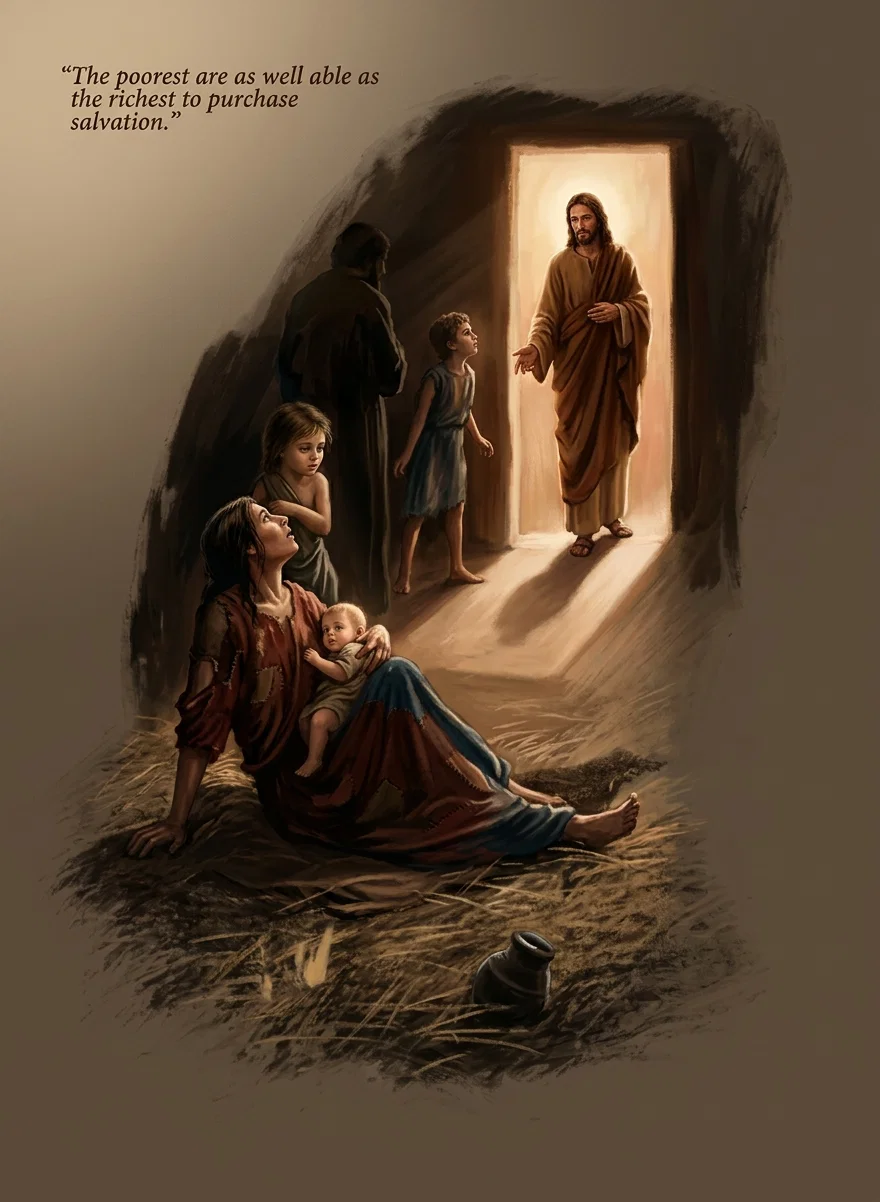
The gospel of Christ is a blessing that all may possess. The poorest are as well able as the richest to purchase salvation; for no amount of worldly wealth can secure it. It is obtained by willing obedience, by giving ourselves to Christ as His own purchased possession. Education, even of the highest class, cannot of itself bring a man nearer to God. The Pharisees were honored with every temporal and every spiritual advantage, and they said with boastful pride, We are “rich, and increased with goods, and have need of nothing”; yet they were “wretched, and miserable, and poor, and blind, and naked.” Verse 17. Christ offered them the pearl of great price; but they disdained to accept it, and He said to them, “The publicans and the harlots go into the kingdom of God before you.” Matt. 21: 31.
“The poorest are as well able as the richest to purchase salvation.”

CANNOT EARN IT, BUT MAY HAVE IT

We cannot earn salvation, but we are to seek for it with as much interest and perseverance as though we would abandon everything in the world for it.
We are to seek for the pearl of great price, but not in worldly marts or in worldly ways. The price we are required to pay is not gold or silver, for this belongs to God. Abandon the idea that temporal or spiritual advantages will win for you salvation. God calls for your willing obedience. He asks you to give up your sins. “To him that overcometh,” Christ declares, “will I grant to sit with Me in My throne, even as I also overcame, and am set down with My Father in His throne.” Rev. 3: 21.
There are some who seem to be always seeking for the heavenly pearl. But they do not make an entire surrender of their wrong habits. They do not die to self that Christ may live in them. Therefore they do not find the precious pearl. They have not overcome unholy ambition and their love for worldly attractions. They do not take up the cross and follow Christ in the path of self-denial and sacrifice. Almost Christians, yet not fully Christians, they seem near the kingdom of heaven, but they cannot enter there. Almost but not wholly saved, means to be not almost but wholly lost.

THE MOST PRECIOUS OF ALL

The parable of the merchantman seeking goodly pearls has a double significance: it applies not only to men as seeking the kingdom of heaven, but to Christ as seeking His lost inheritance. Christ, the heavenly merchantman seeking goodly pearls, saw in lost humanity the pearl of price. In man, defiled and ruined by sin, He saw the possibilities of redemption. Hearts that have been the battleground of the conflict with Satan, and that have been rescued by the power of love, are more precious to the Redeemer than are those who have never fallen. God looked upon humanity, not as vile and worthless; He looked upon it in Christ, saw it as it might become through redeeming love. He collected all the riches of the universe, and laid them down in order to buy the pearl. And Jesus, having found it, resets it in His own diadem. “For they shall be as the stones of a crown, lifted up as an ensign upon His land.” Zech. 9: 16. “They shall be Mine, saith the Lord of hosts, in that day when I make up My jewels.” Mal. 3: 17.

Two Edenic Blessings

They Still Are with Us—God's Plan Provides No Separation in Either Case
By S. B. HORTON
DESPITE the blighting effect of sin for over six thousand years, there still remain as blessings to humanity two great institutions which link the present time with that of creation week; namely, the marriage relation and Sabbath observance. And while the religious world blushes at the terrible record of divorce—putting asunder that which “God hath joined together”—and further, notwithstanding the subject of Sabbath observance is receiving at present a large share of theological attention, yet there exists a lamentable indifference concerning the fact that the Creator joined the seventh day of the week to the Sabbath institution, and that He never intended that these should be “put asunder.”

Did Not Originate at Sinai

Many Christians are of the opinion that the Sabbath institution had its origin in the law of Ten Commandments given at Sinai. This conclusion evidently proceeds from a superficial study of the subject, for Sabbath observance has a history antedating the Mosaic period by 2,500 years. From Genesis 2 we learn that the Sabbath institution was made by three specific acts performed by the Creator. The first act was that of rest. The seventh day was employed in rest. The second and third acts followed the close of the seventh day. “God blessed the seventh day, and sanctified it; because that in it He had rested from all His work which God created and made.” The blessing and sanctification of the seventh day relate not simply to the first seventh day of time, but to the seventh day of each week for all time to come. In commemoration of God's rest on that day. “The seventh day is”—not was or will be—“the Sabbath of the Lord,” is the language of the fourth commandment.
In this connection let it be said that “the Lord of the Sabbath,” while on earth, proclaimed, “The Sabbath was made for man”—man in the generic sense. These facts cannot be denied nor changed. It can never be true that the Creator or His Son ever rested upon, blessed, or sanctified and made for man, any other day of the week. The seventh day of the week is just as essential to Sabbath observance as are bread and wine to the celebration of the Lord's Supper.

Man Has Tried to Separate Them

Man has put his hand upon the Sabbath institution, and has attempted to put asunder that which “God hath joined together.” This is to be seen in the general attitude of the religious world to the observance of Sunday. They admit that Christ did not abolish the Ten Commandment law, nor did He or the apostles institute any change from Sabbath to Sunday observance. The first requirement in behalf of Sunday observance was the celebrated Sunday law of Constantine the Great in 321.
Would it not be more consistent for the teachers of Sunday observance to remove from the Decalogue the fourth commandment, which calls for the observance of the seventh day of the week, and put in its stead either the Constantine law or the command of some church council that gave ecclesiastical recognition to Sunday observance? For it is admitted that “he who takes his faith and practice from the Bible is bound at whatever inconvenience to observe Saturday as the Sabbath.”—Rev. E. A. Wasson, quoted in Review and Herald, September 24, 1895.
At Calvary the Sabbath was reaffirmed by precept and example of Christ; it was honored and taught by the apostles; and just as surely as the “Thou shalt not kill” and “Thou shalt not steal” are in effect today, just so surely may we know that the Sabbath institution of the Decalogue is to be honored and respected.

The Glacial Theory Disproved

By A. SMITH
SCIENTISTS do not admit the fact of the Deluge in the days of Noah, but attribute the phenomena incident to such an event to an alleged flood at the close of the so-called glacial epoch. Such a flood cannot be explained on the principles of evaporation and precipitation, for the water from the melting ice would seek a lower level by running off into the sea.
The data recorded in the earth's structure point to a flood universal and supernatural in character. The proof of a glacial flood lies wholly outside such evidence.
Christ and His apostles testify to the fact of the Deluge. See Matt. 24: 37-39; 2 Peter 2: 4, 5; Gen. 6: 13, 17; 7: 1-4. As an incident given in proof of the glacial theory, it is alleged that scratches and furrows now seen in some places, and deposits of drift rock, were caused by glacial movements antedating the appearance of man on the earth.
It has been claimed, by careful estimate upon the glacial theory, that the advancement of arctic conditions upon the north temperate zone was at the slow rate of twenty feet a year. Animals that could not flee before such slowly advancing cold toward a warmer climate, deserved to be incased in ice.
The glacial theory admitted, it is a fact that at every moment of that period, the sun's rays covered more than one half the earth's surface; that day and night, and a change of seasons, with torrid and temperate conditions, constantly prevailed, always affording comfortable regions to which all animals could have fled in winter. The conditions of sunlight and temperature could not then have varied more than three per cent from what they are now.
Truly it is a laborious undertaking to disprove the word of God.

Work To-Day and Not To-Morrow

By L. D. SANTEE
Work for God to-day, and not to-morrow, For the hours go swiftly by. Yield no place to fear or idle sorrow. Soon will Christ appear in yonder sky. Earth is fading, and her flowers are dying. Life is short, existence scarce a span; But love's heralds through the world are flying, Offering life through Christ to sinful man.
Prophet pens have told the matchless story Of the “King of kings” upon His throne. Now with joy we tell the thrilling story That the Saviour comes to claim His own. Life is strangely blended, joy and sorrow, And its hours are swiftly passing by. Work for God to-day, and not to-morrow. Soon the Saviour comes adown the sky.
Work for God to-day, and not to-morrow. Souls for whom He died are perishing, Lifting pleading hands in hopeless sorrow. Christ would have them shout for joy, and sing. Raise the fallen, loose the heavy burden, Tell of Jesus and His death of shame, Tell the weary world there's hope and pardon Through a risen Saviour's holy name.

Not Under the Law

IF the words, “For we are not under the law, but under grace,” mean that the law of Ten Commandments is gone, abolished, or set aside, why did Christ come and die? If God could remove the Ten Commandment law and set man free from it, why did He not first set it aside, and thus save His beloved Son from the dreadful humiliation and suffering of the death on the cross?
“Sin is the transgression of the law.” 1 John 3: 4. Paul says to the one who is baptized into Christ, “Let not sin therefore reign in your mortal body, that ye should obey it in the lusts thereof.” Rom. 6:12. How is it possible for sin, or transgression, to reign if there is no law to transgress?
Christ must have come to bring deliverance to those who were under the condemnation of the law which they had transgressed. He speaks pardon to every repentant sinner who believes in Him. Then so long as sin does not reign over that individual, he is “under grace.” ALLEN MOON.

Truth Unveiled

It sometimes happens that when a truth long downtrodden is uncovered, and its light and beauty flash out through the dense darkness of the ages, men say: “This is too much. This cannot be. To-day and custom wall up our horizon.” And saying thus, they reject the word of God.
Other men, more humble and teachable, say:
“We have wandered in the mountains misbewildered, And now a breeze comes, and the veil is lifted, And priceless flowers o’er which we trod unheeding, Gleam ready for our grasp.”
And these men search the Scriptures eagerly, and to the joy of their souls, find that which enables them to look, as it were, into the promised land.
ELIZA H. MORTON.
Continue reading: A Menace to American Childhood