The Youth’s Instructor, Vol. 29, No. 14.

PETRA

The Youth’s Instructor

Apr 6, 1881

S. D. A. Publishing Association · Battle Creek, Mich. · Apr 6, 1881

PETRA
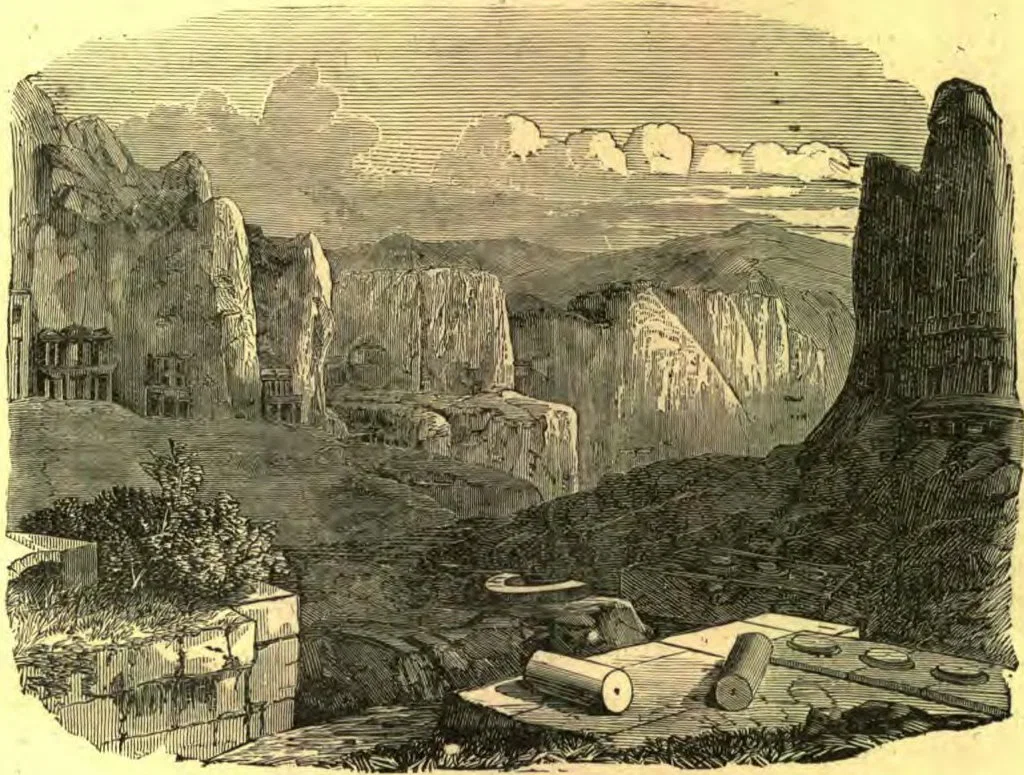
ONE of the most wonderful of ancient cities is Petra. Its peculiar location, the history of its inhabitants, and its connection with prophecy, are the most prominent points of interest. It is located in the mountainous region called Seir, about midway between the Dead Sea and the eastern arm of the Red Sea, or Gulf of Akabah. The city was built in a valley about a mile long and half a mile wide. This valley is inclosed by almost precipitous mountains, varying from two hundred to one thousand feet in height. In the sides of the valley are numerous short ravines, which terminate abruptly in the surrounding mountains, making the whole circuit about four miles. The main entrance to the city is from the east, through a ravine, which in some places is no more than twelve feet wide, while its sides rise two hundred feet high. Facing this ravine is the most beautiful structure of Petra,—a temple, hewn out of the face of the opposite cliff. Further to the west, and high up in a ravine, stands another temple, also hewn out of the solid rock. Its front is one hundred and fifty-two feet in height and width. Travelers who have visited Petra, tell us that these buildings have a striking appearance, as the hewn and polished rocks are of many bright colors, blending with each other; while the cliffs above in their rude state add to the beauty of the scene by the contrast.
Besides many other large structures, there is a huge amphitheater cut entirely out of the rocks, and capable of seating more than three thousand persons. In the accompanying cut are seen some of the ruins with which the valley is strewn. The only edifice not excavated in the mountain, that has survived the ravages of time, is a palace, called by the Arabs, the house of Pharaoh. The most numerous remains at the present time are the tombs excavated in the faces of the cliffs, and sides of the ravines. In the picture, some of these appear on the left.
Petra was the chief city in that region, and for many years was a leading commercial center. For a long time, the Edomites, descendants of Esau, dwelt here. They were the ones who refused to let the children of Israel pass through their country when journeying from Egypt to Canaan. Afterward it was possessed by the Moabites, who were the descendants of Lot. As the city was mostly hewn out of the rocks, entirely surrounded by high, rocky cliffs, and entered only by narrow ravines, it was a very strong fortress, and was for many years the residence of the Arabian princes. Its idolatrous inhabitants felt secure, and carried their wicked practices to such an extent that the Lord determined the destruction of them and their city, Jer. 49 : 7—22. This prophecy has been strikingly fulfilled.
After 536 A. D., Petra was not mentioned in history, and its site not known until the thirteenth century, when its ruins were identified by European travelers. Although it was long the proud capital of Arabia Petraea, like Babylon, it has been entirely desolated. Even the wandering Arabs do not take up their abode in the once beautiful temples or splendid palaces, but dwell in their tents a few miles distant; while these grand structures, once the abode of kings and princes, are now used only for sheep-folds, and oftener make a home for wild beasts or a hiding place for robbers. Many of them are said to be almost as perfect as at the day they came from the builder’s hand; but there they stand, desolate and forsaken, proud but sure witnesses to the unfailing word of God.
H. P. HOLSER.

WAYSIDE SCENES IN INDIA.

LETTER FROM A MISSIONARY.

In this part of India, we are now in the midst of the rainy season. Before the welcome rains came, there were months of great heat such as is never felt in the land in which you live, and during all this time there was scarce a cloud to dim the sun’s brightness. When at length the rain began to fall, there were many happy hearts, and, I trust, many thankful ones; for if the rains are withheld, famine comes with all its terrible evils.
During the hot season, everything is parched and dry, even the grass is brown and withered; but with the coming of the first showers, everything springs quickly into life and beauty. The earth is covered with a soft mantle of green, and the drooping leaves of the great trees are erect and shining. Flowers burst into bloom, and husbandmen are busy in the fields, preparing the ground and sowing the seed.
Many of the fields near our house are now covered with vines bearing a kind of cucumber, smoother and more tender than the cucumbers of our country. These cucumbers are more than a foot long, and are much relished by the people, who eat them just as they are plucked from the vines. Every morning we see the busy owners of these fields gathering the fruit into baskets for the market. In every field we see at this time just what is mentioned in Scripture—“a lodge in a garden of cucumbers.” A few light poles are stuck into the ground and tied together with coarse twine or bark, and over the ridge-pole mats made of grass are thrown and made fast to the poles. In such a lodge the owner of the field spends his time until the fruit has all been gathered. In each lodge there is usually a rude bed, such as is in common use among the natives of the country; and besides a rope and a vessel with which to draw water from the nearest well, a few cooking utensils, a large brass plate from which to eat the food when prepared, and a brass drinking-vessel, the lodge needs no other furniture; and indeed in the houses of the common people we find little more.
When the owner of the field, relieved by some member of his family, lies down to sleep, he rolls himself from head to foot in a blanket till he looks like a mummy. In the morning he shakes himself free from his covering, and his toilet is made.
Sometimes the wife comes to cook for her husband and sons, but frequently they prepare their own food. As these fields are, many of them, close to the roadside, passers-by frequently stop to purchase, and the monotony of the day’s vigil is thus relieved.
In the fields on which the cucumbers are now growing, wheat and other grains will soon be sown. Winter in India is the season of fruit and flowers. The gardens produce vegetables, and in the fields rich stores of grain are ripening. Then in all the fields spring up lodges higher than those we now see, but built in the same manner. To the little porch under the roof of matting the watcher climbs by means of a rude ladder, and here the owner of the field, relieved by some member of his family or a trusted servant, spends his time, day and night, until the ripened grain is cut from the field by sickles. The lodge is then abandoned, but the task of guarding the precious substance is not over until oxen have trodden out the grain and it has all been removed from the field. While it still remains on the ground after threshing, the owner places his bed in the midst of his piles of grain, remaining at his post until the last measure has been conveyed to a place of safety.
As we have passed these fields after nightfall, we have seen the glow of the little fires by which food had been prepared, and around which the owners of the grain sat in groups chatting and smoking their hookahs.
(Concluded next week.)

IN HOPE.

A CHILD in a meadow one summer day Laughingly gathered the flowers in play, And tossed them into the rippling tide That to his prattle in murmur replied. “Give me something, brook!” he said, In trustful innocence, nodding his head. The years rolled on, the years rolled by; The tears of a child are quickly dry.
The child, to manhood’s stature grown, Stood by the stream of the world alone; He flung to it the work of his heart; He said, “In thy life I shall have a part; Thou wilt bring me friends and fame—who knows?” And the hurrying stream in music rose. The years roll on, the years roll by; In the heart of the man lies a hidden sigh.
An aged man leaned silently O’er the stream that glides to eternity; He thought of the honest work of years, Of vanished dreams, of unshed tears; “Bear me on, O stream!” said he, “There’s a world where rich reward I see.” The solemn flood moved slowly on; The flower, the work, the life, were gone. The years roll on, the years roll by; In hope we live, in hope we die.
—N. Y. Home Journal.

The Bible Like a Diamond

The Bible, like a diamond casts its lustre in every direction. Torch-like, the more it is shaken the brighter it shines. Herb-like, the more it is pressed the sweeter its fragrance.

THE GREAT MASTER.

“I AM my own master!” cried a young man, proudly, when a friend tried to persuade him from an enterprise which he had on hand; “I am my own master!”
“Did you ever consider what a responsible post that is?” asked the friend.
“Responsible—is it?”
“A master must lay out the work which he wants done, and see that it is done right. He should try to secure the best ends by the best means. He must keep on the lookout against obstacles and accidents, and watch that everything goes straight, else he must fail.”
“Well.”
“To be master of yourself, you have your conscience to keep clear, your heart to cultivate, your temper to govern, your will to direct, and your judgment to instruct. You are master over a hard lot; and if you don’t master them, they will master you.”
“That is so,” said the young man.
“Now, I could undertake no such thing,” said his friend. “I should surely fail, if I did. Saul wanted to be his own master, and failed. Herod did. Judas did. No man is fit for it. ‘One is my Master, even Christ.’ I work under his direction. He is regular, and where he is master, all goes right.”—Dr. Bacon.

SOWING AND REAPING.

JESSIE RIGGS sat silent and thoughtful upon the lower step of the piazza. Her elbow rested on her knee, her chin was in her hand, while her eyes had a far-away look in them, as if they sought the solution of some question in the distance.
She was so completely lost in thought that she did not observe the presence of her uncle George, who came out on the piazza and seated himself a few steps above her.
For some minutes the silence remained unbroken. At length Mr. Riggs said gently, “Of what are you thinking so busily, Jessie?”
Jessie started like one aroused from sleep:—
“Oh, Uncle George, is that you? How long have you been here?”
“I have been sitting here for a few minutes, wondering what great question was bothering my little niece’s head,” was Mr. Riggs’s reply.
Jessie and her uncle were great friends, and often had long conversations upon one topic or another. Whenever she was puzzled by a hard lesson or wanted some subject explained to her growing mind, it was Uncle George to whom she went for help.
So she turned confidingly to him, and said, “I was thinking, uncle, of Mary Stone, and wishing that people would say the same things about me that they do of her.”
“And what do they say of her, my dear?”
“Why, the poor people of the village call her an angel; old men and women cry ‘God bless you!’ when she passes; and all the boys and girls at school think there is no one like her.”
“And you would like to have them say the same pleasant things of you?”
“Yes, sir,” replied Jessie, clasping her hands, “very much. They say she is sure of her crown in Heaven; I don’t believe any one says that of me.”
“Do you see that field of waving wheat over yonder?” asked Mr. Riggs. “How thrifty and flourishing it looks, with its bearded heads tossing and bending in the summer wind!”
“Yes, uncle, but we were talking of Mary Stone, you know.”
“True, my dear, but you know that I am fond of parables. We will get back to Mary, never fear. How came the wheat there?”
“Why it grew, of course,” was Jessie’s answer.
“Yes, it grew,” replied her uncle, “but what had to be done first? Did it grow from nothing?”
“No, sir, of course not. Papa had the ground plowed and the seed sown.”
“Just so, my child, must we do in this world to obtain the crown prepared for us in Heaven. In the Bible it is said, ‘Whatsoever a man soweth, that shall he also reap.’ Now, your little friend Mary has, I hear, carried many a bowl of soup and many a warm blanket to the poor of the village. While others have been at their play, she has visited the old and sick, read the Bible to them in her sweet child voice, brightened their rooms with little nosegays from her own garden, and made her bright face welcome everywhere. Then at school no one has heard her lips utter an unkind or rude word; she is always ready to join heartily in work or play. No wonder she is a favorite. In this world she is sowing the seed of kind words and deeds, and she is sure to reap an abundant harvest. Now do you understand, Jessie, why I brought the wheat-field into our conversation?”
“Yes, sir,” answered Jessie. “You wish to show me that as the wheat would not be growing in the field unless the seed had first been sown, so I cannot hope to be liked as Mary is, unless I live so as to deserve it.”
“Yes, my dear, that is it; and one thing more. As the plowing and sowing will not make a harvest unless the rain from heaven fall on the seed, so must you have God’s blessing with you if you would live a life full of good works. Try to think of this every morning when you rise, and ask God to help you to be one of his children, doing good to all around you.”—S. S. Visitor.

—Margaret Tupper

Spring.

A whisper along the hills, A stir in the wakening ground, The touch of a tender hand,— A hand in the dark that thrills The heart to a great rebound. Oh, the soul of the spring has gone into the land, The soul of the spring, and the joy of the spring, And a glory of light and love!
A whisper along the hills, The music of life again, A sweet, intangible good That enters and warms and fills The winter of heart and brain. Oh, the soul of the spring has gone into my blood, The soul of the spring, and the song of the spring, And the splendor of light and love!

—Margaret Tupper

KEEP SINGING.

We had a servant once who always used to be singing—whether outside the door whitening the steps, whether washing the linen, cleansing the tea-things, or cooking the dinner, she would be constantly singing or humming over something. I said to her one day, “Betsey, what makes you sing so?”
“Well,” she answered, “I think it keeps bad thoughts away; and if I didn't sing, sometimes I should get so low-spirited I shouldn't know what to do with myself?”
A good deal of philosophy in Betsey; because you know that boys, if they have to go through a church-yard at night, always begin whistling to keep their spirits up.—Spurgeon.

VISIT TO A POET'S HOME.

SEVERAL years since, in a quiet, New England town, lived a boy, in some respects much like hundreds of others,—a bare-footed, whistling boy, whose straw hat with its unevenly fringed brim, shielded, more or less, the happy face beneath. In the farmhouse home he was the light and joy of the family-circle. As he left the sweet child years and grew to manhood, he engaged in the humble occupations of farming and shoe-making. He never enjoyed the reputation to which many a brilliant American boy aspires,—that of being able to instruct the rest of the world. No, he was quiet, modest, retiring, with those most precious ornaments of youth,—delicacy of feeling and appreciation, combined with a high sense of honor. That lordly assumption of superiority which leads one to pass relentlessly over the rights and feelings of others, to gratify self, was never known to him. He attended the village academy, and struggled, as has many another, to obtain an education, and after he was of age engaged chiefly in literary pursuits.
Quietly, unostentatiously has he labored for the interests of common humanity; and now he wears gracefully the coronet wrought by the deft fingers of Time, which the Bible tells us is “a crown of glory.” The name of John G. Whittier has become a household word. Not long since we passed the poet's home, in Danvers, Mass. The house has no “brown stone front” or other superfluous embellishments. It is only a pretty, unpretentious house, in a quiet rural spot, lovely enough in its sweet simplicity to attract an angel visitant. Art has not been encouraged to supplant Nature in the arrangement of yard or grounds. A “leaning apple-tree,” such as we gathered under when children, stands, or lies, by the roadside, in the field opposite the house. Only a few steps from the door is a tangle of evergreens, interspersed with other trees which are at this season of the year leafless, but which will, no doubt, a little later, re-echo sweet bird-songs, and perchance shelter the timid rabbit.
We almost imagined we could see “Maud Muller's” brown eyes gazing down the road in the dreamy summer haze, or “Barbara Frietchie's” wrinkled hand bravely flinging the nation's banner to the breeze.
Only a short distance from here is building a stone mansion, unique and elegant, perhaps, as intellect could devise or wealth execute; yet we doubt if its possessor has ever known the happiness that crowns the sunset hours of this serene, pure-hearted man, whose name is enshrined in the hearts of the American people. But—
“The surest pledge of a deathless fame, Is the silent homage of thoughts unspoken.”
MARY-MARTIN.

Daniel Webster on the Value of the Bible

DANIEL WEBSTER once remarked: I have read the Bible through many times. It is a book of all others, for lawyers, and I pity the man who cannot find in it a rich supply of thought and rule for conduct.

SCENES IN THE LIFE OF CHRIST.

LESSON 11.—CHRIST IN THE WILDERNESS.

Soon after our Lord’s baptism, he was tempted of Satan. It seems to have been necessary that he should suffer the severest temptations that could ever come upon mankind, in order to show that such temptations can be resisted. He had to meet these temptations just as men do, without any help from God more than men may have. He did not use his divine power to protect himself or to relieve his own wants. He prayed to his Father just as we may do, and received the same help that we may receive, if we will be obedient, and pray in faith.
In speaking of this temptation, St. Luke says, “And Jesus being full of the Holy Ghost, returned from Jordan, and was led by the Spirit into the wilderness, being forty days tempted of the devil. And in those days he did eat nothing.”
What wilderness he was led into is not certainly known, but it is supposed to have been the one where John preached. In this wild and lonely place Jesus suffered, not because he needed the experience, but to teach us a lesson.
Just at the close of the forty days of fasting, when Jesus was faint and famishing, Satan brought his strongest temptations upon him. He said, “If thou be the Son of God, command this stone that it be made bread.” But Jesus would not work a miracle to save himself, for that would be doing what man could not do; and the example would be of no use to us. He answered Satan by repeating scripture, just as we may do when he tempts us. He said, “It is written, That man shall not live by bread alone, but by every word of God.” This should teach us that the word of God is more precious than food, and that we should obey it even at the risk of life.
The words that the Saviour here quoted were spoken by Moses, almost fifteen hundred years before, as he was urging the people to keep the commandments of God. If you will read the eighth chapter of Deuteronomy, you will see that Moses reminded the people of God’s care for them, asking them to remember that for forty years God had fed all that great multitude with bread from heaven, and that during all that time their garments had not waxed old, neither had their feet swelled with so much marching. Since the Lord had provided for them under such circumstances, they might safely trust him to provide for them under any circumstances; and our Lord by quoting the words of Moses means to teach us the same lesson.
“And the devil, taking him up into an high mountain, showed unto him all the kingdoms of the world in a moment of time. And the devil said unto him, All this power will I give thee, and the glory of them; for that is delivered unto me, and to whomsoever I will I give it. If thou therefore wilt worship me, all shall be thine. And Jesus answered and said unto him, Get thee behind me, Satan; for it is written, Thou shalt worship the Lord thy God, and him only shalt thou serve.” Just so Satan has always tempted people, and so he will tempt us, by trying to make us believe that, if we live the life of a humble Christian, obeying all the word of God, we cannot prosper in the things of this world. Our only safety lies in answering such temptations just as our Saviour did.
Then Satan proceeded with the Saviour just as he does with people now. When he finds that they are determined to trust in God for the comforts of life and all needful success, he tries to make them believe that God will protect them in taking risks that are unnecessary and even wrong. So “He brought him to Jerusalem, and set him on the pinnacle of the temple, and said unto him, If thou be the Son of God, cast thyself down from hence; for it is written, He shall give his angels charge over thee, to keep thee; and in their hands they shall bear thee up, lest at any time thou dash thy foot against a stone. And Jesus answering said unto him, It is said, ‘Thou shalt not tempt the Lord thy God.’ And when the devil had ended all the temptation, he departed from him for a season.”

QUESTIONS.

  1. What befall our Lord soon after his baptism? Luke 4.
  2. Why was it necessary that he should suffer the severest temptations that could befall mankind?
  3. Did he have more help from God than men may have?
  4. Did he use his divine power to help himself, or to relieve his own wants?
  5. How did he obtain help?
  6. May we obtain help in the same way?
  7. What does St. Luke say in introducing his account of this temptation?
  8. How long was the Saviour tempted?
  9. What privation had he to suffer?
  10. Into what wilderness is he supposed to have been led?
  11. Was it for his own sins, or because he needed the experience, that he had to suffer in this wild and lonely place?
  12. Why was it?
  13. When did Satan bring his strongest temptation upon Jesus?
  14. What did Satan say to him?
  15. Why would not Jesus work a miracle to save himself?
  16. In what way did Jesus answer Satan?
  17. What may we learn from this?
  18. What did he say is written?
  19. What should these words teach us?
  20. Who spoke these words at first?
  21. When were they spoken?
  22. What was he urging the people to do?
  23. Where may we find an account of this?
  24. Of what had Moses been reminding the people at the time he spoke these words?
  25. What great miracles did he ask them to remember?
  26. Since the Lord had provided for them under such circumstances, what might they safely do?
  27. Why do you think the Saviour quoted the words of Moses?
  28. How did the devil tempt the Saviour to worship him?
  29. What answer did Jesus make him?
  30. How does Satan tempt us in a similar way?
  31. What is the only safe course for us to take when we are so tempted?
  32. When Satan finds that people are determined to trust in God for the comforts of life and all needful success, what does he try to make them believe?
  33. How did he bring a similar temptation upon Jesus?
  34. How did Jesus answer him?
  35. Was it necessary for Christ to cast himself from the temple?
  36. Would it have done any good?
  37. Do you think it would have been right?
  38. Then could he have expected God to protect him from harm?
  39. Can we expect God to protect us, if we go into danger unnecessarily?
  40. When Satan found that all his temptations were unsuccessful, what did he do?

LESSONS ON NEW-TESTAMENT HISTORY.

LESSON 24.—REVIEW.

1. What reply did Jesus make when his mother reproved him before the doctors of the law?
2. How may we apply these words to ourselves?
3. When John thought himself unworthy to baptize him, what reply did Jesus make?
4. What did a voice from heaven say when the Holy Ghost descended upon Jesus immediately after his baptism?
5. When Satan, in tempting Jesus, said to him, “If thou be the Son of God, command that these stones be made bread,” what reply did the Saviour make?
6. Under what circumstances were these words first uttered? Deut. 8.
7. By what proofs did Moses show that God, whenever he chooses to do so, is able by his word alone to provide for all the temporal wants of his people?
8. What reply did Jesus make when Satan offered him all the kingdoms of this world if he would fall down and worship him?
9. What similar temptation does Satan often bring upon us?
10. When Satan found that Jesus answered him every time by quoting scripture, what passage did he quote?
11. How did Jesus meet this temptation to rashness?
12. How would it have been tempting the Lord for Jesus to cast himself from the pinnacle of the temple?
13. When Simon first came to Jesus, what did Jesus say to him?
14. Repeat the conversation between Jesus and Nathanael.
15. What did he say to the money-changers and other traffickers, as he drove them from the temple?
16. What did he say to the Jews who asked him to give a sign in proof of his authority to do such things?
17. To what temple did he refer?
18. What saying of our Lord’s was Nicodemus unable to understand?
19. Explain its meaning.
20. What comparison did Jesus draw between himself and the brazen serpent which Moses set up in the wilderness?
21. What did he say in regard to God’s love for the world?
22. For what purpose did God send his Son into the world?
23. What condemnation rests upon those who do not receive Christ?
24. Why do men refuse to come to the light?
25. How did Jesus convince the woman of Samaria that he was the Messiah?
26. What did he say to her in regard to the worship that God accepts?
27. When his disciples on returning from the city begged him to eat, what did he say in regard to his food?
28. What lesson may we learn from these words?
29. What proclamation did he make as he went preaching throughout Galilee?
30. Repeat the conversation between Christ and the nobleman who came from Capernaum to Cana.
31. When Jesus had returned to Nazareth, what scripture did he read to the people on the Sabbath day?
32. What did he say to them in regard to the fulfillment of these scriptures?
33. What did he afterward say which made the people so angry that they tried to take his life?
34. What did he say to John and James, Simon and Andrew, when he called them to follow him?
35. What testimony was borne by an evil spirit in the synagogue at Capernaum?
36. How did Jesus rebuke this spirit?
37. As Jesus was making his second tour through Galilee, what did he say to the leper who came to be healed?
38. What did he say to Matthew when he saw him sitting at the receipt of custom?
39. What did he say to the Pharisees who reproved him for eating with publicans and sinners?
40. What did he say to those who found fault with his disciples because they did not fast?
41. How did he defend his custom of performing miracles on the Sabbath day?

THE CLIMATE OF PALESTINE.

The climate of Palestine resembles that of the countries by which it is surrounded. There is a long, dry, hot season, and a rainy season. In our country, as in Europe generally, rain falls more or less during the whole year; but in Palestine it falls only during certain months. The rainy and the dry seasons constitute the two divisions of the year, the former being sometimes called the winter, and the latter the summer. When the rainy season has begun, the seed-time comes, and at its close, the harvest, so the division of the year given in Genesis,—“seed-time and harvest, and cold and heat, and summer and winter,” is, for Palestine, perfectly natural.
“The rains usually begin to fall in the last half of October or the beginning of November; and they continue into April, sometimes even till the first of May. The rainy season does not come suddenly, but by degrees, and it ends in like manner. It finds the earth hard-baked and incapable of being plowed. The showers, coming at intervals, soften the soil, and give the husbandman an opportunity to plow his ground and sow his fields of winter wheat and barley.” It does not rain daily, but usually there will be several rainy days together, and then several days of clear weather, followed by another fall of rain. Thunder and lightning frequently accompany the rains, and some of these thunder-storms are very violent.
In the winter the cold is not severe, and frost is rare. Snow falls in the higher mountain regions, but is seldom seen in the lowlands or upon the coast. “During the whole winter the roads, or rather tracks, in Palestine, are muddy, deep, and slippery; so that the traveler at this season is subjected to great inconvenience and discomfort.” “Pray ye,” says our Saviour to his disciples, in anticipation of the overthrow of Jerusalem, “that your flight be not in the winter.”
The beginning of the dry season, or summer, in April and May, is delightful. “The sky is serene, the air balmy, and the face of nature arrayed in verdure, with a profusion of gay flowers.” All this is beautifully described in the Song of Solomon, Chap. 2: 11-13. “For lo, the winter is past; the rain is over and gone; the flowers appear on the earth; the time of the singing of birds is come, and the voice of the turtle is heard in our land; the fig-tree ripeneth her green figs, and the vines are in blossom; they give a goodly smell.”
The dews, especially during the early part of the summer, are very heavy, so abundant that the traveler upon waking in the morning and finding his tent saturated, can hardly believe that it has not rained during the night. Mention of these heavy dews is frequently made in the Bible.
As the dry season advances, the cheerful aspect of nature gradually disappears. The “grass upon the house-tops,” which had sprung up during the rainy season, speedily withers. Next, the fields lose their freshness and verdure, and the landscape becomes brown and parched. “The deep green of the broad fig-leaves and the bright shade of the millet is delightful to the eye amid the general aridness; while the foliage of the olive, with its dull grayish hue, scarcely deserves the name of verdure.” Later in the season “the cloudless sky and burning sun dry up all moisture. The grass withers, the flowers fade, the bushes and shrubs take on a hard, gray look, the soil becomes dust, and the country assumes the aspect of a parched, barren desert.”
We who live in this western world can scarcely appreciate the force and beauty of the psalmist’s words (Psalms 65: 9, 10), where he describes the blessed influence of the early rain after the continuous drought of six months: “Thou visitest the earth, and waterest it abundantly; thou greatly enrichest it; the river of God is full of water; thou preparest the corn, for so thou hast provided it. Abundantly watering its furrows, settling its ridges, thou makest it soft with showers; thou blessest its springing.” The transformation is wonderful. The fields lately so brown, parched, and desolate, put on their robes of “living green,” and all nature rejoices; “the pastures are clothed with flocks; the valleys also robe themselves with corn; they shout for joy; yea, they sing.”
E. B.

EASTER HYMN.

SING, children, sing! And the lily censers swing; Sing that life and joy are waking, and that Death no more is king. Sing the happy, happy tumult, of the slowly brightening spring; Sing, little children, sing!
Sing, children, sing! Winter wild has taken wing. Fill the air with the sweet tidings till the frosty echoes ring! Along the eaves the icicles no longer glittering cling; And the crocus in the garden lifts its bright face to the sun, And in the meadows softly the brooks begin to run; And the golden catkins swing In the warm airs of the spring; Sing, children, sing! —Selected.

HOW THE SPRING COMES.

It begins very early, not in March, but in the summer, when new buds form on trees, and push off the leaves, which fall to the ground.
If you look at any tree in October or November, you will see the next spring’s buds. Perhaps the horse-chestnut is the best to study, for its buds are so large, and it is an easy tree to find.
If you cut off a bud, you see that it shines as if it were covered with varnish; and if you open it carefully, you find something that looks like cotton-wool wrapped around the tiny green leaves that some day will cover the branches.
The varnish, or gum, keeps out the cold and wet; so does the wool, and the little leaves are as well protected as a duckling in the egg, or a baby in its crib-blankets.
Some day you will like to learn some pretty verses that begin— “The trees and the flowers are running a race,” and how they shout to the chestnut-tree to put forth his leaves. “Then the chestnut hears, and breaks out in bloom, White and pink, to the topmost boughs; Oh, why not grow higher, you’ve plenty of room, You beautiful tree, with the sky for your house;” and you will hear of the avenue of horse-chestnut trees, a mile long, at Bushy Park, near London, that everybody goes to see in blossom-time.
If you think the winter very long, and are tired of waiting for spring, you can coax a little of it to come early for you. Go into the woods some mild day in winter, and dig up a few roots of hepatica, or liverwort, as some people call it. It has glossy green leaves that last all winter, and are divided into three parts, or lobes. Under these leaves are little flower-buds, rolled up in their furry coverings.
Put the plants into a pot of earth and set it in a sunny window.
Long before the out-of-door flowers have thought of blooming, your pot will be full of pale-purple, pink, or white blossoms. If somebody who painted a little group of them that I have just seen, had known, and loved, and watched them when she was a little girl, she would not have made them bright blue in her picture. That is what comes of not learning to use one’s own eyes, and copying from others who have never used theirs.
About the middle of March the bluebirds begin to sing, and a week or two later whole flocks of blackbirds are creaking and chattering in the bare trees. When I hear them, I begin to look for pussy-willows, and bring great handfuls of them into the house. Do you know whether “pussies” are flower or leaf buds? This spring will be a good time to find out. What becomes of them after they lose their gray, furry look?
What kind of blossoms has the birch?
Does the elm-tree ever blossom, and when?
You all know, don’t you, when to look for the red flowers of the maple? When you see them, it is time to search for hepaticas in sunny, sheltered places.
By this time, too, you hear the frogs in the ponds—two kinds, the deep-voiced “bull-paddies,” as the boys call them, and the small, shrill-voiced peeping hylas. When they are fairly awake, you may look for red-winged blackbirds, and a week or two later, for early anemones.
By this time spring is fairly awake; and you will be surprised to find, even after two or three days of cold rain, that the pastures are blue with violets.
The may-flower, or trailing arbutus, has come long ago, but everybody has not the good luck to live near it. If it grows near you, take a few roots into the house in the fall, and you will have blossoms early in the winter.
Red and yellow columbines, too, are nodding on the rocks; and before you fairly look for them, the long-stemmed violets and jack-in-the-pulpit are springing up to welcome you.
What is the jack-in-the-pulpit? Is it a flower? What kind of seeds has it?
Just use your eyes, children, and find out some of these things for yourselves before next summer.—Youth’s Companion.
Continue reading: PEOPLE WITH THREE HANDS