The Youth’s Instructor, Vol. LIII, No. 6

Visit to the Vale of Wonders

The Youth’s Instructor

February 7, 1905

Review and Herald Publishing Assn. · Washington, D. C. · February 7, 1905

Visit to the Vale of Wonders

  • (Concluded)*
After crossing the Nevada Falls bridge, we take the trail which leads around to Glacier Peak. We have already had a long tramp; but we have as far to go to get back to camp as we have come, and to cover this distance we must descend about one third the distance we have elevated ourselves, and then ascend again to a still greater height to reach Glacier Peak; and yet every step of the way is a joy in spite of weary limbs. Just before beginning to make the ascent to Glacier Peak, we crossed a little stream, flowing leisurely along, and giving no indication of being able so soon to transform itself into a thing of beauty; but only a few rods from the bridge, it made its plunge to the valley floor. It is the smallest of the falls, with the exception of Ribbon Fall (which was not in operation while we were there); but it has a beauty peculiarly its own. Like the little wood violet which prefers to bloom in some retired nook, this fall seems anxious to reach the level below with as little noise and ostentation as possible. One can ride by it on horseback and not see it, so sudden its dip, so far its fall, and so shut in is it on both sides. We succeeded, however, in securing a good position from which to view it, and felt well repaid. Like silken drapery, it hangs straight down some hundreds of feet, and most of the noise of its fall is swallowed up in the depths below. Its name is Tululaweack.
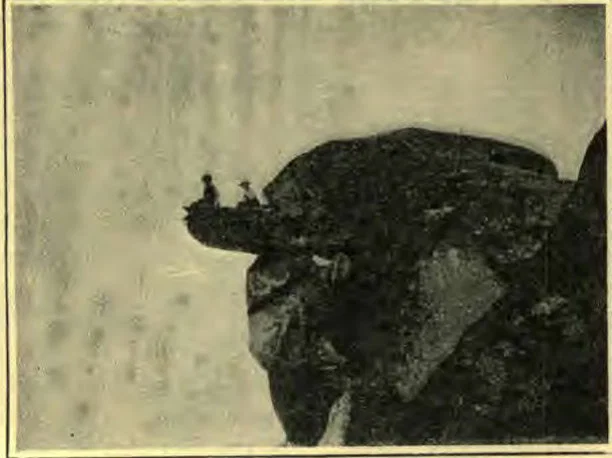
A long, steady, but not steep climb brings us to what is one of the most commanding views of the whole valley. It is called Glacier Peak because of certain scarifications of the ledges which scientists claim to have been made by glaciers thousands of years ago. The view all around is grand, sublime, unsurpassable. At this place Iva and Professor Ballenger went out upon the overhanging rock, and Carrie, seeking an equally perilous position, took a picture of the others. The height above the valley does not show in the cut; but a person falling from this position would find no place of rest until he had descended some thirty-seven hundred feet.
From this point a short side trail takes one to the Fissures,—great clefts in the earth,—while still another trail leads to Sentinel Rock; but our company was well contented to get down to camp by the shortest way. The sun was well up when we began the descent; but the friendly moon was our only light long before we reached the floor of the valley. The sinuosities of the downward trail are something to be wondered at, and there are several places on the way where one could easily step out of the world. One of our horses, tired of the long descent, attempted to end his troubles in that way, and was stopped just at the edge of the precipice. He was riderless at the time. Various members of the party expressed the belief that the bottom had fallen out of the valley, so long seemed the down grade to our tired knees.
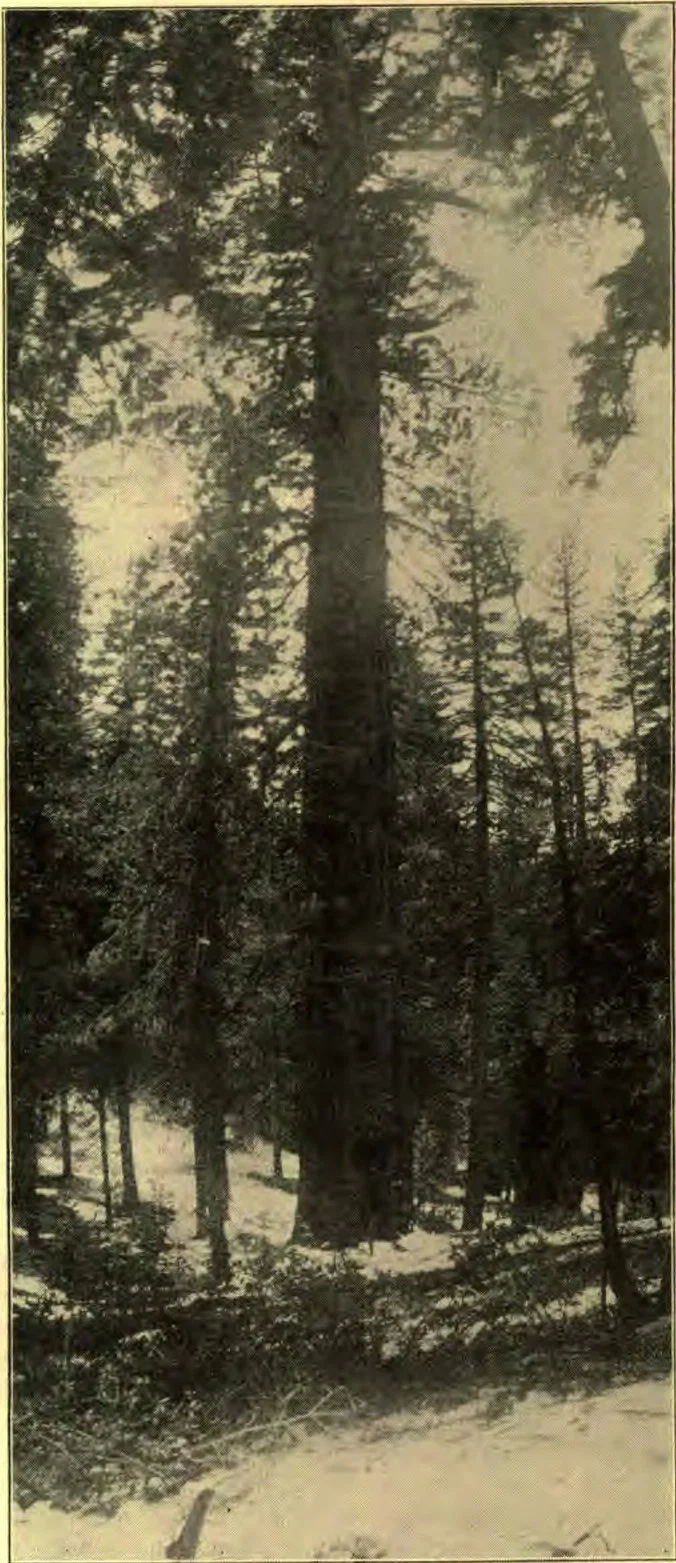
One of the California Big Trees (Sequoia gigantea). Notice the difference between the size of the tree and the size of the man standing in front of it.
We spent eleven most delightful days in the valley, visiting and revisiting places of interest, fishing, and getting acquainted with our Piute neighbors. I would say that in our fishing we did no harm to the fish.
On one of the trips which I took alone I met a party of some thirty men, women, and children of the Piute tribe of Indians, who were coming into the valley to visit their neighbors. They were all either riding or leading ponies. Some of them had beautiful saddles of American make, and all the women and children were arrayed in all the colors of the rainbow and the flower garden. The women, strong and sturdy, were leading their ponies, and were laughing to one another as they passed me, evidently amused at the fact that I had to stop and rest on the trail.
We had a chance while in the valley to study some of the ways of the Indians. Their manner of preserving food was interesting to me. They had gathered a large quantity of acorns, which a white person would hardly think of using as an article of diet, because of their bitter taste, and the “puckery” feeling which they leave in the mouth. The Indians, that is, the women, old men, and children, sit down in a circle, take the shells off the acorns, grind up the meats, and then wash the pulverized mass until they have taken out the properties that make the acorn so unpalatable. The “dough” is then made up into small loaves about the size and shape of half a muskmelon that has been cut in two lengthwise. The loaf is flat on one side and rounded out on the other. These loaves are wrapped in cloth separately, and boiled. After the boiling process, they were taken to the stream and dumped by the basketful into the water. The Indian girls then rolled up their dresses to the knees, waded into the water, took each separate loaf and gave it a thorough washing with their hands. This done, the loaves were handed up to a young Indian woman seated on the bank, who placed them in baskets. When the whole baking had been washed, the young women carried the baskets of acorn bread back to their cabins. There must have been at least a hundred loaves in that “batch of bread.” It was evident that the keeping qualities of the bread must have been exceptionally good, or else the Indian is not delicate of taste in the matter of stale bread.
When winter invades these regions, and covers the ground with a heavy coating of snow and ice, the acorns can not be found, and it is doubtful if they would be palatable, after lying on the ground under the snow, even to an Indian. Therefore large stores of acorns are gathered up in the autumn; and the Indian has a novel way of preserving his precious horde from squirrels and mice. The acorns are “cached,” but not in the ground. Four poles about twelve feet long are driven into the ground, each one of which forms a corner post for the cache. A platform is built in between the poles, high enough so that it will be above the snow. Then a receptacle is arranged on this platform, in which the acorns are deposited. The top and sides and bottom of this cache, or receptacle, are covered with long pine needles, all pointing downward, and so thickly set that no squirrel or mouse could possibly force its way into them. We saw quite a number of these caches in the valley. So the Yosemite Indian, even though he should not stay in the valley during the winter, knows that when he does return in the spring, there will be plenty of that kind of food waiting for him. The Indian has been so accustomed to finding his food in the woods that he will live in what would be to him comparative comfort where a white man would soon starve. He knows the roots and plants that are edible; he knows how to get food from the fruit of the oak; and above all, he knows how to get along with scarcity.
THE ADVENTURERS OF GLACIER PEAK
Many regard the Indians as slovenly and uncleanly in their habits; but one little circumstance will serve to show that they are particular in some things. In front of one of the largest buildings in the valley was a public drinking place, where persons were frequently quenching their thirst. A tin cup was the common drinking vessel. A young Indian woman with several children, brothers and sisters, came to the fountain for a drink; but this child of nature would not drink from the cup, nor permit the little folk to do so, until she had washed it out to her satisfaction. She washed it with her bare hand, having no cloth to do it with, and subjected it to several rinsings before it was clean enough for her and her charges to use.
Having entered the valley over the Big Oak Flat Road, which brought us through the Tuolumne Big Tree Grove, we decided on our return to take a different road, and visit the Merced Grove of forest giants. To do this we must take the Coulterville Road, which follows the river out of the valley, and emerges over a lower range of hills than that over which we had come in. It was a magnificent drive along the brink of this rushing river. The Merced River is four thousand feet above sea-level when it passes out between El Capitan and the Two Sisters, so it naturally attains some surprising velocities before it reaches the valley of the San Joaquin, to find its way slowly and sluggishly to the great Pacific Ocean. From the place where the road parts company with the river, it was a long, steady climb to the summit; but we had mastered it before noon, having passed through one of nature’s most beautiful colonnades. Here on the summit of these hills the mountain pines attain an enormous growth. At the base they range in size from large barrels to a size at least a half larger than the largest hogsheads, and they reach a tremendous height. These pine-wooded hills might be termed rolling hills, and one can look off considerable distances through these colonnades of gigantic trees. There is no undergrowth to obstruct the view, no low branches on the trunks of these trees, and all the ground is covered with the smooth, brown carpet of fallen pine needles. It is with a feeling of awe and indescribable veneration that one lies down upon this natural carpet, and looks up through the interlacing boughs of these grand standard-bearers of the everlasting hills. They have stood here for centuries, and they seem good for centuries yet to come. While they are not so old or so large as the sequoia gigantea, they are old, and they are large. So true, so straight, so grand they stand that they do not seem to have been in any sense the plaything of the winds, but rather its playmates, and have come almost unscathed through many a titanic wrestling-match. Lessons of strength and courage do they speak to man. It is a beautiful drive from the summit down through and among the hills—but a dusty one after July. The road has been so laid out that it is one continual, gradual descent, winding in and out among canyons, wooded slopes, and beetling hills; and when night comes down, and the tent is pitched for repose, it is hard to repress a sigh—not of weariness, but of regret that it is all in the past.
And so it is with the close of the outing—all too short, but packed so full of pleasant memories. So, too, our eyes now never turn to the beautiful hills without the recollections of the wondrous works of God in that grandest of nature’s museums—Yosemite Valley.
C. M. Snow.

The Christian's Library

How much time have you? It all depends on that. I mean, there are so many good books in the world that it will take a very long time to become master of their contents, and it depends upon how much time you have, what ones we shall need to select, and what reject. The world is worse now in the matter of book production than it was in the days of Solomon, and the multitude of them is a bewildering sight. No one can enter a large library, or look through the catalogue of a great book supply company, without having a feeling of helplessness in an endeavor to compass the world's thought as contained in books. Consequently, all of us make choices, and we make our choice with the more or the less wisdom, as we have a good or a poor standard of judgment.
I look at it in this way: there are not only ten thousand more books in English, on science, history, philosophy, religion, travel, and miscellaneous subjects, than I can expect ever to read, but there are libraries filled with the wisdom of philosophers of other ages and nations, who have made great impressions upon the world's thought; and beyond these there are the works of peoples long since forgotten, which some archeologist has unearthed in temples and tombs, in cities and deserts,—all these would give me knowledge, a certain wisdom, and much culture, if I could grasp them. But the thought is appalling! It would take a thousand years of steady application to become acquainted with them all, and then I would be a learned man only to the degree to which the combined wisdom of a small fraction of the earth's inhabitants has attained. I would be a very little wise man.
Yet now we study toward that far-away goal, and think we have made much progress when we have obtained little more than a smattering of the English poets, novelists, essayists, and historians. It is true, our ambition may be more modest: it is not to make ourselves famous sages, but merely to show ourselves cultured through acquaintance with the masters, or to revel in the fancies that such study begets; but that ambition, if we stop to analyze it, is only a mushroom imitation of the higher aim. And if we go a little beyond, so as to touch the finger-tips of the German philosophers and the French atheists, and can prate ever so little of Dante and Sappho and Omar Khayyam, we feel lifted very high, until we catch a glimpse of the mighty mountain yet before us. Then suddenly our pyramid sinks to a little mound, and man, we judge ourselves more justly. We never can climb that hill; and after all, when we study our map, does our path lie that way?
The truth is, we nearly all read too much in proportion to our intellectual activity; and yet we nearly all read too little! To give to young or old the unmodified advice, “Read less,” would be perhaps to give dangerous counsel; yet to most it would be well to say, “Read less now, ponder more, do more, until you have gained that power of thought and of execution which will justify a wider reading.” To gorge ourselves with unmasticated lumps of books, and not to be able to show therefor anything in word or deed, is to invite mental dyspepsia; and it is very hard to cure a dyspeptic.
What, then, do we need to read? Why, truly, I think we need just what our wants call for; and our wants are made by our circumstances. We need to read what will give us strength in conflict, fortitude in trouble, activity before difficulties, and cheerfulness under all conditions. Each of us is master of a little shallop, just now upon sunny seas, perhaps, but needing to make harbor before the typhoon rages. It may be very pleasant occupation to lean over the side and watch the changing hues of the waters, the darting fishes, and the barnacles upon our own ship's side,—a very pleasant and a very innocent occupation. But what shall we do when the sky is overcast, and the wind and the waves smite their terrific fists against our little ship, and the land is—we know not where? There is a chart to study, a compass to consult, an observation to be made, a science of sailing to master; and every one ought to have sufficient foresight to study not merely what it is innocent to study, but what will save him and many others with him, when the tempest breaks. How much of the wisdom which we find in literature shall we carry over with us into the new earth? How much of the heavenly wisdom will you need to take you there, and to lead others there? How much time have you in which to get it? A thousand years, remember, a thousand years will suffice only to make you a little wise in earth's affairs. How much time is it worth while to abandon to that study, when you have to subtract it from your study of the science that saves?
I wish to tell you another thing, which may sound severe, and to many untrue. But it is true. If you are lazy, you will choose to read worldly literature, be it classic or commonplace; if you are to study the immortal literature, you will have to have, or get and have, vigor of mind. Because, for one thing, the literature of the world is displayed in very tempting guise, ready to be swallowed, and you can find in it anything to please a depraved appetite with just as little activity as you desire; but the field of sacred literature has not been so prepared. You may have to dig, and work with, and prepare whatever you find therein, and for that you will need a vigorous intellect. The imagination has been let loose by worldly writers upon many unworthy objects, which are made bewitching by the play of fancy. The same power used upon matters of revelation, whether in the written or in the created word, will give a beauty to those objects far surpassing the flimsy fabrics which human fancy has irradiated. But of this I will say more in another article. The question is, Do you want somebody else to do your mental work for you, or are you willing to enter a rich and virgin field, and be a pioneer yourself? There is room for many authors in this field, and they will yet appear.
(Continued)
A. W. SPAULDING.

Fearless Only in Foolishness

“OFTEN a man thinks that he is fearless when he is only foolish.”

A Great Ostrich Farm

Few tourists visit California without paying a visit to the justly famous ostrich farm of Mr. Edwin Cawston, which is located near South Pasadena, in southern California. This farm, or “ostrichy,” is one of the novel and curious sights of the Pacific Slope. Every year thousands of persons visit the place.
Nearly twenty years ago Mr. Cawston started his ostrich farm. At the beginning he had only a very few birds. The ostriches have thriven remarkably well, and now he has hundreds of grown birds. This farm is among the very few ostrich farms in the United States, and one of the very largest in the whole world. Mr. Cawston has a large tract of land, which is covered with subtropical plants and trees, and is really a spacious park. In this wide space these great birds may wander at will. The enterprise has been most successful, and ostrich farming promises to become one of the great industries of California.
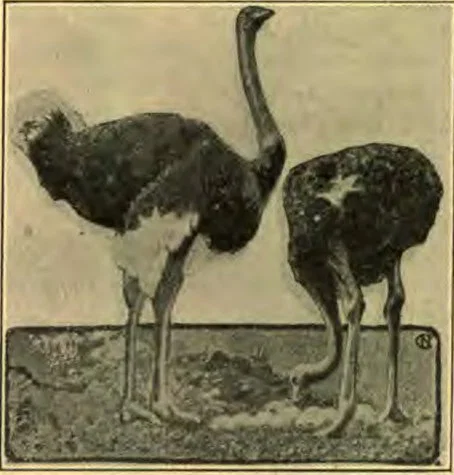
The ostrich costs but little to keep. He is a hardy creature, and has a very careless appetite. On an average an ostrich yields annually to his owner about thirty-five dollars. The average increase to the stock each year is about fifteen ostriches to the pair. Some pairs have been known to yield as high as thirty-five in a year. Some of the birds are kept in large pens at times. The young grow with wonderful rapidity. In six months the young bird will grow from the size of a domestic duck up to a height of six feet. A full-grown ostrich often reaches eight feet, and weighs over three hundred pounds.
These great bipeds are remarkably powerful, and can run with wonderful swiftness. Usually they are very gentle, quiet, and tractable, unless provoked and angered. The appetite of these creatures is most voracious. Their gluttony can never be appeased. Young ostriches are fed on green grass, alfalfa, bran, cabbage, and other vegetables. The older birds thrive well on chopped hay, grasses, and other grains. They relish watches, buttons, pins, and most any other trinket they can snatch from the curious visitor. They have even been known to greedily swallow lighted pipes, tennis balls, nails, keys, and small stones. These creatures have no gizzard like ordinary fowls, and retain their food until digested in a queer sort of sack about the long, hairy neck. They are exceedingly fond of apples and oranges, and, if permitted, will swallow a dozen or more at one time.
As a rule, the ostrich lives to a great age. Some claim that these birds have been known to live from seventy-five to even one hundred years. Until they are from twelve to fifteen months old, one sex can not be distinguished from the other, the plumage of both being a dull, brownish gray. Then gradually the feathers of the male turn black.
For some reason these birds have a great hatred for children and small animals, particularly dogs. This dislike the creatures show on all occasions, and are ever ready to make an attack. Any brightly colored trinket instantly challenges their attention, and they are ready to snatch it away and gobble it down. These creatures have many other queer habits. When angered, they have been known to savagely attack their keepers. Several men on the farm have been severely injured, and had narrow escapes for their lives. Often these birds, particularly the males, fight among themselves.
The nest consists of a mere shallow hole scooped out in the sandy soil. In forty days the eggs are hatched out. Each chick is worth twenty-five dollars as soon as it bursts the shell. One egg is usually laid a day by the female. About fifteen eggs constitute a sitting. Every egg weighs about three pounds. When the last egg is laid, the parents begin sitting, the male staying on the nest at night and the female during the day. At first the chicks are allowed to run in the sunshine during the day, but are placed under cover at night. In a few weeks, however, they become quite hardy, and require no shelter.
When the ostriches are a year old, their handsome, brilliant feathers are ready for the market. The cropping, or clipping, of the gaudy plumage is accomplished by placing a hood over the ostrich’s head, and wielding a strong pair of sharp shears. This clipping process is repeated every eight months. The feathers on the large side wings are clipped off near the roots; the smaller feathers on the tail are pulled out carefully, without pain or injury to the bird. These feathers are then carefully graded, and sent to the manufacturers of New York and other large Eastern cities, where they are sold for a good price. The feathers are very highly prized for rich hues and delicate silken texture.—J. Mayne Baltimore, in Children’s Visitor.

Visiting the Czar's Palace

The second of October, 1904, in company with two friends I visited the czar's winter palace, facing the Neva, in St. Petersburg. We entered the building about half-past eleven, and remained until after two o'clock, and visited only on one floor. It is impossible to see the rooms occupied by a living ruler of Russia; for one is admitted only into the apartments formerly belonging to the emperors or empresses.
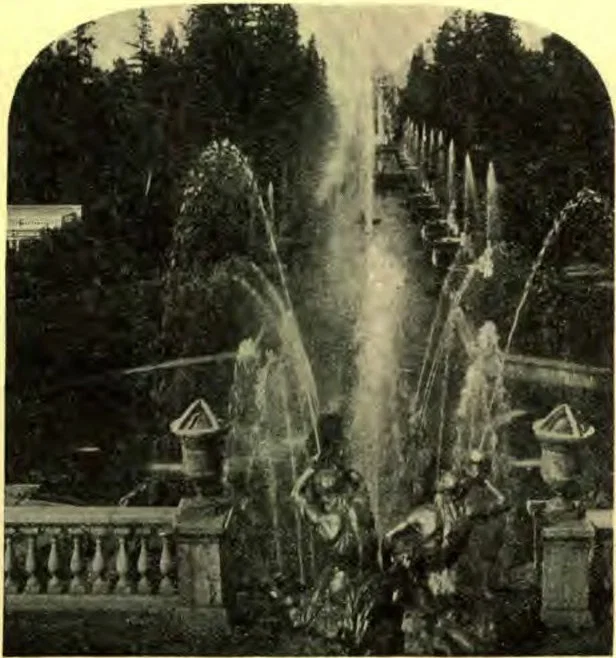
FOUNTAIN AT CZAR'S SUMMER RESIDENCE
We first showed our passports, and received a card to admit us. Then we entered the massive building, and were hastened from one room to another, all too fast to comprehend everything that was shown us. Having visited a king's palace before, I had some idea of what I should here see; but the splendor, the immensity, the almost incredible grandeur of the display, the Croesus-like wealth, were quite beyond my expectations. The scores and scores of very large oil-paintings, mostly representing battle and naval scenes, showed that the Russians have at least done their share in military operations, and gained a due proportion of the victories in war, and been able to constantly add new territory to the empire, as well as to protect western Europe from the depredations of the Mohammedans.
When a visitor is shown single diamonds worth more than five hundred thousand dollars; when he sees pearls, rubies, emeralds, jaspers, beryls, gold and silver shields, and all manner of crystals, in such abundance as I saw them here, he must admit that Russia is not a poor country. However, the common people receive no special benefit from these almost countless treasures.
Some of the rooms were large, and had high ceilings, beautiful carpets, and other furnishings. In the holy place where the czar worships (he has his own church in the palace), we saw many valuable precious stones, relics, and pictures of saints. The Russian Church is especially well provided with these objects of worship. Here we saw the reputed right hand of John the Baptist, a picture of the mother of God,—made without hands and bearing the signature of Luke,—and a bone of the arm of Mary Magdalene. On the sixth of January an imperial religious procession begins here, and the czar, his family, the high spiritual leaders, and the chief government officials go out upon the Neva, and in an ice chapel erected for the purpose, bless the water, converting it into “holy water.” The people then take home bottles filled with this water, to drink in case of sickness.
There was another suite of rooms here which interested me very much—the apartments occupied by Alexander II, who was killed by the Nihilists, in 1881. This ruler was undoubtedly one of the most wise and progressive men that ever governed this great empire. He instituted reforms, gave more liberties to his subjects, and attempted to dispense justice, but for all that, he was unable to escape the assassin's hand. That he was much beloved of the Russians one can easily believe when he sees with what care the czar's apartments in the palace are still kept up. Even his writing materials, books, dressing-gown, boots, tobacco and cigarettes, letter-files, and in fact everything pertaining to his person or dwelling, are carefully preserved as they lay that fatal morning. We could but feel to suffer with his people because of the loss they sustained when the good czar was so suddenly taken from them.
Leaving the palace, we shortly found ourselves in New Prospect Street, the Broadway of St. Petersburg. This is a wide street, as are the thoroughfares of the Russian capital in general, and it is full of life and diversity. All sorts of wagons, carriages, and carts are to be seen here. The czar's equipages are known by the bright-red-clad servants and liverymen. The princes and the rich are there, as well as the middle classes and the poor. Many nationalities and tribes display themselves on the walks, or in the horse-cars, or the trams. There is one sort of train I never saw before. It goes not in a regular iron bed, but wherever the driver wishes. The hacks and small carriages are to be had for only a meager sum. There are between seventeen thousand and twenty thousand coachmen in the city. Many of them drive fine, fleet-footed, nimble-limbed black stallions. The common Russian coachman has the queer style of making himself as large as he can by the addition of cotton batting wadding to his clothes, so that his outward appearance is that of a very portly person. In winter this superabundance of clothing may be useful; but in the summer the style is superfluous. But it is to be expected that Russia would have some way of showing allegiance to the goddess of fashion.
The various uniforms one sees is another noticeable feature of street life in St. Petersburg. Nearly one tenth of the men in the city wear some sort of uniform, even the students, who were an interesting class to me, and compare favorably in appearance with students of other countries. They stand for a freer government, and for reform in many lines, but they often get into trouble with the police and ecclesiastical authorities.
I would not forget to mention the long-haired priests, and the church beggars, who here, as in other parts of Russia, are in evidence. Although the church is wealthy, there are many persons who ask alms for the church.
On this New Prospect Street lies the Kazan Cathedral of the mother of God. This I also visited. It is fashioned after St. Peters at Rome. I saw in this building one of the saddest things I had seen,—two little children, poor, ignorant, evidently of the lower class, about eight and four years of age, came in, and went from one holy picture to the other, crossed themselves, kissed the glass over the pictures, and in most cases the larger sister had to lift up the smaller, that her lips might touch the lifeless pane. This scene could but thrill a Protestant with pain and sorrow.
But the church which is the pride of St. Petersburg is St. Isaac's Cathedral. I will give you a few facts about this magnificent structure. It was about forty years in building, and was finished in 1858. To provide the foundation, a regular “forest” of masts had to be driven into the ground, and even later a very costly substructure was necessary to prevent a sinking on the side next to the Neva River. The church cost about $27,500,000. It is built of marble and granite, and the statuary and trimmings are of bronze. It is in the form of a Greek cross, three hundred fifty feet long, two hundred seventy feet wide, and three hundred forty feet to the top of the eighteen-foot-high cross. To the tip of the cupola inside is two hundred seventy-three feet, and the dome is eighty-seven feet in diameter. It is gilded on top, and from a distance looks like burnished gold. There are four entrances: the two larger are on the north and south, respectively, where the roomy porches are fashioned after the Pantheon in Rome. Each of the sixteen columns in these two porches is of one piece of polished Finnish granite, fifty-eight feet high and seven feet in diameter. The bases and capitals are of bronze, as well as the outside relief work (representing the history of the church), which these pillars support.
I have seen many churches and cathedrals in various parts of America and Europe, but I never saw anything to excel this in grandeur, magnificence, and display. The massive oak bronze-adorned doors we entered are said to have cost fifty thousand dollars. The polished white marble statues, and the two hundred beautifully wrought paintings on the walls, the thirty-three large mosaic pictures made of costly stones, the pillars covered with malachite or with lapis stone, the grandeur and beauty of the holy and most holy places,—these are things of which I had not seen before the equal. Of course the temple of Solomon was a more glorious building, and the splendor of the temple in the city for which we look is beyond even a comparison with this cathedral, the pride of Russia.
But the form, the pomp, the outward display, do not constitute true Christianity. The numerous shrines, chapels, churches, and cathedrals do not prove that the people need no gospel. A short visit to any of these churches will only convince one of the great need of the people,—their lack of instruction in the Scriptures and the salvation that is free to all. God prizes the humble and contrite heart much more than all the glory that man can bring to him. GUY DAIL.

Paul’s Second Missionary Journey

(Concluded)
OPENING EXERCISES.
SCRIPTURE FOR STUDY: Acts 18: 18-22.
REFERENCE STUDY: “Sketches from the Life of Paul,” pages 118, 119.
REVIEW: Name the principal places visited by Paul in his second missionary tour, and some of the most striking events recorded. Who were his companions? What happened at Philippi? Sketch his experience at Thessalonica, Berea, Athens, and Corinth.
PAUL’S COMMISSION: Acts 26: 15-18.
OUR COMMISSION: Matt. 28: 18-20.
HOW WE SHOULD SOW: 1 Peter 3:15; Ps. 126: 5.
THE REWARD: Ps. 126: 6.
TOPICS FOR STUDY:—
Paul leaves Corinth.
By whom accompanied.
Reach Ephesus.
Priscilla and Aquila remain at Ephesus.
Paul’s departure for Cæsarea.
Goes up to Jerusalem.
Goes to Antioch.

Notes

Paul’s second missionary journey covered a period of about three years.
Not much space is devoted to an account of Paul’s visit to Jerusalem. No particulars are given. We are simply told that having landed at Cæsarea, he went up “and saluted the church.” From here he went down to Antioch and remained for a time.
“After leaving Corinth, Paul’s next scene of labor was at Ephesus. He was on his way to Jerusalem to celebrate the approaching festival, and his stay at Ephesus was necessarily brief. He reasoned with the Jews in the synagogue, and produced so favorable an impression that he was entreated to continue his labors among them. His plan to visit Jerusalem prevented him from tarrying, but he promised to labor with them on his return. He had been accompanied to Ephesus by Aquila and Priscilla, and he now left them to carry forward the good work which he had begun.” G. B. T.

Don't Snub the Boy

Don’t snub a boy because he wears shabby clothes. When Edison, the inventor of the telephone, first entered Boston, he wore a pair of linen breeches in the depth of winter.
Don’t snub a boy because his house is plain and unpretending. Abraham Lincoln’s early home was in a log cabin.
Don’t snub a boy because of ignorance of parents. Shakespeare, the world’s poet, was the son of a man who was not able to write his own name.
Don’t snub a boy because he chooses a humble trade. The author of “Pilgrim’s Progress” was a tinker.
Don’t snub a boy because of physical inability. Milton was blind.
Don’t snub a boy because of dulness in his lessons. Hogarth, the celebrated painter and engraver, was a stupid boy at his books.
Don’t snub anybody. Not only because some day he may far outstrip you in the race of life, but because it is neither kind, nor right, nor Christian.—Selected.

The Strong, Worthy Life Is Selection

“THE strong, worthy life is the life of selection, not of weak surrender.”
Continue reading: Books for Young People